Enneagram Type Three and Enneagram Type Nine are quite different in almost all regards, so much so that they are each other’s arrow on the Enneagram symbol. Threes are a Heart type and are focused on gaining validation and approval for their merits and talents, while Nines are a Body type, concerned with independence, which they try to scure by not causing trouble with others.
Threes are highly driven, ambitious and combative, and they want to excel and to emerge above others as worthy of praise. By contrast, Nines tend to be meek, easygoing, conciliatory and ready to take a step back to allow others to shine.
More deeply, Threes have accepted a certain image of themselves which has been handed down to them by society or parental figures and they run with it until it brings them validation (or a nervous breakdown). Nines, on the other hand, often suppress their own individuality, their own priorities and their own agenda for fear of it setting them on a collision course with others. This is not to say that Nines are inert: they can lead very active lives, but they are usually undemanding and unwilling to stand out for their own sake.
Identity
Surprisingly, the two types do have one similarity. Threes often fight with the inner feeling of not truly knowing who they are, a troubling sensation that the image they submit to the world for a stamp of approval does not truly encapsulate them. Usually they try not to think too much about it, which is in part why they are so driven and motivated in accomplishing their goals, but when this feeling catches up to them it can lead them to an identity crisis.
Nines can also find it hard to pinpoint themselves, but for a different reason: they instinctively feel that to emerge as an individual with a specific identity or mission means cutting themselves off from an all-encompassing merging with a greater whole, whether this greater whole be God, a social group, married life, etc. In other words, Threes may not know who they are and fear this sensation, while Nines dread having a sharp separate identity pushed onto them.
I’m currently studying horary astrology under Chris Warnock’s supervision. He puts a great deal of emphasis on studying old sources, which is perfect for a guy like me who breaks out in hives when occultism is boiled down to “just wear a deep knowing expression, drink herbal tea and let the ascended masters guide your intuition.”
Geomancy is similar to horary astrology in that it allows you to answer questions, though it is less dependent on the time the question is asked. It is also similar in that you need to go back to really old books in order to study it seriously.
When reading premodern sources we always run a couple of risks:
Unless they’ve been edited and discussed by a modern, they are probably written in a language that is not our own, or, even if it is, it’s an old version of it. This makes room for misunderstanding.
More subtly, the world in which the author lived and wrote is not our world: it has different cultural, political and spiritual reference points.
The source is written by someone who is just as fallible as we moderns (or rather postmoderns) are.
If one thing that grinds my gears is when people just turn occultism into their little escape from reality (“I wanna believe the world is magical but I’m too special for Christianity”), the other thing that equally grinds my gears is when people desperately seek a doctrine to follow blindly just because it happens to run against the Zeitgeist.
An occultist (and divination is a branch of occultism, though we often forget it) must be capable of being equally distant from intellectual lassitude and fanaticism, from scientism and religion. It takes a particular temperament that most people don’t possess, and I say this in a neutral sense: most people simply don’t have the temperament for most things, which is why only few people in any generation do any one thing.
Point three on the list is what I’m referring to here. The few on the occult path who have what it takes to move beyond the sanitized, advertiser-friendly version of occultism that gets tarot readers invited to corporate meetings often run the contrary risk: that of believing “if something says the opposite of what we hear everyday in our decadent world, it must be true and I must worship at its altar.”
When reading old sources (and I’m talking about geomancy, but it could refer to any other branch) this can turn us into fanatics if we don’t constantly remind ourselves that a book, even in the old days, could be written for a variety of reasons:
to pass on important knowledge (but still from the author’s limited perspective)
to record your experience
to help others
as a publicity stunt
to impress others
to confuse others
a mix of all the above
Furthermore, old authors are just as capable as modern ones of believing crap. As such, while it is vital to question our own worldview, it is also just as vital to question all others. The moment you are asked (or you feel like you ought) to stop questioning is exactly the point where prejudice has crystallized, be it yours or someone else’s. It is also the point where you can break new ground if you proceed cautiously and with intelligence.
All this is to say, old books are treasure troves of information that we can study, learn from, adapt sensibly to our current needs, and much more. But if you are looking for a new Bible, you’re better off sticking to the old one.
Daily readings are not always very clear, for a couple of reasons. First, since we don’t live in an action movie, not every day is the setting of some memorable event. Second, the cards could sometimes bring up a minor situation that we barely pick up on. Third, I have personally found in my practice that torturing the cards for daily glimpses is not always a good idea, if done systematically, as sometimes it causes me to feel I’m losing my connection with the cards. That’s why I only draw three cards for the day every once in a while, when I feel inspired to.
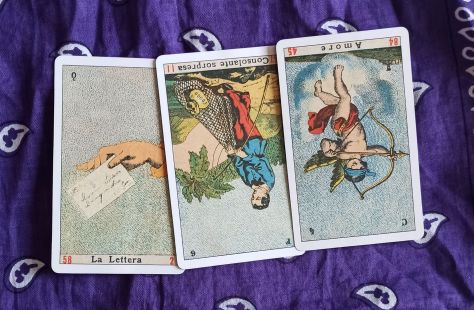
Today was one such day, and it was very clear:
Daily vera sibilla reading
The cards talked about a communication reaching me, but that was the extent of my interpretation. I did not try to read further into it, because what is valid for a general reading is not always valid in a daily reading, where the interpretation needs to often be toned down.
If I were to interpret these cards for someone in a regular reading, I would tell them that their partner would communicate to them that they no longer have anything in common and it’s over. The Surprise, The Six of Clubs, represents, when upright, all situations that flourish easily, and therefore it shows compatibility, while, when reversed, it represents falling out of love due to growing apart.
Well, this is exactly what happened today. Only, not to me. I was the one who received the communication, but not from my husband. I received it from a friend who told me she and her partner were breaking off their relationship, because “they don’t even recognize each other anymore”
When I was a teen, I remember stumbling upon Aristotle’s definition of the “educated mind” as being able to hold a thought without accepting it, and I remember thinking how silly and basic the definition was. The older I get, the more I find myself agreeing with him, as I see fewer and fewer people capable of doing it (the fact that Aristotle never actually wrote the sentence is a whole ‘nother can of worms)
A lot of people don’t have an educated mind per the definition above. One would like to think that tarot readers, astrologers and the like would not be like a lot of people, seeing how much the word “wisdom” gets thrown around in their circles. But one would be wrong. Leave it to the “spiritual community” to be among the most ideological and stiff. And, consequently, not among the brightest. If there is a group of people I don’t trust to be capable of holding any thought except the ones they agree with, that’s these people.
I believe I already talked a little about this, but one of the most memorable examples I can think of is the 2016 US election, when every tarot reader on youtube and their mom were busy predicting Trump would lose the election disgracefully, poop his pants, writhe on the floor, throw a tantrum and retreat into the hell that spawned him while Hillary Clinton swung her throbbing, veiny, 25 inch hard-on at the glass ceiling. While I am slightly exaggerating, this was pretty much the tone. (interestingly, those same readers routinely claim that the tarot is not for fortune-telling)
One such reader went as far as channeling Trump’s character. I do not remember the exact spread, nor most of the cards, but two things stuck with me: first, no egregiously bad card showed up, and second, the King of Cups featured prominently in the spread. She interpreted the card as Trump being a violent man prey to his base emotions and instincts. I took a quick look at some of that reader’s other videos, only to discover that she never, ever interpreted the King of Cups this way. In fact, she always interpreted it as the significator of a good man who takes care of the querent.
This is a good time to point out that I am fiercely apolitical, so this is not about politics. All ideologies are, as far as I am concerned, clouds over the mind’s clarity. I’m not saying everyone needs to think like me. Everyone has their delusion of choice, and everyone (including me) has their way of slanting reality in one direction or the other, whether politically, spiritually or philosophically (or even scientifically, for that matter). In fact, slanting reality is probably needed in order to filter information that might be useful to us.
Yet divination should be something else. What that reader did was merely using the cards as a mirror of her own (perfectly legitimate) bias. This is fine, and can even be useful at times–if you are aware that you are doing it. Even that would not be actual divination, but at least it wouldn’t be a waste of time.
I already discussed that divination is really a process of deification, that is, the process of allowing the dispassionate, bird-eye view clarity of the divine into one’s limited, subjective world by letting new information in. In other words, true divination is the opposite of retreating into one’s bubble: it’s the bursting of the bubble.
This, in turn, requires a certain readiness to accept the information we get (which is why it is always best to get someone you don’t know to read your cards.) Divination without intellectual honesty is just a crutch for one’s ego, and that’s how it is currently being used by the vast majority of diviners.
Unfortunately, intellectual honesty won’t make you many friends. Back in 2016 I had arguments with more tarot readers than I care to remember and was routinely labeled a dangerous extremist just because I called into question the usefulness of this type of reading (back then I still tried to entertain fruitful conversations with people). But occultism, in all its branches, is a narrow path.
Two lessons from all this: 1) if you are reading for yourself and the cards (or chart, or dice, or whatever) seem to confirm what you already think or wish, apply a bucketful of salt to the reading; 2) invest some money into a simple handbook of logic, or at least expand your knowledge of logical fallacies. This will repay you many times over, regardless of what branch of sorcery you practice.
I don’t remember if I already talked about a reading I did for myself some time ago. I was expecting a parcel but needed to go somewhere else, so I asked the cards if the package would come on that day. The cards clearly answered in the negative, and I was right: I went out, and the parcel arrived the day after.
Thinking back on this, I was reminded of an experience reported by famous British astrologer John Frawley. I cannot remember if he discusses it in The Real Astrology or in his Horary Textbook, but it goes somewhat like this: he was waiting for some repairman to come to his house, but he also wanted to take a relaxing bath, so he cast a horary chart to know when the guy would come, only to discover that he wouldn’t. So he slipped into the bathtube, and his prediction proved correct
I believe this kind of readings is the most fun and instructive on the nature of divination. Ultimately, divination is intelligence-gathering. Sentient beings organize their behavior based on the information available to them. Therefore, new information is bound to change the being’s behavior.
The more complex the organism, of course, the more factors come into play, but the basic principle remains true. This is not to say that anything is possible, because only someone with infinite knowledge would know how to overcome all kinds of situations he or she finds unpleasant. We humble mortals are always restricted by difficult circumstances. Still, the information we gather through divination is not, in principle, different from the one we gather through other means which are all just as imperfect.
A fatalist might try to defend the idea of an all-encompassing destiny by arguing that the prediction is itself part of the person’s fate. I was destined to pull those cards and go out. But this stance, interestingly enough, invalidates the idea of prediction itself. If everything is destiny, then even knowledge that everything is destiny is destiny, rather than the truth.
I believe that divination is not simply communication with the divine, but also a form of deification: if we take God on one hand, that is, someone who is capable to be the pure consequence of its own choice, and a rock on the other, that is, something that simply passively receives whatever action external forces exert on it, then divination moves us closer to the divine condition of being the consequence of our own choice.
This is also why I am skeptical of airy-fairy forms of divination that try to take the focus away from concrete life in the name of some vapid divine idea. Ultimately, there is far more divine depth to Frawley’s ability to take a bath thanks to a horary chart than there is to questions like “How can I embody the divine feminine and honor my ancestral heritage more fully?”
It is well-known that the Sibilla is damn chatty, sometimes too much. Every deck can veer off topic if it needs to, but the Sibilla has a penchant for it, whereas, for instance, regular playing cards are usually easier to keep on a leash. Still, I believe what I’m about to show would have popped up with any other deck, since the cards usually warn us of unexpected happenings, whether positive or negative. This is a spread we did for a friend of mine in January. He wanted to know about his love life.
Vera Sibilla Reading, my friend’s misadventure
The thing that immediately struck me is that the cards clearly were not talking about my friend’s love life. Instead, judging by the first line, they were depicting something difficult that was going to happen. I must confess I was not capable of organizing my garbled thoughts into a coherent prediction back then, even though looking at it now it seems obvious. I believe a part of me knew what the cards were talking about but didn’t want to give the news to my friend. I knew the cards were talking about danger at the hand of some people, and that a man would help him. I told him so much, but of course this was too vague to be of help.
Here is what happened around a month later, as told by the cards. While out of his house (Journey) he was attacked (Widower reversed. I made a mistake in reenacting the spread) by a small gang of criminals (Enemy, Fools). Fortunately (Levity reversed) a man saw the whole thing, chased off the strangers and helped my friend (Friend reversed, Fortune reversed). My friend sprained his ankle badly, I’m guessing this is why the Fortune card is reversed, showing delayed fortune, but is otherwise unharmed, except the anxiety (Sighs).
I think part of the problem of reading for friends is that, because you don’t want them to come to any harm, your mind tends to censor you a bit. Still, an interesting case study, and a story that could have ended much worse.
Sometimes the cards speak like directors of a theater piece, ordering characters around in a way that makes almost intuitive sense and gives a visual representation of the issue. This is not always the case (some readings are super hard to decipher) but when it is it becomes almost impossible to doubt that divination truly works.
Here’s an example. A friend of my husband asked me why her boyfriend was acting strange. These were the cards (the reading started out as a three card reading, but I kept adding cards until I was satisfied):
Vera Sibilla Reading: Why is he acting strange
Look how the characters seem to relate to one another like characters in a play. We have Juliette, the Queen of Hearts. Behind her is the Five of Diamonds, Melancholy. She is dissatisfied. Then we have the Jack of Hearts, Romeo. Between them is a card. This can either represent an action or a state of affairs. Because the Melancholy card describes a state of affair, it seems more likely that the reversed Ace of Hearts also represent their current state of affairs, one of miscommunication, instability and a general sense of incompleteness.
Following is the Queen of Clubs. This can be another character, but sometimes she acts as a “pointer”: wherever she points her finger is where the problem lies. In this case, because she is reversed, she points to her right (otherwise it would be to her left). Then we have the card of secrets (the Soldier, reversed) and that of homosexuality (the Love card, reversed) and a male figure. The answer is obvious.
A couple of months after the reading a gay friend of hers saw her boyfriend on an app, who then came out as bi, validating the spread. This is not the first time I’ve encountered this kind of issue. I may even have posted a spread about it before (I can’t remember).
One of my dreams is of writing a book about divination, not explaining any particular kind of divination, but exploring divination as a topic, its foundations and its place in the world. And this kind of spreads has me convinced that life is a drama, and divination is a tool capable of unveiling the script.
Enneagram Type One and Enneagram Type Six can sometimes be similar, but their differences are even more striking. Ones are a Body type, and focus on how to act rightly as autonomous beings. Sixes are a Head type, and their focus is on security from potential threats and uncertainties, which they try to achieve by thinking about all possibilities and by finding allies and leaders they can rely on.
Both Ones and Sixes tend to be dependable, dutiful and reasonable, linear in their thinking. They usually dislike extravagance and iffy ideas. Ones dislike them because they see themselves as the keepers of the orthodoxy, while Sixes dislike them because they want to try to focus on things and ideas that give them certainty.
Sixes have a marked social component that is not very prevalent in Ones. Sixes appreciate group cohesion and therefore conformity of opinions. They like their beliefs being reflected back at them by others like them. A Six with rebellious ideas tend to like being together with other rebels like them. Even Sixes who appreciate or accept pluralism and settings where pluralism is accentuated want to make sure that everyone is on board at least on the fact that pluralism is good.
Ones, on the other hand, do not need social validation and do not look for someone to tell them what’s right or wrong, what’s true or false, so while they are by no means loners, they can accept that their beliefs will make them some enemies. By contrast, Sixes can accept the existence of an enemy as long as there is a “we the people” fighting against it that can provide them group protection, even if just in their heads.
Duty
Both can have an ambivalent relationship with authorities: Ones ultimately obey their conscience, which can cause frictions with the powers that be; Sixes are desperately looking for someone or something whose authority they can rely on, but they also distrust authorities on the grounds of them either being potentially dangerous or not providing them enough protection or peace of mind. Both Ones and Sixes can occupy themselves with ideas of justice and can be very ideological, but Ones have a selfless relation with justice (“this is what is right. We must do it. Period”), while Sixes want to create a society in which they or those like them can feel safe or nurtured.
Ones rarely question their values and ideals and are possessed of a certain inner certainty about what’s to be done and what’s to be left alone. Sixes definitely lack this sense of inner guidance as they are known for sometimes spinning in circles about even the most trivial matters and are forever drowning in a sea of questions in their search for an unquestionable dry land. Of course, they may adhere blindly to a belief, an ideology, a religion, a group, etc. as a way to rescue themselves from their uncertainties, but there is always, even if just subconsciously, a nagging sensation that they may be wrong, and are always looking for external reassurance that the path they’ve chosen is the right one. Even the most committed Six will occasionally look at someone outside of them with a “This is the absolute truth, right?” look in their face.
If Ones can quite easily play the role of the lone martyr, Sixes tend to play that of the party members getting each other going at a political rally, or that of brave warriors inspired by a great speech their leader made in an epic movie.
Enneagram Type One and Enneagram Type Three belong to different centers: Ones are a Body type and Threes a Heart type. Therefore, there are broad differences between them, although they may have some similarities on the surface, depending on their particular life circumstances. Ones’ main aim is autonomous action, which they believe themselves entitled to only in so far as it is the right action. Threes, though, are not especially concerned with right or wrong, but rather with recognition and admiration.
From this fact alone it is clear that Ones and Threes live in vastly different worlds. Of course, Threes who have been socialized in an environment where morality and righteousness are, for better or worse, the standard to meet may occasionally behave like Ones. However, even in this case, Threes will generally do so as long as recognition is forthcoming.
Achieving
Furthermore, both Threes and Ones tend to be unsentimental and action-oriented, but again, in different ways. Ones feel the need to suppress their particular feelings, preferences and desires in order to abide by an ideal they believe to be more or less absolute. Threes, on the other hand, file their feelings away for later consideration in order to achieve a goal not necessarily because it is good, but because they believe it will bring them prestige.
In a word, if a One is the crusader converting the infidels of distant lands, the Three is the Roman emperor conquering a new province to be remembered forever. If Threes are the competitors, Ones are the referees.
Shame can be a powerful experience for both Ones and Threes. Ones constantly feel they need to work on themselves in order to improve their adherence to their ideal, and may feel shame in front of themselves if they feel they have failed to do so. Threes feel shame in a more mundane sense, as internalized social pressure to achieve a certain goal and improve their performance.
While both types can be perfectionistic, Threes are motivated by the joy and sense of challenge of making others see how praiseworthy they are, while Ones are prepared to go through the desert alone, or even for martyrdom if necessary.
Ultimately, like all Heart types, Threes are not necessarily principled individuals, which doesn’t mean they are immoral, but that the core structure of their personality does not revolve around principles as it does around interpersonal dynamics, and the opposite is true for Ones.
Enneagram Type One and Enneagram Type Two are quite different, although they can share some traits. Ones are a Body type, meaning they are chiefly concerned with autonomy, while Twos are Heart type, whose main preoccupation is recognition by others. Ones defend their autonomy by abiding by rules and trying to enforce them so as to justify their actions. Twos seek recognition in the eyes of others by being ‘helpful’ to them, that is, they try to carve themselves a place in another person’s life.
These different motivations can lead both Ones and Twos to similar activities and superficial behavior, such as being altruistic and of service to others, taking care of things the right way and just generally being a goody-two-shoes.
However, the two types are vastly different in most respects. Ones are dry, unemotional and often suppress their subjective preferences in the name of their ideal, while Twos are very wet in their behavior, being emotional and subjective, and they are less interested in how things are supposed to be than in doing what it takes to receive the love and appreciation they need.
Service
Ones are famous for telling people off (“this is against the rules”) and are somewhat pessimistic, while Twos usually limit themselves in this regard, at most advising you in a motherly way (“that’s not good for you”) and tend to be upbeat and positive. Furthermore, Ones are more formal and rigid, while Twos tend to be informal and almost flirty with others, seeking close contact with them. Ones rarely unclench and are highly methodical, while Twos love to be in a flow in all their activities. Also, ultimately, Twos tend to be self-serving, even though an average Two would never admit it, even to themselves, while Ones usually deny themselves for the ideal they serve.
Interestingly, both types tend to have a problem with anger, but for different reasons: Ones can’t let the choler flow unhindered through them, so they put it in the service of a law (“it’s only ok to be angry if I get angry at things not being right”) which leads them to passive-aggressive behavior; Twos usually shy away from anger altogether because they feel it would endanger their relationship with the object of their desire, and only when they move to Eight under stress can they explode into a fit of rage if they feel scorned, unseen or when they see that their attempts at creating complicity (or codependence) with others are failing. But this rarely lasts.
Both Ones and Twos, though, tend to feel shame after a bout of anger: Twos almost always, because they fear their behavior has made them unlovable and unworthy of appreciation; Ones when they feel the anger wasn’t perfectly justified.