Enneagram Type Five and Enneagram Type Seven are very different, but they do share some connections, so much so that Seven is the stress point of Five and Five the growth point of Seven. Both are Head types. Fives are intellectual individualists who remove themselves from the world to feel safe from it. Sevens are exciteable planners who seek to escape their inner sense of fear or pain by taking refuge into the opportunities the world seems to offer them.
Both Fives and Sevens are Head-driven, but in vastly different way. Fives are THE brainy type, as they spend the majority of their time in their heads, thinking odd ideas and formulating concepts almost as an aim in itself. For Sevens the mind is declassed to the rank of means in formulating plans for enjoyment and flight from (or rationalization of) the things the Seven fears.
Both Fives and Sevens are very good at establishing connections between disparate things, subjects and ideas that few would ever think of mentioning in the same sentence. Still, they do it in vastly different ways and following different avenues. Sevens usually move on the surface of things, casting a wide net on their multiplicity in a bid to explore as many of them as the Seven wishes to. They enjoy this sense of variety and love having options and freedom, and this almost inevitably leads them to heaping up odd experiences and ideas in never-before-seen patterns. They are, in a way, the Renaissance men and women of the Enneagram.
Fives, on the other hand, delve deeply, with an almost surgical focus, into a single abstruse and socially disregarded idea that interests them until they have broken it into its smallest possible components, which they can reassemble, often with a taste for paradox, into widely different ideas. Then they break them apart again and start over in the same endless process of analysis and synthesis. Since, at the end of the day, everything in the universe is connected with everything else, Fives end up (or at least aim at) possessing the Whole within a single concept by leveraging a single, obsessively developed core idea that allows them access to all other ideas. In other words, Sevens tend to be exploratory, Fives tend to be conceptual.
The Mind’s Eye
Socially, the two types are very different. Sevens, while not necessarily extroverts, are outgoing, in the very real sense that they go out of themselves and toward others, often directly if not bluntly. Fives tend to withdraw from social contact in a hermit-like fashion.
Furthermore, both types have a keen awareness of their needs, but take care of them in starkly different ways. Fives generally minimize their needs in order to avoid offering themselves up to the vagaries of good and bad fortune, but in pursuing this course they often end up withered and emotionally dry. Sevens on the other hand are usually anything except minimalistic, tending more toward extravagance, as they fear confinement, because confinement and lack of external fulfillment force them to bear witness to a less than happy inner reality that, in one way or another, they refuse to confront.
(Note: this is a collection of the meanings attributed to the cards by some occultists in the past centuries. It does not reflect my own study or opinion of the cards. It is only meant as a quick comparative reference as I develop my own take.)
The Ace of Coins or Pentacles from the Builders of the Adytum (BOTA) tarot
Paul Foster Case (and Ann Davies)
The time period is from the beginning of Capricorn to the end of Pisces, December 22 to March 20. Occult title: The Root of the Powers of Earth. Divinatory meanings: The power of Will as expressed on the physical plane. Materiality in all its phases, whether good or evil. “The things that are Caeser’s.” The power of the world-illusion. Material gain, contentment, wealth, and the things, conditions and works which contribute to such gain. Keyword: Materiality. (From the Oracle of Tarot course)
A. E. Waite
A hand–issuing, as usual, from a cloud–holds up a pentacle. Divinatory Meanings: Perfect contentment, felicity, ecstasy; also speedy intelligence; gold. Reversed: The evil side of wealth, bad intelligence; also great riches. In any case it shews prosperity, comfortable material conditions, but whether these are of advantage to the possessor will depend on whether the card is reversed or not. (From The Pictorial Key to the Tarot)
Aleister Crowley
The Ace of Disks pictures the entry of that type of Energy which is called Earth. It is here proper to insist a little strongly upon one of the essential theoretical theses which have inflamed the constitution of this present pack of Tarot cards; for this feature is significant, and distinguishes it from the numerous crude efforts of uninitiates to put themselves forward as adepts. The grotesque barber Alliette, the obscurely perverse Wirth, the poseur-fumiste Peladan, down to the verbose ignorance of such Autolycus-quacks as Raffalovitch and Ouspensky; none of these or their kin have done more than “play the sedulous ape” to the conventional Mediaeval designs. (Their luck was out: the Tarot is a razor!)
Eliphaz Levi was a master-scholar, and knew the true attributions; but his grade in the Great White Brotherhood was only 6○=5□ (Adeptus Major); and he had no instructed foresight of the New Aeon. He did indeed hope to find a Messiah in Napoleon III; but of the complete spiritual upheaval which accompanies the Proclamation of a new Magical Formula he had no glimpse; no, not though he had Maistre Alcofribas Nasier to guide him! [See The Grands Annales ou croniques Tresveritables des filz. Roy des Dipsodes. 1542. Book I, Chapter LVIII, where is given not only a remarkable description of the social conditions of the twentieth century e.v., but even, in the last line of the Prophetic Riddle, a clear indication of the Magical Motto of the Adept chosen by the Masters to announce this Formula-this Word, openly given in the name of the Abbey itself. But, as so often is the case, it was too simple and straightforward to be seen!]
Dr. Gerard Encausse, “Papus”, who followed Eliphaz Levi, felt himself even more closely bound by his Oath of Secrecy, so that his dealings with the Tarot are worthless; and that although he was Grand Master of the O.T.O. in France, and Grand Hierophant 97° of the Rite of Memphis on the death of John Yarker.
These historical data are necessary to explain why all previous packs are of little more than archaeological interest; for the New Aeon demanded a new system of symbolism. Thus, in particular, the old conception of the Earth as a passive, immobile, even dead, even “evil” element, had to go. It was imperative to restore the King-Scale colour attribution to that of the Aeon of Isis, Emerald Green, as was understood by the Egyptian Hierophants. This green is, however, not the original vegetable green of Isis, but the new green of spring following the resurrection of Osiris as Horus. Nor are the Disks any more to be considered as Coins; the Disk is a whirling emblem. Naturally so; since it is now know that every Star, every true Planet, is a whirling sphere. The Atom, again, is no more the hard, intractable, dead Particle of Dalton, but a system of whirling forces, comparable to the Solar hierarchy itself.
This thesis dovetails perfectly with the new Doctrine of Tetragrammaton, where the Earthy component, He’ final, the Daughter, is set upon the Throne of the Mother, to awaken the Eld of the All-Father. The NAME itself, accordingly, is no longer a fixed symbol, emblem of extension and limit, but a continuously revolving sphere; in the words of Zoroaster, “rebounding, whirling forth, crying aloud”.
It has been the custom of publishers or designers of packs to set their personal seal upon the Ace of Disks, for grammatical reasons not unconnected with the perhaps arbitrary differentiation in the Latin Language between the pronouns “meum” and “tuum”. Saith not the Bard?
“Steal not this Book for fear of shame! The Ace of Disks-the Author’s name. The Ace of Swords-thy corpse shall look Like Agag’s did, in Samuel’s book. The Ace of Cups-drink thou no less Than Brinvilliers the Marchioness! The Ace of Wands-thy death be reckoned Like that of good King Edward Second!”
The central symbol of the Ace of Disks is consequently the personal Hieroglyph of “the chosen priest and apostle of infinite space”, “the prince-priest the Beast”. (Liber AL. 1.15.)
This is to be compared with the Sigillum Sanctum of the Order of A∴A∴
In the centre of all is yet another form of Tetragrammaton, the Phallus, showing Sol and Luna, with the number 666 duly inscribed, as if to equilibrate, to fit into the Vesica, with the seven sevens adding to 156 (BABALON 2 + 1 + 2 + 1 + 30 + 70 + 50=(7 + 7) divided by 7 + 77+ 77=156) as the Magick Square of 6 adds to 666 (1=62= TO MEGA QHRION 300 + 70 + 40 + 5 + 3 + I + 9 + 8 + 100 + 10 + 70 + 50=]Vyrt 400 + 200 + 10 + 6 + 50). Should one choose to interpret the vertical line above 666 as 1, and add it, the number of the Scarlet Woman, 667, appears. (667 = H KOKKINH GUNH =8 + 20 + 70 + 20 + 20 + 10 + 50 + 8 + 3 + 400 + 50+ 8.) This cipher is enclosed in a Heptagram, as manifestly needful; and this figure again in interlaced Pentagons whose sides are extended, so forming a Wheel of 10 spokes whose boundary is a Decagon; and this again within a circular band, upon which is inscribed in full the name TO MEGA QHRION, of 12 (6 x 2) letters.
About this whirling Disk are its six Wings; the entire symbol is not only a glyph of Earth as understood in this New Aeon of Horus, but of the number 6, the number of the Sun. This card is thus an affirmation of the identity of Sol and Terra-and that will be best understood by those who have punctually practised Liber Resh for the necessary number of years, preferably in such Hermitages as those of the Sahara Desert, where the Sun and the Earth can soon be instinctively recognized as living Beings, one’s constant companions in a Universe of Pure Joy. (From The Book of Thoth)
AI generated illustration for the Ace of Pentacles or Ace of Coins
Golden Dawn’s Book T
A WHITE Radiant Angelic Hand, holding a branch of a Rose Tree, whereon is a large Pentacle, formed of Five concentric circles. The Innermost Circle is white, charged with a red Greek Cross. From this White Centre, Twelve Rays, also white, issue: these terminate at the circumference, making the whole something like an Astrological figure of the Heavens. It is surmounted by a small circle, above which is a large white Maltese Cross, and with two white wings. Four Crosses and two buds are shewn. The Hand issueth from the Clouds as in the other three cases. It represents materiality in all senses, good and evil: and is, therefore, in a sense, illusionary: it shows material gain, labour, power, wealth, etc.
Etteilla
Perfect contentment Upright. This card, as far as the medicine of the spirit is concerned, means, in its natural position: Perfect contentment, Happiness, Fortune, Rapture, Enchantment, Ecstasy, Wonder, Complete satisfaction, Unspeakable joy, Inexpressible pleasure, Red color, Perfect medicine, Solar medicine, Pure, Fulfillment. Reversed. Amount, Capital, Coin of great value. – Treasure, Wealth, Opulence. – Rare, Dear, Precious, Priceless.
(Note: this is a collection of the meanings attributed to the cards by some occultists in the past centuries. It does not reflect my own study or opinion of the cards. It is only meant as a quick comparative reference as I develop my own take.)
The Ace of Swords from the Builders of the Adyum (BOTA) tarot deck
Paul Foster Case (and Ann Davies)
The time period is from the beginning of Libra to the end of Sagittarius, Sept. 23 to Dec. 21., representing the conjoined power of Venus, Mars and Jupiter. In divination , when the sword is turned downward it is ill-dignified and has a negative significance. In ceremonial magic the sword in this position is used for the invocation of evil forces, while with the point upward it denotes invocation of spiritual forces. Keep this in mind in divination , as an ill-dignified Ace of Swords shows need to control and overcome negative emotions and thoughts. Keyword: Activity (particularly mental force in operation). (From the Oracle of Tarot course)
A. E. Waite
A hand issues from a cloud, grasping as word, the point of which is encircled by a crown. Divinatory Meanings: Triumph, the excessive degree in everything, conquest, triumph of force. It is a card of great force, in love as well as in hatred. The crown may carry a much higher significance than comes usually within the sphere of fortune-telling. Reversed: The same, but the results are disastrous; another account says–conception, childbirth, augmentation, multiplicity. (From The Pictorial Key to the Tarot)
Aleister Crowley
The Ace of Swords is the primordial Energy of Air, the Essence of the Vau of Tetragrammaton, the integration of the Ruach. Air is the result of the conjunction of Fire and Water; thus it lacks the purity of its superiors in the male hierarchy, Fire, Sol and the Phallus. But for this same reason it is the first card directly to be apprehended by the normal consciousness of Mankind. The errors of such cards as the 7 and 10 of Cups are yet of an Order altogether higher than the apparently much milder 4 of Swords. The study of the subtle and gradual degradation of the planes is excessively difficult.
In nature, the obvious symbol of Air is the Wind “which bloweth whithersoever it listeth”. It lacks the concentrated Will of Fire to unite with Water: it has no corresponding passion for its Twin Element, Earth. There is indeed, a notable passivity in its nature; evidently, it has no self-generated impulse. But, set in motion by its Father and Mother, its power is manifestly terrific. It visibly attacks its objective, as they, being of subtler and more tenuous character, can never do. Its “all-embracing, all-wandering, all-penetrating, all-consuming” qualities have been described by many admirable writers, and its analogies are for the most part patent to quite ordinary observers.
But, it will instantly be asked, what of the status of this Element in the light of other attributions? In the Yetziratic World, is not Air the first element to follow Spirit? Is not Vayu the first emergence of the phenomenal from the arcane obscurity of Akasha? How may one reconcile the doctrine of Mind with the fact that Ruh, or Ruach, actually means Spirit itself? “Achath Ruach Elohim Chiim” (777) means “One is the Spirit (not Air) of the Gods of the Living”? And is not Air, the element attributed to Mercury, also most properly the Breath of Life, the Word, the Logos itself?
The student must be referred to some less raw, cursory, elementary and superficial Treatise than this present bat-eyed, penguin-winged, bluebottle-brained buzzing. Nevertheless, although Air is in no system the lowest, and so cannot claim benefit of clergy from the doctrine that Malkuth automatically resolves into Kether, the following reference seems not wholly to lack either cogency or pertinence.
The Ruach is centred in the airy Sephira, Tiphareth, who is the Son, the first-born of the Father, and the Sun, the first emanation of the creative Phallus. He derives directly from his mother Binah through the Path of Zain, the sublime intuitive sense, so that he partakes absolutely of the nature of Neschamah. From his father, Chokmah, he is informed though the Path of Heh’, the Great Mother, the Star, our Lady Nuit, so that the creative impulse is communicated to him by all possibilities soever. [How strikingly this fact confirms the counterchange of IV and XVII, above fully expounded: as a link between Chokmah and Tiphareth, the Emperor would have no great significance, and this exquisite doctrine of the Three Mothers would be lost.] Finally, from Kether, the supreme, descends directly upon him, though the Path of Gimel, the High Priestess, the triune light of Initiation. The Three-in-One, the Secret Mother in her polymorphous plenitude; these, these alone, hail him thrice blessed of the Supernals!
The card represents the Sword of the Magus (see Book 4, Part II) crowned with the twenty-two rayed diadem of pure Light. The number refers to the Atu; also 22=2 X II, the Magical manifestation of Chokmah, Wisdom, the Logos. Upon the blade, accordingly, is inscribed the Word of the Law, This Word sends forth a blaze of Light, dispersing the dark clouds of the Mind. (From The Book of Thoth)
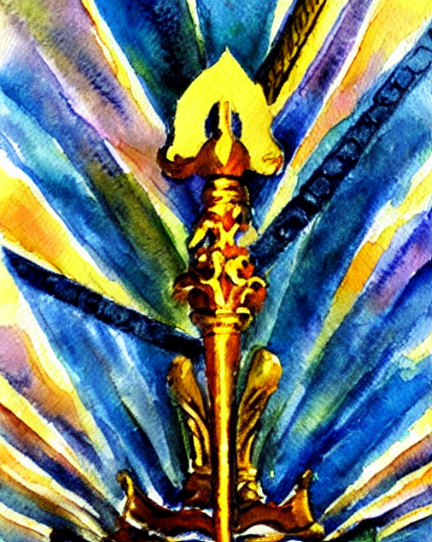
AI generated illustration for the Ace of Swords, looking more like a spear
Golden Dawn’s Book T
A WHITE Radiating Angelic Hand, issuing from clouds, and grasping the hilt of a sword, which supports a White Radiant Celestial Crown; from which depend, on the right, the olive branch of Peace; and on the left, the palm branch of suffering. Six Vaus fall from its point. It symbolizes “Invoked,” as contrasted with Natural Force: for it is the Invocation of the Sword. Raised upward, it invokes the Divine crown of Spiritual Brightness, but reversed it is the Invocation of Demonic Force; and becomes a fearfully evil symbol. It represents, therefore, very great power for good or evil, but invoked; and it also represents whirling Force, and strength through trouble. It is the affirmation of Justice upholding Divine Authority; and it may become the Sword of Wrath, Punishment, and Affliction.
Etteilla
Fructification Upright. This card, as far as the medicine of the spirit is concerned, means, in its natural position: Extreme, Great, Excessive. – Exaggerated, Furious, Choleric. – Extremely, Passionately, Excessively. – Vehemence, Animosity, Carriage, Impetus, Anger, Fury, Rage. – Extremity, Terms, Boundary, End, Limits. – Last sigh, Last extremity. – Divergence. Reversed. Pregnancy, Germ, Seed, Sperm, Matter, Impregnation, Generation, Conception, Fructification. – Childbirth, Puerperium. – Fertilization, Production, Composition. – Enlargement, Increase, Multiplicity.
(Note: this is a collection of the meanings attributed to the cards by some occultists in the past centuries. It does not reflect my own study or opinion of the cards. It is only meant as a quick comparative reference as I develop my own take.)
The Ace of Cups from the Builders of the Adytum (BOTA) tarot deck
Paul Foster Case (and Ann Davies)
Well Dignified: fertility, productiveness, development, multiplication, happiness, pleasure, gratification, fruition of desires; cheerfulness, geniality, gaiety. lll Dignified: too much emphasis on pleasure; over-intensity of the desire nature; trouble in love. Keyword: Desire force (From the Oracle of Tarot course)
A. E. Waite
The waters are beneath, and thereon are water-lilies; the hand issues from the cloud, holding in its palm the cup, from which four streams are pouring; a dove, bearing in its bill a cross-marked Host, descends to place the Wafer in the Cup; the dew of water is falling on all sides. It is an intimation of that which may lie behind the Lesser Arcana. Divinatory Meanings: House of the true heart, joy, content, abode, nourishment, abundance, fertility; Holy Table, felicity hereof. Reversed: House of the false heart, mutation, instability, revolution. (From The Pictorial Key to the Tarot)
Aleister Crowley
This card represents the element of Water in its most secret and original form. It is the feminine complement of the Ace of Wands, and is derived from the Yoni and the Moon exactly as that is from the Lingam and the Sun. The third in the Hierarchy. This accordingly represents the essential form of the Holy Grail. Upon the dark sea of Binah, the Great Mother, are Lotuses, two in one, which fill the cup with the Life-fluid, symbolically represented either as Water, as Blood, or as Wine, according to the selected purpose of the symbolism. This being a primordial card, the liquid is shown as water; it can be transformed into Wine or Blood as may be required.
Above the Cup, descending upon it, is the Dove of the Holy Ghost, thus consecrating the element.
At the base of the Cup is the Moon, for it is the virtue of this card to conceive and to produce the second form of its Nature. (From The Book of Thoth)
AI-generated illustration for the Ace of Cups
Golden Dawn’s Book T
A WHITE Radiant Angelic Hand, issuing from clouds, and supporting on the palm thereof a cup, resembling that of the Stolistes. From it rises a fountain of clear and glistening water: and sprays falling on all sides into clear calm water below, in which grow Lotuses and Water-lilies. The great Letter of the Supernal Mother is traced in the spray of the Fountain. It symbolizes Fertility — productiveness, beauty, pleasure, happiness, etc.
Etteilla
Table Upright. This card, as far as the medicine of the spirit is concerned, means, in its natural position: Table, Meal, Feast, Gala, Banquet, Nourishment, Food, Nutrition. – Guests, Services. – Invitation, Prayer, Supplication, Convocation. – Guest, Hotel, Inn, Tavern. – Abundance, Fertility, Production, Soundness, Stability, Steadfastness, Constancy, Perseverance, Continuance, Duration, Follow-through, Assiduity, Persistence, Steadfastness, Courage. – Picture, Painting, Image, Hieroglyphic, Description. – Tablet, Portfolio, Office, Secretary. – Natural tablet, Bronze tablet, Marble tablet, Law. – Catalog, Index of subjects. – Harmonic table, Garden table, Holy table. Reversed. Mutation, Permutation, Transmutation, Alteration, Vicissitude, Variety, Variation, Inconstancy, Lightness. – Exchange, Barter, Purchase, Sale, Market, Treaty, Convention. – Metamorphosis, Diversity, Versatility, Reversal, Reversal, Revolution, Reversal. – Version, Translation, Interpretation.
As promised in a previous post, I’m discussing a (rather old) reading on spiritual issues. It is common to believe that the Tarot is better suited to talk about spiritual issues and oracles such as the Sibilla or Lenormand are more useful for practical, everyday events. This is not true. The Tarot can be just as practical, and the Sibilla (and, I assume, other oracles) can be just as clear about spiritual issues. The thing that makes people think otherwise is that they are used to that kind of tarot reading where the psychic spends the whole time pulling pseudodeep psychobabble out of their butt by looking at the pictures on the cards. That’s not a tarot reading, that’s a therapy session (for the reader, not for the querent).
Spirituality is part of real life, and as such all oracles can talk about it, but always in real-life terms. Here the querent was a man and had asked me generically about his spiritual life.
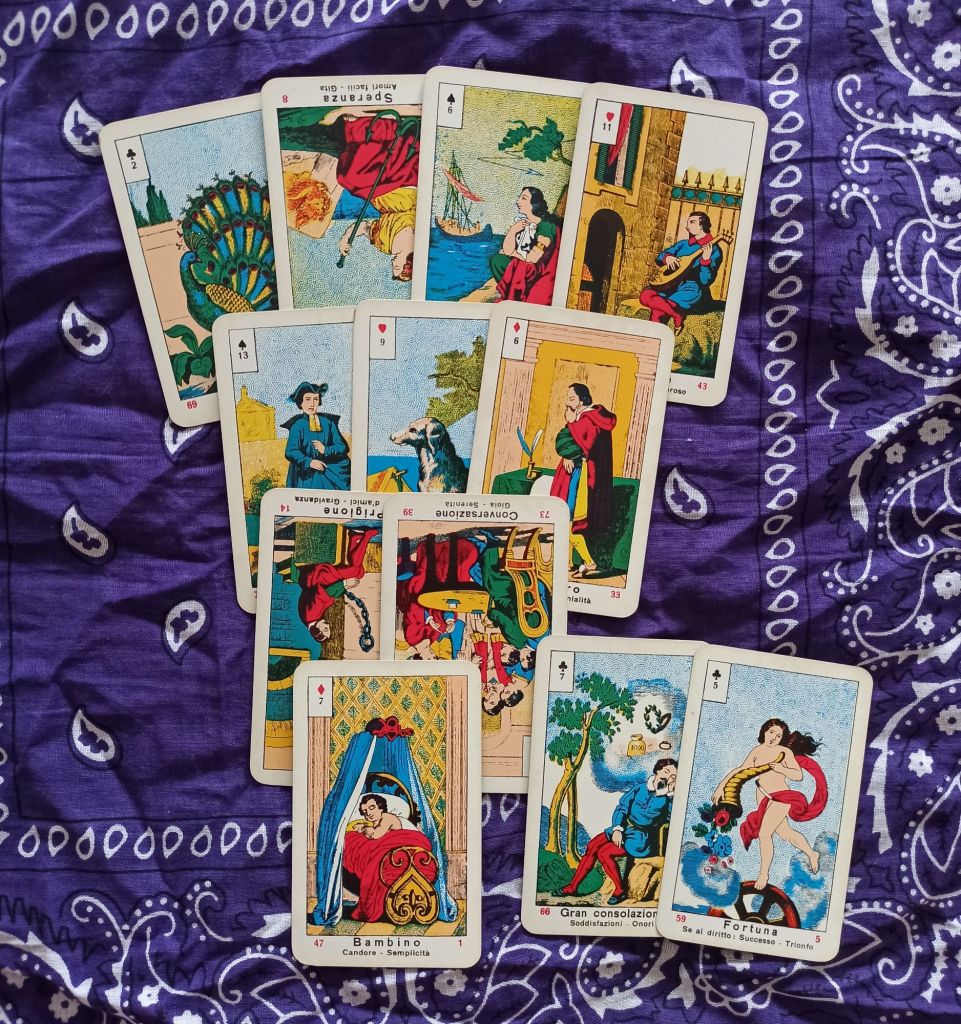
A spiritual reading with the Vera Sibilla cards
The first thing I was able to detect was the presence of the Priest in the second row. The Priest is usually not a real priest, and rather indicates a figure of authority. We also have, it seems, the significator card for the querent, represented by the Boyfriend, or Jack of Hearts, in the first line. The Priest is accompanied by the Dog/Faithfulness. This is a very good card, even outside of a love reading. It shows that, whoever the Priest is, he (or she) is good, trustworthy and has the querent’s best interest at heart. Furthermore, they are true believers.
The Thought card perplexed me a little, so I skipped over it (though you can see that the Thought card is just under the querent, so it turned out that it was the querent’s thinking process setting into motion). However, I did ask the querent if he was in contact with some kind of spiritual authority and he confirmed it, though he said it wasn’t a traditional priest or minister. This doesn’t matter: all kind of spiritual authorities can be signified by the Priest card.
The querent’s line, the first, has the card of God in it. This is the Peacock (when reversed, it represents the Devil and demons, as well as pride and haughtiness). The Peacock indicates totality, wholeness, miracles, etc. when upright. But it is followed by the Hope card reversed. Hope is the card of faith, but it is reversed, thus showing unbelief.
Yet it is not a clear atheism. Look at the Six of Spades, the Sighs card, right between the querent and the combination of lack of faith in God: the querent is sighing about his lack of faith. He is uncertain and tormented. I remember judging that he was probably a wobbly agnostic, and upon asking he confirmed that he had doubts (I didn’t ask him “are you a wobbly agnostic?” of course. We need to be kind to the querent).
It turned out, the querent had long banished spirituality from his life, had gone for an engineering degree, had been active in the skeptic community online, etc. However, some personal experiences had made him doubt his position.
Look at the last three cards of the pyramid. The Prison reversed shows unburdening, unshackling, freedom, etc. (when not followed by negative cards). Then we have the Conversation card. When reversed, it shows change. Finally, the Child, which shows a new beginning. I don’t know about you, but liberation + change + new beginning sounds like a spiritual conversion.
Furthermore, look at the angles of the pyramid plus the center: the Peacock (God), the querent, the new beginning (Child) and the Faithfulness card. This is a very positive indication.
Still, just to make sure, I asked the querent to draw two cards, and these were the Gratification and Fortune, confirming the good outcome.
As far as I know, the querent has since chosen his spiritual path.
Enneagram Type Five and Enneagram Type Six belong both to the Head triad, yet they give off markedly different energies. Fives actively employ their Head energy, using it to make sense of the world from a distance. Sixes often suppress their Head energy, don’t trust their own judgment and seek someone or something that will explain reality to them.
Being both Head types, both Fives and Sixes deal at their core with fear of the world around them.Fives thus retreat from the world into the safe realm of their own intellect, from which they observe life without being touched by it. It is often held that Fives are taking time off from real life in order to look for something, an idea or strategy, with which they may join the others and be useful or have a fighting chance, but while some great Fives really do come up with revolutionary ideas that changed the world, most Fives become lost and almost hooked on their own thinking power.
Sixes deal with fear differently. They don’t trust their own mind, so they seek structures outside of them, whether social, political, religious or other kind. For them, life is a sea of difficult choices, risks and dangers, a place where nothing seems certain. They therefore become engaged in an endless quest for the person, idea, group or thing that will give them clear answers that they don’t need to question anymore. Once they have found (or if they find) something that stands up to their scrutiny, they espouse it with militant fervor.
Fives tend to be philosophical and rational (though not always reasonable). Their approach to ideas and concepts is seldom practical, and they tend build up mental constructs not to employ them but to sharpen their overactive mind’s claws on them. Their attitude toward ideas is often playful and nihilistic. Sixes on the other hand are more practically oriented because their sense of fear is less rarefied and is almost palpable, as if they needed to actually survive from moment to moment. Their attempt at tearing down ideas and concepts is not playful at all: they keep poking holes in everything in hopes of finding the one thing where holes cannot be poked.
From a social standpoint, the difference between Fives and Sixes is often marked. Fives are withdrawn, remote, aloof. Even at average levels they are often socially inept, nor do they care to work on this aspect of their life, as they consider it inessential. Sixes, on the other hand, while often questioning people’s motivations, put on a friendly and even cheerful facade, because they are aware of how important networking is in dealing with the uncertainties of the world.
In reality, both Fives and Sixes are mistrustful of people. However, as far as Fives are concerned, rather than mistrusting people’s motives, like Sixes do, they tend to mistrust other people’s ability to understand reality better than them. On the other hand, a Six’s skepticism is generally oriented at people’s loyalties and competence in providing answers the Six can rely on. For instance, in an educational context, a Six pupil may not believe the teacher is good and is, in a way, faking it, while a Five pupil will often think they are better.
(Note: this is a collection of the meanings attributed to the cards by some occultists in the past centuries. It does not reflect my own study or opinion of the cards. It is only meant as a quick comparative reference as I develop my own take.)
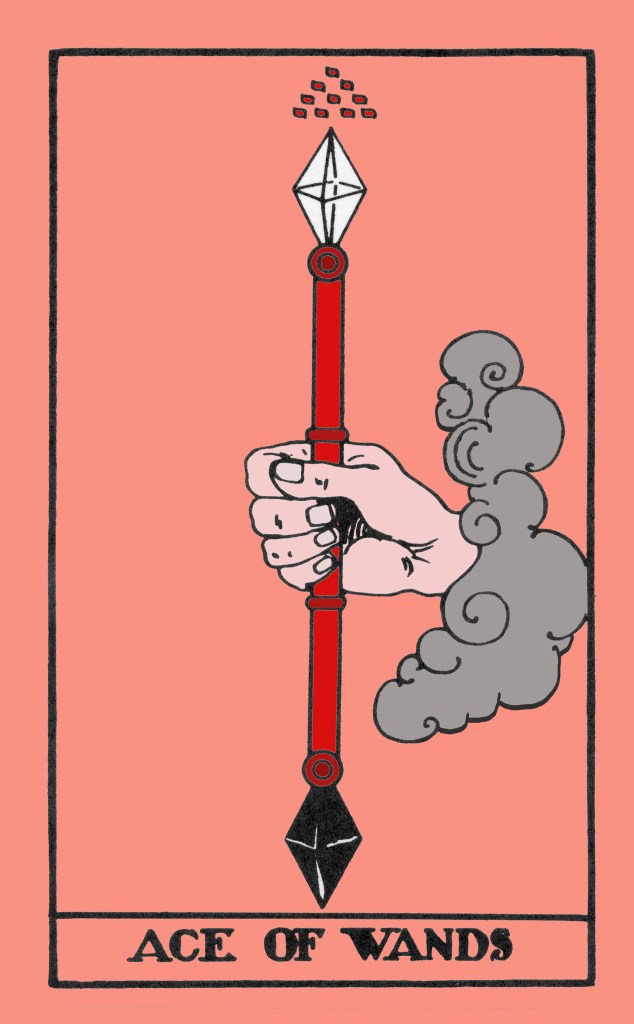
The Ace of Wands from the Builders of the Adytum (BOTA) Tarot deck
Paul Foster Case (and Ann Davies)
In Tarot Divination the Ace of Wands has these key meanings: natural as opposed to invoked force; strength; force; vigor; vitality; particularly the force of concentrated will; the principle of beginning; initiation or inception of any enterprise or activity; concentration of power; involution of force. Keyword: Initiative (From the Oracle of Tarot course)
A. E. Waite
A hand issuing from a cloud grasps a stout wand or club. Divinatory Meanings: Creation, invention, enterprise, the powers which result in these; principle, beginning, source; birth, family, origin, and in a sense the virility which is behind them; the starting point of enterprises; according to another account, money, fortune, inheritance. Reversed: Fall, decadence, ruin, perdition, to perish also a certain clouded joy. (From The Pictorial Key to the Tarot)
Aleister Crowley
This card represents the essence of the element of Fire in its inception. It is a solar-phallic outburst of flame from which spring lightnings in every direction. These flames are Yods, arranged in the form of the Tree of Life. (For Yod, see Atu IX supra.) It is the primordial Energy of the Divine manifesting in Matter, at so early a stage that it is not yet definitely formulated as Will.
Important: although these “small cards” are sympathetic with their Sephirotic origin, they are not identical; nor are they Divine Persons. These (and the Court Cards also) are primarily sub-Elements, parts of the “Blind Forces” under the Demiourgos, Tetragrammaton. Their rulers are the Intelligences, in the Yetziratic world, who go to form the Schemhamphorasch. Nor is even this Name, “Lord of the Universe” though it be, truly Divine, as are the Lords of the Atu in the Element of Spirit. Each Atu possesses its own private, personal and particular Universe, with Demiourgos (and all the rest) complete, just as every man and every woman does.
For example II’s or VI’s Three of Disks might represent the establishment of such an oracle as that of Delphi, or VIII’s might be the first formula of a Code such as Manu gave to Hindustan; V’s, a cathedral, XVI’s, a standing army; and so on. The great point is that all the Elemental Forces, however sublime, powerful, or intelligent, are Blind Forces and no more. (From The Book of Thoth)
Golden Dawn’s Book T
A WHITE Radiating Angelic Hand, issuing from clouds, and grasping a heavy club, which has three branches in the colours, and with the sigils, of the scales. The Right-and Left-hand branches end respectively in three Flames, and the Centre one in four Flames: thus yielding Ten: the Number of the Sephiroth. Twoand-twenty leaping Flames, or Yodh, surround it, answering to the Paths; of these, three fall below the Right branch for Aleph, Men, and Shin, seven above the Central branch for the double letters; and between it and that of the Right twelve: six above and six below about the Left-hand branch. The whole is a great and flaming Torch. It symbolizes Force — strength, rush, vigour, energy, and it governs, according to its nature, various works and questions. It implies Natural, as opposed to Invoked, Force.
Etteilla
Birth Upright. This card means, in its natural position, as far as the medicine of the spirit is concerned: Birth, Beginning. – Nativity, Origin, Creation. – Source, Beginning, Primacy. – Extraction, Race, Family, Condition, House, Lineage, Posterity, Occasion, Cause, Reason, First, First fruits. Reversed. Fall, Decadence, Decay, Decline, Decay, Decay, Dissipation, Failure, Bankruptcy, Ruin, Destruction, Demolition, Damage, Devastation. – Guilt, Error, Contempt, Abatement, Depression, Discouragement. – Perdition, Abyss, Chasm, Precipice. – Dying, Falling, Decay, Derogation. – Depth.
The founder of BOTA, Paul Foster Case, proudly started his short book “Oracle of the Tarot” with the assertion that Tarot divination is not fortune-telling. The reason, he explains, is that fortune-telling is grounded in the belief in luck, chance or fate, while divination understands that everything is about our personality. The same statement is found at the beginning of the advanced BOTA course on tarot divination (Oracle of Tarot, without the ‘the’). Ann Davies clearly had a hand in rewriting it, considering how verbose the course is, but the substance was similar.
Paul Case was tapping into the spirit of the times when he made that statement. Since Tarot had the (mis)fortune of attracting the attention of XVIII and XIX century occultists, it hasn’t enjoyed a moment of peace: everyone wants to believe it to be not an obvious masterpiece of Renaissance art and Medieval philosophy, but an occult device made to transmit mystical knowledge unknown to most people (even though most people prior to the Enlightenment and the French revolution would have been able to tell you what the Tarot was about).
The same has happened to Astrology. Once a practical art for foretelling the ups and downs of actual life, it became the victim of the occult intelligentsia of the last couple of centuries and was turned into a hodgepodge of pseudomysticism, ill-digested psychoanalytic concepts and “it’s true if you believe it” New Thought crap.1
But this is not the whole story. If one takes the time to study, say, the Golden Dawn system, one quickly finds out that their traditional way of reading the Tarot is grounded in fortune-telling (just read MacGregor Mathers’ example of the Opening of the Key spread). Even the BOTA system, which derives from it, preserves very concrete meanings to be strung together into sentences, despite Ann Davies’ attempt to turn divination into a form of Kabbalistic meditation.
In other words, the occultist attempt at reappropriating the Tarotand Astrology (which in part continues to this day with some bogus theories about the so-called Tarot of Marseille, but more on this in another post) is only partly responsible for the divination/fortune-telling dichotomy. Much of contemporary occultism is grounded in the psychoanalyzation of magic and spirituality, which, in turn, is a defense mechanism against the death of the classical spiritual worldview. Yet, for all its shortcomings, it at least preserves some core tenets of the magical worldview.
But the problem with this is that while it does preseve in some ways the roots of the worldview in which divination can flourish, it has lost the intellectual basis for defending it. Intellectually speaking, even today occultism is largely stuck in the pre-WWII era, with its myths of scientific positivism, of constant historical progress and of magic as misunderstood technology (while I would argue the opposite, namely that technology is misunderstood magic).
Essentially, what has gone lost is the philosophical framework that allows us to keep together divination as spiritual practice and divination as uttering of concrete, verifiable truths.2 That’s largely because spirituality, in the post-XVIII-century Western world, was only allowed to survive as private indulgence in irrational behavior, a weakness to be tolerated.
Thus the split was born: 1) on one hand divination: a ‘serious’, and therefore unverifiable endeavor, a tool for vague self-reflection, cheap catharsis and shallow instagrammable aha moments. In other words, something that the small judgmental scientist constantly perched on most people’s shoulder could smile upon as at least benign, if not really true; 2) on the other hand fortune-telling: a crass or quaint superstition that is just a scam when it gets things wrong and just a coincidence when it gets them right. The little scientist can be free to frown on it. In other words, the distinction was born out of the guilty conscience of “spiritual” people, i.e., out of their subconscious scientism, as a way of telling themselves and society “I indulge in this silliness, but I am just quirky, not stupid.”
The occultists of yore were at least intelligent men and women who actually had something to say. They may have worked in an intellectually hostile environment, but they at least gave it their best shot, and for this they deserve leniency. What happened next is worse: that the already battered art of divination fell into the hands of stoned hippies and people with degrees in the most useless branches of socially acceptable knowledge. Then along came the Liz Greene’s and the Rachel Pollack’s (to make just two examples) who destroyed Astrology and Tarot even further. From then on it could only go in one direction: past life readings, divine feminine, empty motivationalism and strategizing, healing of generational traumas and all the attendant nonsense.3
Interestingly, the more contemporary divination’s fake husk rots, the more one needs to be intellectually dead to practice it, the more it becomes reintegrated in the higher spheres of society. I believe I already talked about a friend of mine who works for Google and has to endure meaningless meetings with tarot readers and astrologers because her boss is the manifestation-obsessed boss babe type. Nor are tarot readers a rarity in corporate America. This probably says something about how brain-damaged this kind of environments is. The nicest thing we can say about this part of society and this strand of divination is that they deserve each other.
MQS
This is not to say that Astrology or divination were unanimously accepted, but the debate was much more complex. ↩︎
This, by the way, is not a call to “go back” to some long lost good old times. I am no reactionary. Nor am I a progressive. I am a realist. ↩︎
By which, of course, I do not mean that there is not a feminine side of the divine, nor that trauma cannot be a real thing. I only mean that these words correspond to nothing but the most vapid pseudointellectual nonsense when coming out of most people’s mouths nowadays. ↩︎
Traditional cartomancy, like all traditional divination systems, is full of tips on how to handle spiritual topics. The difference with contemporary psychobabble is that in traditional cartomancy we deal with a spirituality that is rooted in the earth and in everyday life rather than in Mind/Body/Spirit section poppycock. As I often remark, in such systems spirituality is seen as the logical next step for someone who is acquainted with real life, not as a consolation prize for someone who is trying to avoid it.
The querent asked if her boyfriend believes in “a superior being”, by which I assume she meant God (“being” is probably a more reassuring term compared to “bearded guy holding a lightning bolt”). She places great importance on the topic, but he seems to avoid talking about it. This is a playing card reading. In the next days I will also post a Vera Sibilla reading done on a similar question by a different person some time ago.
A♥ – 8♣ – 9♣ – K♥ – 7♣
Seeing this, I asked the querent to draw three more cards to open the reading on the Ace of Hearts, which yielded the 2♠, the 2♣ and the 6♣.
The first thing I noticed was the complete absence of Spades (except in opening the spread, but that’s a very weak Spade). This generally bodes well for spirituality. However, there is also a majority of Clubs, which indicate struggles and difficulties. There is no need to interpret the spread card by card. The spread indicates a slow or difficult relation with the divine. Belief is not denied, but it is rendered heavy, problematic.
The first card is the Ace of Hearts, which can indicate “inner” issues, but because the first card in a spread can also represent the cause of a situation described by the following cards, I ventured to interpret it as issues relating to the home causing the querent’s boyfriend to falter in his faith. The three additional cards with which I opened the spread on the Ace of Hearts reinforced my idea that there must have been a difficult atmosphere at home surrounding the topic.
What about the King of Hearts? Is it the dad? Well, no. Traditionally, in spiritual readings the King of Hearts is God himself (just like in the Sibilla): he is the lord (King) of your inner life (Hearts). Surrounded by all those Clubs, the God-side of the boyfriend’s life suffers, is stifled. Yet it is there, since the King of Hearts comes up and is not surrounded by Spades.
I asked the querent to give another three cards to open the spread on the King of Hearts. These were the 10♠, the 4♣ and the 10♥. At night (Ten of Spades) he speaks (Four of Clubs) spiritually/finding consolation (Ten of Hearts). He prays to God at night.
This is intended as a collection of meanings attributed by some sources to the Major Arcana and Minor Arcana of the Tarot. I will add sources as I study them. If you have sources to recommend, hit me up.
If you are interested in a (partial) list of the meanings I attribute to the Major arcana in my reading examples and case studies, click here.