Tag Archives: Spirituality

A Water Spirit (Example Reading)

One cool thing about moving to our new place is that we now live much closer to the countryside. Although there are a couple of major cities around us, our district is basically a cluster of small pictoresque old German villages close to the woods. This is a very good place for a magic practitioner to settle down.

I also discovered that there is a small lake or large pond (depending on who you ask) nearby. It’s been my experience that old water places, just like old caves, tend to be stably inhabited by spirits. In fact, in a subtle way, these spirits *are* the place they inhabit.

Before visiting the place I drew three cards to investigate, and these cards came up:
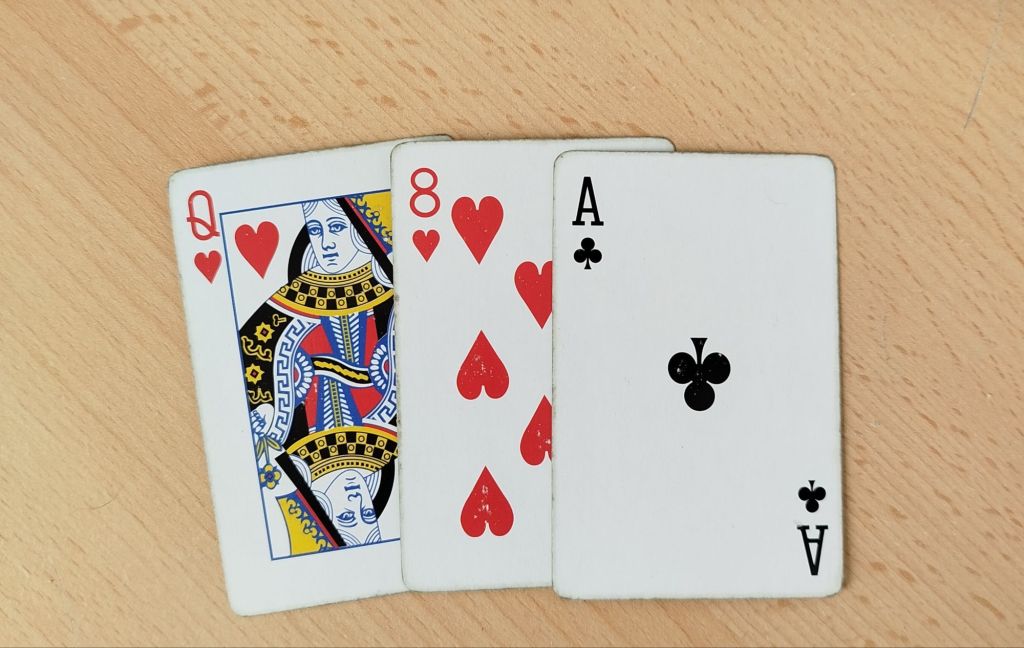
A water spirit – Cartomancy with playing cards

Obviously, the first thing to take note of is the presence of the Queen of Hearts, which is a motherly figure or a positive female entity. This is confirmed by the Eight of Hearts which can represent a water place, so in the context of an esoteric / magical reading it would represent a female entity of a broadly positive nature tied to water. The Ace of Clubs represents power, dominion, rulership. It indicates that the spirit has power over the place, so while she is positive, she is not the airy-fairy pushover type.

After doing the reading, I started researching local folklore. If you know of any such place near where you live, it may be wise to research local legends, as they often contain romanticized but accurate hints about the nature of the spirit.

What I discovered is that there is a medieval legend tied to the place, according to which a mother (!!!) once brought a local duke a basket of vegetables, in exchange for having a new irrigation system dug near where she lived. This irrigation system became the pond. There is no narrative reason why she should be characterized as a mother. Her being a mother serves no purpose in the legend, which makes it a very important hint in understanding the spirit: she is essentially motherly.

“But” you may be wondering “this is an artificial pond, how can it be magical?”

We must not draw strict boundaries between the world of humans and that of the great powers of nature. What we know from the legend is that a water spirit wanted to establish herself in this place and convinced the humans around her to cooperate by being motherly and nurturing toward them, and the humans were intelligent enough to accept her offer. There is nothing strange about this: in actuality, humans cooperate with nature all the time.

Note how the reading hints at a spirit that is positive (Queen of Hearts) but not submissive (Ace of Clubs). Had she been a difficult spirit she could have simply flooded the zone. There is altogether too much mischaracterization of water in the spiritual and magical community as something weak, vague and mystical. Water can be devastatingly powerful, so it is a good thing our local water spirit is a positive member of the community.

MQS
The Mystery of the Seven of Swords

Waite the Juggler

The Rider Waite’s minor arcana (which I already talked about here) are based on the Golden Dawn’s correspondences and titles found in Mathers’ and Felkin’s Book T. Yet Waite, who was very fond of showing off his erudition, made it a point to look for as many similarities as possible between the Book T system and other lists of meanings such as Etteilla’s, Christian’s and others.

This is reflected in the accompanying book to his deck, The Pictorial Key to the Tarot, where he tries to find similarities between various sources for each minor card. He never mentions the Golden Dawn material, despite the fact that knowing the GD’s card names would clarify most of the designs.

The 1 to 1 correspondence between GD meanings and Waite’s minor arcana is self-evident, and once it is noted it cannot be unseen. Yet in his book he makes it a point to just rely on non-esoteric sources, or at least on non-GD sources.

Note that the Golden Dawn did something similar, despite the claim that the card titles were revealed to them. Take the Four of Cups, for instance, which technically should be ascribed to the rulership of the Moon in the third decan of Cancer and to the sephira Chesed (mercy). All these things sound very promising. Yet the card is called Blended Pleasure and it is less positive than the previous two, largely (I believe) in an attempt to accomodate Etteilla’s relatively negative interpretation of the Four of Cups as a card of boredom, annoyance, etc.

Similarly, the Golden Dawn retained certain meanings found in traditional fortune-telling, such as ‘travel by water’ for the Six of Swords. This can be seen as part of the GD’s attempt at summarizing the whole of the Western magical tradition in a new synthesis.

Going back to Waite, it is clear that in his book he is also trying to balance various sources, but if in doubt about which one to follow, he will stick (without saying so explicitly) to the GD tradition. An example I already discussed is the Five of Pentacles, which Etteilla calls the card of the lovers, but the Golden Dawn called it ‘Material Trouble’.

Another example is the Two of Wands, which Etteilla calls a card of sorrow, but for the GD it is a card of Dominion, so Waite goes with the GD but tries to stretch the interpretation in his text by saying that it could be the sorrow of a great leader, like Alexander the Great, at the height of his power.

But What About the Seven of Swords?

With that in mind, what the hell is going on with the Seven of Swords? Let me explain: most people who pick up a Rider Waite tarot deck, even today, have no idea about the esoteric stuff behind it, so they base their interpretation on the design (which, incidentally, Waite thought very little of). This is how, for instance, the Two of Pentacles, the Lord of Harmonious Change according to GD, became the card of juggling, or how the Seven of Cups, the Lord of Illusionary Success, became the card of options.

In this new folk approach to the Waite deck, the Seven of Swords became known as the thief card due to the design.

Yet Waite does not even mention thieves in his description. He says:

A man in the act of carrying away five swords rapidly; the two others of the card remain stuck in the ground. A camp is close at hand. Divinatory Meanings: Design, attempt, wish, hope, confidence; also quarrelling, a plan that may fail, annoyance. The design is uncertain in its import, because the significations are widely at variance with each other. Reversed: Good advice, counsel, instruction, slander, babbling.

The meanings he gives are from Etteilla, where the Seven of Swords is one of the few non negative Sword cards. The description of the card, however, is far more consonant with what we find in Book T, which is:

The Lord of Unstable Effort […]Partial success. Yielding when victory is within grasp, as if the last reserves of strength were used up. Inclination to lose when on the point of gaining, through not continuing the effort. Love of abundance, fascinated by display, given to compliments, affronts and insolences, and to spy upon others. Inclined to betray confidences, not always intentionally. Rather vacillatory and unreliable.
Netzach of HB:V (Journey by land: in character untrustworthy)

This thing with the yielding when victory is within grasp is clearly depicted in the card, where the thief takes away most of the enemy’s swords, but not all, as Waite clearly states.

But why did Waite (and, maybe, Smith) decide to depict a thief in the Seven of Swords despite it being so thematically different from Waite’s actual inspiration (Book T) and even his cover-up inspiration (Etteilla)?

The only hints we find in Book T that seem to point in this direction are “to spy upon others” and “in character untrustworthy”. In an attempt to accomodate Etteilla, Waite probably saw the man looking longingly at the swords he left on the ground as a symbol of hope, which is Etteilla’s meaning for the card.

One possible explanation is that Waite and/or Smith probably thought the type of action that is best suited to the Suit of Swords is the kind of sneaky, underhanded action depicted in the final design of the card. Be it as it may, this is one of the cards that always stood out to me when studying the history of this deck, because it takes a very non-obvious approach to its theme.

MQS

AI, Dream Logic and Visionary Magic Work

I’ve been having a lot of fun lately, watching AI generated videos based on pre-existing material. If you are not familiar with the “steamed hams” meme, here’s the original video:

and this is a meme version (one of the hundreds of versions being produced every year) of the same video, but reworked with AI:

One thing that struck me about it was how incredibly similar this video’s internal logic (or lack of it) is to the logic of dreams, especially of weird dreams. Everything flows into everything else, hanging together with it by thin threads of association.1

Notice, for instance, how the two characters, Skinner and Superintendent Chalmers, start dancing a romantic dance out of the blue just because the AI interprets the two characters getting close to each other as them engaging in romantic behavior, in spite of the fact that one of them is actually rather pissed at the other in the actual scene, and the other actually would rather avoid being in his presence.

This reminds me of how clearly the tone of dreams seems to shift flowingly from fun to scary to dramatic, to fun again, to romantic and so on, based on cues that the brain interprets much more loosely than when governing our waking consciousness. As an example, I recently dreamt I was visiting an old friend back in Italy, and the tone of the dream was cheerful and whimsical. Then, my friend taps on my shoulder from behind, and this must have reminded my brain of some horror movie I watched, because upon turning, my friend’s face turned into a demonic one and I was jumpscared awake.

Interestingly, what AI seems to be lacking, at least at this point in time, is the faculty of judgment, which is exactly what we also lack when dreaming or inebriated.

What I’m saying doesn’t really have any direct magical application. Technically, from a purely magical standpoint, the ability to let the consciousness flow in a dreamlike state is only one of the first levels to be achieved,2 as visionary work deals not only with a rigorous sculpting of the inner reality but also with the contacting of beings on different planes, which does require judgment (and sound judgment, possibly). On the other hand, the free flow of association, while it does have its artistic, psychological and even spiritual uses, is not immediately helpful in magic. In fact, it can lead to self-deception.

Still, I am left wondering if further progress can push AI in the same direction our consciousness moves toward in visionary work. It is a stretch, of course. After all, even the term ‘intelligence’ is used rather loosely when describing AI at this point. But what we thought was impossible yesterday is coming true today, so it is really hard to discern what AI will and won’t be able to achieve, and whether some kind of computer-generated magic or computer-fueled magic is possible.

MQS

Footnotes
  1. It reminded me of what Paul Foster Case says about how the subconscious works, when describing his own version of the High Priestess tarot card ↩︎
  2. Which is why so many self-styled visionaries who used or use drugs to fuel their trips are usually rather shallow, when the consistency of their vision is probed (and we should always probe the consistency of our visions) ↩︎

Enneagram Comparisons – Type Eight and Type Nine

Enneagram Type Eight and Enneagram Type Nine are extremely different and almost never confused, despite the fact that they form each other’s wing. Both are Body types concerned with their own independence. Eights preserve their independence by asserting themselves on others and challenging them. Nines preserve their independence by being compliant, accomodating and friendly so as to avoid causing issues that might result in uncomfortable strife.

Both Eights and Nines can be extremely dynamic people, but Nines prefer routines that comfort them and fill them with a general sense of wellbeing, balance and calm. Ultimately, Nines want to avoid unpleasant sensations of sadness, isolation and conflict, whether outer or inner. Eights, on the other hand, generally go down the path of greatest reasistance and seek to overcome it, finding pleasure in difficulty and in the challenges the world around them and other people offer them.

opposites

Socially, the two types behave in radically different ways. Average Eights immediately sense the power relations among people and disrupt them to impose themselves as the reference point, so that they may have better control over others and therefore over themselves (more healthy Eights often use this vantage position to help others, but they still often want to be the ones initiating the action).

Average Nines, by contrast, take a step back by allowing others to express themselves, often finding it hard to get their own point-of-view or agenda across, and their personal energy tends to disappear, assimilated by that of others (whereas more healthy Nines learn to cooperate with others while still mantaining a separate sense of self and of their own preferences).

MQS

Tarot Encyclopedia – The Three of Pentacles or Coins

(Note: this is a collection of the meanings attributed to the cards by some occultists in the past centuries. It does not reflect my own study or opinion of the cards. It is only meant as a quick comparative reference as I develop my own take.)

The Three of Pentacles from the Builders of the Adytum (BOTA) deck

Paul Foster Case (and Ann Davies)

The time period is the second decanate of Capricorn, under the rulership of Venus, from January 1 to January 9.
Well-Dignified: construction; increase, growth; financial gain; the building up of favorable conditions; gain in commercial transactions; rank or prestige in vocation or business; beginning of matters to be perfected later.
Ill-Dignified: selfishness; cleverness in business, but lack of scruples;
narrowness and prejudice; too much ambition.
Keyword: Constructiveness.
(From the Oracle of Tarot course)

A. E. Waite

A sculptor at his work in a monastery. Compare the design which illustrates the Eight of Pentacles. The apprentice or amateur therein has received his reward and is now at work in earnest. Divinatory MeaningsMétier, trade, skilled labour; usually, however, regarded as a card of nobility, aristocracy, renown, glory. Reversed: Mediocrity, in work and otherwise, puerility, pettiness, weakness.
(From The Pictorial Key to the Tarot)

Aleister Crowley

The Three of Pentacles, in a similar manner, exhibits the result of the idea of Earth, of the crystallization of forces; and so the Three of Pentacles is called the Lord of Work. Something has definitely been done.

[…]

The influence of Binah in the sphere of Earth shows the material establishment of the idea of the Universe, the determination of its basic form. It is ruled by Mars in Capricornus; he is exalted in that Sign, and therefore at his best. His energy is constructive, like that of the builder or engineer. The card represents a pyramid viewed from above the apex. The base is formed by three wheels-Mercury, Sulphur, and Salt; Sattvas, Rajas, and Tamas in the Hindu system; Aleph, Shin, and Mem-Air, Fire, and Water-the three Mother letters of the Hebrew alphabet.

This pyramid is situated in the great Sea of Binah in the Night of Time, but the sea is solidified; hence the colours of the back-ground are mottled, a cold thin dark grey with a pattern of indigo and green. The sides of the pyramid have a strong reddish tint, showing the influence of Mars.
(From The Book of Thoth)

AI-generated illustration for the Three of Pentacles or Coins

Golden Dawn’s Book T

A WHITE-WINGED Angelic Hand, as before, holding a branch of a rose tree, of which two white rosebuds touch and surmount the topmost Pentacle. The Pentacles are arranged in an equilateral triangle. Above and below the symbols Mars and Capricorn.
Working and constructive force, building up, creation, erection; realization and increase of material things; gain in commercial transactions, rank; increase of substance, influence, cleverness in business, selfishness. Commencement of matters to be established later. Narrow and prejudiced. Keen in matters of gain; sometimes given to seeking after impossibilities.
Binah of HB:H (Business, paid employment, commercial transaction).
Herein are HB:YChVYH and HB:LHChYH Angelic Rulers.

Etteilla

Important
Upright. This card, as far as the medicine of the spirit is concerned, means, in its natural position: Noble, Considerable, Famous, Important, Great, Major, Extended, Vast, Sublime, Renowned, Famous, Powerful, Elevated, Illustrious. – Excellence, Consideration, Greatness of mind, Nobility of conduct, Generous deeds, Magnificently, Splendidly.
Reversed. Puerility, Childhood, Infantilism, Frivolity. – Weakening, Lowering, Diminishing, Education, Modicity, Mediocrity, Minuity, Inezia, Frivolity, Lowness, Vileness, Poltrony, Rampant, Small, Puerile, Petty, Low, Servile, Vile, Abject, Humble. – Abjection, Humility, Humiliation.

MQS

Enneagram Comparisons – Type Seven and Type Nine

Enneagram Type Seven and Enneagram Type Nine share some similarities, and can therefore be confused. Sevens are a Head type and seek to avoid anxiety and fear by being hyped about things they can enjoy. Nines are a Body type who maintain their sense or independence by being agreeable and positive to avoid causing trouble that might come back to haunt them.

Both Sevens and Nines are known to have a hard time selecting a single thing that they can be or do. Sevens thrive on pursuing variety as this allows them to continue skimming the surface of life in search of the next big thrill and avoid staying with negative emotions for too long. However, Sevens tend to have a rather strong sense of self and of their wants and needs.

Nines on the other hand have a diffuse sense of their identity and do not feel comfortable defining themselves, often sensing that they can resonate with almost anything and anyone. By avoiding taking on a sharp identity, Nines protect themselves from potential trouble by simply passively flowing through it instead of bumping against it.

variety

Both Sevens and Nines have a broadly optimistic worldview. To a Seven, the world is their oyster and they look forward to the next thing to be hyped about. They are excitable and quick, and even when in a situation that they dislike, they can learn to tolerate it in anticipation of something better to come.

Nines by contrast move at a slower pace and have a sense of placid and unassuming satisfaction about them. They do not demand much from life and do not spiral into the manic frenzy of Sevens. In fact, they are very wary of anything that might cause excessive reactions in them. Their sense of optimism takes the form of a generalized, vague it’s-fine-ness that they adopt to avoid having to take a stronger stance, which might open them up to trouble and strife with others.

Both types can be rather superficial. Sevens are superficial in the sense that they remain on the surface of the things that they get excited about and avoid settling down so as to not miss out on the next thing that excites them. Nines are superficial in the sense that they avoid deep emotional or intellectual commitments that might put them in a corner or pit them against others, and so prefer to remain flexible and deal in generalities, which may sometimes sound deep but aren’t.

MQS

Enneagram Comparisons – Type Seven and Type Eight

Enneagram Type Seven and Enneagram Type Eight can be very similar and are often confused. Sevens are a Head type, who cope with their fear, pain and anxiety by getting lost in a world of pleasure-seeking and fun distractions. Eights are a Body type, and they seek to protect their independence by being assertive and bold and forcing others to deal with them and take them into account.

Both Sevens and Eights are very assertive and outgoing on the surface. Sevens find it easy to attract interesting people and adventures, since remaining confined in a routine can cause them to become restless or even to suffer. Eights are more guarded and do not trust people very much, but they do come out of their inner fortress to mark their territory against others and to let them know that they (the Eight) are not to be messed with. Thus they often end up either submitting others or guiding them.

Both types tend to have a somewhat materialistic view of reality and seek earthly pleasures. Generally speaking, Sevens seek variety and change in order to be constantly dazzled and stimulated and stay hyped about something positive, so that they can avoid being sucked into a cycle of fear. Eights on the other hand usually seek intensity in powerful experiences, as they enjoy the feeling of having something outside of them offer them resistance, and they enjoy conquering it in the end, to prove that they are the ones who are still standing (it is typical, for instance, for alcoholic Eights to want to prove that they can handle one more glass).

passion

Both types often come across as action-oriented. Eights attack problems from an instinctive standpoint, throwing brute force (either literal or metaphorical) against the obstacle until it is destroyed. Sevens are more intellectually versatile (not necessarily more intelligent) and they often quickly come up with plans to overcome obstacles in order to reap the rewards, the rewards usually being meterial comfort and/or the ability to pursue their many passions.

Socially, average Eights operate on a friend/enemy level: they quickly sort other people out in either one of the two camps. For them, life is a battle and they need to know whom they are going to defend and whom they are going to attack. Sevens are not naive, but they see the world more as their oyster, and while they know that there are difficult people in the world, they seek to look past them in anticipation of the fun time to be had after dealing with them.

Eights tend to be more unshakably dedicated to the small handful of people they call friends. Sevens are also very good friends, but they also often look to create different groups of friends based on their interests (the group they go dancing with, the group they watch movies with, etc.) although they too often have a small core of best friends.

MQS

Enneagram Comparisons – Type Six and Type Nine

Enneagram Type Six and Enneagram Type Nine are quite distinct from one another, so much so that they are each other’s arrow: Six relaxes at Nine, Nine stresses at Six. Sixes are a Head type, and their priority is to find security and certainty in an uncertain world. Nines are a Body type, whose main goal is to not have their inner sense of independence disrupted by disharmonious trends.

Both Six and Nine usually come across as friendly and likeable. Sixes want to prove to others that they are dependable and that they can be allies in facing common struggles. Nines are also broadly supportive of others, but more in the sense that they go with other people’s flow so as to not cause the kind of friction that might disrupt their inner sense of balance as independent individuals (“If I say yes to the invitation she won’t make a fuss”).

Sixes are often found evaluating the risk factors in every situation or assessing other people’s behavior to see if they can trust them, while Nines normally hold a non-descript optimistic view of people and life, and a sense that things will turn out well somehow, to the point where they may deny the existence of objective hurdles and problems. Sixes seek to predict all possible problems, while Nines often look the other way. On the other hand, average to unhealthy Sixes often end up compromising stable or positive situations in an attempt to smoke out hidden threats or enemies that exist only in their head.

Peace

A Six’s strategy for survival generally implies developing a conscience of themselves as a social being (they are the archetype of the ‘member’, whether of a party, a church, an organization, a class, a country, etc.) The Six’s idea of survival implies minimizing risk and uncertainty by handing over the final say on their life decisions to something external (a belief system, a person, a group, etc.) that is perceived as stable or trustworthy. However, once a Six has identified the idea or group they belong to, they can become rather confrontational with that idea’s or group’s enemies.

A Nine’s minimization of problems is more geared toward preserving an inner sense of peace. Swept under the rug of a general, bland “it’s all fine”-ness, external trouble can be denied the status of force that pushes against them. Similarly, in social situations Nines will tend to be agreeable and limber so as to not allow others to perceive resistance in their part that might turn into a power struggle. In other words, by denying a strong reaction, Nines seek to cause the external action to dissipate by itself.

MQS

Enneagram Comparisons – Type Six and Type Eight

Enneagram Type Six and Enneagram Type Eight can be similar, depending on certain factors, but overall they are very different. Sixes are a Head type and are concerned with security and certainty. Eights are a Body type and are concerned with independence and autonomy.

Sixes often tend to be sheepish, friendly, helpful and gregarious. They look for external points of reference that can give them the security they feel they lack (whether this point of reference be a leader, an idea, a group or something else). Eights are much more maverick-like, usually fight for themselves (and for those they wish to protect) and don’t usually need external frames of reference. In fact, they may despise them. If Eights are warriors, Sixes are worriers.

However, Sixes can also act in a radically different way when they enter their contraphobic stance, when they stop running away from fear and tackle it head-on. When this happens, Sixes can be very similar to Eights in that they act in an bold, fierce way that could even come across as arrogant or smug. The main difference between an Eight and a contraphobic Six is that the contraphobic Six still acts based on their deep fears. They are like herbivores charging against the predator.

courage

Socially, Sixes generally adopt a friendly stance. They hope to come across as those fun, dependable fellas you’d take inside and defend if the zombie apocalypse they fear should actually happen. They have a strong sense of the importance of safety nets, since they are forever catastrophizing and thinking about worst case scenarios and since they feel helpless in front of an uncertain world.

Eights rarely act like this. They are usually fierce and even overconfident. Their strategy is to force others to see them as either a threat they want to stay away from or a point of reference to gravitate around, submitting to their guidance. If Sixes try to poke holes in every certainty they have in order to see if if it is, in fact, certain, Eights can often jump the gun, confident they can bend the world to their will by sheer power.

MQS

The Objectivity of Magic

Since it’s Leo season I’m rather busy creating Sun talismans and “recharging” old ones (I am not fond of the idea of talismans as something to be charged, but I digress).

This reminded me of one time, a couple of years back, when hubby was in somewhat of an existential crisis as far as his job was concerned. I was working on a Sun talisman, but didn’t tell him (he knows of my esoteric interests but doesn’t interfere, and I don’t keep him abreast of all my workings).

The night after the consecration, hubby woke up at dawn, something that rarely happens, and was drawn by the rising Sun. Inexplicably he was compelled to open a job-searching app he hadn’t opened in a while. Right in front of him was the perfect job opportunity. He applied and got the job.

This little episode, I think, is a good example of how objective magic’s power is. Of course, if by objective we mean “amenable to consistent, quasi-scientific manipulation” then magic is not objective. The presupposition nestled in the heart of science is the possibility of endlessly manipulating reality, while magic has its unbreakable patterns.

Furthermore, white magic tends to have less dramatic (sometimes hardly noticeable) effects than dark magic, because it largely harmonizes the person with the patterns available in their life rather than running against them (if someone is saying that they’ll bring back the love of your life with white magic, they are lying).

Finally, magic doesn’t work as reliably as the technology stemming from science, and never will. If the remote doesn’t work you know you must either change the batteries or see if some wires have come loose inside. But pinpointing what’s gone wrong in a magical operation is much harder, and sometimes things simply don’t work because screw you any old mortal.

But magic is objective in the sense that its influence on reality becomes undeniable to those who have had to do with it. Just like with divination, it is really hard to find excuses and rationalizations.

Also, magic is objective in the sense that it forces us out of our ego and in contact with objective forces outside of us. Some may argue these forces also exist inside of us, and that’s true. In the esoteric constitution of humanity the seven planets are all present, but in so far as their activity is bound by our limitation it is relatively useless, which is why it becomes imperative to overcome those limitations by coming into contact with those same forces outside of us.

Way too much emphasis today is placed on the psychological side of magic and spirituality. This is in part a survival mechanism adopted by our forebears to allow magic to survive the scientific revolution (you can’t disprove me if I’m just an inner feeling).

Working on ourselves is certainly a great idea, though rarely in the sense that this is done nowadays, which usually plunges people even more deeply in their narcissism. However, I believe much of the value of the esoteric arts is that they force us to come out of our selves and in contact with something objective and far greater.

The famous esoteric/philosophical motto “Know thyself” has been reinterpreted in the most abstrusely psychological ways recently, but it is very unlikely that this is what those who wrote it meant by “knowing ourselves”: in the old view of the cosmos, it was impossible to know oneself without knowing one’s place in the scheme of things and therefore not eluding reality, including higher forms of reality, and experiencing the point of juncture between the individual and the universal.

MQS