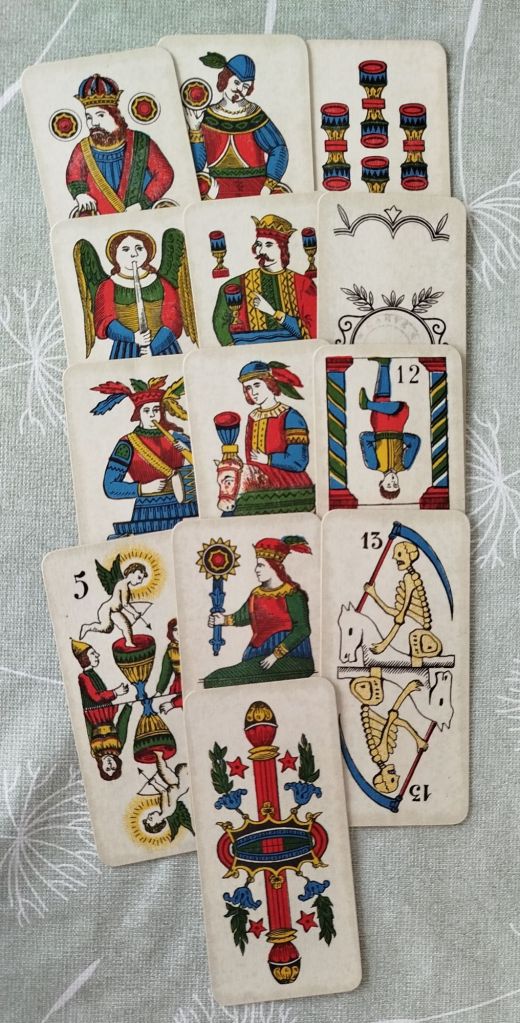
The Tarocco Bolognese is famous in Italy for relying heavily on combinations of cards. Rather than each card being a full picture, the cards are like small tiles in a mosaic, and need to be interpreted as a whole. No individual card can tell us much of anything. Let’s take the most favorable card in the deck, the Angel. In itself a wonderful card of protection and solution. Yet, alone, the Angel merely says “protection” or “solution” or “friendship” or any other keyword. We still don’t know if this protection exists, is longed for, is missing, is crumbling, or what effects it will have.
In this, the Bolognese tarot is much closer to the Sibilla or Playing Cards or other traditional oracles than to how tarot is often read nowadays (but regular tarot did use to be read in a combinatory manner in the past, before the Waite deck became popular and people started focusing on illustrations).
Since each individual card doesn’t say much by itself, the spreads tend to rely on a larger number of cards. The smallest traditional spread done with the Bolognese tarot is the thirteen card spread, which I have already shown, and which I will cover again. This is a small tableau of three columns of four cards (or four rows of three cards) plus one at the end. In this small tableau, the cards are interpreted in their interaction with one another.
Often, therefore, it is necessary to be able to see the big picture when interpreting the Bolognese Tarot. Occasionally, all cards are important and need to be considered. At other times, one or two cards come up in the spread that we don’t know how to interpret and don’t make sense to us, and there is no point in banging our head against them, trying to fit them into the interpretation at all costs: we should be able to see where the answer to our question lies, where the cards that are clearly forming a message are clustering, and go from there.
Look at the spread as if it were a bunch of people in central square. Some are there to meet other people and discuss something important or go somewhere interesting together. Others are simply sitting there because their wife kicked them out so she can finish waxing the floor in peace, so they just sit alone. They don’t have much to add. They are just there. Or, if you prefer the image of the mosaic I used earlier, some tiles go together to show the cool angel warding off the horde of demons, while other tiles are just vaguely blue and form the sky in the background.
This sounds complicated but it isn’t necessarily, once we have developed an eye for which cards tend to go together. Don’t fixate on rigid 1+ 1 + 1 + 1 +1 = 5 kind of combinations. In cartomancy, 1 + 1 +1 + 1 +1 often equals a bunch of crap if you are not careful. Who says that it’s 1 + 1 +1 +1 +1, and not 1 + 1 on one hand and then 1 +1 +1 on the other? Or 1 + 1 + 1 + 1 and then one left over? Who says the cards add up, instead of detracting from each other? The Angel is good, but followed by the Hermit and the Tower it is diminished. Strength makes you strong, but Strength followed by the Moon? Not so much.
Look at the flow and apply logic to it. See how the small meanings of the cards cluster together to form one coherent bit of mosaic. That coherent bit of mosaic may be next to another bit that is coherent in itself, without the two going together: in one corner you may have the scene with the angel warding off the demons, but right next to it you could have God creating Adam and Eve. Mix them the wrong way and you’ll have the angel warding off God, while the demons create Adam and Eve. Not good on the angel’s resume.
Also, don’t fixate rigidly on methods like “the first card is the noun and the second is the adjective” that were popular some time ago in the Lenormand community. I don’t use Lenormand, don’t know if that’s how they work, but it certainly doesn’t help with the Bolognese tarot. Again, the big picture is essential. Once we have that down, we can carefully add the details.
Finally, go for concrete life. The cards can talk about many things, from the most mundane to the most deep, including spirituality, psychology and so on. Do keep in mind, though, that the card readers of yore didn’t ponder too many questions we (often deludedly) consider deep. Not because they were dumb (they weren’t) but because they had other priorities: they were too occupied seeing if they could put away enough food for the winter or if the doctor would be able to come in time from two towns over on his rickety buggy to see what was wrong with little Guido.
Ordinary life is our starting point. It is in it that more spiritual or introspective topics are nestled. Without real life, spirituality falls into the void, failing to manifest, and it therefore remains an abstract collection of feel-good statements. But just because we start from real life doesn’t mean the tarot can’t talk about it in sometimes strikingly deep or metaphorical ways.
The tarot is highly metaphorical. Never forget that the old card readers had entire poems, folk songs, stories and even Bible books committed to memory. They were often capable of seing meaning in things we consider bland. Again, they were practical, not dumb. Life is highly metaphorical and symbolic if you know how to look at it, and the tarot is a good lens. Of course Truth (Queen of Coins) and Love can mean a true love, but what does it mean that your job is true? Think about it.
I was having one of my philosophical discussions with a friend, and she was venting about how she doesn’t believe in love anymore, and that, at the end of the day, love is just a chemical reaction of the brain.
I thought this was an interesting take, not because it hasn’t been done before (it’s a cliché for a reason), but because it is ripe with philosophical (and magical) presuppositions that are worth exploring.
Usually, by saying that love is only a chemical reaction, we are trying to decrease the power or importance of love. This in turn implies that we consider chemistry something inferior to feelings, since we are trying to reduce feelings to chemistry.
Yet why should such a statement make us believe that love is less than we think it is, instead of opening us to the idea that chemistry is more than we give it credit for? After all, if love = chemical reaction X, then saying ‘chemical reaction X’ instead of ‘love’ is just a rebranding excercise: we are merely giving a different name to the same experience. It doesn’t change one iota of how love works, its effects on us and on existence itself.
So love *is* a chemical reaction we experience. It isn’t *just* a chemical reaction we experience. And who does the experiencing anyway? Is it the same biological substance that is subject to the chemical reaction or is it something further beyond it, an observing consciousness which can become aware of it, as well as being aware of its own awareness?
Even if we choose the first route (i.e., it is the same biological substance) , we are still saying that the chemical reaction has awareness attached to itself. So we are saying that same substance subject to chemical reactions is capable of developing awareness of them. That’s no small fit. And yet again, we are still left with something that polarizes into two aspects: love and awareness of it. In this majestic self-aware process there is plenty of space for wonder, and love is once again restored to the status of powerful driving force.
The Greek philosopher and magus Empedocles considered love/friendship one of the two great powers setting existence in motion, together with hatred/enmity, because they fuse the four elements together and then disintegrate them. Magicians ever since have worked with the links of sympathy and antipathy (of love and hatred, of compatibility and incompatibility) that animate everything. Empedocles was, at heart, a naturalist, who didn’t try to introduce extra principles into his philosophy. Be he, too, saw that the fusion and disintegration of the elements (chemical reactions, one might say) is something so universal and so fundamental that without it nothing can get done.
Some weeks ago I got asked why I only present readings I did for myself or others, and don’t do interactive readings which may be useful to more people. The question was asked in good faith and in good faith I answered. But I thought it made for a nice article. As usual, I will be brash and abrasive, because I’m not an easy person, but I mean no disrespect to any particular individual.
Horoscopes. In reality, horoscopes are more the invention of journalists than of astrologers: astrologers just unwittingly lent themselves to the farce. Horoscopes are predicated on the fundamental misunderstanding that the place the Sun occupies at birth automatically has something to say about us. This is a relatively modern invention in the long history of astrology, and anyone who thinks about it seriously for even five minutes must conclude that, in order to say anything at all about one twelfth of the world population purely based on their month of birth, one needs to water down everything one says to the point that nothing is said at all except playing into the belief that everyone is adorably quirky (oh those Aries boys who ram through everything, oh those Gemini girls always being nutty). That some astrologers, realizing this, feel the need to add Moon signs, Rising signs etc. into the equation does not improve matters at all: a fundamentally silly idea multiplied by itself remains silly.
Taroscopes. Taroscopes are an even more modern invention. They substitute or complement the reading of a sun sign chart with a broad card reading (usually tarot, hence the name). They started popping up on social media some ten years ago as a way of feeding the sludgeflow of nonsense that is required to keep the algorithm satisfied. I am pretty sure they started out as a silly game, then some saw that it was good for business. I am even aware of established readers who haughtily denounced taroscopes for the travesty of divination that they are, only to bend the knee once it was clear the current flowed in one direction only.
Interactive Readings. Interactive readings are the height of silliness, and the perfect exemplification of the words ‘internetslop‘. Choose between Deck One and Deck Two and listen to why he doesn’t deserve you because you are such a special, intuitive an free-minded queen. Choose between the butterfly and the butter knife and listen to why all the narcissists in your life hate you for being such an authentic empath (somehow those buying into this nonsense are always surrounded by narcissists, yet they are never narcissists themselves). That’s the essence of interactive readings as a further development from taroscopes.
The reality is that divination is already hard as it is, being an imprecise and complex art due to the amount of factors to be considered and the fallibility of humans in considering them. Trying to extend it to a whole swath of people who randomly happen to bump into your video or post is beyond ludicrous.
In attempting to justify this to themselves, some readers are eternally caught between two stances: “if you bump into it, it is meant for you” and “if it doesn’t resonate it’s not the right message”, logic being the first thing to fly out the window once someone decides to be a brave and empowered little witch. Of course you’ll always find someone who responds to an interactive saying “I chose the butterfly. That’s exactly it, that’s me to a T”. And those are the unlucky ones, because they get roped into a world of self-delusion and meaningless hype: the universe seems to be constantly cooking up something big for you, according to interactive readers, so you better stick around for the next video!
So yeah, that’s why I stick to traditional readings.
The way we do things, the way we say things, matters. The same apologetic arguments we find in Blaise Pascal’s most feverish and haunting pages would be enough to bring a doubter to conversion, yet when coming out of the lips of a cheap street preacher holding a sign, they are often received with distrust, when not with disgust.
The way we do and say things matters in occultism as well. The old texts of magical tradition, and even some old accounts of rituals and supernatural occurrences, are full of the frenzy-stillness dichotomy: some things seem to happen in a state of ecstasy, others in a state of torpor.
My path, both as diviner and as occultist, has been informed by the pursuit of stillness more than by that of frenzy. All the teachers I’ve had the honor to learn from have always required of me to reach a state of calm rather than one of heightened overexcitement.
In divination, there is always a moment of randomness required in order to break the barrier between what the personality thinks it knows and what is actually the case. Arranging the cards (or geomantic points, or whatever) consciously in the order we wish they would come out may teach us something about ourselves, but very little about the reality of a situation. Randomness ensures that our self-consciousness doesn’t interfere with the processof allignment between oracle and reality.
Whether through a frenzy or through calmness, randomness introduces itself into the process by bypassing the limits of our personality’s structure, with its limits and its biases. The choice between the “inspired” moment of frenzy and the “deadened” moment of calm rests on a partially different view of the relationship between individual and whole, between ourselves and the divine.
Ecstasy, which is the process of leaving oneself behind, occurs in both cases, but it occurs differently. By achieving a drunken confusion one simply rams through the walls of one’s personality, achieving contact with what is outside of it. By stilling oneself, one reaches the point within one’s core where individual and divine coincide.
Obviously, once each option is brought to an extreme, it bleads into its opposite. Pure frenzy becomes absence of limits and therefore absence of what is limited, and its movement resolves itself in calm. Pure calm is delivered from all difference from change, so it coincides with pure frenzy.
When a person sits in front of a diviner, a number of preconceptions have often already been set off in their mind, and sometimes even in the mind of the diviner.
We must always remember that, nowadays, many people don’t visit an astrologer or card reader by chance, nor (usually) as their first go-to choice. Often, they have made a deliberate choice to step outside of the norm, for better or for worse, meaning that they have found the norm to be lacking in its ability to provide certainty. For many, therefore, the underlying presupposition seems to be: “I accept to take part in something that operates outside of consensus reality as long as it gives me the certainty I can’t find any other way.”
As diviners, we instinctively know it, and we may feel pressured to play into this presupposition or swim directly against it, thus falling into the opposite error.
Some diviners may feel they need to provide the querent with the unreasonable all-knowledge that only God can gift them with, only to end up providing uncertain information with unreasonable confidence. Others may push in the direction of vague self-help: We may not know if Mr. Right is behind the corner for our love-starved querent, but her divine feminine or other buzzword can still derive important lessons and “aha moments” from reflecting on the whole situation.
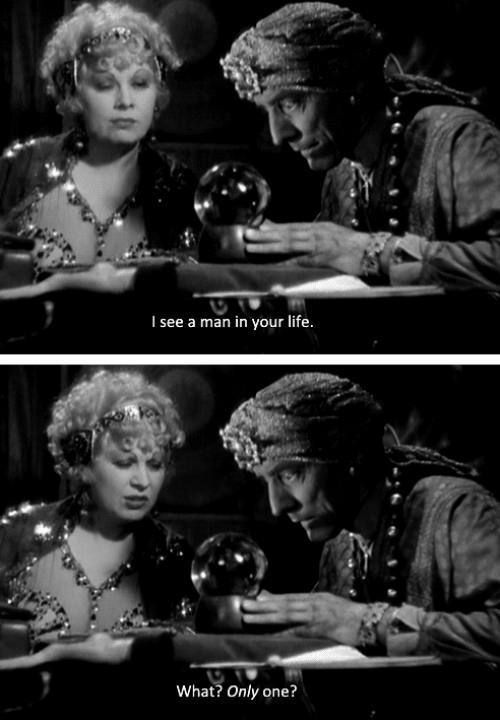
Mae West said it best. Picture by Sophie Charlotte on Pinterest
There are many dimensions to divination, some of which are indeed very deep. However, as far as our relationship with querents is concerned, we are simply an added means of intelligence-gathering, which, like all tools at our disposal, may fail for a variety of reasons, not the least of which is the diviner’s limited knowledge (our knowledge is always limited).
“But I came here to have undebiable, clearcut answers,” one might argue. To which I anwer: Tough titties! If you want undeniable clearcut answers shake a magic eightball. Divination is, quite literally, a divine language, and is not always so cleacut, either in itself or due to our limitations, or sometimes simply because the situation isn’t clearcut in itself. This is especially the case for issues involving human emotions.
As a rule, honesty is the best policy. I believe in voicing my procress to the querent, and the querent has a right to as clear an answer as I am capable of giving them, but we should never feel pressured to give them more certainty than we can truly see in the oracle.
It is perfectly acceptable to talk to the querent about our doubts or about the possible interpretations we are seeing in the oracle. For instance, it is ok to say “it seems like x, but y is also a possibility, while z seems less likely and w is out of the question.” It is also acceptable to say “these cards seem to point to such and such being the case, but I’m uncertain, as this other interpretation might also be right”. More often than not, the querent will say that both interpretations apply, and when this is not the case they can help us disambiguate the oracle.
Ultimately, the fact that divination has no legitimate place in our society implies as a consequence that, because our society believes itself to be held together by reasonable rules and processes, then divination must be either complete poppycock for delusional idiots or it must be capable of unreasonable fits of prowess in other to justify its existence in spite of its current ostracism.
This in turn creates expectations and hang-ups on both ends of the divination process that need to be analyzed and clarified to avoid them subconsciously ruling our practice. Doing so can make divination much more valuable and much more enjoyable.
Master Feiyu scolded his pupil, Qiang, for consulting the I Ching by tossing coins instead of using the meditative yarrow stalks.
Mortified, Qiang, who’d been deriving great benefit from the oracle, set about manipulating the sticks. He asked if he’d been wrong in using coins. He got Hexagram 7, The Army. Not understanding the answer, he abandoned the divination.
Later he asked again, but tossed his coins instead. Again he got Hexagram 7, which he still didn’t understand. What Qiang did understand was that there was nothing wrong in his choice of method, but plenty in his choice of master.
Western occultism has an idiosyncratic relationship with the notion of sacrifice. On one hand we come from the Abrahamitic tradition, and especially the Christian one, where sacrifice plays a central doctrinal role (God sacrifices himself) and where the concept of sacrifice has often been used as a club against dissent or to elicit guilt and compliance.
On the other hand, the occult revival of the XIX century, especially but not only in its Crowleian branch, was incapable of integrating this concept in a positive way, largely as a form of juvenile reaction against the previous tradition. If the universe is pure and blind bliss there can be little place for sacrifice except in the most illusory sense. As long as occultism remains largely the occupation of misfits and oddballs, it must retain this juvenile attitude toward sacrifice (which largely explains the philosophical paucity of so much of the occult world).
But sacrifice comes from the Latin ‘sacer facere’, ‘to render sacred’. As such, there can be no spiritual path without sacrifice. Even the most atheistic and chaotic paths must render something sacred, whether it’s themselves and their ego or some abstract philosophical concept. Once something is made sacred, the rest is sacrificed to it as a means to an end, and thus also rendered sacred as a consequence.
In magic (and in religion as well), power can come from two sources: from formulas that have been solidified into a metaphysical building over the years (or centuries) or from contact with a direct source. In reality even the former path, if it is functional, must have had some direct contact at least at the beginning.
Therefore, much of one’s magical training consists in bridging the gap that exists between oneself and the source, that is, between micro- and macrocosm, between individual and universal. The aim is always to be able to embody the universal within oneself. To do so, we must necessarily sacrifice our singular nature, that is, we must empty ourselves of the decades of junk that have been filling our individual vessel since we were born, so that a higher power may come down and occupy it: after all, a pitcher must be emptied of muk before it can be filled with water.
This process necessarily implies sacrifice. As we grow up, we accumulate big and small vices, big and small dysfunctions and illusions, and anyone who has lived long enough and has developed enough self-reflection can probably recognize at least some of them as they keep reemerging.
All this needs to be purged from the system. In other words, it needs to be sacrificed, to be rendered sacred. One of my teachers’ mantras was “Offer it to the Divine“. It took me some years to understand what she meant. Whenever some of my vices, some of my illusions, pains, dysfunctions presented themselves, it was easy to simply abandon myself to them, to live them out in the solitary confinement of my individuality as a sort of chosen doom.
But “Offer it to the Divine” was the key to leaving that solitary confinement, of bridging the gap between the small world and the large world. It went beyond despair and guilt and all the typical associations of the word ‘sacrifice’. It required no judgement. It only required for me to stand back, allowing the sun to shine on that lower part of me.
This, I later learned, is the inner equivalent of what happens during rituals, when we sacrifice something to whatever power we are working with. It is part of what allows that apple offered to that spirit to be more than just a tip of the hat to a recipe found in a dusty grimoire.
As I mentioned here, I got a new parrot from a local breeder and I had an interesting reading concerning it. The reading was done using the Bologna Tarot in its 45-card variant. We had already gotten some pictures of some of the available birds, and we had settled on a gray cockatiel, because it looked like the one I had as a kid. As the day approached, I asked the cards if everything would go alright. This is the spread I got:
Is the bird handover going to go smoothly?
Although I’ve already talked about the 13 card spread, when used with the Bolognese tarot there are some peculiar aspects to it (it is, after all, one of the “official” traditional spreads to be used with this deck). Traditionally, when a yes-or-no question is asked, the following rules apply:
If the Death card shows up in the spread, it’s a yes (as sure as we all die)
If the Angel (Judgement) card shows up, it’s a good chance
If both show up, it’s a sure thing
If the Angel and the Devil show up, it represents great satisfaction within the context (the Devil is in itself a negative card, but it is redeemed by the presence of the Angel)
Well, in my (still limited) experience with this tarot deck, I have found that it’s best not to rely too much on mechanical rules: the cards must always be interpreted, and exceptions allowed for. Still, it is encouraging to see both the Angel and the Death card as answer. Let’s interpret the cards row by row, as they came up very clear and orderly (it is not always like this, unfortunately):
King of Coins – Page of Coins – Seven of Cups: there have been talks (Page) with a man concerning business (King). The Seven of Cups is generically positive here. Angel – King of Cups – Ace of Coins: There is help (Angel) from a man of the house (King) concerning money (Ace). My husband paid in part for the parrot and the cage and food. Fool – Knight of Cups – Hanged Man: This is the most interesting row in the spread. It shows something that brings chaos or confusion (Fool) and that betrays or upends (Hanged Man) the agreement (Knight of Cups) Love – Queen of Coins – Death: True (Queen of Coins) Love (Love) is confirmed (Death) Ace of Wands: Success, positive ending
So in general what we can say from the spread is that the breeder is trustworthy, my husband helps me and I will be very satisfied, but still the deal will somehow be changed in an unexpected/confused way.
What ended up happening: we got there and the breeder introduced us to the various chicks that were ready for adoption, including the one we had settled on. But as we were playing with them, a white cockatiel chick quickly flew onto my shirt looking for cuddles. Obviously, it was love at first sight (see the true love in the spread), and we got that one instead.
I believe this change of plans is shown in the spread by combination of Knight of Cups (agreement, conciliation) followed by the Hanged Man (betrayal, upending). Our initial agreement was upended (or “betrayed” in a metaphorical sense), but still everything ended on a positive note.
NOTE: look how “dry” this reading is. Traditionally, tarot was not interpreted by musing on how the pictures looked, but by applying clear and specific meanings.
Fludd offers interesting anecdotes from his life to elucidate the nature of Geomancy.
The Internal Principle of Terrestrial Astrology, or Geomancy
In the penultimate year of the life and reign of Elisateth, the glorious queen of England whose fame will never die, I was forced to stay in the city of Avignon during the whole of that winter, because of the severity of the weather, which covered the mountains with a lot of snow, and completely barred the journey to Italy.
In the house of a certain captain, together with many other noble and well-educated young men, and having received board from the Jesuits, I discussed philosophy with them one evening during supper, and perceived a variety of opinions concerning geomantic astrology. Some of them denied its virtue altogether, while others, on whose side I stood, vigorously defend the power of that art, and I adduced many reasons by which I proved that I was engaged in that knowledge of fate.
When the supper was over, as soon as I had betaken myself to my apartments, one of these men followed me and asked me to try my art, which he believed to be great, regarding some important matter whose resolution, he said, greatly concerned him.
After making many excuses, at last his prayers convinced me and I made him a geomantic figure in response to the question proposed by him, which was as follows: Whether the girl, by whose love he was vehemently captivated, would redeem him more than the others from the sufferings of mind and body.1
And after making him the figure, I affirmed that I could well describe the nature and disposition of the body of his beloved and, having done so, I noticed a particular mark or a certain spot, namely a fateful wart noticeable on her body, and so also I noted its place, indicating it to be on the left eyelid.2
This, of course, he also confessed. I also said that she was very fond of vineyards. He confirmed, as if exultant, adding that it was because her mother had built her house among vineyards. In short, I answered the question in this way: his beloved was inconstant and by no means firm, so much so that she loved someone else.
To which he said that he also suspected the same, and that he now saw it as if with open eyes. He then left my room with excited haste, and he reported [to the others] with some wonder the truth and power of my art.
But some of them, who happened to know this girl well, totally denied the existence of the mark described on her eyelids, until the next day, talking with her, they themselves also became witnesses to the truth of this matter, which I had explained to them by way of geomancy, and which they had not even observed before.
From here, therefore, more than I desired it, I became renowned, so that the report of this matter was carried to the ears of the Jesuits themselves. Two of them, hurrying to the steps of the palace, told the viceconsul all these things, and, moved by envy, said that there was a certain stranger present, an Englishman, who had foretold the future by a science rejected by the Catholic Church, that is, geomancy.3
These things were reported to me in the morning by the captain of the palace, named Johannes, who also referred to me the answer given to the viceconsul to these very things, which he affirmed to have been such:
“What?” said he, “This is not such an abomination as you make of it. Is there anyone among all the Cardinals of Italy who does not have his birth astrologically or geomantically described?”4 A few days afterward, the consul himself desired to speak with me, and kindly invited me to dinner. With a certain dear friend of mine, Monsieur Malceau, the apothecary of the Papal Palace, I went to the palace, where, having paid due respect in the usual manner, the viceconsul engaged with me in dialogue:
“I understand,” said he, “that you are well versed in the geomantic art; what is your opinion of that science?” To which I replied that I had proved by experience that this knowledge was essential and established by fundamental secret principles.
“How is this possible,” said he, “that there should be any certainty in something that consists of accidental points?”5
I told him: “The principle of these points made by the human hand is internal and very essential, since it is derived from the soul itself, which is the origin by this kind of movement. Moreover, the errors of this science are not caused by the soul itself, but by a perverse and incongruous movement of the body itself, moving against the intention of the soul.
Hence the general rule in this art is that the soul should be peaceful and that the body should obey it, and similarly, neither the body nor the soul should be confused or partial in the question, but let them be like a just and fair judge, and turn to God, praying from the heart that the truth may be revealed. At the same time, turn your soul energetically to the question proposed, and don’t be seduced by extraneous thoughts.”
“What then,” he answered, “is that soul of which you speak? Perhaps you understand by that your own soul, or the genius of Plato,6 or at least some angel?”
To which I answered: “An angel could not be the origin of that knowledge, since angels are divided into good and bad: good angels were seldom granted to the Arabs, Chaldeans, and Egyptians, who were the inventors of this art, and evil angels are all authors of lies rather than the truth, as the Holy Scripture testifies.”7
“From this, then,” said he, “it is evident that you yourself are not able to give a distinct and certain account of the principle in this science.”8
To which I answered that the human body is related to its soul as a servant is related to his master. A master may send his servant hither and thither with letters, without the servants in any way perceiving the intention of his master. Even a distinguished painter can send an excellent picture to a king through his servant; yet the servant is completely ignorant of the mixtures of colors and their symmetrical proportions.
In the same way, a king can impose taxes on his people through others, although the reason for these impositions is known only to the king himself. Similarly, of course, the body itself can perform what the soul commands, while remaining ignorant of the principles of this action except through its effects alone.
After hearing these things, he called me to a table standing in the midst of some of the bishops and deacons. There, taking pen and ink, he composed a geomantic figure, and very skilfully went over it, so that I could see that he himself was far more learned and expedient in that knowledge than me. Having thus finished my meal, I departed with his blessings, and visited him often afterwards; for I perceived that he was a very inquisitive prince, skilled in the sciences, kind to strangers, and in no way tyrannical.
Among the Jesuits, one was very desirous of conversing with me as a lecturer in philosophy. Therefore, at the entreaty of my dear Rheinaud, a young man of marked genius and modesty, I went to him, and was graciously received by him. There, after some philosophical discussions, he suddenly brought up geomancy, thinking perhaps that I would answer him easily.
“How is it possible” said he, “that by means of geomancy someone might be able to foretell the danger or death imminent to this or that person on his journey towards Rome? What is the participation and communication between his soul and yours, since both are contained within the human body?”
To which I answered briefly in this way: “Because the soul of each body is that chief light, having dominion over the rest of the body, no differently than the Sun in heaven has dominion over the other stars. Since the soul is the Sun of the microcosm, directing the whole body with her life-giving rays, there is no doubt that she also casts her invisible rays invisibly through the pores of the body in no other way than that Sun transmits his heavenly ones through the sieve of the elements toward the world below.9
In the same way that one star has a relation to another by ways of aspect, so that by application to one another they create the effects to be transmitted to the lower plane, so also without a doubt between the soul of one and the soul of another, which are invisible lights, rays are emitted, and by the emission they are joined together.
Thus, since either the petitioner himself or his friend is the one to who is in danger, and since the soul is very divine, and is the keeper of the body, she can foresee the future danger (for inasmuch as she is immortal, she can know the future and the present). So the soul will reveal to the querent the future secrets of the body, which the soul could not tell the body because of the body’s thickness. In this way the soul, quiet and peaceful, and prepared for judgment, very responsive to the bodily motion,10 can prognosticate without difficulty.
Moreover, Olaus Magnus,11 in his history of Finland, tells a great story about the amazing actions of the sorcerers of that region, among which he recounts the story of a certain enchantress.
It seems that when some from a remote country came to her in order to know about the state of his friends, the mode of operation was this: the witch, with some other woman and an assistant, entered the room, where, after many words muttered in silence, she took a serpent made of air, and, holding it by the tail, struck it twice with a small hammer, and having done so, she suddenly collapsed as if dead. And the other helped by driving away flies and other small animals, so that they might not touch her. Half an hour later the witch arose from her sleep, and told the truth about the petitioner’s friends.
But what does this mean, if not that the soul of that witch had communion with the souls of the querent’s friends? And since the semi-diameter of its rays was too short to reach the extremity of the soul of the friends, in order to fulfill the desire of the querent it was necessary for the her to depart from her heart to find a place where it could have communication and its application with the rays of the souls of the friends.
Doubtless the animal rays extend themselves insensibly outside the body, far beyond the field of vision, so readily can they penetrate the thinness and purity of their essential substance, as through elementary means without hindrance.
After making some other similar similar remarks, he embraced me in a friendly manner, swearing that he would regard me as his brother, and praying that I would often visit him and his brothers. This, however, I could not do because of my sudden departure from that city to the Duke of Guyse, who at that time was living in Marseilles, who sent for me to teach him and his brother, a Knight Militant, the mathematical sciences.
In conclusion, therefore, this art is a science directly dependent on the soul, in such a way that its root is the soul itself, and therefore it is more subtle than all the other sciences which man can learn in this corruptible world.
MQS
Footnotes
I am not sure I translated the question exactly. However, the gist is correct, as may be seen from Fludd’s answer. ↩︎
It is common for old geomancy and astrology manuals to teach how to find peculiar marks on the querent’s or other people’s body. It was a way of convincing them of the veracity of the art. ↩︎
The status of astrology has always been ambiguous in the West. However, geomancy was more unanimously rejected as dangerous. ↩︎
It was important for Fludd to establish the semi-official status of geomancy as a legitimate science by mentioning the common practice of horoscopy ↩︎
The objection of the viceconsul is similar to the one already discussed by Fludd in the introduction. ↩︎
In order to conform to the Christian orthodoxy, Fludd must deny the influence of angels, since Geomancy was not invented in the Christian West. ↩︎
The reason for the need to establish the principles of Geomancy as a science is twofold: on one hand, to justify it, and on the other in order to conform to the Aristotelean view of science typical of the time ↩︎
This answer is typical of the Renaissance point-of-view, which always sought to establish correspondences between the inner and the outer, the higher and the lower. ↩︎
probably the bodily motion of the creation of the geomantic figure ↩︎
I am an ecumenical troll: I will pour salt wherever I can regardless of political, religious, ethnic and gender affiliation, IF what I see is a sheer display of stupidity. This is one of those cases.
As most people will know by now, a certain oddly-colored politician has been reelected into office. Amongst the predictable TikTok meltdowns that were caused by the event, one peculiar trend caught my eye: that of witches sending him curses, either to make him croak or, and I quote, “having him willingly resign from the office so that Harris can take his place.”
Let us pretend for a second that this is how politics works (if it did, most politicians would dread winning an election more than losing it). What never ceases to amaze me is the complete detachment from reality that informs the witchcore scene.
Magic used to be the logical next step on the path to wisdom after mastering the worldly sciences. Now it’s a hobby for people with funny hair who need to unlearn anything resembling critical thinking in order to be able to tell themselves in front of a mirror that they are “witches”.
In large part this is due to the process of specialization and separation of knowledge that occurred after the scientific revolution, which virtually left no space for magic in the curriculum of the wise. This has led to two opposite tendencies developing: the “science confirms our eternal truths” tendency and the irrationalist tendency.
The “science confirms our eternal truths” strategy is typical of many XIX and XX century occultists. It makes no sense. Science is an open and ever-evolving body of theoretical and practical understanding which would survive even if it threw its most well-established theories overboard. If “scientific theory X is actually a reformulation of our eternal occult wisdom”, what does it say about that wisdom when, in 500 years, that theory is disproven and science moves on to the next one?
The scientific path is generally characterized by a flattening of magic onto (pseudo)scientific rationality. The irrationalist path, on the other hand, is characterized by the abandonment of all logic and understanding. It is typical of most milquetoast magical practitioners nowadays. This is the path that leads people to say with a straight face that you can manifest the result of an election and you can substitute sage with a piece of paper with “sage” written on it.1
This kind of irrationalist magic is the variety practiced by the TikTok witches sending curses to Trump. Rest assured that curses do exist. They mostly require some kind of contact with the victim, and even then almost no one can pull them off.
Even from the point of view of sending influences at a distance, Trump is as loved by those who voted for him as he is hated by those who didn’t: from a purely numerical standpoint, these influences cancel each other out, with something left over in his favor.
Finally, whether one likes it or not, the movement he leads has its own well-established etheric egregoric presence, which was created not just internally by those who support him, but also just as much externally by those who loathe him. A simple study of the life of Donald Trump, and even of the last months, shows that it would be very hard–not impossible, but hard–to hurt him, either physically or esoterically. Do you seriously think you lighting a candle and regurgitating formulas from a grimoir you bought on Etsy is going to change the course of humanity?
MQS
Substitutions CAN be operated in magic, but they are an art in an of itself, and require understanding ↩︎