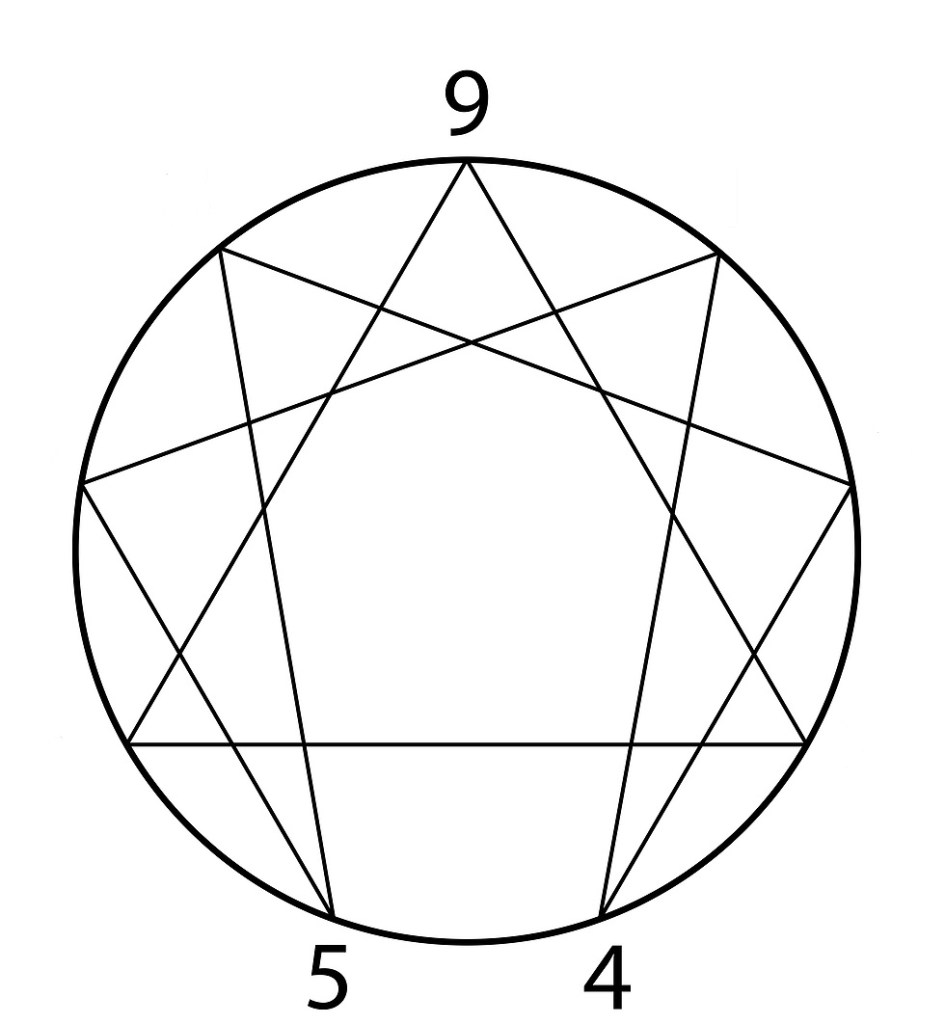
The Enneagram is a great tool for self-reflection, whatever your path in life. It’s a system of personality types consisting of nine main categories based on nine core “sins” or “passions”: Anger, Pride, Falsehood, Envy, Stinginess, Fear, Gluttony, Lust, Sloth. As on this site I share my musings on all things connected with occultism, divination, hermeticism and spirituality, the Enneagram is something I think is useful to present for those interested in internal alchemy work. In this article I discuss a few guidelines I will follow.
I was first introduced to the Enneagram almost ten years ago by my now husband. We had a long distance relationship going on at that time, which meant that every time we actually met we found each other to have turned into an almost unrecognizable person. It is very easy to grow out of sync when you don’t spend much time together. He bought an introductory book on the Enneagram and then lent it to me. It was an incredibly useful tool for keeping track of ourselves and finding a common level of understanding. It made me realize how much of what people do is not due to them wanting to disrespect or hurt other people as much as it is because they are caught up in their unconscious mechanisms. It was a great lesson.
Where did it come from? How does it work? Dunno!
The Enneagram has been popular for some time, but never has it been as popular as now. And of course, nothing ruins something more than popularity, especially in the age of social media. Here I strive to present it in as simple and essential a manner as possible, as way too often people add useless frills to it in an attempt at branding it. At its core, the Enneagram is simple, and I personally love meaningful, essential things.
I’m not going to waste anyone’s time with bogus theories on the Enneagram’s origins, and, to be clear: no claim as to the Enneagram’s antiquity is valid, at least not in today’s form as a psychological typology tool. Nor is it clear why it seems to work. After all, you don’t get your Enneagram type back with your blood work. Some say it’s because its types are transcendental from a Kantian or at least biological standpoint. Maybe, but you’d have to stretch the notion of transcendental and suspend disbelief–to what purpose?
It is much easier to accept that the Enneagram is a human construct to make sense of ourselves, and, because it draws from such archetypal notions as the seven sins or passions (extended to nine), it gives us a good representation of our core motivation in acting the way we do when our default mindset takes over. This doesn’t mean it’s the one true way or the one true model. It is just a (good) model.
It’s not the Tree of Life
There is also a tendency to compile endless lists of correspondences for the Enneagram, such as with astrology or other occult matters (and even with car types). As an astrology and an occult student and practitioner myself, I can honestly say that all these additions are useless. They give one the illusion of having learned something while adding nothing meaningful at all.
Attributing this Type or that Type to Scorpio or to Saturn or to Venus in Taurus sextile Mars in Pisces is purely a way to scratch a pseudointellectual itch for order at all costs, just so one may complacently pat himself on the shoulder and reassure himself that everything is for the best in the best of all possible worlds. It also usually betrays a very poor understanding of these subjects, one usually acquired through fifteen minutes spent in the Mind Body Spirit section of the local bookstore. Those of us who have had the Tree of Life drilled into our heads know what I’m talking about, so I shall leave it at that. Again, the Enneagram is simple and it stands on its own two (or rather nine) feet. You CAN use the Enneagram as a substitute for the Tree of Life, but that’s not the Enneagram we are interested in here. Therefore I am going to avoid correspondences.
I’m also going to try to avoid two extremes. One one side we have those equating types with a couple of extremely shallow generalizations (“fours are artsy”, “sevens never finish what they start”) some of which are plain silly (“fives wear glasses”). These things have nothing to do with the type, even when they happen to be true, because they do not capture the essence of each type. So you are a four and you are artsy. What about that artsy eight over there? Clearly there cannot be any link of causality between these traits. This crap is rather popular on social media, especially on sites that favor short-form content, and that therefore tend to attract users that barely have basic object permanence, but are eager to have another checkbox ticked in their bio, because that’s their idea of having an identity.
Let’s Keep it Simple
At the other extreme, we have those who bury the poor reader or listener under an endless barrage of pseudodeep psychobabble. Don’t get me wrong, we could spend hours talking about each type, but the psychobabble I’m referring to is usually accomplished by adding useless complications to a simple system, such as tri-types or even wings. This stems from two common issues: on one hand, as more people discover the Enneagram, more and more people try to come up with their own version of it to sell books and courses; on the other hand there is a fundamental misunderstanding of what the Enneagram does. Let me give you an example.
If you believe in Sun sign astrology (I don’t) I’m an Aries. People who dabble in astrology constantly tell me “but you don’t strike me as an Aries”, only to go on to learnedly discuss how my Cancer ascendant modifies my character. For some people it gets even more complicated–they drag the Moon into consideration, and Saturn, and the asteroids, and, and, and. In their quest to create ever smaller boxes that cater to their shallow and inauthentic need for uniqueness (despite the fact that they are often all pretty much the same) people keep making up new stuff, disregarding the fact that even if we had one thousand factors at play, we would still end up with a system that considers way too many people to be exactly as way too many other people.
The same happens with the Enneagram. Nine types don’t seem enough. How can you keep harping on how pleasantly peculiar you are if roughly one ninth of the population is like you? And so people came up with wings, and tri-types, and, and, and. Once again, though, no matter how many factors we add, we keep finding that too many people end up in the same category, and so ever newer, more meaningless factors are dragged into the equation.
But here there is a fundamental misunderstanding of the nature of the Enneagram (just as modern astrology comes from a fundamental understanding of astrology as a divination tool rather than a mirror for narcissistic self-admiration). The Enneagram is not meant to capture every feeling, thought, action and fleeting whim. it is meant to describe the core mechanism and motivation that keeps surfacing through most of what you do, and to make you aware of it. This leaves plenty of space for individuals to be themselves, just as saying that something is a plant because it can effect photosynthesis leaves plenty of space for millions of individual plant species to be discovered.
In terms of the Enneagram, therefore, nine types are more than enough. Everything else is a distraction. Take the concept of wing, which has been popularized mostly by Riso and Hudson and has then gotten out of hand, to the point where wings are often considered to be as important as the type itself. They aren’t. Wings can have some descriptive role in categorizing some of your behavior, I’ll grant you that. But this is not what the Enneagram is for. If you are a Type 8, your core is given by your Lust, and it doesn’t matter whether you are an 8 with a 9 wing or an 8 with a 7 wing. You are an 8.
Sometimes, the concept of wing (and that of tri-type too, but let’s keep it simple) is often used by people to pretend to be a type they aren’t, just because they consider it cool. Example: almost no one on Tumblr or Twitter is a Type 4, yet there is an overabundance of people on Tumblr and Twitter who fake being 4s because they think it makes them deep and creative. But when you ask them how they live out their Envy (which is Four’s core passion) they all resolutely deny ever feeling it. This may be because they are unaware of it or in denial. Or, more often than not, they pick whichever type on the two sides of Type 4 they can pass themselves off as and then say that they are a 4w5 or 4w3 or 3w4 or 5w4. “Yea, I have nothing in common with Fours, but if I frame it in this or that way I can kind of fake it and live my fantasy,” is their reasoning. What they fail to realize is that, no matter how many shallow fourish character traits they may have, if Envy is not there, they ain’t Fours.
I’m a Sinner Just for Kicks Now
This leads us neatly to my next point: each Type can be essentially boiled down to its “sin”, or passion, if you are easily triggered by words. There are also other important considerations (e.g., Four’s melancholy) but the passion HAS to be there, and while it doesn’t need to be interpreted religiously and can (and often must) be seen allegorically, THAT’s the type. Yet, if you look around on the internet, you often see anything mentioned in type descriptions except the very foundation of the type. Why? I would say because in their ceaseless quest to the perfect rose-tinted mirror, people mill endless amounts of fluff that amount to little more than “look how endearing I am, with my quirks and all!”
Here are some other pointers along the way to conclude. The Enneagram is not meant for you to tell yourself who you think you are. “Yup, the Enneagram confirms it, I am THAT smart/funny/unique.” That’s the (not-so-)grown-up version of “My mom thinks I’m special”. The Enneagram should ideally lead you out of your bubble, at least in your most lucid moments.
The Enneagram is not meant to excuse crappy behavior. “I’m a 2, so I can’t help being manipulative” is the “no wonder I’m a bitch, I have Mars in Scorpio” for people who think themselves too smart for astrology. If anything, once you know your Enneatype, you pretty much run out of excuses for being crappy.
Similarly, the Enneagram is not meant for us to pigeonhole people into it and use it against them. If we find that we no longer meet people on the street, but types, that’s a sign it’s best to take a break. It is also not meant to disparage them or their gifts. “You are Three, you should stop trying to have so much success”, “You are a Five, you must give up intellectual occupations”. Each Enneagram type has its gifts. The point of the Enneagram is not to relinquish them, but avoiding them turning into impediments when we are fixated on them to the exclusion of other things. But they remain gifts.
Finally, the Enneagram is not meant as a normative tool. Often–again, especially on social media–you will see people acting out their (supposed) type, adhering to it as if it were a description of what they ought to do. “I’m a One, so I MUST lecture people,” “I’m a Six, so I MUST pick up a cause to work myself up mindlessly about,” “I’m a Four, so I MUST be whiny.” Sometimes this is done by people who, for whatever reason, have decided that they want to be a certain type and so seek to mimic the first traits that come to mind. This is silly though, and it turns the Enneagram from a simple and effective tool for self-discovery into a sex toy for your psychic masturbation. And there’s already altogether too much of it around.