Tag Archives: spiritual reading

Calling Other People’s Demons By Name

In many supernatural movies about exorcism, the priest trying to free the victim needs to discover the demon’s name. This is actually founded in (part of) the real practice of exorcism and does have its roots in the magical belief of the power of names. For instance, there are certain practices in folk magic in Italy that require the magician to go to the christening of a child whose name translates to the effect he or she wants to achieve.

But belief in the power of names is not just found in Italy and it probably goes back to the most ancient and elemental relationship that humans established with the things around them in their attempt to dominate them. Traces of this fact are found in the doctrines of many Greek philosophers, sophists, poets and playwrights, and I have also found some similarities with Chinese Daoist literature. A wonderful fictionalized account of this belief is found in Ursula LeGuin’s Earthsea saga, which anyone interested in magic should read, in my humble opinion.

I am not one who seeks to psychologize occultism, although I believe that psychology is not at all a useless discovery and can be part of a modern magus’ training. I think that the attempt to reduce occultism to psychology is just as misguided as the attept to condemn anything that modernity has brought us as a deviation from an ancient splendor.

That being said, as someone who practices divination for others, there is also a certain sense in which naming works in a cathartic way. Most of the people that consult me are rather upfront about their problems, especially since I don’t ask for money and therefore feel no guilt in telling them to go sit on a cactus if they are trying to waste my time.

But people can be reticent about their issues for a variety of reasons, and malice is not always the motivation. Among the many possible reasons is the fact that people sometimes feel the need to have their demons driven out of them by someone outside of their regular field of experience.

Having someone discover our particular demon’s name without us feeding it to them can be a powerful and cathartic experience, because it smokes the demon out of the dark recesses of our subjective experience and into the light of objectivity, where it can be addressed as a definite and therefore limited issue, rather than being consumed by its overwhelming lack of contours.

Not every divination session calls forth such existential experiences, nor should we as diviners try to turn each session into a catharsis. We are not therapists and our duty is not to give people advice, although advice can certainly be given if required. Our role is to provide information, whatever that may mean in the context of each particular reading. For this reason, our language and that of our divination tool needs to be earthly, concrete and objective.

But sometimes informing the querent can mean gathering the diffuse knowledge that they already have festering inside of them and turning it into useable information by giving it its proper name.

MQS

Spirituality and the Sibilla (Example Reading)

As promised in a previous post, I’m discussing a (rather old) reading on spiritual issues. It is common to believe that the Tarot is better suited to talk about spiritual issues and oracles such as the Sibilla or Lenormand are more useful for practical, everyday events. This is not true. The Tarot can be just as practical, and the Sibilla (and, I assume, other oracles) can be just as clear about spiritual issues. The thing that makes people think otherwise is that they are used to that kind of tarot reading where the psychic spends the whole time pulling pseudodeep psychobabble out of their butt by looking at the pictures on the cards. That’s not a tarot reading, that’s a therapy session (for the reader, not for the querent).

Spirituality is part of real life, and as such all oracles can talk about it, but always in real-life terms. Here the querent was a man and had asked me generically about his spiritual life.

A spiritual reading with the Vera Sibilla cards

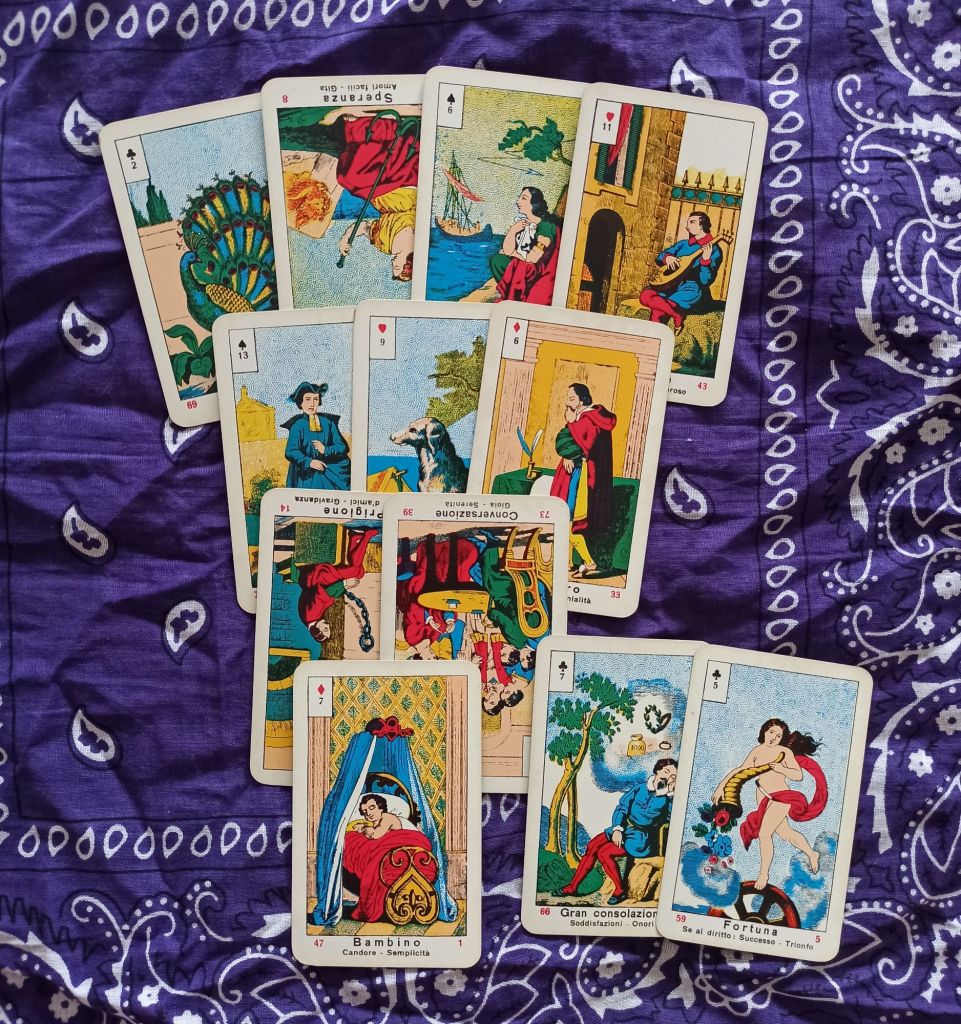
The first thing I was able to detect was the presence of the Priest in the second row. The Priest is usually not a real priest, and rather indicates a figure of authority. We also have, it seems, the significator card for the querent, represented by the Boyfriend, or Jack of Hearts, in the first line. The Priest is accompanied by the Dog/Faithfulness. This is a very good card, even outside of a love reading. It shows that, whoever the Priest is, he (or she) is good, trustworthy and has the querent’s best interest at heart. Furthermore, they are true believers.

The Thought card perplexed me a little, so I skipped over it (though you can see that the Thought card is just under the querent, so it turned out that it was the querent’s thinking process setting into motion). However, I did ask the querent if he was in contact with some kind of spiritual authority and he confirmed it, though he said it wasn’t a traditional priest or minister. This doesn’t matter: all kind of spiritual authorities can be signified by the Priest card.

The querent’s line, the first, has the card of God in it. This is the Peacock (when reversed, it represents the Devil and demons, as well as pride and haughtiness). The Peacock indicates totality, wholeness, miracles, etc. when upright. But it is followed by the Hope card reversed. Hope is the card of faith, but it is reversed, thus showing unbelief.

Yet it is not a clear atheism. Look at the Six of Spades, the Sighs card, right between the querent and the combination of lack of faith in God: the querent is sighing about his lack of faith. He is uncertain and tormented. I remember judging that he was probably a wobbly agnostic, and upon asking he confirmed that he had doubts (I didn’t ask him “are you a wobbly agnostic?” of course. We need to be kind to the querent).

It turned out, the querent had long banished spirituality from his life, had gone for an engineering degree, had been active in the skeptic community online, etc. However, some personal experiences had made him doubt his position.

Look at the last three cards of the pyramid. The Prison reversed shows unburdening, unshackling, freedom, etc. (when not followed by negative cards). Then we have the Conversation card. When reversed, it shows change. Finally, the Child, which shows a new beginning. I don’t know about you, but liberation + change + new beginning sounds like a spiritual conversion.

Furthermore, look at the angles of the pyramid plus the center: the Peacock (God), the querent, the new beginning (Child) and the Faithfulness card. This is a very positive indication.

Still, just to make sure, I asked the querent to draw two cards, and these were the Gratification and Fortune, confirming the good outcome.

As far as I know, the querent has since chosen his spiritual path.

MQS

Is He An Atheist? (Card Reading Example)

Traditional cartomancy, like all traditional divination systems, is full of tips on how to handle spiritual topics. The difference with contemporary psychobabble is that in traditional cartomancy we deal with a spirituality that is rooted in the earth and in everyday life rather than in Mind/Body/Spirit section poppycock. As I often remark, in such systems spirituality is seen as the logical next step for someone who is acquainted with real life, not as a consolation prize for someone who is trying to avoid it.

The querent asked if her boyfriend believes in “a superior being”, by which I assume she meant God (“being” is probably a more reassuring term compared to “bearded guy holding a lightning bolt”). She places great importance on the topic, but he seems to avoid talking about it. This is a playing card reading. In the next days I will also post a Vera Sibilla reading done on a similar question by a different person some time ago.

A♥ – 8♣ – 9♣ – K♥ – 7♣

Seeing this, I asked the querent to draw three more cards to open the reading on the Ace of Hearts, which yielded the 2♠, the 2♣ and the 6♣.

The first thing I noticed was the complete absence of Spades (except in opening the spread, but that’s a very weak Spade). This generally bodes well for spirituality. However, there is also a majority of Clubs, which indicate struggles and difficulties. There is no need to interpret the spread card by card. The spread indicates a slow or difficult relation with the divine. Belief is not denied, but it is rendered heavy, problematic.

The first card is the Ace of Hearts, which can indicate “inner” issues, but because the first card in a spread can also represent the cause of a situation described by the following cards, I ventured to interpret it as issues relating to the home causing the querent’s boyfriend to falter in his faith. The three additional cards with which I opened the spread on the Ace of Hearts reinforced my idea that there must have been a difficult atmosphere at home surrounding the topic.

What about the King of Hearts? Is it the dad? Well, no. Traditionally, in spiritual readings the King of Hearts is God himself (just like in the Sibilla): he is the lord (King) of your inner life (Hearts). Surrounded by all those Clubs, the God-side of the boyfriend’s life suffers, is stifled. Yet it is there, since the King of Hearts comes up and is not surrounded by Spades.

I asked the querent to give another three cards to open the spread on the King of Hearts. These were the 10♠, the 4♣ and the 10♥. At night (Ten of Spades) he speaks (Four of Clubs) spiritually/finding consolation (Ten of Hearts). He prays to God at night.

MQS