Tag Archives: spiritual path

“I Do X But I Am Still Miserable”

I keep coming across people on the Internet who dabble either in magic or spirituality (generally alternative spirituality) who lament that after a while they still feel miserable. Although my heart breaks for them, I think there is great confusion surrounding the place of spirituality and, let’s say, alternative practices.

One of the very few perks of rigid orthodoxy is that it exists beyond individual’s will, so that each practitioner needs to adapt to it rather than adapting it to themselves.

Once the idea of orthodoxy crumbled, at least in the West, spiritual and other practices became a supermaket of parts that each person could adapt to their own whim, picking and choosing what currently fit their mental narrative.

Although with some discernment this power of personal choice  can yield great results, what in practice often ends up happening is that spirituality is reduced to a crutch for personal prejudices about oneself, others and the world.

In the end, each individual flavor of postmodern spirituality is more an inkblot test of what the person would be better off discussing with a therapist than a workable spiritual path.

What’s more, the expectation of finding a definitive cure for life is always dangerous: firstly, because life is not an illness; secondly, because spirituality is not a good substitute for therapy or other forms of support; and thirdly, and most importantly, because anything that promises to turn our life into happy trip is always to be looked at with skepticism. No serious spiritual or magical doctrine can promise that.

The life of someone who always smiles and is always happy is not balanced. If anything, it’s creepy. There is a time for happiness and there is a time for sorrow. A balanced person is someone who responds to life in an adequate manner depending on the concrete situation. Look at the traditional descriptions of wisdom in Daoism or ancient Western philosophy, and you’ll always note that the wise person is the one who always reacts in the adequate manner, with as little influence from their personal demons as possible.

It is unfortunate that these practices are often the go-to for people who would benefit from other types of help. Sometimes they simply cannot afford official help, and this is another conversation, so they simply look for something they can afford and promises them miracles.

MQS

The Slop Must Flow On (and the Esoteric Anti-Initiation)

I don’t know about you, but at the ripe old age of 35 I’m an old fart who remembers the wild west days of the Internet, when people tried cool stuff just because they could. In the last few years I’ve noticed a shift, which probably started in the early 2010s when governments and corporations decided the internet wasn’t something to be vilified as they had done up until that point, but a space to be sanitized, homogenized and monetized.

I am not one to decry money as evil: money is simply an equivalent for one’s work that may be exchanged for the equivalent of another person’s work. In this sense, money has deep metaphysical properties and implications.

What I did notice, however, is that now, wherever I go, someone is trying to sell me something, even if it’s just a free, safe, “binge-worthy” series of videos designed to hook me in so that they may make money out of my attention.

And the more safe formulas get proofed and tested for grabbing people’s attention as quickly as possible, often with AI to provide the missing accelerationist flavor, the more the content that is peddled can be identified as slop. The existential ennui of someone who browses the internet in the year of our Lord 2025 with a smidgen of self-awareness is not to be undererstimated.

I’m bringing this up because I recently received an (automated) email on the account I use for my youtube channel where I was invited to take a course for blowing up my channel, which included such thoughtful advice as “make bad content” (their words, not mine). And honestly, that might very well work, if it wasn’t for the fact that I don’t give a rat’s tutu about drawing big numbers and am perfectly happy with my little corner.

Essentially, slop has been acknowledged as the fastest and most effective way to plug oneself into a premade template of ‘Internet success story’. This, in itself, is not a revolutionary discovery: crap has always existed and has always had success, and the reason why we often don’t know about the crap that existed in the past is that crap tends to be forgotten in the long run, unless it’s so bad it becomes an acquired taste.

What is new is the psychotic speed at which this is happening as attention spans get shorter, the number of people competing for them gets higher and the tools for achieving the result get more powerful.

From a metaphysical and esoteric standpoint, slop is simply the elevation of the lower aspects of the human consciousness to the status of aim to be pursued, with a result that might very well be seen as a form of anti-initiation.

The word initiation tends to conjure images of hooded figures bestowing grace on a supplicant. While the ritual aspect of it is not insignificant, the idea of initiation is far broader and it applies to many fields, not just esoteric, as a path that forces the person’s spirit to acquire, develop or balance certain qualities that allow it to adapt to the ideals of that path.

An anti-initiation, in this sense, is a process whereby the human spirit ossifies, rots and collapses in on itself, having lost any semblance of a guiding light and being only stirred into motion by the gravitational pull of its own ass.

I am not a prude and I am not a no-fun Fräulein Rottenmeier. I enjoy some of the products of our current age, and I accept the rest with some irony (what else is left?) I am merely observing an interesting trend. It is often repeated that initiation (any initiation) is for the few, but it seems to me that is becoming something for the fewer.

MQS

Stuff You Don’t HAVE To Believe: Reincarnation

We talked about Karma and manifestation. Now let’s tackle reincarnation. Unlike manifestation, which is based on pure New Thought superstion and is indefensible from all standpoints, logical, philosophical, moral and practical, reincarnation does have a noble tradition behind it. Still, the magical inheritance of Victorian occultism has made it almost so as if reincarnation is another one of those compulsory beliefs that come with the Spiritual Outsider starter pack.

Reincarnation reentered Western occultism largely through the many misunterstandings of Eastern doctrines perpetuated by the Theosophists. Yet, contrary to what some may think, reincarnation is not an exclusively Eastern belief, and it is found in many parts of the world, including in pre-Christian (and sometimes even Christian) Europe. In fact, the idea of reincarnation is probably suggested to the mind by the observation of the cycles of nature, so it is, in a way, a somewhat valid inference, at least from an analogical standpoint.

But analogical inferences do not reality make. If that were the case, you could slap four wheels on your grandma and call her a Ferrari. Regardless of how reincarnation may be suggested to the mind of ancient civilizations, let us ask ourselves why it is the go-to belief of many self-styled independent thinkers.

I would submit that, once the average Westerner abandons the idea of Heaven and Hell as expoused by our main religions in order to approach the occult or magical worldview, they find themselves wanting for another destination for their great hereafter, so they grope around for the first purple-covered book in the local esoteric library, where they invariably find reelaborations of reelaborations of reelaborations of the same Victorian metaphysical dogmas, they mistake them for something new, refreshing and forward-looking that goes well with their new crystals and adopt it.

I don’t want to crap on reincarnation, because, as I will shortly discuss, I do believe in some version of it. What I want to drive across is that independent thinking starts with challenging dogmas, both the mainstream and the counter-mainstream ones.1 It is perfectly legitimate to examine, question and argue and to reach other conclusions, just as it is legitimate to adopt the belief in reincarnation, or some variant of it.

As for me, I would believe in reincarnation if I believed in individual souls. To me there is only one universal soul which is present as a whole within each part of existence. That soul definitely reincarnates. I may even go further and argue that, since this universal soul reincarnates continuously through endless amouts of beings, at some point some of the beings that are born are bound to have some semblance of continuity with some beings that have died before, and since the individual being who dies loses its ability to distinguish time t1 from time t2, from the standpoint of its individual perception its death and its rebirth are contiguous. Needless to say, there is nothing karmic or retributive about this view of reincarnation.

These are my two cents, very succinctly explained. Feel free to take them, leave them or add them to your collection of two cents.

MQS

  1. Not to mention the ability to know when and how to question and when how not to. ↩︎

Calling Other People’s Demons By Name

In many supernatural movies about exorcism, the priest trying to free the victim needs to discover the demon’s name. This is actually founded in (part of) the real practice of exorcism and does have its roots in the magical belief of the power of names. For instance, there are certain practices in folk magic in Italy that require the magician to go to the christening of a child whose name translates to the effect he or she wants to achieve.

But belief in the power of names is not just found in Italy and it probably goes back to the most ancient and elemental relationship that humans established with the things around them in their attempt to dominate them. Traces of this fact are found in the doctrines of many Greek philosophers, sophists, poets and playwrights, and I have also found some similarities with Chinese Daoist literature. A wonderful fictionalized account of this belief is found in Ursula LeGuin’s Earthsea saga, which anyone interested in magic should read, in my humble opinion.

I am not one who seeks to psychologize occultism, although I believe that psychology is not at all a useless discovery and can be part of a modern magus’ training. I think that the attempt to reduce occultism to psychology is just as misguided as the attept to condemn anything that modernity has brought us as a deviation from an ancient splendor.

That being said, as someone who practices divination for others, there is also a certain sense in which naming works in a cathartic way. Most of the people that consult me are rather upfront about their problems, especially since I don’t ask for money and therefore feel no guilt in telling them to go sit on a cactus if they are trying to waste my time.

But people can be reticent about their issues for a variety of reasons, and malice is not always the motivation. Among the many possible reasons is the fact that people sometimes feel the need to have their demons driven out of them by someone outside of their regular field of experience.

Having someone discover our particular demon’s name without us feeding it to them can be a powerful and cathartic experience, because it smokes the demon out of the dark recesses of our subjective experience and into the light of objectivity, where it can be addressed as a definite and therefore limited issue, rather than being consumed by its overwhelming lack of contours.

Not every divination session calls forth such existential experiences, nor should we as diviners try to turn each session into a catharsis. We are not therapists and our duty is not to give people advice, although advice can certainly be given if required. Our role is to provide information, whatever that may mean in the context of each particular reading. For this reason, our language and that of our divination tool needs to be earthly, concrete and objective.

But sometimes informing the querent can mean gathering the diffuse knowledge that they already have festering inside of them and turning it into useable information by giving it its proper name.

MQS

On The Esoteric Meaning of Meditation (and Where Magic Power Comes From)

Often people associate meditation with the quest for aha-moments. There is more than one kind of meditation. While realizations can come from any kind, the one that tends to produce them is discursive meditation, where attention is fixed on a symbol, image, phrase, prayer or problem.

Meditation, understood as simply sitting somewhere, catching one’s attention in the act of wandering off and bringing it back, does not necessarily entail the reaching of any conclusion on any particular subject, although it can foster clarity, which is conducive of finding solutions.

Many occult schools and spiritual organizations recommend meditation, and even though I am no longer part of any of them at the current stage, I think it is for good reason. The stilling of the “monkey mind” before ritual work is only the most obvious of the benefits of meditating.

Deeper than that is the fact that meditation is not a state we get into. It is a state we get out of and must return to consciously. Our attention’s natural place is here, next to us. Our attention is like a blade: it belongs sheathed on our belt, ready for action when needed. Instead, we spend our time swinging it about maniacally, blunting it by hitting it against anything that crosses our path.

There is tremendous power in keeping our attention by ourselves, in the present moment. Here and now, being and changing coincide one with the other, and together they coincide the the state of initial void from which the power needed for magic comes.

All too often I hear phrases like “you are the magic” or “the power comes from you.” Although these are supposed to be empowering statements and they mean well, they are founded on an egocentric misunderstanding typical of our age, where old ideas that would otherwise be dismissed as superstitions, like magic, seek to survive by psychologizing themselves.1

But Magic is the art of creating vessels for spiritual forces to dwell in. We, too, are vessels. Magic comes through us, not from us. In meditation, with our attention sheathed by our side, we slowly make room from something other than our ego to incarnate through us.

MQS

  1. This is not meant to discredit psychological work, which can and often is necessary in our line of work. But psychology is not spirituality or occultism. ↩︎

On The Way To Follow

Previous / Back to Index / Next

From the Microcosmicon, 35:

Master Feiyu scolded his pupil, Qiang, for consulting the I Ching by tossing coins instead of using the meditative yarrow stalks.

Mortified, Qiang, who’d been deriving great benefit from the oracle, set about manipulating the sticks. He asked if he’d been wrong in using coins. He got Hexagram 7, The Army. Not understanding the answer, he abandoned the divination.

Later he asked again, but tossed his coins instead. Again he got Hexagram 7, which he still didn’t understand.
What Qiang did understand was that there was nothing wrong in his choice of method, but plenty in his choice of master.

MQS

Answering Airy-Fairy Questions… Meaningfully (Example Reading)

As someone who advocates a grounded approach to divination, you’d expect me to scoff at questions that deal with more philosophical or spiritual themes. But this is not so. Airy-fairy is in the eye of the beholder, or rather, of the reader. Just like many airy-fairy readers can drown concrete topics in a deluge of commonplace spiritual-but-not-religious buzzwords, so can a grounded reader approach complex, ‘soulful’ topics from a grounded standpoint, while always following what the oracle says.

Someone asked me what was the goal of her current incarnation. Right off the bat we are confronted with a dilemma: firstly, the question presupposes that there is such a thing as reincarnation, which I don’t believe (at least, not in a sense that is compatible with what most people think of as reincarnation);1 secondly, it presupposes that this happens with a goal.

The first problem (reincarnation) we may circumvent by simply asking what’s the goal of the querent’s life. The second question (the goal) is trickier, but as I show in the example, it is not unanswerable.

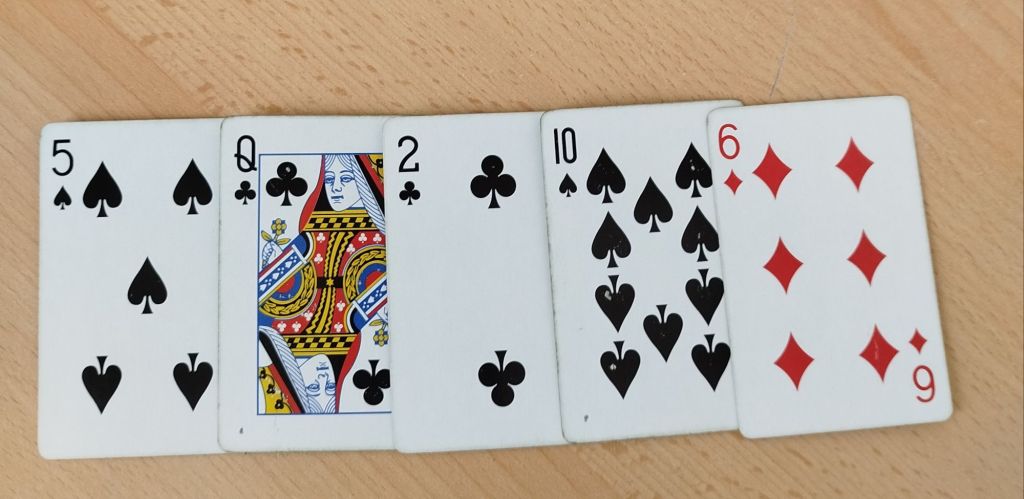
What is my life’s goal? Playing card divination

Since we have absolutely nothing to go off on, we can start by noting that the querent’s significator shows up (the Queen of Clubs), though not in a very good spot. She comes after the Five of Spades which is the card of sacrifice, imprisonment and the inability to move. So we can already sort of guess that the querent is feeling trapped in some form or another.

The spread ends with the Six of Diamonds, which represents worry, insecurity and the like. Often it shows financial problems, but not necessarily: it can be a card of general nervousness and uncertainty. The spread is now starting to reek of psychological hang-ups.

Usually, the Two of Clubs after a person card indicates the person taking steps. Toward what? Toward the Ten of Spades. This is the card of secrets, of the night and of unknown situations.

At this point I asked the querent if she’s someone who never leaps into unclear, unknown situations. She said that that was one of the things keeping her from enjoying life, since she always prefers to avoid risk or put off taking it until she feels prepared, which is never.

Bingo. This is the answer: she must learn to step into the dark, take risks and be ok with not having everything figured out. She must learn to swim by swimming rather than by reading up on how to swim. If she doesn’t do it, she will spend her whole life by the poolside waiting for every condition to be perfect.

So, have the cards talked about the purpose of the querent’s whole life? You may disagree with me, but I don’t think so. I do not think that this is the purpose of her whole life (I think there is much, much more to anyone’s life), nor do I think that this is the reason she was born or has reincarnated (if you believe in reincarnation at all). And I told the querent as much, in the spirit of transparency.

What I do mean is that, at least at this juncture in her life, this is a recurring pattern that weighs her down and that needs addressing because it influences her general quality of life. That’s already enough to be worth being mentioned by the cards.

Ultimately, almost every airy-fairy woo woo question is the voluntary or involuntary corruption and modernization of some kind of longing that is deeply seated in the human soul. Questions about the purpose of one’s life may be often answered with the usual mix of mind body spirit platitudes, but the human desire for purpose is not to be lightly dismissed, whether the purpose is really there or not. And divination can address this desire in some form or another.

I believe that divination should be able to run the whole gamut of the human experience, from the most concrete questions to the most abstract, because this is the extension of the human soul. The problem arises only when we try to reduce one order of problems (Will I the chicken cross the street?) to another order of problems (What kind of psychospiritual drama do you think caused the chicken to want to cross the street?)

MQS

  1. I will probably discuss it more at length in another section, but my belief is that there is only one, universal soul that is constantly incarnating and reincarnating through everything. ↩︎

Spirituality and the Sibilla (Example Reading)

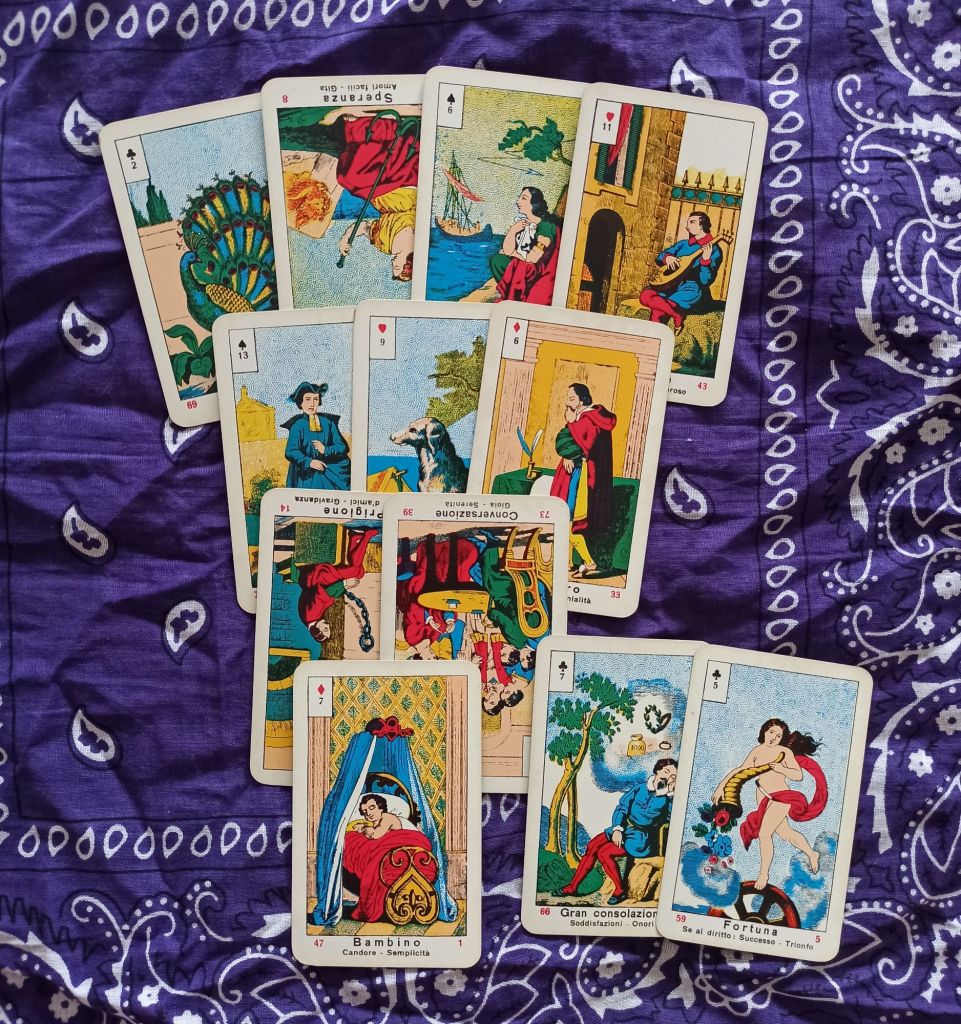
As promised in a previous post, I’m discussing a (rather old) reading on spiritual issues. It is common to believe that the Tarot is better suited to talk about spiritual issues and oracles such as the Sibilla or Lenormand are more useful for practical, everyday events. This is not true. The Tarot can be just as practical, and the Sibilla (and, I assume, other oracles) can be just as clear about spiritual issues. The thing that makes people think otherwise is that they are used to that kind of tarot reading where the psychic spends the whole time pulling pseudodeep psychobabble out of their butt by looking at the pictures on the cards. That’s not a tarot reading, that’s a therapy session (for the reader, not for the querent).

Spirituality is part of real life, and as such all oracles can talk about it, but always in real-life terms. Here the querent was a man and had asked me generically about his spiritual life.

A spiritual reading with the Vera Sibilla cards

The first thing I was able to detect was the presence of the Priest in the second row. The Priest is usually not a real priest, and rather indicates a figure of authority. We also have, it seems, the significator card for the querent, represented by the Boyfriend, or Jack of Hearts, in the first line. The Priest is accompanied by the Dog/Faithfulness. This is a very good card, even outside of a love reading. It shows that, whoever the Priest is, he (or she) is good, trustworthy and has the querent’s best interest at heart. Furthermore, they are true believers.

The Thought card perplexed me a little, so I skipped over it (though you can see that the Thought card is just under the querent, so it turned out that it was the querent’s thinking process setting into motion). However, I did ask the querent if he was in contact with some kind of spiritual authority and he confirmed it, though he said it wasn’t a traditional priest or minister. This doesn’t matter: all kind of spiritual authorities can be signified by the Priest card.

The querent’s line, the first, has the card of God in it. This is the Peacock (when reversed, it represents the Devil and demons, as well as pride and haughtiness). The Peacock indicates totality, wholeness, miracles, etc. when upright. But it is followed by the Hope card reversed. Hope is the card of faith, but it is reversed, thus showing unbelief.

Yet it is not a clear atheism. Look at the Six of Spades, the Sighs card, right between the querent and the combination of lack of faith in God: the querent is sighing about his lack of faith. He is uncertain and tormented. I remember judging that he was probably a wobbly agnostic, and upon asking he confirmed that he had doubts (I didn’t ask him “are you a wobbly agnostic?” of course. We need to be kind to the querent).

It turned out, the querent had long banished spirituality from his life, had gone for an engineering degree, had been active in the skeptic community online, etc. However, some personal experiences had made him doubt his position.

Look at the last three cards of the pyramid. The Prison reversed shows unburdening, unshackling, freedom, etc. (when not followed by negative cards). Then we have the Conversation card. When reversed, it shows change. Finally, the Child, which shows a new beginning. I don’t know about you, but liberation + change + new beginning sounds like a spiritual conversion.

Furthermore, look at the angles of the pyramid plus the center: the Peacock (God), the querent, the new beginning (Child) and the Faithfulness card. This is a very positive indication.

Still, just to make sure, I asked the querent to draw two cards, and these were the Gratification and Fortune, confirming the good outcome.

As far as I know, the querent has since chosen his spiritual path.

MQS

Is He An Atheist? (Card Reading Example)

Traditional cartomancy, like all traditional divination systems, is full of tips on how to handle spiritual topics. The difference with contemporary psychobabble is that in traditional cartomancy we deal with a spirituality that is rooted in the earth and in everyday life rather than in Mind/Body/Spirit section poppycock. As I often remark, in such systems spirituality is seen as the logical next step for someone who is acquainted with real life, not as a consolation prize for someone who is trying to avoid it.

The querent asked if her boyfriend believes in “a superior being”, by which I assume she meant God (“being” is probably a more reassuring term compared to “bearded guy holding a lightning bolt”). She places great importance on the topic, but he seems to avoid talking about it. This is a playing card reading. In the next days I will also post a Vera Sibilla reading done on a similar question by a different person some time ago.

A♥ – 8♣ – 9♣ – K♥ – 7♣

Seeing this, I asked the querent to draw three more cards to open the reading on the Ace of Hearts, which yielded the 2♠, the 2♣ and the 6♣.

The first thing I noticed was the complete absence of Spades (except in opening the spread, but that’s a very weak Spade). This generally bodes well for spirituality. However, there is also a majority of Clubs, which indicate struggles and difficulties. There is no need to interpret the spread card by card. The spread indicates a slow or difficult relation with the divine. Belief is not denied, but it is rendered heavy, problematic.

The first card is the Ace of Hearts, which can indicate “inner” issues, but because the first card in a spread can also represent the cause of a situation described by the following cards, I ventured to interpret it as issues relating to the home causing the querent’s boyfriend to falter in his faith. The three additional cards with which I opened the spread on the Ace of Hearts reinforced my idea that there must have been a difficult atmosphere at home surrounding the topic.

What about the King of Hearts? Is it the dad? Well, no. Traditionally, in spiritual readings the King of Hearts is God himself (just like in the Sibilla): he is the lord (King) of your inner life (Hearts). Surrounded by all those Clubs, the God-side of the boyfriend’s life suffers, is stifled. Yet it is there, since the King of Hearts comes up and is not surrounded by Spades.

I asked the querent to give another three cards to open the spread on the King of Hearts. These were the 10♠, the 4♣ and the 10♥. At night (Ten of Spades) he speaks (Four of Clubs) spiritually/finding consolation (Ten of Hearts). He prays to God at night.

MQS