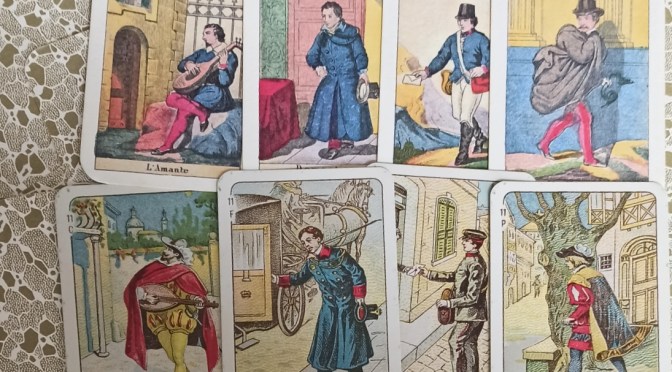
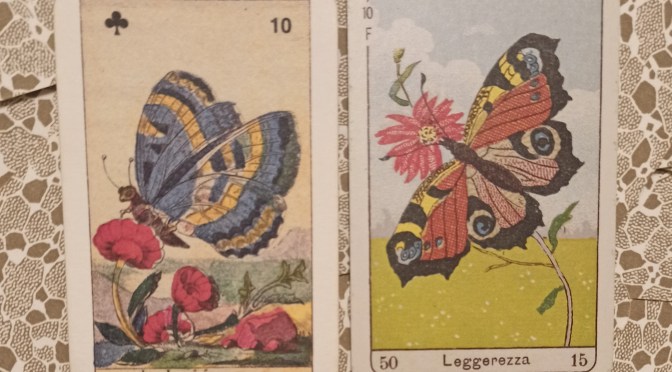
I start now a series of posts on card interactions in the Vera Sibilla. I should point out that this is a very hard topic to cover from a theoretical standpoint and that it’s best to discover it by practice. Still, some guidelines may be given. We are going to start simple by looking at some interactions between two cards.
The cards of the Vera Sibilla are generally read in more or less linear spreads. While you are at liberty to make up positional spreads for it, it is far more interesting to see them interact, especially because you don’t spend a great deal of time rambling on about a card. This doesn’t mean that there aren’t situations in which more than one meaning applies (in fact, it happens quite often) but you do not try to come up with artful and soulful interpretations that take you away from the querent’s concrete life.
As a general rule, neutral cards are influenced for better or worse by positive and negative cards. Note that a card can have both positive and neutral, or both negative and neutral, nuances. What we are interested in is not the theoretical polarity of the card, but how it behaves concretely. So, for instance, the A♥, the Conversation, is a slightly positive card when it comes to personal relationships, but when it represents an interview or date it is neutral. Similarly, the 7♠, the Disaster, is mostly negative, but when it represents something happening quickly, soon and all of a sudden it is neutral.
The second general notion is that cards taking on a similar polarity tend to be indifferent as to their placement in the spread, because they strengthen each other. For instance, 7♠ + 5♠ is mostly the same as 5♠ + 7♠: a disruptive and rather traumatic ending. Conversely, 4♥ + A♥ is often the same as A♥ + 4♥, showing lovers’ sweet talk or a date.
The third general notion you should become familiar with is that when two cards have starkly different polarities (in the context) the card that falls last between the two tends to influence the previous one more than the other way around.
So, for instance, A♥ + 7♠ is usually a disagreement, i.e., a conversation with anger and disruption in it.
If we swap the cards, 7♠ + A♥, it can mean that all of a sudden there will be a meeting or someone will speak to you. It can also mean (depending on the context of the question and the other cards) that a disruption or argument is followed by a clarifying talk.
This second possibility is rarer, because of a fourth general consideration: red cards tend to be influenced more by black cards than the other way around. Therefore, in the previous example of 7♠ + A♥, if the 7♠ assumed its negative meaning of disruption and anger, the A♥ would usually not be powerful enough to resolve the issue, unless supported by other cards. On the other hand, if it were 7♠ + 8♣, then the breakup would be followed by a reconciliation.
A fifth basic consideration is that when cards take on opposite meanings, the cards falling last tends to influence those before. So, for instance, 2♠ is what is old or getting old, and 7♦ is what is young or still growing. They are neutral cards in themselves, but the 2♠ is black so that it is not greatly influenced. What matters is the meaning. If we had 2♠ + 7♦, the end of a phase would be followed by the beginning of a new cycle. If we had 7♦ + 2♠, a new cycle would soon die off.
On the other hand, if we had 4♦ and 9♥, the situation would be different. The cards are opposite not just in meaning (truthfulness vs falseness) but also in polarity (negative vs positive) but they are both red. So even if the 9♥ fell last, it would not overcome the 4♦, and we would still have an idea of lack of sincerity at least.
All these considerations are preliminary and somewhat abstract, as they are based on only two cards (usually you’ll have at least three), but they will hold you in good stead. Also, the more you practice, the more you’ll see that they are not really rules so much as a general description of how the cards tend to concretely interact with each other. You will see, also, that you have plenty of latitude for interpretation.