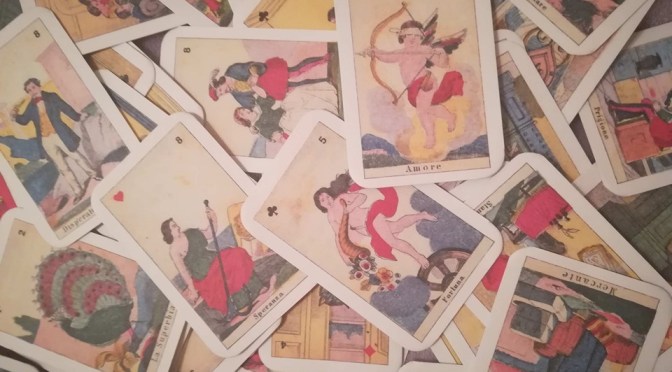
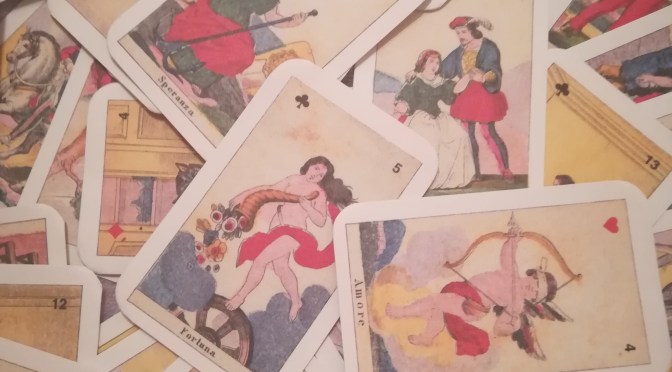
Face cards are those that represent people. This is a more comprehensive notion than “court cards”, because not all face cards are court cards: for instance, the 2♠ can behave like a face card, a significator, but it is not a court card. Conversely, not all court cards necessarily behave like face cards: for instance, the K♦ is rarely a physical person, being a significator of the querent’s job.
Face cards are, for the most part, neutral. Heart cards tend to be slightly positive in themselves, but they also absorb the meaning of the cards surrounding them. Spade cards tend to be negative (though the K♠ is neutral when it is a face card) and being black they tend to assert their negativity over the positive meanings of other cards.
Face cards are neutral, and this means that they are heavily influenced by their surroundings. The cards immediately outside of a face card often give us the context and description of the person in terms of the situation. For instance, if the J♣ falls between K♦ and A♥, he can be a coworker or a work contact. If the same card falls between the 4♥ and the 9♥, he is either your best friend or your boyfriend. If he falls next to the A♣, he is probably a young husband. And so on.
When a face card does NOT appear in the spread even though you’d expect it to, that’s a sign. The person is not active in the events of the spread and is unlikely to be able to change them.
When a face card DOES appear in the spread, its suit will give us a hint of the role it takes on, if caring, helpful, disinterested, disingenuous, axe-grinding, inimical, if they are active, optimist, or passive and in need of help, etc. This is to be understood within the context of the question. For instance, a mature woman may occasionally show up as the Q♣ if she is either immature or in a precarious situation where she needs help.
When a face card appears as a suit that is not good for the question, the cards surrounding it may supplement positive connotations that the suit lacks. For instance, the Q♦ is a married woman, however when a married woman appears as the Q♦ in a love reading, her primary loyalty is not to the partner but to the marriage itself, which doesn’t mean she doesn’t love, but that she is primarily in the relationship out of inertia or tradition. However, if the Q♦ is next to the 4♥ or the 9♥, then she is very much in love, as though she were the Q♥.
When two face cards fall immediately next to each other, this is a sign that they know each other and interact (or will interact), unless other signs contradict this. Sometimes, if two face cards falling immediately next to each other are of the same sex, they can represent the same person. For instance, the Q♦ and Q♠ together can either signify two people or the same person, depending on the context. This is rarer when one of the two is reversed and the other isn’t, but it can still happen. Usually, when two face cards signify the same person it means the person has a dual role in the situation (in the example above, a wife who is inimical, maybe in the process of getting a divorce, etc.)
When two face cards have one or two or three cards between them (on occasion even more) those cards can be taken to describe their relationship and what unites them. For instance, J♣ + 9♦ + 5♠ + K♥ can show a very turbulent father-son relationship. Usually, when a combination showing the dynamics between two people fall between those people, they tend to have a less predictive effect. In the example above, if the 9♦ + 5♠ had fallen outside of the two significators it could have shown a breakup, and a rather painful one. But because it falls between them, it tends to only show how they relate to each other, and other cards will tell us whether or not they will fall out. If the sequence is followed by 8♣, there will be reconciliation, if 7♠, a break in the relationship.
When of two face cards one is reversed, they tend to be incompatible for whatever reason (look at the other cards). When they are both reversed they are still incompatible, but the incompatibility is more pervasive and visceral and less due to circumstances.
In general, a face card that is not the querent who is reversed signifies either someone who is in trouble or someone who works against the querent or, at least, disagree with them within the context of the situation.
When a face card is reversed, sometimes it signifies that the person has some type of issue related to the cards surrounding his significator. For instance, K♥R + 7♣ can signify a man who doesn’t feel realized. His card being reversed introduces a negation. It is similar to K♥ + 7♣R, the difference being subtle and somewhat psychological: if the face card is reversed, he is probably one who generally doesn’t feel realized. This notion however must be supported by other considerations.
Another example. Q♥R + 9♥ can signify a woman who is not faithful. The meaning is similar to Q♥ + 9♥R, but in the former case it is possible that she generally has a tendency not to be faithful–it is more rooted in her character than in the context of the situation. Again, you need to check for other signs.
When a slew of cards come up reversed (possibly all of them) it is a sign that the person’s world has been turned upside down.