I recently received some questions from a visitor to this website. One of them was in which sense the Sibilla is considered “chiacchierina”, i.e., chatty.
This is an interesting question, because it gets to the heart of how divination works (and not just divination with cards). I don’t want to foster the belief that the Sibilla is more capable of conveying information than other divination systems. This would be false advertising. Every deck and every system is capable of informing us.
But the way in which the Sibilla informs us is rather unique. Here we get into the specific character that each deck and system has. The Sibilla is like an off-beat aunt with a poor sense of boundaries.
A girl once asked me how her crush for a guy would develop. The girl had moved in with her grandma and the grandma disapproved of the guy. The Sibilla started off not with an answer to the question, but by telling me that the girl’s grandma disapproved of the situation. If I had asked another one of the decks I work with, I probably would have gotten a more straightforward answer.
It takes working with each deck in order to understand their language and personality, but these always emerge sooner or later. This is also probably why old folk diviners believed that each deck has a spirit attached to it that lives inside its cards and infuses them with its peculiar traits, a belief that I tend to share, since it explains this phenomenon much better than the impersonal Jungian theory of synchronicity.
The reality is that each (valid) divination system is chatty in its own way. I’ve heard the Bolognese tarot being referred to as chatty, and as I work with it I understand that its chattiness really is a factor, even though it is less chaotic than the Sibilla.
This is a recurrent question I get. Some people are of the opinion that reading decks have something akin to a shelf life, after which they stop answering or they become impregnated with negative energy from all the readings. I often get asked if this is the case.
To which my answer is: under normal circumstances, your deck will keep answering you (or at least it will keep working, even if it occasionally snubs your questions) for as long as you use it. This has been my experience, as well as that of all my teachers, and I’ve had the good luck having many teachers.
My first teacher, from whom I learned to read playing cards and the Sibilla, followed the Italian tradition that divination decks need to be old, must have been used to play at the local inn and the people playing with them must have covered them in offensive swearwords (read here my hypothesis on why this tradition exists).
This obviously doesn’t apply to the Sibilla, since Sibilla decks, as well as similar decks like Lenormand or Kipper cards, are pretty much the only card decks specifically designed for divination. But tarot was a playing card game, and playing cards… well, it’s in the name, and so, according to my teacher, they needed to be “giocati e bestiemmati” (played with and offended with swearwords). And after you got a hold of one such deck, you probably were going to use it for as long as you lived.
When I started learning the tarot, my other teacher held on to her first deck as if it was a relic, and it did answer her beautifully. She was of the opinion, however, that the deck could stop answering correctly or become more negative in its answers if you read for many people with a tragic life. When this happened, she usually took the deck to church and had it blessed by the priest. I honestly cannot say I ever needed this, but there you have it.
As for the Bolognese tarot, I do not know what deck the person who taught me the 45-card system used, but I do know that my teacher for the 50-card system still uses her grandmother’s deck. Another person I am in contact with, who uses 49 cards, still uses the deck her teacher gifted her.
As for me, I have a conservative outlook on life, and I don’t throw away something unless I really, really have to. The Sibilla deck I use is the one I bought when I started learning, and while I don’t insist on always using the same playing card deck, I still occasionally whip out my old one.
Still, there are people who believe decks can stop working after a while, including people I admire (see Josephine MacCarthy). Is there anything to it? Obviously, much depends on the theoretical framework one uses for their magical activities (which includes divination).
I was taught that divination (any divination) can stop working if you are the recipient of a curse, but that’s an extreme scenario. More often, the people who complain about their deck going lazy on them tend to torture them with repeated questions on the same topic over and over.
As much as skeptics may point out that this is proof that divination doesn’t work because it cannot be repeated ad libitum in lab conditions, it is simply how it is: if you annoy the deck it will stop answering. This simple fact shows, at least in my opinion, that there is something alive attached to the deck.
Usually, in traditional divination folklore, we would say that the deck has a little spirit hidden inside. And while this may sound like a childish explanation, it is the one that best explains my experience, as well as being perfectly in line with traditional hermetic principles. The point is that while many valiant attempts have been made at explaining divination using more or less recognized principles (see Jung’s views), we are at work with something we don’t fully understand. Some level of respect is due to this something, if for nothing else than to keep the work environment positive with whatever it is.
There is a number of cards in the Vera Sibilla that can indicate ambiguity and unreliability. As usual, context is key, but the following ones are the most common.
Four of Hearts Reversed – Love
As I discussed in my recent video about the Fours, traditionally the Four of Hearts is the card of homosexuality. And it can still mean that in particular situations, but more broadly, aside from the other main meaning of ‘lack of love’, it can also indicate an unhealthy approach to love (hence the XIX century association with homosexuality). An unhealthy approach to love can also involve secret perversions or cheating, so the Love card reversed can be an indicator of unreliability in love.
Five of Hearts Reversed – Happiness
Being a card that represents more than one person, being in the suit of Hearts and being reversed, the Happiness card can indicate betrayal. However, traditionally, this more commonly refers to relatives (since the upright card can stand for relatives in a neutral sense). It can show disharmony among relatives, and relatives you must guard against, especially with people cards next to it.
Seven of Hearts Reversed – The Scholar
Upright, the Scholar is a symbol of the positive use of the intellect in a creative or constructive way. Reversed, the card can symbolize nonsensical or useless abstraction from reality, impotence (in all senses) but also the negative use of the intellect. Hence, the card can indicate ulterior motives and a sneaky disposition of character.
Eight of Hearts Upright/Reversed – Hope
The Hope card has many spiritual and moral virtues, among them that of choosing the high road and doing what’s good. When the card is next to cards of ambiguity, or when reversed, it can stand for someone who is extremely fickle and even promiscuous in love.
Nine of Hearts Reversed – Faithfulness
Upright, the dog symbolizes fidelity, friendship, sincerity in the affections. Reversed it can, quite literally, indicate unfaithfulness. It is also the proverbial dog biting the hand that feeds it, showing ungratefulness, anarchy, rebellion.
Ten of Hearts Reversed – Perseverance
Upright, the Ten of Hearts can indicate a stable, reliable character. Like the dog card, it reversed this symbolism when reversed, showing situations that are not stable, but also people who are unreliable.
Two of Clubs Reversed – The Peacock
When upright, the card emanates the positive energy of the peacock symbolism, showing beauty, marvel, art, beauty, completion, immortality. Reversed, it takes on its more sinister characteristics: vanity, being full of oneself, being blinded by one’s ego, which can all of course make us unreliable.
Ten of Clubs – Levity
The butterfly symbol speaks for itself. It shows someone who is fickle, not thorough, changeable, too easygoing or carefree. Still, the unreliability indicated by this card, unless supported by cards of dubious moral character, can also be of the innocent kind, due to superficiality rather than to some grand secret plan.
Four of Diamonds – Falsehood
The cat card is obviously the opposite of the dog: it indicates everything that isn’t as it seems, and so is the card of lies and cover-ups. But don’t go crying foul too easily: this is also the card of everything that is wrong, and so it also covers such things as mistakes and oversights. Still, it is never good when coming up next to a significator.
Six of Diamonds Reversed – Thought
Somewhat similarly to the Scholar, the Thought card is connected with what goes on between one’s ears. When it is reversed, the card indicates negative thoughts, which must be understood broadly to signify negative thinking or the thought of doing something negative. As such, if a significator comes up with the Thought card reversed after it, look at the other cards to see if they are feeling down, are deluded or a plotting something.
Seven of Diamonds Upright/Reversed – The Child
The Child card is neutral and has many positive undertones, but it is also card of immaturity. If it comes up upright with cards that highlight this side of its symbolism, or even worse if it comes up reversed, then you may be dealing with people who are not mature enough to be trusted, in whatever sense that might be meaningful in the context.
Eight of Diamonds Reversed – The Handmaid
Upright, the Handmaid is a card of morality and education. But when it is reversed, it becomes a card of the shallow trashy character that you should not take seriously. It can stand for someone who will betray your confidence.
Ten of Diamonds – The Thief
Obviously, the Thief is the card of betrayal par excellence. It always shows something that sneaks into a situation to ruin it from the inside. A person card with the Thief card next to it should make you think twice about trusting them.
Six of Spades Reversed – Sighs
The Sighs card is complex in its meanings, especially when reversed. Its broadest meaning is that of “no sighs”, so it can be good. But this can also signify that someone is not losing any sleep over the evil they are concocting, and so it can be a symptom of an unscrupulous character. This submeaning of the card usually emerges when other cards of similar signification are next to it.
Nine of Spades Reversed – The Prison
As with the Sighs card, the Prison reversed can be positive, as it shows freedom, being unchained or unburdened, repentance, and similar concepts. But with cards of dubious moral character it can indicate that someone is unhinged, lacking restraint and giving into unscrupulous ambitions.
Ten of Spades Upright/Reversed – The Soldier
The Soldier is the card of the night, and of everything that happens at night, including shady dealings. Because of this, especially when reversed, it can sound the alarm on the fact that something is going on behind your back. A person card next to the Soldier reversed is rarely someone you can trust.
People Cards
The general rule is that a person card reversed is either suffering or is against the querent. Especially the Heart court cards must be treated with caution, as they can become traitors and cheaters. It goes without saying that the two Enemy cards already have this potential indication baked into their upright meaning.
A Warning
You may have noticed that a lot of cards in the Sibilla can indicate unreliability. Follow these indications strictly and you’ll go around accusing everyone and their mother of being a cheater and a fraud. Interpretation is never a matter of a single card: it is important to see if cards of similar import accumulate, how the court cards relate to them and if there aren’t more likely explanations.
This one’s a quickie. A friend of mine who tends to take things way more seriously than she should asked if the boyfriend had really misplaced the small gift they had bought for her mother or if he had hidden it out of spite (he doesn’t like her mother). Knowing the dude I was quite sure she was overreacting. Still we asked the Sibilla:
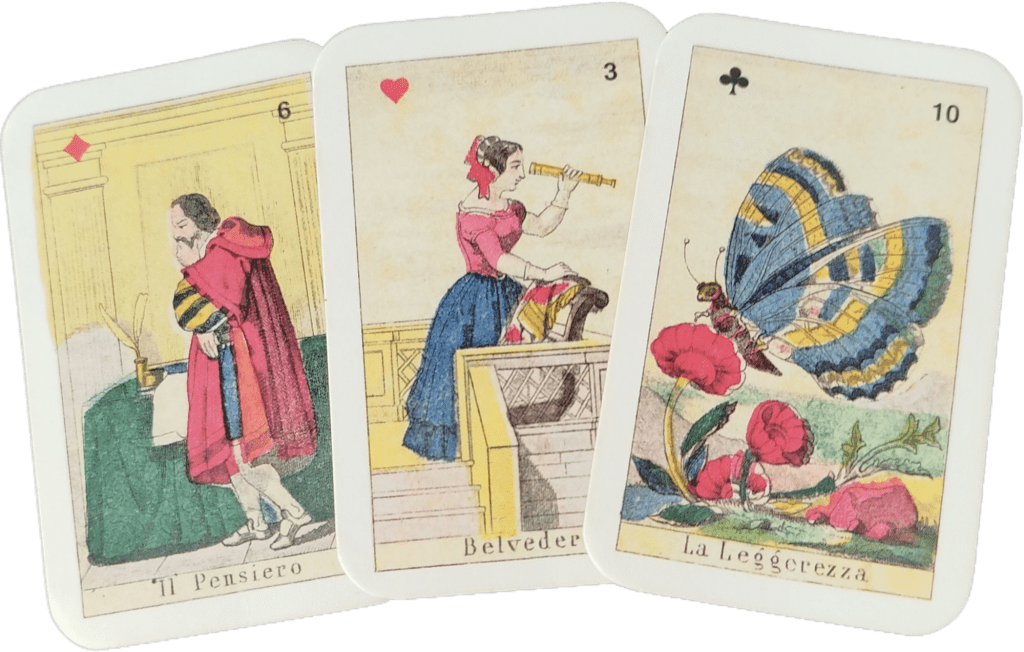
Vera Sibilla reading: was that on purpose?
The Thought card is indicative of someone’s inner reality (their thoughts, plans, character, proclivities, etc). Since we asked about the boyfriend’s intention, the thought is his. The Belvedere card is usually associated with the arrival of something. However, it is also the card of sight. Next to the Ten of Clubs, which is a card of carefreeness, this seems to point to an oversight.
It turned out the gift had been left in the car, where it had lodged itself between the the two front seats. As silly as the reason for the reading is, it’s nice to have the cards confirm our suspicion.
We did a little experiment with a friend. She wanted to know if the bureaucratic process to get the inheritance from the recently deceased grandfather would finally come to an end, since there had been several delays (leave it to the Italian bureaucracy). We started with the Sibilla.
Sibilla
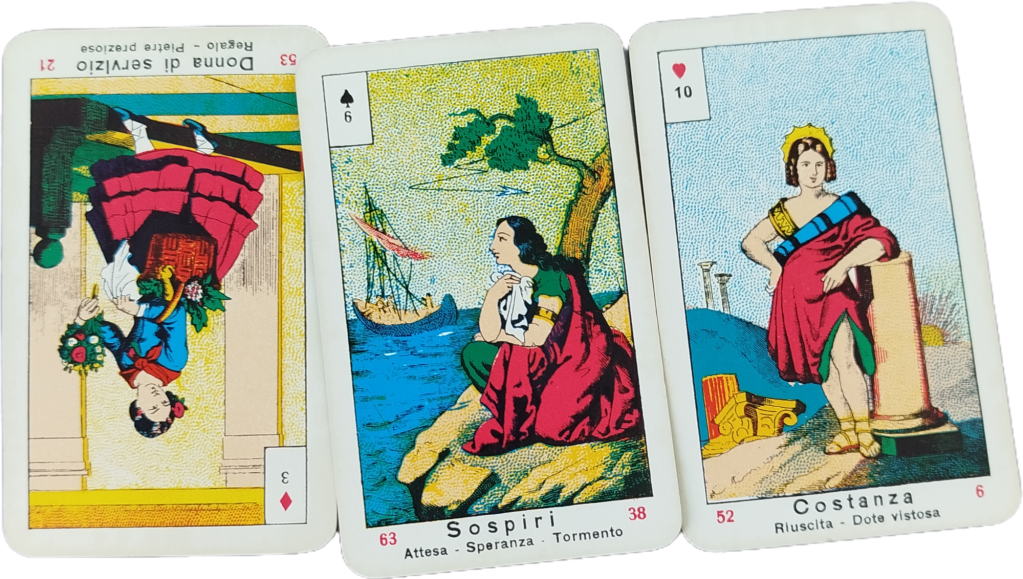
A three card reading with the Vera Sibilla
In this case, the Handmaid reversed indicates money going out (of the querent’s wallet). The Sighs card simply indicates that the person worries they’ll have to pay money. The Ten of Hearts here is not a positive influence, because it is a card that makes the uncertain certain (in the context of a trial, for instance, it might indicate the sentence being decided). So in this case the worries shown by the Sighs are confirmed.
I asked my friend if she was worried about having to pay some extra money, and she said that this was her and her dad’s worry, but that they had looked into inheritance law and thought they were safe and wouldn’t need to pay . Clearly the Sibilla begs to differ.
Playing cards
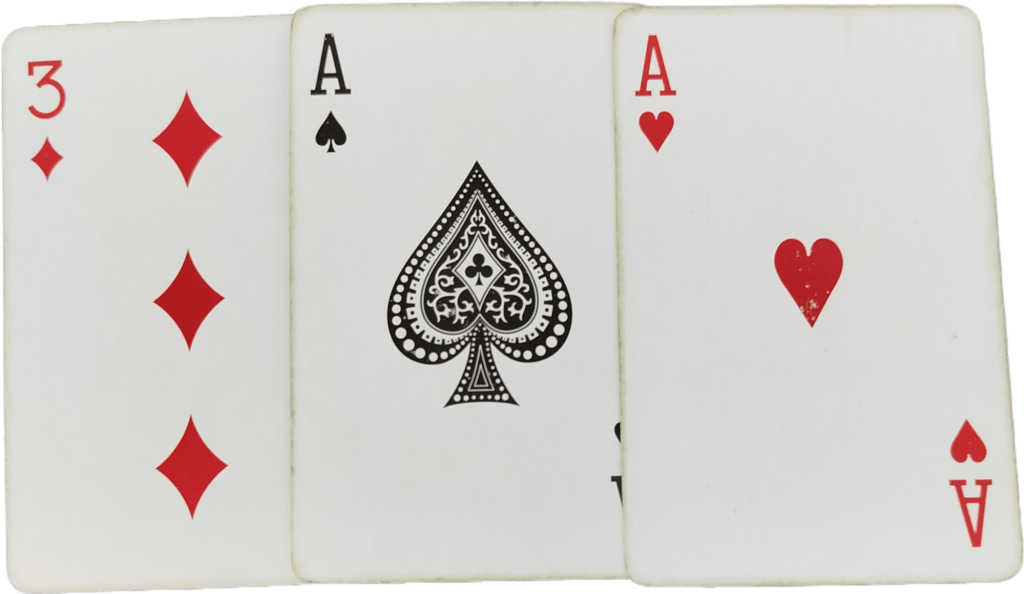
A three card reading with regular playing cards
In this case we don’t have the querent’s state of mind (which the Sibilla talked about). However, we do have, once again, the loss of money, indicated by the Three of Diamonds being covered by the Ace of Spades. The Ace of Hearts shows us that the money going out is due to family issues, something which was absent from the Sibilla.
Skat cards
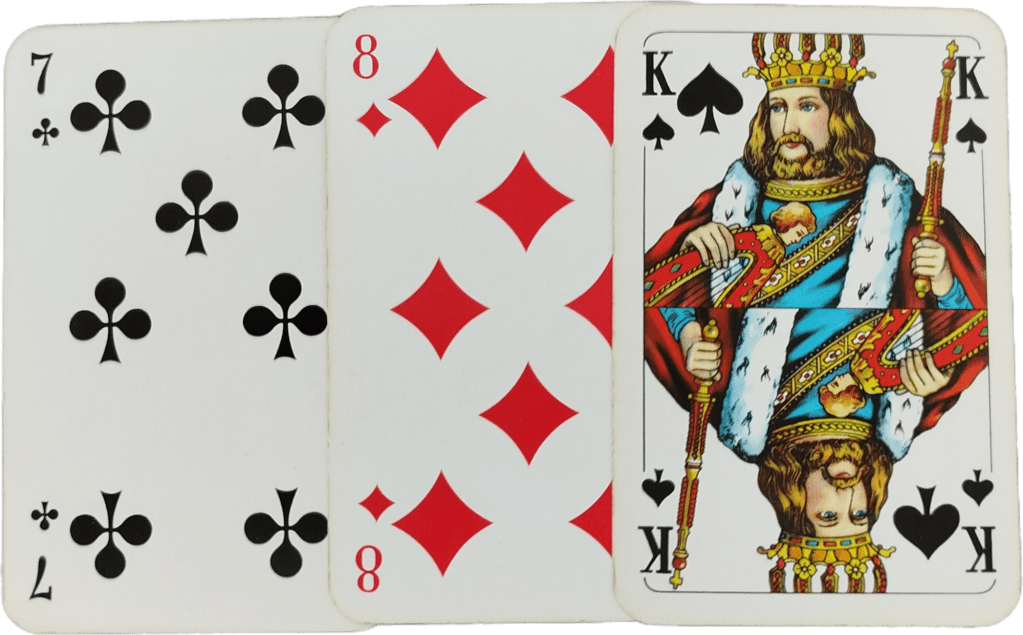
A three card reading with the Skat / Piquet deck
I decided to make an experiment with the Skat cards as well, just for kicks. The Eight of Diamonds is technically the card of work. However, if I understand the meanings correctly, it represents work because it shows the flow of money, money being exchanged. So it can represent, more broadly, the economy. With the Seven of Clubs, which indicates tears, the economy will take a hit. The King of Spades might be the office worker who will give the querent the news.
A week ago they received news that they needed to pay an extra 3000€ to unfreeze the granddad’s money. My friend doesn’t know if the office worker who worked on their case was a man (the King). Still I think the Skat cards were rather accurate.
In the latest reading I presented, an interesting phenomenon occurred. At some point during the reading, two cards came up that seemed very negative, but which actually had nothing to do with the reading in itself. Instead, they simply acted as some form of punctuation. This happens especially with simple methods like the one I used, called ‘alla zdoura’ (literally, ‘method of the housewife’, or ‘like the housewives do it’ in dialect), where we start with a very limited number of cards, usually one, two or three, and then we keep adding them without following a specific layout.
In this type of reading, if the cards need to signal that we are changing topics and moving on to a new one, they may use cards or combinations that show an ending (sometimes even just the Death card). Of course, I had a huge deal of luck in this reading, because it came up clear. It isn’t always like that. Often, these combinations look really bad, but if we look around we see that they feel out of place.
In playing cards, the same can happen when the Four of Spades and Five of Spades, or the Ace of Spades, or the Five of Diamonds come up. Usually, in these situations, it pays to zoom out of the reading and catch the general flow of it: it will become apparent, generally, whether these cards are part of the reading or if they act as punctuation.
I am also experiencing a similar phenomenon while experimenting with the Bolognese tarot. For instance, in the first few lines of a thirteen- card spread, it may happen that the Angel and Death cards come up together, and then the cards seem to discuss other topics. In this case, the cards seem to be answering the question positively and quickly, only to introduce new discussions. At other times, the Queen of Coins comes up to say “and that’s the truth about it, period.” or the Justice card, to say “and that ok the way it is.” Of course, I need to experiment a little more, especially to see if apparently negative combinations can act in the same way.
No, not me–science hasn’t come that far. I picked three cards for the day around a week ago.
A daily reading reveals news about a pregnancy
In a daily reading, these cards could indicate just about anything, although the tone is positive and it is connected with good news for sure. But two days later a friend in our group announced she was pregnant. The Hope card is strongly connected with maternity and nourishment, and is often present when asking about pregnancies, and the Child card speaks for itself. Also note that daily readings can come true even in the following days.
Two of Hearts – The House In most situations, the House card is relatively neutral, as it often indicates the person’s home environment or family, or some other place depending on the combinations. However, in itself the card, when upright, symbolizes a protective environment where the querent feels safe and taken care of. Figuratively, it shows situations that are solid, positive and protective (so you feel at home).
Eight of Hearts – Hope The Hope card’s main meaning is that of representing the hopes and wishes of the querent, and the cards following it will tell us if they come true or not. However, it also indicates the solution of trouble or compensation for it, as the card says “there is hope”. This is especially the case when the Eight of Hearts comes up after a negative sequence of cards. Sometimes the Hope card’s intervention may not be enough to give us what we want, but it will make sure that we come out of a situation still alive and breathing, and with some kind of hope.
King of Hearts – The Gentleman The King of Hearts is, in most situation, a neutral person card, indicating a married man or an older man. However, it does indicate someone who has our interest at heart (unless it is reversed or surrounded by cards of dubious moral quality). He is the archetype of the philanthropist who is out to help others. For this reason, in spiritual readings, it represents God or a saint.
Two of Clubs – The Peacock The best card in the deck, the Two of Clubs represents divine intervention (due to its symbolism of completeness and rebirth). It often shows up to protect us from the worst that could happen, or to increase the quality of something that is already good. It often shows positive undercurrents that do not manifest immediately in all their positive import, but which will save us, protect us or enrich us when they do manifest. For this reason it is known as the talisman card.
Five of Clubs – Fortune While the Two of Clubs indicates divine intervention, the Five of Clubs represents gifts from heaven in the form of good luck. It often indicates positive turns of events, a turn of the wheel that brings us something we want us, or at least something good. Unlike the Two of Clubs, it retains its positivity when reversed, but it becomes delayed or less blatant, maybe a bit less satisying
Seven of Clubs – Gratification The Seven of Clubs is a card of satisfaction, but it also represents our ability to reach our aims and ambitions in the real world. It represents the achievement of goals and reaching of landmarks in one’s life (marriage, promotion, property, recognition, etc.) However, the card can also represent “a light at the end of the tunnel” when it falls after negative cards, indicating, as it were, our ability to pick ourselves up.
Ten of Clubs Reversed – Levity The Butterfly is a symbol of carefreeness, lack of focus and lack of attention. When it is reversed, however, it shows carefulness with one’s finances and, even more importantly, the arrival of good occasions that need to be seized. Although it is not a card of protection per se, it does show us a way out (a new therapy, a new job opportunity, a new meeting, etc.)
Three of Diamonds Reversed – The Gift Again, not a card of protection, but still a welcome sight. It shows situations that somehow sort themselves out, at least in part. It is a relatively weak card, so the presence of very difficult situations may be mitigated only in part, and often it shows some kind of improvement rather than triumph.
Four of Diamonds Reversed – Falsehood When upright, the cat brings falseness and negativity in general. Negativity is to be understood broadly as situations that are negative or bad for us (even when there is no direct lying involved). When it is reversed, the same card brings positivity, relief, solution of trouble.