To be clear, I have the same interest in soccer that a koala has in space exploration. Two days ago I didn’t even know that Italy was playing Switzerland, and I would have kept not knowing it if I hadn’t been at a friend’s birthday party, where I met a fellow Italian, one who does care about soccer. Since she knows of my interest in occultism and divination, she asked if Italy would win. I used horary astrology to answer.
Note that the match had already started when she asked me the question, though I knew nothing of how it was going and I asked her not to tell me to avoid influencing my judgment. Furthermore, I forgot to screenshot the chart, so this is a recreation that I believe to be close to the original.
Will Italy win? App used: Astro Charts
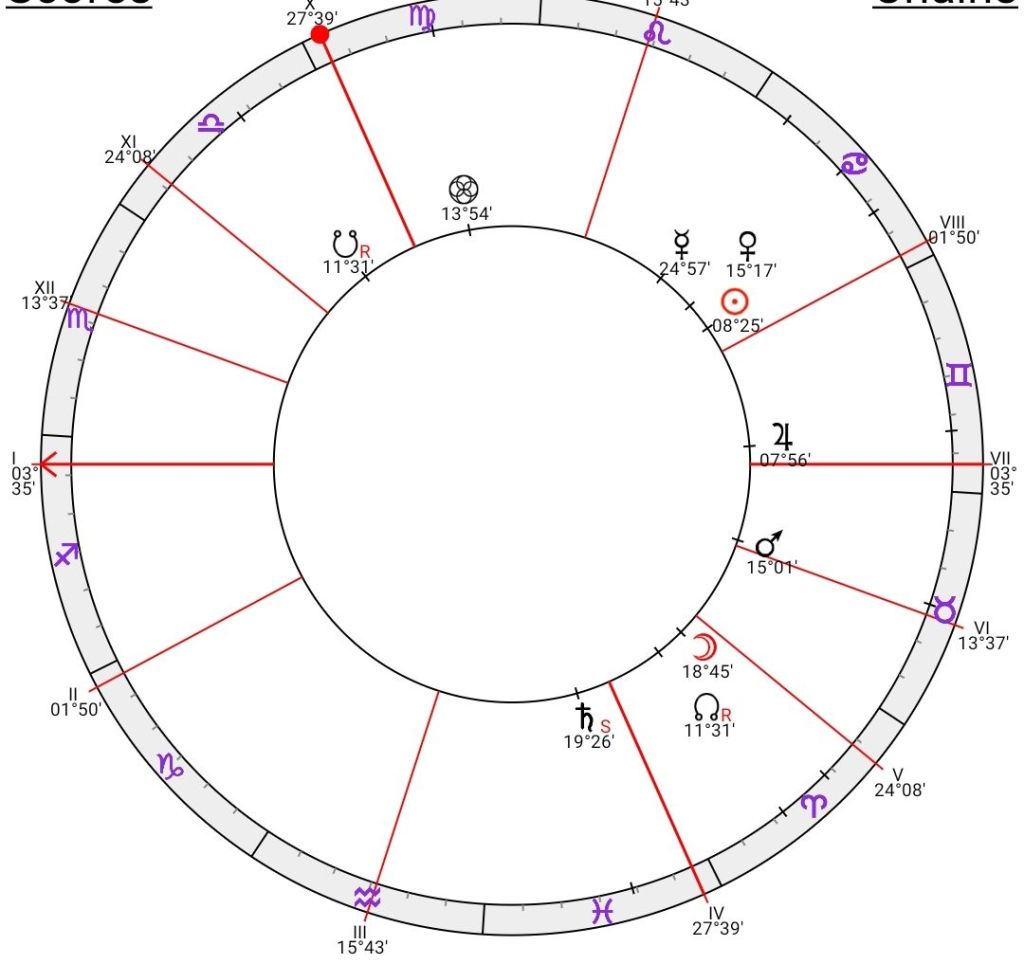
Since the querent is Italian and wants Italy to win, Italy takes the First house. Switzerland is given the seventh house of the enemy. The first, and decisive, clue is given by the position of Jupiter, significator of the First house. It is stuck inside the Seventh house, in the grips of the opposing team.
Once we see this, pretty much nothing else matters. The opposing team, signified by Mercury, is in the Eighth house, which is not great, but by antiscion it is right inside the Seventh, which is bad for Jupiter but again good for Mercury. The Moon is moving to square Mercury with reception. Bonatti says that a square with reception is like a sextile without reception, so it is generally smooth. At any rate, Switzerland should win. And indeed they won 2 to 0.
Important note: Horary astrology requires the querent to have some kind of emotional involvement in the question. Since I couldn’t care less about soccer, despite being Italian, if I had asked the question I would have regarded the chart with some suspicion. It is only because the querent is a soccer fan that the chart was accurate.
Here Abano discusses matters relating to the Seventh House and Eighth House.
Seventh House
Of marriage The first and second house are for the man, the seventh and eighth for the woman.1 The first signifies the person, the second his wealth, the eighth the wife’s dowry. If these figures are good they show a positive outcome. If the third figure is conform to the first and seventh, the marriage is mediated by messenger [intermediary],2 especially if the eleventh is conform to the third. If the fourth is conform to the first and seventh, it means the marriage is arranged by one’s relatives, especially if the fifteenth figure confirms it. If the second house is bad it means the husband’s (lack of) wealth is a problem, and so judge for the wife if the eighth is unfortunate. Similarly, if the first or seventh are bad, either the husband or the wife cause problems, and if the third, the mediator, and if the fourth, the family. If the first or seventh are unfortunate and move to the sixth, it shows that the marriage won’t happen due to sickness or because one of the two has a physical defect.3
If the spouse shall be chaste and honest4 Look at the first and sixth, seventh, eighth, fourth and twelfth. If you find good figures, it shows the spouse to be chaste and honest, especially if the figures move to other houses. But if the figures are evil, it shows the contrary, especially if they move to other houses, especially if Populus is born from those houses. If Puer is in the sixth and seventh, it shows the wife to be cheating with a young(er) man, and if it is in the seventh and eighth, it means it’s common knowledge.5 If in these places you find Rubeus, and if it moved as we have said above, it means the same, and similarly if in those houses you find Rubeus and Tristitia or Puer and Laetitia. And again, the more you find Populus in the whole figure, all the more dishonest the spouse is shown to be. But if the you find that the figures add up to Carcer, it shows honesty and reserve, and if the above mentioned figures cause Tristitia in the twelfth it means dishonesty with a family member or with a vile person, or with an almost beast-like man. And if Puer or Rubeus were formed in the twelfth, it means dishonesty with young men or with strangers, especially if they are conform to the thirteenth, fourteenth and fifteenth.
If the querent shall have (the love of) the lover or girlfriend If the first and seventh are fortunate and entering, benign and conform one to the other, it shows obtaining what he wants. If the first moves to the eighth or sixth, it means he will need to insist a little, but if the seventh moves to the second she will insist with him, but the mutation still shows a positive answer.6
Of partnerships and similar affairs If the first, second, fifth, seventh and eleventh figures are good, fortunate, fixed, it shows the partnership is good, especially if the second and seventh are the same figure. If the figures are fixed and fortunate it will last, but if not it shows they won’t. If you want to know who will cause problems, look at which side of the chart hosts more signs of instability and ill will, and judge in the same way as with marriage.
If one’s enemy will cause one offense If the seventh is fortunate and positive it means the enmity is of small moment, unless the enemy is a woman, because it still means ill will toward the enemy.7 But if the seventh is unfortunagte and strong and malicious, it means a great and powerful enmity, especially if the twelfth is equally evil. Look also at the fifteenth, and which planets are more fortunate, whether in the first or seventh, and in the other angles, whom they conform to. And if the first and seventh are good, fortunate, entering and the seventh conjuncts the first, or vice versa, it shows reconciliation and peace. If the figure that conjunct the other also moves to another place, it means that the reconciliation will happen through the persons signified by those houses. Always consider the fifteenth and the Witnesses. If there is no conjunction and no translation, but only conformity of the first and seventh, look at the Judge, whether it is also found in another house (of the first twelve), and the more you find it, the more the two parties shall make peace.
Whether there will be war or peace Assign the first house to one side and the seventh to the other, and look on whose side there are more fortunate figures, and look whether the figures that signify war are in the seventh or the first, or if the figures are fortunate, entering and good. If the figures are good, there is no war, but if they are malicious and fortunate in war, they mean war from the side where they are, and it will be as bad as the figures are, and the side will win that holds the more fortunate figures. Rubeus, Tristitia, Puer, Conjunctio are fortunate in war. Carcer, Amissio, Laetitia are unfortunate in war. If Popoulus or Conjunctio are in the sixth, seventh, eighth or twelfth it means death and great loss of blood, and fleeing, and great cruelty.8 If in those places you find Rubeus and Carcer is in the eighth it means death, prison, fires and flames, and if in the seventh and eighth you find Puer it shows great victory, but always look at the tenth, fifteenth and first, whether they move.
Of litigations The first is the querent, the seventh is the other party. The figure that is stronger and more fortunate wins, and if Amissio is found in either, that party shall lose. Laetitia and Puella signify concord, while Tristitia and Rubeus are very evil. And if the first moves to the sixth, eighth or twelfth, the person shall lose, but if the seventh moves in the same way, the other party shall lose. And if the whole figure is occupied by figures of more or less positive import, there will be agreement.
Of fled servants, prison and lost items If the first, seventh, eighth figures are conform and are entering and fortunate, it shows retrieval, and vice versa if they aren’t. If the first is in the sixth, the servant has not fled, but has hidden, and if the figure is Carcer, he hasn’t changed place, if not very little, especially if the first, fourth and the Judge are entering and fortunate. Acquisitio and Fortuna Major signify retrieval, but the opposite figures show the opposite.
Whether the absent party shall come back, and how soon If the first house is fortunate and well-meaning, and similarly the seventh and ninth, it shows the absent party is well and in good state,9 and vice versa if the figures are bad, especially if the sixth is unfortunate. Also look at the fifteenth and tenth. If the first is unfortunate and moves to the eighth it means death, especially if in conjunction with Carcer, Rubeus or Conjunctio.
If the sixth is unfortunate and moves to the first or in conjunction with it, it means a deadly infirmity, and similarly when the first and seventh are unfortunate are united somewhere in the figure. But if the sixth is unfortunate (but doesn’t move) it shows an illness that shall pass, especially if the eighth is good. And if you want to know whether the absent party shall come back soon, look at the first and ninth, and if they are Cauda, Acquisitio or Laetitia he shall come back soon. If Populus or Via, very soon. If the eighth is good and is in the first, he will come back in a month, if in the second, in two, and so on. And if the said figure is in the second and in the eighth, entering, he shall come in a month.10
Eighth House
Whether one shall die within the year If the first figure is the same as the eighth, or if it is conjunct to it, it is an indication of death, especially if it is also in the thirteenth or fifteenth house. If you want to see what kind of death one shall suffer, look at the nature and quality of the figure, and judge as follows: if it’s Rubeus, it indicates fire or steel (that is, being wounded by an arm,) if it is Puella, being beaten to death, if it is Carcer due to a long sickness, phlegm, melancholy or various health issues; and similarly judge of every other figure depending on its virtue and meaning and quality.
On who shall die first between two people Consider the eighth and see if it is in the house of the person you are inquiring about, or if it in conjunction to it, or if it is in the first house, and judge accordingly who shall die first.
If one shall have the money back If the eighth and the first are entering and fortunate it shows getting the money back without difficulty or problems, vice versa if they aren’t. And this is especially true if the thirteenth and the fifteenth agree, but when they don’t, and if on the side of the first house you find weak figures, it means getting back the money with great trouble. If the eighth is in the third it means one’s siblings will help, and if in the fourth, the relatives, and if in the fifth, one’s children, etc.
If the bad thing you fear shall come to pass Consider the first, second, eighth and twelfth.11 If they are lucky it shows the thing won’t come to pass, but if some of them are unfortunate, it shows it shall partly come to pass, and if they are evil, it shall come to pass, and the bad thing will be identified by the type of figure. If the first figure is in conjunction with the eighth or the eighth with the first, it means harm to the person. If the second is in the seventh or ninth, it means harm to one’s wealth. And so judge all the other things with respect to the eighth house according to the meaning of the house and the thing inquired about. Always keep in mind the Witnesses and the Judge.
MQS
Footnotes
This statement is interesting for a number of reasons. I will only mention one. Abano does not say that the First is for the querent and the Seventh for the spouse, but that the First is for the man and the Seventh for the woman. It would be easy, especially in the current cultural climate, to attribute this to Medieval sexism. I am not saying that it doesn’t play a part, but there could be more. In many Medieval astrological texts the Seventh house, as noted before, is assigned to women, and when delineating marriage from the birth chart different procedures seem to have been used to predict a man’s marriage as opposed to a woman’s, the method for the man involving the seventh house, the one for the woman being more weighed toward other considerations. ↩︎
It would be easy to update this interpretation to show the influence of social media in bringing two partners together nowadays. ↩︎
The modern doctrine would dictate that the marriage happens if the first figure springs to the Sixth House. ↩︎
The Italian title is “if she will be chaste and honest”, again presupposing a female Seventh House. ↩︎
This passage is exceedingly complex. It is not clear if Puer in the Sixth indicates a younger man because it is Puer or because it is in the Sixth (which is below the Seventh). The thing being common knowledge when it happens in the Eighth is possibly due to the fact that the Eighth house is above the horizon. ↩︎
Of interest here is that the querent can obtain the lover by moving to the Eighth or Sixth House, but the Seventh can only spring to the Second, not the Twelfth. ↩︎
This passage is not clear. It seems to imply that a good figure in the Seventh House still bodes ill if the enemy is a woman. ↩︎
These attributes seem ill-fitting for Conjunctio. ↩︎
Older astrology handbooks are filled with indications on delineating the Eleventh House in a horary question to know whether what one hopes will come to pass. Abano here applies the same method to the Eighth house to delineate one’s fears. ↩︎
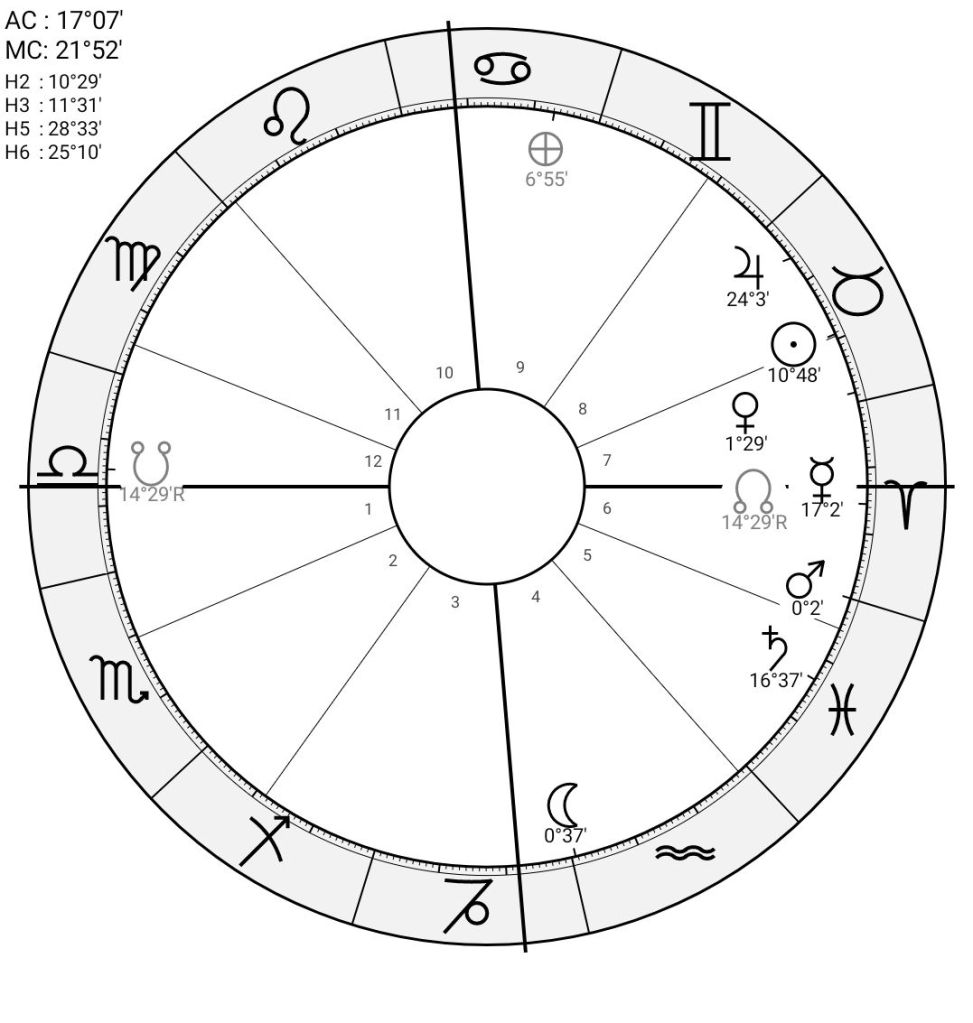
As most people reading this blog probably know at this point, we’ve recently bought our first home. A couple of weeke ago we scheduled the key handover with the previous owner, and I asked if everything would run smoothly. The result was a very interesting chart with a clear example or translation of light.
We are represented by Venus, ruler of Libra on the Ascendant. The previous owner is Mars, ruler of Aries on the Seventh. The Moon represents action. Notice the South Node of the Moon on the Ascendant, indicating troubles.
The second thing I noticed is that both Venus and Mars have recently changed signs, and especially that Mars has moved from Pisces, the sign of Venus’ exaltation, to its own sign, and Venus has moved from Mars’ sign to her own sign. Furthermore, the Moon has also just changed signs while being in the Fourth house which represents the property.
The Moon is the most interesting factor here: she is separating from a sextile with reception of Mars (back when she was in the last minutes of Capricorn) and applies to a square with reception of Venus from Aquarius. By this translation of light the Moon shows very well the passage from one owner to the other.
A square aspect is technically a negative indication, showing either friction or obstacles. The reception, though, allows the obstacle to be overcome. In his chapter on reception, the Medieval astrologer Guido Bonatti seems to hint at the idea that a square with reception is basically like a sextile without reception, but this doesn’t seem to be the case here: a square is a square, and it shows trouble, even though reception shows the overcoming of the difficulty.
And this is what happened: the owner cancelled on us two times for other appointments that took up a lot of his time, so the handover happened (reception) but with delay (square).
NOTE: the two aspects made by the Moon were both with reception: she was received by Mars in his exaltation and then received Venus in her (the Moon’s) own exaltation, thus smoothly transfering the ‘virtue’ she had received.
Horary astrology is a centuries old form of divination. The word ‘horary’ means ‘of the hour’, because unlike natal astrology, which predicts from someone’s natal chart, Horary looks at a chart for the time and place a meaningful question is asked.
The fascinating thing about Horary is the way it works: it doesn’t require you to shuffle a deck or cast dice. There’s nothing for you to manipulate. Once someone asks a (relatively) serious question to someone else who can cast a chart, the answer is there. In a way, it presupposes a view of the universe as an unraveling system of self-answering questions or self-solving problems.
As I strive to create a coherent philosophy of divination, Horary is definitely one of my most important sources of inspiration. I will probably start offering cheap email horary readings in the near future in exchange for feedback, in order to gain experience. In the meantime, here’s an example from yesterday.
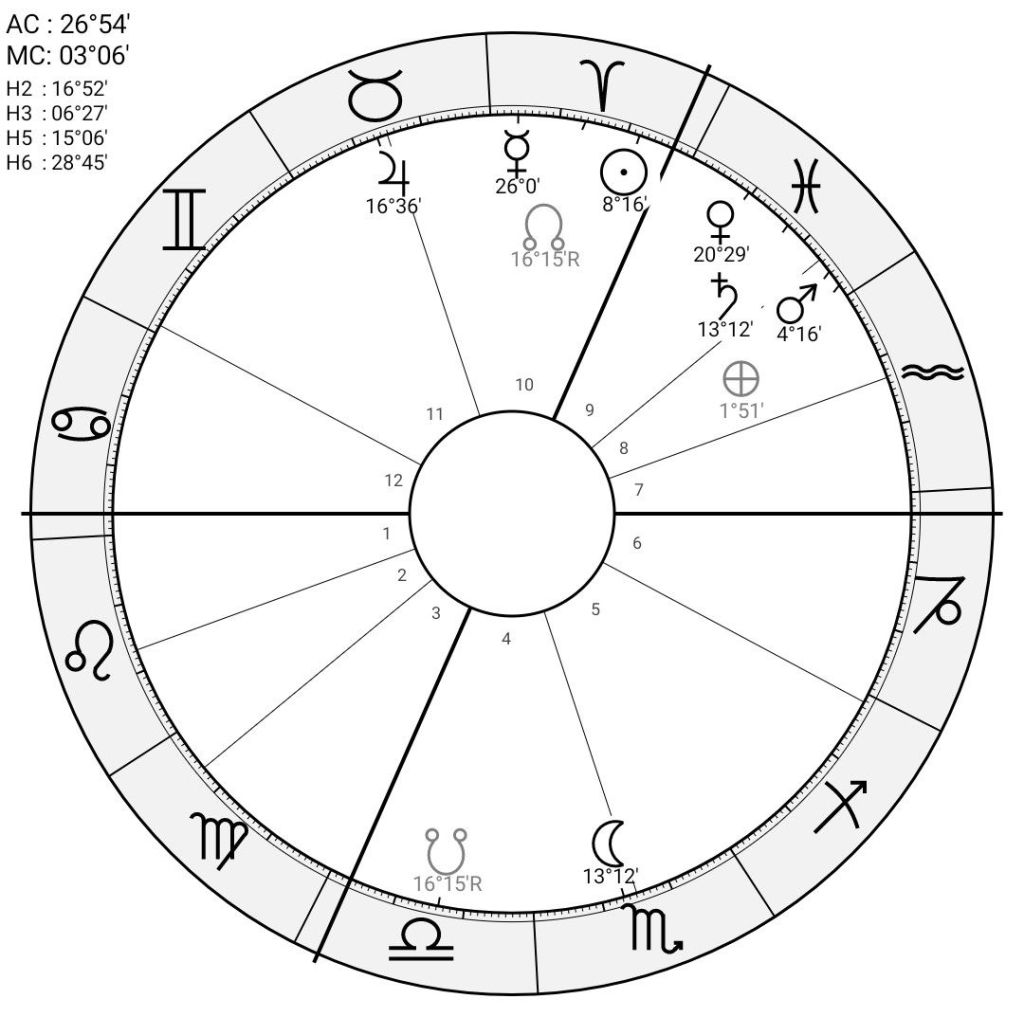
Is she alright? Horary question answered with the App Aquarius2Go
Background: A woman my husband is involved with for some projects had disappeared for a couple weeks after the death of her father. She didn’t answer any message my husband or the other people involved sent her, so naturally they were all worried that she might have fallen into depression and done something silly. So the question he asked me, knowing I’ve started dabbling in Horary, was “Is she alright?”
My husband is signified by the Moon, lady of the Ascendant. The woman is not really his friend (Eleventh house) but rather his colleague, so she is signified by the Seventh house and its ruler, Saturn. This is appropriate, as Saturn rules solitude.
Since the question is about this person’s wellbeing, we are looking at potential afflictions that Saturn may be suffering from. It’s peregrine, that is, it is in no dignity. Peregrination is a minor affliction. It also describes her very well: “peregrine” means “wanderer”, and she has disappeared. Saturn is also in a cadent house, the ninth, which however is not especially malefic. On the other hand, Saturn is Sextiled by Jupiter. This is a positive aspect, and Jupiter is a protective planet. My idea was that she wasn’t especially fine, but she wasn’t in any great danger either.
My husband (and probably the other people involved) is the Moon. The Moon is in her fall and inside the Via Combusta, i.e., the stretch of Zodiac that goes from 15 Libra to 15 Scorpio, which is bad for the Moon, as it is said to indicate turmoil. This is a good description of their apprehension. Mercury is slow in motion and squaring the Ascendant: communication is a problem.
The Moon is in exact Trine (to the minute) with Saturn. Trines are aspects of amity, so obviously they want to know that Saturn (aka the woman) is fine, and are worried (Fall, Via Combusta) about her.
Since Saturn doesn’t seem to be in any grave peril, it stands to reason that the woman will be back in contact (we would need strong testimonies to show the contrary). The fact that the Trine aspect is exact doesn’t allow us to say whether it is still applying or separating, but considering all the chart, it seems to be an indication that she will soon resurface. This is also shown by the fact that the Moon is near the end of the Via Combusta, so I judged that she would write my husband soon. Another possible indication is that the First House Cusp is nearing the end of Cancer, so the situation is in its late phase and is about to change. But I’m on the fence about this testimony.
Result: yesterday (day of the question) after weeks of not hearing from her, my husband got a message from her three or four hours after this chart was cast. The woman was of course not in top shape, but she was relatively fine.