Tag Archives: seven of swords

Tarot Encyclopedia – The Seven of Swords

(Note: this is a collection of the meanings attributed to the cards by some occultists in the past centuries. It does not reflect my own study or opinion of the cards. It is only meant as a quick comparative reference as I develop my own take.)
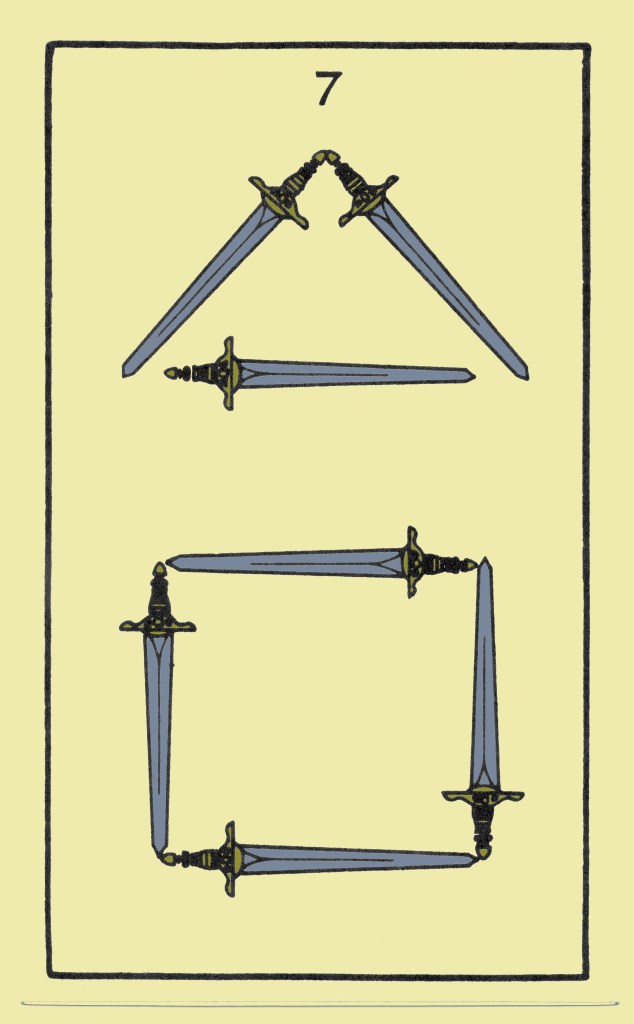
The Seven of Swords from the Builders of the Adytum (BOTA) tarot deck

Paul Foster Case (and Ann Davies)

The time period is the third decanate of Aquarius, February 9 to 18, under the rulership of Venus.
Well-Dignified: partial success; the Querent is too easy-going or does not draw sufficiently on his reserve force; he has good opportunities but may not make the most of them; he is likely to compromise too easily.
Ill-Dignified: love of ease and display cause loss; the Querent suffers from the insolence of others and may be insolent himself; there is danger that his own confidence may be betrayed, or that he may be led into betraying the confidence of others.
Keyword: Instability.
(From the Oracle of Tarot course)

A. E. Waite

A man in the act of carrying away five swords rapidly; the two others of the card remain stuck in the ground. A camp is close at hand. Divinatory Meanings: Design, attempt, wish, hope, confidence; also quarrelling, a plan that may fail, annoyance. The design is uncertain in its import, because the significations are widely at variance with each other. Reversed: Good advice, counsel, instruction, slander, babbling.
(From The Pictorial Key to the Tarot)
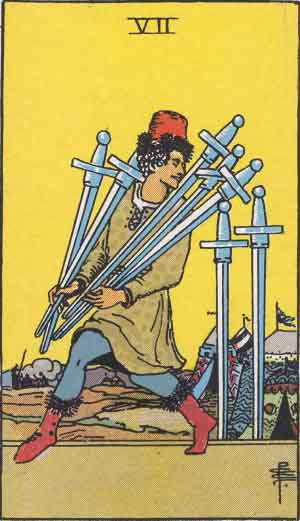
The Seven of Swords from the Rider Waite Smith tarot

Aleister Crowley

The Seven of Swords is called Futility. This is a yet weaker card than the Seven of Wands. It has a passive sign instead of an active one, a passive planet instead of an active one. It is like a rheumatic boxer trying to “come back” after being out of the ring for years. Its ruler is the Moon. The little energy that it possesses is no more than dream-work; it is quite incapable of the sustained labour which alone, bar miracles, can bring any endeavour to fruition. The comparison with the Seven of Wands is most instructive.

[…]

Netzach, in the suit of Swords, does not represent such catastrophe as in the other suits, for Netzach, the Sephira of Venus, means victory. There is, therefore, a modifying influence; and this is accentuated by the celestial rule of the Moon in Aquarius.

The intellectual wreckage of the card is thus not so vehement as in the Five. There is vacillation, a wish to compromise, a certain toleration. But, in certain circumstances, the results may be more disastrous than ever. This naturally depends upon the success of the policy. This is always in doubt as long as there exist violent, uncompromising forces which take it as a natural prey.

This card, like the Four, suggests the policy of appeasement. The symbol shows six Swords with their hilts in crescent formation. Their points meet below the centre of the card, impinging upon a blade of a much larger up-thrusting sword, as if there were a contest between the many feeble and the one strong. He strives in vain.
(From the Book of Thoth)

The Seven of Swords from the Thoth tarot deck

Golden Dawn’s Book T

TWO Angelic Radiating Hands as before, each holding three swords. A third hand holds up a single sword in the centre. The points of all the swords “just touch” each other, the central sword not altogether dividing them.
The Rose of the previous symbols of this suit is held up by the same hand which holds the central sword: as if the victory were at its disposal. Symbols of Moon and Aquarius.

Partial success. Yielding when victory is within grasp, as if the last reserves of strength were used up. Inclination to lose when on the point of gaining, through not continuing the effort. Love of abundance, fascinated by display, given to compliments, affronts and insolences, and to spy upon others. Inclined to betray confidences, not always intentionally. Rather vacillatory and unreliable.
Netzach of HB:V (Journey by land: in character untrustworthy).
Herein rule the Great Angels HB:HHHAL and HB:Ma’aKAL.

Etteilla

Hope
Upright. This card, as far as the medicine of the spirit is concerned, means, in its natural position: Hope, Expectation, Expectation, Pretending, Founding, Overestimating, Founding, Designing, Willing, Wanting, Wishing, Vowing, Wanting, Taste, Fantasy.
Reversed. Wise opinion, Good advice, Salutary warnings, Instruction, Lesson. – Observation, Reflection, Note, Caution, Thoughtfulness. – Reprehension, Reprimand. – News, Announcement, Posting. – Consultation, Admonition.

MQS

The Mystery of the Seven of Swords

Waite the Juggler

The Rider Waite’s minor arcana (which I already talked about here) are based on the Golden Dawn’s correspondences and titles found in Mathers’ and Felkin’s Book T. Yet Waite, who was very fond of showing off his erudition, made it a point to look for as many similarities as possible between the Book T system and other lists of meanings such as Etteilla’s, Christian’s and others.

This is reflected in the accompanying book to his deck, The Pictorial Key to the Tarot, where he tries to find similarities between various sources for each minor card. He never mentions the Golden Dawn material, despite the fact that knowing the GD’s card names would clarify most of the designs.

The 1 to 1 correspondence between GD meanings and Waite’s minor arcana is self-evident, and once it is noted it cannot be unseen. Yet in his book he makes it a point to just rely on non-esoteric sources, or at least on non-GD sources.

Note that the Golden Dawn did something similar, despite the claim that the card titles were revealed to them. Take the Four of Cups, for instance, which technically should be ascribed to the rulership of the Moon in the third decan of Cancer and to the sephira Chesed (mercy). All these things sound very promising. Yet the card is called Blended Pleasure and it is less positive than the previous two, largely (I believe) in an attempt to accomodate Etteilla’s relatively negative interpretation of the Four of Cups as a card of boredom, annoyance, etc.

Similarly, the Golden Dawn retained certain meanings found in traditional fortune-telling, such as ‘travel by water’ for the Six of Swords. This can be seen as part of the GD’s attempt at summarizing the whole of the Western magical tradition in a new synthesis.

Going back to Waite, it is clear that in his book he is also trying to balance various sources, but if in doubt about which one to follow, he will stick (without saying so explicitly) to the GD tradition. An example I already discussed is the Five of Pentacles, which Etteilla calls the card of the lovers, but the Golden Dawn called it ‘Material Trouble’.

Another example is the Two of Wands, which Etteilla calls a card of sorrow, but for the GD it is a card of Dominion, so Waite goes with the GD but tries to stretch the interpretation in his text by saying that it could be the sorrow of a great leader, like Alexander the Great, at the height of his power.

But What About the Seven of Swords?

With that in mind, what the hell is going on with the Seven of Swords? Let me explain: most people who pick up a Rider Waite tarot deck, even today, have no idea about the esoteric stuff behind it, so they base their interpretation on the design (which, incidentally, Waite thought very little of). This is how, for instance, the Two of Pentacles, the Lord of Harmonious Change according to GD, became the card of juggling, or how the Seven of Cups, the Lord of Illusionary Success, became the card of options.

In this new folk approach to the Waite deck, the Seven of Swords became known as the thief card due to the design.

Yet Waite does not even mention thieves in his description. He says:

A man in the act of carrying away five swords rapidly; the two others of the card remain stuck in the ground. A camp is close at hand. Divinatory Meanings: Design, attempt, wish, hope, confidence; also quarrelling, a plan that may fail, annoyance. The design is uncertain in its import, because the significations are widely at variance with each other. Reversed: Good advice, counsel, instruction, slander, babbling.

The meanings he gives are from Etteilla, where the Seven of Swords is one of the few non negative Sword cards. The description of the card, however, is far more consonant with what we find in Book T, which is:

The Lord of Unstable Effort […]Partial success. Yielding when victory is within grasp, as if the last reserves of strength were used up. Inclination to lose when on the point of gaining, through not continuing the effort. Love of abundance, fascinated by display, given to compliments, affronts and insolences, and to spy upon others. Inclined to betray confidences, not always intentionally. Rather vacillatory and unreliable.
Netzach of HB:V (Journey by land: in character untrustworthy)

This thing with the yielding when victory is within grasp is clearly depicted in the card, where the thief takes away most of the enemy’s swords, but not all, as Waite clearly states.

But why did Waite (and, maybe, Smith) decide to depict a thief in the Seven of Swords despite it being so thematically different from Waite’s actual inspiration (Book T) and even his cover-up inspiration (Etteilla)?

The only hints we find in Book T that seem to point in this direction are “to spy upon others” and “in character untrustworthy”. In an attempt to accomodate Etteilla, Waite probably saw the man looking longingly at the swords he left on the ground as a symbol of hope, which is Etteilla’s meaning for the card.

One possible explanation is that Waite and/or Smith probably thought the type of action that is best suited to the Suit of Swords is the kind of sneaky, underhanded action depicted in the final design of the card. Be it as it may, this is one of the cards that always stood out to me when studying the history of this deck, because it takes a very non-obvious approach to its theme.

MQS