Enneagram Type One and Enneagram Type Eight can showcase some similarities, but they are also quite easy to tell apart. Both are Body types, and both are concerned with the issue of autonomy. Eights want to be autonomous in that they dislike having to bow to powers other than their own. This distaste for others’ control is behind the Eight’s attempt to assert themselves and to force others to deal to them upfront. Deep down, Ones would also like to have the drive and magnetism of an Eight, but they feel they need to justify their autonomy, which is why they mediate it by turning into ‘the right kind of autonomy’, i.e., right action.
This is the basis of the distinction between the two types. Both are highly choleric,* but the Eight’s choler flows free and unhindered, in an instinctual and preintellectual way, while that of a One stagnates inside of them, welling up while awaiting release once it is intellectually justified (but often finding expression in passive-aggressive ways).
In Eights, the energy goes outward and others must learn to live with it, whether they like it or not; in Ones, energy is blocked inside of them and they must try to convince others of their reasons. In this sense, while both Ones and Eights can be rigid and controlling, Ones never try to submit others to their personal power, but rather to the ideal that they themselves submit to.
Fairness
Both Ones and Eights often hold concepts such as truth, justice, fairness, etc. dear to their heart. Eights, though, have an immediate and almost bodily understanding of them, as they react with immediate action as soon as an instance of injustice or untruth appears before them. Ones, once again, have a more intellectual and systematic approach to them.
Therefore, while Eights are certainly more heroic, they may fail to be able to make finer distinctions even when they are important, thus quickly becoming unjust themselves (you stole an apple, so I’m going to cut off your hand.) Ones, of course, may very well believe in dangerous ideas of justice, but they tend to elaborate them in such a systematic way that a whole society would be able to function according to them, and they would be the first to submit to the system.
Furthermore, Ones may very well be heroic themselves. For instance, my father, a One, has ended up on the newspaper a couple of times for tackling thieves on the street. Ones, however, know that a single act of courage is not enough to substitute a general, impersonal system of rules, whereas Eights may have a more maverick idea of justice as administered by courageous superheroes.
A wonderful example of the difference between Ones and Eights in matters of justice is seen in Plato’s dialogues, where Socrates, the mouthpiece of Plato’s one-ish idealism, often goes up against Sophists who are more eight-ish in their beliefs, wanting to assert the reasons of driven, powerful individuals as opposed to more abstract systems of law. Of course, the story is always told from the One’s perspective, but it is instructive nonetheless.
MQS
* I use the words ‘choleric’ and ‘choler’ in the old-fashioned way. Choler is just the bodily energy that leads to self-assertion and is behind our ability to tackle obstacles and enemies. Anger is only one of its expressions.
Enneagram Type One and Enneagram Type Seven are very much unlike each other, so much so that they are each other’s arrow: Ones grow at Seven, Sevens stress at One. Ones are a Body type, and their primary focus is on right action as autonomous beings; Sevens are a Head type, and they focus mainly on security, which they seek to achieve by planning their comfort and diversions.
Both Ones and Sevens are, in a sense, idealistic, but their idealism has different roots and different effects on their worldview: Ones believe in high ideals and standards and, by consequence, see the world as imperfect and fallen; Sevens idealize their potential for future enjoyment and so see the world as their oyster, full of cool stuff to be hyped about.
Ones are known for their harsh inner critic, which constantly nags them about what they are doing wrong and why. Everyone, including Sevens, may have a strong inner critic depending on their particular life story, but what’s usually even stronger than any inner critic in a Seven’s mind is their inner Yes-Man, a voice that constantly justifies and encourages their desire for more and broader avenues of enjoyment.
Ideals
In a social context, Ones and Sevens are also very different. Average Ones are generally restrained and somewhat uncomfortable. They may love to try to be more personable and warm, but they also feel that something is holding them back and doesn’t allow them to just relax and enjoy others’ company. Even Ones that have worked a lot on themselves usually retain a degree of inner tension.
Sevens, on the other hand, are people magnets (even when they don’t want to be). They love quick and witty banter with others, and even more introverted Sevens relate to others with peculiar ease, and are often capable of making fun of themselves and of odd or paradoxical everyday situations in a way that Ones would find disconcerting.
The difference between Sevens and Ones is the difference between fun and duty: they are notoriously tricky to reconcile. Unhealthy, stressed Sevens who have strayed too far may suddenly try to save their wanton selves from their mistakes by suddenly developing the rigidity of a One, but in more regular circumstances they are positive, upbeat and open to the world’s possibilities. Healthy Ones, by contrast, are usually capable of incorporating some Seven traits in their behavior by becoming more serene and developing a more positive attitude, but in general they remain tense perfectionists.
Enneagram Type One and Enneagram Type Six can sometimes be similar, but their differences are even more striking. Ones are a Body type, and focus on how to act rightly as autonomous beings. Sixes are a Head type, and their focus is on security from potential threats and uncertainties, which they try to achieve by thinking about all possibilities and by finding allies and leaders they can rely on.
Both Ones and Sixes tend to be dependable, dutiful and reasonable, linear in their thinking. They usually dislike extravagance and iffy ideas. Ones dislike them because they see themselves as the keepers of the orthodoxy, while Sixes dislike them because they want to try to focus on things and ideas that give them certainty.
Sixes have a marked social component that is not very prevalent in Ones. Sixes appreciate group cohesion and therefore conformity of opinions. They like their beliefs being reflected back at them by others like them. A Six with rebellious ideas tend to like being together with other rebels like them. Even Sixes who appreciate or accept pluralism and settings where pluralism is accentuated want to make sure that everyone is on board at least on the fact that pluralism is good.
Ones, on the other hand, do not need social validation and do not look for someone to tell them what’s right or wrong, what’s true or false, so while they are by no means loners, they can accept that their beliefs will make them some enemies. By contrast, Sixes can accept the existence of an enemy as long as there is a “we the people” fighting against it that can provide them group protection, even if just in their heads.
Duty
Both can have an ambivalent relationship with authorities: Ones ultimately obey their conscience, which can cause frictions with the powers that be; Sixes are desperately looking for someone or something whose authority they can rely on, but they also distrust authorities on the grounds of them either being potentially dangerous or not providing them enough protection or peace of mind. Both Ones and Sixes can occupy themselves with ideas of justice and can be very ideological, but Ones have a selfless relation with justice (“this is what is right. We must do it. Period”), while Sixes want to create a society in which they or those like them can feel safe or nurtured.
Ones rarely question their values and ideals and are possessed of a certain inner certainty about what’s to be done and what’s to be left alone. Sixes definitely lack this sense of inner guidance as they are known for sometimes spinning in circles about even the most trivial matters and are forever drowning in a sea of questions in their search for an unquestionable dry land. Of course, they may adhere blindly to a belief, an ideology, a religion, a group, etc. as a way to rescue themselves from their uncertainties, but there is always, even if just subconsciously, a nagging sensation that they may be wrong, and are always looking for external reassurance that the path they’ve chosen is the right one. Even the most committed Six will occasionally look at someone outside of them with a “This is the absolute truth, right?” look in their face.
If Ones can quite easily play the role of the lone martyr, Sixes tend to play that of the party members getting each other going at a political rally, or that of brave warriors inspired by a great speech their leader made in an epic movie.
Enneagram Type One and Enneagram Type Five can occasionally resemble each other in that both are rational, unsentimental, emotionally controlled, but they are also very different. Ones are a Body type, and they are concerned with acting rightly as an autonomous being in the world. Fives are a Head type, and they are focused on security, which they get by detaching from the world and identifying with their rational power, which is often considerable.
Both Ones and Fives have a difficult relationship with emotions. Both tend to set their own subjective reaction to reality aside: Ones to make truth and righteousness prevail; Fives to quickly get to the logical core of a given situation and analyze it from that objective standpoint. Fives, however, do not consider emotions such as anger as something that needs to be justified, as Ones do, but rather know emotions to be logically meaningless and therefore unimportant to their survival strategy. Ones on the other hand are nagged by emotions (especially anger) that they would love to express but fail to.
Both Ones and Fives can care little about social approval, but while Ones can stand up to the crowd for what they believe to be the right ideal, that is, the one everyone should obey, Fives are more clearly anarchic and chaotic, and laugh in the face of consensus not because they have the ultimate solution to push, but because they know this consensus to be relative, arbitrary, meaningless. In the end, Fives are inherently outsiders, while Ones are only outsiders if they deem the insiders wrong.
Truth
Ones use their mind as a tool to strategize the best, most moral and most correct way to embody their ideal. However, they rarely question this ideal from a rational standpoint, although they are keen on finding positive proofs that it is, indeed, the right ideal. In a way, they resemble those Medieval theologians who made up proofs of the existence of a God they already believed in anyway. Ones are rarely concerned with ideas for the sake of ideas. They are action-oriented and want to improve themselves and the world. In this, they have a very somber, serious, practical demeanor.
Fives, on the other hand, would perceive this behavior as an arbitrary limitation of their analytical faculties. They are far more playful and far more unrestrained, almost Dionysian, in their rationality. They entertain thoughts and create new concepts, worlds, stories just for the joy of doing so, or just for the joy derived from destroying them, like a child on a beach gleefully destroying a sand castle it just spent an hour building. Fives rarely care about right and wrong, moral and immoral, or rather, they usually don’t let these concepts color their objectivity. Their rational abilities are like a highly corrosive substance that burns its way out of every container: no concept, ideal, belief can stop it and keep it sealed forver. Of course, Fives are also terribly impractical and usually care as little to lead others as they care to follow them.
Enneagram Type One and Enneagram Type Four are almost nothing alike, so much so that they represent the arrow each of the other (Four grows at One, One stresses at Four). Ones are a Body type and are concerned with acting rightly in order to justify their existence as autonomous beings, while Fours are a Heart type and focus on what they are missing that would allow them to be happy.
Both Ones and Fours usually have a somewhat negative view of the world. However, Ones see the world as something to redeem, while Fours see the world as something they long to be redeemed from. For a One, most things are imperfect and require their guidance and action in order to be straightened out; for a Four, the world is a place of exile, and the best they can do is either to tolerate the pain or to wait for someone to rescue them.
Both Ones and Fours can focus on what they are missing or lacking, but in different ways: Ones feel that they are falling short of an objective ideal, and this spurs them into action, while Fours feel they are missing something more existential, and this lack (which they may not even be able to put a word to) singles them out as tragic victims.
Longing
Ones are usually objective, rational and somewhat impersonal, and as such there is a sobriety in them that is missing in Fours. They deal in terms of facts, albeit facts colored by their value judgements, and tend to be practical. They are extremely organized, dependable, tidy and usually try to take themselves out of the equation when judging a situation.
None of this is true of Fours. Fours relate everything to themselves, put great value on their subjective reactions and feelings and whatever schedule they try to submit themselves to is almost sure to be disrupted by their need to withdraw from objective reality to take an aromatic bath in some mix of dark emotions they’ve saved for a special occasion. Furthermore, Fours may feel that rules are unimportant or beneath them, because they fail to capture the essence of their life. Indeed, one of the reasons Four grows at One is that they learn to be more principled and consistent.
On the other hand, there is an interpersonal component in Fours that is almost completely absent from Ones. Fours feel rejected by the world and envy others, but they also long to be rescued from this state by the right people who will relate to them in a special way. Ones, of course, long for relationships like most other human beings, but their primary focus is on changing themselves and the world so that everything is as it should be.
Enneagram Type One and Enneagram Type Three belong to different centers: Ones are a Body type and Threes a Heart type. Therefore, there are broad differences between them, although they may have some similarities on the surface, depending on their particular life circumstances. Ones’ main aim is autonomous action, which they believe themselves entitled to only in so far as it is the right action. Threes, though, are not especially concerned with right or wrong, but rather with recognition and admiration.
From this fact alone it is clear that Ones and Threes live in vastly different worlds. Of course, Threes who have been socialized in an environment where morality and righteousness are, for better or worse, the standard to meet may occasionally behave like Ones. However, even in this case, Threes will generally do so as long as recognition is forthcoming.
Achieving
Furthermore, both Threes and Ones tend to be unsentimental and action-oriented, but again, in different ways. Ones feel the need to suppress their particular feelings, preferences and desires in order to abide by an ideal they believe to be more or less absolute. Threes, on the other hand, file their feelings away for later consideration in order to achieve a goal not necessarily because it is good, but because they believe it will bring them prestige.
In a word, if a One is the crusader converting the infidels of distant lands, the Three is the Roman emperor conquering a new province to be remembered forever. If Threes are the competitors, Ones are the referees.
Shame can be a powerful experience for both Ones and Threes. Ones constantly feel they need to work on themselves in order to improve their adherence to their ideal, and may feel shame in front of themselves if they feel they have failed to do so. Threes feel shame in a more mundane sense, as internalized social pressure to achieve a certain goal and improve their performance.
While both types can be perfectionistic, Threes are motivated by the joy and sense of challenge of making others see how praiseworthy they are, while Ones are prepared to go through the desert alone, or even for martyrdom if necessary.
Ultimately, like all Heart types, Threes are not necessarily principled individuals, which doesn’t mean they are immoral, but that the core structure of their personality does not revolve around principles as it does around interpersonal dynamics, and the opposite is true for Ones.
Developing a personality means excluding something of the whole from one’s self-image. We cannot have a distinct sense of self without contracting our identity from ‘everything all the time’ to ‘some things some of the time’.
This partiality becomes the reason why we seek some things while avoiding other things. If we weren’t partial to pleasure rather than pain we wouldn’t look before crossing the street. If we weren’t partial to recognition we wouldn’t seek it, while avoiding shame, and so on. If the world were populated by enlightened sages, we would never have left our caves and we’d still be dying of the flu.
Each Enneagram type has its own mechanism, which revolves around a specific passion, as discussed previously. This mechanism drives us to the accomplishment of certain things, focus on certain aspects of ourselves and of reality, but it also, complementarily, leads us to fear certain other things. These two aspects are two faces of the same coin: one cannot strive for something without fearing the opposite outcome.
Therefore, each of us tends to justify their existence and their efforts by subconsciously adhering to propositions like “I am only ok if…” or “Everything will be alright if I…” We shall call this proposition the “contract with ourselves and with reality.” These are ways we use to subconsciously attempt to manipulate ourselves, reality, and others, dictating the conditions that allow us to accept ourselves. In other words, we accept ourselves on the condition that we fulfill the drive that is implicit in our mechanism. This, of course, colors the way we relate to other people, as we tend to project these subconscious issues outside of ourselves. Usually, this fear is counterbalanced by an opposite longing that we feel, in our lucid moments, to abandon the mechanism and simply be: “So what if I’m….” If the mechanism is a night of debauchery and drunkenness, this is the moment where sobriety kicks in.
The Nine Fears
TYPE ONE One’s focus: Ones are highly self-critical, with a strong conscience. They tend to mediate their right to autonomy by measuring it in terms of how much they adhere to a certain ideal of how they should behave. Their focus is consequently on standards. They are keenly aware of the difference between their life as it is and their life as it ought to be in order for the ideals that move them to be fulilled. It becomes almost a mathematical subtraction: What ought to be – What I’m not doing to fulfill it = myselfmyself currently. One’s fear: their basic fear is to be wrong, or rather, to act wrongly or badly. Note that a One’s idea of good or bad is not solely moral but also technical. In a One’s perspective, morality (what we ought to do) and procedural issues (how to carry it out) are deeply intertwined, and it is not always easy to disentangle them. One’s contract with themselves and with reality: “I am only ok if I act rightly, all will be alright if I do the right thing.” One’s projection toward others: it is widely reported that merely being in the presence of a One is enough to feel like something is wrong with our life. Ones who are not conscious of their mechanism tend to exude their sense of being in the wrong toward others. One’s longing: to cut themselves some slack and have some respite form the inner critic. “So what if I’m not perfect?”
TYPE TWO Two’s focus: Twos are deeply interpersonal. As a matter of fact, they basically live at the intersection between themselves and others. Their primary focus is on other people’s needs, and how they may anticipate those needs and take care of them. Two’s fear: a Two’s basic fear is of being surrounded by a world that doesn’t take them into consideration, doesn’t validate them and that doesn’t love them with all their needs. Two’s contract with themselvesand with reality: “I am only ok when I put others ahead of myself , all will be alright if I meet others’ needs.” Two’s projection toward others: Twos have a marked tendency to infantilize others, seeking unconsciously to deprive them of their autonomy, so that they will come to recognize that they need the Two. It is not uncommon to feel helpless and incapable of taking care of oneself in the presence of a Two. It is also not uncommon to develop a dirty conscience for nothing, especially for exerting one’s autonomy without the help of the Two. This is the same dirty conscience that Twos have when they think about themselves and their own needs without taking others into consideration. Two’s longing: to be appreciated and loved for how they are, even if they are not needed. “So what if I think of myself?”
TYPE THREE Three’s focus: Threes are showmen. They are constantly driven to excel in enterprises that will gain them validation and ammiration. Because they overidentify with their actions, rather than with their being, they tend to act within conventionally accepted fields so as to maximize the likelihood of being met with approval. Therefore, their focus is on what’s valuable. Three’s fear: Obviously, their great fear lies in not being considered worthy or valuable. They fear that the activities they seek to impress others and win accolades with will be found lacking or, even worse, that they will be called out as fake or phony in some manner. Three’s contract with themselvesand with reality: obviously, this is “I am only ok if I earn respect, all will be alright if what I do gains recognition.” Three’s projection toward others: being by nature very competitive, Threes easily hurt other people’s feelings, sometimes unwittingly, sometimes very wittingly. In their presence it is easy to feel like one doesn’t have their life together and isn’t worthy of respect, recognition or approval. Three’s longing: to simply let go of the pretense, quit the charade and show their true selves honestly. “So what if I’m not some admirable hero?”
TYPE FOUR Four’s focus: Fours see themselves as defective, as if everyone else has an undefinable something that makes their lives ok, while Fours lack it. This is what they focus on. Therefore, they perceive the normal instability of their personality as something dramatic, and they wish to be rid of this suffering by fashioning an identity for themselves. Four’s fear: Four’s nemesis is their sense that they don’t have a stable identity to which they can point to to tell themselves they are significant. They fear the idea that they might be just another collection of whirring atoms catching dust while waiting for the inevitable. Because they attribute great importance to this unique identity, they fear that they won’t be loved unless they have it. if there is a word they flee from, it’s “ordinary.” Four’s contract with themselves and with reality: “I am only ok if I am unique and have a deeply meaningful existence, all will be alright if I differentiate myself from others by finding my own self and expressing it.” Four’s projection toward others: because Fours fear the possibility of being just another human being, they tend to project this fear toward others, making them feel coarse, ordinary, and that whatever suffering they experience, the Four has suffered more and is more justified in lamenting (or is more admirable for not lamenting) Four’s longing: when in their own mechanism, Fours tend to spend a lot of time longing, but deep inside, the real longing is to be loved even if they are ordinary. “So what if I’m just another living thing?”
TYPE FIVE Five’s focus: Fives are incredibly cerebral, which is a strategy they use to avoid the uncertainty they have about their own ability to live ‘in the world’ together with the rest of humanity. They feel they first need to retreat to stock up on resources, knowledge, time, competence, etc. Their focus is on competence and on resources, broadly construed. Five’s fear: Five’s basic fear is of being incompetent, of lacking the skills required to succeed in life or even just to make a contribution to society. They tend to procrastinate on engaging the world until such time as they’ll be fully prepared. Inside, a sometimes unconscious, sometimes loud voice taunts them, “You are so dumb.” Five’s contract with themselvesand with reality: as a consequence, their contract with themselves is “I am only ok if I know exactly what I’m doing, all will be alright if I gain enough competence.” This usually leads Fives toward futile overspecialization, and to avoiding all situations where the particular branch of knowledge they are mastering won’t be of use. Five’s projection toward others: Five’s emphasis on knowledge, competence and rationality tends to find expression in a sarcastic attitude toward others, who consequently often feel unjustifiably dumb or irrational when in a Five’s presence. Five’s longing: to stop fiddling with empty concepts and join the world with simplicity. “So what if I’m not all-knowing?”
TYPE SIX Six’s focus: Sixes can’t for the life of them stop questioning whatever it is that is giving them security, which they usually find outside of themselves. Obviously, their focus is on security, which keeps them poking holes in anything where a hole may be poked in hopes of finding something stable they can depend on. Six’s fear: it shouldn’t come as a surprise that Six’s fear is fear itself. However, because they are working overtime to find something or someone that will allay the fear, their greatest fear is of not finding it, and that they will be left to their own devices, weak and small in a large, threatening world teeming with wolves. Six’s contract with themselvesand with reality: this reads, “I am only ok if I know something is beyond doubt, all will be alright if I find someone or something to trust without reservations” Six’s projection toward others: Sixes are masters in destroying other people’s certainties. If the Six you have to do with is a hypochondriac, you’ll soon be one as well. Sixes, by the way, have the sense that they are being completely rational in worrying so much, so in instilling their fears into others they often feel that they are educating them or making them understand their situation, sometimes with the aim of showing them that they are similar, they are both (potential) victims, and should become allies. Either way, Sixes project their fears onto their peers. Six’s longing: to simply turn off the ceaseless questioning and just accept reality and trust others to be decent human beings. “So what if I don’t know what tomorrow will bring?”
TYPE SEVEN Seven’s focus: Sevens are excitable and quick-witted, focusing usually only on the positive side, and feeling that negativity would drag them down overmuch if they allowed their mind to dwell on it. Therefore, their focus is on planning diversions and pleasurable activities. Seven’s fear: normally, Sevens are terrorized by the idea of experiencing want or pain or fear itself. That’s what sets them on their journey of pleasure-seeking. There is a sense that, unless they keep stuffing the hole in their soul full of pleasure, the gaping wound is going to start hurting. Seven’s contract with themselves and with reality: “I am only ok if I stay positive, all will be alright if I plan something new to move toward.” Seven’s projection toward others: as they tend to avoid less than positive feelings and states of mind, Sevens can be put off by others’ willingless to explore such issues when they arise in their own life. Yet, in a Seven’s presence one often feels that it’s not the time to be a Debbie Downer. Sevens can make others feel that they are being too negative or are taking life too seriously. They accomplish this both actively, by minimizing and joking about people when they open up, and more subconsciously by the way they carry themselves to drown everyone around them in mirth. Seven’s longing: to stop the obsessive planning and consuming of life and acknowledge the deep wounds they carry. “So what if not everything is fine and I take care of my darker side?”
TYPE EIGHT Eight’s focus: Eights go out into the world and conquer it for themselves. Each Eight is like a warring nation, constantly looking to increase their wins, minimize their losses and defend their borders. They feel the need to be strong and look for ways to prove it. Their focus is on power, on who has it, who lacks it, and how to exert it. Eight’s fear: predictably, an Eight’s greatest fear is for their soft, weak side to come to light and be exploited or used against them. This prompts them to always keep their guard up and not sit on their hands: attack is the best defense. Eight’s contract with themselves and with reality: this would be, “I am only ok if I am strong and unconquered, all will be alright if I make it clear I’m not to be underestimated.” Eight’s projection toward others: anyone who’s seen a couple of Eights brawling in the streets knows the feeling of helplessness and weakness that comes from the experience. Eights tend to make other people feel the weakness that they want to hide from themselves. Eight’s longing: to let their guard down and call a truce with life. “So what if I’m not a perfect fortress?”
TYPE NINE Nine’s focus: Nines are diffuse and conciliatory. Being a body type, they are concerned with autonomy, but they achieve this by not creating struggles or problems or going against the flow. Their primary focus is therefore on peace and peacekeeping. As a former boss of mine, a Nine, once said, “how many problems have been avoided by people doing nothing!” (He said it while running his business into the ground out of inaction) Nine’s fear: Nine’s fear is that, by rocking the boat, they will lose contact with others and not be acknowledged or ‘seen’ as a consequence. They fear that if they asserted themselves conflict would inevitably ensue. Nine’s contract with themselves and with reality: “I am only ok if I remain passive, all will be alright if I just keep peace.” Nine’s projection toward others: the narcotic properties of many Nines are almost legendary. In a Nine’s presence, other people often find that they have to struggle twice as much as they are used to in order to achieve their aims. This is partly due to Nine’s passive sabotage, partly due to Nine’s desire for pure, unadulterated, unmoving harmony that they tend to project outwards. They are not rocking the boat, and nobody should. Because Nines have trouble finding themselves, others can lose their sense of self in their presence. Nine’s longing: to be seen as individuals with their aims even if they assert themselves. “So what if I do my own thing?”
A unique feature of the Enneagram is that discovering one’s type is not the end of the journey, but merely the beginning. The goal of using the Enneagram is not to pigeonhole the individual into yet another box, but to hand him the tools to work on himself. The Enneagram comes with an inbuilt system of dynamic transformation, showing us what direction we tend toward when we learn to wear our type more lightly.
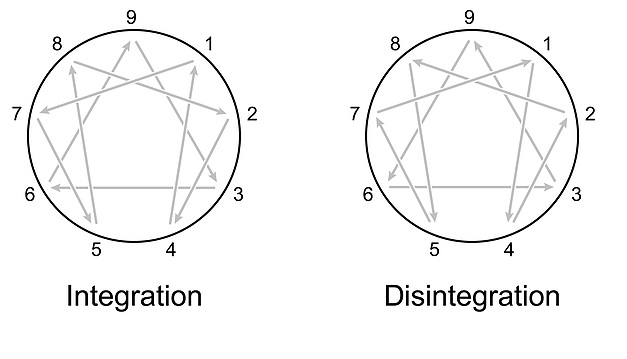
This is what is known as the path of integration. Basically, when you feel at ease, or when you learn to process your type’s challenges in a more mature way, you develop some of the healthy characteristics of another Enneagram type, namely the one connected to yours by the forward-pointing arrow. Note that you do not become a different type: your type is fixed and will stay with you as long as you live. You merely acquire some of the good traits of your integration direction.
One the other hand, when you are under stress or when you become more and more trapped in your mechanism, you tend to develop traits associated with the less healthy side of the type whose direction of integration you represent. This is known as your path of disintegration.
The Enneagram symbol with the arrows showing the directions of integration and disintegration
Note the two terms ‘stress’ and ‘relax’, as these are used with a specific meaning in Enneagram theory. Stress doesn’t simply mean having a busy schedule, just as relax doesn’t simply mean tanning on the beach. Stress is every situation that reinforces or incentivises the vicious cycle typical of your type, so that your type’s mechanism tightens its grip on you.Relax is the opposite–every situation that gets you out of your negative spiral or even leads you into your virtuous cycle.
Again, just as with integration, disintegration doesn’t make you change type. Furthermore, there is some indication that it is actually possible to work positively with your path of disintegration, although it tends to be hard, just as it is possible to use your direction of integration negatively. For instance, Fives may get a sense that they need to be more present in their bodies and act boldly, like Eights (Five’s integration), but because this is alien to their usual mechanism, they may end up doing it exactly when it is uncalled for; or a Four may have the idea of adhering more strictly to objective rules and mundane schedules, like Ones (Four’s integration), but they may end up doing it in an unhelpful or blind way that defeats the purpose of it, because they are trying to do something that is not typical for them.
These issues stem from a misunderstanding, namely that you need to start acting like a different type. This is not so. You are you. Work on yourself and on your type. The Enneagram symbol represents an uninterrupted flow of energy, while the types are like strictures on the road that partially block the flow. Working on yourself means loosening this stricture. This will lead you to naturally develop new attitudes, without you trying to be someone you are not. Keep in mind that the goal of every form of psychological and spiritual development is to be able to act appropriately now, and to react appropriately to what is happening now, without or with as little conditioning from your past preconceptions as possible. This is why the first thing is to learn your type, and then you start learning how wear it lightly.
The Nine Types with their Paths of Integration and Disintegration
Type One to Seven (Integration): Ones have a strong sense of duty. This is part of their subconscious deal with themselves: you are ok and are allowed to exist and act only if you do it right and in order to uphold an idea. As they relax, Ones move to Seven, learning to let go of the harshest aspects of their resentment toward themselves and others. They learn to look at the world with a sense of wonder, accepting a wider variety of points of view and sources of joy.
Type One to Four (Disintegration): when they become entangled in their own mechanism, Ones begin to despair at their inability to live up to their own ideal. They begin to see the world as impure or lost, and in moving to Four, they develop a marked melancholic or even depressive note, feeling that all is useless and they are shipwrecked in the wrong world, a world of chaos and lawlessness, without principles or order, a world that doesn’t listen to them. They tend to become resentful of others because they see in them the type of careless happiness that they secretly envy.
Type Two to Four (Integration): Twos exist, or rather, feel that they only have a right to exist in the interpersonal dimension, even when they are alone. As they develop, they move toward type Four, and acquire a greater sense of their own needs and a greater compassion for themselves. They learn to see themselves as valid, accepting and feeling their own urges without pushing them on other people, and experience and accept the hurt that comes from the realization that they are alone, like everyone else, and that connecting with others presupposes first being alone. They become their own primary focus of care and understand the legitimacy of this being so, which allows them to be more genuine and truly disinterested when helping others.
Type Two to Eight (Disintegration): despite their often sweet demeanor, Twos have an authoritarian streak that becomes apparent when the other resists Two’s attempt at creating a symbiotic unity with them by ‘helping’ them. When all else fails, and Two feels that reality is slipping away from their grip, they move to Eight, becoming hostile and aggressive, punishing the other in a demeaning way, as though the neutralization of otherness that they could not achieve with sweet manipulation they now seek to accomplish by turning overtly overbearing.
Type Three to Six (Integration): Threes tend to identify with their performance, achieving often marvelous feats that they seek to sell to others as the real image of who they are. They are extremely competitive and live in other people’s good impression of them. As they relax, however, Threes move to Six, they learn to be more ‘like others’, which doesn’t mean abandoning their drive, but using it together with others rather than to emerge at all costs. This is because they realize that their inner worth cannot be measured by how they perform. They often concentrate on creating meaningful social connections.
Type Three to Nine (Disintegration): every type has a vague feeling of what can go wrong with their mechanism, but often refuse to verbalize it in front of themselves because it’s a tough pill to swallow. Threes have it especially hard, because they perceive, at least on some level, the phoniness of the image of themselves that they submit for people to consider, but because the Heart energy is blocked in them, they don’t see or feel what else they could ‘truly’ be. This can lead them down a spiral that lands them at Nine, where they become lethargic and disillusioned about their own worth, sensing that they will never be anyone except, at most, frauds.
Type Four to One (Integration): Fours are extremely sensitive to their ever-changing inner emotional landscape. As they relax and move toward integration at One, they become more principled and appreciative of the mundane tasks that fill everyday life. They cease to long for the unattainable and become focused on practical plans for achieving what can be achieved and cultivating themselves more methodically. Emotions still find expression, but in a more measured and authentic way, without exaggerating. Authentic connections with others develop naturally.
Type Four to Two (Disintegration): Fours can throw hissy fits to express their disdain for the drab, gray, unfair world that surrounds them and makes them suffer. Furthermore, their envy leads them to being spiteful, often taking solace for their suffering in the suffering of other people. This leads to damaging personal relationships with snide remarks, underhandedness and all-around bitchy behavior. Yet when others are at the end of their rope with Four, Four becomes clingy, people-pleasing and unctuously accomodating at Two in an effort to patch the relationship back together.
Type Five to Eight (Integration): Fives live in their own head, where they identify with their own mental process and with some carefully selected truths or (often esoteric) areas of competence. As they relax, they move to Eight, learning to take up space in the world and inhabit their own body more fully. Their knowledge may find practical application or simply be more grounded, and they learn to listen to their guts when needed. They also learn to appreciate their own physical existence and realize that they have way more energy and resources (broadly construed) than they could ever imagine, which allows them to take action without first needing to hoard energies or time to devote to needless tinkering and fiddle-farting.
Type Five to Seven (Disintegration): When under serious stress, Fives find themselves incapable of using their typical strategy of retreating in preparation. This is especially the case when there are time constraints or when it is impossible to take a pause from social interactions (especially with people they know less well.) This leads them to become scattered and oddly unfocused, like unhealthy Sevens. Their typical sarcastic humor starts missing the mark, they often become incapable of saying what they think or thinking about what they are saying. They also tend to become airy in an ungrounded sort of way. They realize they’ve said something only after the fact, and realizing that what they said is stupid, or at least unrefined, they become even more scattered as panic sets in.
Type Six to Nine (Integration): Sixes are always looking for the one thing, idea, institution, person, group they can trust so much that they can finally turn off their brain and go on autopilot. Unfortunately, it takes little for them to start tearing down the object of their trust. When relaxing, Sixes move to Nine, where they become more trusting and calm. When watching a Six, I always have the sense that behind all their turbulent questioning there is a small white pearl of calmness that they are looking for and can’t seem to reach, despite it being right in front of them. Integrating to Nine means reaching that pearl. Relaxed Sixes allow space for the sense that all will be well and other people can be trusted even if they are not perfect.
Type Six to Three (Disintegration): under stress Sixes move to Three. As they lose their trust in others and despair of their possibility of finding safety in life, they become like fearful sheep realizing their need to fend for themselves as a pack of wolves attacks. They develop a desperate competitive edge, often exactly when it’s unwarranted or when doing so will cause even more uncertainty. Furthermore they may ‘puff themselves up’ in hopes of scaring away predators, trying to sell an exaggerated image of themselves to others.
Type Seven to Five (Integration): Sevens tend to flee from their inner sense of worry and their fear of pain. This often causes them to become engrossed in a superficial pursuit of distraction. When they relax, Sevens move to Five, developing a deeper stance and greater self-reflection. They learn to accept the darker side of life, like Fives do, and put their endless supply of energy to good use on long-term projects, staying focused while maintaining their typical cheerful demeanor. They are often able to confront their own shadow with great depth and tackling their problems soberly without slipping into hopelessness.
Type Seven to One (Disintegration): Sevens are constantly fleeing from worry, fear and pain. When this becomes impossible, or when they perceive the futility of it, or when all the issues that have been piling up finally explode, they tend to move to One, where they become highly critical of others for making it impossible to enjoy life, usually projecting their own failings onto them. Often they develop unrealistic plans to cleanse their life of all the problems they have been ignoring, which however could even make the situation worse, and they tend to take refuge and solace in ‘being right’ on things that are ultimately of no consequence.
Type Eight to Two (Integration): Eights have a bold, aggressive attitude, which they use to secure the borders of their ‘territory’. They can be confrontational and overly assertive with those they do not consider friends. In relaxing, Eights go to Two, where they become more giving and interpersonal. As a matter of fact, the average Eight already has a liberal, giving streak with the people they like. However, in relaxing their mechanism, they learn to stop dividing the world in friends and foes, and are capable to connect deeply with people, opening up about their vulnerable spots and showing their sensitive side. This ends up increasing their sense that there is a space for sweetness and nurturing in the world, and that sometimes it’s ok to let one’s guard down.
Type Eight to Five (Disintegration): under stress, Eights will usually double down on their typical strategy of pummeling the other to the ground to protect and assert themselves. However, when this strategy is defeated, we witness a real implosion of Eight, who seems to be sucked into a hole in the center of their being. This is their move to Five, which sees them fleeing reality and contact, becoming brooding and given to silly rationalizations of all that has happened. It is common for them to physically remove themselves from the presence of others, retreating into their den, going for a drive, etc. Usually they employ this time to build themselves back up, stocking up on energy and mental resources, as if their fortress had been cannoned full of holes they need to patch.
Type Nine to Three (Integration): Nines have a very diffuse sense of self, as they have learned to put their priorities behind those of others. As they relax, they move to Three, where they finally go through the normal process of developing a stronger self-image that has at least as much a right of being taken seriously as that of any other person. They typically become more active in their pursuit of their own aims and are more capable of setting up healthy boundaries. They learn that it is ok to emerge and to seek a place in the Sun. Because they become capable of openly saying no to things they don’t want, they have less need for passive resistance.
Type Nine to Six (Disintegration): Under stress, Nines tend to try to make reality disappear under a cottony coat of numbness. Those who have witnessed unhealthy Nines know how hard it is to get anything done that even partly depends on them. When this strategy breaks down, however, slothful Nines move to Six and suddenly become preoccupied and given to catastrophising. They also tend to become demeaning toward other people, poking holes in all they say and being skeptical of all they do, in hopes that all will go back to being still and motionless and all undertaking will be put off or abandoned. Like unhealthy Sixes, they also tend to fall into the “we poor little people against the evil guys upstairs” rhetoric.