Tag Archives: Saturn

Tarot Encyclopedia – The Ten of Wands

(Note: this is a collection of the meanings attributed to the cards by some occultists in the past centuries. It does not reflect my own study or opinion of the cards. It is only meant as a quick comparative reference as I develop my own take.)
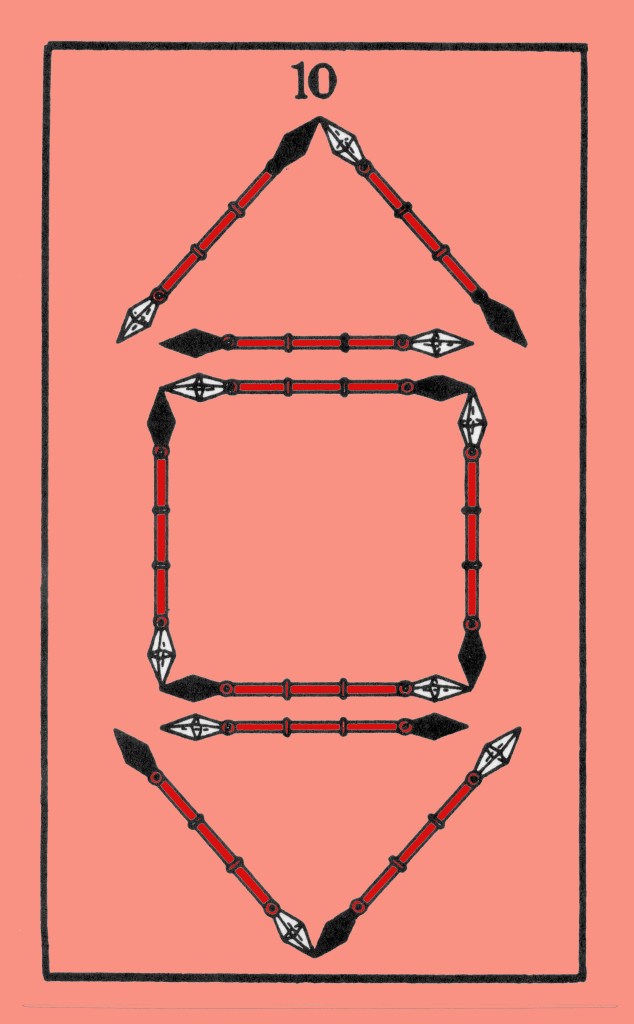
The Ten of Wands from the Builders of the Adytum (BOTA) tarot deck

Paul Foster Case (and Ann Davies)

The third decanate of Sagittarius is the time period from December 12 to December 21. In divination its meanings are those of the Tenth Sephirah combined with the planetary forces of the Sun and Jupiter, the zodiacal sign of Sagittarius together with its natural Ninth house of the Higher Mind.
Well-Dignified: generosity; success and honor in connection with the law, religion or philosophy; possibility of post of responsibility; gain through travel.
Ill-Dignified: ostentation; dogmatism; overbearing pride.
Note :- this card often carries the significance of a burden of responsibility of ‘too many irons in the fire’, or the need for a rearrangement of the Querent’s affairs or activities so as to get them in better order.
Keyword: Fullness of power.
(From The Oracle of Tarot course)

A. E. Waite

A man oppressed by the weight of the ten staves which he is carrying. Divinatory Meanings: A card of many significances, and some of the readings cannot be harmonized. I set aside that which connects it with honour and good faith. The chief meaning is oppression simply, but it is also fortune, gain, any kind of success, and then it is the oppression of these things. It is also a card of false-seeming, disguise, perfidy. The place which the figure is approaching may suffer from the rods that he carries. Success is stultified if the Nine of Swords follows, and if it is a question of a lawsuit, there will be certain loss. Reversed: Contrarieties, difficulties, intrigues, and their analogies.
(From The Pictorial Key to the Tarot)
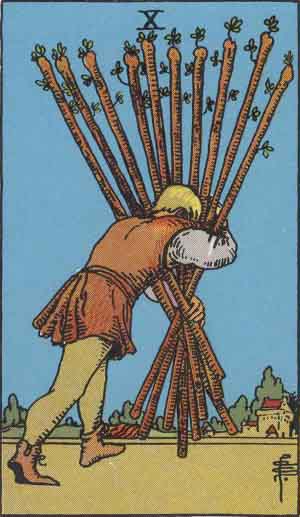
The Ten of Wands from the Rider Waite Smith tarot

Aleister Crowley

The Ten of Wands is called Oppression. This is what happens when one uses force, force, and nothing else but force all the time. Here looms the dull and heavy planet Saturn weighing down the fiery, ethereal side of Sagittarius; it brings out all the worst in Sagittarius. See the Archer, not shooting forth benign rays, but dealing the sharp rain of death! The Wand has conquered; it has done its work; it has done its work too well; it did not know when to stop; Government has become Tyranny. One thinks of the Hydra when one reflects that King Charles was beheaded in White hall!

[…]

The number Ten refers to Malkuth, which depends from the other nine Sephiroth, but is not directly in communication with them. It shows the Force detached from its spiritual sources. It is become a blind Force; so, the most violent form of that particular energy, without any modifying influences. The flames in the background of the card have run wild. It is Fire in its most destructive aspect.

The card also refers to the influence of Saturn in Sagittarius. Here is the greatest antipathy. Sagittarius is spiritual, swift, light, elusive, and luminous; Saturn is material, slow, heavy, obstinate, and obscure.

The eight Wands are still crossed, showing the enormous power of the completed energies of Fire; but they have lost their patents of nobility. Their ends seem more like claws; they lack the authority and intelligence shown in the earlier cards; and in front are the two formidable Dorjes of the Two of Wands, but lengthened to bars.

The whole picture suggests Oppression and repression. It is a stupid and obstinate cruelty from which there is no escape. It is a Will which has not understood anything beyond its dull purpose, its “lust of result”, and will devour itself in the conflagrations it has evoked.
(From The Book of Thoth)

The Ten of Wands from the Thoth tarot deck

Golden Dawn’s Book T

FOUR hands holding eight wands crossed as before. A fifth hand holding two wands upright, which traverses the junction of the others. Flames issuant. Saturn and Sagittarius.

Cruel and overbearing force and energy, but applied only to material and selfish ends. Sometimes shows failure in a matter, and the opposition too strong to be controlled; arising from the person’s too great selfishness at the beginning. Illwill, levity, lying, malice, slander, envy, obstinacy; swiftness in evil and deceit, if ill dignified. Also generosity, disinterestedness and self-sacrifice, when well dignified.
Malkuth of HB:V (Cruelty, malice, revenge, injustice).
Therein rule HB:RYYAL and HB:AVMAL.

Etteilla

Betrayal
Upright. In terms of spiritual medicine, this card, in its natural position, signifies: Betrayal, Perfidy, Cunning, Deception, Trickery, Surprise, Misdirection, Dissimulation, Hypocrisy, Prevarication, Duplicity, Dishonesty, Darkness, Falsehood, Conspiracy, Collusion. – Imposture.
Reversed. Obstacle, Concern. – Barrier, Hindrance, Contradiction, Difficulty, Pain, Work. – Inconvenience, Abjection, Dispute, Complaint, Stumbling block, Enclosure, Entrenchment, Fort, Fortification.

MQS

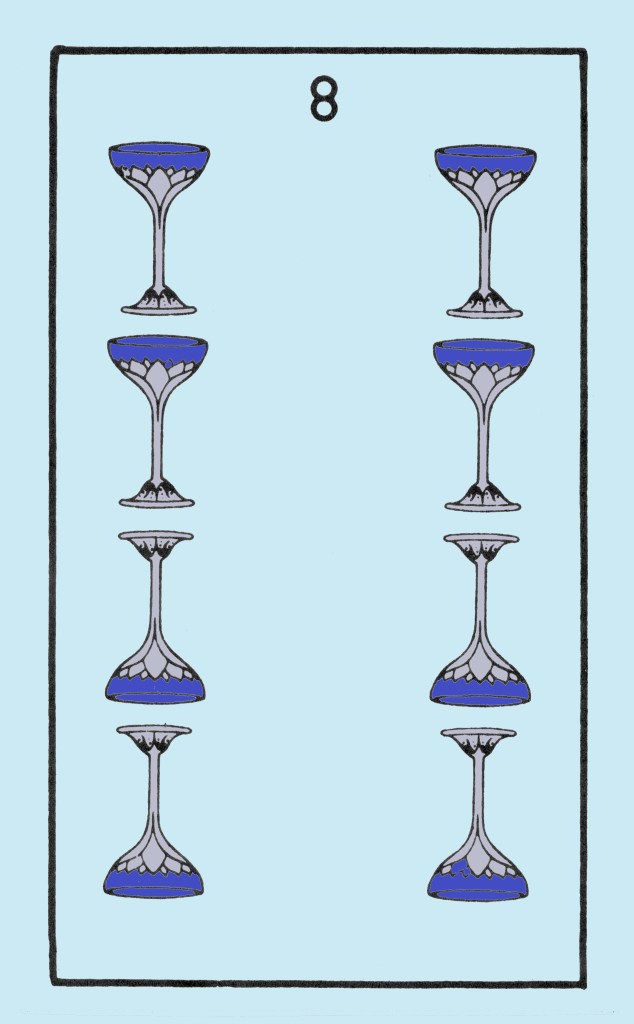
Tarot Encyclopedia – The Eight of Cups

(Note: this is a collection of the meanings attributed to the cards by some occultists in the past centuries. It does not reflect my own study or opinion of the cards. It is only meant as a quick comparative reference as I develop my own take.)

The Eight of Cups from the Builders of the Adytum (BOTA) tarot deck

Paul Foster Case (and Ann Davies)

The time period is the first decanate of Pisces, February 19 to February 28, ruled by Jupiter and Neptune.
Well-Dignified: renunciation of material success for something higher; interest in psychic and spiritual things; strong emotions; charity and helpfulness; love of travel and of scientific investigation.
Ill-Dignified: momentary success, but nothing lasting; the person to whom the card applies is overimpressionable, erratic and unsteady in his emotions; meaningless change of mood; purposeless journeying; querulous disposition.
Keyword: Instability
(From the Oracle of Tarot course)

A. E. Waite

A man of dejected aspect is deserting the cups of his felicity, enterprise, undertaking or previous concern. Divinatory Meanings: The card speaks for itself on the surface, but other readings are entirely antithetical–giving joy, mildness, timidity, honour, modesty. In practice, it is usually found that the card shews the decline of a matter, or that a matter which has been thought to be important is really of slight consequence–either for good or evil. Reversed: Great joy, happiness, feasting.
(From The Pictorial Key to the Tarot)

The Eight of Cups from the Rider Waite Smith tarot

Aleister Crowley

The Eight of Cups is called Indolence. This card is the very apex of unpleasantness. It is ruled by the planet Saturn; time, sorrow, have descended upon pleasure, and there is no strength in the element of water which can react against it. This card is not exactly “the morning after the night before”; but it is very nearly that. The difference is that the “night before” has not happened! This card represents a party for which all preparations have been made; but the host has forgotten to invite the guests; or, the caterers have not delivered the good cheer. There is this difference, though, that it is in some way or other the host’s own fault. The party that he planned was just a little bit above his capacity; perhaps he lost heart at the last moment.

[…]

The Eight, Hod, in the suit of Water, governs this card. It shows the influence of Mercury, but this is overpowered by the reference of the card to Saturn in Pisces. Pisces is calm but stagnant water; and Saturn deadens it completely. Water appears no longer as the Sea but as pools; and there is no florescence in this card as there was in the last. The Lotuses droop for lack of sun and rain, and the soil is poison to them; only two of the stems show blossoms at all. The cups are shallow, old and broken. They are arranged in three rows; of these the upper row of three is quite empty. Water trickles from the two flowers into the two central cups, and they drip into the two lowest without filling them. The background of the card shows pools, or lagoons, in very extensive country, incapable of cultivation; only disease and miasmatic poison can flourish in those vast Bad Lands.

The water is dark and muddy. On the horizon is a pallid, yellowish light, weighed down by leaden clouds of indigo. Compare with the last card; it represents the opposite and complementary error. The one is the Garden of Kundry, the other the Palace of Klingsor. In the psychopathology of The Path, this card is the German Measles of Christian Mysticism.
(From The Book of Thoth)

The Eight of Cups from the Thoth Tarot deck

Golden Dawn’s Book T

A WHITE Radiating Angelic Hand, holding a group of stems of lotuses or waterlilies. There are only two flowers shown, which bend over the two central cups, pouring into them a white water which fills them and runs over into the three lowest, which later are not yet filled. The three uppermost are quite empty.

U U U
U U
U U U

At the top and bottom of the card are symbols Saturn and Pisces.

Temporary success, but without further results. Thing thrown aside as soon as gained. Not lasting, even in the matter in hand. Indolence in success. Journeying from place to place. Misery and repining without cause. Seeking after riches. Instability.
Hod of HB:H (Success abandoned; decline of interest).
The Angels ruling are HB:VVLYH and HB:YLHYH.

Etteilla

Blonde girl
Upright. This card, as far as the medicine of the spirit is concerned, means, in its natural position: Blonde Girl, Honest Girl, Practical Girl, Honor, Modesty, Restraint, Timidity, Fear, Apprehension, Sweetness, Attraction.
Reversed. Satisfaction, Happiness, Contentment, Gaiety, Joy, Cheerfulness, Enjoyment, Fun, Celebration. – Apology, Reparation, Discompense. – Public Joy, Spectacle, Arrangement, Recollection, Preparations, Arrangements.

MQS

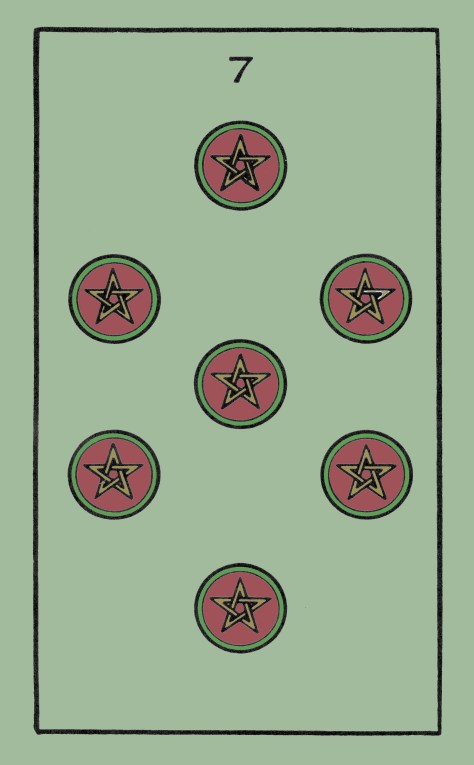
Tarot Encyclopedia – The Seven of Pentacles or Coins

(Note: this is a collection of the meanings attributed to the cards by some occultists in the past centuries. It does not reflect my own study or opinion of the cards. It is only meant as a quick comparative reference as I develop my own take.)

The Seven of Pentacles from the Builders of the Adytum (BOTA) tarot deck

Paul Foster Case (and Ann Davies)

The time period is the third decanate of Taurus, under the rulership of Saturn, May 11 to 20. Meanings:
Well-Dignified: slight gains, but of small account; much labor for small returns.
Ill-Dignified: something promising turns out badly; loss in speculation and unprofitable employment; financial restriction; unrealized hopes and
wishes.
Keyword: Loss
(From the Oracle of Tarot course)

A. E. Waite

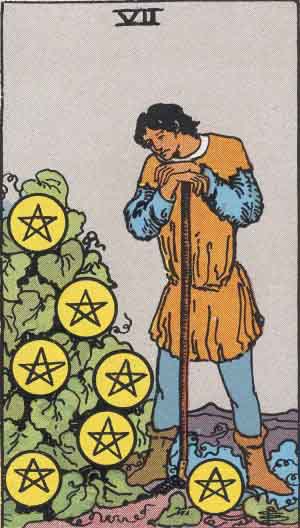
A young man, leaning on his staff, looks intently at seven pentacles attached to a clump of greenery on his right; one would say that these were his treasures and that his heart was there. Divinatory Meanings: These are exceedingly contradictory; in the main, it is a card of money, business, barter; but one reading gives altercation, quarrels–and another innocence, ingenuity, purgation. Reversed: Cause for anxiety regarding money which it may be proposed to lend.
(From The Pictorial Key to the Tarot)

The Seven of Pentacles from the Rider Waite Smith tarot

Aleister Crowley

The Seven of Disks is called Failure. This suit gives the extreme of passivity; there is no positive virtue in it below the Abyss. This card is ruled by Saturn. Compare it with the three other Sevens; there is no effort here; not even dream; the stake has been thrown down, and it is lost. That is all. Labour itself is abandoned; every thing is sunk in sloth.

[…]

The number Seven, Netzach, has its customary enfeebling effect, and this is made worse by the influence of Saturn in Taurus. The disks are arranged in the shape of the geomantic figure Rubeus, the most ugly and menacing of the Sixteen. (See Five of Cups.) The atmosphere of the card is that of Blight. On the background, which represents vegetation and cultivation, everything is spoiled. The four colours of Netzach appear, but they are blotched with angry indigo and reddish orange. The disks themselves are the leaden disks of Saturn. They suggest bad money.
(From The Book of Thoth)

The Seven of Disks from the Thoth Tarot

Golden Dawn’s Book T

A WHITE Radiating Angelic Hand issuing from a cloud, and holding a white rose branch. Seven Pentacles arranged like the geomantic figure Rubeus. There are only five buds, which overhang, but do not touch the five uppermost Pentacles. Above and below are the Decan symbols, Saturn and Taurus respectively.

Promises of success unfulfilled. (Shewn, as it were, by the fact that the rosebuds do not come to anything.) Loss of apparently promising fortune. Hopes deceived and crushed. Disappointment, misery, slavery, necessity and baseness. A cultivator of land, and yet a loser thereby. Sometimes it denotes slight and isolated gains with no fruits resulting therefrom, and of no further account, though seeming to promise well.

Netzach of HB:H (Unprofitable speculations and employments; little gain for much labour).
Therein HB:HRChAL and HB:MTzRAL are ruling Angels.

Etteilla

Money
Upright. This card, as far as the medicine of the spirit is concerned, means, in its natural position: Money, Wealth, Sum, Coin. – Silver. – Whiteness, Purity, Candor, Innocence, Naiveté, Moon. – Purgation, Purification.
Reversed. Restlessness, Torment of spirit, Impatience, Affliction, Remorse, Concern, Solicitude, Care, Attention, Diligence, Application. – Apprehension, Fear, Distrust, Misgiving, Suspicion.

MQS

Collection of Light in Astrology (with Example)

In another article, I discussed the technique called translation of light, which occurs when a planet collects the influence of one significator and translates it to the other.

There is another technique which is, in many ways, the opposite of translation, but has the same effect. This is called collection of light. It happens when a slower-moving planet has been in contact with a faster one, thus receiving its influence, and then another planet also comes into contact with the slow planet. Contact can happen by conjunction or by (usually) positive aspect, that is, sextile or trine, or at least with reception. As with translation, collection usually implies the presence of third parties or external circumstances bringing things together.

Whereas translation can only be effected by a fast planet, and therefore the Moon (or sometimes Mercury) is the most likely culprit, collection of light can only be caused by a slow planet, and therefore Saturn or Jupiter are the most likely intermediaries here.

Example: Is The Book Arriving At All?

My Bolognese Tarot teacher, who is now a good friend, has recently written a follow-up to her book on the 50-card method, and she wanted to send me a dedicated copy. She posted the parcel before Christmas 2024, but by January 6 it hadn’t arrived and I was worried it might have been lost or forgotten in some dispatchment center. So I asked the heavens.

Is the gift arriving at all? App used: Aquarius2Go

I am signified by Mercury, ruler of the ascendant. My teacher sent me the book in her quality of personal friend (it wasn’t part of a course or anything), so she is signified by the Eleventh House ruler, the Moon. The Moon also represents the flow of the action (keep that in mind for later). Her gift for me is her second house, that is, the second house from the Eleventh, i.e., the radical Twelfth, ruled by the Sun. My stuff is signified by Venus, ruler of my second house.

So, ideally, we would want the Sun to be reached by Mercury. How do we get them together? Well, we don’t, clearly, or at least not for a while and not before the Sun has left Capricorn. That’s a problem.

However, we note that the Sun has just sextiled Saturn, having been received by it as well. What is Saturn? Well, it rules the Fifth and Sixth Houses, so the closest thing I can think of is the courier/delivery service (Sixth, house of servants).

What happens to Saturn next? It is sextiled by the Moon. The Moon is the ruler of the Eleventh, my teacher/friend, but it doesn’t make sense (she sent the book, she’s not gonna receive it). However, in most horary charts, the Moon also signifies the flow of the action. So the flow of the action moves favorably (sextile) with the courier (Saturn): the book hasn’t been lost. What happens next is that my significator (Mercury) and the significator of my stuff (Venus) almost simultaneously meet Saturn: Mercury by sextile with reception by sign, Venus by conjunction with reception by exaltation. Even if we chose to disqualify the Venus conjunction because Venus squares Jupiter first, Mercury makes no other aspect before the Saturn sextile.

Thankfully, the book arrived yesterday (I’m gonna review it in the near future). Note that timing in this chart seems to fail: the chart was made on January 8, the parcel arrived on January 15. If we take the Moon sextile it is two degrees away (two days, two weeks), if we take the Mercury sextile it is 15/16something degrees away (again, 16 days). The only aspect that seems to come closer is the Venus conjunction with around 10 degrees (10 days, though it took 7). It is probable that the chart was simply responding to my core question: yes, it will arrive, and took timing for granted. It could also be that I’ve misread the chart and got lucky. If you have an idea, drop a line!

Either way, we’ve finally answered the age-old question: Why is Saturn so fat and slow? The better to collect your light!

MQS

Tarot Encyclopedia – The Five of Wands

(Note: this is a collection of the meanings attributed to the cards by some occultists in the past centuries. It does not reflect my own study or opinion of the cards. It is only meant as a quick comparative reference as I develop my own take.)

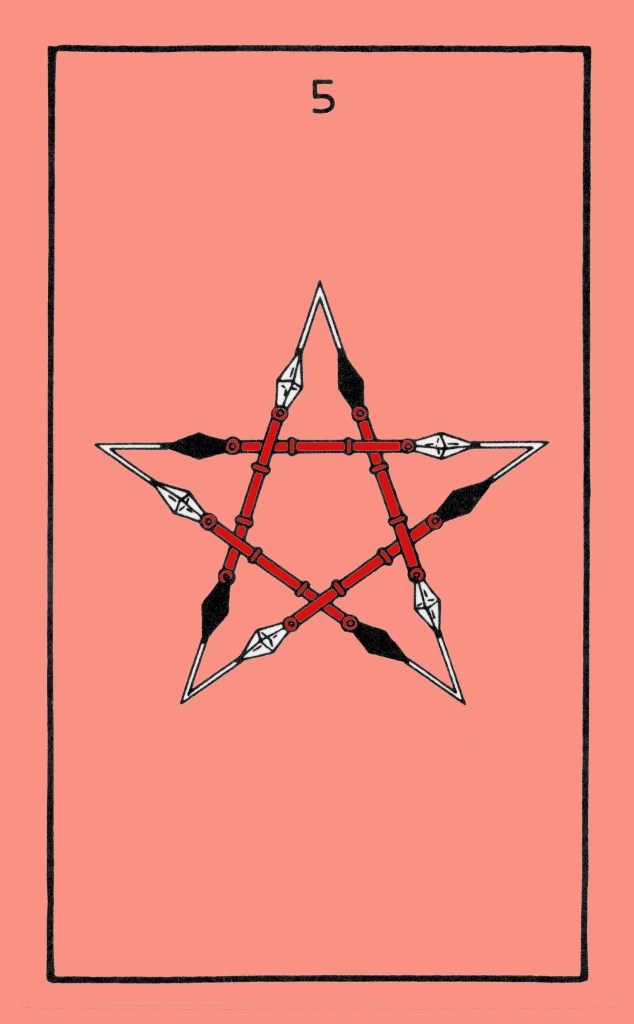
The Five of Wands from the Builders of the Adytum (BOTA) tarot deck

Paul Foster Case (and Ann Davies)

The first decanate of Leo encompasses the time period from July 23 to August 1. It is ruled doubly by the Sun, so that the Sun and its attributions have a marked influence on the meanings of this Key.
Thus the Five of Wands is a combination of the powers of Mars, active in Geburah and the powers of the Sun in Leo, together with the meanings of the number five and the pentagram. Key ideas associated with the Five of Wands are power and pleasure in exercising it. This is the combined influence of the strength resident in Geburah together with the pleasure associated with Leo and its natural fifth house in astrology.
The Martian influence gives a spirit of adventure and speculation, together with some uncertainty in carrying out plans. The Leo influence, a fixed fire sign, intimates strong attachments, either to family or in love affairs.
Well-Dignified: boldness, command and generosity.
lll-Dignified: cruelty, violence, lust, prodigality. –
Keyword: Competition.
(From the Oracle of Tarot course)

A. E. Waite

A posse of youths, who are brandishing staves, as if in sport or strife. It is mimic warfare, and hereto correspond the Divinatory Meanings: Imitation, as, for example, sham fight, but also the strenuous competition and struggle of the search after riches and fortune. In this sense it connects with the battle of life. Hence some attributions say that it is a card of gold, gain, opulence. Reversed: Litigation, disputes, trickery, contradiction.
(From The Pictorial Key to the Tarot)

Aleister Crowley

This card is referred to Geburah of the suit of Fire. Geburah itself being fiery, it is a purely active ,force. It is ruled also by Saturn and Leo. Leo shows the element of Fire at its strongest and most balanced. Saturn tends to weigh it down and to embitter it. There is no limit to the scope of this volcanic energy.

The symbol represents the wand of the Chief Adept, showing that the authority is derived from the superiors; were it not so, this card would be thoroughly disastrous. Moreover, there are also two wands of the Second, or Major Adept. They have the head of the Phoenix, which gives the idea of destruction (or rather purgation) through fire, and the resurrection of the energy from its ashes.

There is also a pair of wands of the Third, or Minor, Adept, which are daughters, so to speak, of the wands in the Three of Wands. In this card there is the mitigating influence of the Mother. One of the most difficult doctrines with regard to Geburah is that, while it represents all this tameless irrational energy and disturbance, yet it derives from the benign and gentle influence of the feminine.

The Egyptians understood this doctrine perfectly. Their Lion goddess, Pasht, was hailed as “saeva” and “ferox”, was even called “red in tooth and claw” by those fanatical devotees who wished to identify her with Nature. The idea of sexual cruelty is often inherent in the highest divine nature; compare Bhavani and Kali in the Hindu system, and observe the Shiva-Sakti coition portrayed on many Tibetan banners. See also Liber 418,4th, 3rd, and 2nd Aethyrs; and the description supra of Atu XI.
(From The Book of Thoth)

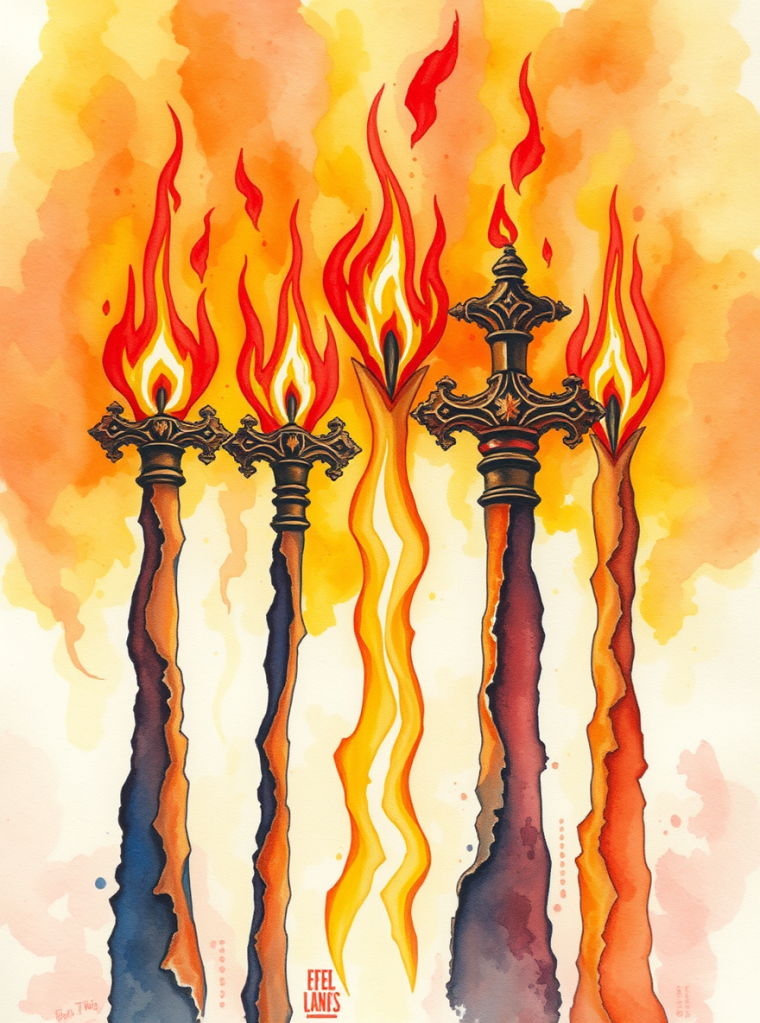
AI-generated illustration for the Five of Wands

Golden Dawn’s Book T

TWO White Radiant Angelic Hands issuant per nubes dexter and sinister. They are clasped together in the grip of the First Order, “i.e.” the four fingers of each right hand crooked into each other, the thumbs meeting above; and they hold, at the same time, by their centres, five wands or torches which are similar unto the wands of a Zelator Adeptus Minor. One wand is upright in the middle; the others cross each other. Flames leap from the point of junction. Above the middle wand is the sign Saturn, and below is that of Leo: thus representing the Decante.

Violent strife and boldness, rashness, cruelty, violence, lust, desire, prodigality and generosity; depending on whether the card is well or ill dignified.
Geburah of HB:Y (Quarrelling and fighting).
This Decan hath its beginning from the Royal Star of Leo: and unto it are allotted
the two great Angels of the Schemhamphorash HB:VHVYH and HB:YLYAL.

Etteilla

Gold
Upright. This card, as far as the medicine of the spirit is concerned, means, in its natural position: Gold, Wealth, Opulence, Magnificence, Sumptuousness, Splendor, Luxury, Abundance, Good. – Physical, philosophical and moral sunshine.
Reversed. Trial, Arguing, Differences, Altercations, Disputes, Disputes, Instance, Investigation, Judicial proceedings. – Contradictions, Arguments, Brig, Harassment. – Contradiction, Inconsistency.

MQS

The Problem With the Neighbors (Reading Example)

As I already talked about ad nauseam, some months ago hubby and I bought an apartment. During that period I kept track of the situation using various divination tools, including Horary. This is a reading that I didn’t cover, since I didn’t have any feedback for it yet.

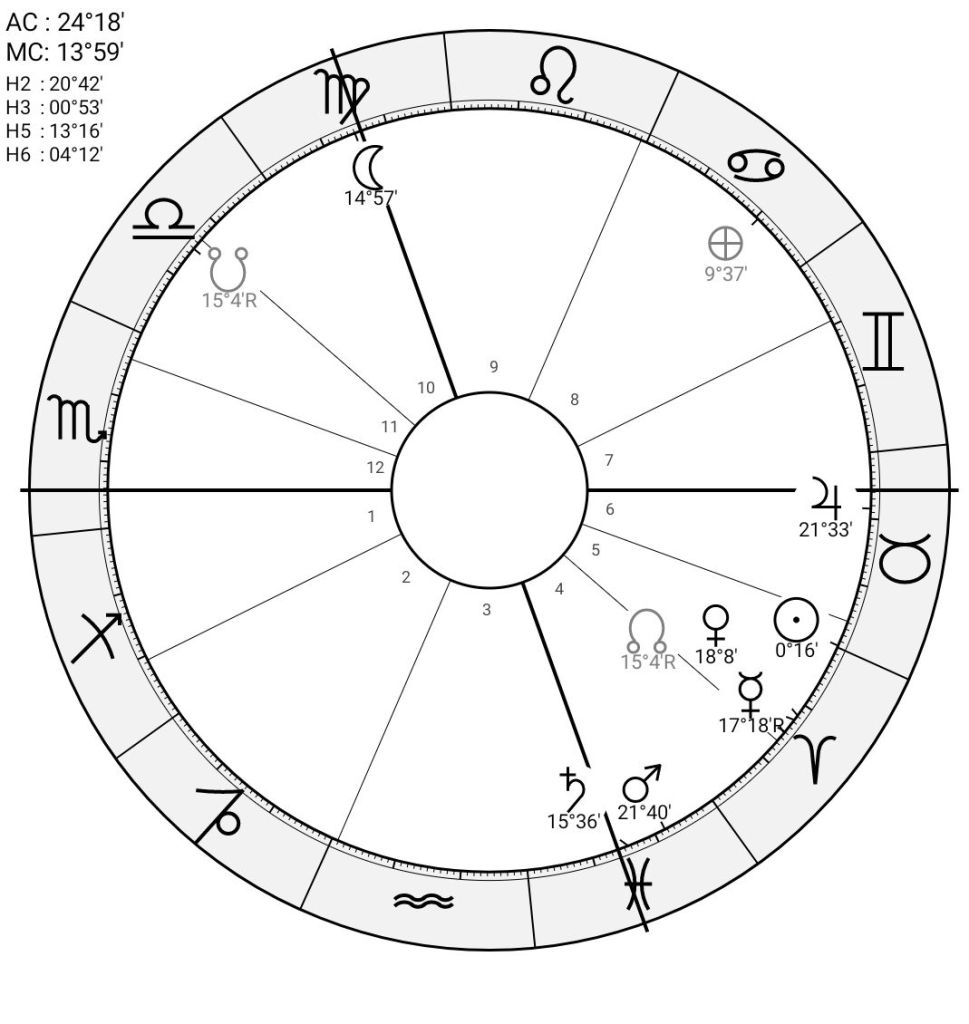
My question was simply if we would be happy in the new home. Here is the chart.

Will we be happy in the new home? Horary question. App used: Aquarius2go

We are represented by the First house and the planet ruling it, Mars (ruler of the rising sign Scorpio). As for which house represents the new place, I believe there are two schools of thought: either the Seventh House (that place there, as opposed to this place here, which is the First house), or the Fourth House of real estate and umoveable property.

The chart seems to guide us to the Fourth House. Plus, usually the Seventh house is reserved for hypothetical “there” places, whereas we had already bought the new place (therefore it was our property) and I was not interested in a comparison between the old apartment and the new, but only in the new place (I already hated the old one).

The Fourth House thus represents the apartment. Jupiter, ruler of Pisces, is the house. And look! Mars, our significator, is right inside the Fourth House, which is good and a symbol of liking the place. It has no major dignity in it (no house rulership or exaltation) but it is dignified by triplicity, term and face. So while it is not the ultimate castle of our dreams, it is very comfortable indeed.

The place’s significator, Jupiter, is conjunct the Seventh cusp and thus angular, and sextiles our significator. A sextile is a positive aspect of ‘friendship’. All in all the picture that emerges is not perfect, but it is quite satisfying.

However, look at the Moon! The Moon is about to oppose Saturn, which is right inside the Fourth cusp, afflicting it. There is some kind of problem ahead. Pinpointing it is not very easy, but considering that Saturn is inside the house representing the place itself and that Saturn rules the Third house, my first instinct was that there might be issues concerning the neighbors (the other people who live in the building). These issues would not be major, as the picture remains generally favorable, but they would be serious enough to be worth mentioning.

Fortunately, a couple of months passed and we saw that the neighbors are generally well-adjusted people. Furthermore, the apartment is, in fact, very comfortable.

What did turn out to be the problem was that the neighbors started some major fuss about the manager of the building as, according to them, he is incompetent and charges way too much for his services and even skims off on the money required for taking care of the building. The thing escalated so far as to almost end up in court, and finding a new manager is costing us quite a lot of time spent traveling and talking to new candidates.

MQS

Tarot Encyclopedia – The Three of Swords

(Note: this is a collection of the meanings attributed to the cards by some occultists in the past centuries. It does not reflect my own study or opinion of the cards. It is only meant as a quick comparative reference as I develop my own take.)

The Three of Swords from the Builders of the Adytum (BOTA) tarot deck

Paul Foster Case (and Ann Davies)

The time period is the second decanate of Libra, under the combined rulership of Saturn and Uranus, October 3 to October 12. Because Libra is involved, remember that the qualities of the Seventh house are prominent.
Well-Dignified: this is nevertheless a Key depicting sorrow, disappointment and tears, but it can be the beginning of deep understanding as to the basis and cause of our problems; disruption of friendship; interruption of cherished projects; quarrels; occasionally the position in the layout may indicate platonic friendships; in money matters this card is almost always a symbol of loss, but indicates that whatever money matters are under consideration have been fair and honest, so that no blame attaches to anyone for the loss.
Ill-Dignified: slander; selfishness and dissipation; deceit with respect to promises; loss in legal affairs.
Keyword: Sorrow
(From the Oracle of Tarot course)

A. E. Waite

Three swords piercing a heart; cloud and rain behind. Divinatory Meanings: Removal, absence, delay, division, rupture, dispersion, and all that the design signifies naturally, being too simple and obvious to call for specific enumeration. Reversed: Mental alienation, error, loss, distraction, disorder, confusion.
(From The Pictorial Key to the Tarot)

Aleister Crowley

The idea of division, of mutability, the idea of the airy quality of things, manifests itself in the Three of Swords, the Lord of Sorrow. Here one is reminded of the darkness of Binah, of the mourning of Isis; but this is not any vulgar sorrow dependent upon any individual disappointment or discontent. It is Weltschmerz, the universal sorrow; it is the quality of melancholy.

[…]

Binah, the Great Mother, here rules the realm of Air. This fact involves an extremely difficult doctrine which must be studied at length in The Vision and the Voice: Aethyr 14.
Binah is here not the beneficent Mother completing the Trinity with Kether and Chokmah. She represents the darkness of the Great Sea.
This is accentuated by the Celestial Lordship of Saturn in Libra.
This card is dark and heavy; it is, so to speak, the womb of Chaos. There is an intense lurking passion to create, but its children are monsters. This may mean the supreme transcendence of the natural order. Secrecy is here, and Perversion.
The symbol represents the great Sword of the Magician, point uppermost; it cuts the junction of two short curved swords. The impact has destroyed the rose. In the background, storm broods under implacable night.
(From The Book of Thoth)

A gruesome AI-generated illustration for the Three of Swords

Golden Dawn’s Book T

THREE White Radiating Angelic Hands, issuing from clouds, and holding three swords upright (as though the central sword had struck apart the two others, which were crossed in the preceding symbol): the central sword cuts asunder the rose of five petals, which in the previous symbol grew at the junction of the swords; its petals are falling, and no white rays issue from it. Above and below the central sword are the symbols of Saturn and Libra.

Disruption, interruption, separation, quarrelling; sowing of discord and strife, mischief-making, sorrow and tears; yet mirth in Platonic pleasures; singing, faithfulness in promises, honesty in money transactions, selfish and dissipated, yet sometimes generous: deceitful in words and repetitions; the whole according to dignity.
Binah of HB:V (Unhappiness, sorrow, and tears).
Herein rule the Great Angels HB:HRYAL and HB:HQMYH as Lords of the Decan.

Etteilla

Removal
Upright. This card, as far as the medicine of the spirit is concerned, means, in its natural position: estrangement, Departure, Absence, Discarding, Dispersion, Remoteness, Delay. – Contempt, Repugnance, Aversion, Hatred, Disgust, Horror. – Incompatibility, Contrariness, Opposition, Unsociability, Misanthropy, Incivility. – Separation, Division, Breaking, Antipathy, Section, Cutting off.
Reversed. Misdirection, Dementia, Vanity, Alienation of spirit, Distraction, Insane conduct. – Error, Miscalculation, Loss, Deviation, Discard, Dispersion.

MQS

The Geomancy of Peter of Abano – Book III Pt. 9

Previous / Back to Index / Next

Here Abano talks about the meanings of Caput Draconis and Cauda Draconis in the various houses.

Caput Draconis (The Dragon’s Head or North Moon Node)

Caput Draconis in the first house means good luck, noble people, wise people, leaders, captains, honor, dignity, a prelate.1
In the second it means good success, gaining wealth or dignity or money.
In the third it means noble brothers and sisters, lucky siblings, good through them, isolated gardens2, pleasures.

In the fourth it means good for the parents, inheritance, buildings, cities, citizens, noble people, good end to an issue.
In the fifth it means science, good children, gain and help through them.
In the sixth it means good servants, faithful servants, good officials, grave infirmity, melancholic infirmity,3 long fevers.

In the seventh it means honorable women, good marriage, good company, gain from noble people or from women and thanks to them.
In the eighth it means inheritance, goods gain from the dead, usefulness through women and noble people, gain through war and by violence against life, being beheaded.4
In the ninth it means honoring God, ecclesiastical dignity, religious people, noble people, good journeys, delay in coming back but with good results, a messenger with bad news, messenger bearing news of legal issues, ingeniousness in a noble science.

In the tenth it means the king, the emperor, the lord, a magistrate, dignity, honor, good regents and orators, noble people.
In the eleventh it means noble soldiers, captains, dignity, sublimation5, succeeding one’s lord, faithfulness, valor, good luck.
In the twelfth it means noble inheritance through the mother, honorable things for [or through] women, few enemies, weak enemies, certainty, fame.

In the thirteenth it means journeys, messengers, a king, lords, usefulness, gain, honor, dignity, friendship and good recoglientia.6
In the fourteenth it means coming back from a journey with dignity and mirth and gain, letters, positive answer, honors, dignity, usefulness.
In the fifteenth it means a good end to the question and strong hope.7

Cauda Draconis (The Dragon’s Tail or South Moon Node)

Cauda draconis in the first house means evil disposition of the querent or of the quesited, fear of death, being murdered.8
In the second it means wealth gain through illicit means, theft, violence.
In the third it means iniquity against siblings and relatives, remains, retaliations, killings on the streets.

In the fourth it means loss of inheritance, evil lands, evil people, betrayals, false rumors, destruction of a city or fortress.
In the fifth it means evil children or women, loss of children, danger during childbirth, loss of blood.
In the sixth it means evil servants, runaways, grave illness, bodily fluids, killing, desperation, damage.

In the seventh it means a harlot, vile marriage, evil company, unfaithfulness, betrayal, violence, enmity.
In the eighth it means fear of death for [or through] women, rumors, freedom from prison and from illness, loss through women, being killed, loss of blood and flobotomia.9
In the ninth it means being forced on a journey, loss, danger of death, toil, changing one’s religion, evil or false religious people, evil Christians,10 evil messengers, death during a journey.

In the tenth it means an evil lord, traitors of one’s country, iniquitous judges or orators, overthrowing tyrants, loss of dignity, destruction of one’s kingdom.
In the eleventh it means wrongful succession, betrayal, violence, rebellion, death of one’s lord.
In the twelfth it means hidden enemies of the kingdom, machinations, treason against one’s lord, assassinations both public and private, violence.

In the thirteenth it means betrayals during a journey, hate from noble people, the absent party doesn’t come back.
In the fourteenth it means toiling for gain and honor, bad luck, hatred from underlings and very evil enemies, overcoming one’s enemies,.
In the fifteenth it is the worst of all, eccept for doing evil things.11

MQS

Footnotes
  1. Possibly due to the Moon’s North Node connection with beginnings and with increase, as well as the connection of the term ‘head’ with leadership. ↩︎
  2. The text seems to say “giardini solati”, and I am not sure if it means isolated gardens or gardens in the sun or something else that escapes me. The connection with gardens is clear, as the Third House rules neighborhoods and therefore what’s around the house. ↩︎
  3. Illnessess were traditionally categorized based on the prevailing humor. ↩︎
  4. This is another excellent example of how to read the meaning of the figure into the meaning of the house. Caput Draconis is the head, and the Eighth House rules death, thus giving beheading (death by losing one’s head). Of course much depends on the question and the rest of the Shield. ↩︎
  5. This is not clear. ↩︎
  6. An archaic Italian word of whose meaning I am unaware. ↩︎
  7. Caput cannot be the Judge. ↩︎
  8. It is usually said that Cauda being in the First House is enough to break the figure. However, here Abano gives us coherent interpretations. Most of them are very dramatic, but it’s the principle that counts and needs to be assimilated. ↩︎
  9. A term belonging to the vocabulary of Medieval medicine. I do not know what it means. ↩︎
  10. Probably to be interpreted as evil believers in general, nowadays. ↩︎
  11. Cauda cannot be the Judge. ↩︎

The Geomancy of Peter of Abano – Book III Pt. 8

Previous / Back to Index / Next

Abano talks about some of the meanings of Carcer and Conjunctio in the various houses.

Carcer

Carcer in the first means difficulties, preoccupations, melancholy, prison, deep thoughts, secret thoughts.
In the second it means delay in gain and increase, success through toil, but with difficulty.
In the third it means evil siblings, dishonest pleasures, dishonest and disgraceful neighbors, licentiousness with siblings.

In the fourth it means fortresses, cities, stable buildings, inheritance, abudance, hidden treasures, hidden things.
In the fifth it means miscarriage, dead children,1 danger through childbirth, evil children, lame children, or deranged or possessed, womanly pains.
In the sixth it means good, trustworthy servants, gain from animals, long sickness, danger and pain, crying.

In the seventh it means chaste women, stable marriage, good company,2 faithful people, stable peace, people who can keep secrets.
In the eighth it means death, interment, hiding treasures and goods from the dead, funeral or congregation of people caused by a death.
In the ninth it means religion, serving God, hidden things coming to light, long travel or pilgrimage, good monks, just people, faithful Christians.

In the tenth it means a stable kingdom, lordship, palaces, just judges and orators.
In the eleventh it means succession in a kingdom, oppressing enemies, gain with difficulty, hidden machinations, frauds, rumors.
In the twelfth it means dangerous hidden enemies, long imprisonment, death of the inmate.

In the thirteenth it means danger from childbirth, miscarriage, dangers for the mother, long illness, bad in everything.
In the fourteenth it means freedom from dangers and other issues, but after much trouble, leaving all problems behind.
In the fifteenth it means inner strength, delay in getting one’s wish.

Conjunctio

Conjunctio in the first house means an evil disposition, machinations, fraud, cheating, unstable life, a variety of colors.3
In the second it means merchandise, gain through one’s ingenuity, being active, promptness.
In the third it means ingenious brothers and sisters, good short journey and a speedy return, a messenger, false letters, having fun in company.

In the fourth it means good for the father, good inheritance, a beautiful building, ingenious actions, divisions among citizens, killings, rumors, betrayals among them [the citizens]4
In the fifth it means mirth through one’s children, giving birth, false women, a fun evening.5
In the sixth it means good but petty servants, fugitives, various illnesses but not grave, thieves in one’s family.

in the seventh it means iniquitous women, petty women, harlots, false company, thieves, scuffles and brawls, war, a sad marriage, various colors.
In the eighth it means a prisoner being hanged, for the ill man it means death, and likewise for the absent party, desperation, danger of death for women [or through women].
In the ninth it means intelligence, various interests, various journeys, various fatherlands, traveling to acquire knowledge or virtue.

In the tenth it means official documents, judges, litigations, kings, lords, various offices, dignity.
In the eleventh it means promises or oaths, dispatching soldiers or courtesans, instability, wrongful succession, wrong faith.
In the twelfth it means hidden enemies, betrayal, damage through evil animals, infamy, detractions, dishonor, but it is good to buy animals.

In the thirteenth it means good luck in the quesited thing, in marriage and in doing good.
In the fourteenth it means well for litigations and scriptures or writings, for promises and for lordships and congregations.
In the fifteenth it means happy ending and good luck depending on the question.6

MQS

Footnotes
  1. Elsewhere Carcer is given as positive for pregnancies. ↩︎
  2. Usually Carcer signifies solitude. Perhaps, though, if the question is about someone else’s goodness it may indicate a serious character. Needless to say, much depends on the configuration as a whole. ↩︎
  3. Conjunctio’s description is perhaps where Abano is at his most contradictory, possibly highlighting the inherently contradictory nature of this mercurial figure. Keep in mind that Mercury was seen not just as messenger but as patron of thieves. ↩︎
  4. Possibly here Mercury suggests the idea of partisanship. ↩︎
  5. The latin word ‘conjunctio’ can literally means the act of being joined to another in intercourse. ↩︎
  6. Often Conjunctio is taken to means a middling result. ↩︎

The Esoteric Side of the Loneliness Epidemic

In scrolling on youtube I must have passed the third or fourth pompous video essay on the loneliness epidemic and the atomization of society. Then I had to laugh as I looked at myself from the outside, lonely in my office, my eyes glued to a stupid screen, which is usually what these videos complain about. I don’t like complaining, but I do like observing.

From an astrological standpoint, loneliness is ruled by Saturn, the greater malefic. Let me stress the word ‘malefic’. Generations of people better than us had no problem calling Saturn and Mars malefic and acknowledging the presence of evil in the world, yet the Becky’s and LaRhonda’s of the world who spend their time deluding themseves manifesting on social media think the concept of evil is beneath them.

It is, by the way, no moralistic notion of evil. Evil is simply that which is contrary to life (life being understood not vitalistically, but as outward expression of the metaphysical process of emanation).

Saturn is evil, greatly so. Even the few gifts it has for us are laced with poison: its deep wisdom, discernment and secret philosophy are often accompanied by illness, depression, poverty, general gloominess of circumstances. Saturn is not the cantankerous but loveable teacher that it is made out to be in pop astrology.

This doesn’t mean that Saturn is an unaccountable Satan like that of the exoteric tradition of many religions: Saturn does actively take part in the process of creation, but it usually does so by fulfilling the destructive and separative part of the equation. For instance, in some old hermetic and astrological texts Saturn is said to rule the first part of the pregnancy. This is the part where the soul becomes bound to the biological process of an individual body.

Through Saturn we become ‘this thing here’, before the other planets add their traits. Because we become ‘this thing here’ we also become subject to death, also ruled by Saturn, who is thus the first Planet we encounter descending and the last one we encounter ascending. Our being one thing, one individual, is the result of Saturn’s work.

As such, our existence as individual, ‘saturnian’ beings is also the basis of our loneliness, which is the presupposition of all we can do and achieve in life, all the social, political, cultural and economic structures we can weave together with other people.

It is not casual that all totalitarian ideologies seek to break down the ties that bind us to other people. All ideologies aim to push a certain image of humanity that corresponds to that ideology’s idea of good, but this image is usually the product of the ideologue’s deep delusion and would never occur by itself. The ideologue’s push becomes therefore a push for the reconstruction of humanity from the ground up.

And what is the ground? Saturn! The isolated individual, the one who has been torn from his or her social, moral, spiritual fabric is an individual who has been reduced to the Saturn phase of his conception, the phase where all we can say about them is that they are one thing, but before the other planets (let alone life experience) have added their specifications. The ideology then seeks to add its own imprint on this amorphous thing.

We do not live in times of totalitarian rule (anyone who argues the contrary has likely never experienced the horrors of totalitarianism). But we do live in times where there are people who profit from our isolation in a similar way.

So what is the conclusion? There is no conclusion. This is just a collection of notes as I observe the world around me. I am not suggesting any conspiracy or any evil master plan. I am merely observing who profits and who doesn’t from the current state of affairs. It is a simple reflection on what it means, from a magical standpoint, to isolate people.

MQS