Tag Archives: religion

The Trouble with Keywords

This reflection was prompted by witnessing how shallow many people discussing the Enneagram are, but it applies to anything connected with spirituality and occultism, including divination.

Keywords can be a great learning tool, and often they tend to stand us in better stead than cheap, unguided intuition. There’s also the false assumption that keywords are useful only until our intuition kicks in, but that presupposes that what most people call intuition is serviceable at all beyond suggesting sugary commonplace statements (true intuition is another thing altogether, of much nobler origin, and a much rarer phenomenon).

But keywords, too, must be handled with care. I was at an Enneagram retreat and we were discussing Type One, which everyone kept referring to as the Perfectionist or the Critic. At which point everyone and their mother started realizing that they, too, were perfectionists and sometimes too critical, even if they didn’t think they were a One.

The trouble with keywords is that they are effective at condensing knowledge and understanding only as long as that understanding has taken place beforehand. Otherwise, keywords veil just as much as they reveal. Taken at face value, and not as quick stands-in, they lead us astray.

Type One is constantly in a tension between their irreflective urges and the perceived need to justify them in front of an (internal) higher authority, so they end up trying to align those immediate urges with ‘what’s right’. If this then expresses as criticism or perfectionism, it is purely an outward manifestation. A Type Six can be just as perfectionistic because abiding by a certain ideal gives them peace and security and soothes their fear of being left to their own devices. In fact, any type can be perfectionistic in a way that fits their internal dynamic.

The trouble with keywords is therefore that we  simply take them at face value from our own perspective, without seeing them as condensations of deeper knowledge. In the case of the Enneagram, a Six will hear “perfectionism” (Type One) or Helper (Type Two) and apply it to themselves.

Even a Type Five can see themselves as a Helper if they find themselves giving out knowledge to others whom they deem to be helping. But a Five is motivated by themes of (in)adequacy and (in)competence to function in the world, which they compensate for by acquiring knowledge. A Two (the Helper) is motivated by the need to be seen, loved and confirmed in their existence by another.

What I just applied to the Enneagram is valid for pretty much all fields of occultism, and for that matter all fields of life. But especially in occultism, whether it be divination, magic or devotion, we are trying by definition (occult is what is hidden) to look past the veil of appearances and to go to the essence of things. Essence is an unfashionable word in our postmodern world, where everything is performative and internally empty, Yet keywords are useful only in so far as they represent on the surface what lies beneath. Once the connection is lost, occultism becomes the confused research so many people rightfully consider it to be.

MQS

“I Do X But I Am Still Miserable”

I keep coming across people on the Internet who dabble either in magic or spirituality (generally alternative spirituality) who lament that after a while they still feel miserable. Although my heart breaks for them, I think there is great confusion surrounding the place of spirituality and, let’s say, alternative practices.

One of the very few perks of rigid orthodoxy is that it exists beyond individual’s will, so that each practitioner needs to adapt to it rather than adapting it to themselves.

Once the idea of orthodoxy crumbled, at least in the West, spiritual and other practices became a supermaket of parts that each person could adapt to their own whim, picking and choosing what currently fit their mental narrative.

Although with some discernment this power of personal choice  can yield great results, what in practice often ends up happening is that spirituality is reduced to a crutch for personal prejudices about oneself, others and the world.

In the end, each individual flavor of postmodern spirituality is more an inkblot test of what the person would be better off discussing with a therapist than a workable spiritual path.

What’s more, the expectation of finding a definitive cure for life is always dangerous: firstly, because life is not an illness; secondly, because spirituality is not a good substitute for therapy or other forms of support; and thirdly, and most importantly, because anything that promises to turn our life into happy trip is always to be looked at with skepticism. No serious spiritual or magical doctrine can promise that.

The life of someone who always smiles and is always happy is not balanced. If anything, it’s creepy. There is a time for happiness and there is a time for sorrow. A balanced person is someone who responds to life in an adequate manner depending on the concrete situation. Look at the traditional descriptions of wisdom in Daoism or ancient Western philosophy, and you’ll always note that the wise person is the one who always reacts in the adequate manner, with as little influence from their personal demons as possible.

It is unfortunate that these practices are often the go-to for people who would benefit from other types of help. Sometimes they simply cannot afford official help, and this is another conversation, so they simply look for something they can afford and promises them miracles.

MQS

Plotinus vs Proclus From a Hermetic Magical Standpoint

When it comes to searching for philosophical-magical inspiration from pre-Christian times, many occultists look at Plotinus and Proclus, two of the most important among Plato’s successors. After Plato, they are the most noteworthy representatives of Platonism, and if Platonism is up your alley, as it is right up mine, you’ve probably looked into them.

Proclus, who was one of Plotinus’ successors as head of the Academy, and was also the last noteworthy Platonist, is especially popular among those who seek inspiration for magical work. The reason is that, unlike Plotinus, Proclus did have a strong interest in religious and magical practices as well as being an important philosopher.

My personal preference, though, is Plotinus. I discovered his work, the Enneads, in my late teens and read it all throughout college. Unlike Proclus, Plotinus was a pure philosopher, with no interests outside of philosophy. Yet his writings have inspired many generations of theologians, occultists, hermeticians and devotees.

Writing at a time when Christianity and other early odd religious beliefs held sway, Plotinus managed to single-handedly revive philosophy as an exalted pursuit that connected the mind with the divine realm. Although he did not appear out of nowhere (his predecessors at the Academy had already laid the groundwork), his genius does tower over anything and anyone who lived in his time.

Plotinus had the aspiration to simply explain Plato’s work, and as a matter of fact we often find assertions in his writings that he is doing nothing more than saying what Plato has already said. But this is not true. His philosophy sought to coherently explain the whole of reality starting from the initial unity, and to trace the steps that mortals can take to re-experience that unity in their ascent back to the One. Although one could argue that the same aspiration is present in Plato, and especially in his esoteric doctrines, the two philosophers are still very much distinct, as is to be expected, considering how many centuries separate them.

From a philosophical standpoint, Proclus is not a cipher like some others of Plotinus’ successors. In fact, he was a gifted philosopher, who would have probably contributed much more, had he lived a couple of centuries earlier. Yet most of the innovations he introduced in the Platonic doctrine feel like complications rather than meaningful developments. His (over)zealous attempts at systematizing and consolidating the entire wisdom of the Greeks, from religion to philosophy to magic, may appear impressive at first, but soon one realizes that they are just the last ossification of the dying world of classical antiquity.

His systematic fervor, so appreciated by Hegel, finds a neat little place to everything that the Greeks had produced, yet at the cost of sucking them dry of their lymph. Everything is there–the gods, the beliefs, the art, the spirituality, the science of the time–yet only as an empty husk, as a relic with a tag underneath in an intellectual museum.

What many occultists today admire in Proclus is his commitment to theurgy. And from that standpoint, Proclus is definitely an important source of inspiration for us. Yet even that was a product of the crisis of the Greek worldview and of Proclus’ spiritual weakness (or rather, of the spiritual weakness that was typical of his time).

Plotinus, still firmly rooted in the Greek tradition, had no place for rituals. Union with the divine was certainly the aim of his philosophy, but his method was and remained that of philosophy, that is, pure inner moral, intellectual and spiritual cultivation. It’s not that he didn’t believe in the gods or in magic. He simply thought the method of philosophy was superior.

But by the time Proclus came to prominence, the old Greek confidence in the sole power of the human mind had crumbled under the attacks of early Christian or Christian-inspired irrationalism. Everywhere Proclus looked, people were scrambling for a source of salvation outside of themselves, because they felt small and powerless in an uncertain world. Come to think of it, we don’t live in much different times today.

Nothing that belongs to history can ever be retrieved and applied 1:1. But it is certainly permissible to look for inspiration. From a philosophical standpoint, there is no contest: Plotinus’ philosophy is still very much alive, if one knows how to get to its pulp, how to work with it, where to trim, where to add, where to change a part. By contrast, Proclus’ philosophy feels rigid, like a sculpted sarcophagus lid trying to capture the likeness of the dear departed.

From a magical standpoint, one would think that Proclus, given his interest in the topic, would have more to offer than the scoffing, eyebrow-raising Plotinus. Yet a look at Renaissance magic, heavily inspired by Plotinus’ philosophy, tells us otherwise. In fact, though Plotinus’ Enneads are a challenging text, the reader often comes across evocative bits full of beauty and wonder that may be easily adapted to prayer, ritual and other magical aims.

The fact is that Plotinus’ philosophy is a living thing that captures something universal, so it is a good framework for other pursuits, including occultism, while Proclus tried to supplement philosophy with magic because he had no confidence in it, so even his view of magic is remedial and somewhat desperate.

I do not mean to be overly critical of Proclus. He did what he had to, given the circumstances he found himself in. Plus, there is much in his work that can be salvaged, if one has the patience to wade through the abstractions. But what one cannot get from Proclus, or at least what I cannot get from him, is the sense that the cohesive picture he presents is still alive, whereas Plotinus’ system is considerably harder to recontruct, and less cohesive than Proclus’, but feels animated by a flame that was alive before him, was alive in him and will be alive forever.

MQS

Mentalism in Hermeticism vs Modern Occultism

Following up on yesterday’s post about the Kybalion, I felt the need to clarify a bit further the difference between the panpsychism or mentalism of traditional Hermeticism as opposed to that of modern occultism, as espoused in books like the Kybalion. It is actually a topic that deserves a much longer discussion, and maybe one day I’ll start that discussion. This is just a short collection of incomplete notes.

The trouble with philosophical terms is that they often originate in ancient times, but they develop additional or alternative meanings as history goes on. The term psyche, for instance, is usually taken in a psychological sense today, but in most older philosophers it was just the term for ‘soul’. The idea of soul, in turn, was somewhat different in pre-Christian pagan philosophy than it ended up being after Christianity took over.

When we read in texts like the Kybalion statements like “the universe is mental” (in the sense of part of the mind, not in the sense of crazy, which would be understandable) and compare it with assertions found in the Hermetica about the nous (usually translated mind) revealing itself as the ultimate principle; or even when we compare it with the great presocratic philosophers that certainly inspired the mysteries that later merged into the Hermetic tradition (take Heraclitus’ “the limits of the soul you could not discover”, or Anaxagoras’ assertion that the mind/nous is the principle that orders all things), then we would at first think that this person writing the Kybalion must have been exactly in the same tradition.

But between the ancient notion of mind and the Kybalion’s notion of mind there are two millennia. Two millennia during which Christianity essentially reinvented the concept of soul to mean something much closer to what we understand it to be; then modern philosophy radicalized the subject-object and mind-world distinction; then Idealism mashed everything together again into a new panpsychism that is only an echo of the ancient one; then philosophical decadence set in, leading to the gradual dissolution of all great philosophies; during which time the notion of psyche or mind was slowly appropriated by people attempting to treat it according to the scientific method (those who would later become the first psychologists), as well as by irrationalists of the vitalistic trend.

Against this background, it is unreasonable to think that the concept of mind would remain the same, especially since XIX century occultism is largely the product of the post-revolutionary (as in French revolution) desire for the exotic and strange that the revolution had wiped away together with the old regime.

When there is a historical paradigm shift, finding ourselves in the new paradigm usually estranges us from the old one, and since we operate from the new paradigm, we tend to apply its categories in our attempt to understand how the old paradigm was. This, for instance, is also what led people after the French revolution to look at the tarot as an incomprehensible artifact with arcane meanings, even though it was perfectly understandable within the medieval framework in which it was created.

Well, the cultural paradigm from which the author of the Kybalion talked about the mind is evidently modern. This, in itself, is not bad. No one says that old Hermeticism had all the answers and everything past that is junk. I am not a reactionary who believes all that needed to be said and done has been said and done in times of yore and now all that is left is to go back to it.

The problem arises when the author of the Kybalion is so clearly ignorant of his own paradigm that he uses it to concoct a philosophy that is just a mediocre expression of its own Zeitgeist but uses enough words of the old Hermeticism to make it seem as though he is just summing up millennia of history in a pamphlet. This, in itself, is clearly un-hermetic.

Again, creating new philosophies is not in itself a problem. The problem is that modern occultism (of which the Kybalion is an expression, and not even the best one) is intellectually stuck in that period and has turned into a philosophical and spiritual cul-de-sac of misunderstandings.

In that cul-de-sac, mentalism is simply the triumph of the subjectivistic view of the mind that was en vogue at the time, and that forms the framework of today’s nonsense (see law of attraction, for instance); whereas in the old philosophy, the mind was generally seen as a superior ordering principle of which humans could partake (when they were reasonable, that is, reason-like) but not exhaust.

MQS

Stuff You Don’t HAVE To Believe: Reincarnation

We talked about Karma and manifestation. Now let’s tackle reincarnation. Unlike manifestation, which is based on pure New Thought superstion and is indefensible from all standpoints, logical, philosophical, moral and practical, reincarnation does have a noble tradition behind it. Still, the magical inheritance of Victorian occultism has made it almost so as if reincarnation is another one of those compulsory beliefs that come with the Spiritual Outsider starter pack.

Reincarnation reentered Western occultism largely through the many misunterstandings of Eastern doctrines perpetuated by the Theosophists. Yet, contrary to what some may think, reincarnation is not an exclusively Eastern belief, and it is found in many parts of the world, including in pre-Christian (and sometimes even Christian) Europe. In fact, the idea of reincarnation is probably suggested to the mind by the observation of the cycles of nature, so it is, in a way, a somewhat valid inference, at least from an analogical standpoint.

But analogical inferences do not reality make. If that were the case, you could slap four wheels on your grandma and call her a Ferrari. Regardless of how reincarnation may be suggested to the mind of ancient civilizations, let us ask ourselves why it is the go-to belief of many self-styled independent thinkers.

I would submit that, once the average Westerner abandons the idea of Heaven and Hell as expoused by our main religions in order to approach the occult or magical worldview, they find themselves wanting for another destination for their great hereafter, so they grope around for the first purple-covered book in the local esoteric library, where they invariably find reelaborations of reelaborations of reelaborations of the same Victorian metaphysical dogmas, they mistake them for something new, refreshing and forward-looking that goes well with their new crystals and adopt it.

I don’t want to crap on reincarnation, because, as I will shortly discuss, I do believe in some version of it. What I want to drive across is that independent thinking starts with challenging dogmas, both the mainstream and the counter-mainstream ones.1 It is perfectly legitimate to examine, question and argue and to reach other conclusions, just as it is legitimate to adopt the belief in reincarnation, or some variant of it.

As for me, I would believe in reincarnation if I believed in individual souls. To me there is only one universal soul which is present as a whole within each part of existence. That soul definitely reincarnates. I may even go further and argue that, since this universal soul reincarnates continuously through endless amouts of beings, at some point some of the beings that are born are bound to have some semblance of continuity with some beings that have died before, and since the individual being who dies loses its ability to distinguish time t1 from time t2, from the standpoint of its individual perception its death and its rebirth are contiguous. Needless to say, there is nothing karmic or retributive about this view of reincarnation.

These are my two cents, very succinctly explained. Feel free to take them, leave them or add them to your collection of two cents.

MQS

  1. Not to mention the ability to know when and how to question and when how not to. ↩︎

Stuff You Don’t HAVE to Believe: Karma

I talked about manifestation, now let’s tackle karma. This is one of those things that grind my gears about the spiritual community, largely because it unveils how derivative, unoriginal and moralistic it often is.

To understand this we need to remind ourselves of one of Nietzsche’s criticisms of his philosophical predecessors, who, according to him, were trying to safeguard religious morality even after doing away (overtly or covertly) with the concept of God.

This exact same thing happened to the spiritual community, which often reacts allergically to Christianity, yet seeks to safeguard the moralistic notion of hell (“if you do X you will be metaphysically punished”) by transfering its role to a vaguely defined “universe” whose task is, somehow, to uphold the believer’s social, political and spiritual views and punishing those who contravene them by causing bad things to happen to them.

Let us grant that this is somewhat of a misunderstanding of the original concept of karma found in some Eastern philosophies, even though it is not THAT much of a misunderstanding. The fact remains that, as used by most Western “alternative” thinkers (who somehow always end up believing the exact same crap), karma is just a lazy excuse for maintaining the holier-than-thou attitude they accuse traditional religion of: hey, enough with the badly understood Christian superstition! Time for the badly understood Oriental superstition!

Except that at least traditional religion has something grandiose and awe-inspiring about it (some passages from the Bible could be turned into a cool metal opera). The alternative spirituality of many girlypops has a way of pettifying everything: wow you left your girlfriend via message? That’s bad karma! What? You acted like a douche your whole life and suffered no consequences for it? That’s for another life then! If this is not the epitome of bitchy passive aggression I don’t know what is.

As many silly beliefs, this, too, has its glimmer of truth hidden in it. The Platonic myth of the soul, according to which our soul chooses what to incarnate as, offers much food for thought and meditation on the nature of our choices and how we must then live with the traces that those choices invite into our soul. There is no need to add metaphysical burdens on top of it.

MQS

Robert Fludd’s Geomancy – Introduction Pt. 3

Previous / Back to Index / Next

Fludd discusses the mystical implications of using divination.

5. The Act of a True Geomancer Is Like a Movement of the Mind in Ecstasy, or Rather a Sort of Rapture, in Which There Is Prophecy

Rapture in general is called the abstraction, alienation, and illumination of the human mind, proceeding directly from God, through which prophecy is obtained.1

Thus also a certain kind of rapture and ecstasy is required for divination by Geomancy, which is not called the illumination of the mind directly emanating from God, but rather the act of gathering of the mind’s rays into a narrower place, that is to say, into the seat of the human body and its own home, so that through them the divining soul discerns the simple truth more clearly.2

As such, ecstasy is first of all required in this knowledge, that is, the abstraction of the rays of the mind from all external things or affairs, so that they are contracted within themselves: for in a great rapture of the mind and soul the rays are lifted up to the divine essence of God, or into the region of the mental world.3

Thus, even in this minor rapture of the human soul, the rays sent out from without, and scattered here and there, are recalled to their center, and are reflected in the mind, and thus man, who was formerly dark because of the diffusion of his own light, is now enlightened and glorious by the aggregation of the expanded rays.

In a similar manner, as we gather from the opinion of the learned men, on the third day of creation the rays created by the light scattered evenly throughout the sky, and all appeared in a dark manner, as if darkness were mixed equally with light, or night with day.4

But when, on the fourth day, all that light scattered everywhere was collected in the center of the solar body by a certain magnetic property, there was produced that glorious and worthy example of light, in which God himself is said to have had his tabernacle.5

We also see, for instance, that in a fortress equipped with a thousand soldiers, if the greater part of these soldiers, either for the purpose of preparing for defeat or for some other attempt, goes out and runs to and fro, then that fortification is rendered weak, and those who are left experience great fear.

But if those who had gone forth should return safe and sound, those who had been left in the stronghold recover their former confidence and their former hope, and putting aside all fear, they are in no way afraid of the invasions of the enemy, since that place is already well-furnished with warriors.

Here, therefore, things are in the same way with the bright rays of the human soul. For the human body is a stronghold or fortress, where the rays of the mind and the middle soul are likened to soldiers, of whom we may compare those who are sent out of the body to attend to foreign affairs, to soldiers running hither and thither outside the fortress, the absence of which renders the body less confident, and more insecure and timid, and weak in facilitating some noble and bright aim, such as divination, which is the best and highest thing.

We say, therefore, that the recollection of rays of this kind is the reduction of man’s internal nature from multitude to simplicity.6 As a result the soul, recalled from external meditations, and reflected and recollected within itself, renders a man, as it were, raptured and ecstatic, because he thinks of himself and within himself, he is only present to himself, oblivious of strangers, so that it appears to the ignorant that he is not aware of himself. when, in truth, he is now more than ever before.7

For he who neglects worldly things is sure to care for himself more, and he who withdraws himself from the multitude into himself seems to be most present to himself, since there will not be a great interval of distance between him and God.8

To such an attitude or disposition must he reduce himself, who endeavors to procure for himself the gift of future divination. For those thinking of externals divert the powers of the soul from the judgment of truth, so that the uncertainty of the geomancer is great in his judgment, or to be more precise, the truth in him will be as great as the variation of the soul from its unity.9 Indeed, in the multitude of things, tricks, vanities, and lies are concealed; in true unity and simplicity perfection, identity and unity [are found].

Let the soul therefore snatch from the Macrocosm that which is its own, given to it by the Creator in its creation, and internalize it into its own Microcosm, and let no one else enjoy what is its own.

By virtue, I say, of his own excellency, he is snatched from the world, and restored to himself and recollected, and clings to ecstasy, so that in his most refined mirror or spirit he may reflect not only worldly things, but also divine ones. For the more clarity he achieves, the more effective will be his visions and motions for prophesying the truth

6. About the Hidden Properties of Geomancy, and How the Soul or Mind Passes in Its Operation Through the Whole Nature of the Macrocosm

Nor is it right that those who are ignorant of geomancy should regard a series of points as mere lines, formed from the act of divination, since under these characters, the objects of the eye and the senses, many things, both spiritual and material, are concealed. Indeed, these series of lines comprise no less the idea of ​​the universe than the human body itself.10

In fact, although in man his body can only be seen from the outside, yet with spiritual eyes we contemplate his spirit and soul and mind inwardly. Of course, in the body we see the elements invisibly mixed in composition;11 in the spirit and soul we observe the ethereal nature, in the intellect and mind we observe the empyrean nature.

the same can be observed also in Geomancy, since readings consist of four lines of points, and we perceive that the four elements are concealed in it, that is to say, the element of fire under the first line, of air under the second, of water under the third, and of earth under the fourth. 12

Furthermore, in the figures produced by those series of points, the seven planets and the twelve heavenly signs are included, which can only be perceived by the eyes of the spirit.

Thus the figure of Carcer is attributed to Saturn direct and Tristitia retrograde: the figure Laetitia signifies Jupiter direct, Acquisitio retrograde; Rubeus denotes Mars direct, and Puella retrograde; Major indicates the Sun in a certain direction, and the Minor in retrogradation; although the astrologers deny the retrogradation of the Sun, because of its epicycle; Puer is given to Venus direct, Amissio retrograde;13 Albus is attributed to Mercury direct, Conjunctio when retrograde; the direct Moon is symbolized by Populus, the retrograde by Via;14 Caput Draconis is represented by a figure bearing the same name, and Cauda Draconis is represented by a figure bearing the same name as well.

So also those figures contain in themselves the natures of the twelve signs. For Acquisitio is of Aries in an abstract manner; Laetitia and the Minor of Taurus, Rubeus and the Puer of Gemini; Albus and Populus of Cancer; Via of Leo; Caput and Conjunctio of Virgo; Puella of Libra; Tristitia and Amissio of Scorpio; Caput of Sagittarius; Cauda of Capricorn; Major of Aquarius; Carcer of Pisces.

Furthermore, Rubeus, Minor, Amissio and Cauda denote the element of Fire and the Southern part of the world; Laetitia, Acquisitio, Puella and Conjunctio denote Air and the Eastern part of the world; Populus, Via, Puer and Albus denote Water and the Northern corner of the world; Major, Caput, Carcer and Tristitia denote Earth and the Western part of the world.

Even deeper towards the center of the sky lies the empyrean spirit,15 which is the revealer of the future and the present, that is to say, the rational or intellectual collection of these figures and the worldly things contained in them.

From all this it is evident how purely and sincerely the intellectual spirit must be preserved from the inconveniences and harms of the flesh and filth, when from it the movement to produce the Geomantic points first arises, taking with it in a secret manner the natures of the heavenly signs, the planets, and the elements, and finally hiding all these under the number and in proportion to the points, like a certain treasure in a chest.16

If, therefore, we wish to open that chest, first to the elements, then to the planets and celestial signs, and finally to the boundary from which these movements originally flowed, we shall penetrate in the sanctuary of the mind, its will, in the mythotheque of the intellect, of the will, of the signs and planets; in the closet of the ether we shall find the act or execution of the mind; and in the storehouse of the elements, we shall find the effect of the mind’s will, reason, and act (all of which are contained and hidden under figures, as if in a chest).

From the aforesaid, therefore, it is evidently clear that, just as the prophecy of the inspired is the union of the divine mind with the human mind (whence it is the most complete and greatest, this species of prophecy), so also the prophecy of the uninspired sometimes happens, when the soul is united, with its rays drawn back to itself from the multitude toward its summit, that is, with the human mind, which, without doubt, if united with the soul and collected, can perform enormous things by itself, and can lead to the summit and a happy outcome.

MQS

Footnotes
  1. The words ‘abstraction’ and ‘alienation’ must not be understood in their usually negative sense. In Neoplatonism (and mostly in Plato himself as well), the dialectical method allows the spiritual seeker to climb up the ladder of being through a process that leads from the particulars of the material world upward and inward to unity with the divine. Ecstasy, which is the goal of Neoplatonic spirituality, literally means “going out of oneself”. This is the process of abstraction and alienation. ↩︎
  2. That is, prophecy stems from direct union with the divine and is harder to control, while divination (such as Geomancy) happens by focusing inward. ↩︎
  3. See Note 1. Fludd describes the Neoplatonic method of retreating inward and upward. ↩︎
  4. If the light is evenly distributed, no difference appears and everything is as equally dark as it is equally radiant. ↩︎
  5. In the Hermetic interpretation of Astrology, the Sun is a symbol of divinity. ↩︎
  6. Broadly speaking, the path of magic in all its branches (and divination is one of these branches) require an endless attempt at simplifying one’s life and one’s external nature. ↩︎
  7. This is a common theme in mystical and occult literature, and one of the great truths of our art. As we reach what some have called ‘superconsciousness’ we appear to be less aware, while in fact we exceed regular awareness. ↩︎
  8. The phrasing here is clearly very careful to avoid scandal. As for the words “caring for himself”, this is not to be understood as being egoistic. ↩︎
  9. that is, we are capable of seing the truth in the measure that our soul is unified. This is probably part of the reason why divining for oneself is especially difficult, since divination implies doubt about an external topic. ↩︎
  10. Here lies a great and central secret about all functional systems of divination: that their symbolic vocabulary is complete in itself, so as to be able to reflect within its permutations the truth of things to come. Here, Fludd compares the language of Geomancy to the human body, which is a symbol of the completeness of the universe. ↩︎
  11. He means the four elements, which were thought to be mixed to form the material bodies. ↩︎
  12. This is a reference to the fact that in Geomancy each figure is made up of four series of points, and each series is assigned to one of the elements. ↩︎
  13. compared to the usual attributions, Fludd switches Puer and Puella ↩︎
  14. The Moon cannot go into retrogradation. Usually, Populus is assigned to the waxing Moon and Via to the waning Moon. ↩︎
  15. with reference to the Aristotelean and Ptolemaic view of the cosmos. ↩︎
  16. This comparison is very much a consequence of Fludd’s Renaissance worldview, according to which Nature is replete with symbols. ↩︎

A Water Spirit (Example Reading)

One cool thing about moving to our new place is that we now live much closer to the countryside. Although there are a couple of major cities around us, our district is basically a cluster of small pictoresque old German villages close to the woods. This is a very good place for a magic practitioner to settle down.

I also discovered that there is a small lake or large pond (depending on who you ask) nearby. It’s been my experience that old water places, just like old caves, tend to be stably inhabited by spirits. In fact, in a subtle way, these spirits *are* the place they inhabit.

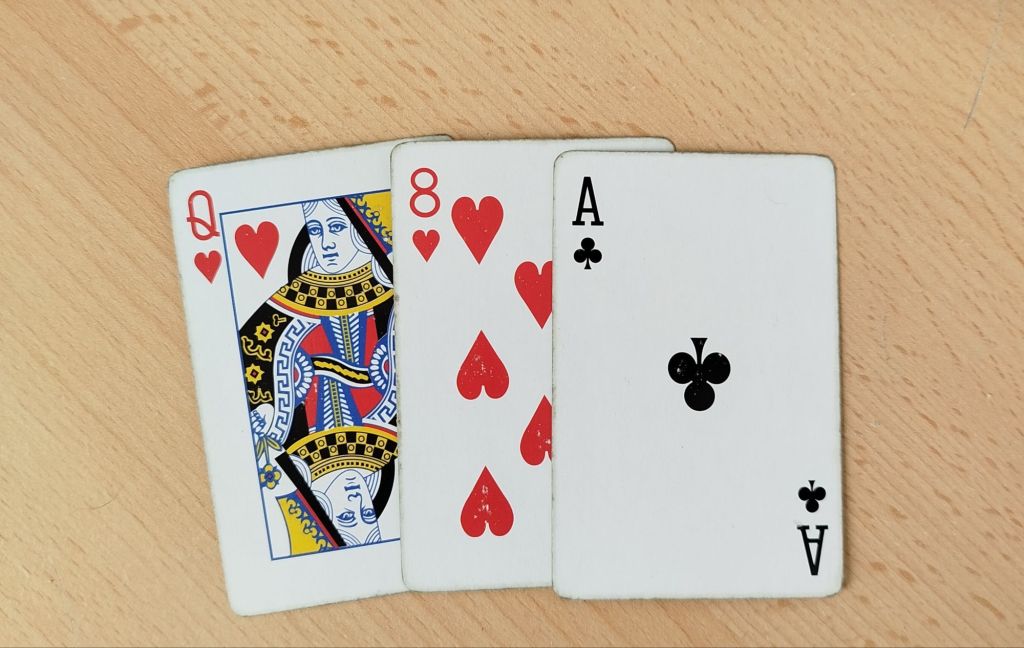
Before visiting the place I drew three cards to investigate, and these cards came up:

A water spirit – Cartomancy with playing cards

Obviously, the first thing to take note of is the presence of the Queen of Hearts, which is a motherly figure or a positive female entity. This is confirmed by the Eight of Hearts which can represent a water place, so in the context of an esoteric / magical reading it would represent a female entity of a broadly positive nature tied to water. The Ace of Clubs represents power, dominion, rulership. It indicates that the spirit has power over the place, so while she is positive, she is not the airy-fairy pushover type.

After doing the reading, I started researching local folklore. If you know of any such place near where you live, it may be wise to research local legends, as they often contain romanticized but accurate hints about the nature of the spirit.

What I discovered is that there is a medieval legend tied to the place, according to which a mother (!!!) once brought a local duke a basket of vegetables, in exchange for having a new irrigation system dug near where she lived. This irrigation system became the pond. There is no narrative reason why she should be characterized as a mother. Her being a mother serves no purpose in the legend, which makes it a very important hint in understanding the spirit: she is essentially motherly.

“But” you may be wondering “this is an artificial pond, how can it be magical?”

We must not draw strict boundaries between the world of humans and that of the great powers of nature. What we know from the legend is that a water spirit wanted to establish herself in this place and convinced the humans around her to cooperate by being motherly and nurturing toward them, and the humans were intelligent enough to accept her offer. There is nothing strange about this: in actuality, humans cooperate with nature all the time.

Note how the reading hints at a spirit that is positive (Queen of Hearts) but not submissive (Ace of Clubs). Had she been a difficult spirit she could have simply flooded the zone. There is altogether too much mischaracterization of water in the spiritual and magical community as something weak, vague and mystical. Water can be devastatingly powerful, so it is a good thing our local water spirit is a positive member of the community.

MQS

Fantasy in Divination: A Double-Edged Sword

I’m currently still doing readings in exchange for recommendations for when I  decide to start offering readings from this site. After a short reading with a querent we began chatting about the process of divination, and he asked me if fantasy is required to interpret the cards. I thought this was a really great question. I’m taking fantasy as a synonym with imagination, that is, the ability to conjure up images in one’s mind.

First off, we need to distinguish fantasy/imagination from (true) intuition. True intuition is relatively rare and it does not originate from the limited structure of the personality. It is, for all intents and purposes, otherworldly. Before being appropriated by boss babes on TikTok, intuition was rightfully considered a gift of the gods. It is hard to obtain and even harder to train, although the practice of divination, as it leads to the divine, does allow for the development of intuition.

Fantasy or imagination is mostly the product of neurons bouncing together, and it is at least in good part under our control (though whether imagination is also merely a personal power is up for debate. Many occultists think it isn’t, and I agree.)

Imagination plays a large role in modern magic, and, it could be argued, in the magic of all times (though with different implications and within different frameworks), but I’ll leave this discussion for another time. The point is that imagination is one among the many legitimate sources of understanding that we have at our disposal, including in the occult world.

Ordinarily, if someone asked me what’s the one thing that is required in order to become a diviner, I would answer that they need to understand the vocabulary, grammar and syntax of what is essentially a divine language.

Yet, in philosophy of language, and even more in philosophy of science, there is a concept called underdetermination. In its most frequent use, the principle of underdetermination states that, given a number of facts, there exist more than one theory that can explain those facts and account for them. How we then choose the most appropriate theory has sparked a debate that largely goes on to this day between scientists, philosophers, psychologists and anthropologists.

Something similar happens with divination: given a spread of cards, or a chart, it is often the case that more than one explanation might appear plausible at first. True, the more cards we string together, the fewer the possible interpretations are, just as a single word out of context might mean many things, but the more words there are, the more we understand the sentence.

But take a sentence like “we saw her duck“. Was she avoiding a bullet or does she live on a farm? This is a form of underdetermination, because the possible mental images evoked by the sentence cannot be reduced to the sentence itself.

Probably if we had a perfect understanding of the language of divination we would get unambiguous results, but we don’t. We must therefore use logic and context to weed out the less likely predictions, yet even so we might be left with more than one possible image of the future in mind. The word image here is key.

Can we predict a future we cannot imagine? That is, can we predict a future (or reveal a past) that we cannot put in the form of a picture or series of pictures? If one asks me: would you be able to understand a sentence you’ve never heard before? The answer is: if I know the language, yes. We hear sentences we’ve never heard before everyday and we rarely have problems. But going back to “we saw her duck”, if I didn’t know that duck can also be a verb, I would interpret the sentence univocally, as I wouldn’t be able to create a mental image corresponding to the interpretation of “duck” as verb instead of noun.

In real world languages the ambiguity is often removed by clear context. But in divination context is not always clear, meaning it is harder to exclude possible interpretations, and we need to be capable of creating mental images of all the most likely interpretations of an oracle before choosing which one is the most likely.

We need to be able to extrapolate the many possible meanings a spread can have before submitting them to inquiry. The ability to construct mental images or scenes from the divination tool we are using is consequently incredibly important. In other words, yes, imagination is key in divination.

But the imagination I am talking about is not the unbridled imagination that so many mistake for intuition, and which usually leads either to error or to unverifiable predictions. Imagination is the ability to create possible images derived from our (limited) understanding of the medium we are using, so that we can then see which one is more likely to be accurate by finding testimonies in the spread or by asking the querent.

Like all other occult arts, divination therefore requires the cooperation of both sides of the brain (to which we may add the importance of bodily grounding, but that’s a matter for another post).

MQS

Do You Need To Believe In It For It To Work?

One of the questions that occupy way too many people in the esoteric community is whether divination or even magic require the person to believe in it in order for it to work. If you’ve ever watched the movie The Skeleton Key, you’ll know that this concept has seeped into the collective consciousness enough for it to find its way into mainstream products (I will not spoil the movie here, since it is actually a fun watch, but it depends heavily on its twist).

If you open most premodern books on magic, you’ll be stunned to discover that their content bears very little resemblance to the post-Golden Dawn landscape. This, by the way, is neither good nor bad. Things change. But we need to be aware of the change to avoid being unconsciously ruled by it. One clear difference is that the magician’s will1 or his imagining/manifesting faculties are barely taken into consideration in older sources, at least outwardly.

This is not to say that there aren’t sources that encourage the practitioner to be of firm mind and clear intent (after all, you’d want your doctor to focus, too, even though their focus is not what make their science work), but even those old sources do not consider, generally speaking, the magician’s mind to be the cause of the change. Broadly speaking, when dealing with sources that date back to before the invention of modern psychoanalysis and psychology, we must be extremely careful when interpreting their concept of mind, soul, psyche, etc.

An example will suffice. In his De Vita, Neoplatonic Renaissance philosopher and magus Marsilio Ficino encourages us, among other things, to “think solar thoughts”, or jovial, or venusian, depending on the aim. Similar remarks are found, in various form, in many old sources. A contemporary practitioner might be tempted to interpret Ficino’s invitation as saying that we must envision solar things in order for them to manifest. But neither the language nor the substance of this interpretation belong to his worldview.

Ficino’s view of the cosmos is essentially the same as Agrippa’s and that of many other premodern magi: we are surrounded by chains of sympathy and antipathy between universal powers (typified by the planets). When we think “solar thoughts” we are doing essentially nothing except stepping inside a current of power that has its own metaphysical reality regardless of our attitude toward it. This is because in Renaissance naturalism, the mind is essentially like the body, i.e., a part of the cosmos, and a movement of the mind is like a movement of the body, and just like the body can create a talisman or a concoction, so can the mind shape images that allow it to shower in certain currents of universal power.

Thus, the invitation to think certain thoughts found in Ficino (and others) is not a precursor to manifestation, attraction and other modern concepts, but a natural consequence of the old view of the mind and the world.

On the other hand, from a postmodern standpoint, reality is for us to create at will. Yes, I am exaggerating, but not too much. Therefore, there is the widespread idea, or at least the widespread implication, that what happens happens because we believe in it.

Let us leave magic alone for now and concentrate on divination. Does divination work because we believe in it? Well, no. Certainly divination doesn’t require the querent to believe in it in order for it to work. In fact, it is my belief that, considering how many frauds there are in this field, a querent should be borderline psychotic to blindly believe in divination without a healthy dose of scepticism.

What about diviners? Do they need to believe in divination in order for it to work? That’s complicated, in my view. On the surface of it I would argue that, again, no, we don’t need to believe in divination for it to work. Divination systems work because they have their own internal consistency. The most obvious is Natal Astrology, which presents us with an objective set of symbols that have nothing to do with the manipulation of counters on the part of the diviner.

On the other hand, we need to allow for the fact that divination is not a mechanic set of behaviors, especially with the overwhelming majority of divination systems that do require manipulation (cartomancy, geomancy, dice, etc.) As I often repeat on this blog, divination is and remains something extraordinary. The honest desire for an answer, or at least for a picture of the future, tends to guarantee a crisp and clear answer. This is because the honest desire for an answer allows us to honestly connect with the symbols in a way that makes them fall in the appropriate order.

The querent doesn’t need to be honest in his or her desire, unless they are also the diviner. But if the diviner does not have at least a degree of confidence in what he or she is doing, then the question they put to the system is not the surface question (e.g., “Does X love Y?”) but “Do you really work?” which is an impossible question for the system to answer (if the answer is no, then the system does work).

Even then, I would be cautious in overexaggerating the importance of the diviner’s attitude. As I believe I have mentioned, one of the ways my teacher trained me was by asking me to discover secrets about her past. Clearly, the exercise was not meant to discover something new that might benefit my querent or me, but rather to build my confidence and skill. Yet it worked, and it worked well. Maybe the diviner doesn’t need to believe in divination (I know I am always skeptical until proven right), but they do need to at least be open to the idea that this is a legitimate way of receiving information, just enough to enter into the system rather than operating it from the outside as a scientist would manipulate a bunch of molecules.

My general belief at this point is that the esoteric arts do not require our consent in order to work, but they are also not the product of the mechanistic application of abstract principles. It is indeed a fine balance.

MQS

  1. Let’s leave aside the fact that the concept of Will found in modern magic is actually more complex than what it appears to be on the surface ↩︎