Tag Archives: reincarnation

Stuff You Don’t HAVE To Believe: Reincarnation

We talked about Karma and manifestation. Now let’s tackle reincarnation. Unlike manifestation, which is based on pure New Thought superstion and is indefensible from all standpoints, logical, philosophical, moral and practical, reincarnation does have a noble tradition behind it. Still, the magical inheritance of Victorian occultism has made it almost so as if reincarnation is another one of those compulsory beliefs that come with the Spiritual Outsider starter pack.

Reincarnation reentered Western occultism largely through the many misunterstandings of Eastern doctrines perpetuated by the Theosophists. Yet, contrary to what some may think, reincarnation is not an exclusively Eastern belief, and it is found in many parts of the world, including in pre-Christian (and sometimes even Christian) Europe. In fact, the idea of reincarnation is probably suggested to the mind by the observation of the cycles of nature, so it is, in a way, a somewhat valid inference, at least from an analogical standpoint.

But analogical inferences do not reality make. If that were the case, you could slap four wheels on your grandma and call her a Ferrari. Regardless of how reincarnation may be suggested to the mind of ancient civilizations, let us ask ourselves why it is the go-to belief of many self-styled independent thinkers.

I would submit that, once the average Westerner abandons the idea of Heaven and Hell as expoused by our main religions in order to approach the occult or magical worldview, they find themselves wanting for another destination for their great hereafter, so they grope around for the first purple-covered book in the local esoteric library, where they invariably find reelaborations of reelaborations of reelaborations of the same Victorian metaphysical dogmas, they mistake them for something new, refreshing and forward-looking that goes well with their new crystals and adopt it.

I don’t want to crap on reincarnation, because, as I will shortly discuss, I do believe in some version of it. What I want to drive across is that independent thinking starts with challenging dogmas, both the mainstream and the counter-mainstream ones.1 It is perfectly legitimate to examine, question and argue and to reach other conclusions, just as it is legitimate to adopt the belief in reincarnation, or some variant of it.

As for me, I would believe in reincarnation if I believed in individual souls. To me there is only one universal soul which is present as a whole within each part of existence. That soul definitely reincarnates. I may even go further and argue that, since this universal soul reincarnates continuously through endless amouts of beings, at some point some of the beings that are born are bound to have some semblance of continuity with some beings that have died before, and since the individual being who dies loses its ability to distinguish time t1 from time t2, from the standpoint of its individual perception its death and its rebirth are contiguous. Needless to say, there is nothing karmic or retributive about this view of reincarnation.

These are my two cents, very succinctly explained. Feel free to take them, leave them or add them to your collection of two cents.

MQS

  1. Not to mention the ability to know when and how to question and when how not to. ↩︎
Stuff You Don’t HAVE to Believe: Karma

I talked about manifestation, now let’s tackle karma. This is one of those things that grind my gears about the spiritual community, largely because it unveils how derivative, unoriginal and moralistic it often is.

To understand this we need to remind ourselves of one of Nietzsche’s criticisms of his philosophical predecessors, who, according to him, were trying to safeguard religious morality even after doing away (overtly or covertly) with the concept of God.

This exact same thing happened to the spiritual community, which often reacts allergically to Christianity, yet seeks to safeguard the moralistic notion of hell (“if you do X you will be metaphysically punished”) by transfering its role to a vaguely defined “universe” whose task is, somehow, to uphold the believer’s social, political and spiritual views and punishing those who contravene them by causing bad things to happen to them.

Let us grant that this is somewhat of a misunderstanding of the original concept of karma found in some Eastern philosophies, even though it is not THAT much of a misunderstanding. The fact remains that, as used by most Western “alternative” thinkers (who somehow always end up believing the exact same crap), karma is just a lazy excuse for maintaining the holier-than-thou attitude they accuse traditional religion of: hey, enough with the badly understood Christian superstition! Time for the badly understood Oriental superstition!

Except that at least traditional religion has something grandiose and awe-inspiring about it (some passages from the Bible could be turned into a cool metal opera). The alternative spirituality of many girlypops has a way of pettifying everything: wow you left your girlfriend via message? That’s bad karma! What? You acted like a douche your whole life and suffered no consequences for it? That’s for another life then! If this is not the epitome of bitchy passive aggression I don’t know what is.

As many silly beliefs, this, too, has its glimmer of truth hidden in it. The Platonic myth of the soul, according to which our soul chooses what to incarnate as, offers much food for thought and meditation on the nature of our choices and how we must then live with the traces that those choices invite into our soul. There is no need to add metaphysical burdens on top of it.

MQS

Answering Airy-Fairy Questions… Meaningfully (Example Reading)

As someone who advocates a grounded approach to divination, you’d expect me to scoff at questions that deal with more philosophical or spiritual themes. But this is not so. Airy-fairy is in the eye of the beholder, or rather, of the reader. Just like many airy-fairy readers can drown concrete topics in a deluge of commonplace spiritual-but-not-religious buzzwords, so can a grounded reader approach complex, ‘soulful’ topics from a grounded standpoint, while always following what the oracle says.

Someone asked me what was the goal of her current incarnation. Right off the bat we are confronted with a dilemma: firstly, the question presupposes that there is such a thing as reincarnation, which I don’t believe (at least, not in a sense that is compatible with what most people think of as reincarnation);1 secondly, it presupposes that this happens with a goal.

The first problem (reincarnation) we may circumvent by simply asking what’s the goal of the querent’s life. The second question (the goal) is trickier, but as I show in the example, it is not unanswerable.

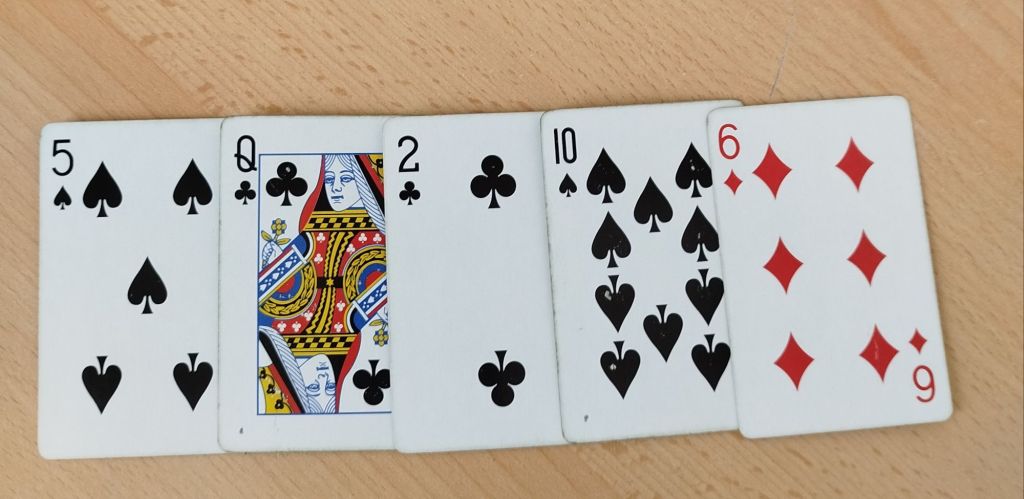
What is my life’s goal? Playing card divination

Since we have absolutely nothing to go off on, we can start by noting that the querent’s significator shows up (the Queen of Clubs), though not in a very good spot. She comes after the Five of Spades which is the card of sacrifice, imprisonment and the inability to move. So we can already sort of guess that the querent is feeling trapped in some form or another.

The spread ends with the Six of Diamonds, which represents worry, insecurity and the like. Often it shows financial problems, but not necessarily: it can be a card of general nervousness and uncertainty. The spread is now starting to reek of psychological hang-ups.

Usually, the Two of Clubs after a person card indicates the person taking steps. Toward what? Toward the Ten of Spades. This is the card of secrets, of the night and of unknown situations.

At this point I asked the querent if she’s someone who never leaps into unclear, unknown situations. She said that that was one of the things keeping her from enjoying life, since she always prefers to avoid risk or put off taking it until she feels prepared, which is never.

Bingo. This is the answer: she must learn to step into the dark, take risks and be ok with not having everything figured out. She must learn to swim by swimming rather than by reading up on how to swim. If she doesn’t do it, she will spend her whole life by the poolside waiting for every condition to be perfect.

So, have the cards talked about the purpose of the querent’s whole life? You may disagree with me, but I don’t think so. I do not think that this is the purpose of her whole life (I think there is much, much more to anyone’s life), nor do I think that this is the reason she was born or has reincarnated (if you believe in reincarnation at all). And I told the querent as much, in the spirit of transparency.

What I do mean is that, at least at this juncture in her life, this is a recurring pattern that weighs her down and that needs addressing because it influences her general quality of life. That’s already enough to be worth being mentioned by the cards.

Ultimately, almost every airy-fairy woo woo question is the voluntary or involuntary corruption and modernization of some kind of longing that is deeply seated in the human soul. Questions about the purpose of one’s life may be often answered with the usual mix of mind body spirit platitudes, but the human desire for purpose is not to be lightly dismissed, whether the purpose is really there or not. And divination can address this desire in some form or another.

I believe that divination should be able to run the whole gamut of the human experience, from the most concrete questions to the most abstract, because this is the extension of the human soul. The problem arises only when we try to reduce one order of problems (Will I the chicken cross the street?) to another order of problems (What kind of psychospiritual drama do you think caused the chicken to want to cross the street?)

MQS

  1. I will probably discuss it more at length in another section, but my belief is that there is only one, universal soul that is constantly incarnating and reincarnating through everything. ↩︎