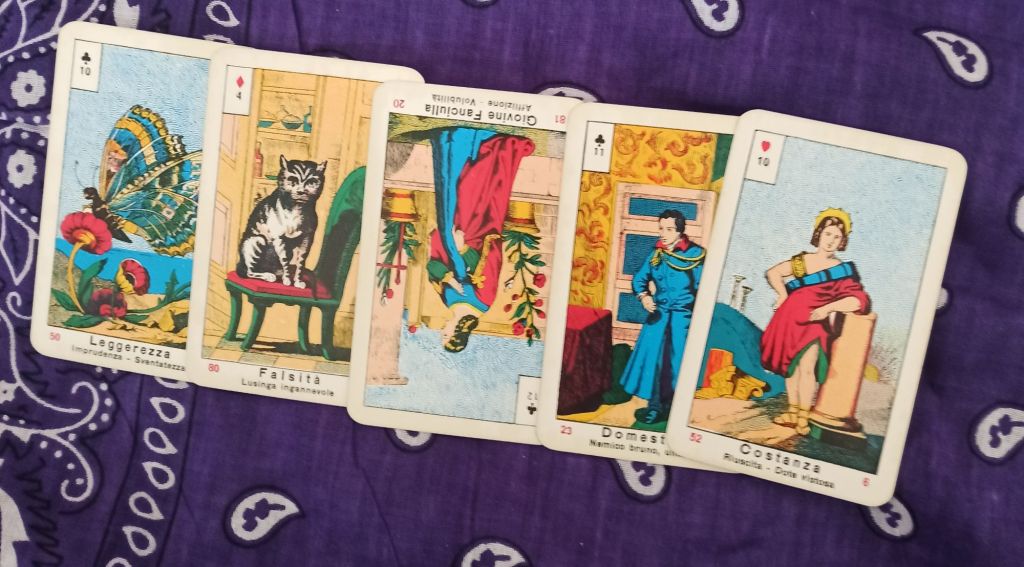
As promised in a previous post, I’m discussing a (rather old) reading on spiritual issues. It is common to believe that the Tarot is better suited to talk about spiritual issues and oracles such as the Sibilla or Lenormand are more useful for practical, everyday events. This is not true. The Tarot can be just as practical, and the Sibilla (and, I assume, other oracles) can be just as clear about spiritual issues. The thing that makes people think otherwise is that they are used to that kind of tarot reading where the psychic spends the whole time pulling pseudodeep psychobabble out of their butt by looking at the pictures on the cards. That’s not a tarot reading, that’s a therapy session (for the reader, not for the querent).
Spirituality is part of real life, and as such all oracles can talk about it, but always in real-life terms. Here the querent was a man and had asked me generically about his spiritual life.
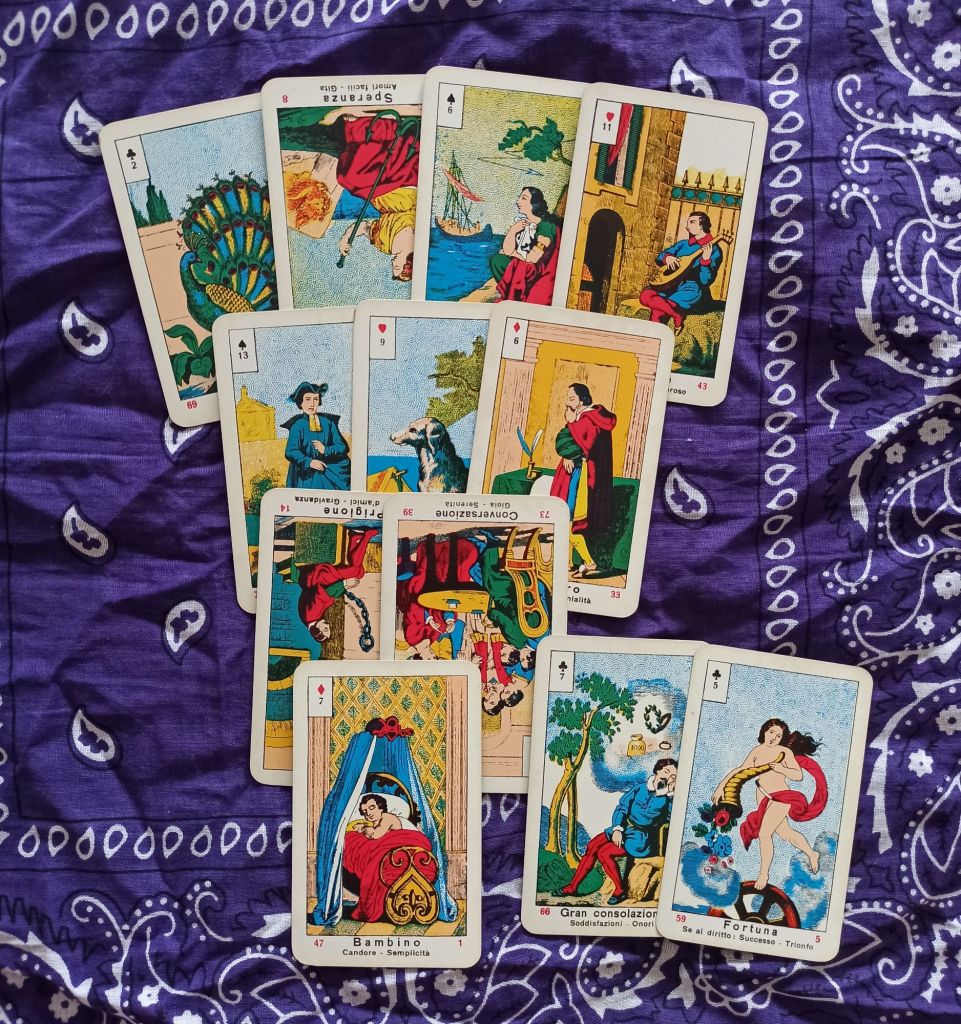
The first thing I was able to detect was the presence of the Priest in the second row. The Priest is usually not a real priest, and rather indicates a figure of authority. We also have, it seems, the significator card for the querent, represented by the Boyfriend, or Jack of Hearts, in the first line. The Priest is accompanied by the Dog/Faithfulness. This is a very good card, even outside of a love reading. It shows that, whoever the Priest is, he (or she) is good, trustworthy and has the querent’s best interest at heart. Furthermore, they are true believers.
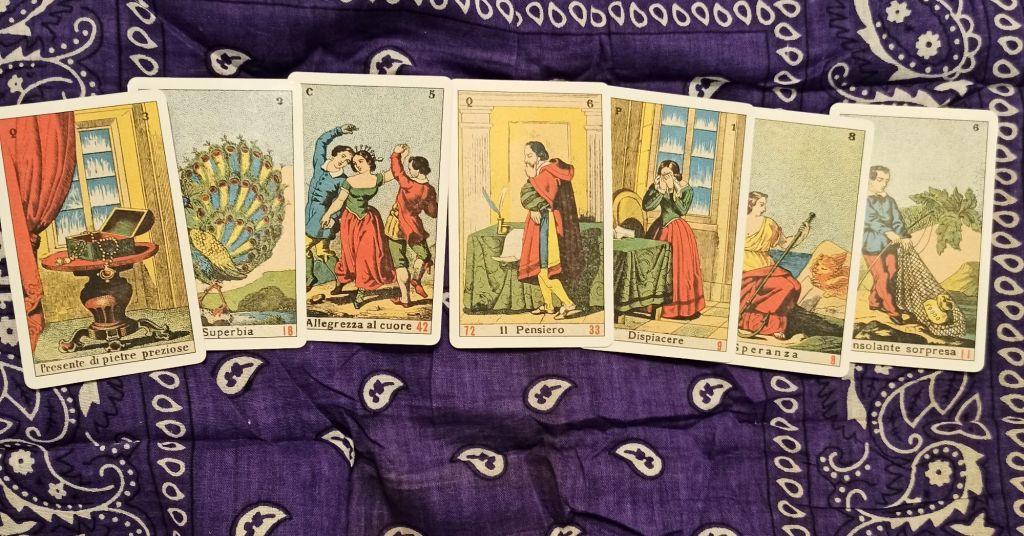
The Thought card perplexed me a little, so I skipped over it (though you can see that the Thought card is just under the querent, so it turned out that it was the querent’s thinking process setting into motion). However, I did ask the querent if he was in contact with some kind of spiritual authority and he confirmed it, though he said it wasn’t a traditional priest or minister. This doesn’t matter: all kind of spiritual authorities can be signified by the Priest card.
The querent’s line, the first, has the card of God in it. This is the Peacock (when reversed, it represents the Devil and demons, as well as pride and haughtiness). The Peacock indicates totality, wholeness, miracles, etc. when upright. But it is followed by the Hope card reversed. Hope is the card of faith, but it is reversed, thus showing unbelief.
Yet it is not a clear atheism. Look at the Six of Spades, the Sighs card, right between the querent and the combination of lack of faith in God: the querent is sighing about his lack of faith. He is uncertain and tormented. I remember judging that he was probably a wobbly agnostic, and upon asking he confirmed that he had doubts (I didn’t ask him “are you a wobbly agnostic?” of course. We need to be kind to the querent).
It turned out, the querent had long banished spirituality from his life, had gone for an engineering degree, had been active in the skeptic community online, etc. However, some personal experiences had made him doubt his position.
Look at the last three cards of the pyramid. The Prison reversed shows unburdening, unshackling, freedom, etc. (when not followed by negative cards). Then we have the Conversation card. When reversed, it shows change. Finally, the Child, which shows a new beginning. I don’t know about you, but liberation + change + new beginning sounds like a spiritual conversion.
Furthermore, look at the angles of the pyramid plus the center: the Peacock (God), the querent, the new beginning (Child) and the Faithfulness card. This is a very positive indication.
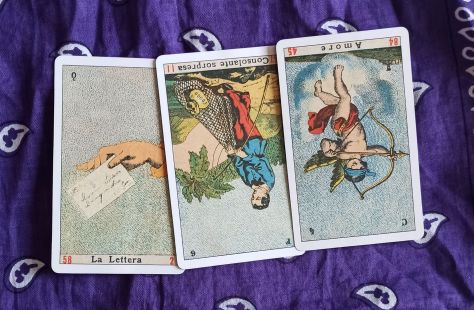
Still, just to make sure, I asked the querent to draw two cards, and these were the Gratification and Fortune, confirming the good outcome.
As far as I know, the querent has since chosen his spiritual path.
MQS