Tag Archives: Psychology

The Trouble with Keywords

This reflection was prompted by witnessing how shallow many people discussing the Enneagram are, but it applies to anything connected with spirituality and occultism, including divination.

Keywords can be a great learning tool, and often they tend to stand us in better stead than cheap, unguided intuition. There’s also the false assumption that keywords are useful only until our intuition kicks in, but that presupposes that what most people call intuition is serviceable at all beyond suggesting sugary commonplace statements (true intuition is another thing altogether, of much nobler origin, and a much rarer phenomenon).

But keywords, too, must be handled with care. I was at an Enneagram retreat and we were discussing Type One, which everyone kept referring to as the Perfectionist or the Critic. At which point everyone and their mother started realizing that they, too, were perfectionists and sometimes too critical, even if they didn’t think they were a One.

The trouble with keywords is that they are effective at condensing knowledge and understanding only as long as that understanding has taken place beforehand. Otherwise, keywords veil just as much as they reveal. Taken at face value, and not as quick stands-in, they lead us astray.

Type One is constantly in a tension between their irreflective urges and the perceived need to justify them in front of an (internal) higher authority, so they end up trying to align those immediate urges with ‘what’s right’. If this then expresses as criticism or perfectionism, it is purely an outward manifestation. A Type Six can be just as perfectionistic because abiding by a certain ideal gives them peace and security and soothes their fear of being left to their own devices. In fact, any type can be perfectionistic in a way that fits their internal dynamic.

The trouble with keywords is therefore that we  simply take them at face value from our own perspective, without seeing them as condensations of deeper knowledge. In the case of the Enneagram, a Six will hear “perfectionism” (Type One) or Helper (Type Two) and apply it to themselves.

Even a Type Five can see themselves as a Helper if they find themselves giving out knowledge to others whom they deem to be helping. But a Five is motivated by themes of (in)adequacy and (in)competence to function in the world, which they compensate for by acquiring knowledge. A Two (the Helper) is motivated by the need to be seen, loved and confirmed in their existence by another.

What I just applied to the Enneagram is valid for pretty much all fields of occultism, and for that matter all fields of life. But especially in occultism, whether it be divination, magic or devotion, we are trying by definition (occult is what is hidden) to look past the veil of appearances and to go to the essence of things. Essence is an unfashionable word in our postmodern world, where everything is performative and internally empty, Yet keywords are useful only in so far as they represent on the surface what lies beneath. Once the connection is lost, occultism becomes the confused research so many people rightfully consider it to be.

MQS

On Managing Attention

You know the old adage that people who sell solutions need the problem to remain unsolved. I’m not talking about odd conspiratorial crap, like “the government is hiding the secret of immortality”. I’m talking about observable facts.

When influencers started becoming a thing, it was simply a bunch of kids in their rooms talking about stuff they were passionate about. Corporations then smelled the opportunity and ruined everything, as they usually do, by turning them into advertisers.

There is, obviously, absolutely nothing wrong in wanting to make money on the Internet. My mom, who was a journalist, used to say to people criticizing that she made money off of reporting tragedies, that it’s possible to do her job well with professionalism and strong ethics. A look at the Internet today shows me that most people are not my mom.

Whenever you end up in a rabbit hole on a particular topic on social media or youtube, your feed is going to fill to the brim with people trying to part you from your money. Even if they don’t want to part you from your money, they still want to part you from your attention, and your attention is one of the most precious things you have, so you should administer it well.

I’ve already talked about the pros I experienced from reducing Internet consumption, learning again to stay with myself. I’m not some kind of Luddite or Amish. I don’t dislike technical progress. I just think it should serve me rather than the other way around.

I generally try to spend less than an hour a day on the Internet (which, for a Millennial, is quite the achievement) not counting the time I spend working on the blog or yt channel. I’ve found that most days I can safely stay under 30 minutes.

What I’ve noticed in my journey toward reclaiming my own attention is that it is especially easy to spot someone trying to sell you something on the Internet. Again, I’m not saying it is wrong to sell goods and services, and in a way all is fair in love and marketing, but the point is that my aim of keeping my attention to myself and deploying it only for worthwhile pursuits is at odds with most people’s need to make a couple of bucks off of me.

You can immediately spot a youtuber (and probably tiktoker) who is out to get your attention and/or money because they have a distinctive (and very effective) way of serializing even the most minute unit of crappy information they are going to give you. For instance, if you watch a video about fitness, you’ll be swamped with videos all telling you how you are missing out on every possible secret hack.

You will always notice that their way of pushing out ‘content’ is to make it seem as though that video is always going to be exactly the one thing you need in whatever niche you’re exploring, and without which you will utterly fail or be lied to by invisible entities who won’t tell you the truth about it.

That is, until the next video, which will drop 24 hours later, and which will also be exactly the one thing you need and are missing and are being lied to by others and without which you’ll fail. Once you start spotting these trends it becomes almost amusing to see how much sludge can be manufactured with so little actual material.

MQS

The Scrolling Mind

Back in my smoking days, I remember thinking that the biggest obstacle to quitting was not just the physical addiction to nicotine, but the fact that cigarettes had simply become a part of my day. Addictions slowly (or quickly) carve time for themselves in our life, so that even when we decide to stop engaging in the addictive behavior, there is a chasm left between the time before engaging in it and the time after engaging in it that needs to be filled. The hardest thing is beginning to reimagine our life as something whole even without the thing we stop doing.

I was talking to my husband’s little cousin the other day. She’s 16 and she is the typical fried-brained teenager who has been conditioned to expect that anything should be presented in small 15-second soundbites that you can scroll through if the gratification doesn’t hit within the first two seconds. By the way, I’m not saying this as a jab at the younger generations: my generation was fried-brained in a different sense, and besides, I know plenty of people older than me whose mind has been beaten to a pulp by the mechanisms of social media.

What I thought was funny, but also a bit worrying, was her fidgety demeanor whenever she had to spend more than a couple of minutes without fiddling with her phone. She was in principle no different than me after an hour of not smoking–except that the withdrawal symptoms kick in much more quickly. I asked her if she could fathom spending a day doing absolutely nothing that she didn’t have to do (e.g., going to school, help clean the house, etc.) and she looked at me as if I started speaking in tongues.

To be fair, asking this of most teenagers is asking too much, regardless of the generation, and she’s the ‘go go go’ type anyway. But yesterday I spent the day doing exactly that–nothing that I didn’t have to do. It was refreshingly hard to accomplish.

Coming to a point of stillness is difficult when we are constantly bombarded by stimuli. Plus, our conscience of other people’s awareness and attention has expanded in recent years from the couple of people around us to potentially the whole world.

The ringing silence I experienced was a reminder of how abstract this type of conscience actually is: I am not in front of an audience. I am alone, a point in the existence reflecting upon itself. It was one of the longest days I had in my recent memory, but not in a bad sense. I can start to see why so many ancient stoics said that each day can be treated as a lifetime in and of itself.

I feel this is a good exercise to do regularly, so I will incorporate it into my practice. It is not meant to be a flight from reality. It is a way of coming back to it so I don’t lose sight of its right proportions.

MQS

“I Do X But I Am Still Miserable”

I keep coming across people on the Internet who dabble either in magic or spirituality (generally alternative spirituality) who lament that after a while they still feel miserable. Although my heart breaks for them, I think there is great confusion surrounding the place of spirituality and, let’s say, alternative practices.

One of the very few perks of rigid orthodoxy is that it exists beyond individual’s will, so that each practitioner needs to adapt to it rather than adapting it to themselves.

Once the idea of orthodoxy crumbled, at least in the West, spiritual and other practices became a supermaket of parts that each person could adapt to their own whim, picking and choosing what currently fit their mental narrative.

Although with some discernment this power of personal choice  can yield great results, what in practice often ends up happening is that spirituality is reduced to a crutch for personal prejudices about oneself, others and the world.

In the end, each individual flavor of postmodern spirituality is more an inkblot test of what the person would be better off discussing with a therapist than a workable spiritual path.

What’s more, the expectation of finding a definitive cure for life is always dangerous: firstly, because life is not an illness; secondly, because spirituality is not a good substitute for therapy or other forms of support; and thirdly, and most importantly, because anything that promises to turn our life into happy trip is always to be looked at with skepticism. No serious spiritual or magical doctrine can promise that.

The life of someone who always smiles and is always happy is not balanced. If anything, it’s creepy. There is a time for happiness and there is a time for sorrow. A balanced person is someone who responds to life in an adequate manner depending on the concrete situation. Look at the traditional descriptions of wisdom in Daoism or ancient Western philosophy, and you’ll always note that the wise person is the one who always reacts in the adequate manner, with as little influence from their personal demons as possible.

It is unfortunate that these practices are often the go-to for people who would benefit from other types of help. Sometimes they simply cannot afford official help, and this is another conversation, so they simply look for something they can afford and promises them miracles.

MQS

Calling Other People’s Demons By Name

In many supernatural movies about exorcism, the priest trying to free the victim needs to discover the demon’s name. This is actually founded in (part of) the real practice of exorcism and does have its roots in the magical belief of the power of names. For instance, there are certain practices in folk magic in Italy that require the magician to go to the christening of a child whose name translates to the effect he or she wants to achieve.

But belief in the power of names is not just found in Italy and it probably goes back to the most ancient and elemental relationship that humans established with the things around them in their attempt to dominate them. Traces of this fact are found in the doctrines of many Greek philosophers, sophists, poets and playwrights, and I have also found some similarities with Chinese Daoist literature. A wonderful fictionalized account of this belief is found in Ursula LeGuin’s Earthsea saga, which anyone interested in magic should read, in my humble opinion.

I am not one who seeks to psychologize occultism, although I believe that psychology is not at all a useless discovery and can be part of a modern magus’ training. I think that the attempt to reduce occultism to psychology is just as misguided as the attept to condemn anything that modernity has brought us as a deviation from an ancient splendor.

That being said, as someone who practices divination for others, there is also a certain sense in which naming works in a cathartic way. Most of the people that consult me are rather upfront about their problems, especially since I don’t ask for money and therefore feel no guilt in telling them to go sit on a cactus if they are trying to waste my time.

But people can be reticent about their issues for a variety of reasons, and malice is not always the motivation. Among the many possible reasons is the fact that people sometimes feel the need to have their demons driven out of them by someone outside of their regular field of experience.

Having someone discover our particular demon’s name without us feeding it to them can be a powerful and cathartic experience, because it smokes the demon out of the dark recesses of our subjective experience and into the light of objectivity, where it can be addressed as a definite and therefore limited issue, rather than being consumed by its overwhelming lack of contours.

Not every divination session calls forth such existential experiences, nor should we as diviners try to turn each session into a catharsis. We are not therapists and our duty is not to give people advice, although advice can certainly be given if required. Our role is to provide information, whatever that may mean in the context of each particular reading. For this reason, our language and that of our divination tool needs to be earthly, concrete and objective.

But sometimes informing the querent can mean gathering the diffuse knowledge that they already have festering inside of them and turning it into useable information by giving it its proper name.

MQS

Same Behavior, Different Motivations

In Enneagram work, what matters is not so much what we do, but why we do it. Each type is characterized by a core motivation, and even though each core motivation tends to produce, on occasion, similar behaviors across different individuals, relying too much on the what instead of the why can lead us astray.

A Type Two, for instance, might very well be constantly distracted by ideas on how to make themselves useful to others as a way of eliciting love, affection or appreciation. Fives may also try to make themselves useful, but this is usually done in order to boost their sense of being intelligent or capable, that is, of proving to themselves that they are not inept. Of course, the style in which the help is delivered also varies: Twos tend to be personable and warm, while Fives are generally concentrated on giving others facts or conceptual tools.

In many Enneagram groups, a useful exercise is simply that of settling into a meditation, with one’s attention kept on a short leash, and then becoming aware of where the attention naturally drifts to. Our core mechanism is so ingrained in us that it often takes conscious effort to act contrary to it, and even then, the mechanism that we push out of the door comes back through the window (the typical example is that of a Two who consciously tries not to be helpful, and ends up justifying it to himself or herself by saying “so I can catch my breath to be more helpful in the future”).

This exercise is very useful, but we need, again, not to concentrate too much on the what. Sometimes our attention is caught by thoughts that appear random, but once the motivation behind those thoughts is questioned, the Enneatype becomes clear. For instance, a Three’s attention during meditation may drift toward some kind of task that they need to complete, or even simply to what they are going to eat for lunch. There is nothing inherently specific in any of these thoughts, but often the Three will have these thoughts as a reflection of their mechanism, e.g., they may think about what to have for lunch so they can cross that item off their mental to-do list and optimize their schedule.

That being said, there is also another risk, and that is of becoming so fixated on catching ourselves in the act that we forget to live life. Our character is not a curse. It can become one if we wrap it too tightly around our life, but as long as we learn to wear it loosely and see it with some irony, it actually affords us gifts, tools and opportunities.

MQS

On Mental Health (Example Reading)

Since I’ve started studying horary astrology, my teacher has encouraged me to take on questions to learn on battlefield, as it were. I probably only need some exra push to start offering cheap readings here. This horary was asked by a social media contact of mine, who wants to know how her mental health will evolve.

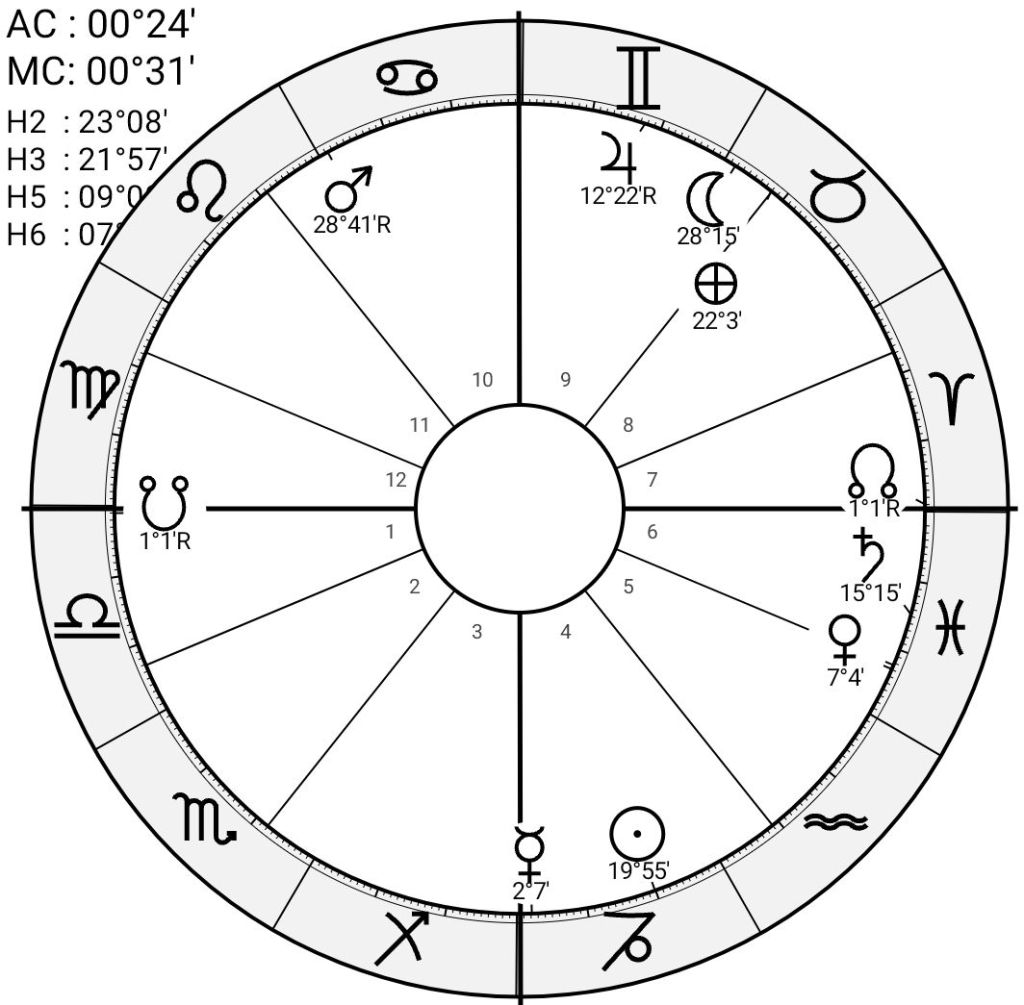
Mental health. App used: Aquarius2Go

An immediate giveaway that something is off is the conjunction of the South Node of the Moon to the Ascendant. This is the “bad” node, traditionally attributed to the nature of the malefics, Mars and Saturn. It is as if the chart wanted to tell us “hey, there IS something wrong, go look!”

The querent is represented by the ruler of the Ascendant, Venus. Venus is exalted in Pisces, but conjunct the cusp of the malefic Sixth House of sickness. The Moon shows us the flow of the action. She, too, is exalted in Taurus, but conjunct some evil fixed stars and cadent in the Ninth House. She is sextiling Mars.

Venus is not terribly afflicted, but it is in a bad place in the chart. Since we are talking about mental health, and Venus is conjunct a house of sickness, it is probably reasonable to conclude that the querent is experiencing mental trouble of some sort. Considering that Pisces is a common sign, the trouble is probably recurring, coming and going.

Venus is approaching conjunction with a bad Saturn in the Sixth, and before that a square aspect with the ruler of the Sixth house, Jupiter, which is cadent, retrograde and in detriment. Since the square is approaching, the trouble is intensifying, at least at present. Still, there is reception between Venus and Jupiter, which tells me that the querent does have some inner strength to deal with it and work through it, especially with someone’s help. Note that both Venus and the Moon are exalted, which argues that the mental trouble is due to excessive expectations being disappointed.

The Moon is quickly approaching the sextile aspect with Mars. Mars is ruler of the Third and Eighth house. The Eighth house is the house of death, but also of mental anguish. But the sextile is a positive aspect and it happens with reception, so once again we have an image of the potential for overcoming the trouble.

All in all, the chart depicts a situation of suffering but it is encouraging. The querent is not as helpless as she may think and can find the strategies to go through the period of difficulty.

MQS

“Will I Ever Be Happy?” Or, How to Torture Yourself With the Cards

I’ve already written a couple of articles on unanswerable questions. Some of them are unanswerable for logical reasons, others because they ask about something on which no objective standard of measurement exists. Some are also unanswerable for ethical reasons (“Tell me when is the best time to rob the bank.”)

But occasionally someone comes along who asks a question that we instinctively feel is unanswerable, yet we can’t put our finger on why. It’s happened a couple of times to me that someone would ask me something to the effect of “Will I ever be happy?

Obviously no one whose life is coming up roses would seek out a diviner of all people to ask such a question. These queries are put to the cards or the skies in a moment of weakness. My experience in these situations is that the cards behave in one of three ways. They:

  1. Show the cause of the person’s unhappiness rather objectively, and whether the problem is likely to be overcome over the next few months (usually not)
  2. Are generically very negative, without a specific sense to them
  3. Are generically very positive, without a specific sense to them

In the first instance, the cards usually show the problem not getting resolved, not necessarily because it never will be, but because the person is still knee-deep in it. The fact that they chose to frame their question in such tragic terms tells us that, whatever the nature of their problem, it goes beyond its specific objective nature and it has wounded the person in their soul.

Extreme care is advised in dealing with people in such a state of difficulty. They come to us broken and they should, at the very least, not leave even more broken. Furthermore, it is not unlikely that they have started consulting many diviners, obsessively asking the same question in hopes of getting a magical solution to their issue dropped in their lap. It would be good to advise them to stay away from divination for a while, unless we are capable of pointing out a solution they haven’t thought about, which unfortunately is rare.

When the cards are generically positive or generically negative, they are merely reflecting the person’s state of confusion: the bleakness of their outlook or the irrational hope for unexpected redemption. I don’t think there is much that we can do in such situations, except telling them that their upset shows in the cards and that, life being a succession of phases, even this one will pass. Sometimes, in such situations, talking to them in our quality of human beings is better than talking to them in our quality of diviners. In extreme cases, having a hotline number handy may be helpful.

Really there isn’t much sense in asking this question except to torture ourselves. We as diviners should know this when asking our own questions, but many people don’t, so it’s best to be prepared.

MQS

Enneagram – Don’t Think Too Much About It!

I just had an enlightening conversation with a user who read through the Enneagram section of the blog. They said they have spent a lot of time thinking and reflecting about what type they may be, but aside from excluding one of two types they haven’t made much progress. I want to give my two cents about the issue.

First off, the process of discovering one’s type can last quite a bit. It took me a few months to reduce the choice to either Four or Five, and then a couple of years to understand I am a Five. The magical thing about the Enneagram is that the discovery of one’s type is only the beginning of the journey. The Enneagram is not meant to be yet another checkbox in our bio, though unfortunately it is often reduced to it. Unlike many other personality systems, though, the Enneagram is less a pigeonhole than a map. With this in mind, there’s nothing wrong with taking one’s time.

Secondly, and crucially, often we think way too much about the Enneagram and are mesmerized by it. Sometimes we cease to see reality and we start substituting people–unique individuals–with Enneagram types, and that’s not very helpful, nor is it the aim of the Enneagram. More importantly, when thinking about our type, we tend to intellectualize it overmuch and we get lost in a sea of minutiae. The intellectual side of ourselves must be engaged in the process of discovery (I have nothing to share with the cheap antiintellectualism of the so-called spiritual community), but it cannot be the only criterion.

In reality, our Enneagram type is often most evident when we are not thinking about the Enneagram, because it is ingrained into our everyday behavior, from which we lapse when we start thinking about it with detachment. This is the reason some people say you absolutely need someone else to tell you your type. It is not necessarily true, but there is certainly an advantage to having someone who really knows the Enneagram observe you dispassionately for a while.

In the absence of such a person, the best way sometimes is to just go about our everyday life normally, while keeping the Enneagram just in the back of our mind and occasionally checking in, but without going into overdrive about interpreting our behavior, unless some serious a-ha moment takes place.

Our Enneagram type is sometimes obvious, and sometimes it’s a surprise. It has nothing to do with what type we want to be (I know quite a few people who have deluded themselves into thinking they are Fives because they think they are ‘deep intellectuals’, or Fours because they think they are ‘original and unique’, and or, or or…) Unfortunately, in the abstraction of our own mind, logic can be put in the service of glamour and we may be led astray.

MQS

Enneagram Comparisons – Type Eight and Type Nine

Enneagram Type Eight and Enneagram Type Nine are extremely different and almost never confused, despite the fact that they form each other’s wing. Both are Body types concerned with their own independence. Eights preserve their independence by asserting themselves on others and challenging them. Nines preserve their independence by being compliant, accomodating and friendly so as to avoid causing issues that might result in uncomfortable strife.

Both Eights and Nines can be extremely dynamic people, but Nines prefer routines that comfort them and fill them with a general sense of wellbeing, balance and calm. Ultimately, Nines want to avoid unpleasant sensations of sadness, isolation and conflict, whether outer or inner. Eights, on the other hand, generally go down the path of greatest reasistance and seek to overcome it, finding pleasure in difficulty and in the challenges the world around them and other people offer them.

opposites

Socially, the two types behave in radically different ways. Average Eights immediately sense the power relations among people and disrupt them to impose themselves as the reference point, so that they may have better control over others and therefore over themselves (more healthy Eights often use this vantage position to help others, but they still often want to be the ones initiating the action).

Average Nines, by contrast, take a step back by allowing others to express themselves, often finding it hard to get their own point-of-view or agenda across, and their personal energy tends to disappear, assimilated by that of others (whereas more healthy Nines learn to cooperate with others while still mantaining a separate sense of self and of their own preferences).

MQS