I don’t remember talking about it here, but I was asked to teach evening Italian classes at the local school, mostly for adults (in that most students are adult, not because I teach NSFW vocabulary).
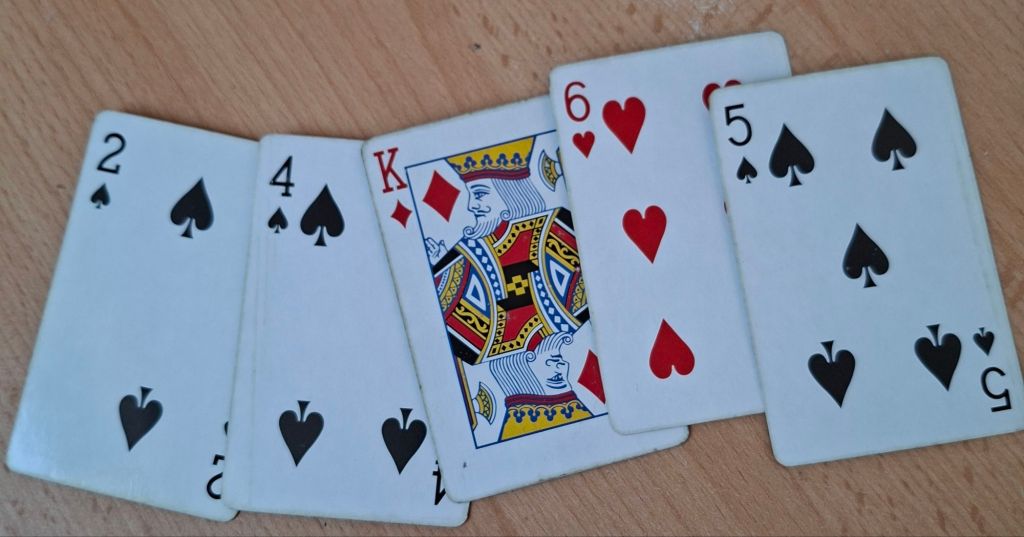
I have been having fun using the cards to predict how the classes would go. They are mostly accurate, although obviously their meanings must be toned down a bit to apply to the situation. One glaring example of the cards predicting something major is this spread on yesterday’s class.
How will the class go?
I’ll tell you what happened, and then we’ll get into the spread, especially since I didn’t predict anything ahead of time, so this is more of an exercise.
What happened was that one of the students, a man who sould have reached the age of reason some years ago, decided that I wasn’t paying enough attention to him. So when I asked him a question he reacted angrily, throwing a hissy fit and questioning me and my method. I reacted more maturely, yelling back at him that he can either get on with my method or be gone, at which point I invited him to leave.
Now let’s look at the cards I drew that evening before class. The cards are quite clear in this case, probably because what happened was relatively major compared to a boring day reading.
The King of Diamonds is ‘some dude’. He doesn’t come up as a Spade, so he’s not a sworn enemy or anything. The K♦️ dominates the spread from the center, so the situation revolves around him. The Two of Spades can be anger, while the Four of Spades can be an obstacle, but with negative cards it becomes a clean break.
So upheaval is to be expected in the relationship to this man. Since the Five of Spades ends the spread, this upheaval is unlikely to be reconciled. Especially since the Six of Hearts, the card of conciliation, is surrounded by all these spades, so it is as if the cards were saying “the conciliation is not” or, in English, there won’t be conciliation. Paradoxically, therefore, the 6♥️ worsens the spread by its presence.
Let’s move on with our look at the playing cards divided by concept. This time, we see which cards represent stability.
Ace of Hearts The Ace of Hearts, like in many systems of reading playing cards, represents the home. It is a symbol of durability and stability, since houses tend to be stable things that don’t change. Mostly, the Ace of Hearts symbolizes the house or the family, however, when describing someone’s character, for instance, it shows them to be family-oriented, looking at stabilizing their life, being rooted in traditional values, etc.
Four of Hearts The Four of Hearts usually brings agreement in all fields of life. However, the type of agreement it shows is effortless, and it resembles more a state of peace where the waters aren’t ruffled (and if they are, the waves calm down immediately). Usually this card indicates harmony, harmonious surroundings and ease.
Six of Hearts Unlike the previous two cards, the Six of Hearts, which represents such things as reconciliation, healing, etc. does often imply the presence of some disturbing factors (though not necessarily. We need to look at the spread as a whole), but it shows that these disturbing factors, such as a break-up or a disagreement, can and probably will be overcome, returning the situation to its previous stability.
Ten of Hearts The Ten of Hearts is one of the most powerful in the deck, as it is often capable of diminishing the negative impact of negative cards. Since it is symbolic of paradise, heaven or ultimate attainment of one’s happiness, it hints at a situation either being stable (and happy) or becoming stable (and happy). When it is followed by very negative cards, though, it can show this paradise being lost. In fact, it is sometimes a bad sign when we find the Ten of Hearts at the beginning of the spread without other strong cards, because it shows that the best is already in the past.
Three of Clubs The Three of Clubs brings union and unity. It causes situations or people to become locked in place, usually by signing contracts, celebrating a marriage of making a commitment to each other or doing things together. Sometimes it can show that a situation perseveres (it remains married to us).
Six of Clubs A somewhat obnoxious card, the Six of Clubs isn’t tragic, but it brings disturbance. It shows situations that have lost their momentum, and problems that we thought we had overcome reemerging. It shows a sort of static discontent with no disruption in sight, either for good or bad, unless other cards clearly show it.
Nine of Clubs This is the card of distance, either in terms of miles or in terms of time. As such, it lengthens out the timeframe, but unlike the Six, the Nine of Clubs has no negative undertones, except in the sense that often we want all the good in the world to happen to us quickly, and this card stalls us for some time. However, it can also make a good situation last longer.
Four of Diamonds Unlike the Four of Hearts, which shows effortless stability and agreement, the Four of Diamonds represents agreement following either tensions or negotiations. Thus it represents all things to do with bureaucracy and the government that seek to regulate life and make it more stable within the borders of a country.
Ten of Diamonds Of the Ten of Diamonds we can say something similar to the Ten of Hearts, except that the success promised by Diamonds tends to be more material, and doesn’t necessarily imply happiness. However, it does represent situations that have developmed to their utmost in a positive sense and have reached their aim.
Five of Spades Being the card of prison, the Five of Spades symbolizes constraints, blockages and the need to make great sacrifices. As such, it means that the person (symbolized by the central pip, hemmed in by the four other pips at the corners) cannot move and is bound to a situation. Usually this is in a negative sense. Even when surrounded by positive cards, thus showing a positive commitment, it still indicates a certain sense of being stifled.
Six of Spades The Six of Spades is the card of illness, and it shows all situations that are ill, broken, suffering, etc. In itself it is not the most tragic card in the suit, but it represents a state of suffering stillness, which may be overcome or lead to disruption, depending on the cards that follow this one.
A couple of years ago I published a series of three articles on the Skat deck. This is not a system I use, merely one that has been kindly passed down to me, together with the premission to translate it. I came into contact with another reader, who also kindly accepted to share her system, which she learned from a friend some years back. This is another German system, which is recognizable in that Spades tend to be neutral and Clubs negative. There are also many similarities with the previous system I published, which is not surprising since the various systems tend to be regional, and both readers come from the same region ( the Südpfalz). Still, there are some interesting differences. What follows is my translation of the meanings, combinations and reading method. Thanks to Anke for this method.
Hearts
Ace – The Home King – The Man (Herzensmann, the man of my heart) Queen – The Woman (Herzensfrau, the woman of my heart) Jack – Thoughts, Projects, Hopes, Positive Feelings/Thoughts (gute Gesinnung) Ten – Great Joy, Wish Fulfillment, Wedding Bells (Hochzeitsglocken) Nine – Joy, Love, Sympathy, Affection / Inclination (Zuneigung) Eight – A Relationship, Harmony, Accord / Deal, Reconciliation Seven – Fun, Entertainment (Fröhlichkeit, Spaß)
Spades
Ace – Office (Amt), understood as official things, Bureaucracy, Documents, Laws, Lawsuits, etc. King – A friend or relative, Can be an office worker Queen – A friend, relative or office worker (Büroangestellte) Jack – Message, Contacts Ten – Journey, A long period of time, The Long Road (auf dem langen Weg), An important change (Umbruch) Nine – Uncertainty, Uncertain timeframe, Jealousy, Unwarranted turmoil, at the end of a sequence it improves the situation (the worry is unwarranted) Eight – A short timeframe, Also the card of society (Gesellschaftskarte) Seven – Very short timeframe, Discussions and Talks, The Short Road (auf dem kurzen Weg)
Diamonds
Ace – Letter, Invitation or Gift King – A Man of position, Respected (angesehener Mann), Someone who counts Queen – A woman of position, Respected, Who counts Jack – The Jack of Good Luck (Glücksbube) Ten – Big Money Nine – Success, Ambition, Idealism Eight – Work, Also buying and selling, Business (Geschäftskarte) Seven – Small Money, A child
Clubs
Ace – Shock (Schreck), Fear, Fright, Suffering or Loss King – A lonely man, Older or inimical, Father-in-law Queen – A lonely woman, Older or inimical, Mother-in-law Jack – The Jack of Bad Luck (Pechbube), Bad/evil ideas / feelings / disposition (böse Gesinnung) Ten – Great sorrow, Illness Nine – Falseness, Antipathy (Abneigung), Dislike Eight – Arguments, Fights, The need to fight, Obstacles Seven – Tears
Some Combinations
Ace of Hearts – Ace of Spades – Ten of Hearts = Wedding Ace of Spades – Ten of Clubs – King of Clubs = Hospital stay Any Queen – Seven of Diamonds – Ten of Clubs = Pregnancy (apparently pregnancy is seen as a sickness) Ace of Clubs – Ace of Spades – Evil card (especially the Jack of Clubs) = death Ace of Spades – Eight of Clubs – King of Clubs = Court case Ten of Spades – Person card = Someone who comes from afar (but can also be someone who is away)
Spreads
There are two phases to a general reading. The first is a cross spread not unlike the one I use. Lay out the querent’s card (King or Queen of Hearts), but with some slight variations. Let’s say you are reading for a woman:
4
9
14
2
7
12
QH
3
8
13
1
6
11
5
10
15
The positions’ meanings are quite similar, although the order of laying out the cards differs: above are the thoughts, underneath the problems or what she has command over, behind is the past, in front is the next future. The second stage is as follows:
3
8
13
4
9
14
QH
1
6
11
2
7
12
5
10
15
This second spread is called the Rundum Blick, literally the comprehensive view or all-around view. The cards covering the Queen are supposed to be the most important ones, while the others all cover the future, with those to the left being a bit closer than the ones to the right, unless the Ten of Spades (the long time card) is present, in which case it can change the timeframe.
I didn’t receive any instructions on how to read the cards for answering specific questions, which is not surprising, since many folk methods of divination were simply meant to talk generally about what was ahead. Still, I am quite sure you can devise your own strategy.
They are the bane of many a reader: Court Cards are seen as difficult to read, in part because they clearly represent people, and so refuse to be banished into the realm of woolly platitudes inhabited by way too many readers, in part because locating them within the querent’s life can be objectively difficult.
In cartomancy with playing cards, however, the inherent signification of the cards can help us: The Queen and King of Clubs are almost always the main protagonists (the querent and his/her significant other), though there may be exceptions. I know of cartomancy systems where the querents are represented by the Heart suit, but this is just semantics.
Then we have the Heart court cards, of which the Jack is a child, a pet or something fresh and immature and small and the Queen and King represent people close to the querent’s heart. This is actually a modern interpretation: traditionally, they would be people sharing the querent’s bloodline, but modern times require modern solutions. I have found that the Heart courts can simply indicate very dear friends. For gay people, usually the significant other is a Heart card of the same sex, although occasionally the cards simply use the Club cards. We need to stay open. The Jack of Clubs can indicate friendship, help, cooperation.
The Diamond suit represents people usually unrelated to the querent, though they can indicate relatives by marriage. More usually, they show colleagues, acquaintances, bosses, rich people or people who have a more neutral or even cold perspective of the querent compared to the Hearts. The Jack of Diamonds usually represents a message.
Finally, Spades show people who are downright inimical to the querent, or who wield power over the querent’s well-being and enforce an objective set of rules, such as the police, doctors, judges, etc. This is especially the case for the King. The Jack can represent enmity, scheming, etc.
All Jacks can indicate children or very young people, though in practice this is more likely with the Jack of Hearts.
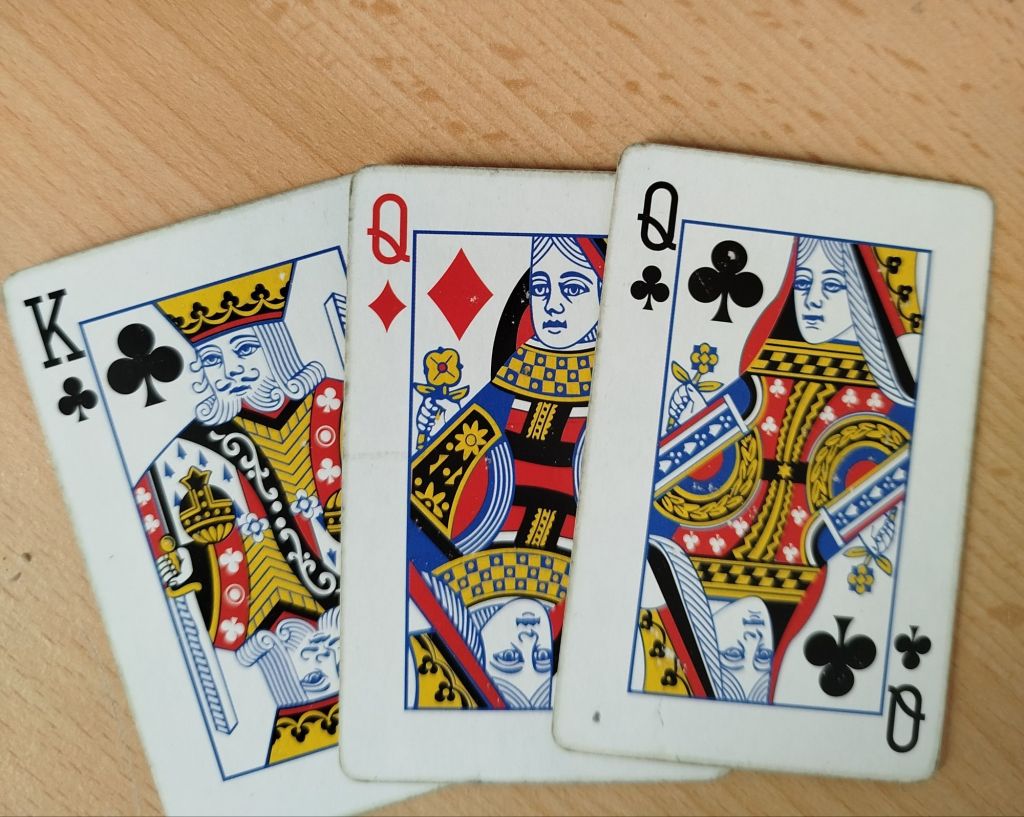
Usually, one court card within a reading is already more than we can tolerate, but sometimes we find that there are ONLY court cards. This is an example of a reading a did yesterday for a man who asked about his relationship:
A marriage-related three-card spread
When more than one court card shows up, it is important to look at the cards between them, as they show the nature of their relationship, or what’s between them.
It is easy to jump to conclusions here: there’s a woman between you two! You have a lover! This could very well be the case, actually, but it is always important to keep in mind that, with so few cards on the table, more than one interpretation is possible. Here are some possibilities:
There could actually be a woman between them. He may have a lover (or, more rarely, she may have a female lover)
It might be a threesome
There could be a woman who interferes but who is not a lover: it could be her mother, her friend, any other person.
There might be a person mediating between them in a positive way
He might know her from work or from a business context, since sometimes, two queens or two kings together can represent a single person, merging the qualities of two suits.
So, how do we know which interpretation applies? Well, first off, we ought never to play Nostradamus: in doubt, we ask. This may sound unimpressive, but our aim is not to impress, but to give accurate information. Still, with experience, we may rule out a couple of possibilities as being less likely:
This is a simple three-card spread. If the querent were in some kind of odd polyamorous arrangement, the cards would not lead off with three court cards, but by telling us the querent is weird. This may sound politically incorrect, but the cards are keyed to a rather traditional view of the world. This doesn’t mean they are a compass of morality: it’s just their language. They highlight the strange and untypical in rather clear ways. Three court cards together aren’t strange enough.
This is a simple three-card reading. If the querent had a hidden lover they would tell us the relationship is in danger, or at least they would highlight the lover by assigning her to the Queen of Spades rather than Diamonds (The Queen of Diamonds can be a lover, but it requires more hints from the surrounding cards). Even the Queen of Spades wouldn’t necessarily be a lover, but at least we’d know she’s trouble.
This is a simple three-card spread. If there were a positive influence mediating between them, the cards would have given her to the suit of Hearts, or they would have omitted the information altogether and told us the querent and his significant other are in a positive phase (the mediator isn’t that important, and a three-card spread only has space for what’s important).
With that in mind, I asked the querent if he knew his girlfriend from work or from a business context, and he denied this. I asked him then if there was a woman causing some issues between them. He smirked and said: “A friend of hers doesn’t like me, she’s trying to break us up.”
Obviously, this spread doesn’t tell us how it’s going to end. It just describes the situation rather than how it will evolve, and more cards should be drawn.
Yesterday I was cleaning in my office. I took my playing card deck (the one I use for divination) and was about to put it on the windowsill to dust my desktop, when it fell to the floor and the cards went flying in all directions.
So I gathered the cards without thinking anything of it and went on with my day. Later on I realized that one of the cards was the wrong way around: the Six of Spades, the sickness card.
Around an hour later my husband was on the phone with my mother-in-law, when she suddenly started slurring her words and being unable to move one side of her face. Fearing a stroke, we immediately called an ambulance and they were there a few minutes later.
We are still not sure what it was, but it was thankfully gone. She seems to be doing fine now, but the paramedics told her to remain in contact in case the situation presents itself again.
It is a good thing that we were on the phone with her when it happened, and I find the way the cards forewarned me endlessly fascinating, though I didn’t put two and two together until after the fact.
After discussing the playing cards that indicate gain, let’s take a look at the ones that represent loss. Keep in mind that loss can be indicated by any card of gain that is poorly placed in the spread, i.e., when surrounded by difficult cards. For instance, the 7♦, normally a card of money, followed by most Spades or even some Clubs, would represent either loss of money or a sum of money being withheld.
Six of Clubs
The Six of Clubs is a card of difficulties, toil and fatigue. It is not inherently a card of monetary loss. However, it represents a stagnand situation which, applied to money, can imply either loss or lack of gain, and especially lack of compensation for one’s toil.
Seven of Clubs
The Seven of Clubs is, again, not directly connected to loss, but it does show problems in all levels, and as such it can indicate loss or lack of gain when together with Diamonds or when summoned for a money reading. Keep in mind, though, that Clubs are not tremendously nefarious, so while they can create unsatisfactory situations, that are unlikely to cause dramatic loss.
Six of Diamonds
The Six of Diamonds is a card of worry and preoccupation, usually over money matters (but not necessarily). In general it shows situations of all kinds that stand on a shaky foundation, living paycheck to paycheck, businesses that don’t take off, etc. Again, it is not a dramatic card, but it can signify money problems or even, in general, not gaining something.
Ace of Spades and Nine of Spades
All Spades can signal loss. However, the way each of them causes loss is different. I will just highlight some of the differences. The Ace of Spades is a seriously bad card, which is often involved of configurations indicating bankruptcy, poverty and failure all around. The Nine of Spades is equally bad, and when they come up together they often prevent success in accumulating money for very long periods of time.
Two of Spades and Three of Spades
Less dramatic than most Spades, the Two of Spades indicates small losses, situations that cause headaches from a financial standpoint. The Three can also indicate small losses, and can also be found in sequences indicating scams.
Four of Spades, Five of Spadesand Six of Spades
Much more dramatic, the Four and Five of Spades indicate serious loss, projects going awry and being abandoned. They can often represent difficult circumstances, but with the appropriate cards they can point to the querent being at fault (missteps, etc). The Six of Spades represents financial situations characterized as ‘sick’, that is, unhealthy, structurally unsound and therefore destined to failure.
Seven of Spades and Eight of Spades
These cards, especially the Seven, can indicate accidental loss, that is, loss not due to negligence (however, always remember to take the context into account).
Readings about lost objects are hard. I am very much less than infallible in finding them. The reason is quite simple: most questions have a limited number of likely answers and an even more limited number of unlikely ones, so it is usually easier to make sense of the cards. “Yes he’ll marry you”, “No, he hates you”, “There doesn’t seem to be much tenderness left in the relationship, but with some effort you can keep it going a while.” There is, of course, some skill for finding nuances involved, and a good reader will add some details, but in general, the possible answers are relatively limited.
But a lost object can be anywhere, and we can either be very right or very wrong, with little space for “yes, but…” and “no, although…” Especially if we’ve never seen the place where the object was lost, it becomes hard to read the symbolism of the cards without reading our own fantasy into them. As far as I am concerned, much depends on how clear the cards decide to be with me. Since I have nothing to prove, I have no problem throwing my hands up and saying “Dunno” if that is my honest answer.
As we are moving all our stuff from the old house into the new one, plenty of things have gone momentarily missing, in the sense that I don’t know which of the dozens of boxes we’ve brought along they are in, and frankly I’m not too eager to start searching.
Except that I started itching to do some I Ching readings, and I couldn’t find my I Ching coins anymore. I did remember putting them somewhere where “I know I will find them”. The problem is that I have done the same with so many of my things in the last couple of months that the trick doesn’t work anymore. So I asked the cards for a pointer:
K♣ – 2♥ – 5♣
In general, what makes this reading relatively easy, compared to other lost item readings, is that it does not describe the place where the coins are, but rather their relationship to me. The King of Clubs is my significator. It is followed by a card, the Two of Hearts, which indicates ‘close to home’, but also ‘close’ in general. I know I cannot have left the coins in the neighborhood, which is naturally signified by the Two of Hearts, so I take it to mean ‘close’.
That Five of Clubs is interesting. In general it represents effort, but it is connected also with the body in general, understood as moving, acting ‘machine’, and also the hands. Close at hand, maybe? Or close to my body?
Either reading would have been correct. I found the coins in an internal pocket of my jacket where I usually don’t keep anything and don’t bother looking.
I’m doing it with the Sibilla, so it stands to reason that I should do it with playing cards too. As usual, this list is not meant to be complete. It is only intended to look at the cards as if through a cross-section based on a particular topic. In this case, gain.
Three of Hearts
In my playing card system, the Three of Hearts is a gift. It represents all things that we acquire easily. It is not, strictly speaking, a card of gain, but it can entail gain. For instance, if someone asked about their business, this card falling at the end of the spread would indicate improvements and therefore, within the context, additional wealth, that is, gain.
Five of Hearts
The Five of Hearts is the card of abundance. It is one of the cards that can indicate a very positive evolution and increase of wealth. As with the Three, the Five, being in the suit of Hearts, is not strictly about money, but it can promise positive situations in a reading about finances. Furthermore, next to money cards, it increases their import.
Nine of Hearts
Not much to say here. In many respects the Nine of Hearts is like the Three of Hearts, but much more powerful.
Ace of Clubs
The Ace of Clubs is a very strong card, which indicates power within the situation. If it falls next to the querent, it shows the querent actively obtaining something, having power over it. However, unlike in the suit of Hearts, the Club suit requires effort and action, and is therefore less rosy than the Three, Five or Nine of Hearts. The Ace of Clubs can also indicate a powerful vision that comes true in material terms.
Three of Clubs
The Three of Clubs is a card of union, and can represent a business affair. As such, it usually promises gain in material issues, but we must be careful in our analysis of the whole spread, as we all know a business deal can be disastrous when attended by Spades or less promising Club cards. By itself, the Three is mildly encouraging.
Ace of Diamonds
The Ace of Diamonds represents news in general, but it also represents gold and all things that have high value. It is a card of great riches and wealth when not impeded by other difficult cards.
Three of Diamonds
The Three of Diamonds is a money card. As such it is usually read as small gains, whether in a positive sense (as in a small inheritance or a small raise) or in a negative sense (as in having only little money). Furthermore, we must be careful to note whether the little money is being gained or spent. By itself the Three shows gain.
Four of Diamonds
The Four of Diamonds represents agreements and pacts. Being in the suit of Diamonds it is geared more toward material affairs and thus indicates contract, whether positive or negative will be shown by other cards.
Five of Diamonds
The Five of Diamonds indicates change, especially (though not exclusively) within the context of money matters. It can indicate money changing hands for better or worse.
Seven of Diamonds
This is like the Three of Diamonds, but it shows a larger amount. Furthermore, the Seven is more clearly indicative of gain over loss. It is a more inherently fortunate cards.
Nine of Diamonds
The Nine of Diamonds is strongly connected with the realization of plans, material projects and with social ascent. Increase in wealth may or may not be tied to it, though in our society it usually is. It represents strong satisfaction in money matters, and upward mobility with all the perks that are entailed.
Ten of Diamonds
The biggest money card in the game, the Ten of Diamonds indicates success all around. For entrepreneurs it shows the reaching of great goals, while for business owners it can represents advantageous situations that generate wealth and ease in terms of money. Note that gain can be intended also as a reduction in expenses, so if the question is something like “Will I manage to get my landlord toreduce my rent in the next contract?” that counts as gain.
This is a fun little reading I did some time ago for myself. I’ve waited enough to know with relative confidence that it was accurate. Basically, one day, about four or so months ago, I found a message in my folder by someone claiming I had appropriated their image without asking them for permission.
Since I only use stock photos from WP’s archives or pictures I have taken myself, I knew this could not be the case. Still, the person was threatening legal action against me, and I wanted to avoid issues, so I sent them an email asking what picture they were referring to, and saying that I could take the picture down although I highly doubted I was in the wrong.
I also pulled some cards from the playing card deck. This was the reading:
Q♠ – 2♣ – 3♥ – 10♠ – 9♥
Notice immediately the Queen of Spades. The person who sent me the email was a woman. If it had been a man, in the absence of mentions of a woman, I could have taken it to indicate some evil intent on his part. The fact that the woman is represented by a Spade does not necessarily indicate that she is trying to scam me or anything. It could very well be that she thought she was in the right and was angry (Spades) at me. The reality is that I have no real evidence from the spread about her true motives.
She is immediately followed by the Two of Clubs, which indicates a step taken, so obviously the angry woman took a step, or I wouldn’t have an email in my folder accusing me of breaking the copyright law.
Finally, note the Ten of Spades, a usually negative card, besieged by two of the most positive cards in the deck, the Three of Hearts and the Nine of Hearts. The Ten of Spades is the night, and it indicates everything that is dark, secret or obscure, but also all things that come out of nothing. The two positive cards surrounding it represent the positive solution of the problem. Therefore, the solution comes out of nothing, which, I reasoned, is the same as saying that the person writing me that email will, more or less, disappear into the night. Thus, I judged that little or nothing would come of the situation. So far I seem to be correct. The woman hasn’t answered my email. It may be that she realized she had made a mistake.