Tag Archives: playing card divination

Carte Piacentine. Divinare con le Briscole by Ernesto Fazioli – Review / Recensione

English Version (scroll down for the Italian version)

It is an exciting time to be practicing divination. Among the occult arts it is probably the most popular for its immediate practical usefulness. The tarot is enjoying a divinatory revival after being brought to its knees by decades of pseudodeep elucubrations, and even lesser known systems of fortune-telling are being slowly fished out the obscure underbelly of folk tradition.

And occult folk tradition is especially rich in Italy, a country which, in part due to its chaotic and conflicted history, can boast a huge diversity of divinatory systems, especially (but not exclusively) of the card-based kind. It is especially reassuring to see that, unlike in the past, people of considerable education are taking these folk systems seriously.

It’s the case with Ernesto Fazioli’s latest book: Carte Piacentine. Divinare con le Briscole (Piacentine Cards. Divining with Briscola* Cards), a book dedicated to one of the many dozens of cartomancy systems based on the many types of Italian playing cards — in this case, Piacentine Cards–

Carte piacentine, one of the most popular playing card decks in Italy

Fazioli’s book is part of the same series as Germana Tartari’s Book on the Bolognese Tarot and it shares some of its traits: it is short (84 pages) and goes straight to the point; it is prefaced by a very quick but well-documented historical introduction; finally, it is aimed at shining a light on a small part of the Italian folk tradition while giving the reader the tools to work with it in today’s world.

I could quibble on a couple of points that made me wrinkle my nose, such as the association of the four suits with the four elements following the Golden Dawn pattern (which is not rooted in folk tradition, Italian or otherwise) but in reality all this is of very little account, as it can be very easily overlooked. The bulk of the book is solid and it teaches a traditional and little-known method of fortune-telling using a reduced pack of 30 Piacentine cards.

Each of the 30 cards is dedicated a small paragraph, which is enough, considering that, in traditional fortune-telling, one doesn’t spend a great deal of time musing on the quaint design of this or that card based on the latest fashion. For what little I know about this deck, the meanings retrieved by Fazioli feel genuine and even show a degree of overlap with the meanings of the Bolognese tarot.

This should not be a surprise, as fortune-telling and divination were born as methods of “gathering intelligence” about the world, meaning that, whatever system one uses, one must be given access do an adequate vocabulary–that is, a vocabulary that is adequate to describing the real world.

The spreads that Fazioli present also come from the folk tradition, and vary from the easier ones (the five card spread) to the very complex (a tableau of all 30 cards).

All in all, I am very pleased with my purchase, and will probably be posting a spread or two following the system. I am especially surprised by the good amount of information that Mr. Fazioli could pack into such a short booklet, and am endlessly fascinated, once again, by how folk divination emerges in its quality of spontaneous and creative remedy to life’s uncertainty.

Where to buy: Amazon or Mutus Liber

* Briscola refers to one of the most popular game cards in Italy, usually played with Piacentine cards or a similar 40 card regional deck. For this reason, regional playing cards are often known as “carte da briscola” (briscola cards) in common parlance.

Versione Italiana

È un momento storico molto entusiasmante per chi pratica la divinazione. Tra le arti occulte è probabilmente la più popolare per la sua immediata utilità pratica. I tarocchi stanno vivendo un revival divinatorio dopo essere stati messi in ginocchio da decenni di elucubrazioni pseudointelletuali, e anche sistemi di cartomanzia meno conosciuti vengono lentamente ripescati dal ventre oscuro e creativo della tradizione popolare.

E la tradizione popolare occulta è particolarmente ricca in Italia, un Paese che, anche a causa della sua storia caotica e frammentata, può vantare un’enorme varietà di sistemi divinatori, soprattutto (ma non esclusivamente) del tipo basato sulle carte. È particolarmente rassicurante vedere che, a differenza del passato, persone di notevole cultura prendono sul serio questi sistemi popolari.

È il caso dell’ultimo libro di Ernesto Fazioli: Carte Piacentine. Divinare con le Briscole, un libro dedicato a una delle molte decine di sistemi di cartomanzia basati sui numerosi tipi di carte da gioco italiane – in questo caso le carte piacentine -.

Il libro di Fazioli fa parte della stessa collana del Libro sui Tarocchi Bolognesi di Germana Tartari e ne condivide alcuni tratti: è breve (84 pagine) e va dritto al punto; è preceduto da un’introduzione storica molto rapida ma ben documentata; infine, si propone di far luce su una piccola parte della tradizione popolare italiana dando al lettore gli strumenti per metterla a frutto nel contesto odierno.

Potrei cavillare su uno o due punti che mi hanno fatto storcere il naso, come l’associazione dei quattro semi con i quattro elementi secondo lo schema della Golden Dawn (che non ha radici nella tradizione popolare, italiana o meno), ma in realtà tutto ciò è di ben poco conto, perché può essere facilmente trascurato da chi non è interessato. Il libro ha solidi contenuti e insegna un metodo di cartomanzia tradizionale e poco conosciuto, utilizzando un mazzo ridotto di 30 carte piacentine.

A ciascuna delle 30 carte è dedicato un piccolo paragrafo, il che è sufficiente, considerando che, nella cartomanzia tradizionale, non si passa molto tempo a riflettere sul design pittoresco di questa o quella carta in base all’ultima moda. Per quel poco che so di questo mazzo, i significati recuperati da Fazioli nella sua attenta indagine sembrano genuini e mostrano persino un certo grado di similitudine con i significati dei tarocchi bolognesi.

Ciò non deve sorprendere, poiché la cartomanzia e la divinazione sono nate come metodi di “raccolta di informazioni” sul mondo, il che significa che, qualunque sia il sistema utilizzato, ci deve dare accesso a un vocabolario adeguato, cioè un vocabolario che sia adeguato a descrivere il mondo reale.

Anche le stese che Fazioli presenta provengono per lo più dalla tradizione popolare e variano da quelli più semplici (la stesa delle cinque carte) a quelli molto complessi (una stesa di tutte le 30 carte).

Nel complesso, sono molto soddisfatto del mio acquisto e probabilmente pubblicherò una o due stese seguendo il sistema. Sono particolarmente sorpreso dalla buona quantità di informazioni che Fazioli è riuscito a racchiudere in un libricino così breve e sono infinitamente affascinato, ancora una volta, da come la divinazione popolare emerga nella sua qualità di rimedio spontaneo e creativo all’incertezza della vita.

Dove acquistarlo: Amazon or Mutus Liber

Playing Cards – The Ace of Spades VS the Five of Diamonds

I was asked in a private message about the difference between the Ace of Spades and the Five of Diamonds in my way of reading playing cards, since both seem to signify change. This is a nice question, so I thought I’d write an article about it. Maybe I’ll write other comparative articles if I feel inspired to.

First off, let’s start with two obvious facts. The Ace of Spades belongs to the Suit of Spades, which is the most negative in the deck. Spades have very few redeeming qualities. They represent the dark side of existence, pain, grief and sorrow. The Suit of Diamonds, on the other hand, is neutral, with some positive undertones. It is a symbol of energy, change, progress. It is connected to technology and science, to money, wealth, intelligence. Broadly, it shows impulses and new impulses. This fact alone indicates that the Ace of Spades must have more negative connotations than the Five of Diamonds.

Furthermore, the Ace of Spades is, well, an ace. Aces have a powerful impact on any reading, as they can show the manifestation of new currents of destiny, new life phases, etc. They indicate the beginning of something. Even when they don’t, they are still very dominant cards, and we must always pay close attention to them. Fives, on the other hand, are roughly in the middle of the sequence, so the change they indicate is more akin to a transition within the same sequence or current of events.

This is, of course, somewhat vague and needs to be understood within the context of each reading. However, when we combine the suit with the number, we do have a general picture of the Ace of Spades as a very drastic card, whereas the Five of Diamonds, unless supported by drastic cards, tends to show a smoother transition, which is also less all-encompassing.

There is something else to take into account. Calling the Ace of Spades the card of change is somewhat reductive, as if we were trying to neutralize it. The Ace of Spades is, for the most part, a negative card. One of the ways my teacher called it, in addition to ‘the Death card’ was also ‘a thorn in the heart‘ though I don’t remember if I talked about this in the post. Perhaps I, too, have been guilty of playing it down.

A thorn in the heart is something that makes us suffer beyond words. It symbolizes grief, bereavement, sometimes even trauma. Even when followed by positive cards, the Ace of Spades represents painful changes that take a toll on our psyche, changes we are likely to perceive as some kind of great loss. The somewhat sterile concept of ‘change’ pales in comparison to this description.

The Five of Diamonds has, by itself, none of these connotations. It shows transition in the most neutral sense possible. For instance, when found next to the Ace of Hearts, i.e., the house, the Five of Diamonds can show renovations or changing the place of some piece of furniture, depending on the accompanying cards. The Ace of Spades next to the House can show grief in the family or coming from the family, and if it does indicate change, it is more likely to indicate an eviction or an unwanted change of residence.

Again, this is rather vague: we need to understand the cards within the context of a concrete reading, but by and large that’s my experience.

MQS

Using Playing Card Divination on Psychological Questions (Example Reading)

There is a general stigma toward certain forms of divination such as cartomancy with playing cards, namely that they are good at discussing mundane issues, while the Tarot should be used for deeper questions. This presupposes two things: that deeper questions don’t take place in the same world as regular life and that the Tarot is too deep to talk about everyday occurences. Both these beliefs are wrong.

The Tarot is perfectly capable of talking about whatever it wishes, just like playing cards, the Sibilla deck and every other oracle. The first presupposition, though, is more insidious and requires a bit more discussion.

The oldest extant series of tarot meanings has been retrieved in Bologna. The meanings there are what you would expect from a fortune-telling deck: the Ace of Swords is a letter, the Ace of Cups the house, the Hermit an old person etc. Furthermore, some rare examples of tarot fortune-telling in pre-modern Italian literature confirm that the Tarot has probably been used for such aims long before the occult revival started by Court de Gébelin, which slowly removed the Tarot from real life and confined it to the realm of “higher metaphysics”, that is to say, of psychological onanism.

In order to justify this “higher” (I would say emptier) use, several hypotheses on the Tarot’s origins have been put forth, depending on what was considered fashionable and not too easily disproven at the time. First it was the Egyptians, then the Kabbalists, then the Cathars, etc. Instead of being seen for what it obviously is, namely a wonderful product of European Neoplatonic Christian art that anyone before the Enlightenment would have immediately understood and considered familiar, and that only the ignorance of our post-Enlightenment metaphysicians could try to disguise as a distant voice coming from distant secret masters to apply in the understanding of distant matters, rather than an immediately obvious tool to mirror immediately obvious real life situations, which are all instances of an eternal story that constantly tells itself.

So yes, the Tarot can talk about daily experience. In the same way, other, more apparently mundane forms of fortune-telling can talk about problems that some would consider ‘deep’. Just like the Tarot, they can talk about it in immediate terms, immediately understood by anyone with who has some understanding of symbols.

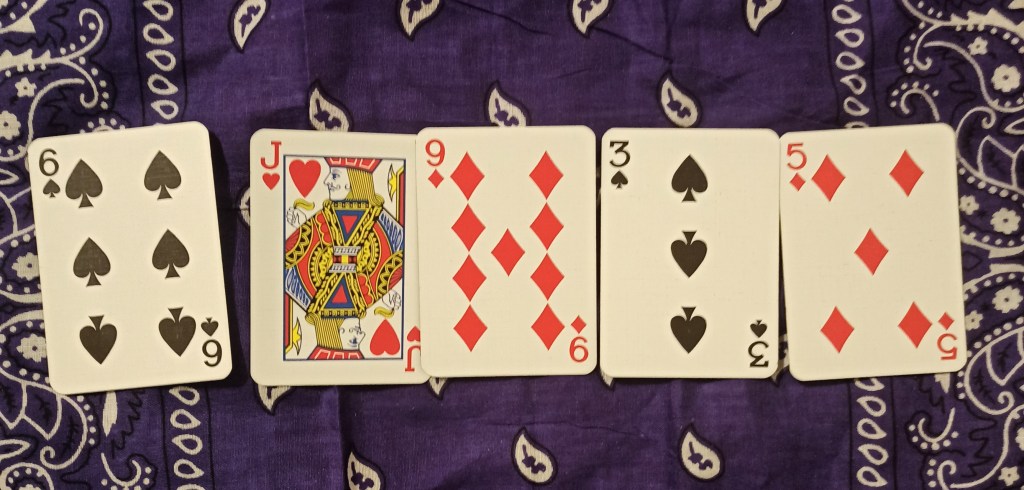
Here’s an example of playing cards used for a ‘deeper’ reading. The querent is a woman I met at an Enneagram convention. She asked what was the reason for her constant bouts of depression. These are the cards:

“Why am I always depressed?”

There is a sickness in her life, signaled by the Six of Spades. There are no cards of deep trauma, but something definitely needs healing. This card falling first sets the tone. The Jack of Hearts represents a child, a project, etc. Next we have the Nine of Diamonds, which is a card that represents the realization of ambitions, but more broadly can represent ambition. Then we have the Three of Spades and the Five of Diamonds. These two cards oftne indicate turning away from something. But the Three of Spades also comes directly before the ambition card. So she has turned away from some ambition. Two possible interpretations that came to mind are that she had the ambition of having a child but couldn’t or that she turned away from a childhood ambition.

I asked her, and it was the second possibility. She’d had big dreams for her life when was a child, but some disappointments had led to seeing them as unrealistic and she had let go of them. I told her that she hadn’t really let go of them, otherwise the Six of Spades wouldn’t have shown up: those ambitions still fester inside of her, and the fact that she is not doing anything about them could make her sick if she isn’t careful. These cards clearly show that she needs to go after her dreams, perhaps in her free time. Alternatively, if she doesn’t want to, she needs to truly let go of them and move on.

MQS

Don’t Mess with the Cards (Example Reading)

Some weeks ago I made an experiment. I asked the cards if an item I had ordered would arrive the next day, knowing full well it was a Sunday. The cards’ response was:

Playing Card Reading – Will the Parcel Arrive Tomorrow?

The cards are pissed off: you’re being an idiot (Jack of Spades) tomorrow is rest day (Four of Hearts) negative answer (Eight of Spades).

Well, yesterday (Saturday) I asked the same question just to try the cards, since I was waiting for another parcel. Here’s the answer I got:

Playing Card Reading – WIll the Parcel Arrive Tomorrow?

Obviously, the answer is positive, though I did not stop to think too much about it. I thought the cards had simply given me a wrong answer because I wasn’t being serious.

Yet, today the doorbell rang. It was my neighbor with a parcel for me. It had arrived yesterday in the afternoon and had been delivered to him by mistake.

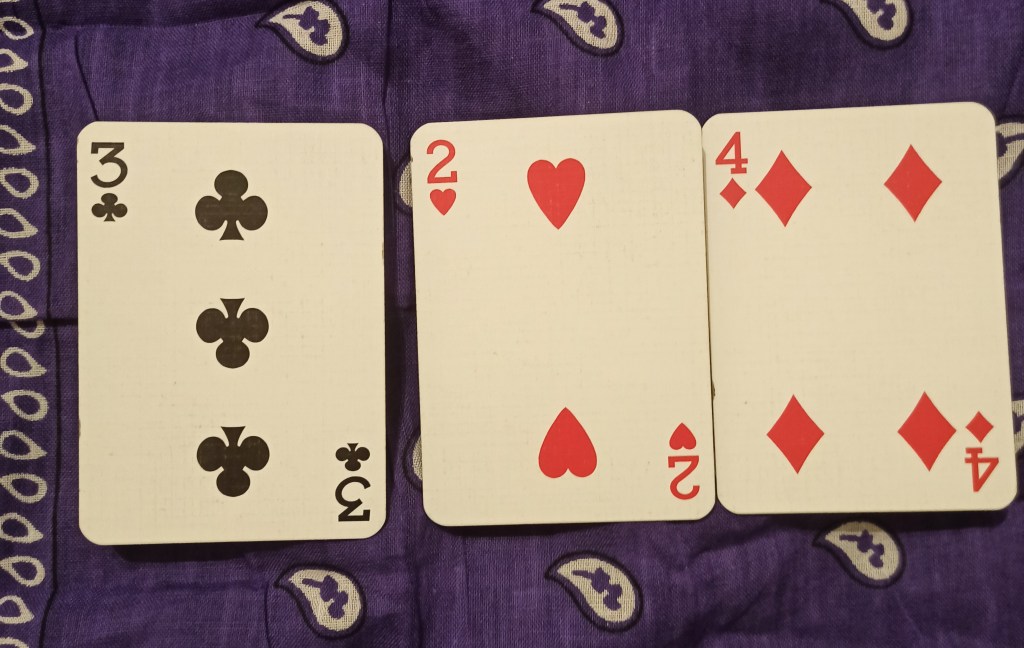
Looking back at the cards, the Three of Clubs represents intermediation, someone who does things in your stead – in this case, collecting the parcel. The Two of Hearts, which usually just shows imminent things, in this case represented what’s “near the home”, i.e., the neighborhood.

Moral of the story: don’t mess with the cards, they know better.

MQS

Whodunnit? Playing Card Reading on Theft and How to Identify People

It’s not just about love. Playing cards (and any other oracle) can be used to identify people, find lost objects and animals and many other things. Unfortunately, this type of reading is extremely complex, and I have a less than stellar track record in this regard (as opposed to the lady who taught me, who was sort of known for finding lost rings and describing thieves)

The reason for the difficulty is that the world’s complexity is almost endless, and we only have a limited number of cards at our disposal, so that there is always a need for combining card meanings in new and clever ways to signify everything. One of the subjects I want to touch on in a next article on the philosophy of divination is exactly the fact that the limits of our imaginations can also be the limits of our ability to make predictions.

Furthermore, the language of the cards is otherworldly, at least as far as making predictions is concerned, so that the oracle will not necessarily answer the question in a linear form that is readily understood. This is why my error rate by people descriptions and by finding lost items tends to be higher than in other readings. Sometimes I can’t so much as make sense of one of the cards, let alone the whole composition.

There is, however, a reading I want to share because of how clear the cards were, which makes this a good case study. A woman had lost her bracelet and, after looking for it everywhere, was beginning to suspect her niece of stealing it, possibly as a game. Here’s the spread:

Playing Card Divination, A Reading about Theft

There is one woman in the spread. She is next to the Ace of Clubs. This is extremely important. The Ace of Clubs represents initiative, and if you ask whether someone will or won’t do something, if their significator comes up next to the Ace of Clubs (or the Five of Clubs, representing action, or, sometimes, even the Two of Clubs, which means taking steps) it shows the person will do it.

In this case, though, we are talking about theft. So this woman took the initiative, i.e., she stole the bracelet. She is next to the Eight of Clubs, which represents work. So this is not the querent’s niece, but a coworker or superior.

Note, though, that she comes up as the Queen of Diamonds, not as the Queen of Spades, so there is no inherent ‘evil’ about her. Furthermore, we have the Three of Diamonds next to the Eight of Clubs. The Three of Diamonds represents all activities that are done part-time. Metaphorically, therefore, the woman is not a ‘full-time’ thief, i.e., she doesn’t have the habit of stealing. She probably just seized the moment to have something that caught her fancy. The Ten of Hearts closing the spread shows the possibility of a happy ending.

To be more sure, I asked the querent to pick another card for the Queen of Diamonds, and she chose the Four of Clubs. So this is a woman the querent speaks to habitually. Furthermore, even though the Queen is a Diamonds, and should technically be very fair, she is surrounded by Clubs, which represent a dark complexion and/or hair (but not as dark as Spades)

Well, some days after the reading the querent’s coworker, a woman of dark complexion and hair, came forward to her, wracked with guilt, and gave her back the bracelet, which the querent had left on her desktop unattended. The woman said she didn’t know what had possessed her to steal the item.

MQS

Sibilla and Playing Cards, Linguistic Differences (Reading Example)

This is not the first time that I compare divination to language. Divination systems *are* a form of language. Each has its own vocabulary, its syntax and its grammar. However, there is more to languages than just these three things (and possibly more, if you are a linguist)

Languages don’t exist in a vacuum. They are spoken concretely by concrete individuals. Each individual has his or her character, quirks, idiosyncrasies, which hugely influence the way they speak.

The Vera Sibilla is notorious for its chatty nature. She is like that old aunt with no sense of personal space who spends the afternoon drinking coffee with her neighbors and spilling tea on others without much in the way of connecting themes. Playing cards, on the other hands, tend to be more sober and to the point. In a way, I find they are easier to interpret, exactly because they are more predictable. Tarot, I find, is also more to the point, although it is more complex in other respects.

Here is an example of the same question asked by the same querent, but answered with the Sibilla first and with playing cards second.

The querent is a young man in his mid-20s we got to know at a friend’s house. He asked if he would find a job.

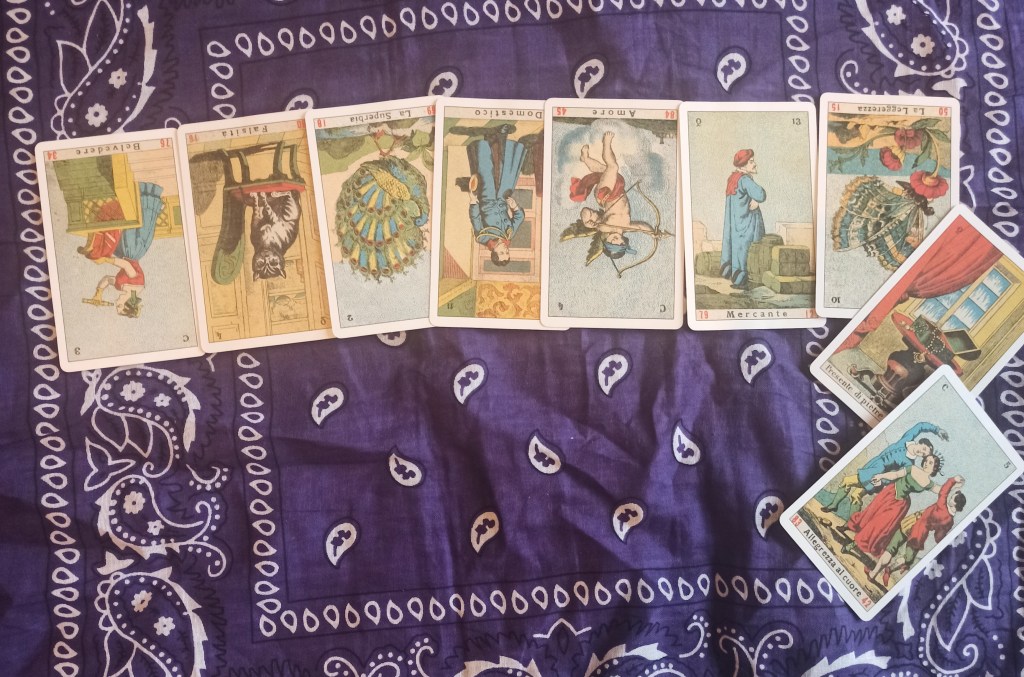
Vera Sibilla reading on job

Important note: this reading started as a three card reading. I had to keep adding cards because, as is often the case, the Sibilla kept giving me quirky details instead of the answer. The first three cards did not contain the answer (if I had tried to answer based on the first three cards, it would have been a no, and I would have been wrong.)

As in a recent reading I posted, the spread stards with the reversed Balcony. This time it’s followed by the reversed Falsehood card and by the reversed Peacock. The first three cards hint at the fact that is awaiting an improvement of his career (reversed Falsehood) that is not coming (reversed Balcony). The reversed Peacock shows both the struggle (it is a card of great obstacles) and the fact that he may be taking things very personally whenever something goes wrong.

Then we have the reversed significator and the reversed Love card. This means two things: firstly, that he is gay (which he confirmed on the spot) and secondly, the reversed Love card flaking the significator together with the reversed Peacock confirms my first intuition that he does take things too personally, maybe as though he were expecting employers to huddle together around him and woo him.

Since it is followed by the Merchant, which is the significator for the querent’s job, it shows again that he has emotional troubles connected with his career. Fortunately, it is followed by the reversed Ten of Clubs, which shows a favorable chance. But this card only shows a chance, not that it will be taken, so I asked the querent to pull two additional cards, and this shows that he will receive a good offer (Present of Jewels) of a part-time job (Happiness).

On to the playing card spread

Playing cards reading example on job

This one also started out as a three card reading. And it remained one. Change, Union, Part-time job. There will be a change which will lead to a part-time position.

You may say that since we had already answered the question with the Sibilla, playing cards didn’t need to add much. Maybe, but the Sibilla’s chattiness is indeed more pronounced than that of playing cards.

MQS

Sometimes Three Cards are Enough to Describe a Person (Playing Card Divination)

I find this short little spread interesting, because it is a good introduction to how playing cards can communicate with us. Often, especially at the beginning, we tend to expect cards to fall into a specific order that represents the whole situation like a movie. And, indeed, sometimes this is what happens (I have a nice Tarot spread coming on this.)

At other times, though, the cards take another approach and use our words ‘against’ us, as it were. Here’s the reading. I have been on a waiting list to receive a certain instruction book on some esoteric doctrines by someone. Yesterday I asked the cards the following question: “Will he do as he says?”

To answer the question, I pulled three cards, which were:

4♣ – K♥ – 10♦

Anyone can see that the spread is broadly positive, but the interesting thing is how the cards respond in the affirmative. The Four of Clubs is the card of words, and represents everything that we do to express what is inside of ourselves. The King of Hearts and the Ten of Diamonds, though, in addition to representing a rich protector, can also be part of larger combinations showing nobility or great wealth.

Therefore, what the cards are saying is “what he says, his words, are the words of a nobleman,” which means that they are truthful. This answers my question “Will he do as he says?” perfectly. The answer is also a broad judgement on the person’s character: he is, generally speaking, a nobleman at heart.

MQS