Tag Archives: playing card divination

Love Fool (Horary Astrology and Playing Cards Reading)

This is the first time I use my new interest, Horary Astrology, in conjunction with playing cards. Let’s see what they have to say. The question was asked by a friend of mine who just broke up with her girlfriend. He wants to know if there is a future. This reading was made a couple of days ago.

Relationship reading, is there a future?
Answered with horary astrology

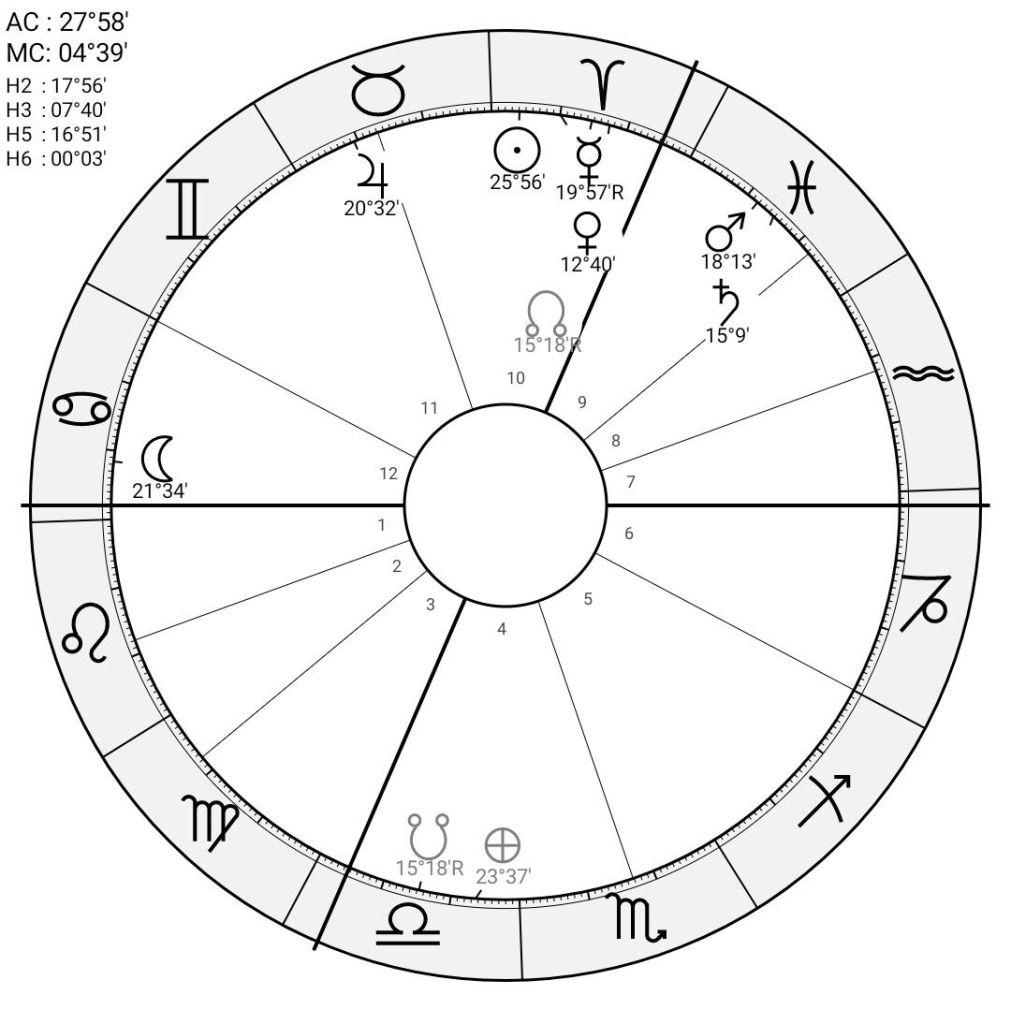
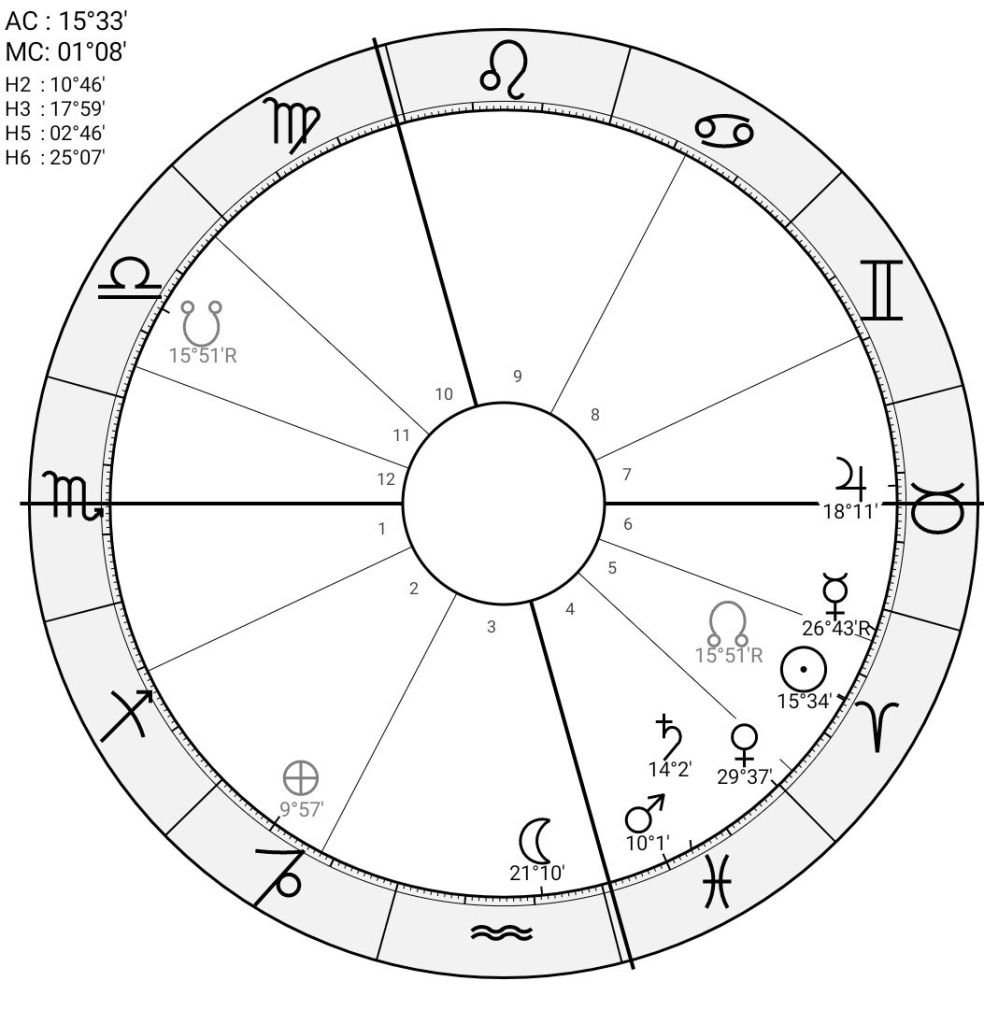
The querent is Mars, lord of the Ascendant, while the quesited, i.e., the girlfriend, is Venus lord of the Seventh. The Moon indicates the flow of the action.

In a night chart, Mars is dignified by triplicity in Pisces, and is angular, while Venus is exalted, also in Pisces, and also angular. The first thing that strikes me is that Venus is moving away from Mars. Furthermore, the Moon is separating from a difficult square with Jupiter in the Seventh. I asked my friend if he had broken up with her or she had broken up with him, since from the chart it seems it was her initiative. He didn’t like to admit it, but said she had left him.

Note that Mars is in triplicity, so a decent Mars, but also conjunct Saturn. Saturn is peregrine. Also note that Venus, the girlfriend, is exalted, and exaltation is sometimes an indication of haughtiness. Clearly she thought she could do better than Saturn-like Mars as she moved away from him. My friend then told me she told him she didn’t like the fact she is to attached to her.

Well, CAN she do better? Venus is about to change sign, from Pisces to Aries, whereupon she will not only lose all her dignity, but she will also enter her detriment. Let us look at the Moon now. The Moon separates from the square with Jupiter and moves toward a sextile with Mercury Retrograde. Sextiles are positive aspects. If we put together the indications, we have: 1) Venus moving away but regretting her decision 2) A future positive contact 3) the contact is about things that go back (retrograde)

This seemed to me a sign of reconciliation. Just to be on the safe side, I had the querent pull three cards from the playing card deck. These were:

5♠ – Q♣ – 3♥

The cards are quite clear. The Five of Spades is a card of imprisonment, but it also indicates regret (which is what you are supposed to feel in prison). Then we have her significator, followed by the Three of Hearts. I would have preferred to see a Six of Hearts to show reconciliation, but the Three of Hearts will do. In this case, the added shade of meaning seems to be that the cards don’t even consider the breakup effective, because the Three of Hearts show things that flow positively without interruption.

I will update this post when I know the outcome.

MQS

Playing Card Multiples

I believe that in the development of divination techniques, the creation of meanings for multiples of cards of the same number must have probably come pretty early. When I was taught to read playing cards, the person who gave me the meanings passed also the signification of card multiples to me, with the caveat that she’d never found them to be very reliable, contrary to the rest of the method. I must confess that I almost never use them, except when the meaning can be derived from the meanings of the cards, which is why I never talked about them before. However, since someone asked me, I’ll retrieved them from my notes so that you can experiment with them.

Note that it does not matter which cards we are talking about as long as they have the appropriate number of pips. However, the presence of Spades in the combination is supposed to worsen the meaning, especially if the Spade card comes last.

Aces
2 = Surprise
3 = Positive Chance
4 = when together, death or great danger, when apart, glory or success

Twos
2 = Exchange
3 = Agreement
4 = Slowness, Boredom

Threes
2 = Tricks
3 = Increase or Progress
4 = Quick Communications

Fours
2 = Worry, Insomnia
3 = Situations speeding up, Unblocking
4 = Travel

Fives
2 = Small losses, Small torments
3 = Resolution
4 = Law

Sixes
2 = Nervousness
3 = Anger
4 = Violence

Sevens
2 = Development
3 = Sickness
4 = Dissatisfaction

Eights
2 = New acquaintances or learning something new
3 = Wedding bells
4 = Infamy

Nines
2 = Help from friends
3 = Triumph
4 = Glory

Tens
2 = Change of place
3 = Change of life
4 = Birth or rebirth

Jacks
2 = Fighting
3 = Litigation
4 = Danger

Queens
2 = Talks
3 = Gossip
4 = Slander

Kings
2 = Help
3 = Commerce
4 = Great Honor

MQS

Checking Talismans with Playing Cards

In one of my recent posts I discussed how playing cards can detect curses (of course, it’s not just playing cards that can do it). Today I wanted to add to this subject by discussing the esoteric use of Playing Cards to check if a spell (in this case, a talisman) is a good idea or has been successfully created and is working.

I should perhaps first explain that there is a modicum of belief in magic involved in all this. The modern worldview tends to react to the idea of magic in two ways: the skeptical way (“it’s not really true”) and the new age way (“it’s not really true, but I would really love for it to be true, so I’ll play make belief and tailor everything to my preconceptions”)

Either way, magic is reduced to the acceptable role of cathartic theater or psychological tool (unfortunately, even great minds within the occult scene, like William Gray, have partly fallen for this approach, or at least considered it viable). From here it has even found its way even into the corporate sphere (a friend of mine working for Google told me she was forced to attend a “magical” day with a psychic who talked to them about tarot and Wicca). You know something is crap when pandering megacorporations appropriate it.

At least since Aleister Crowley (but there are predecessors) magic has been understood as the way of the will. Granted, Crowley’s understanding of the word “Will” is not the same as how we understand it in our everyday life, which would rather be “whim“. His view resembles more closely Nietzsche’s view of the will, so it does have some nobility.

But this doesn’t detract from the fact that most people whose view of magic has been colored by Crowley’s (and that’s almost everyone today, whether they know it or not) don’t REALLY believe in magic. Instead, they tend to see it as, again, little more than a placebo. It’s true if you believe in it. It’s true if you want it to be true.

Still, it’s my experience that belief in magic is not really required for magic to work. In fact, one would be hard pressed to find any trace of the concept of the magician’s will in the traditional Western approach to magic (or in the Eastern approach, for that matter).

Because just believing in it was usually not considered a prerequisite for success, the use of divination to check the efficacy of magical workings has been advocated a long time. Besides, if belief is not enough, other, more objective factors must be checked. *

The Arab mages of old, for instance, invited people to do a horary reading to see if the use of planetary magic was warranted. Agrippa probably used geomancy for the same purpose. We don’t know about Abano, but it is not a stretch to think he would have consulted a geomantic shield to check how his spellwork was doing.

In general, all forms of divination take the reality of magic for granted within the worldview that informs their language. After all, why would divination work, but not magic? ** This is true for playing cards as well. Here is an example.

Last year while the Sun was in Leo I was working on a Sun talisman. I’m not going to disclose the aim of the talisman. It was nothing untoward, but I’d rather keep it to myself. After the creation of the talisman I set out to consecrate it. The number of days varies.

On the first day, after the first consecration, I got the following spread:

A♠ – 6♣ – 5♠

Definitely a bad start. And I wouldn’t have expected anything less. The majority is Spades, which is bad for anything but black magic.

6♣ – 8♣ – 10♣

Second day of consecration. A mash of clubs is not positive. It shows difficulties and toil without success. Still, Spades have abandoned the spread, which is a positive.

6♣ – A♦ – 3♠

This is the third day. Close but no banana. It is still a negative spread. It has the Six of Clubs in common with the previous spread, and it closes with an unpromising Three of Spades, which bring Spades and large obstacles back into the equation. Note that this is the third day in a row I get the Six of Clubs. But the Ace of Diamonds has appeared, which indicates success, talismans and even the Sun.

A♦ – 9♦ – 10♦

Fourth day. This is the sign I was waiting for. The Ace of Diamonds is back. This time it is well-placed. The Nine of Diamonds and Ten of Diamonds together just mean “it works”, whether we are talking about an object, a business plan or a spell.

MQS

* This is not to say that the old magi wanted you to do your homeworks half-heartedly. Marsilio Ficino talks about the importance putting your heart in your spellwork.

** this would lead us off into an interesting discussion of all those that practice divination without believing it to actually work (“it’s just a brainstorming method” being the most common rationalization)

Exploring Curses with Playing Cards

Most systems of divination can also be used to explore esoteric topics. For instance, I have answered the question “have I been hexed?” way more than I would like. The answer is no 95% of the times. Only two times in my life have I sent someone straight to see a priest because something supernatural was objectively at play. Most of the times, people use dark magic as a scapegoat to rationalize natural periods of bad luck.

Of the the two times I did detect a curse I can only find records of one (my notes tend to be rather messy). The girl in question asked me if she’d received the evil eye (malocchio). This was the spread:

10♠ – 5♠ – 5♥ – J♠ – Q♠

I added two cards to the queen, and I got the Q♦ and the 2♥. The reading is quite obvious: a woman cursed her (the Queen of Spades with the Jack) on behalf of a relative (the Queen of Diamonds and Two of Hearts) though probably not a blood relative. The Ten and Five of Spades, when read together with the other spades, indicate the use of negative occult powers, probably at night.

The Five of Hearts in the center of the spread probably showed the sector of the querent’s life that was impacted by the curse: the ‘abundance’ sector. The young woman had lost a ton of weight in a short timeframe, she looked wasted, had started losing her hair and her beauty, had started developing money problems (in that she couldn’t retain any money she made). Her significator is absent, meaning she was completely passive to the hex.

It seems her mother-in-law had gone to see a country witch to try to harm her. This is far more troublesome than the evil eye, which sometimes can even be cast inadvertently without a ritual. The hex was broken by a priest, or rather, thanks to a priest who put her in contact with a monk specializing in this kind of stuff.

I’m bringing up the topic because I was recently asked the same question by a friend of mine who is going through a rough patch (lost her job, broke up with her boyfriend, argued with her sister, etc), which she believed was due to some ‘bad vibes’ or the malocchio. The spread was:

3♠ – 6♣ – Q♣ – 7♠ – 5♦

This time we have the querent in the middle of the spread. This, coupled with the fact that there are no combinations of curse, is encouraging: the querent has not been displaced from the center stage of her life.

The cards are negative, but they don’t reference supernatural phenomena: the Three of Spades could indicate curses or evil eye in combinations, but here there is no such combo, so it just indicates problems, things that don’t go smoothly. The querent is surrounded by the Six of Clubs and the Seven of Spades, the latter showing unfortunate events, the former reiterating the idea of difficulties. The Seven of Spades connects to the Five of Diamonds to indicate a period of misfortune, that is, of natural bad luck, which will pass (there will be change, it won’t stay that way forever).

MQS

A Money Spread – With a Mistake

Not even the best card readers are 100% correct, and I’m far from being the best card reader. This is an example from some time ago. The querent was a woman she asked me, generally, about her finances.

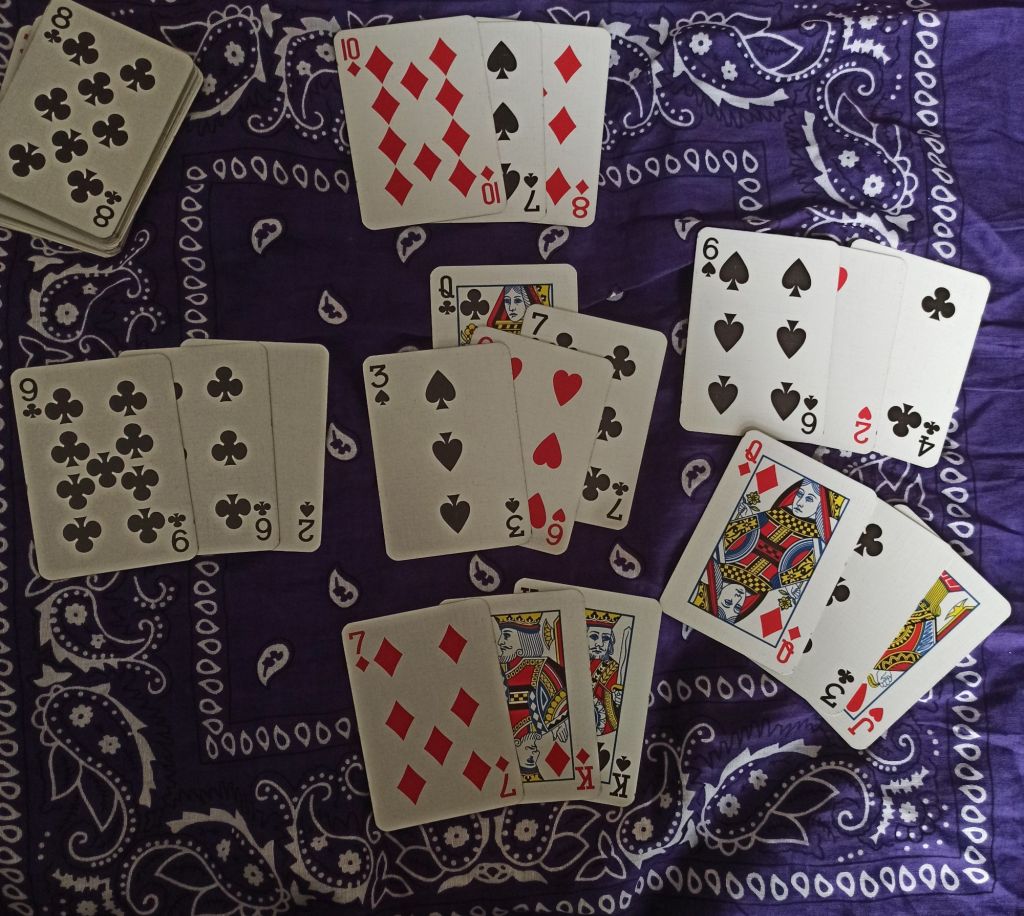
Cartomancy with playing cards – a cross spread about money

Looking at the spread as a whole, it is clear that  it’s about money. In the upper position there are money issues highlighted, particularly a sudden (Seven of Spades) expense. The position below, which often needs to be connected to the one above, indicates issues connected with authority, possibly a bank or other financial institution (the King of Spades and King of Diamonds). In the past position we have a situation of slowness and difficulties for a long time, while in the heart position there are difficulties, possibly either obtaining something or getting it back (the Six of Hearts can mean that) or just simply difficulties finding one’s footing.

I ask the querent and she tells me that she’s a small business owner and business has been slow, and she’s been having trouble applying for financial help in the form of loans to renovate her business (note the Six of Hearts) and make it more appealing.

Encouraged by how responsive the spread seems to be, a look at the future positions. This is where I got everything wrong. I tell her that, although there is trouble (Six of Spades) she will get a positive answer (the last fan with the Three of Clubs and the Jack of Hearts). Looking back it is quite obvious the cards were saying something else.

She didn’t get the loan. The fan with the Six of Spades is not positive at all, even though I had decided to interpret it positively: it merely shows she will be quickly (Two of Hearts) refused the loan, possibly because she is not deemed to have her finances in order.

However, she later did end up partnering (Three of Clubs) with another woman (Queen of Diamonds) to start something new (Jack of Hearts).

The Playing Card Pyramid on a Pregnancy

I don’t believe I ever showed this spread. This is an example of a question by a woman who asked if she would get pregnant.

A Pyramid Spread with Playing Cards on a pregnancy

The first thing I notice is the Queen of Clubs, the querent, falling as the central card in the spread. She is in charge of the spread, and the spread describes her and her life. I also notice that she is mirrored by the Jack of Hearts as the point of the pyramid. This is encouraging, of course. Let’s dig deeper.

She is surrounded by the Ace of Diamonds, which can indicate conception, but it is also the card of news, and the Ten of Diamonds, which is a card of success, especially the success of a long effort.

The first row has the Five of Hearts in it, which is an important card in pregnancy readings. It is surrounded by the Six of Spades and the King of Spades: the doctor. I asked her if she’s been having trouble conceiving, and she responds in the affirmative.

The whole is prefaced by the Seven of Hearts, which can be negative when surrounded by negative cards, and the King of Spades tends to be negative. However, if we take the sequence K♠ 5♥ 6♠ not as something negative, but as a factual description, the Seven of Hearts shows a solution.

I feel suddenly inspired to ask the querent if she’s tried alternative methods of conception, and she nods. So suddenly everything makes sense. I tell her she will have success in conceiving. This supported by the fact that the triangle (7♥ 6♠ J♥) ends with a positive card.

But what about the 3♣ and J♦? Frankly? I don’t know. It is possible the cards were adding details I’m not capable of deciphering (for instance, they may repeat the idea that she would receive the news that ‘it took’). It is also possible the cards were talking about something else and I needed to open the spread to understand it. It is also possible the cards were just filling the spread with ‘filler’ cards, since the other cards gave the clear yes answer. It doesn’t really matter.

MQS

Daily Reading – When the Cards Describe More Than One Thing

A couple of days ago I wrote that a user had pointed out some of my links were broken. It took me a significant amount of time to correct the issue, so this was definitely a significant part of my day.

As I have probably already mentioned, sometimes I draw three cards for the day to see how it’s going. For that day I had:

J ♣ – 7♣ – 2♣

I forgot all about the reading until evening, but then it made sense: the help (the Jack) in taking steps (Two of Clubs) on an issue (Seven of Clubs).

Furthermore, it is not uncommon for daily readings to cover more than one happening in your life. That day I fell on the street (Seven of Clubs on Two of Clubs) and people helped me get up and gathering my groceries.

This may sound silly, but our life is made up of these little things, and the cards can reflect them. It is not always that clear, but sometimes it is possible to see the immediate connection between cards and life.

MQS

Knock knock, who’s there?

My husband and I are the typical Millennials: if we don’t have an appointment with you, don’t come knocking at our door, because we won’t open it. Someone has been knocking quite persistently at our door for a couple of day, more or less at 12.30/13. I pulled some cards to see who that could be (because that’s more sensible than just opening the door)

2♥ – 2♦ – 2♠

The obvious thing here is that the Two of Hearts represents the door knockers. The Two of Spades shows that it’s some kind of nuisance, while the Two of Diamonds can represent letters and exchanges. Before discovering the truth, I thought it must be someone who needed to deliver some letter they’d gotten by mistake, although it felt odd, because they could have just put it in our mailbox.

Today I finally opened the door and it was two (note the three twos) salesmen trying to peddle some scam. Note that the reality of the situation fits the meanings of the cards much better than my half-assed guess. One of the topics I’ve been thinking extensively about is how sometimes what limits our ability to predict is that our fantasy is limited. I don’t mean ‘fantasy’ as in pulling stuff out of our ass, but as in being capable of following the cards precisely in picturing a possible future. If you can’t picture it, you can’t predict it. Definitely gonna write more about it.

MQS

A Cross Spread with Playing Cards

The cross spread I use is often used to get a general picture of the querent before them asking questions. It is useful because people don’t always know what’s really important in their life: they may come to you with a pressing issue which ends up being of no consequence: you can’t find a job, but the cards say it doesn’t even matter because you’ll inherit from an unknown uncle tomorrow. The bottom line is: our perspective on our own life is always limited. The chief use of divination is to give us a wider bird-eye view of our life.

This is a spread I did for a friend of mine I hadn’t seen in a while (note that it is possible to take out the significator of the person, as I did here, but it is not necessary)

General card reading with the cross spread

The first thing I noticed, which ended up not having anything to do with the rest of the reading, is the past position, with the Ten of Clubs, the Ten of Hearts and the Two of Hearts. Upon asking if she’d traveled with family (the Two of Hearts) she said she’d been to Japan with her brother. Clearly this was a journey she’d wanted to go on for a while because the Ten of Hearts is a card of great fulfillment.

The cards over the head and those under the feet are often to be connected (though this isn’t a hard rule). In this case she’s thinking about a woman from her family (Queen of Hearts with Ace of Hearts) in a surprising way. This is not very easy to interpret, so we look under her feet and we find the Three of Spades, the Nine of Clubs and the Nine of Hearts. She’s not happy (Nine of Hearts below) about their interaction, she feels like taking some distance from her.

Upon asking my friend, she said she’s been very disappointed in realizing her mother is starting to have occasional senile moments, which she has reacted to by cutting off contact, not because she doesn’t love her, but because she doesn’t know how to deal with the stress of her realization. I explained to her that the cards in her head still show a great deal of love (three heart cards) so the best course of action is to talk openly about it.

As I was saying this to her, the cards in the center or heart position suddenly made sense to me (I had skipped over them initially because I didn’t know how to interpret them). Contact (Two of Diamonds, Four of Clubs) is going to resume (Six of Hearts) quickly (it’s in the center)

As for the two future positions, they talk about financial/work issues. The right fan (what’s coming to the querent) shows something that should be given to her by an authority figure but there are issues. Looking at the other fan I ventured a guess that it’s money. My friend said she’s waiting for a loan to be approved to refurbish the store she owns. This will be hard and long and she’s probably going to have to jump through absurd hoops (Nine of Spades, Jack of Spades) but the money should come (Seven of Diamonds closing).

MQS

Carte Piacentine. Divinare con le Briscole by Ernesto Fazioli – Review / Recensione

English Version (scroll down for the Italian version)

It is an exciting time to be practicing divination. Among the occult arts it is probably the most popular for its immediate practical usefulness. The tarot is enjoying a divinatory revival after being brought to its knees by decades of pseudodeep elucubrations, and even lesser known systems of fortune-telling are being slowly fished out the obscure underbelly of folk tradition.

And occult folk tradition is especially rich in Italy, a country which, in part due to its chaotic and conflicted history, can boast a huge diversity of divinatory systems, especially (but not exclusively) of the card-based kind. It is especially reassuring to see that, unlike in the past, people of considerable education are taking these folk systems seriously.

It’s the case with Ernesto Fazioli’s latest book: Carte Piacentine. Divinare con le Briscole (Piacentine Cards. Divining with Briscola* Cards), a book dedicated to one of the many dozens of cartomancy systems based on the many types of Italian playing cards — in this case, Piacentine Cards–

Carte piacentine, one of the most popular playing card decks in Italy

Fazioli’s book is part of the same series as Germana Tartari’s Book on the Bolognese Tarot and it shares some of its traits: it is short (84 pages) and goes straight to the point; it is prefaced by a very quick but well-documented historical introduction; finally, it is aimed at shining a light on a small part of the Italian folk tradition while giving the reader the tools to work with it in today’s world.

I could quibble on a couple of points that made me wrinkle my nose, such as the association of the four suits with the four elements following the Golden Dawn pattern (which is not rooted in folk tradition, Italian or otherwise) but in reality all this is of very little account, as it can be very easily overlooked. The bulk of the book is solid and it teaches a traditional and little-known method of fortune-telling using a reduced pack of 30 Piacentine cards.

Each of the 30 cards is dedicated a small paragraph, which is enough, considering that, in traditional fortune-telling, one doesn’t spend a great deal of time musing on the quaint design of this or that card based on the latest fashion. For what little I know about this deck, the meanings retrieved by Fazioli feel genuine and even show a degree of overlap with the meanings of the Bolognese tarot.

This should not be a surprise, as fortune-telling and divination were born as methods of “gathering intelligence” about the world, meaning that, whatever system one uses, one must be given access do an adequate vocabulary–that is, a vocabulary that is adequate to describing the real world.

The spreads that Fazioli present also come from the folk tradition, and vary from the easier ones (the five card spread) to the very complex (a tableau of all 30 cards).

All in all, I am very pleased with my purchase, and will probably be posting a spread or two following the system. I am especially surprised by the good amount of information that Mr. Fazioli could pack into such a short booklet, and am endlessly fascinated, once again, by how folk divination emerges in its quality of spontaneous and creative remedy to life’s uncertainty.

Where to buy: Amazon or Mutus Liber

* Briscola refers to one of the most popular game cards in Italy, usually played with Piacentine cards or a similar 40 card regional deck. For this reason, regional playing cards are often known as “carte da briscola” (briscola cards) in common parlance.

Versione Italiana

È un momento storico molto entusiasmante per chi pratica la divinazione. Tra le arti occulte è probabilmente la più popolare per la sua immediata utilità pratica. I tarocchi stanno vivendo un revival divinatorio dopo essere stati messi in ginocchio da decenni di elucubrazioni pseudointelletuali, e anche sistemi di cartomanzia meno conosciuti vengono lentamente ripescati dal ventre oscuro e creativo della tradizione popolare.

E la tradizione popolare occulta è particolarmente ricca in Italia, un Paese che, anche a causa della sua storia caotica e frammentata, può vantare un’enorme varietà di sistemi divinatori, soprattutto (ma non esclusivamente) del tipo basato sulle carte. È particolarmente rassicurante vedere che, a differenza del passato, persone di notevole cultura prendono sul serio questi sistemi popolari.

È il caso dell’ultimo libro di Ernesto Fazioli: Carte Piacentine. Divinare con le Briscole, un libro dedicato a una delle molte decine di sistemi di cartomanzia basati sui numerosi tipi di carte da gioco italiane – in questo caso le carte piacentine -.

Il libro di Fazioli fa parte della stessa collana del Libro sui Tarocchi Bolognesi di Germana Tartari e ne condivide alcuni tratti: è breve (84 pagine) e va dritto al punto; è preceduto da un’introduzione storica molto rapida ma ben documentata; infine, si propone di far luce su una piccola parte della tradizione popolare italiana dando al lettore gli strumenti per metterla a frutto nel contesto odierno.

Potrei cavillare su uno o due punti che mi hanno fatto storcere il naso, come l’associazione dei quattro semi con i quattro elementi secondo lo schema della Golden Dawn (che non ha radici nella tradizione popolare, italiana o meno), ma in realtà tutto ciò è di ben poco conto, perché può essere facilmente trascurato da chi non è interessato. Il libro ha solidi contenuti e insegna un metodo di cartomanzia tradizionale e poco conosciuto, utilizzando un mazzo ridotto di 30 carte piacentine.

A ciascuna delle 30 carte è dedicato un piccolo paragrafo, il che è sufficiente, considerando che, nella cartomanzia tradizionale, non si passa molto tempo a riflettere sul design pittoresco di questa o quella carta in base all’ultima moda. Per quel poco che so di questo mazzo, i significati recuperati da Fazioli nella sua attenta indagine sembrano genuini e mostrano persino un certo grado di similitudine con i significati dei tarocchi bolognesi.

Ciò non deve sorprendere, poiché la cartomanzia e la divinazione sono nate come metodi di “raccolta di informazioni” sul mondo, il che significa che, qualunque sia il sistema utilizzato, ci deve dare accesso a un vocabolario adeguato, cioè un vocabolario che sia adeguato a descrivere il mondo reale.

Anche le stese che Fazioli presenta provengono per lo più dalla tradizione popolare e variano da quelli più semplici (la stesa delle cinque carte) a quelli molto complessi (una stesa di tutte le 30 carte).

Nel complesso, sono molto soddisfatto del mio acquisto e probabilmente pubblicherò una o due stese seguendo il sistema. Sono particolarmente sorpreso dalla buona quantità di informazioni che Fazioli è riuscito a racchiudere in un libricino così breve e sono infinitamente affascinato, ancora una volta, da come la divinazione popolare emerga nella sua qualità di rimedio spontaneo e creativo all’incertezza della vita.

Dove acquistarlo: Amazon or Mutus Liber