Tag Archives: Pisces

Tarot Encyclopedia – The Ten of Cups

(Note: this is a collection of the meanings attributed to the cards by some occultists in the past centuries. It does not reflect my own study or opinion of the cards. It is only meant as a quick comparative reference as I develop my own take.) 

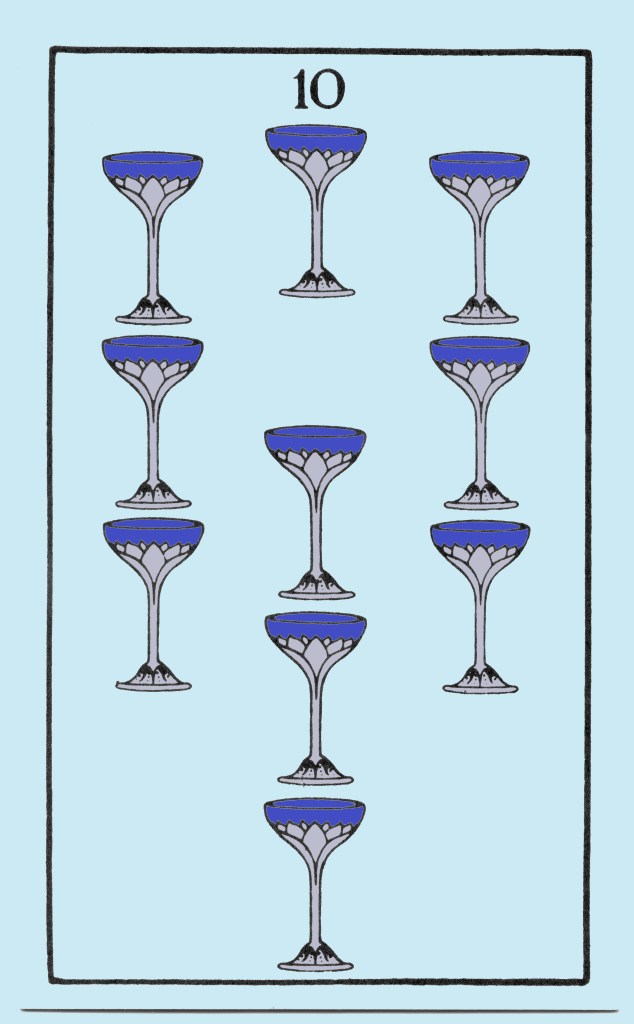
The Ten of Cups from the Builders of the Adytum (BOTA) tarot deck

Paul Foster Case (and Ann Davies)

The time period is the third decanate of Pisces, from March 11 to March 20, under the sub-rulership of Mars in its Scorpio aspect.
The meanings are unfortunate unless the divination refers to spiritual
matters; for the combined forces of Mars, Jupiter and Neptune in Pisces on the physical levels, while they mean tremendous power of desire and sometimes the satisfaction of desire, point rather to unbalanced force than otherwise,
Well-Dignified: if relating to spiritual matters, permanent and lasting success through inspiration from higher levels of consciousness; high psychic development; realization of the highest aspirations; happiness. On questions at a lower level, even if well dignified: great ambition; ultra sensitiveness; great power of realizing desires, but equally great danger of misusing that power.
lll-Dignified: in spiritual questions, danger from psychism; probability of being injured mentally through unwise attempts at meditation. On all other questions: danger of self-undoing from psychism; prodigality; possibility of being influenced by others through the desire-nature; tendency to drug habits and drunkenness; disgust resulting from overindulgence; excess in pleasure.
Keyword: Excess .


(From The Oracle of Tarot course)

A. E. Waite

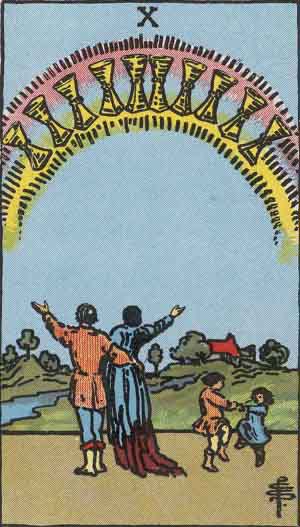
Appearance of Cups in a rainbow; it is contemplated in wonder and ecstacy by a man and woman below, evidently husband and wife. His right arm is about her; his left is raised upward; she raises her right arm. The two children dancing near them have not observed the prodigy but are happy after their own manner. There is a home-scene beyond. Divinatory Meanings: Contentment, repose of the entire heart; the perfection of that state; also perfection of human love and friendship; if with several picture-cards, a person who is taking charge of the Querent’s interests; also the town, village or country inhabited by the Querent. Reversed: Repose of the false heart, indignation, violence.
(From The Pictorial Key to the Tarot)

The Ten of Cups from the Rider Waite Smith tarot

Aleister Crowley

The Ten of Cups is called Satiety. Its attribution is Mars in Pisces. The watery sign has sunk into a stagnant dream, but in it broods and breeds the violent quality of Mars, to putrefy it. As it is written: “Until a dart strike through his liver.” The pursuit of pleasure has been crowned with perfect success; and constantly it is discovered that, having got everything that one wanted, one did not want it after all; now one must pay.

[…]

This card represents a conflicting element. On the one hand, it receives the influence of the Ten, Malkah the Virgin. The arrangement of the cups is that of the Tree of Life. But, on the other hand, they are themselves unstable. They are tilted; they spill the water from the great Lotus which overhangs the whole system from one into the other.

The work proper to water is complete: and disturbance is due. This comes from the influence of Mars in Pisces. Mars is the gross, violent and disruptive force which inevitably attacks every supposed perfection. His energy displays the greatest possible contrast with that of Pisces, which is both peaceful and spiritualized.
(From The Book of Thoth)

The Ten of Cups from the Thoth tarot deck

Golden Dawn’s Book T

HAND, as usual, holding bunch of water-lilies or lotuses, whose flowers pour a white water into all the cups, which “all run over.” The uppermost cup is held sideways by a hand, and pours water into the left-hand upper cup. A single lotus flower surmounts the top cup, and is the source of the water that fills it. Above and below the symbols Mars and Pisces.

Permanent and lasting success and happiness, because inspired from above. Not so sensual as “Lord of Material Happiness,” yet almost more truly happy.
Pleasure, dissipation, debauchery, quietness, peacemaking. Kindness, pity, generosity, wantonness, waste, etc., according to dignity.

Malkuth of HB:H (Matter settled: complete good fortune).
Herein the Great Angels HB:a’aShLYH and HB:MYHAL rule.

Etteilla

The city
Upright. In terms of spiritual medicine, this card, in its natural position, signifies: City, City Center, Homeland, Country, Town, Village, Place, Site, Dwelling, Home, Residence. – Citizen, Group of citizens, City dweller.
Reversed. Anger, Indignation, Agitation, Irritation, Outburst of rage, Wrath, Violence.

MQS

A Note On The Ten Of Cups

I always maintain that the Golden Dawn were not great astrologers, largely because the XIX century astrology they had access to was not very good. Still, for the purposes of deriving symbolism for magical operations, their take was acceptable.

One thing that has always fascinated me about the Golden Dawn’s take on astrology was how they tried to synthesize it into their tarot system. Aside from the attributions of Zodiac signs and planets to the Hebrew letters and of the Hebrew letters to the major trumps, they also assigned the thirty-six decans to the thirty-six minor cards two through ten and, in different ways, to the aces and court cards as well.

This way of allocating the symbolism was not unique to them, but (as someone who doesn’t like to mix cartomancy and astrology) I must say that it probably produced the most coherent system.

Crowley generally doesn’t stray too far from the GD interpretation of the minors, but there are a couple of exceptions, the most obvious of which is the Ten of Cups.

For the GD, the Ten of Cups is an excellent card (which is what inspired Waite’s take on it). Crowley, however, disagrees on account of the decan assigned to the card, which is the third decan of Pisces, ruled by Mars. This leads Crowley to argue that this is a card ruled by two disarmonious symbols (Pisces and Mars) and so it produces bad results.

The problem with Crowley’s take is that he constantly, throughout the book, mistakes decan rulership with the influence of a planet in a sign. This is wrong. Rulerships represent affinities of a planet with a sign or subdivision of the sign.

For instance, Aries is ruled by Mars, which means there is an affinity and so when Mars is in Aries it is said to be well-dignified, at least according to the astrological practice that developed in the middle ages. The Sun is also exalted in Aries, which means there is also an affinity. Then we have the three decans: the first ten degrees ruled my Mars, the second ten by the Sun and the last ten by Venus.

Now, Venus is in detriment in Aries, which means there is disharmony between Venus and Aries, so Venus is ill-dignified in it. She is like a dainty ballerina stranded in a war-torn country. It’s not her place. However, in the last ten degrees of Aries, Venus has subrulership by decanate. This means that, even though she is the anti-venusian environment of Aries, she has a small room where she is a bit more comfortable, though not by much: it’s as if our dainty ballerina had been hired to entertain the troops in the barracks. She’s still in the wrong place, but in a less uncomfortable subplace.

Therefore, when Crowley says that Mars is not compatible with Pisces he is saying something that is irrelevant: by definition, the fact that Mars rules the third decan of Pisces means that Mars is at least a bit comfortable in the last ten degrees of the sign. This is because the last decan of Pisces has some kind of Mars-like quality to it: it is the part of Pisces that expresses through Mars.

This is not to say that his system is more right or wrong than the GD (one can stretch symbolism in almost any direction by abusing it long enough), but his misunderstanding runs through the whole minor arcana section, and I thought it would be interesting to bring it up.

MQS

Tarot Encyclopedia – The Nine of Cups

(Note: this is a collection of the meanings attributed to the cards by some occultists in the past centuries. It does not reflect my own study or opinion of the cards. It is only meant as a quick comparative reference as I develop my own take.)
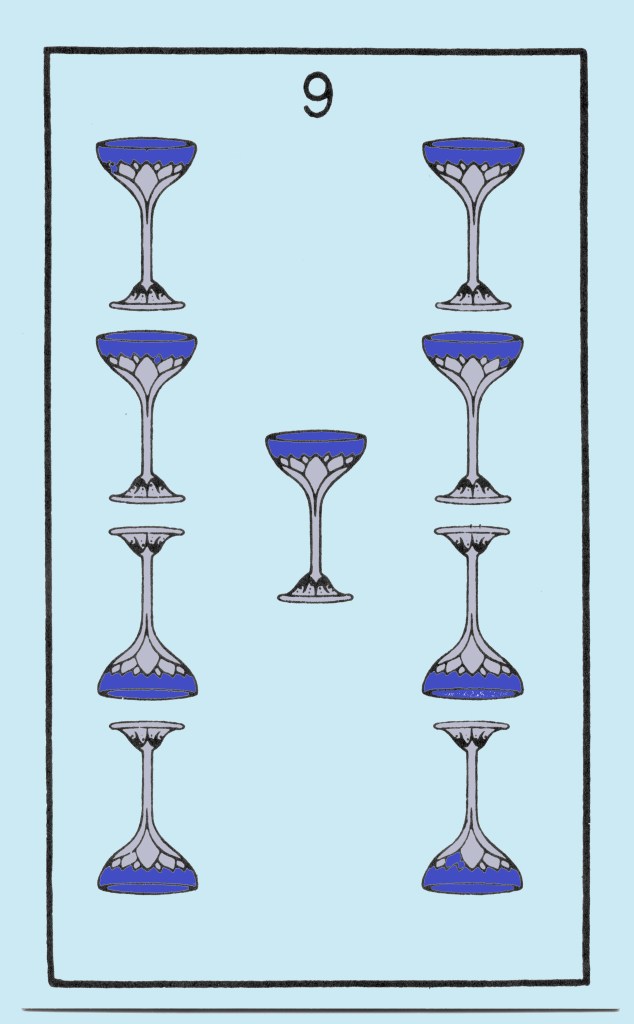
The Nine of Cups from the Builders of the Adytum (BOTA) tarot deck

Paul Foster Case (and Ann Davies)

The time period is the second decanate of Pisces, March 1 to March 10, under the subrulership of the Moon.
Well-Dignified: complete realization of desires; almost perfect pleasure and happiness; wishes fulfilled; physical well-being.
lll-Dignified: vanity, conceit, egotism; foolish generosity or ostentatious expenditure; the
person to whom the card applies is too easily led; one spoilt by
prosperity.
Keyword: Desire fulfilled.
(From the Oracle of Tarot course)

A. E. Waite

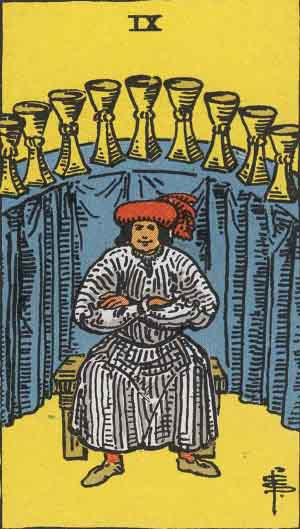
A goodly personage has feasted to his heart’s content, and abundant refreshment of wine is on the arched counter behind him, seeming to indicate that the future is also assured. The picture offers the material side only, but there are other aspects. Divinatory Meanings: Concord, contentment, physical bien-être; also victory, success, advantage; satisfaction for the Querent or person for whom the consultation is made. Reversed: Truth, loyalty, liberty; but the readings vary and include mistakes, imperfections, etc.
(From The Pictorial Key to the Tarot)
The Nine of Cups from the Rider Waite Smith tarot

Aleister Crowley

The Nine of Cups is called Happiness. This is a peculiarly good card, because happiness, as the word implies, is so much a matter of luck: the card is ruled by Jupiter, and Jupiter is Fortune.In all these watery cards, there is a certain element of illusion; they begin by Love, and love is the greatest and most deadly of the illusions. The sign of Pisces is the refinement, the fading away of this instinct, which, begun with dreadful hunger and carried on with passion, has now become “a dream within a dream”.

The card is ruled by Jupiter. Jupiter in Pisces is indeed good fortune, but only in the sense of complete satiety. The fullest satisfaction is merely the matrix of a further putrefaction; there is no such thing as absolute rest. A cottage in the country with the roses all around it? No, there is nothing permanent in this; there is no rest from the Universe. Change guarantees stability. Stability guarantees change.

[…]

The Number Nine, Yesod, in the suit of Water, restores the stability lost by the excursions of Netzach and Hod from the Middle Pillar. It is also the number of the Moon, thus strengthening the idea of Water. In this card is the pageant of the culmination and perfection of the original force of Water.

The Ruler is Jupiter in Pisces. This influence is more than sympathetic; it is a definite benediction, for Jupiter is the planet of Chesed which represents Water in its highest material manifestation, and Pisces brings out the placid qualities of Water. In the symbol are nine cups perfectly arranged in a square; all are filled and overflowing with Water. It is the most complete and most beneficent aspect of the force of Water.

The Geomantic Figure Laetitia is ruled by Jupiter in Pisces. For its meaning consult the “Handbook of Geomancy” (Equinox Vol I, No.2). Laetitia, Joy, gladness, is one of the best and most powerful of the sixteen figures; for the Solar, Lunar, and Mercurial symbols are, at the best, ambiguous and treacherously ambivalent; those of Venus portend rather relief than positive beneficence; Saturn and Mars are seen at their worst; and even the stable-companion of Laetitia, Acquisitio, has its unpleasant aspects, and even its dangers. But the consonance of Laetitia with this card amounts to little less than an identity; the wine is poured by Ganymede himself, unstinted vintage of true nectar of the Gods, brimful and running over, an ordered banquet of delight, True Wisdom self-fulfilled in Perfect Happiness.
(From The Book of Thoth)

The Nine of Cups from the Thoth tarot

Golden Dawn’s Book T

A WHITE Radiant Angelic Hand, issuing from a cloud holding lotus or waterlilies, one flower of which overhangs each cup; from it a white water pours. Cups are arranged in three rows of 3. Jupiter and Pisces above and below.

Complete and perfect realization of pleasure and happiness, almost perfect; selfpraise, vanity, conceit, much talking of self, yet kind and lovable, and may be self-denying therewith. High-minded, not easily satisfied with small and limited ideas. Apt to be maligned through too much self-assumption. A good and generous, but sometimes foolish nature.

Yesod of HB:H (Complete success, pleasure and happiness, wishes fulfilled).

Therein rule the Angels HB:SALYH and HB:a’aRYAL.

Etteilla

Victory
Upright. This card, as far as the medicine of the spirit is concerned, means, in its natural position: Victory, Success, Achievement, Advantage, Gain. – Pump, Triumph, Trophy, Preeminence, Superiority. – Spectacle, Arrangement, Equipment.
Reversed. Sincerity, Truth, Reality, Loyalty, Good faith, Frankness, Naiveté, Candor, Openness of heart, Simplicity. – Freedom, Science, Overconfidence, Familiarity, Boldness, Looseness, Debauchery

MQS

Tarot Encyclopedia – The Eight of Cups

(Note: this is a collection of the meanings attributed to the cards by some occultists in the past centuries. It does not reflect my own study or opinion of the cards. It is only meant as a quick comparative reference as I develop my own take.)

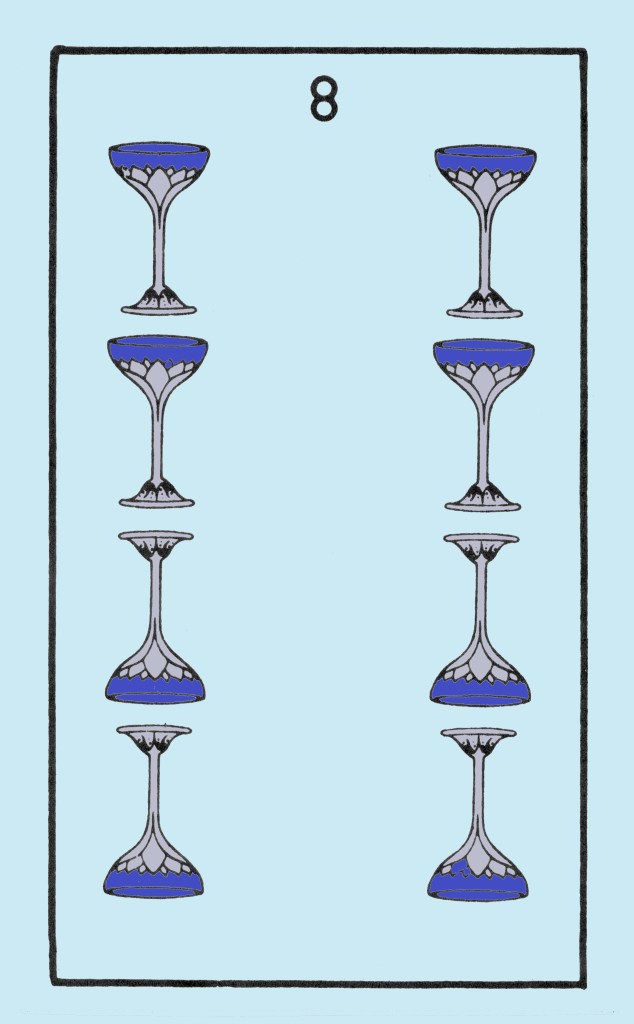
The Eight of Cups from the Builders of the Adytum (BOTA) tarot deck

Paul Foster Case (and Ann Davies)

The time period is the first decanate of Pisces, February 19 to February 28, ruled by Jupiter and Neptune.
Well-Dignified: renunciation of material success for something higher; interest in psychic and spiritual things; strong emotions; charity and helpfulness; love of travel and of scientific investigation.
Ill-Dignified: momentary success, but nothing lasting; the person to whom the card applies is overimpressionable, erratic and unsteady in his emotions; meaningless change of mood; purposeless journeying; querulous disposition.
Keyword: Instability
(From the Oracle of Tarot course)

A. E. Waite

A man of dejected aspect is deserting the cups of his felicity, enterprise, undertaking or previous concern. Divinatory Meanings: The card speaks for itself on the surface, but other readings are entirely antithetical–giving joy, mildness, timidity, honour, modesty. In practice, it is usually found that the card shews the decline of a matter, or that a matter which has been thought to be important is really of slight consequence–either for good or evil. Reversed: Great joy, happiness, feasting.
(From The Pictorial Key to the Tarot)

The Eight of Cups from the Rider Waite Smith tarot

Aleister Crowley

The Eight of Cups is called Indolence. This card is the very apex of unpleasantness. It is ruled by the planet Saturn; time, sorrow, have descended upon pleasure, and there is no strength in the element of water which can react against it. This card is not exactly “the morning after the night before”; but it is very nearly that. The difference is that the “night before” has not happened! This card represents a party for which all preparations have been made; but the host has forgotten to invite the guests; or, the caterers have not delivered the good cheer. There is this difference, though, that it is in some way or other the host’s own fault. The party that he planned was just a little bit above his capacity; perhaps he lost heart at the last moment.

[…]

The Eight, Hod, in the suit of Water, governs this card. It shows the influence of Mercury, but this is overpowered by the reference of the card to Saturn in Pisces. Pisces is calm but stagnant water; and Saturn deadens it completely. Water appears no longer as the Sea but as pools; and there is no florescence in this card as there was in the last. The Lotuses droop for lack of sun and rain, and the soil is poison to them; only two of the stems show blossoms at all. The cups are shallow, old and broken. They are arranged in three rows; of these the upper row of three is quite empty. Water trickles from the two flowers into the two central cups, and they drip into the two lowest without filling them. The background of the card shows pools, or lagoons, in very extensive country, incapable of cultivation; only disease and miasmatic poison can flourish in those vast Bad Lands.

The water is dark and muddy. On the horizon is a pallid, yellowish light, weighed down by leaden clouds of indigo. Compare with the last card; it represents the opposite and complementary error. The one is the Garden of Kundry, the other the Palace of Klingsor. In the psychopathology of The Path, this card is the German Measles of Christian Mysticism.
(From The Book of Thoth)

The Eight of Cups from the Thoth Tarot deck

Golden Dawn’s Book T

A WHITE Radiating Angelic Hand, holding a group of stems of lotuses or waterlilies. There are only two flowers shown, which bend over the two central cups, pouring into them a white water which fills them and runs over into the three lowest, which later are not yet filled. The three uppermost are quite empty.

U U U
U U
U U U

At the top and bottom of the card are symbols Saturn and Pisces.

Temporary success, but without further results. Thing thrown aside as soon as gained. Not lasting, even in the matter in hand. Indolence in success. Journeying from place to place. Misery and repining without cause. Seeking after riches. Instability.
Hod of HB:H (Success abandoned; decline of interest).
The Angels ruling are HB:VVLYH and HB:YLHYH.

Etteilla

Blonde girl
Upright. This card, as far as the medicine of the spirit is concerned, means, in its natural position: Blonde Girl, Honest Girl, Practical Girl, Honor, Modesty, Restraint, Timidity, Fear, Apprehension, Sweetness, Attraction.
Reversed. Satisfaction, Happiness, Contentment, Gaiety, Joy, Cheerfulness, Enjoyment, Fun, Celebration. – Apology, Reparation, Discompense. – Public Joy, Spectacle, Arrangement, Recollection, Preparations, Arrangements.

MQS

Love Fool (Horary Astrology and Playing Cards Reading)

This is the first time I use my new interest, Horary Astrology, in conjunction with playing cards. Let’s see what they have to say. The question was asked by a friend of mine who just broke up with her girlfriend. He wants to know if there is a future. This reading was made a couple of days ago.

Relationship reading, is there a future?
Answered with horary astrology

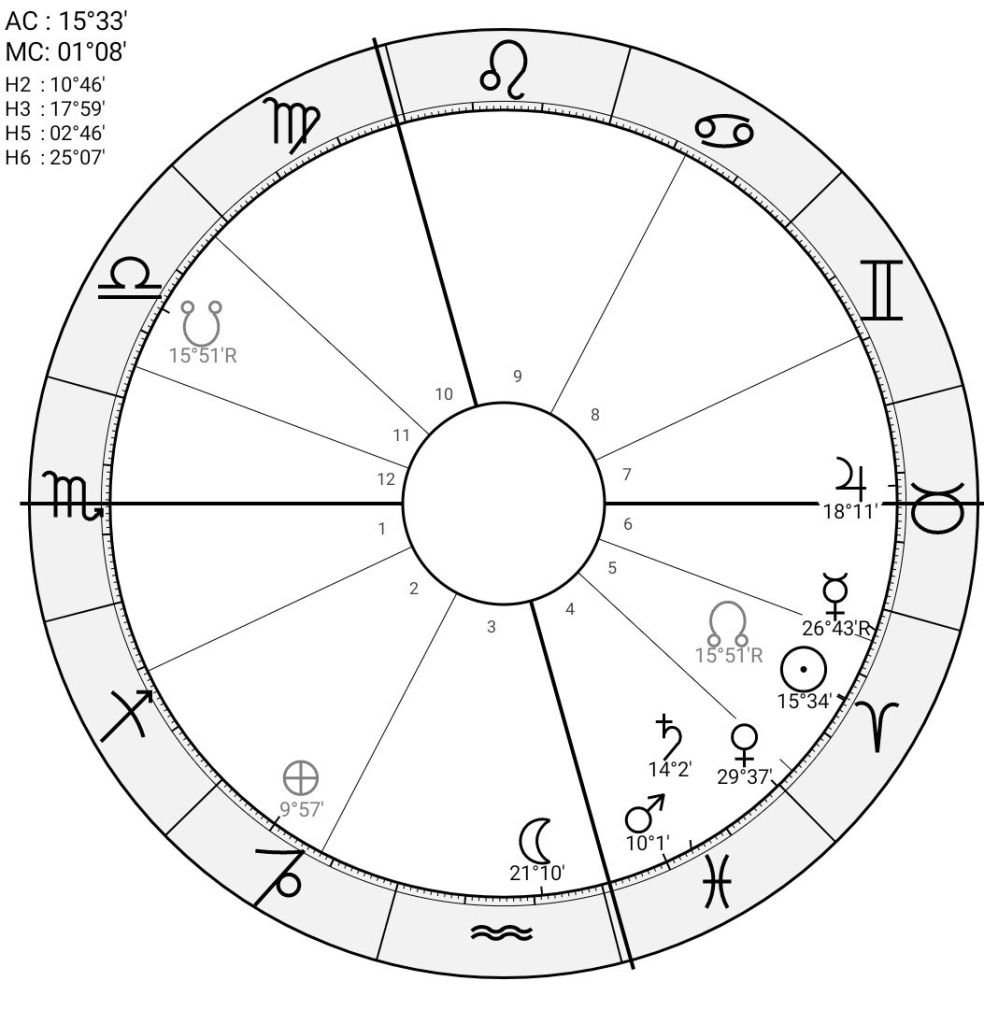
The querent is Mars, lord of the Ascendant, while the quesited, i.e., the girlfriend, is Venus lord of the Seventh. The Moon indicates the flow of the action.

In a night chart, Mars is dignified by triplicity in Pisces, and is angular, while Venus is exalted, also in Pisces, and also angular. The first thing that strikes me is that Venus is moving away from Mars. Furthermore, the Moon is separating from a difficult square with Jupiter in the Seventh. I asked my friend if he had broken up with her or she had broken up with him, since from the chart it seems it was her initiative. He didn’t like to admit it, but said she had left him.

Note that Mars is in triplicity, so a decent Mars, but also conjunct Saturn. Saturn is peregrine. Also note that Venus, the girlfriend, is exalted, and exaltation is sometimes an indication of haughtiness. Clearly she thought she could do better than Saturn-like Mars as she moved away from him. My friend then told me she told him she didn’t like the fact she is to attached to her.

Well, CAN she do better? Venus is about to change sign, from Pisces to Aries, whereupon she will not only lose all her dignity, but she will also enter her detriment. Let us look at the Moon now. The Moon separates from the square with Jupiter and moves toward a sextile with Mercury Retrograde. Sextiles are positive aspects. If we put together the indications, we have: 1) Venus moving away but regretting her decision 2) A future positive contact 3) the contact is about things that go back (retrograde)

This seemed to me a sign of reconciliation. Just to be on the safe side, I had the querent pull three cards from the playing card deck. These were:

5♠ – Q♣ – 3♥

The cards are quite clear. The Five of Spades is a card of imprisonment, but it also indicates regret (which is what you are supposed to feel in prison). Then we have her significator, followed by the Three of Hearts. I would have preferred to see a Six of Hearts to show reconciliation, but the Three of Hearts will do. In this case, the added shade of meaning seems to be that the cards don’t even consider the breakup effective, because the Three of Hearts show things that flow positively without interruption.

I will update this post when I know the outcome.

MQS

Carcer / Prison (Geomancy Figures)

Name of the Figure: Carcer (Prison)
Element: Earth
Planet: Saturn (direct)
Sign: Pisces
Quality: Common
Fortune: Bad

Carcer is a figure of Saturn direct. Its symbol is said to represent an enclosure, pen or prison of some kind. If we choose to look at the single dots as active elements, then Carcer is the opposite of Conjunctio, in that its active elements have in common the quality of dryness, which indicates difficulty in integrating and mixing together. Furthermore, the two elements are spread apart (one at the top, one at the bottom) and the figure can also be seen as two arrows pointing in opposite directions.

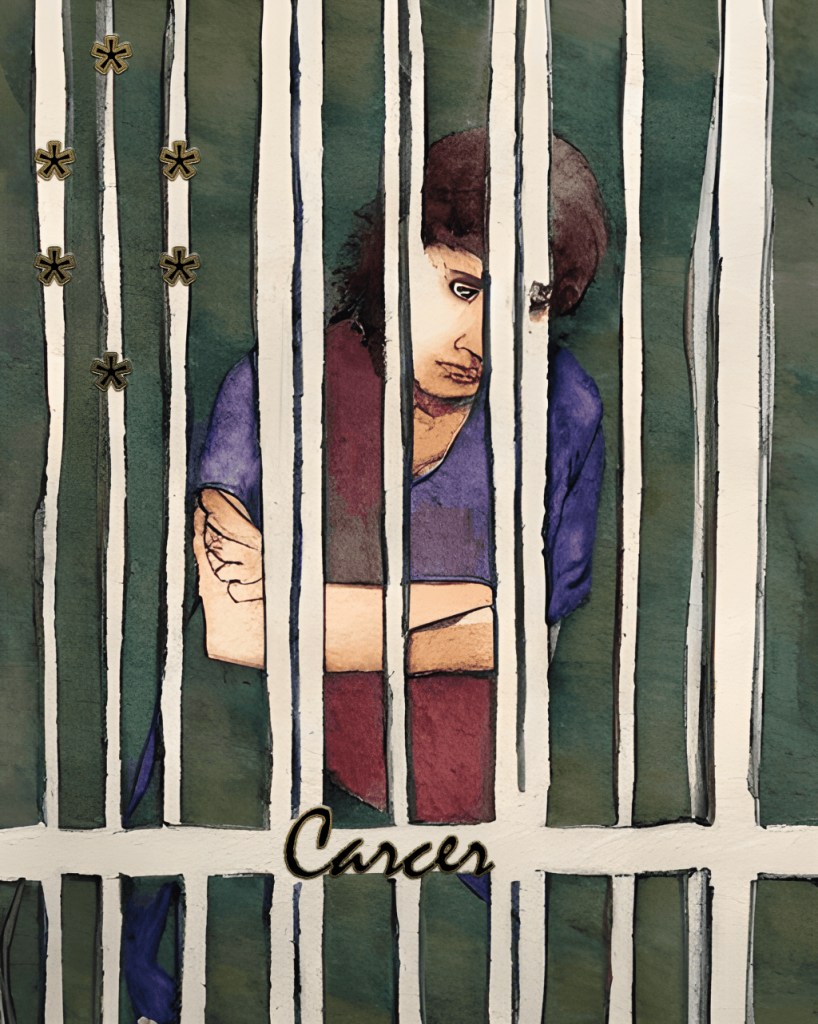
Illustration for the geomantic figure Carcer, prison

Carcer’s association with Saturn is very telling, as it embodies many of its qualities. It indicates loneliness, and in personal relationships it is broadly bad in its import. Although with positive indications it can show long-term commitment, it is more likely to show feelings cooling off, if not outright separation, or more simply it can speak of not finding anyone to be with. Lack of communication and personal contact all belong to the figure’s array of meanings.

Carcer can show prison and negative sentences in general, but the symbol of a prison or enclosed place can be interpreted metaphorically as obstacles, blockages and restriction. It indicates situations where we are in difficulty and it is difficult for us to act. However, on a brighter note, the symbol of the enclosed space can be interpreted as a womb, and Carcer is said in some sources to be good for pregnancy.

Another field where Carcer is generally positive is for building and laying the foundations of buildings (or maybe, metaphorically, for laying the foundations of something) and for keeping things secrets and solo endeavors such as meditation, study, etc. In most mundane questions, though, Carcer is one of the worst figures you can obtain, especially since it can become Judge, unlike other negative figures.

Common Keywords: Loneliness, sadness, blockage, obstacles, stoppage, building, laying foundations, separation, obligations, debts, poverty, pregnancy, secrets, deep knowledge

Carcer in the Geomantic Houses (these are only examples. Use context to guide your interpretation)

HousePossible Meanings
FirstLonely person, blocked, in difficulties, Stingy, Difficult to relate to
SecondPoverty, Lack of means, Hardships, Debt, Financial obligations
ThirdLack of communication, Isolation from the community, Only child, Lack of relationship with the siblings
FourthCastle, Large building, Constructing, Building, City, City walls, Tombstones, Loss of the father
FifthDepression, lack of fun or excitement, restraint, pregnancy
Sixthlong convalescence, difficult illness, lack of mobility, animal pens, death of animals
Seventhloneliness, interpersonal difficulties, person is already committed, lack of relationships, separation
EighthCemetery, death, fear, lack of progress, lack of money from the partner
Ninthserious study, hidden knowledge, atheism, a priest or hermit,
Tenthunemployment, lack of upward mobility, dead end
Eleventhloneliness, lack of help or friends
Twelfthprison, black magic
Thirteenthpast loneliness or hardships, person is serious, solid
Fourteenthfuture difficulties, person needs to face serious challenges
Fifteenthlack of success except in building and keeping secrets or pregnancy
Possible meanings of Carcer in the various Geomantic Houses. Note that this is not meant to be exhaustive, and it only serves to jog your interpretive muscles

MQS

Laetitia / Happiness (Geomancy Figures)

Name of the Figure: Laetitia (Happiness), sometimes called “Bearded”
Element: Air
Planet: Jupiter (direct, though some say retrograde)
Sign: Taurus
Quality: Exiting
Fortune: Good (in most questions)

Laetitia is another “pure element” figure, if we accept the theory that signle dots represent active element. In this case, only the fire line should be active. It is a figure of Jupiter, the planet of happiness, nobility, religion and wealth. By its own design, Laetitia is often likened to a tower or to an upward pointing arrow.

Illustration of the geomantic figure Laetitia, happiness

Although the wealth aspect of Jupiter is definitely represented by Laetitia, it falls more under the domain of Acquisitio, the other Jupiter figure. Laetitia highlights more the psychological aspect of being glad, being happy, feasting, etc. which are all aspects of Jupiter. It represents everything that is “high” in a positive sense: high spirits, high-mindedness, honor, increase, growth, etc.

Laetitia is one of the few positive exiting figures, as opposed to Tristitia, which is one of the few negative incoming figures. Laetitia indicates partying and being happy, but it can also show fleeting situations, if not accompanied by more stable figures.

It is also a figure of visibility. It is therefore excellent for finding out secrets, discovering, finding lost items, etc. On the other hand, it is very bad for keeping things secret and under wraps. For instance, if someone asked if their spouse will find out about their affair, Laetitia is not an encouraging sign.

One aspect that is not often emphasized about Laetitia is that it is connected being being “bearded”. A beard, aside from indicating manliness, was also traditionally a sign of wisdom, and wisdom is one of the attributes of Jupiter, especially as it pertains conventional wisdom (e.g., the wisdom of a priest or a mentor or benefactor, as opposed to Mercury’s cunning and technological know-how and Saturn’s occult depth). It can therefore indicate “growing” in the sense of acquiring wisdom, becoming adult, either literally or figuratively

Common Keywords: Joy, merriment, happiness, feasts, parties, things that raise your spirits, up, upward, ceiling, growth, increase, visibility, fame, recognition, being seen, being busted, unearthing, lack of durability, fleeting success, wisdom, maturity

Laetitia in the Geomantic Houses (these are only examples. Use context to guide your interpretation)

HousePossible Meanings
FirstHappy, positive, high-minded, handsome, a sight to behold
SecondIncrease of wealth, positive financial period, stocks going up, retrieving lost objects
ThirdGood news all around, positive relationships with siblings and neighbors, neighborhood celebrations
FourthHelp from the father, Tall buildings, unearthing treasures, Unearthing secrets
FifthJoy, partying, pregnancy, Flirting, drinking, luxury
Sixthhealing, gain through subordinates (maybe giving them a raise), buying pets
SeventhGood acquaintances, no problems relating to others, marriage celebrations
EighthProtection from fear or from death, escaping danger, increase through business or marriage
NinthReligion, Wisdom, Religious festivals, Education, Realization, discovery
TenthA raise, a promotion, finding a job, government buildings, positive decision from a judge
Eleventhhelp from friends, money, wish fulfilled
Twelfthescaping from danger, release from prison, nothing to worry about, protection from magic
Thirteenthpast joy, upward mobility, increase
Fourteenthfuture joy, being discovered, finding out
FifteenthLaetitia cannot be Judge
Possible meanings of Laetitia in the various Geomantic Houses. Note that this is not meant to be exhaustive, and it only serves to jog your interpretive muscles

MQS