Tag Archives: Philosophy

Fatalism and the Moment of Divination (Notes on Divination)

This post is part of my Notes on Divination series. This gets somewhat philosophical and is rough and not organized, so bear with me.

In the previous post in this series, I started discussing some general ideas on why fatalism is an inherently flawed view, while in the one before I had shown why pure free will makes just as little sense. To summarize, pure free will simply doesn’t take into account the fact that we don’t live and move within a blank space that we can change at whim.

On the other hand, pure fatalism cannot even be articulated as a view without contradicting itself: if fatalism is real, then my fatalism is not due to me assessing reality and forming a fatalistic worldview that corresponds to how reality factually is, but it’s due to destiny forcing me to be a fatalist. This implies that when I say I am a fatalist, I don’t really mean it. I *cannot* really mean it – It is conceptually impossible. In order to be a fatalist, I must have the freedom to develop a fatalistic worldview. This is a contradiction.

My view of the universe is consequently inherently libertarian, though it is a reasonable and limited libertarianism.* No matter how small our personal freedom is, it exists and is the place we our soul inhabits. Freedom is the consequence of consciousness. When I become aware of something, I posit it as the object of my awareness, outside of myself, and therefore incapable of completely determining my whole being.

Now let us ask: what happens during a (serious) divination session? What does divination do, at heart? At the very least, divination must either make us aware of unknown facts about the past, present or future, or it must shed new light on known facts, thus revealing them from a different, previously unknown point of view. A divination session that does not do this is not a divination session. It may or may not be helpful in other regards, but it is not divination.
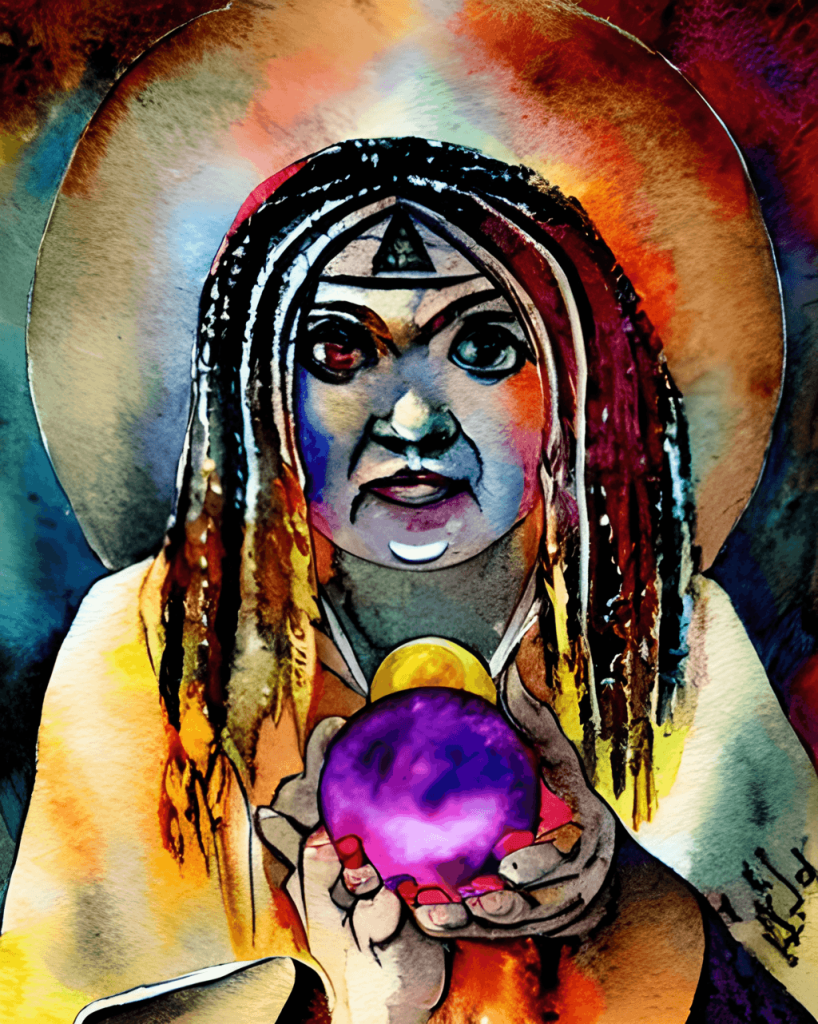
The Moment of Divination

It is clear, therefore, that divination is inherently connected to consciousness and to increasing our conscious awareness of (our) reality. This is another reason why a (mildly) libertarian view of divination makes more sense. Suppose you cross the fortune-teller’s palm with silver and then you get told you will win over your crush: is the fortune-teller right because she actually sees this in the crystal ball or is she doomed to say this to you? If she is doomed to say it, then the fact that she is saying it has nothing to do with the statement being true and everything to do with destiny forcing her to say it.

Furthermore, in revealing your future to you, the fortune-teller cannot help but modify it. This has nothing to do with some odd theories I’ve read on the internet, about the fact that if you predict something you make it happen. If that were true, I could predict myself into a billionaire. Besides, even if the fortune-teller saw your future and didn’t tell you, she would still be modifying your future.

Reality is much more subtle. Suppose that X is going to happen to you. If the fortune-teller tells you, then you are aware of X happening. X happening with your awareness is different from X happening without your awareness. The fabric of the fact itself changes with your awareness of it, for the simple fact that something that happens with your knowledge is not something that happens without your knowledge.

The moment of divination, therefore, has a very important place in our life, because it is part of our life, but it is also a part of our life wherein our awareness of reality increases, thereby changing our reality. This does not automatically mean that divination can make us realize every whim that crosses our mind, nor that it can always save our butt. Sometimes the only choice possible is between accepting a fact and not accepting it.

I like to liken an oracle to a friend on top of a high building, who has a wider view of our surroundings than us as we move in a busy intersection of streets, and who texts us hints that increase our understanding of our reality and can help us make better choices, though sometimes the choices we can make are so severely limited as to border on predestination.

MQS

* I mean ‘libertarian’ from a metaphysical standpoint.

Why You Can’t Be a Fatalist

This post is part of my Notes on Divination series. This gets somewhat philosophical and is rough and not organized, so bear with me.

I already talked about the limitations of free will in divination. Undoubtedly I will need to talk a lot more about it in the future. For now, though, I want to discuss the other side of the coin, namely predestination.

Predesination is the idea that the future is predetermined. This is already vague, because the way in which the future is supposed to be predetermined changes based on the particular view: the way in which a flower necessarily follows from a seed is not the same way as the ending of a movie necessarily follows its beginning. No matter how many times you rewind, Baby Jane always snaps. She cannot do otherwise, for her life has been scripted and it plays out from beginning to end according to the script.

In the case of the seed, although there are contingent factors at play (for instance, the quality of the soil or the amount of water it receives) we are talking about a form of internal necessity. Baby Jane’s life, though, is determined by external factors: she is nothing more than what the author of the book and those of the movie wanted her to be.

The question is: could Baby Jane understand that her life is so predetermined, if someone told her? Let us suppose that the writers had added a scene where she consults a diviner and has her fortunes told to her. The diviner is a good one, and correctly tells her what is going to happen to her, her sister, etc.

Does this change things? The answer, in this case, is no. It doesn’t change anything, because the fortune teller’s scene has also been scripted and plays out for the same reason every other scene in the movie plays out. From an external standpoint, the meeting with the diviner would be no different than any other part of the movie. It would be just another link in the chain.

The Fatalist

But this is not how divination works in real life. In real life, we don’t have the privilege of an external poit of view from which to witness our existence in the same way as when we watch a movie. We can watch a movie because we are not in any meaningful sense part of it.

But we are part of life. We are part of the flow of existence. More specifically, we are that section of existence that is capable of reflecting on existence itself, or, if we want to get trippy, we are the section of existence through which existence reflects on itself: we are existence’s self-consciousness.

This has enormous consequences on our freedom. Let us suppose someone tried to argue that our life is predetermined by a kind of external destiny that uses us like sockpuppets in the same way a character is written by a writer.

The first and most important consequence is that the very fact that they are saying that we are predetermined would itself be predetermined. That is to say, the person does not believe that we are predetermined because it is true that we are predetermined, but because he or she has been written as a fatalist.

Of course, the person in question would like to argue back that they are a fatalist because it is true that we are predetermined. But in defending this view, what they are truly saying is “everything is predetermined, except me when I argue that everything is predetermined.” This is obviously inconsistent: a theory–any theory–must be consistent with its own uttering. But fatalism cannot be truly uttered without incurring self-contradiction. The moment one says “Everything is predetermined,” they place themselves outside of the destiny they try to describe.

This happens for a subtle reason. Consciousness is inherently the place of freedom. It would take me a whole treatise to discuss this (and maybe I will write one at some point) but to be concise, we cannot be conscious of something without placing ourselves outside of it and beyond it. If I am conscious of this pen or this flower, this pen or this flower are the object of my attention, and I am the subject. No matter how strictly connected subject and object are, they are not the same, and when they are, there is no consciousness.*

If you read a few paragraphs back, I said that we are essentially existence’s self-consciousness. This means that through us existence perceives itself as its own object. Furthermore, in being conscious of itself, existence moves beyond necessity, exactly in the same way that any person (even a fatalist) places themselves outside of their own fatalism by being conscious of it.

In the next blog post I will discuss more closely how the ideas I just presented impact divination.

MQS

* I know that mystics like to argue that the subject-object distinction is artificial, but I’ll leave this for another post. My short answer is that without duality, unity is barren, while without unity, duality is inconsistent and inconceivable.

Free Will and Prediction (Notes on Divination)

This post is part of my Notes on Divination series. This gets somewhat philosophical and is rough and not organized, so bear with me.

I have been playing with the idea of writing a book on the philosophy of divination. In fact, I have been playing with ideas for a lot of books on occultism, but I need to start somewhere. This is the first in a series of articles on such topics. Don’t take the following as an organized treatise–it is more like a random gathering of thoughts.

It’s impossible to be self-aware diviners without sooner or later stumbling upon the question of free will, the two most simplistic options being that we have complete free will and therefore divination is not about the future or that we have no free will at all and everything is predestined. I will argue in another article that both options actually prevent meaningful prediction.

Often people talk about “compatibilism” that is, the idea that prediction and free will can be seen as compatible. This is all very well, but it means nothing unless one explains how. Inevitably, explaining it requires one to clearly define the space alloted to both. Here I talk about all things that limit our choice, while in a future article I will talk about the limits of prediction.

Firstly, we need to acknowledge that when it comes to divination, it is not at all clear that we talk about prediction. After decades of New Age nonsense, divination has largely been relegated to the uttering of ‘inspired wisdom’, wisdom apparently being the consolation prize for those that can’t look at reality for what it is.

People who usually manage to compose their faces in a mask of sanity abandon all commonsense as soon as they pick up a tarot deck: you create your own destiny, you can do whatever you want. Well, you don’t. This is provably so. We cannot treat people as if they were bundles of free will floating in empty space. People come from specific backgrounds and have specific problems, idiosyncrasies and preferences that dictate their course.

You may be free, for instance, to choose between vanilla and chocolate, but if you hate chocolate you’ll probably pick vanilla. This is often seen as part of people’s free choice, but if we think about it for a second, it is actually a limit to personal freedom: an inner disgust toward something leads you toward something else without you being able to control it.

Free Will and Destiny

In other words, your choice, which is theoretically open to everything, is already limited by a number of psychological hangups that push you around like a sock puppet. That is a limit to free will in my book. Divination may very well be used to delve into these issues and to widen your options. In fact, it is a very good use of divination. But we cannot use divination to do so if we don’t first acknowledge that our options are limited, sometimes severely so.

But preferences are just one kind of limit. Another one comes in the form of ( the much reviled in spiritual circles) objective reality. If you are in a blind alley, know no martial arts, have no means of self-defense and an armed thug is walking toward you, that’s a pickle you can’t meditate or visualize your way out of.

This is not to say that you’ll inevitably lose. Maybe the dude is drunk and collapses to the ground as soon as he stumbles on that banana peel; maybe you are very good at talking and you persuade him to let you go by striking the right note; maybe a falling bit of debris from a ramshackle building takes care of him.

All this (and more) is possible. But the objective fact that you are in the blind alley in a less-than-desirable situation instead of sucking on a Capri Sun on your way to Hawaii imposes certain limits (just as this latter scenario imposes other limits)

The example above is situational, but our whole life is a series of determining factors that limit our trajectory. Look back on your personal history and you’ll probably be able to see traces of many, many past situations that still accompany you to this day, for better or worse. Even past choices become hard, unchangeable facts once enough time passes. You cannot, for instance, ungraduate from that useless gender studies degree in order to pursue a STEM subject. Although you can divorce, you cannot unmarry the person you married. Although you can abandon your child, you cannot unbirth it.

We could go on, but this point is clear enough: at any given moment in time we find ourselves shaped by a series of objective, subjective and intersubjective factors that limit us and our possible trajectory.

The delusional New Age view that we are the product of our current decisions does happen to stumble upon a little bit of truth, though it mischaracterizes it. It is true that, in so far as we abstract from ourselves and we move toward the universal, we peel backs layers of individual conditioning and we move toward the unconditional, however you may choose to call it (God, Being, One, Reality, Ensoph, etc.)

But there is a catch: moving toward the unconditional means not just letting go of our limits, but also of the aims that would lead us to want to overcome those limits as, however we may understand the unconditional, it is not conditioned by this or that choice. The fact of the matter is that free will may very well be the substance of reality, but in so far as it is the substance of reality it is not the substance of my limited whims.

In practice, therefore, the idea of unconditional free will is untenable from the standpoint of a diviner, as abiding by it renders the divination process futile, however we may understand it. This is not to say that complete determinism fares much better, as I shall show in the next article.

MQS

A Step by Step Deconstruction of a Geomancy Reading

In all Medieval handbooks of Geomancy, this method of divination is called something like “a brief science”, meaning an art that can be mastered with little effort. It was often sold as some kind of quick, “portable” oracle. This, I presume, is in comparison with Astrology, which back then required no small amount of mathematical knowledge, astrological software still being a couple of years away.

By comparison, anyone who can memorize a couple of meanings and rules and is capable of producing a Geomantic Shield (i.e., the chart) can obtain a quick answer.

The more I delve into Geomancy’s Medieval practice, the more I realize that all modern attempts at reviving it hinge on some kind of rationalization or optimization of what was, essentially, a rather chaotic (though not random) method. It is typical of the pre-modern approach to rely on older authority and compile as many observations and rules as possible from previous sources, even when contradictory with each other, so as to have an endless array of techniques to throw at the chart in hopes of teasing out the wanted response. This is not unlike what modern astrologers do when they interpret birth charts, though I must say, unlike contemporary astrology, traditional geomancy does work.

Producing a Geomantic Shield, Step by Step

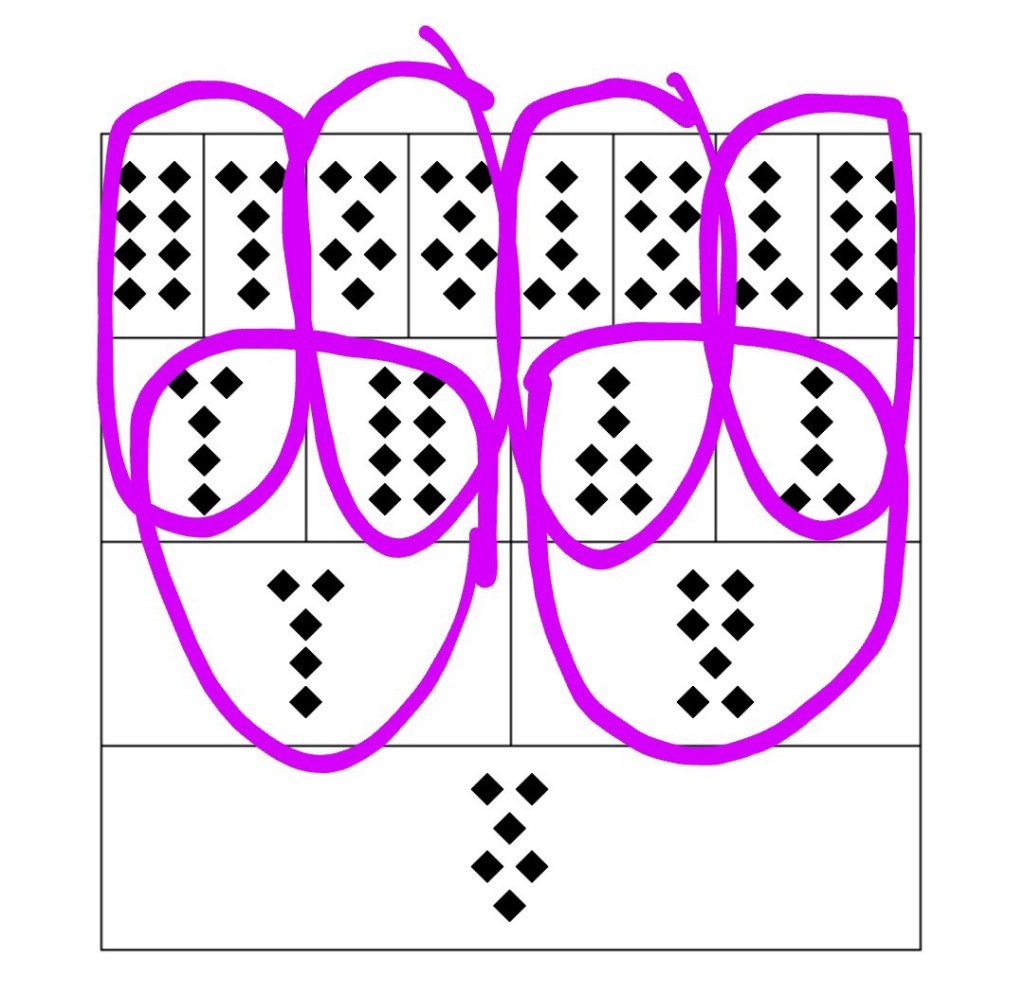
If rationalization it must be, then it makes sense first to understand what it is that a geomancy reading does, that is, what it accomplishes from a structural standpoint. This is a Geomancy Shield.

Example of Geomantic Shield

In this shield, not all the figures are generated by the querent/diviner. In fact, only the figures circled in red are actively produced by the person interested in the reading. These are made from right to left, following the numbered order.

The Four Mothers produced by the querent are in red, the Four Daughters in blue

Once the four main geomantic figures (called the “four Mothers“) are produced, every other passage is automatic and relies on certain geomantic operations to fill out the Shield. One such operation is very particular, in that it only occurs once throughout the reading, while the other one is repeated many times. I’m talking about the operation that produces the “four Daughters.” This consists in taking the first line from every one of the first four figures (the mothers) to produce the fifth figure or first daughter; then taking the second line from each of the four mothers to produce the sixth figure or second daughter, and so on, until we have four mothers and four daughters (the daughters are circled in blue.)

As you can see, for instance, if you take the first line from each of the four mothers, you get a first line of two points, a second line of one point, then a third line of two points and a last, fourth line of one point, which now occupies the fifth house.

Once this operation is over, it is never repeated again, and it leaves us with a double set of four figures each. These two sets are not unrelated (hence the names of mothers and daughters.) They must of necessity be comprised of the same number of points, albeit differently shuffled around. Still, as much as they are related, they represent a split of some type, a doubling of reality from one into two related but separate sides.

Now it is a matter of producing the rest of the chart. This is done by taking the figures two by two and “adding” them line by line. We pair the first and second mother together, then the third and fourth, then the fist and second daughter together, and then the third and fourth. Adding here means taking the points that comprise each line in the two figures, adding them and seeing if you get an odd or even number: if you get an odd number, the resulting line will have one point; if you get an even number, the resulting figure line will have two points. This produces the “four Nieces” which occupy the second row in the Shield. Take careful notice that, at this point, Mothers and Daughters have not interacted with each other yet.

The Four Nieces in Geomancy

Once we have the Mothers, the Daughters and the Nieces, we repeat the second operation once more by pairing up the Nieces, the first with the second and the third with the fourth. As you can appreciate, once more, Mothers and Daughters haven’t come into contact: the split hasn’t been mended.

The Two Witnesses coming out of the Four Nieces

The two figures resulting from the addition of the four Nieces are the two Witnesses, which are the first two members of the “Geomantic Court.” The Right Witness is the ultimate consequence of the four Mothers, while the Left Witness is the ultimate consequence of the four Daughters. We can’t produce any more figures without finally bridging the gap between the right side of the Shield and the left side. This is done by producing the fifteenth figure, the last one, called the Judge. This brings the operation to a close.

The Geomantic Court complete with the Judge is in blue

So, What are we doing in Geomancy?

Anyone familiar with Hegel’s dialectics cannot but look in admiration at what I have just described. We begin the operation with a set of four symbols (the four Mothers) which represent the querent’s active involvement, in the hope of knowing something. A querent that doesn’t want to know anything does not consult an oracle: he is not a querent, ‘querent’ meaning ‘asker’. Therefore, the four Mothers represent the question itself, not in a divinatory sense, but in a structural one: if someone doesn’t want to know something, the Four Mothers don’t appear.

Once this happens, reality splits into two, the Right side representing the querent, the Left side the quesited. This culminates in the reading of the Geomantic Court, in which the Right Witnesses pleads for the querent and the Left one for the quesited, among other possible interpretations. Other variants are: Right side good, Left side bad, Right side past, Left side future, Right side helpful, Left side hindering. These are all variations on the same theme.

The point is that from a Geomantic standpoint, duality comes into being as a result of someone either desiring something they don’t have or fearing they might lose something they have. Objective reality comes into being by “lapsing away” as it were from the Subject, creating a would of sort that requires a series of steps in order to be healed again (‘heal’ literally meaning ‘to make whole’). Try to think of a situation where you don’t need anything: you don’t need food, clothes, air, light, aspirations. You’d be very godly or very dead.

What I just said, therefore, is not a disparaging of dualism: without duality, unity cannot manifest, and remains a sterile, barren field. Without the split, the querent wouldn’t be able to know, or, indeed, to get. By pronouncing his sentence, the Judge makes the situation whole again, which is signified by the fact that only the eight figures with an even number of points can become Judge. Either the querent gets his wish or he doesn’t. But the making whole again presupposes the split, just as in dialectics the synthetic moment cannot be understood and appreciated but through the process of opposition that led to it.

What I just described is, as far as I know, never mentioned in Medieval or Renaissance works on Geomancy–one obvious reason being that dialectics in the Hegelian sense hadn’t been invented yet. Platonic dialectics (that is, conceptual dialectics) comes close, but again, all this seems implicit in the operations of Geomancy and never articulated. I harbor no delusion therefore of having discovered the secret meaning of the art. I am conscious, in fact, that I am merely organizing it according to a model that is familiar to me. But I must say Geomancy wears this model beautifully. It contains a whole philosophy of what it means to ask a question and to get an answer.

Thoughts of a Recovering Quitter

I used to think that once I got out of my comfort zone, life would reward me. I’m realizing right now that as soon as one steps out of his comfort zone, life tries its best to punch him back into it. The moment you start asking for what you want is the moment you start hearing the word “no”. That’s the moment when getting back to your comfort zones is going to feel more attractive. But in your comfort zone there is no life. There is only existence. Is existing enough for you?