In astrology, the contiguity of the houses is obvious, since the houses are usually arranged either in a square or in a circle, but always forming a loop. Thus, we have that the Ascendant is always squished between the second house and the twelfth; that it always opposes the seventh, and, if we go by whole sign houses, that it has fixed relationships with all the others (inconjunct, sextile, square or trine).
This is not the case in Geomancy, where the relationship between houses is controversial, at least nowadays. First off, it is not pacific that the houses of the Shield represent astrological houses, unless we operate an equivalence with astrology, as was done at least since Geomancy reached Europe.
Those coming to Geomancy through Michael Greer, as I did, are probably used seeing the geomantic houses as equivalent to astrological houses: once the Shield is turned into a square chart, the houses follow the same astrological pattern as in an astrological chart. Those coming to Geomancy through the Golden Dawn, though using a different way of assigning the mothers to the houses (the one popularized by Agrippa), still end up dealing with a 1:1 replica of an astrological chart.
However, the idea that the Shield chart and the astrological chart are separate ways of doing Geomancy seems to be relatively new. In most old books, only the Shield is shown, and even when the astrological format is followed, this is done more to show some of the similarities with astrology.
Secondly, which house is next to which is not always clear, and sometimes varies by author. In some sources it seems that only houses that are in company are considered to be next to each other: first and second, third and fourth (but not second and third), fifth and sixth (but not fourth and fifth) and so on pair by pair. This seems to follow the order in which the Shield chart is generated.
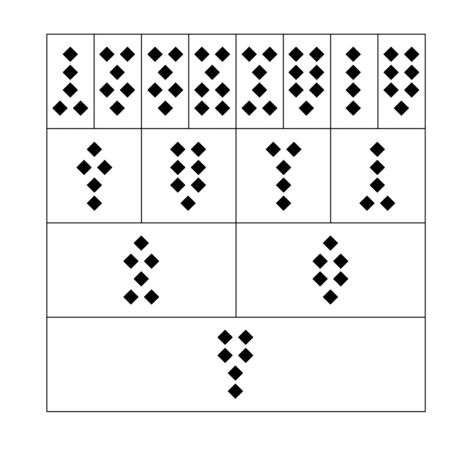
In the example above, Tristitia in the first is next to Via in the second, and Tristitia in the third is next to Conjunctio in the fourth, but not to Via in the second. This is possibly because the first and second combine to form the ninth and the third and fourth combine to form the tenth, but the second and third never combine. This approach obviously restricts the possibilities of perfecting the chart, since most houses end up losing a possible spot next to them for other figures to move to.
Another approach is the one I found while translating Abano’s work. Here Abano started by saying (or rather, implying) that the twelfth house is not next to the first. Initially, I thought this was because he was following the arrangement for the company of houses I just discussed. Yet he gives other examples where he does not follow it, for instance by implying that the eighth and ninth house are next to each other, which would contradict the company of houses (the eighth is with the seventh, the ninth with the tenth).
Then, in another one of his examples, he implies that a figure in the tenth house is next to a figure in the third. This does not make sense from an astrological standpoint, but from a sheer geomantic standpoint it does: the third house DOES border with the tenth, since it co-generates it with the fourth. This would also explain why he doesn’t consider the twelfth house to be next to the first: not because they are not in company, but because they are not close on the Shield (they are, in fact, on opposite ends of the shield).
This approach of considering the houses close on the Shield as being next to each other is certainly different from anything I’ve seen, especially in contemporary geomancy, and if it weren’t for the fact that enough readings I’ve done confirmed to me that the twelfth house CAN perfect with the first, I would find Abano’s approach extremely appealing. Unfortunately, one of my rules when dealing with divination is that practice trumps theory.
Abano goes even further, implying that the Witnesses (and possibly even the Judge) are to be treated as regular houses. This, in itself, is not unique to him, but what I find unique is that he considers the Witnesses capable of perfecting the reading, for instance if the first figure moves to the tenth and the quesited’s figure moves to the right Witness, where, by Abano’s theory, the two figures touch.
Another consequence of Abano’s approach is that not all houses are created equal: the first house, for instance, only touches with the second and the ninth, while the tenth house must be considered to be next to the ninth, eleventh, third, fourth and to the right Witness.
A possible argument, at this point, could be that this approach makes certain readings too easy (like those involving the tenth house, as I just showed). Still, we should keep in mind 1. that divination reflects reality, so a no is a no, regardless of the system 2. secondly, that Abano doesn’t always consider merely the querent and quesited. Often he considers the whole chart, and sometimes he resolves certain questions by dividing the shield into two sides (the left and the right side) and seeing which side is stronger. This is a method he has from traditional astrology, where questions of contest or war are often decided in such manner.
Ultimately, which approach we choose depends on what works, which means that the only way is to try, record and compare with what actually ends up happening.
MQS