Enneagram Type Two, sometimes called the Helper, belongs to the Heart triad. People of this Enneatype often seek validation, appreciation and affection from others by meeting their needs, real or perceived. Their hope is generally to find significance for themselves by becoming important (or even vital) to others. Often, Twos have a hard time trying to take care of their own needs without either feeling selfish and guilty or trying to reformulate them in such a way that they can be seen as favors to others and good for other people’s well-being.
Enneagram Type Two
Enneatype Two Grows: Move to Four
Average Twos are horrified at the prospect of being considered selfish or self-centered. Somehow they have learned that taking care of one’s needs first is wrong. As we know that the person who hasn’t secured his oxygen mask cannot help the person sitting next to him, this a wrong conviction. Still, Twos tend to irreflexively sacrifice themselves for others (which is why they feel scorned when they don’t get appreciation for it)
A Two’s growth begins by being honest with themselves about their own needs and learning to disentangle them from those of other people. There is often a painful spot right in the center of the Two’s heart, where the Two feels alone, hurt and unloved. Normally, Twos tend to stay away from this spot by being cheerful and by filling up their schedule with ‘useful activities’. Obviously, as long as this spot goes unrecognized and unelaborated it will be the one thing that drives the Two around.
By learning to accept and integrate this aspect of themselves, Twos begin to showcase some of the positive traits of Enneagram Type Four, which is definitely a more self-centered type. But healthy Fours have a remarkable emotional honesty and have great compassion for themselves and the darker side of their life, which is why they are also full of compassion for the suffering of others.
In moving to Four, Twos paradoxically learn to truly be loving, in a more humble and authentic way, as their kindness won’t stem from odd psychological gymnastics to create a bond of codependence with another, but from the true desire to help that overflows from their empathy with themselves.
Humility, the virtue of Enneagram Type Two
Enneatype Two Under Stress: Move to Eight
A Two moving to Eight is a sight to behold. Hell truly hath no fury like a Two scorned. I would go as far as to say that it is one of the great wonders of the Enneagram. Since my husband is a Two and since I am not the easiest person to live with, I know this well.
The way I would formulate it is that every Two has a raging lunatic locked in the basement of their mind, which they do all they can to keep at bay, but when the pressure becomes excessive, the monster escapes, and at that point the person you regularly know has no longer any control over the situation.
This raging lunatic is really the accumulated scorn that Twos are unable to work through in a positive way. Twos are a seductive type: they seek to besiege selected people whose appreciation they want with attentions, kindness and favors. When the strategy fails to get the Two the sort of recognition and appreciation they feel they deserve, this aggravates them, but because Twos generally have a positive, upbeat outlook, they tend to brush it off. They don’t forget about it, but they choose to ignore it for the time being.
They therefore double down on their seductive efforts. When it becomes clear that they aren’t getting anywhere, or when they feel cornered or at the end of their rope, Twos explode, and that’s when the lunatic escapes the basement. The accumulated aggravation, anger, resentment and hurt pride is let out all at once. They therefore display some of the less positive traits of Enneagram Type Eight, such as aggressiveness, rashness, authoritarianism.*
MQS
*on a personal note I may add that Twos become very sexy when they move to Eight, as they tend to emanate the type of choleric energy that is, in principle, channeled through sexual activity. Make-up sex with a Two is wonderful.
Enneagram Type One, sometimes called the Perfectionist, belongs to the Body Triad. People of this Enneatype tend to have a strong inner critic that judges everything they (and other people) do based on norms, ideals and right precedures or methods. Ultimately, Ones derive a sense of justification for their existence in the world by adhering to standards and ideas of how things ‘ought to’ go. They often feel that they have a duty to uphold these standards and to put them into practice in the world around them.
Enneagram Type One
Enneatype One Grows: Move to Seven
Ones’ sense of duty is part of their subconscious deal with themselves, which states that they are okay and are allowed to take up space in the world only if they do it the right way, usually by asserting an ideal or implementing or upholding certain standards.
It is always hard for anyone to accept the world as it is, but especially for Ones. They tend to see the world as if it were in a fallen state and needed to be amended. There is nothing wrong with changing what needs to be changed, but doing so in order to obey a harsh inner critic who will latch on to anything to demand improvement is a recipe for unhappiness, both for the One and for those around them. Remember that history is full of visionaries who tried to reform the world and ended up making it worse.
As Ones learn to let go of the resentment they feel toward the world and toward themselves for not being the perfect mirror image of an ideal, Ones move toward point Seven on the Enneagram. Sevens are a mundane type. They love finding always new ways of enjoying the world and the variety it has to offer. Even average Ones can sometimes display this childlike curiosity and sense of adventure in their best moment.
The great gift that Ones can develop by developing this sevenish side is that they learn to improve the world around them by developing its inherent promises from moment to moment rather than by trying to impose foreign ideals onto it. No longer angry at themselves and at the world, Ones learn to accept different opinions and different ways of acting, and their behavior becomes less reactive.
Serenity, the virtue of Enneagram Type One
Enneagram One Under Stress: Move to Four
I said that average Ones see the world as if it were in a fallen state. It makes sense that, under stress, Ones move to Four, the type that more than any other feels like a fallen being.
Ones have considerable faith in their ideals and in the fact that their way of doing things is the right one. They can keep beliving so under the harshest conditions and against all oppositions. Since they usually have a large reservoir of pent up anger inside of them, when challenged beyond a certain or when witnessing something they do not approve of, they may explode.
However, if Ones lose their faith in their ability to change themselves and the world around them to make them match how they ought to be, Ones may move toward their direction of stress at Four. Average to unhealthy Fours are melancholic, dramatic and reserved. They have an air of defeat about them, as though they had lost something of great value that used to make them happy, or if they had been shipwrecked in the wrong world.
Under stress, Ones tend to take on some of these less healthy characteristics of Enneatype Four, becoming pessimistic and despairing. Ones thus begin to witness a world of irredeemable lawlessness and wrongdoing around them. Since they feel that all is lost, they may start indulging unhealthy pastimes, while at the same time feeling bad about it as they alternate between their “OCD streak” and their depressive, defeatist one.
A unique feature of the Enneagram is that discovering one’s type is not the end of the journey, but merely the beginning. The goal of using the Enneagram is not to pigeonhole the individual into yet another box, but to hand him the tools to work on himself. The Enneagram comes with an inbuilt system of dynamic transformation, showing us what direction we tend toward when we learn to wear our type more lightly.
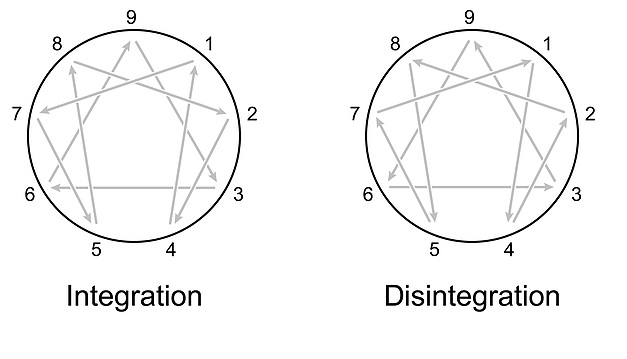
This is what is known as the path of integration. Basically, when you feel at ease, or when you learn to process your type’s challenges in a more mature way, you develop some of the healthy characteristics of another Enneagram type, namely the one connected to yours by the forward-pointing arrow. Note that you do not become a different type: your type is fixed and will stay with you as long as you live. You merely acquire some of the good traits of your integration direction.
One the other hand, when you are under stress or when you become more and more trapped in your mechanism, you tend to develop traits associated with the less healthy side of the type whose direction of integration you represent. This is known as your path of disintegration.
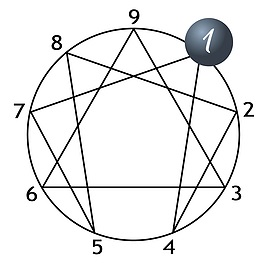
The Enneagram symbol with the arrows showing the directions of integration and disintegration
Note the two terms ‘stress’ and ‘relax’, as these are used with a specific meaning in Enneagram theory. Stress doesn’t simply mean having a busy schedule, just as relax doesn’t simply mean tanning on the beach. Stress is every situation that reinforces or incentivises the vicious cycle typical of your type, so that your type’s mechanism tightens its grip on you.Relax is the opposite–every situation that gets you out of your negative spiral or even leads you into your virtuous cycle.
Again, just as with integration, disintegration doesn’t make you change type. Furthermore, there is some indication that it is actually possible to work positively with your path of disintegration, although it tends to be hard, just as it is possible to use your direction of integration negatively. For instance, Fives may get a sense that they need to be more present in their bodies and act boldly, like Eights (Five’s integration), but because this is alien to their usual mechanism, they may end up doing it exactly when it is uncalled for; or a Four may have the idea of adhering more strictly to objective rules and mundane schedules, like Ones (Four’s integration), but they may end up doing it in an unhelpful or blind way that defeats the purpose of it, because they are trying to do something that is not typical for them.
These issues stem from a misunderstanding, namely that you need to start acting like a different type. This is not so. You are you. Work on yourself and on your type. The Enneagram symbol represents an uninterrupted flow of energy, while the types are like strictures on the road that partially block the flow. Working on yourself means loosening this stricture. This will lead you to naturally develop new attitudes, without you trying to be someone you are not. Keep in mind that the goal of every form of psychological and spiritual development is to be able to act appropriately now, and to react appropriately to what is happening now, without or with as little conditioning from your past preconceptions as possible. This is why the first thing is to learn your type, and then you start learning how wear it lightly.
The Nine Types with their Paths of Integration and Disintegration
Type One to Seven (Integration): Ones have a strong sense of duty. This is part of their subconscious deal with themselves: you are ok and are allowed to exist and act only if you do it right and in order to uphold an idea. As they relax, Ones move to Seven, learning to let go of the harshest aspects of their resentment toward themselves and others. They learn to look at the world with a sense of wonder, accepting a wider variety of points of view and sources of joy.
Type One to Four (Disintegration): when they become entangled in their own mechanism, Ones begin to despair at their inability to live up to their own ideal. They begin to see the world as impure or lost, and in moving to Four, they develop a marked melancholic or even depressive note, feeling that all is useless and they are shipwrecked in the wrong world, a world of chaos and lawlessness, without principles or order, a world that doesn’t listen to them. They tend to become resentful of others because they see in them the type of careless happiness that they secretly envy.
Type Two to Four (Integration): Twos exist, or rather, feel that they only have a right to exist in the interpersonal dimension, even when they are alone. As they develop, they move toward type Four, and acquire a greater sense of their own needs and a greater compassion for themselves. They learn to see themselves as valid, accepting and feeling their own urges without pushing them on other people, and experience and accept the hurt that comes from the realization that they are alone, like everyone else, and that connecting with others presupposes first being alone. They become their own primary focus of care and understand the legitimacy of this being so, which allows them to be more genuine and truly disinterested when helping others.
Type Two to Eight (Disintegration): despite their often sweet demeanor, Twos have an authoritarian streak that becomes apparent when the other resists Two’s attempt at creating a symbiotic unity with them by ‘helping’ them. When all else fails, and Two feels that reality is slipping away from their grip, they move to Eight, becoming hostile and aggressive, punishing the other in a demeaning way, as though the neutralization of otherness that they could not achieve with sweet manipulation they now seek to accomplish by turning overtly overbearing.
Type Three to Six (Integration): Threes tend to identify with their performance, achieving often marvelous feats that they seek to sell to others as the real image of who they are. They are extremely competitive and live in other people’s good impression of them. As they relax, however, Threes move to Six, they learn to be more ‘like others’, which doesn’t mean abandoning their drive, but using it together with others rather than to emerge at all costs. This is because they realize that their inner worth cannot be measured by how they perform. They often concentrate on creating meaningful social connections.
Type Three to Nine (Disintegration): every type has a vague feeling of what can go wrong with their mechanism, but often refuse to verbalize it in front of themselves because it’s a tough pill to swallow. Threes have it especially hard, because they perceive, at least on some level, the phoniness of the image of themselves that they submit for people to consider, but because the Heart energy is blocked in them, they don’t see or feel what else they could ‘truly’ be. This can lead them down a spiral that lands them at Nine, where they become lethargic and disillusioned about their own worth, sensing that they will never be anyone except, at most, frauds.
Type Four to One (Integration): Fours are extremely sensitive to their ever-changing inner emotional landscape. As they relax and move toward integration at One, they become more principled and appreciative of the mundane tasks that fill everyday life. They cease to long for the unattainable and become focused on practical plans for achieving what can be achieved and cultivating themselves more methodically. Emotions still find expression, but in a more measured and authentic way, without exaggerating. Authentic connections with others develop naturally.
Type Four to Two (Disintegration): Fours can throw hissy fits to express their disdain for the drab, gray, unfair world that surrounds them and makes them suffer. Furthermore, their envy leads them to being spiteful, often taking solace for their suffering in the suffering of other people. This leads to damaging personal relationships with snide remarks, underhandedness and all-around bitchy behavior. Yet when others are at the end of their rope with Four, Four becomes clingy, people-pleasing and unctuously accomodating at Two in an effort to patch the relationship back together.
Type Five to Eight (Integration): Fives live in their own head, where they identify with their own mental process and with some carefully selected truths or (often esoteric) areas of competence. As they relax, they move to Eight, learning to take up space in the world and inhabit their own body more fully. Their knowledge may find practical application or simply be more grounded, and they learn to listen to their guts when needed. They also learn to appreciate their own physical existence and realize that they have way more energy and resources (broadly construed) than they could ever imagine, which allows them to take action without first needing to hoard energies or time to devote to needless tinkering and fiddle-farting.
Type Five to Seven (Disintegration): When under serious stress, Fives find themselves incapable of using their typical strategy of retreating in preparation. This is especially the case when there are time constraints or when it is impossible to take a pause from social interactions (especially with people they know less well.) This leads them to become scattered and oddly unfocused, like unhealthy Sevens. Their typical sarcastic humor starts missing the mark, they often become incapable of saying what they think or thinking about what they are saying. They also tend to become airy in an ungrounded sort of way. They realize they’ve said something only after the fact, and realizing that what they said is stupid, or at least unrefined, they become even more scattered as panic sets in.
Type Six to Nine (Integration): Sixes are always looking for the one thing, idea, institution, person, group they can trust so much that they can finally turn off their brain and go on autopilot. Unfortunately, it takes little for them to start tearing down the object of their trust. When relaxing, Sixes move to Nine, where they become more trusting and calm. When watching a Six, I always have the sense that behind all their turbulent questioning there is a small white pearl of calmness that they are looking for and can’t seem to reach, despite it being right in front of them. Integrating to Nine means reaching that pearl. Relaxed Sixes allow space for the sense that all will be well and other people can be trusted even if they are not perfect.
Type Six to Three (Disintegration): under stress Sixes move to Three. As they lose their trust in others and despair of their possibility of finding safety in life, they become like fearful sheep realizing their need to fend for themselves as a pack of wolves attacks. They develop a desperate competitive edge, often exactly when it’s unwarranted or when doing so will cause even more uncertainty. Furthermore they may ‘puff themselves up’ in hopes of scaring away predators, trying to sell an exaggerated image of themselves to others.
Type Seven to Five (Integration): Sevens tend to flee from their inner sense of worry and their fear of pain. This often causes them to become engrossed in a superficial pursuit of distraction. When they relax, Sevens move to Five, developing a deeper stance and greater self-reflection. They learn to accept the darker side of life, like Fives do, and put their endless supply of energy to good use on long-term projects, staying focused while maintaining their typical cheerful demeanor. They are often able to confront their own shadow with great depth and tackling their problems soberly without slipping into hopelessness.
Type Seven to One (Disintegration): Sevens are constantly fleeing from worry, fear and pain. When this becomes impossible, or when they perceive the futility of it, or when all the issues that have been piling up finally explode, they tend to move to One, where they become highly critical of others for making it impossible to enjoy life, usually projecting their own failings onto them. Often they develop unrealistic plans to cleanse their life of all the problems they have been ignoring, which however could even make the situation worse, and they tend to take refuge and solace in ‘being right’ on things that are ultimately of no consequence.
Type Eight to Two (Integration): Eights have a bold, aggressive attitude, which they use to secure the borders of their ‘territory’. They can be confrontational and overly assertive with those they do not consider friends. In relaxing, Eights go to Two, where they become more giving and interpersonal. As a matter of fact, the average Eight already has a liberal, giving streak with the people they like. However, in relaxing their mechanism, they learn to stop dividing the world in friends and foes, and are capable to connect deeply with people, opening up about their vulnerable spots and showing their sensitive side. This ends up increasing their sense that there is a space for sweetness and nurturing in the world, and that sometimes it’s ok to let one’s guard down.
Type Eight to Five (Disintegration): under stress, Eights will usually double down on their typical strategy of pummeling the other to the ground to protect and assert themselves. However, when this strategy is defeated, we witness a real implosion of Eight, who seems to be sucked into a hole in the center of their being. This is their move to Five, which sees them fleeing reality and contact, becoming brooding and given to silly rationalizations of all that has happened. It is common for them to physically remove themselves from the presence of others, retreating into their den, going for a drive, etc. Usually they employ this time to build themselves back up, stocking up on energy and mental resources, as if their fortress had been cannoned full of holes they need to patch.
Type Nine to Three (Integration): Nines have a very diffuse sense of self, as they have learned to put their priorities behind those of others. As they relax, they move to Three, where they finally go through the normal process of developing a stronger self-image that has at least as much a right of being taken seriously as that of any other person. They typically become more active in their pursuit of their own aims and are more capable of setting up healthy boundaries. They learn that it is ok to emerge and to seek a place in the Sun. Because they become capable of openly saying no to things they don’t want, they have less need for passive resistance.
Type Nine to Six (Disintegration): Under stress, Nines tend to try to make reality disappear under a cottony coat of numbness. Those who have witnessed unhealthy Nines know how hard it is to get anything done that even partly depends on them. When this strategy breaks down, however, slothful Nines move to Six and suddenly become preoccupied and given to catastrophising. They also tend to become demeaning toward other people, poking holes in all they say and being skeptical of all they do, in hopes that all will go back to being still and motionless and all undertaking will be put off or abandoned. Like unhealthy Sixes, they also tend to fall into the “we poor little people against the evil guys upstairs” rhetoric.