Tag Archives: personal-development

Enneagram Comparisons | Type Two and Type Six

Enneagram Type Two and Enneagram Type Six can be incredibly similar in a number of way. Twos are a Heart type and want to be recognized by others as loveable or somehow to be important for them. Sixes are a Head type and look for security, which they try to achieve by forming strong connections with people they can depend on and be led by.

Both Twos and Sixes place great importance on relationships. Twos want to become important to someone to be confirmed in their identity. They want someone to tell them (and show them) that they could not live without them and that they are ever so lucky to have them. In this, average Twos act like benevolent tyrants. Like Sixes, Twos tend to be likeable, but they are also easily slighted if their sense of importance is called into question even indirectly. Although they tend to be pleasers, they demand that the value they bring to the table be recognized and appreciated.

Sixes on the other hand want to forge alliances with others like them against the things they fear, or if anything, they want someone or something higher to protect them and quench their fears and doubts. In this, Sixes are like an assembly of fearful citizens deciding what to do in the face of impending doom. Again, like Twos, Sixes tend to be likeable, but they also become easily suspicious of people that give them leave (even just in their mind) to doubt their loyalty, because a Six’s worst nightmare is to have a wolf in sheep’s clothing next to them. They can also be pleasers, but it is also very clear to them that this is just a social nicety between good neighbors, whereas Twos are more invested in pleasing others.

People

In general, Twos tend to have a poise, elegance and self-assuredness that Sixes lack. Twos know who they are, although they may not know what they want, as they tend to think in terms of other people’s desires. They are not constantly assailed by doubts, ‘the sky is falling’ style. Their primary concern is with creating a (dis)functional unity with another person who relies on them and mirrors to them who they are, even if that means getting lost in pleasant illusions together with that person. The intense way in which they look at others is a metaphorical mating ritual:”aren’t I exactly who you are looking for?”

Sixes don’t want to be told reassuring lies, but the harsh truth, and how to deal with it. In this they are more frantic than Twos, but they make up for it by being goofy, funny or relatable (Type Six panels at Enneagram conventions are always the ones where everyone laughs their pants off, far more than at Type Seven panels). They often look at others in a “aren’t I cute and nice? you wouldn’t hurt me right?” way. Counterphobic Sixes, on the other hand, may have a more aggressive look, but still one where fear is clearly visible (the way I see them is as herbivores going berserk when a predator approaches)

A Six’s eternal dilemma is that they want someone else to give them confidence, or sometimes even take charge of their decisions in life, but at the same time they never find anyone whom they can trust one hundred percent. Twos, on the other hand, are regal and imperious, and would never accept being bossed around without good reason.

MQS

Enneagram Comparisons | Type One and Type Nine

Enneagram Type One and Enneagram Type Nine are different in many respects. Both are Body types, and are therefore concerned with issues of autonomy. Neither of them is as assertive and warrior-like as Type Eight, the other Body type, but both find different strategies to preserve their autonomy. Nines seek to maintain their autonomy by being friendly and avoiding conflict with others. Ones maintain their autonomy by justifying it rationally as a means for them to pursue an ideal of rightness or justice.

While both Nines and Ones can believe that justice is important, for Nines justice is more a matter of harmonious balance with others. They do not quibble about rules and methodologies and are more than happy to accept (or even to sugarcoat) the world’s and other people’s shortcomings. They usually do not go out of their way to convert others to their point of view and prefer to keep peace, something alien to Ones.

Both Nines and Ones have a difficult relationship with anger. Nines are the least choleric of the nine types, and often need to work hard on themselves to learn to express anger and disappointment when it is appropriate. Average Nines may even feel that the notion of anger is completely alien to them. Ones certainly feel their anger simmering inside of them, but they have a difficult time expressing it directly.

harmony

Both types can be passive-aggressive. Nines are so in an attempt to neutralize other people’s agendas that risk disturbing their peaceful flow. In this sense, they are passive saboteurs. Ones are passive-aggressive because they would like everything to be perfect and everyone to accept that they are right about what it means for everything to be perfect, but they generally find it hard to boldly force others to comply. Furthermore, they often project onto others the anger they feel at their own shortcomings.

In general, Nines believe that the world is (or could very easily become) a good place, and usually keep themselves mentally occupied with bucolic platitudes about themselves and the world. Ones are more pessimistic about the world and about human nature, as they tend to see the world as the negative of a perfect picture that requires an inordinate amount of effort to reach. Furthermore, Ones tend to be methodical and spurred on by clear objectives. Nines, on the contrary, are more placid and, while not necessarily inactive, they can content themselves with following their routine without rigid aspirations and methods.

MQS

Enneagram Comparisons | Type One and Type Seven

Enneagram Type One and Enneagram Type Seven are very much unlike each other, so much so that they are each other’s arrow: Ones grow at Seven, Sevens stress at One. Ones are a Body type, and their primary focus is on right action as autonomous beings; Sevens are a Head type, and they focus mainly on security, which they seek to achieve by planning their comfort and diversions.

Both Ones and Sevens are, in a sense, idealistic, but their idealism has different roots and different effects on their worldview: Ones believe in high ideals and standards and, by consequence, see the world as imperfect and fallen; Sevens idealize their potential for future enjoyment and so see the world as their oyster, full of cool stuff to be hyped about.

Ones are known for their harsh inner critic, which constantly nags them about what they are doing wrong and why. Everyone, including Sevens, may have a strong inner critic depending on their particular life story, but what’s usually even stronger than any inner critic in a Seven’s mind is their inner Yes-Man, a voice that constantly justifies and encourages their desire for more and broader avenues of enjoyment.

Ideals

In a social context, Ones and Sevens are also very different. Average Ones are generally restrained and somewhat uncomfortable. They may love to try to be more personable and warm, but they also feel that something is holding them back and doesn’t allow them to just relax and enjoy others’ company. Even Ones that have worked a lot on themselves usually retain a degree of inner tension.

Sevens, on the other hand, are people magnets (even when they don’t want to be). They love quick and witty banter with others, and even more introverted Sevens relate to others with peculiar ease, and are often capable of making fun of themselves and of odd or paradoxical everyday situations in a way that Ones would find disconcerting.

The difference between Sevens and Ones is the difference between fun and duty: they are notoriously tricky to reconcile. Unhealthy, stressed Sevens who have strayed too far may suddenly try to save their wanton selves from their mistakes by suddenly developing the rigidity of a One, but in more regular circumstances they are positive, upbeat and open to the world’s possibilities. Healthy Ones, by contrast, are usually capable of incorporating some Seven traits in their behavior by becoming more serene and developing a more positive attitude, but in general they remain tense perfectionists.

MQS

Enneagram Type Nine – Growth and Stress

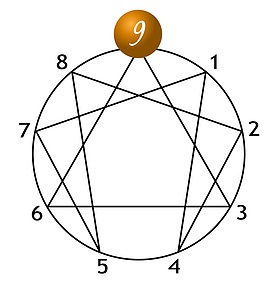
Enneagram Type Nine, sometimes called the Mediator, belongs to the Body triad. People of this Enneatype tend to be nurturing, accepting, agreeable and flexible. They are usually very good at holding space for other people, and they often manage to find common grounds with others. They are generally driven by a desire to avoid conflict, because they fear that conflict will make others fail to see them as independent individuals. They much prefer to work together with others, sometimes giving up on their own agenda to avoid rocking the boat, but also exerting a kind of silent passive resistance against things they don’t want to do or accept.

Enneagram Type Nine

Enneatype Nine Grows: Move to Three

Nines have a tendency to ‘disappear’, but not necessarily because they are shy or because they retreat from others in a traditional sense (like a Five avoiding draining contact or a Four witholding themselves to lick their wounds). Instead, average Nines fail to emerge as individuals in the eyes of others (and even in their own eyes): they often find it hard to articulate their preferences, projects and views out of fear of clashing with the people around them.

So while Nines are usually the most sociable of the three withdrawing types (Nine, Four, Five) they still withdraw from others by not opposing them or putting their foot down. This way of remaining merged with other people’s preferences and ideas and going with their flow can cause pain to the Nine as they may feel that they are being stepped on, even though they never drew a line to begin with, which makes it hard even for well-meaning friends to respect their boundaries.

However, as they develop and relax their mechanism, Nines learn to assert themselves more clearly. They learn that there is nothing wrong with having their own agenda, aims and views, and that in fact life cannot be meaningfully lived without choosing one’s path rather than remaining stuck in an all-encompassing mystical haze. Nines thus take on some of the qualities of healthy Threes.

Threes are very assertive people, with a strong desire to emerge and embody exceptional qualities. As one of the most driven Enneatypes, Threes’ way of getting the social acceptance they seek is not to blend in, but to stand out. As they take on some of these qualities, healthy Nines learn to take action by themselves, even if it means risking conflict with others by defending their own identity, their boundaries and their vision.

Action, the virtue of Enneagram Type Nine

Enneatype Nine Under Stress: Move to Six

Average Nines generally have a rather diffuse sense of self. Their ideal of a good day is one spent in peace, though not necessarily in inaction, as Nines can be very active people. What gives them peace is the idea that everything has its neat little place, everyone is a good neighbor, pleasantries are exchanged and no one causes any trouble. As long as everything goes like this, Nines don’t feel pressured into taking uncomfortable stances and they can simply occupy themselves with comforting thoughts.

Obviously, since life rarely takes place in Hobbitville, the Nines’ ideal rarely comes true, especially because many people don’t share Nines’ worldview. Nines usually go with other people’s flow as long as it doesn’t cause them any trouble and the even surface of their life is not ruffled. When someone threatens to bring serious change into their placid routine, Nines often engage in passive sabotage until the ‘agitator’ gives up in the face of the futility of their effort.

When this typical strategy fails though, Nines can become seriously stressed out as it becomes impossible for them to sweep every problem and irregularity under the rug. This is when they reach their stress point at Six. Enneatype Six is usually the opposite of Nine’s serene peace. High-strung and catastrophizing, they seek to poke a hole into every possibility and theory in order to find the one that will give them the certainty they are looking for.

In embodying some of Six’s negative traits, unhealthy Nines often become cynical toward those trying to bring change in their life. They will often conjure up endless amounts of excuses for why whatever has been proposed is silly or doesn’t work. In extreme cases, others may even be treated as threats to the Nine’s way of life and dealt with accordingly.

Enneagram Type Eight – Growth and Stress

Enneagram Type Eight, sometimes called the Boss or the Challenger, belongs to the Body triad. Those of this Enneatype tend to be powerful, assertive and present in their body. They have seemingly endless endurance and stamina. They highly value their own independence and hate submitting to people, especially if they consider them unworthy. Their best defense is often offense, in the form of being imposing and challenging, but they also have a sense of duty toward their friends and associates, especially if they feel they need to defend them.

Enneagram Type Eight

Enneatype Eight Grows: Move to Two

Average Eights are known for their power-exuding, in-control behavior. In a way, they go through life as if they were a fortress constantly redying for war (and occasionally attacking a neighboring country to be on the safe side). They generally seem to believe that the best way of maintaining their autonomy is to behave in an assertive, hands-on way.

In general, Enneagram Type Eight is deeply aware of a weakness or softness within them that they feel they need to defend from exploitation and aggression. This is what leads them to being defensive (or aggressive, depending on the circumstances) and to wanting to establish themselves above other people, because once they know that they are the reference point for everyone else in the room, they know how to deal with them directly and head-on, which is Eight’s favorite kind of confrontation, as it leaves little space for subtlety and underhandedness.

As they grow and learn to relax their mechanism, Eights become capable of taking care of their soft side in a more nurturing way. They learn to see that not everyone is out to get them and that, in fact, other people have a tender, weak spot too that is deserving of love and protection. As they recognize this, maturing Eights take on some of the healthy traits of Enneagram Type Two.

At their best, Twos are caring, interpersonal, giving, motherly and see the needs of others as theirs to take care of. In growing toward Two, Eights become capable of putting their warrior qualities to a higher use in honoring others’ need and defending them. They become extremely giving (in a more neutral, less manipulative way than unhealthy Twos) and their energy is expressed in a way that is innocent because it places itself beyond the rigid distinction between friend and foe.

Innocence, the Virtue of Enneagram Type Eight

Enneatype Eight Under Stress: Move to Five

All Eights tend to act assertively in order to protect a part of them that they consider vulnerable and tender. In a way, it is as if they were padding the space around that vulnerable point with their boldness and in-your-face behavior, so that others can’t take advantage of it.

Unfortunately, it is not always possible for them to succeed in this effort. Sometimes their vulnerability comes to light, especially in the form of not feeling adequate or smart enough or strong enough to meet the challenges of life. While average to healthy Eights can enjoy meeting the resistance of the world and can appreciate worthy sparring partners, unhealthy Eights can feel that big challenges threaten their independence as individuals. In these circumstances, receiving a reaction that is equal to or stronger than the action they exert can cause Eights to lose their balance.

When this happens, Eights move to their stress point, where they develop some of the less healthy traits of Enneagram Type Five. Seeing an Eight move to Five is like seeing a bloated baloon letting out the air all at once. Suddenly all the assertive energy of Type Eight implodes toward the center of their being and they become insecure, silent and almost invisible.

Eights, like average to unhealthy Fives, now tend to feel exposed and in need of putting distance between them and the threat, and it is not uncommon for stressed out Eights to physically remove themselves from others’ presence. In doing so, Eights hope to regain some power and energy and to strategize a way out of the impasse.

Enneagram Type Seven – Growth and Stress

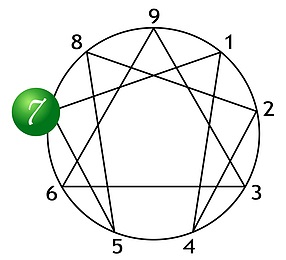
Enneagram Type Seven, sometimes called the Epicurean or the Enthusiast, belongs to the Head triad. Those of this Enneatype are usually positive, upbeat, energetic and fun-loving. They are mainly driven by the desire to avoid negative sensations and to maximize their options of experiencing the world and its potentials without being held back or restricted. They often make lots of plans and are engaged in many projects, activities, side activities, etc, some of which are bound to be left incomplete. They are usually possessed of quick wits and have an aptitude toward picking up new skills and interests. They rarely focus on the negative side of life, and even when they do, they tend to snap out of it quickly (or more quickly than other people.)

Enneagram Type Seven

Enneatype Seven Grows: Move to Five

One of the common themes in most Sevens’ lives is their fear of being confined to just one option, which will lead them (in their perception) to not experiecing life to the fullest or to not having back-up plans if one option fails. This tendency can cause Sevens to remain perpetually stuck on the surface of life, to the point that some unhealthy Sevens believe the surface is all there is. Sometimes this belief can cause Sevens to make rash decisions out of fear of being chained down in one place or situation.

As they grow and learn to relax their mechanism, though, Sevens start to develop a keener appreciation for the depth and complexity of life and a greater focus in pursuing certain options as more obviously right for them as opposed to others. In this, they start to take on some of the better qualities of Enneagram Type Five. Fives are the intellectuals of the Enneagram. They rarely make rash decisions and are often laser-focused, as though their mind were a blade that they use to cut through the surface of things to reach their core. They also don’t shy away from the negative side of life.

In general, even healthy Fives tend to lead a more sober life than their Seven friends, with a preference for a few well-chosen activities (or a few well-chosen possessions, friends, etc.) as opposed to the epicurean sludgeflow that usually clutters the lives of unhealthy Sevens. This is not to say that Sevens must become minimalistic, but as they grow they do become more stably anchored to their own core.

As they do so, Sevens realize that they are not necessarily foregoing anything essential if they choose to pursue one option to the exclusion of another, and instead they learn to cultivate what they do choose with care and persistence, while bringing their sense of humor, childlike wonder and almost endless adaptability with them.

Sobriety, the Virtue of Enneagram Type Seven

Enneatype Seven Under Stress: Move to One

Perceptive Sevens can sometimes feel that they are being led on a leash by their fear of restriction and pain. While healthy Sevens face their demons directly (like all healthy types) less healthy individuals can become absorbed in an endless whirlwind of meaningless novelty-chasing and hype traps, whereby they drop their toy as soon as the next shiny trinket catches their attention.

Because Sevens are very sharp-witted, they usually notice this trend, but they also feel that they must keep going, because stopping for a second (they feel) would cause more obscure feelings and fears to catch up with them. Unhealthy Sevens generally know that they are caught in a loop, but they feel that it’s too late to stop (Sevens in general have a tendency to excuse away their lack of restraint).

In moving toward their direction of stress, Sevens can pick up some of the less healthy qualities of Enneatype One. Like unhealthy Ones, they become critical and rigid, usually toward those around them who refuse to jump on the next hype train with them. Furthermore, perceiving the futility of their behavior, Sevens may also try to organize themselves to bring more structure to their life and activities (especially if it is spiralling out of control due to poor decision-making), but they tend to organize them to death, until all the wonderful Seven-ish spontaneity is sucked out of them and all that is left is the unhealthy One’s grayish sense of bureaucratic doom.

MQS