Tag Archives: occultism

The Geomancy of Peter of Abano – Book II Pt. 1

Previous / Back to Index / Next

Abano discusses matters related to the First House. and Second House

Having shown in the first book how one may know and judge (questions), we must now show some practical examples of this science according to the twelve houses of the chart, so that everyone may more easily understand what they wish to know. And this always according to the above described rule of giving the first house to the querent and the appropriate one to the quesited.

First House

Of the life of the man or woman.1
Having made the chart and the fifteenth figure, and wanting to know one’s fortune or misfortune,2 consider the figure in the first house and, depending on its meaning and the virtue of the planet ruling this figure, judge whether it is good or bad.

And if you want further clues, look whether the figure moves toward one of the angles or in more than one of them.3 And the life is all the more long and better and fortunate depending on how good the angle is, as said before.4 And if the figure doesn’t move, but it is still good and fortunate, it means one still has a long time to live, but is lonely.5 And if it moves to the second, it causes gain through one’s industriousness and solicitude. And if it moves to the third, it means getting along with younger relatives and siblings, and if to the fourth, it indicates increase of patrimony and wealth of the father or of the older relatives.

If to the fifth, it means happiness through children, and usefulness, but if to the sixth, misfortune, tragedy, accidents, but also other people’s service (to the querent), depending on whether the figure is fortunate or not. If it moves to the seventh, it means good things from the wife or girlfriend, and good deals, or gain through war or gambling, and maybe in a foreign country, depending on the quality and condition of the figure. If it moves to the eighth, the life is short, unless one is a butcher or deals in dead animals, that is, skin, wool, or if one is a loan shark.6

If it moves to the ninth, it means much journeying, and being a knight or a wayfarer or a churchman, and the person’s luck is better if the figure is good. If it moves to the tenth, it means honors and public office and receiving dignity from people up high, or through them, depending as the figure is fortunate or not. If it moves to the eleventh, it shows good luck with friends and from people who are noble or from the Roman Curia. If it moves to the twelfth, the person will meet his end in prison, or through long infirmity, or it shows being kidnapped or being in a remote place like some religious people do.

If the figure shows up as a Witness or as the Judge, the person’s fortune depends on how good the figure is. And what we have said of the first figure, whether it is good, mediocre or bad depends on its nature.

Second House

Of wealth, possessions and gain.
If you want to know about merchandise, one must judge the first house, whether it is good or bad, and then the second, depending on its virtue, and judge thus: if it contains one figure among Acquisitio, Major, Conjunctio, Caput and Albus, it means that gain will come from things that are easily movable from place to place, or from things that change, or that are sold by approximation (that is, without carefully weighing them).

If it were Puer it signifies gain through things sold after careful weighing. If it were Puella, it means gain through things that are easily obtained. If it were Rubeus, it means in things that cause fire or that have to do with blood. If it were Amissio, Cauda or Via, it shows little gain, and if it were Tristitia or Carcer, it means ups and downs of fortune or possessions. And if it is Laetitia or Minor, it means being able to keep one’s possessions. If it is Populus, then it depends on how good the first figure is, however by its own nature it means abundance.
Note that every entering figure indicates gain or buying, and exiting indicates loss or selling.7

Whether one will retrieve the lost possession.
If the question is about lost items, or stolen items, and we want to know whether we will get them back, look at the first figure, whether it is good or not, and then the second, and if they are entering or exiting. Afterwards, if you are looking for the thing, look at the tenth figure, if it is entering and good it means retrieval of the lost thing, especially if the same figure is in the second, or if here is another figure that is entering.8 Also look at the eleventh and the fifteenth. If instead the figures are exiting or bad, it means the opposite.

If you are looking for a stolen item, look at the seventh house, if it is entering and fortunate, and if it moves to the second or first house, which means retrieval.9 Similarly in the tenth, eleventh of fifteenth. And if the seventh [figure] is in the third, it means that the lost or stolen item is in the house of a sibling or relatives; if in the fourth, in or around the house of the father or of the older relatives, or near the house or place were it was originally. If it is in the fifth or sixth or eighth it means it is far away. If it is entering, however, you still will get it back.

If one will get back the money they lent to someone else.
The first figure is he who must receive back the money, the second is the thing that he wants to get back, and the seventh is the borrower. If the first and second figure, or at least one of them (especially the second) are entering, and if the seventh is exiting, it means getting it all back easily. Similarly, if the second and seventh are the same, that is, entering. But if they aren’t, it means the opposite.

MQS
Footnotes
  1. The First House was often called “Life, Body and Wit/Talent” ↩︎
  2. This type of question may sound vague nowadays, but it must have been common in the premodern era, as Astrology and Geomancy handbooks are full of tips on how to handle it. This was especially true at a time when one couldn’t just arrange an online meeting with the diviner and when one’s time of birth was unknown, so that one may have looked at other possible alternatives to know about their general fortune in life that didn’t involve the birth chart. ↩︎
  3. the angles, i.e., the First, Tenth, Seventh and Fourth houses, are considered strong and highly performant, so they endow the figure with strength. ↩︎
  4. I am not sure what Abano means here. The angles are traditionally arranged as stronger (First and Tenth) and weaker (Seventh and Fourth) though all are generally strong. He may be referring to this. Or he may be referring to the practice of assigning the angles to the four phases of life, so that maybe a good figure passing, say, in the Seventh, shows good midlife. ↩︎
  5. Probably because he remains by himself. ↩︎
  6. Because the eighth represents other people’s money (being the second from the seventh). ↩︎
  7. “Every entering figure” probably implies “to the exception of Tristitia”. ↩︎
  8. It is not clear why Abano mentions the Tenth House. It is possible that this is because the Tenth House opposes the Fourth House of buried and invisible things, and thus shows visibility and coming to light. ↩︎
  9. Abano does not seem to count the Twelfth house as being next to the First. He is not the only authority to do so. Possibly this has to do with the doctrine of the Company of Houses, or simply with the fact that, on the Geomantic Shield, the First and Twelfth houses are visually distant. ↩︎


On Prayer Before Divination

Some days ago I was talking to a fellow occult student and we were comparing notes on how we go about the process of divination. When I told her that I tend to say a little prayer before divination she was surprised, so I thought it would make for a nice topic.

First off, I do not think that praying before divination is mandatory, nor do I think that it’s the prayer that makes divination work. It doesn’t matter if it’s synchronicity, as Jung said, or if it’s the spirits that live inside the cards, as my first teacher told me, or if it’s the Soul of the World, as the Platonists believe, or if symbols are living beings, as I believe: the point is that the cards always rearrange themselves in a meaningful pattern, the planets always find themselves in the right aspects, the right geomantic figures always emerge, the right I Ching Hexagram always forms.

As such, in a way, divination is a natural activity, so much so that it’s probably one of the earliest activities humans have undertaken. The reading of symbols came much sooner than the reading of characters, because symbols occur naturally to the mind whenever we realize that X means Y. The moment the first men drew any kind or conclusion from any kind of observation, divination was born.

And yet, I believe that divination is also essentially extraordinary. In a way, divining is as normal as cleaning your cat’s litter box, but in another sense it is also very different. In divining we read a part of the whole (the divination system) to derive conclusions on the whole (life itself). Indeed most divination systems are universal languages that mirror the complexity of the Macrocosm.

As such, divination cannot be decoupled from a global understanding of life, and this global plane is where philosophy, spirituality and occultism unfurl their wings.

In my own view, occultism is divided into three branches: devotion, divination and magic. But these three aspects are not discretely separated. For instance, theurgy brings together magic and devotion. Divination and magic are often coupled together, such as in electing the right time to make a talisman or in asking if a magical action is warranted or advisable or effective.

Praying before divination brings together devotion and divination. It is a way of recognizing the extraordinary import of the action I’m about to take, despite this action being, in another sense, perfectly ordinary.

It helps me more than it helps the divination system itself. Nor does it have to be prayer. I know of some people who wash their hands before divining. In Imperial China official diviners had to cleanse themselves before attempting divination, and this is true all over the world.

No one divines willy-nilly. No one *should* divine willy-nilly. This has nothing to do with respect (unless you are receiving information from a particular spirit), it has nothing to do with asking deep questions (divination should always be practical) and it has nothing to do with not having a sense of humor (you can have a sense of humor, in spite of how bland and vapid many of us are). It does have to do with knowing what place divination has in the scheme of things and reaching that place. I do it through prayer, others may do it by just taking a second to clear their mind, but everyone does it one way or another.

MQS

Is This Course for Me? (Playing Cards Reading and Horary Astrology)

I’m always on the look-out for opportunities to deepen my knowledge of esoteric topics. Since the esoteric world is filled to the brim with junk covering a couple of pearls on the bottom (but don’t worry, things don’t get much better outside of lalaland) it is very useful to know some forms of divination to supplement my bullshitometer.

I recently came across a certain course on traditional Italian witchcraft which passed all my preliminary tests (no mention of Wicca or neopaganism, relating anecdotes on practices I’m already familiar with and know are valid, etc.)

Still something was off, though I couldn’t put my finger on it. On thing was probably the reference to authors, like Raven Grimassi, who have been largely debunked. I asked the heavens for a sign, and then pulled some cards. Let’s start with the cards. They were:

4♣ – 2♠ – K♦ – 2♣ – 6♦

Right off the bat, I don’t like the teacher being represented by a King of Diamonds. The King of Diamonds is the merchant, the banker, the one whose end goal is money. If he had been the King of Hearts or even the King of Spades I would have been reassured. You may argue that obviously a course is offered to earn money, to which I respond that there is a difference between earning through your passion and earning through other people’s passion.

I am unsure about the preceding combination of Four of Clubs and Two of Spades, but it likely represents contradictory (2♠, arguments, going apart) doctrines (4♣, that which is told). The Two of Clubs and Six of Diamonds traditionally represent limping (insecure steps). The King of Diamonds is not secure enough in his knowledge. Limping is still better than being bed-ridden, so there is something good to the course, but probably not enough to offset the negatives.

Horary Astrology Reading

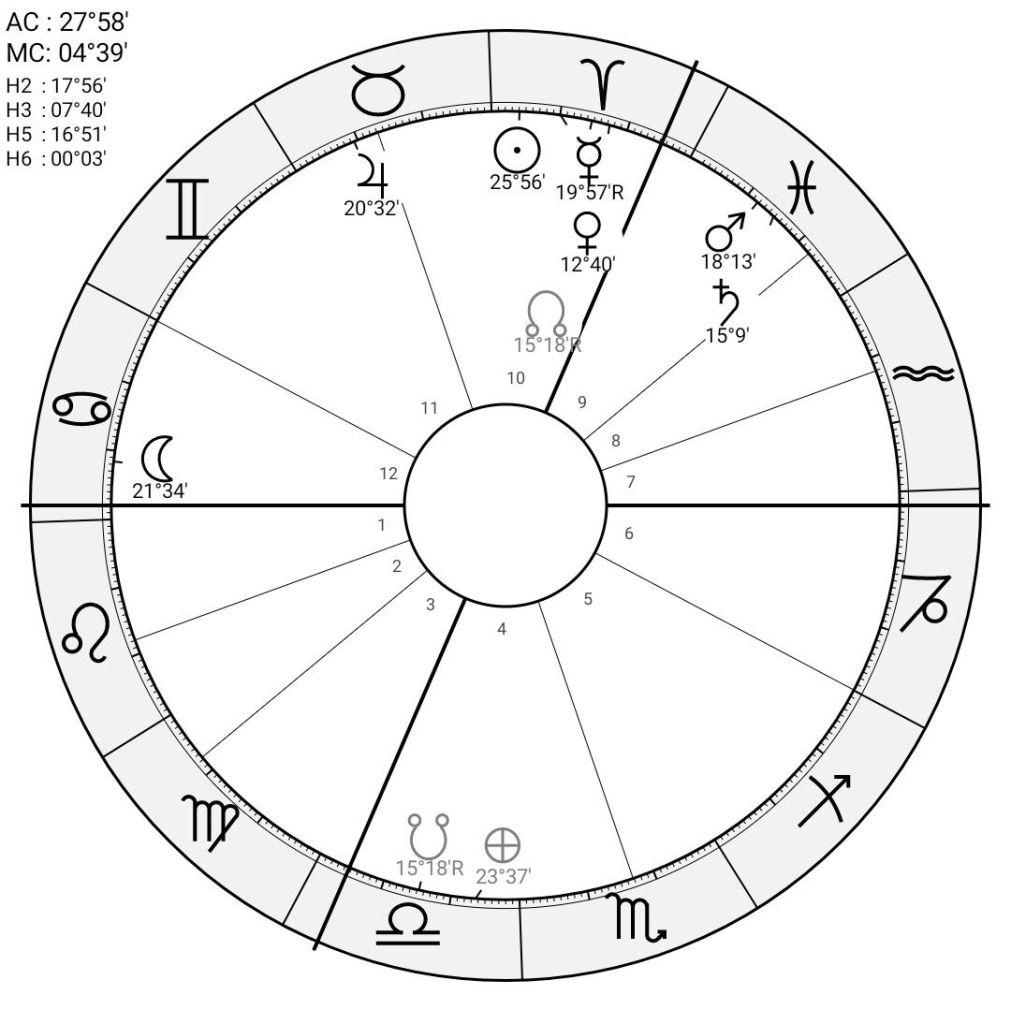
Let’s look at the horary chart:

Is the course good for me?

The Moon is the Lady of the Ascendant and thus represents me. Magic is higher knowledge, so it’s Ninth House. This is Jupiter. The two malefics Mars and Jupiter are present in the Ninth house, and are both peregrine, so they afflict the house.

The Moon is in her sign, but she’s also tucked away in the very malefic Twelfth house. Interestingly, the Twlefth house represents witchcraft, but only in the sense of something done behind the querent’s back to hurt him, not magic in general (which, again, is higher knowledge). So while I’d be capable of learning (Moon in own sign) my position is not good. There’s something iffy.

Jupiter is mildly dignified by term and in the succedent Eleventh house. The Moon is in sextile with Jupiter, which is technically good, but it is separating from it, indicating growing divergence. The Moon’s next aspect is a square of the Sun, which is negative. The Sun rules the second house, the house of money. So proceeding would put a strain on my finances. This isn’t necessarily to say that it costs too much in absolute terms, but it costs too much compared to its quality. Interestingly, Jupiter is disposited by Venus, which is in detriment and moving toward the Sun, which hurts her, so Venus has a rather excessive love of my money compared to the necessary love of knowledge.

All in all, based on both readings, I would say that the course would probably contain some valuable information, but would not be a great investment in my education.

MQS

Checking Talismans with Playing Cards

In one of my recent posts I discussed how playing cards can detect curses (of course, it’s not just playing cards that can do it). Today I wanted to add to this subject by discussing the esoteric use of Playing Cards to check if a spell (in this case, a talisman) is a good idea or has been successfully created and is working.

I should perhaps first explain that there is a modicum of belief in magic involved in all this. The modern worldview tends to react to the idea of magic in two ways: the skeptical way (“it’s not really true”) and the new age way (“it’s not really true, but I would really love for it to be true, so I’ll play make belief and tailor everything to my preconceptions”)

Either way, magic is reduced to the acceptable role of cathartic theater or psychological tool (unfortunately, even great minds within the occult scene, like William Gray, have partly fallen for this approach, or at least considered it viable). From here it has even found its way even into the corporate sphere (a friend of mine working for Google told me she was forced to attend a “magical” day with a psychic who talked to them about tarot and Wicca). You know something is crap when pandering megacorporations appropriate it.

At least since Aleister Crowley (but there are predecessors) magic has been understood as the way of the will. Granted, Crowley’s understanding of the word “Will” is not the same as how we understand it in our everyday life, which would rather be “whim“. His view resembles more closely Nietzsche’s view of the will, so it does have some nobility.

But this doesn’t detract from the fact that most people whose view of magic has been colored by Crowley’s (and that’s almost everyone today, whether they know it or not) don’t REALLY believe in magic. Instead, they tend to see it as, again, little more than a placebo. It’s true if you believe in it. It’s true if you want it to be true.

Still, it’s my experience that belief in magic is not really required for magic to work. In fact, one would be hard pressed to find any trace of the concept of the magician’s will in the traditional Western approach to magic (or in the Eastern approach, for that matter).

Because just believing in it was usually not considered a prerequisite for success, the use of divination to check the efficacy of magical workings has been advocated a long time. Besides, if belief is not enough, other, more objective factors must be checked. *

The Arab mages of old, for instance, invited people to do a horary reading to see if the use of planetary magic was warranted. Agrippa probably used geomancy for the same purpose. We don’t know about Abano, but it is not a stretch to think he would have consulted a geomantic shield to check how his spellwork was doing.

In general, all forms of divination take the reality of magic for granted within the worldview that informs their language. After all, why would divination work, but not magic? ** This is true for playing cards as well. Here is an example.

Last year while the Sun was in Leo I was working on a Sun talisman. I’m not going to disclose the aim of the talisman. It was nothing untoward, but I’d rather keep it to myself. After the creation of the talisman I set out to consecrate it. The number of days varies.

On the first day, after the first consecration, I got the following spread:

A♠ – 6♣ – 5♠

Definitely a bad start. And I wouldn’t have expected anything less. The majority is Spades, which is bad for anything but black magic.

6♣ – 8♣ – 10♣

Second day of consecration. A mash of clubs is not positive. It shows difficulties and toil without success. Still, Spades have abandoned the spread, which is a positive.

6♣ – A♦ – 3♠

This is the third day. Close but no banana. It is still a negative spread. It has the Six of Clubs in common with the previous spread, and it closes with an unpromising Three of Spades, which bring Spades and large obstacles back into the equation. Note that this is the third day in a row I get the Six of Clubs. But the Ace of Diamonds has appeared, which indicates success, talismans and even the Sun.

A♦ – 9♦ – 10♦

Fourth day. This is the sign I was waiting for. The Ace of Diamonds is back. This time it is well-placed. The Nine of Diamonds and Ten of Diamonds together just mean “it works”, whether we are talking about an object, a business plan or a spell.

MQS

* This is not to say that the old magi wanted you to do your homeworks half-heartedly. Marsilio Ficino talks about the importance putting your heart in your spellwork.

** this would lead us off into an interesting discussion of all those that practice divination without believing it to actually work (“it’s just a brainstorming method” being the most common rationalization)

Exploring Curses with Playing Cards

Most systems of divination can also be used to explore esoteric topics. For instance, I have answered the question “have I been hexed?” way more than I would like. The answer is no 95% of the times. Only two times in my life have I sent someone straight to see a priest because something supernatural was objectively at play. Most of the times, people use dark magic as a scapegoat to rationalize natural periods of bad luck.

Of the the two times I did detect a curse I can only find records of one (my notes tend to be rather messy). The girl in question asked me if she’d received the evil eye (malocchio). This was the spread:

10♠ – 5♠ – 5♥ – J♠ – Q♠

I added two cards to the queen, and I got the Q♦ and the 2♥. The reading is quite obvious: a woman cursed her (the Queen of Spades with the Jack) on behalf of a relative (the Queen of Diamonds and Two of Hearts) though probably not a blood relative. The Ten and Five of Spades, when read together with the other spades, indicate the use of negative occult powers, probably at night.

The Five of Hearts in the center of the spread probably showed the sector of the querent’s life that was impacted by the curse: the ‘abundance’ sector. The young woman had lost a ton of weight in a short timeframe, she looked wasted, had started losing her hair and her beauty, had started developing money problems (in that she couldn’t retain any money she made). Her significator is absent, meaning she was completely passive to the hex.

It seems her mother-in-law had gone to see a country witch to try to harm her. This is far more troublesome than the evil eye, which sometimes can even be cast inadvertently without a ritual. The hex was broken by a priest, or rather, thanks to a priest who put her in contact with a monk specializing in this kind of stuff.

I’m bringing up the topic because I was recently asked the same question by a friend of mine who is going through a rough patch (lost her job, broke up with her boyfriend, argued with her sister, etc), which she believed was due to some ‘bad vibes’ or the malocchio. The spread was:

3♠ – 6♣ – Q♣ – 7♠ – 5♦

This time we have the querent in the middle of the spread. This, coupled with the fact that there are no combinations of curse, is encouraging: the querent has not been displaced from the center stage of her life.

The cards are negative, but they don’t reference supernatural phenomena: the Three of Spades could indicate curses or evil eye in combinations, but here there is no such combo, so it just indicates problems, things that don’t go smoothly. The querent is surrounded by the Six of Clubs and the Seven of Spades, the latter showing unfortunate events, the former reiterating the idea of difficulties. The Seven of Spades connects to the Five of Diamonds to indicate a period of misfortune, that is, of natural bad luck, which will pass (there will be change, it won’t stay that way forever).

MQS

Reading Old Sources (for Geomancy, Astrology, Occultism)

I’m currently studying horary astrology under Chris Warnock’s supervision. He puts a great deal of emphasis on studying old sources, which is perfect for a guy like me who breaks out in hives when occultism is boiled down to “just wear a deep knowing expression, drink herbal tea and let the ascended masters guide your intuition.”

Geomancy is similar to horary astrology in that it allows you to answer questions, though it is less dependent on the time the question is asked. It is also similar in that you need to go back to really old books in order to study it seriously.

When reading premodern sources we always run a couple of risks:

  1. Unless they’ve been edited and discussed by a modern, they are probably written in a language that is not our own, or, even if it is, it’s an old version of it. This makes room for misunderstanding.
  2. More subtly, the world in which the author lived and wrote is not our world: it has different cultural, political and spiritual reference points.
  3. The source is written by someone who is just as fallible as we moderns (or rather postmoderns) are.

If one thing that grinds my gears is when people just turn occultism into their little escape from reality (“I wanna believe the world is magical but I’m too special for Christianity”), the other thing that equally grinds my gears is when people desperately seek a doctrine to follow blindly just because it happens to run against the Zeitgeist.

An occultist (and divination is a branch of occultism, though we often forget it) must be capable of being equally distant from intellectual lassitude and fanaticism, from scientism and religion. It takes a particular temperament that most people don’t possess, and I say this in a neutral sense: most people simply don’t have the temperament for most things, which is why only few people in any generation do any one thing.

Point three on the list is what I’m referring to here. The few on the occult path who have what it takes to move beyond the sanitized, advertiser-friendly version of occultism that gets tarot readers invited to corporate meetings often run the contrary risk: that of believing “if something says the opposite of what we hear everyday in our decadent world, it must be true and I must worship at its altar.”

When reading old sources (and I’m talking about geomancy, but it could refer to any other branch) this can turn us into fanatics if we don’t constantly remind ourselves that a book, even in the old days, could be written for a variety of reasons:

  1. to pass on important knowledge (but still from the author’s limited perspective)
  2. to record your experience
  3. to help others
  4. as a publicity stunt
  5. to impress others
  6. to confuse others
  7. a mix of all the above

Furthermore, old authors are just as capable as modern ones of believing crap. As such, while it is vital to question our own worldview, it is also just as vital to question all others. The moment you are asked (or you feel like you ought) to stop questioning is exactly the point where prejudice has crystallized, be it yours or someone else’s. It is also the point where you can break new ground if you proceed cautiously and with intelligence.

All this is to say, old books are treasure troves of information that we can study, learn from, adapt sensibly to our current needs, and much more. But if you are looking for a new Bible, you’re better off sticking to the old one.

MQS

Free Will and Prediction (Notes on Divination)

This post is part of my Notes on Divination series. This gets somewhat philosophical and is rough and not organized, so bear with me.

I have been playing with the idea of writing a book on the philosophy of divination. In fact, I have been playing with ideas for a lot of books on occultism, but I need to start somewhere. This is the first in a series of articles on such topics. Don’t take the following as an organized treatise–it is more like a random gathering of thoughts.

It’s impossible to be self-aware diviners without sooner or later stumbling upon the question of free will, the two most simplistic options being that we have complete free will and therefore divination is not about the future or that we have no free will at all and everything is predestined. I will argue in another article that both options actually prevent meaningful prediction.

Often people talk about “compatibilism” that is, the idea that prediction and free will can be seen as compatible. This is all very well, but it means nothing unless one explains how. Inevitably, explaining it requires one to clearly define the space alloted to both. Here I talk about all things that limit our choice, while in a future article I will talk about the limits of prediction.

Firstly, we need to acknowledge that when it comes to divination, it is not at all clear that we talk about prediction. After decades of New Age nonsense, divination has largely been relegated to the uttering of ‘inspired wisdom’, wisdom apparently being the consolation prize for those that can’t look at reality for what it is.

People who usually manage to compose their faces in a mask of sanity abandon all commonsense as soon as they pick up a tarot deck: you create your own destiny, you can do whatever you want. Well, you don’t. This is provably so. We cannot treat people as if they were bundles of free will floating in empty space. People come from specific backgrounds and have specific problems, idiosyncrasies and preferences that dictate their course.

You may be free, for instance, to choose between vanilla and chocolate, but if you hate chocolate you’ll probably pick vanilla. This is often seen as part of people’s free choice, but if we think about it for a second, it is actually a limit to personal freedom: an inner disgust toward something leads you toward something else without you being able to control it.

Free Will and Destiny

In other words, your choice, which is theoretically open to everything, is already limited by a number of psychological hangups that push you around like a sock puppet. That is a limit to free will in my book. Divination may very well be used to delve into these issues and to widen your options. In fact, it is a very good use of divination. But we cannot use divination to do so if we don’t first acknowledge that our options are limited, sometimes severely so.

But preferences are just one kind of limit. Another one comes in the form of ( the much reviled in spiritual circles) objective reality. If you are in a blind alley, know no martial arts, have no means of self-defense and an armed thug is walking toward you, that’s a pickle you can’t meditate or visualize your way out of.

This is not to say that you’ll inevitably lose. Maybe the dude is drunk and collapses to the ground as soon as he stumbles on that banana peel; maybe you are very good at talking and you persuade him to let you go by striking the right note; maybe a falling bit of debris from a ramshackle building takes care of him.

All this (and more) is possible. But the objective fact that you are in the blind alley in a less-than-desirable situation instead of sucking on a Capri Sun on your way to Hawaii imposes certain limits (just as this latter scenario imposes other limits)

The example above is situational, but our whole life is a series of determining factors that limit our trajectory. Look back on your personal history and you’ll probably be able to see traces of many, many past situations that still accompany you to this day, for better or worse. Even past choices become hard, unchangeable facts once enough time passes. You cannot, for instance, ungraduate from that useless gender studies degree in order to pursue a STEM subject. Although you can divorce, you cannot unmarry the person you married. Although you can abandon your child, you cannot unbirth it.

We could go on, but this point is clear enough: at any given moment in time we find ourselves shaped by a series of objective, subjective and intersubjective factors that limit us and our possible trajectory.

The delusional New Age view that we are the product of our current decisions does happen to stumble upon a little bit of truth, though it mischaracterizes it. It is true that, in so far as we abstract from ourselves and we move toward the universal, we peel backs layers of individual conditioning and we move toward the unconditional, however you may choose to call it (God, Being, One, Reality, Ensoph, etc.)

But there is a catch: moving toward the unconditional means not just letting go of our limits, but also of the aims that would lead us to want to overcome those limits as, however we may understand the unconditional, it is not conditioned by this or that choice. The fact of the matter is that free will may very well be the substance of reality, but in so far as it is the substance of reality it is not the substance of my limited whims.

In practice, therefore, the idea of unconditional free will is untenable from the standpoint of a diviner, as abiding by it renders the divination process futile, however we may understand it. This is not to say that complete determinism fares much better, as I shall show in the next article.

MQS