Tag Archives: occultism

Don’t Overdo Magical Protection!

This post is inspired by a forum page I was reading where various people whose whole magical practice consists in casting the defensive spells were comparing notes. One thing that often amuses me is that many people who are looking to get into magic often start by practicing random rituals which are either plucked off the internet (trust me bro) or taken from old books (it’s old so it’s true).

Even supposing that these rituals are effective (no, your wanting it to be effective is not enough for it to be) practicing them outside of the cultural, philosophical and magical framework within which they were conceived can be extremely dangerous if it is not done with full knowledge of the facts pertaining to it and by supplementing your magical knowledge with your reasoning ability to work out its inner mechanism. This is why I advocate for magicians to study philosophy and logic, among other things.

The first thing these people will rush to is defensive magic, their reasoning being that defensive magic can do no harm. In fact, it’s good for you! How can it not be? There are some words that unfortunately evoke unwarranted feelings of safety. ‘Nature‘ is one of those words. People hear “It’s natural” and immediately assume it’s good. Know what is natural? Ebola. But people in industrialized countries have a romantic notion of nature due to how distant it is from them–they can afford such a romantic notion, since usually nature is allowed into their lives in small, sanitized drops of color.

The same goes with the word ‘defensive magic’. It must be good if it is just for defense! After all, defense is good: That’s why we take karate lessons and install cameras on the front door. This, people think, is the equivalent of defensive magic.

Yes, defense is good. So is hygiene. After all, while hygiene now falls mostly under the cosmetic industry, it was once a matter of defense: cities with running water and plumbing had healthier citizens who could defend themselves more effectively. And what is hygiene, at its core, if not defending the body against certain biological threats?

Still, most people would agree that taking antibiotica every day without a reason, or washing your hands every few minutes is not only silly but detrimental. Our body exists in a dynamic balance with the forces outside of it, and neutralizing those outside forces will inevitably lead to our body being incapable of resisting them. The same is true for our soul. Magical hygiene is a thing, and it does contain certain solutions to keeping a good equilibrium. So how do we know if something is good?

The one thing we need to ask ourselves when looking for protection is: protection from what? What am I doing that requires protection? To put this into perspective: a welder’s mask protects his face from flying sparks. Do you need such a mask? Are you in danger of being blinded by flying sparks? Unless you are a welder, probably not, and even if you are, you probably don’t need it the whole day.

Most people have a certain inborn resistance to low-level magical threats, often supplemented by whatever protection derives from the religion they practice, so long as it’s a traditional religion with established rituals and prayers. This basic package is usually enough for anyone who is not a practicing magician. There is no point in people going around casting Banishing Rituals for no reason.

One universal law, maybe of magic, maybe of life, is: if there is no problem, don’t try to implement a solution, lest you cause an imbalance that only the presence of the problem itself can solve, thus inviting the problem to present itself.

The more we advance in the magical path, the more we are going to be on the radar of the odd inner-world larvae, and perhaps worse, the more we are going to need to keep the defenses up, and this will usually involve an always unique combination of strategies that are always specific to the kind of work we are doing.

MQS
Robert Fludd’s Geomancy, Translated and Annotated / Index

Back to the Geomancy Index

My translation and comments on Robert Fludd’s Animae Intellectualis Scientia seu Geomantia (The Intellectual Science of the Soul or Geomancy). Please note that I am no professional translator of old texts and sometimes I had to paraphrase. Feel free to leave comments or contact me on how this project could be improved. The translation and commentaries are copyrighted to me, so please ask for my permission before using it.

Introduction
Part I – Geomancy is an Act of the Soul
Part II – Preparing to Divination, the Hermetic Way
Part III – The Mystical Presuppositions of Divination

Book I
Part I – Anecdotes on the veracity of Geomancy
Part II – How to Prepare to Divination
Part III – Basic rules on projecting the points
Part IV – Filling out the geomantic shield

Book II
Part I – Elemental and astrological attributes of the figures
Part II – The Houses
Part III – The First Four Geomantic Figures
Part IV – The Second Four Geomantic Figures
Part V – The Third Four Geomantic Figures
Part VI – The Final Four Geomantic Figures
Part VII – When the Same Figure is Found in Two Houses
Part VIII – Interpreting the Judge, based on the two Witnesses

MQS

Self-Fulfilling Prophecies And How to Avoid Them

A couple of weeks ago I received a message about the question of whether we, as readers, risk causing self-fulfilling prophecies with our predictions. For instance, if I tell a querent that the relationship she is in is going to end, I may end up causing the break-up. What follows is a slight elaboration on my response.

First off, we need to recognize that some things we can change or at least improve, others we can’t and they will happen regardless of what we do and what a reader tells us. Most people who go about their life with their brain switched on can recognize this. It is only when we get into delulu territory and body-mind-spirit-section pseudomysticism that we encounter people who deny the existence of unavoidable happenings.

On the other hand, sheer fatalism is also a gross misunderstanding. Consider simply this fact: if two people X and Y are exactly the same and go exactly through the same life experience, except that X also uses divination or consults a diviner, this is enough to tell them apart.

The fact that X knows about what is going to happen in advance is enough to make him a different individual, which in turn is enough to change the nature of his fate, because our ability to change a situation is contingent on our knowledge of what the situation truly is. Even if X cannot change a certain fact in any meaningful way, but knows about it enough in advance that he can make his peace with it, the same event Z won’t be the same if X’s attitude toward it changes, because X is part of the event that takes place in his life, and so if X change, the event changes. Even if X cannot bring himself to accept Z, his knowledge of Z is enough to change Z, because X with knowledge of Z is not equal to X without knowledge of Z.

Fate patterns are a difficult topic to tackle without a previous sound philosophical and occult discussion, and I plan on starting that discussion at some point, once I’ve organized my notes. For now, it suffices to say that we, as readers, can play a rather important role in the querent’s life if we are consulted at the right moment.

Yet, this doesn’t mean that we are capable of empowering querents to always turn their life around, and I don’t even think empowering is our mission: our mission is to provide information. On a number of occasions, especially when I was less experienced, I gave querents the wrong prediction on purpose because I didn’t want to disappoint them, even though the cards were clearly negative: Yes, you’ll get the job, yes the relationship is going to last and be wonderful. But it didn’t happen. 

On some of those occasions you may even think that because I didn’t bring up the negative aspects, the querent wasn’t prepared to tackle them, so my not bringing them up may have been just as bad as another diviner handing out negative predictions willy-nilly. That’s because I wasn’t able to give accurate information.

It is nice that some things can be changed even if some things can’t, but unfortunately we don’t always know which is which. Therefore, we must also recognize that we have a degree of power over our querent just by virtue of using odd, mysterious counters to give our predictions, and we must not abuse this power. 

Whenever possible, we should either frame our predictions as potentials and/or accompany them with positive suggestions. These suggestions, though, must ALWAYS be based on what the oracle describes, never on vague self-help platitudes. Sometimes (many times) it is best to highlight critical points so that the querent can become conscious of them (e.g., “you know, this relationship is headed down a pumpy road. You should address x, y and z if you want to try to make it work”) while avoiding drastic predictions unless necessary.

Furthermore, we must never frame our predictions in such way as to take away all hope. It is not our right to do so. Deluding and disillusioning are the two capital sins that we must avoid, even though striking the right balance is sometimes hard. There is plenty of space between being a pushover to our querent’s wishes and being an insufferable sassy tough-love prick.

If there are positive aspects to a situation, we should emphasize those and try to put them at the center of the querent’s life so that they can address the negative points more positively.

Finally, we ought to always remind our querent that diviners are people and are therefore fallible. In a world where doctors, lawyers, judges, scientists and bakers can get things wrong it would be absurd to expect diviners to always be right. Always encourage the querent to take your predictions as an additional input. 

MQS

The Geomancy of Peter of Abano – Book IV Pt. 4

Previous / Back to Index

Abano discusses the various meanings of Tristitia, Laetitia, Puer and Puella as they derive from other figures.

Laetitia

When from Populus and Laetitia, it means luck, gain, especially in large [or great] things.
When from Acquisitio and Puer it means gain, merriment, especially in changeable things.
When from Amissio and Albus it means luck, but with mediocre gain.
When from Major and Puella it means fixity, gain and good luck.

When from Minor and Rubeus it means mediocre gain or honor or good luck.
When from Via and Caput it means gain, honor, positive change.
When from Cauda and Conjunctio it means misfortune, evil, but incapable of doing all it wants.1
When from Tristitia and Carcer it means mifortune, difficulties and problems.

Tristitia

When from Populus and Tristitia it means misfortune, danger, evil.
When from Acquisitio and Rubeus it means fixity and misfortune, except in in things lascivous or feminine.
When from Major and Albus it means luck, gain and honor with firmness.2
When from Minor and Puer it means better3 luck in every question.

When from Caput and Conjunctio it means great fortune, gain and stability.
When from Via and Cauda it means mediocre luck, difficulties, problems.
When from Laetitia and Carcer it means a good deal of luck, but with more problems than positive things.4

Puella

When from Populus and Puella it means infirmity, lascivousness, luck, gain.
When from Acquisitio and Cauda it means mobility, mediocre luck.
When from Amissio and Tristitia it means good luck after much toiling and difficulties, gain in venereal5 things.

When from Via and Rubeus it means misfortune and anger, rumors, change, damage.
When from Albus and Carcer it means gain, good luck, firmness.
When from Conjunctio and Puer it means fortune in everything, luck.

Puer

When from Populus and Puer it means gain, good luck, change.
When from Acquisitio and Laetitia it means gain, honor, mirth, goodness in everything.
When from Amissio and Caput it means good luck, bood in easy things and in seeking pleasure.

When from Major and Cauda it means unfortunate change, damage.
When from Via and Albus it means useful variety,6 fortune, good change.
When from Carcer and Rubeus it means major misfortune in everything, loss.
When from Minor and Tristitia it means fortune, some kind of gain, strife.

THE END

MQS

Footnotes
  1. It is not clear wheter Abano means that the person won’t be able to do all he or she wants, or whether the evil signified by this combination is not all-pervasive. ↩︎
  2. In this case, it seems that Tristitia’s role is to solidify the good fortune signified by the two figures it comes from. ↩︎
  3. ‘migliore’ means ‘better’, but it’s unclear better than what. ↩︎
  4. These two meanings might be hard to harmonize, though maybe not impossible. ↩︎
  5. That is, in things ruled by Venus. ↩︎
  6. It is not always clear what Abano means when he talks about variety, firmness, changeable things, etc. ↩︎

In Divination, If You Can’t Name, Describe!

I had a conversation with a reader of this website, and he told me that the main obstacle in learning how to read the cards is that he can’t put the meanings of the cards together to form a clear picture of the situation. The example he used was that it may be hard to tell a querent that they are at risk of getting fired, when in fact the cards may be predicting a fight with a coworker or a demotion, or some other work-related problem, but not a firing.

Divination is an art in itself, and it does require practice and patience. For the first couple of years after being taught cartomancy, I couldn’t put two card meanings together to save my life, even if it was obvious. I still remember my teacher’s dismayed expression when I couldn’t tell her that “talking” and “work” meant, quite obviously, “talking at work or talking about work”. Yes, it is obvious, just like it’s obvious that you first put one leg forward and then the other in order to walk, yet it takes us time to learn.

There are plenty of reasons why divination is hard, and lack of talent is only rarely an issue. Most of the times, we are simply experiencing the same hardships we would face when learning a new language, and most people can learn a second language if they put their mind to it.

Furthermore, I find that we often feel the need to overperform in order to convince the querent we are not frauds, and we do so by wanting to give them an absolutely accurate, unambiguous and immediately recognizable picture of the future. Of course, it would be nice if every divination session was as clear, but we are limited beings and we must be grateful for what we can do with the hand we are dealt (quite literally).

What do you do if you want to say ‘apple’ in a foreign language but you just can’t remember the name? You get creative and go back to the language’s building blocks: you describe the apple. “A round, red thing to eat.” This may sound weird and it is a bit vague, as there are other round red things we can eat, but it does help you narrow down the thing you want.

The same happens with divination. Sometimes we just can’t put the building blocks together into a single unambiguous picture (“you are at risk of getting fired”). But we can always describe what the cards are telling us: “I see some potentially upsetting circumstances surrounding your career.”

This is very vague, but it’s a start. Once we have narrowed down the topic, we can look for cards and combinations that give us additional clues: “These upsetting circumstances seem to involve a man, possibly a boss, who causes you trouble, and as a result I see the potential for some money problems.”

This is still not unambiguous: there are plenty of events that fit the description, e.g., being fired, being demoted, being assigned to an unrewarding task, a boss being replaced by another one that is so terrible the querent chooses to quit, etc.

Yet in spite of only describing the outline of a situation instead of naming it specifically, this is already very helpful to our querent, because we are giving them rather specific information they can use in preparing for difficult times ahead in their career.

We can also come up with a number of likely scenarios that fit the description as examples for our querent, and often they will help us fill the blanks (“Oh right, there’s that new project coming up no one wants to take on” or “Oh right, my boss has been talking about relocating for some time now”)

Note, also, that it is perfectly acceptable to voice our insecurity to the querent: “It is something between X1 and X10, and it seems to me like X1 to X3 are more problable, but I could be wrong”.

Once the prediction has come to pass, it is always possible to go back and see if perhaps we couldn’t have been more specific. This is a very important part of learning: there’s always something we miss, some turn of phrase of the cards we have misread or some meanings we have misapplied or even forgotten.

Still, the aim of divination is to provide help to people, not to impress them, and we are of service in the measure that we can point them in the right direction. If we can’t give them precise indications on the path ahead, “Between North and West, but more West than North” is good enough.

MQS

A Water Spirit (Example Reading)

One cool thing about moving to our new place is that we now live much closer to the countryside. Although there are a couple of major cities around us, our district is basically a cluster of small pictoresque old German villages close to the woods. This is a very good place for a magic practitioner to settle down.

I also discovered that there is a small lake or large pond (depending on who you ask) nearby. It’s been my experience that old water places, just like old caves, tend to be stably inhabited by spirits. In fact, in a subtle way, these spirits *are* the place they inhabit.

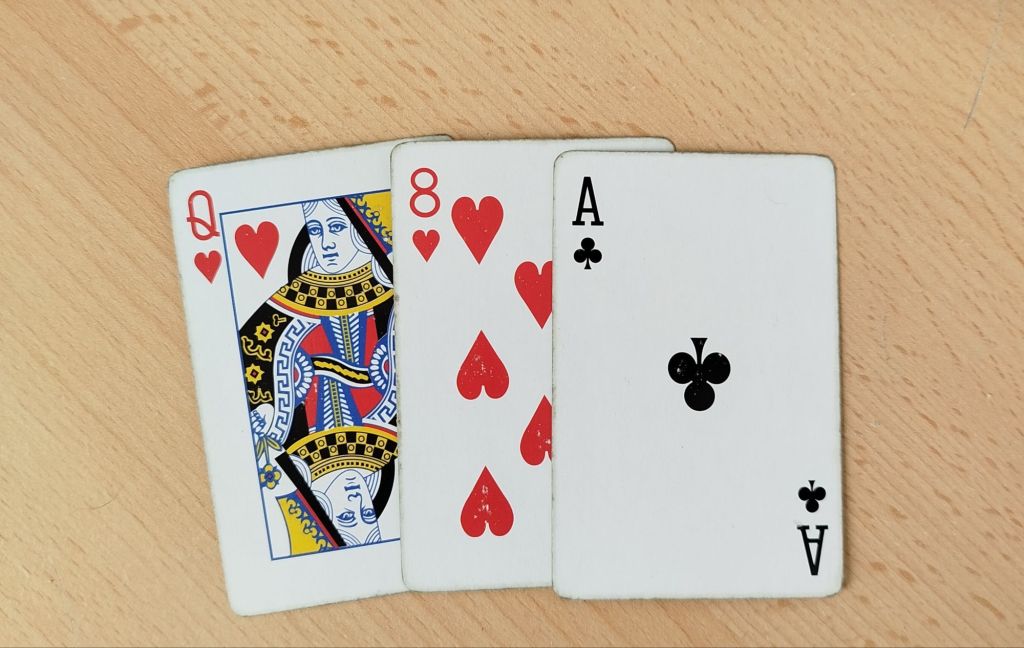
Before visiting the place I drew three cards to investigate, and these cards came up:

A water spirit – Cartomancy with playing cards

Obviously, the first thing to take note of is the presence of the Queen of Hearts, which is a motherly figure or a positive female entity. This is confirmed by the Eight of Hearts which can represent a water place, so in the context of an esoteric / magical reading it would represent a female entity of a broadly positive nature tied to water. The Ace of Clubs represents power, dominion, rulership. It indicates that the spirit has power over the place, so while she is positive, she is not the airy-fairy pushover type.

After doing the reading, I started researching local folklore. If you know of any such place near where you live, it may be wise to research local legends, as they often contain romanticized but accurate hints about the nature of the spirit.

What I discovered is that there is a medieval legend tied to the place, according to which a mother (!!!) once brought a local duke a basket of vegetables, in exchange for having a new irrigation system dug near where she lived. This irrigation system became the pond. There is no narrative reason why she should be characterized as a mother. Her being a mother serves no purpose in the legend, which makes it a very important hint in understanding the spirit: she is essentially motherly.

“But” you may be wondering “this is an artificial pond, how can it be magical?”

We must not draw strict boundaries between the world of humans and that of the great powers of nature. What we know from the legend is that a water spirit wanted to establish herself in this place and convinced the humans around her to cooperate by being motherly and nurturing toward them, and the humans were intelligent enough to accept her offer. There is nothing strange about this: in actuality, humans cooperate with nature all the time.

Note how the reading hints at a spirit that is positive (Queen of Hearts) but not submissive (Ace of Clubs). Had she been a difficult spirit she could have simply flooded the zone. There is altogether too much mischaracterization of water in the spiritual and magical community as something weak, vague and mystical. Water can be devastatingly powerful, so it is a good thing our local water spirit is a positive member of the community.

MQS

AI, Dream Logic and Visionary Magic Work

I’ve been having a lot of fun lately, watching AI generated videos based on pre-existing material. If you are not familiar with the “steamed hams” meme, here’s the original video:

and this is a meme version (one of the hundreds of versions being produced every year) of the same video, but reworked with AI:

One thing that struck me about it was how incredibly similar this video’s internal logic (or lack of it) is to the logic of dreams, especially of weird dreams. Everything flows into everything else, hanging together with it by thin threads of association.1

Notice, for instance, how the two characters, Skinner and Superintendent Chalmers, start dancing a romantic dance out of the blue just because the AI interprets the two characters getting close to each other as them engaging in romantic behavior, in spite of the fact that one of them is actually rather pissed at the other in the actual scene, and the other actually would rather avoid being in his presence.

This reminds me of how clearly the tone of dreams seems to shift flowingly from fun to scary to dramatic, to fun again, to romantic and so on, based on cues that the brain interprets much more loosely than when governing our waking consciousness. As an example, I recently dreamt I was visiting an old friend back in Italy, and the tone of the dream was cheerful and whimsical. Then, my friend taps on my shoulder from behind, and this must have reminded my brain of some horror movie I watched, because upon turning, my friend’s face turned into a demonic one and I was jumpscared awake.

Interestingly, what AI seems to be lacking, at least at this point in time, is the faculty of judgment, which is exactly what we also lack when dreaming or inebriated.

What I’m saying doesn’t really have any direct magical application. Technically, from a purely magical standpoint, the ability to let the consciousness flow in a dreamlike state is only one of the first levels to be achieved,2 as visionary work deals not only with a rigorous sculpting of the inner reality but also with the contacting of beings on different planes, which does require judgment (and sound judgment, possibly). On the other hand, the free flow of association, while it does have its artistic, psychological and even spiritual uses, is not immediately helpful in magic. In fact, it can lead to self-deception.

Still, I am left wondering if further progress can push AI in the same direction our consciousness moves toward in visionary work. It is a stretch, of course. After all, even the term ‘intelligence’ is used rather loosely when describing AI at this point. But what we thought was impossible yesterday is coming true today, so it is really hard to discern what AI will and won’t be able to achieve, and whether some kind of computer-generated magic or computer-fueled magic is possible.

MQS

Footnotes
  1. It reminded me of what Paul Foster Case says about how the subconscious works, when describing his own version of the High Priestess tarot card ↩︎
  2. Which is why so many self-styled visionaries who used or use drugs to fuel their trips are usually rather shallow, when the consistency of their vision is probed (and we should always probe the consistency of our visions) ↩︎

The Geomancy of Peter of Abano – Book III Pt. 8

Previous / Back to Index / Next

Abano talks about some of the meanings of Carcer and Conjunctio in the various houses.

Carcer

Carcer in the first means difficulties, preoccupations, melancholy, prison, deep thoughts, secret thoughts.
In the second it means delay in gain and increase, success through toil, but with difficulty.
In the third it means evil siblings, dishonest pleasures, dishonest and disgraceful neighbors, licentiousness with siblings.

In the fourth it means fortresses, cities, stable buildings, inheritance, abudance, hidden treasures, hidden things.
In the fifth it means miscarriage, dead children,1 danger through childbirth, evil children, lame children, or deranged or possessed, womanly pains.
In the sixth it means good, trustworthy servants, gain from animals, long sickness, danger and pain, crying.

In the seventh it means chaste women, stable marriage, good company,2 faithful people, stable peace, people who can keep secrets.
In the eighth it means death, interment, hiding treasures and goods from the dead, funeral or congregation of people caused by a death.
In the ninth it means religion, serving God, hidden things coming to light, long travel or pilgrimage, good monks, just people, faithful Christians.

In the tenth it means a stable kingdom, lordship, palaces, just judges and orators.
In the eleventh it means succession in a kingdom, oppressing enemies, gain with difficulty, hidden machinations, frauds, rumors.
In the twelfth it means dangerous hidden enemies, long imprisonment, death of the inmate.

In the thirteenth it means danger from childbirth, miscarriage, dangers for the mother, long illness, bad in everything.
In the fourteenth it means freedom from dangers and other issues, but after much trouble, leaving all problems behind.
In the fifteenth it means inner strength, delay in getting one’s wish.

Conjunctio

Conjunctio in the first house means an evil disposition, machinations, fraud, cheating, unstable life, a variety of colors.3
In the second it means merchandise, gain through one’s ingenuity, being active, promptness.
In the third it means ingenious brothers and sisters, good short journey and a speedy return, a messenger, false letters, having fun in company.

In the fourth it means good for the father, good inheritance, a beautiful building, ingenious actions, divisions among citizens, killings, rumors, betrayals among them [the citizens]4
In the fifth it means mirth through one’s children, giving birth, false women, a fun evening.5
In the sixth it means good but petty servants, fugitives, various illnesses but not grave, thieves in one’s family.

in the seventh it means iniquitous women, petty women, harlots, false company, thieves, scuffles and brawls, war, a sad marriage, various colors.
In the eighth it means a prisoner being hanged, for the ill man it means death, and likewise for the absent party, desperation, danger of death for women [or through women].
In the ninth it means intelligence, various interests, various journeys, various fatherlands, traveling to acquire knowledge or virtue.

In the tenth it means official documents, judges, litigations, kings, lords, various offices, dignity.
In the eleventh it means promises or oaths, dispatching soldiers or courtesans, instability, wrongful succession, wrong faith.
In the twelfth it means hidden enemies, betrayal, damage through evil animals, infamy, detractions, dishonor, but it is good to buy animals.

In the thirteenth it means good luck in the quesited thing, in marriage and in doing good.
In the fourteenth it means well for litigations and scriptures or writings, for promises and for lordships and congregations.
In the fifteenth it means happy ending and good luck depending on the question.6

MQS

Footnotes
  1. Elsewhere Carcer is given as positive for pregnancies. ↩︎
  2. Usually Carcer signifies solitude. Perhaps, though, if the question is about someone else’s goodness it may indicate a serious character. Needless to say, much depends on the configuration as a whole. ↩︎
  3. Conjunctio’s description is perhaps where Abano is at his most contradictory, possibly highlighting the inherently contradictory nature of this mercurial figure. Keep in mind that Mercury was seen not just as messenger but as patron of thieves. ↩︎
  4. Possibly here Mercury suggests the idea of partisanship. ↩︎
  5. The latin word ‘conjunctio’ can literally means the act of being joined to another in intercourse. ↩︎
  6. Often Conjunctio is taken to means a middling result. ↩︎

Be Careful What You Worship

One of my favorite books of all times is Ursula Le Guin’s second Earthsea novel, The Tombs of Atuan. Actually, I adore the whole first trilogy. It is one of the few fantasy cycles that can actually inform one’s magical practice quite a lot, if one is observant enough. But The Tombs of Atuan is my absolute favorite, and I find myself rereading it every now and then as a sort of comfort book.

In The Tombs of Atuan, the protagonist Tenar, a young priestess in a remote and almost forgotten place of worship, is tasked with guarding the dark subterranean labyrinth of the Tombs and with worshipping the Old Powers of the Earth that seem to reside there (the Old Powers are never clearly defined in the other Earthsea novels and material, as far as I know, but they seem to be a sort of mix between natural powers, pre-divine titans and incomprehensible amoral entities).

Over the course of the book Tenar comes into contact with Ged, the protagonist of the first Earthsea novel and gradually realizes, thanks to him, not only that there is no point in worshipping the Old Powers, but that her worship of them has actually made her worse. There is a lot more to the novel, but this one key point is worth thinking about.

It is one of the tenets of my devotional, philosophical and magical practice that no power comes from me as an individual. It can, at most, come through me. The way we as individuals become channels for powers greater than us is through our worship of them (whether it be devotional, theurgic or of a different kind.)

We all worship something, whether it be mystical, philosophical or mundane. And the more we worship it, the more we make space for it in our life and in the world. This has nothing to do with the manifestation or attraction nonsense that is practiced by people online and is to magic what McDonalds is to food. It is, actually, a simple, almost physical fact.

Most, if not all, magical traditions recognize this. For instance, the reciting of the rosary in certain strands of Italian witchcraft, in addition to accomplishing certain magical goals, is also meant to empty the devotee of themselves to make space for the divine. In many so-called High Magic traditions, the aim of initiation is to balance the components of the personal vessel so as to make it a better tool for something much greater than it: “Now be assured that no one can be enlightened unless he be first cleansed or purified and
stripped. So also, no one can be united with God unless he be first enlightened.” (Theologia Germanica, Ch. XIV)

(similarly, in many strands of Chinese magic, Qi Gong and other practices are used to the same effect).

A lot of people, including a lot of magicians, worship God, but this is not enough. What does God mean? How do you define the God that you worship? I feel this sort of clarification is extremely important, not because your definition changes the substance of God in a postmodern fashion, but because there are plenty of powers, objective and real, in the world that are capable of fitting the mold of your definition and seeping through the cracks of your practice, just like the Old Powers in Le Guin’s novel. Clarity, therefore, is extremely important.

Way too often do we see people who think of themselves (and are thought of) as spiritually “evolved”, whatever that means, or magically powerful who, at a second glance, have merely turned themselves into a walking collection of metaphysical parasites.

This process of clarification starts with a rational and philosophical assessment, and rationality is incredibly important (I’ve written a whole article about the importance of reason in occultism). However, keeping the lights on in your head is just the first step. What is needed is a broader cultivation of our vessel.

Can this all be taught? It is a tricky question. It is my belief that few things in life can truly be taught, or rather, most things can be taught, but the ability to be taught is harder to teach than all the rest. When I say that most branches of the occult path are for the few I do not mean to sound elitist. I mean it in the same way that I mean that math is really for few people. Not everything is for everyone.

Yet I believe that at least this one process of clarifying what we worship is important to everyone, whether they be on an occult magical path or not, simply because, as said, everyone worships something.

MQS

The Geomancy of Peter of Abano – Book III Pt. 6

Previous / Back to Index / Next

Here Abano examines some of the meanings of Puer and Puella in the various houses.

Puella

Puella in the first house means happy things, fleeing from adversity, singing, dancing, usefulness, younger siblings or dead siblings.1
In the second it means usefulness for women and for merchandise, good luck, clothes.
In the third house it means love between siblings and relatives, good friends, usefulness through them.

In the fourth it means fighting over inheritance, difficulty in whatever you wish to gain from your father or mother,2 hiding secrets, good profession.
In the fifth house it means good messenger and letters, gaiety with children, obtaining your wish.
In the sixth house it means lovesickness,3 good servants, harlots, fornication, lasciviousness.

In the seventh it means a marriage of love,4 lucky marriage, lascivious women, lack of stability.
In the eighth it means death of small children, arms and swords.5
In the ninth it means usefulness through travel, good change of place, gain through merchanidse, knowledge, good news.

In the tenth it means honor from lords, good servants, good things for powerful people, happiness, goodness in everything.
In the eleventh it means happiness from friends, good luck for sick people, gain, usefulness through injustice, good in everything.
In the twelfth it means being firm, scams, gain through animals, problems through servants and evil people and phony people.

In the thirteenth it means usefulness through travel and lords, happiness, good news, good messenger.
In the fourteenth it means freedom from danger, usefulness, happiness, gain through toil.
In the fifteenth it depends on the other figuers, depending on where they fall.6

Puer

Puer in the first house means happiness, hope of gain, having kids, obtaining your wish, money.7
In the second it means gain through merchandise, selling, abundance, obtaining the wish.
In the third it means discord among siblings and relatives, gain with difficulty and with company, difficulties, useless dream.

In the fourth it means controversy, fighting, discord, rumors about the father or mother due to inheritance, it brings to light the hidden, useful strategies.
In the fifth it means happiness, false messenger, fights, wealth from minors.
In the sixth it means fled servants, dishonest women, danger from giving birth, male child.

In the seventh it means illegal marriage, harlots, dirty words, useful company.
In the eighth it means death of an enemy or of a minor, inheritance, fraud, if with Rubeus8 it means wounds and loss of blood.
In the ninth it means long travel, reunion, false science and false people, false news.

In the tenth fight, bad judge, dishonor, one’s lord is too credulous, loss of dignity and wealth.
In the eleventh it means false soldiers, false friends, false churchmen, unfaithfulness, treason, contrarieties.
In the twelfth it means enemies, invasion, bad for journeying, subjects, the sick person is evil and a traitor.

In the thirteenth it means travel, impediments, murder, evil people, violence, eviction, loss of inheritance.
In the fourteenth it means evil company, false marriage, harlots, instability.
In the fifteenth it is always evil except in war.9

MQS

Footnotes
  1. This last correspondence escapes me. ↩︎
  2. Puella is usually presented as a positive, if weak, figure. Why it should cause strife over inheritance is not clear. In some Medieval books on Geomancy it seems as though Puer and Puella are often mixed together. ↩︎
  3. The connection of love, one of the meanings of Venus/Puella, with the sickness typical of the Sixth House, is rather smart here, and should be taken as example of how to derive meanings from the Figure-in-House combination. ↩︎
  4. That is, as opposed to a marriage of convenience or marriage for money, which were common back in the day. ↩︎
  5. This latter correspondence seems more plausible for Puer. ↩︎
  6. Puella cannot be the Judge. ↩︎
  7. Once again, this feels like a mix between Puer and Puella. ↩︎
  8. It is not clear where Rubeus should appear in order for Puer to be ‘with’ it. Perhaps in company. At any rate, it is an interesting comment as it reinforces the idea that the figures combine their meanings to give us a clearer picture of the situation. ↩︎
  9. Puer cannot be the Judge. ↩︎