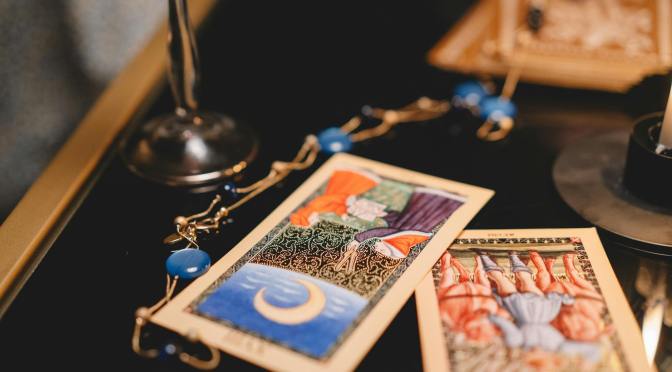
When someone decides that conventional spirituality just doesn’t cut it and takes the logical next step, namely they start being told what to think by the Mind Body Spirit section of their local library (or its social media equivalent), they are often presented with a starter pack of beliefs and practices: lighting candles, burning sage, rubbing crystals, gazing mystically at their daily tarot card, manifesting.
These are often handed out as some kind of miraculous tool for breaking free of the matrix (while in fact they are so commonplace that you scarcely find anyone in the corporate world who doesn’t practice them. You know you’ve become stagnant when corporations agree with you).
The concept of manifestation is especially popular, possibly because several popular aspirations find some type of answer in it: 1) the wish for a solution to one’s problems that is just one thought away; 2) the wish to be seen as doing something magical while not actually doing anything; 3) the wish to gain some sense of control over one’s life. Most of all, manifestation is often presented as the great inner secret™ practiced by successful people and taught by all great religions and philosophies.
In reality, through thousands of years of recorded magical practice there is no mention, explicit, implicit or implied, of the principle of manifestation as we understand it today, unless we stretch and misinterpret everything we read.
I have several objections to manifestation, some logical, some philosophical, some magical. I also think that, like many ideas I consider wrong, it does capture a fragment of truth, even though it twists it until it’s unrecognizable. Maybe I’ll explore all this in the future. But that’s not the point here.
I’m not in the business of telling people what to think. But always remember that there is a universe of teachings, practices and beliefs outside of the 1960s repackaging of Victorian esoteric fads that animates the current spiritual-but-not-religious community, and it’s fine to question, explore, expand, revise. Just because a belief is popular doesn’t imply you HAVE to accept it. If that were the case, you’d be served much better by conventional religion.
I was having one of my philosophical discussions with a friend, and she was venting about how she doesn’t believe in love anymore, and that, at the end of the day, love is just a chemical reaction of the brain.
I thought this was an interesting take, not because it hasn’t been done before (it’s a cliché for a reason), but because it is ripe with philosophical (and magical) presuppositions that are worth exploring.
Usually, by saying that love is only a chemical reaction, we are trying to decrease the power or importance of love. This in turn implies that we consider chemistry something inferior to feelings, since we are trying to reduce feelings to chemistry.
Yet why should such a statement make us believe that love is less than we think it is, instead of opening us to the idea that chemistry is more than we give it credit for? After all, if love = chemical reaction X, then saying ‘chemical reaction X’ instead of ‘love’ is just a rebranding excercise: we are merely giving a different name to the same experience. It doesn’t change one iota of how love works, its effects on us and on existence itself.
So love *is* a chemical reaction we experience. It isn’t *just* a chemical reaction we experience. And who does the experiencing anyway? Is it the same biological substance that is subject to the chemical reaction or is it something further beyond it, an observing consciousness which can become aware of it, as well as being aware of its own awareness?
Even if we choose the first route (i.e., it is the same biological substance) , we are still saying that the chemical reaction has awareness attached to itself. So we are saying that same substance subject to chemical reactions is capable of developing awareness of them. That’s no small fit. And yet again, we are still left with something that polarizes into two aspects: love and awareness of it. In this majestic self-aware process there is plenty of space for wonder, and love is once again restored to the status of powerful driving force.
The Greek philosopher and magus Empedocles considered love/friendship one of the two great powers setting existence in motion, together with hatred/enmity, because they fuse the four elements together and then disintegrate them. Magicians ever since have worked with the links of sympathy and antipathy (of love and hatred, of compatibility and incompatibility) that animate everything. Empedocles was, at heart, a naturalist, who didn’t try to introduce extra principles into his philosophy. Be he, too, saw that the fusion and disintegration of the elements (chemical reactions, one might say) is something so universal and so fundamental that without it nothing can get done.
The way we do things, the way we say things, matters. The same apologetic arguments we find in Blaise Pascal’s most feverish and haunting pages would be enough to bring a doubter to conversion, yet when coming out of the lips of a cheap street preacher holding a sign, they are often received with distrust, when not with disgust.
The way we do and say things matters in occultism as well. The old texts of magical tradition, and even some old accounts of rituals and supernatural occurrences, are full of the frenzy-stillness dichotomy: some things seem to happen in a state of ecstasy, others in a state of torpor.
My path, both as diviner and as occultist, has been informed by the pursuit of stillness more than by that of frenzy. All the teachers I’ve had the honor to learn from have always required of me to reach a state of calm rather than one of heightened overexcitement.
In divination, there is always a moment of randomness required in order to break the barrier between what the personality thinks it knows and what is actually the case. Arranging the cards (or geomantic points, or whatever) consciously in the order we wish they would come out may teach us something about ourselves, but very little about the reality of a situation. Randomness ensures that our self-consciousness doesn’t interfere with the processof allignment between oracle and reality.
Whether through a frenzy or through calmness, randomness introduces itself into the process by bypassing the limits of our personality’s structure, with its limits and its biases. The choice between the “inspired” moment of frenzy and the “deadened” moment of calm rests on a partially different view of the relationship between individual and whole, between ourselves and the divine.
Ecstasy, which is the process of leaving oneself behind, occurs in both cases, but it occurs differently. By achieving a drunken confusion one simply rams through the walls of one’s personality, achieving contact with what is outside of it. By stilling oneself, one reaches the point within one’s core where individual and divine coincide.
Obviously, once each option is brought to an extreme, it bleads into its opposite. Pure frenzy becomes absence of limits and therefore absence of what is limited, and its movement resolves itself in calm. Pure calm is delivered from all difference from change, so it coincides with pure frenzy.
When a person sits in front of a diviner, a number of preconceptions have often already been set off in their mind, and sometimes even in the mind of the diviner.
We must always remember that, nowadays, many people don’t visit an astrologer or card reader by chance, nor (usually) as their first go-to choice. Often, they have made a deliberate choice to step outside of the norm, for better or for worse, meaning that they have found the norm to be lacking in its ability to provide certainty. For many, therefore, the underlying presupposition seems to be: “I accept to take part in something that operates outside of consensus reality as long as it gives me the certainty I can’t find any other way.”
As diviners, we instinctively know it, and we may feel pressured to play into this presupposition or swim directly against it, thus falling into the opposite error.
Some diviners may feel they need to provide the querent with the unreasonable all-knowledge that only God can gift them with, only to end up providing uncertain information with unreasonable confidence. Others may push in the direction of vague self-help: We may not know if Mr. Right is behind the corner for our love-starved querent, but her divine feminine or other buzzword can still derive important lessons and “aha moments” from reflecting on the whole situation.
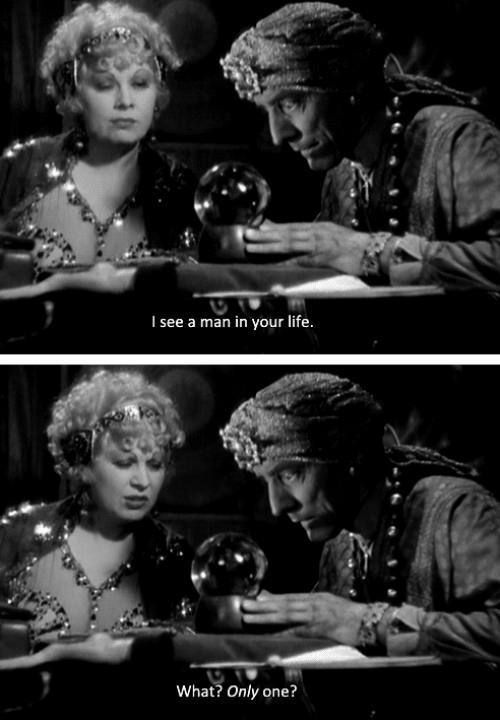
Mae West said it best. Picture by Sophie Charlotte on Pinterest
There are many dimensions to divination, some of which are indeed very deep. However, as far as our relationship with querents is concerned, we are simply an added means of intelligence-gathering, which, like all tools at our disposal, may fail for a variety of reasons, not the least of which is the diviner’s limited knowledge (our knowledge is always limited).
“But I came here to have undebiable, clearcut answers,” one might argue. To which I anwer: Tough titties! If you want undeniable clearcut answers shake a magic eightball. Divination is, quite literally, a divine language, and is not always so cleacut, either in itself or due to our limitations, or sometimes simply because the situation isn’t clearcut in itself. This is especially the case for issues involving human emotions.
As a rule, honesty is the best policy. I believe in voicing my procress to the querent, and the querent has a right to as clear an answer as I am capable of giving them, but we should never feel pressured to give them more certainty than we can truly see in the oracle.
It is perfectly acceptable to talk to the querent about our doubts or about the possible interpretations we are seeing in the oracle. For instance, it is ok to say “it seems like x, but y is also a possibility, while z seems less likely and w is out of the question.” It is also acceptable to say “these cards seem to point to such and such being the case, but I’m uncertain, as this other interpretation might also be right”. More often than not, the querent will say that both interpretations apply, and when this is not the case they can help us disambiguate the oracle.
Ultimately, the fact that divination has no legitimate place in our society implies as a consequence that, because our society believes itself to be held together by reasonable rules and processes, then divination must be either complete poppycock for delusional idiots or it must be capable of unreasonable fits of prowess in other to justify its existence in spite of its current ostracism.
This in turn creates expectations and hang-ups on both ends of the divination process that need to be analyzed and clarified to avoid them subconsciously ruling our practice. Doing so can make divination much more valuable and much more enjoyable.
A reader contacted me and we started chatting a little on magical training. One of his observations, which I found quite interesting, is that most schools require learning meditation as one of the first steps in occult development, and he was wondering if meditation is really necessary to occult development.
The first thing we need to clarify is what kind of meditation we are talking about. The influence of Blavatsky’s orientalist flavor of Theosophy has made it so that, when we say “meditation”, we tend to mean Eastern techniques. In reality, most cultures developed some form or other of meditation.
Western Platonism, for instance, developed its own form following Plotinus’ doctrine (already implicit in Plato) of “remove everything!” (aphele panta), whereby one strips naked of every specific determination of mind and soul, until he reaches a state of peaceful union with the divine.
This doctrine has been developed by some Christian mystics, especially of the German school, and is still very much present in all the iterations of Neoplatonism that have occurred throughout history (for instance in the Renaissance period). I am currently translating Robert Fludd’s treatise on geomancy, and his advice on how to prepare for divination essentially boils down to Plotinus’ aphele panta doctrine.
This is not just “high magic” stuff (I don’t believe in a high/low magic dichotomy). Even in folk magic, such as certain strands of Italian witchcraft, discursive forms of meditations are used (reciting the rosary, for instance, or using certain mantras). Let us also not forget that all religions have their own forms of meditation.
So why does most occult training start with meditation? In itself, meditation does nothing. It serves no necessary purpose outside of itself, in the sense that it is a sovereign technique. One can simply practice it for its own sake, as a form of spiritual dignification.
However, magic is largely about becoming fit vessels for a power higher than our own. Aside from its intrinsic benefits, meditation, in its various forms and with its various possible aims, is one of the techniques that shape our personal vessel to become more fit receivers.
Many times, within a ritual setting, meditation is practiced as a preparatory step, especially to visionary magic (but really, most magic is at least in part visionary). It is a way of starting the operation with a blank slate and to create an interruption between our daily preoccupations and the ritual.
Finally, meditation famously trains the “monkey mind”. Since our mind is one of our most important tools, we don’t want it running around, slinging crap at passers-by and hurting itself by sticking a finger in a wall socket.
Occult training is a balancing act, and while it is not true that anything goes, there is space for adaptation (if there weren’t, there would be only one occult path in the whole world, which is patently not the case). Meditation is NOT necessary, just like prayer, offerings, divination and many other things. But it is a tried and true set of tools for the journey.
I am an ecumenical troll: I will pour salt wherever I can regardless of political, religious, ethnic and gender affiliation, IF what I see is a sheer display of stupidity. This is one of those cases.
As most people will know by now, a certain oddly-colored politician has been reelected into office. Amongst the predictable TikTok meltdowns that were caused by the event, one peculiar trend caught my eye: that of witches sending him curses, either to make him croak or, and I quote, “having him willingly resign from the office so that Harris can take his place.”
Let us pretend for a second that this is how politics works (if it did, most politicians would dread winning an election more than losing it). What never ceases to amaze me is the complete detachment from reality that informs the witchcore scene.
Magic used to be the logical next step on the path to wisdom after mastering the worldly sciences. Now it’s a hobby for people with funny hair who need to unlearn anything resembling critical thinking in order to be able to tell themselves in front of a mirror that they are “witches”.
In large part this is due to the process of specialization and separation of knowledge that occurred after the scientific revolution, which virtually left no space for magic in the curriculum of the wise. This has led to two opposite tendencies developing: the “science confirms our eternal truths” tendency and the irrationalist tendency.
The “science confirms our eternal truths” strategy is typical of many XIX and XX century occultists. It makes no sense. Science is an open and ever-evolving body of theoretical and practical understanding which would survive even if it threw its most well-established theories overboard. If “scientific theory X is actually a reformulation of our eternal occult wisdom”, what does it say about that wisdom when, in 500 years, that theory is disproven and science moves on to the next one?
The scientific path is generally characterized by a flattening of magic onto (pseudo)scientific rationality. The irrationalist path, on the other hand, is characterized by the abandonment of all logic and understanding. It is typical of most milquetoast magical practitioners nowadays. This is the path that leads people to say with a straight face that you can manifest the result of an election and you can substitute sage with a piece of paper with “sage” written on it.1
This kind of irrationalist magic is the variety practiced by the TikTok witches sending curses to Trump. Rest assured that curses do exist. They mostly require some kind of contact with the victim, and even then almost no one can pull them off.
Even from the point of view of sending influences at a distance, Trump is as loved by those who voted for him as he is hated by those who didn’t: from a purely numerical standpoint, these influences cancel each other out, with something left over in his favor.
Finally, whether one likes it or not, the movement he leads has its own well-established etheric egregoric presence, which was created not just internally by those who support him, but also just as much externally by those who loathe him. A simple study of the life of Donald Trump, and even of the last months, shows that it would be very hard–not impossible, but hard–to hurt him, either physically or esoterically. Do you seriously think you lighting a candle and regurgitating formulas from a grimoir you bought on Etsy is going to change the course of humanity?
MQS
Substitutions CAN be operated in magic, but they are an art in an of itself, and require understanding ↩︎
Fludd discusses the mystical implications of using divination.
5. The Act of a True Geomancer Is Like a Movement of the Mind in Ecstasy, or Rather a Sort of Rapture, in Which There Is Prophecy
Rapture in general is called the abstraction, alienation, and illumination of the human mind, proceeding directly from God, through which prophecy is obtained.1
Thus also a certain kind of rapture and ecstasy is required for divination by Geomancy, which is not called the illumination of the mind directly emanating from God, but rather the act of gathering of the mind’s rays into a narrower place, that is to say, into the seat of the human body and its own home, so that through them the divining soul discerns the simple truth more clearly.2
As such, ecstasy is first of all required in this knowledge, that is, the abstraction of the rays of the mind from all external things or affairs, so that they are contracted within themselves: for in a great rapture of the mind and soul the rays are lifted up to the divine essence of God, or into the region of the mental world.3
Thus, even in this minor rapture of the human soul, the rays sent out from without, and scattered here and there, are recalled to their center, and are reflected in the mind, and thus man, who was formerly dark because of the diffusion of his own light, is now enlightened and glorious by the aggregation of the expanded rays.
In a similar manner, as we gather from the opinion of the learned men, on the third day of creation the rays created by the light scattered evenly throughout the sky, and all appeared in a dark manner, as if darkness were mixed equally with light, or night with day.4
But when, on the fourth day, all that light scattered everywhere was collected in the center of the solar body by a certain magnetic property, there was produced that glorious and worthy example of light, in which God himself is said to have had his tabernacle.5
We also see, for instance, that in a fortress equipped with a thousand soldiers, if the greater part of these soldiers, either for the purpose of preparing for defeat or for some other attempt, goes out and runs to and fro, then that fortification is rendered weak, and those who are left experience great fear.
But if those who had gone forth should return safe and sound, those who had been left in the stronghold recover their former confidence and their former hope, and putting aside all fear, they are in no way afraid of the invasions of the enemy, since that place is already well-furnished with warriors.
Here, therefore, things are in the same way with the bright rays of the human soul. For the human body is a stronghold or fortress, where the rays of the mind and the middle soul are likened to soldiers, of whom we may compare those who are sent out of the body to attend to foreign affairs, to soldiers running hither and thither outside the fortress, the absence of which renders the body less confident, and more insecure and timid, and weak in facilitating some noble and bright aim, such as divination, which is the best and highest thing.
We say, therefore, that the recollection of rays of this kind is the reduction of man’s internal nature from multitude to simplicity.6 As a result the soul, recalled from external meditations, and reflected and recollected within itself, renders a man, as it were, raptured and ecstatic, because he thinks of himself and within himself, he is only present to himself, oblivious of strangers, so that it appears to the ignorant that he is not aware of himself. when, in truth, he is now more than ever before.7
For he who neglects worldly things is sure to care for himself more, and he who withdraws himself from the multitude into himself seems to be most present to himself, since there will not be a great interval of distance between him and God.8
To such an attitude or disposition must he reduce himself, who endeavors to procure for himself the gift of future divination. For those thinking of externals divert the powers of the soul from the judgment of truth, so that the uncertainty of the geomancer is great in his judgment, or to be more precise, the truth in him will be as great as the variation of the soul from its unity.9 Indeed, in the multitude of things, tricks, vanities, and lies are concealed; in true unity and simplicity perfection, identity and unity [are found].
Let the soul therefore snatch from the Macrocosm that which is its own, given to it by the Creator in its creation, and internalize it into its own Microcosm, and let no one else enjoy what is its own.
By virtue, I say, of his own excellency, he is snatched from the world, and restored to himself and recollected, and clings to ecstasy, so that in his most refined mirror or spirit he may reflect not only worldly things, but also divine ones. For the more clarity he achieves, the more effective will be his visions and motions for prophesying the truth
6. About the Hidden Properties of Geomancy, and How the Soul or Mind Passes in Its Operation Through the Whole Nature of the Macrocosm
Nor is it right that those who are ignorant of geomancy should regard a series of points as mere lines, formed from the act of divination, since under these characters, the objects of the eye and the senses, many things, both spiritual and material, are concealed. Indeed, these series of lines comprise no less the idea of the universe than the human body itself.10
In fact, although in man his body can only be seen from the outside, yet with spiritual eyes we contemplate his spirit and soul and mind inwardly. Of course, in the body we see the elements invisibly mixed in composition;11 in the spirit and soul we observe the ethereal nature, in the intellect and mind we observe the empyrean nature.
the same can be observed also in Geomancy, since readings consist of four lines of points, and we perceive that the four elements are concealed in it, that is to say, the element of fire under the first line, of air under the second, of water under the third, and of earth under the fourth. 12
Furthermore, in the figures produced by those series of points, the seven planets and the twelve heavenly signs are included, which can only be perceived by the eyes of the spirit.
Thus the figure of Carcer is attributed to Saturn direct and Tristitia retrograde: the figure Laetitia signifies Jupiter direct, Acquisitio retrograde; Rubeus denotes Mars direct, and Puella retrograde; Major indicates the Sun in a certain direction, and the Minor in retrogradation; although the astrologers deny the retrogradation of the Sun, because of its epicycle; Puer is given to Venus direct, Amissio retrograde;13 Albus is attributed to Mercury direct, Conjunctio when retrograde; the direct Moon is symbolized by Populus, the retrograde by Via;14 Caput Draconis is represented by a figure bearing the same name, and Cauda Draconis is represented by a figure bearing the same name as well.
So also those figures contain in themselves the natures of the twelve signs. For Acquisitio is of Aries in an abstract manner; Laetitia and the Minor of Taurus, Rubeus and the Puer of Gemini; Albus and Populus of Cancer; Via of Leo; Caput and Conjunctio of Virgo; Puella of Libra; Tristitia and Amissio of Scorpio; Caput of Sagittarius; Cauda of Capricorn; Major of Aquarius; Carcer of Pisces.
Furthermore, Rubeus, Minor, Amissio and Cauda denote the element of Fire and the Southern part of the world; Laetitia, Acquisitio, Puella and Conjunctio denote Air and the Eastern part of the world; Populus, Via, Puer and Albus denote Water and the Northern corner of the world; Major, Caput, Carcer and Tristitia denote Earth and the Western part of the world.
Even deeper towards the center of the sky lies the empyrean spirit,15 which is the revealer of the future and the present, that is to say, the rational or intellectual collection of these figures and the worldly things contained in them.
From all this it is evident how purely and sincerely the intellectual spirit must be preserved from the inconveniences and harms of the flesh and filth, when from it the movement to produce the Geomantic points first arises, taking with it in a secret manner the natures of the heavenly signs, the planets, and the elements, and finally hiding all these under the number and in proportion to the points, like a certain treasure in a chest.16
If, therefore, we wish to open that chest, first to the elements, then to the planets and celestial signs, and finally to the boundary from which these movements originally flowed, we shall penetrate in the sanctuary of the mind, its will, in the mythotheque of the intellect, of the will, of the signs and planets; in the closet of the ether we shall find the act or execution of the mind; and in the storehouse of the elements, we shall find the effect of the mind’s will, reason, and act (all of which are contained and hidden under figures, as if in a chest).
From the aforesaid, therefore, it is evidently clear that, just as the prophecy of the inspired is the union of the divine mind with the human mind (whence it is the most complete and greatest, this species of prophecy), so also the prophecy of the uninspired sometimes happens, when the soul is united, with its rays drawn back to itself from the multitude toward its summit, that is, with the human mind, which, without doubt, if united with the soul and collected, can perform enormous things by itself, and can lead to the summit and a happy outcome.
MQS
Footnotes
The words ‘abstraction’ and ‘alienation’ must not be understood in their usually negative sense. In Neoplatonism (and mostly in Plato himself as well), the dialectical method allows the spiritual seeker to climb up the ladder of being through a process that leads from the particulars of the material world upward and inward to unity with the divine. Ecstasy, which is the goal of Neoplatonic spirituality, literally means “going out of oneself”. This is the process of abstraction and alienation. ↩︎
That is, prophecy stems from direct union with the divine and is harder to control, while divination (such as Geomancy) happens by focusing inward. ↩︎
See Note 1. Fludd describes the Neoplatonic method of retreating inward and upward. ↩︎
If the light is evenly distributed, no difference appears and everything is as equally dark as it is equally radiant. ↩︎
In the Hermetic interpretation of Astrology, the Sun is a symbol of divinity. ↩︎
Broadly speaking, the path of magic in all its branches (and divination is one of these branches) require an endless attempt at simplifying one’s life and one’s external nature. ↩︎
This is a common theme in mystical and occult literature, and one of the great truths of our art. As we reach what some have called ‘superconsciousness’ we appear to be less aware, while in fact we exceed regular awareness. ↩︎
The phrasing here is clearly very careful to avoid scandal. As for the words “caring for himself”, this is not to be understood as being egoistic. ↩︎
that is, we are capable of seing the truth in the measure that our soul is unified. This is probably part of the reason why divining for oneself is especially difficult, since divination implies doubt about an external topic. ↩︎
Here lies a great and central secret about all functional systems of divination: that their symbolic vocabulary is complete in itself, so as to be able to reflect within its permutations the truth of things to come. Here, Fludd compares the language of Geomancy to the human body, which is a symbol of the completeness of the universe. ↩︎
He means the four elements, which were thought to be mixed to form the material bodies. ↩︎
This is a reference to the fact that in Geomancy each figure is made up of four series of points, and each series is assigned to one of the elements. ↩︎
compared to the usual attributions, Fludd switches Puer and Puella ↩︎
The Moon cannot go into retrogradation. Usually, Populus is assigned to the waxing Moon and Via to the waning Moon. ↩︎
with reference to the Aristotelean and Ptolemaic view of the cosmos. ↩︎
This comparison is very much a consequence of Fludd’s Renaissance worldview, according to which Nature is replete with symbols. ↩︎
In a previous article I discussed how the original Golden Dawn spread known as Opening of the Key fits perfectly into the mold of traditional divination by cards, although it adds certain occult layers to it. This is largely due to the absence of one-card-per-position layouts, the presence of peculiar techniques and the tendency to read cards in rows.
To sum up how the spread worked:
You selected a significator for the querent (usually among the court cards)
You shuffled the deck and let the querent cut it into four stacks (corresponding to the four letters of the Tetragrammaton)
You found the stack with the significator and had to divine, based on its position, the nature of the querent’s problem. If wrong, the divination wasn’t radical.
You had to spread out the cards into a row or arrange them into a ring and count starting from the querent’s card. Then, you had to pair the cards on either side of the querent to fill out the details.
Then you shuffled the deck again and dealt it out into the twelve houses. You had to find the querent’s significator and count and pair as before based on the house.
You shuffled the deck again and dealt it into the twelve signs. You found the stack, counted and paired.
You shuffled the deck, then looked for the significator and dealt out the 36 cards following it into a ring symbolizing the decans of the zodiac. You counted and paired.
Finally, you shuffled and dealt the deck into the ten Sephiroth of the Tree of Life, found the stack, counted and paired.
As you may have guessed, the Opening of the Key was a cumbersome spread, and while it was used for the solution of practical matters (Crowley famously remarked on this fact), it clearly was meant to be used primarily within a ritual setting, at least in its entirety.
What is also clear, though, is that the Opening of the Key is less a spread in itself than a blueprint for a complete tarot reading made up of five individual spreads, each of which analyzes the issue from a different standpoint, or rather by tapping into a different layer of it. The experienced card reader could simply choose one of the five spreads and use it without resorting to the others, as need dictates.
For the most part, it seems that many Golden Dawn members simply stuck to the first operation, which is consequently the most famous and iconic, where one cuts the pack into four smaller stacks and reads the one with the significator. The possible reason why the other operations were generally discounted is probably that almost all of them required the deck to be dealt out into small stacks, only one of which is read, so that it takes more time to deal the cards than to read them.
Other members, though, were more inventive. In his Oracle of the Tarot booklet, Paul Foster Case offers a simpler alternative to the five-operation extravaganza of the full method (which he nonetheless describes and recommends for more serious or complex questions)1
The divination starts as usual: by finding the stack containing the significator and telling the querent what he or she has come for without them telling us, based on the stack. In the original instructions, if the diviner is wrong in assessing the nature of the question, the divination should be abandoned. In reality, aside from the initial period of training, it seems that the location of the significator was simply used to color the interpretation of the cards.
At this point, Case’s simplified method diverges from the original. Instead of spreading out the stack into a single row or ring of cards and starting the counting technique from the significator, Case says the diviner must shuffle the stack and then deal it out into three smaller stacks, corresponding to the past, present, and future. Each stack is then read sequentially (as you would in playing card, Sibilla or Lenormand divination).
The simplification of the method is due to the fact that, instead of starting the exploration of the issue from the past/present with the first operation and then moving on to the further future with the other operations, one has immediately past, present and future condensed into a single method.
There are other ways of simplifying the Opening of the Key. Paul Hughes Barlow rose to some prominence a couple of years ago for his idiosyncratic way of reading the first of operation without relying on a significator, instead reading all four stacks, something for which he was reproved by some.
Personally, I have found Paul Case’s simplification very effective in my experiments, and I’ll probably post an example reading in the future.
MQS
He also introduces certain specifications that are also found in the advanced BOTA course on divination elaborated by Ann Davies based on his notes. ↩︎
Fludd describes the importance of purification, meditation and other practices in preparation to geomancy.
3. How a Geomancer Should Prepare Himself, So That the Intentions of His Mind May Be Clearly Emitted, and May Be United With the Senses by Means of Reason
It is thanks to our senses that we can see the geomantic points. Then, we compare these same points to the celestial [bodies] and the elements with our imagination.1 Finally, the hidden virtue, both of these points and of the figures arising from them proceeds from the correctness of the intellect, both active and passive,2 and consequently from the mind.
From all this follows that the human body must be regulated and governed in such a way that its more intellectual part may not be drowned by too much intercourse with the flesh, or become dulled, and that the imaginative or fantastic spirit may not be rendered dull and impure.3
Therefore, before this work is approached, let our fantastic spirit be clean, pure, unmoved and untroubled by cares, so that it may be made worthy of being trusted by the mind and intellect. Thus, such a spirit, most suitable for divination, will receive the light of the rays of the mind without any hindrance, and will depict the objects of truth in a mystical manner, as if in a mirror, and will cause the sensation and movement of the body to proceed exactly and to the degree to which the effect of the mind itself tends.4
When, therefore, we are safe and healthy in body, and not disturbed in mind, not weighed down by food or drink, not suffering from want or poverty, and not ruled by any vices of lust or anger, let us enter into this area of prophecy. Let him also who wishes to use this art keep his spirit pure, both by quiet and religious meditation, and by moderate and temperate diet according to nature.5
This preparation is necessary for him who desires to foretell the truth of future things, either by the geomantic art, or by any other method, since without it no one can access true divination, for he who is languishing in a fantastical spirit6 will not attain the desired end, but will judge confusedly and indiscernibly.
Similarly, when we are filled with wine, our imaginative spirit, as if submerged in noxious vapors, hides and distorts the glory and truth of the rays of the mind, no differently than a thick cloud, or the earth raised in the middle of the air region, shields the glory of the sun from the eyes of the beholder, and produces a refraction of its rays. In this manner falsities will appear instead of truths, and in the very portion of the cloud the objects of the sun will be seen changed into an iridescent or multi-colored substance, and many phantasms will appear in the air, which are not such as they appear.7
Hence they say that the vassals of Amphariaus,8 as Philostratus testifies, ordered one who wished to divine future things, and to receive the oracles of God or of the mind, to abstain from food and wine for a whole day, or even for three days, if this could be conveniently done.
Thus we read that Ezra and Daniel, and even Moses himself, before they came to God, abstained from their wives for three days and washed their clothes: and so they did all this, at the command of God himself, of which we read Exod. 19 and Ezech. 44.9
And so also must he who desires to devote himself faithfully to this form of divination, be delighted not with carnal intercourse, but with spiritual union, not with wine, but with the light of the mind’s milk, not to be lavished with worldly riches, but with the infinite affluence of the divine intellect, not with junk, but to be filled with spiritual food.10
In an old French manuscript on occult Geomancy I found a confirmation of the above in these following words: “Before you get to the projection of the Geomantic points, I would like you to understand that they are not counted. Indeed, if you do this, nothing good or profitable will result from it, since this is knowledge based on the soul, and therefore the number of points is to be found in the will of the soul, and in no way be established according to the appetite of your senses.
It behooves him, therefore, who undertakes this work, to begin nothing, unless his heart is at peace, and his conscience is whole and healthy, and his spirit and soul are not troubled by any disturbances, so much so that he would not even wish worse for another than for himself.11
Finally, having been prepared in this way, let him trust in God, the teacher of knowledge, and beseech him with prayers, that by the power of that knowledge he may reveal to him the truth; having therefore carefully completed these things, it will be necessary to proceed immediately to the projection and arrangement of the points, etc.”
This author in no way disagrees with our opinion, but rather, on the contrary, seems to agree exactly with it.
4. It Is Not Sufficient for Divination That the Body and Flesh Should be Well Ordered. It is Also Necessary That the Rays of the Internal Soul Be Gathered Together
As concentrating a force generally increases its strength, so also it begets great weakness when it is dispersed.12 Thus we see that the rays of a candle in a confined room illuminate a place in a wonderful manner, since the narrowness of the place compresses and contracts the rays emitted by the flame to each other, so that they have a greater power in illumination. However, if that candle is placed in a larger room, its light is greatly weakened and darkened, because of the dispersion of its rays in a wide area.
In the same way, then, the soul (whose candlestick is the human body) spreads its rays in this or that business, nay, in infinite external things, for example, in lawsuits and legal affairs, in the art of medicine, in the care of family matters, in pain and sadness over a lost cause or the death of a friend, in anger or some unexpected adversity, in some art or knowledge and others of the like, or if he is also affected by the intercourse of concupiscence, the vice of drunkenness, the indulgence of gluttony, or other temptations of the flesh, he will be very weak and have little power to illuminate the body.
But truly, if all these soul-rays are reduced from external affairs to the internal economy of the Microcosm, and are drawn back to their center from the multitude, the force of the soul will be united, and that body, which was formerly dark and gloomy because of the rays, will be illuminated in a wonderful way, and thus the prophetic power in man will be far more effective than it was before.13
However, this reduction of the expanded rays of the soul into one cannot take place without the purification of the body, which is done in the manner mentioned above. As a result it is necessary above all things for him who wishes to claim the name of truth in Geomancy, that his soul should once again turn and reflect its scattered rays upon itself; since the chief virtue of this science consists in the illumination of the soul, in so far as true things are seen in its divine light, as in a mirror of truth, and are explained by the external observation of points in a mystical way through the guidance of the soul that turns its attention to this.
The concept of the ‘intellectus agens’ or Active Intellect is key to Neoplatonist spirituality both in Europe and in the Arab world, and has many similarities with some kabbalistic concepts. Generally, the Active Intellect was a universal form of intelligence that is not confined to one’s individual nature. Whether Fludd is referring to this or simply to the more active faculties of the human soul is unclear to me. The gist of his argument, however, is that the occult sciences, including Geomancy, rest on the highest principles, which makes them hard to access when one is not pure. ↩︎
Imagination is depicted here as a valid aid to understanding, as long as it is in its pure form and not just mere fancy. ↩︎
To put it simply, the body and the lower faculties of our nature must be ruled in such a way that they move in unison with the higher. Once this is accomplished, divination may take place successfully. ↩︎
Old medicine was of the idea that an appropriate diet could only be prescribed based on one’s nature. There was no one-size-fit-all. As for meditation, Fludd is unlikely to refer to those forms of meditation that entered into the Western consciousness thanks to theosophy’s Eastern dabblings, and that have become commonplace today. The West used to have its forms of meditation. ↩︎
possibly meaning someone who gives in to their fantasy without ruling it appropriately ↩︎
It is impossible to read this passage without being reminded of Plato’s myths, especially that of the cave. ↩︎
Here Fludd interprets passages from the Bible as episodes describing some higher form of divination. In a way, this is very true. ↩︎
Here Fludd proposes a series of alternatives to ‘lower’ forms of pleasure that may seem rethorical at first, but on closer inspection aren’t. Such ‘substitutions’ are typical of many occult training curricula. ↩︎
Ill-wishing is part of the things that weigh the soul down. ↩︎
The same pressure applied on a wider surface disperses it. ↩︎
This process of ‘unification’ is the same that has been typical of Neoplatonism since (at least) Plotinus, and which has been described, within a Christian context, by the German mystics (Meister Eckhart and his disciples) who described the Seelengrund (ground of the soul) as the point of contact of the individual soul with the universal presence of the divine. Fludd, living at the end of the Renaissance and its exaltation of humanity, gives us a slightly less mystical version of this idea, one geared toward increasing one’s knowledge through occult practices. ↩︎
Not every question is fit for divination, and as diviners who get approached by people, discernment and, if necessary, gate-keeping is among our rights and duties. I say this not because I want to feel part of a superior caste of priests, but because our practice should be informed by two great principles: the well-being of our querents and the honor of our art.
It is perfectly fine to ask questions out of mere curiosity or for fun, but the ultimate decision on whether a question shall be put to the cards rests with us. I, for one, have dodged more questions about controversial politicians in the last couple of weeks than in the last couple of years altogether, largely because the question, when boiled down to its essential meaning, was “Is it true this politician I hate is a spawn of Satan?”
Such questions are unanswerable not merely because they are idle, but because they are ultimately unverifiable: unless you are that politician’s cleaning lady you have few ways of verifying my answer. Furthermore, consider this: if my answer is anything except “yes, you’re absolutely justified in your hatred,” the person is going to be inclined to dismiss my answer as superstitious nonsense. Why, then, whould a positive answer be of any value?
But unanswerable questions are not just those that belong to the “is it true that my particular preferences are absolutely valid and I don’t ever need to question them?” category. Some are more tragic. Recently I got asked something heart-breaking: “Is my life still worth living?”
No matter how we slice it, THIS is an unanswerable question, which doesn’t make it a meaningless string of sounds. On the contrary, it is a clearly formulated cry for help. As someone who has been struggling with depression since my teen years and has gone dangerously close to the edge on more than one occasion, I resonate strongly with it. But the fact remains that divination is not the tool to solve this issue.
I refused to open the cards on this question, obviously, but suppose I had, and suppose that, predictably, the cards had shown me the absolute mess that is this person’s life: does this make their life less worth living?
There is no answer. In this case, not because we cannot verify the details (I could easily point at the cards and say “your career is in shambles and your family life is a museum of red flags”) but because the reality of the situation has no bearing on the answer. Worth is subjective. The exact same set of circumstances that might drive someone to walk into a lake with stones in their pockets would be taken by someone else as life throwing a little challenge their way.
Therefore, in this case the question would translate as “What is your personal opinion on what makes life worth living and do you think I still meet those criteria?” I don’t think anyone would be foolish enough to even consider taking such a responsibility for themselves.1 It is much wiser to talk to the person, encourage them to open up and direct them to an appropriate source of (medical) help.
Again, though, the fact that the question cannot be answered does not imply that there isn’t a deep, real, visceral experience behind it. It is just that divination is not the way to go. It is like asking a pair of scales to measure whether you are pretty.
MQS
Furthermore, people in a seriously distressed state are especially prone to esoteric influences, and would to better to avoid them, even if it’s just a simple card reading ↩︎