Tag Archives: occult

Tarot Is Not Deep (and Its Limits as a Tool for Self-Reflection)

I always bring up poor Rachel Pollack whenever I need to give a paradigmatic example of someone who utterly ruined tarot divination by turning it into a heap of psychobabble, though in reality the list is quite long. At some point, it was decided that 1) divination could not be a serious undertaking in an age of reason, and 2) we still wanted to think our illustrious predecessors who bought into it were not poor saps. The compromise therefore was that there was something deeper to divination, and so divination had to be reassessed and purged in accordance to this new ideology of ‘depth’ or *shudders* ‘wisdom’.

The reality is that in the “I’m too special for religion but wouldn’t it be fun if there was something more to life” community, where most people tend to think exactly alike in spite of how different they think they are, depth is a misunderstood concept.

Something is considered deep if it will allow them to talk themselves or others silly while giving them plenty of safe thrills and predictable a-ha moments by hurling around the latest buzzwords (try finding a tarot reader who doesn’t talk about narcissists, gaslighting or inner truth).

Thankfully, the tarot is not deep, just like playing cards–and tarot cards ARE playing cards–or tea leaves or dice or geomantic figures are not deep, which is what makes them marvellous divination tools. Even astrology is not deep by today’s standards, if by astrology we mean astrology in its traditional forms (Hellenistic, medieval, Chinese, etc.)

But the depth that is found in divination, just like the depth that is found in all other branches of magic, has nothing to do with finding abstract meanings or deep doctrines that move us beyond real life. Although there can be space of deep philosophy, the real depth is found in the shift in our consciousness of existence and of our place in it as we practice it concretely and see its concrete impact on real life.

I will forever be grateful to my GD supervisor, who always insisted that I practice tarot in real life and not as a mere metaphysical plaything (people will be surprised by how concrete the GD tarot system is, in spite of its metaphysical underpinnings). Traditionally, in magical practice, people are advised on how to recognize when they have established contact with an entity other than themselves.

The risk is sometimes that of contacting parasites masquerading as great beings, but the even higher (and more common) risk is that of simply contacting one’s ego. Psychic onanism IS a thing, and a much worse vice than the physical counterpart.

This is what limits, in my view, the potential for tarot as a tool for self-reflection or meditation or scrying. Granted, most symbols can be used as doorways for these aims, and therefore also the tarot. There is some value to it, especially when done under supervision or with the proper frame of mind. There is also some value in allowing symbols to bring certain aspects of oneself to the surface, if one has the necessary detachment.

Wisdom is a great thing, and it is something that can be pursued on the path of magic, including divination. But more often than not, those who are too good for simple divination and want to discover the “deeper layers” of the tool simply end up massaging the shallower parts of their own psyche without realizing it, and often even thinking they are making some kind of psychological or occult progress when in fact they are simply digging themselves a deeper hole in their own ego.

MQS

Stuff You Don’t HAVE to Believe: Karma

I talked about manifestation, now let’s tackle karma. This is one of those things that grind my gears about the spiritual community, largely because it unveils how derivative, unoriginal and moralistic it often is.

To understand this we need to remind ourselves of one of Nietzsche’s criticisms of his philosophical predecessors, who, according to him, were trying to safeguard religious morality even after doing away (overtly or covertly) with the concept of God.

This exact same thing happened to the spiritual community, which often reacts allergically to Christianity, yet seeks to safeguard the moralistic notion of hell (“if you do X you will be metaphysically punished”) by transfering its role to a vaguely defined “universe” whose task is, somehow, to uphold the believer’s social, political and spiritual views and punishing those who contravene them by causing bad things to happen to them.

Let us grant that this is somewhat of a misunderstanding of the original concept of karma found in some Eastern philosophies, even though it is not THAT much of a misunderstanding. The fact remains that, as used by most Western “alternative” thinkers (who somehow always end up believing the exact same crap), karma is just a lazy excuse for maintaining the holier-than-thou attitude they accuse traditional religion of: hey, enough with the badly understood Christian superstition! Time for the badly understood Oriental superstition!

Except that at least traditional religion has something grandiose and awe-inspiring about it (some passages from the Bible could be turned into a cool metal opera). The alternative spirituality of many girlypops has a way of pettifying everything: wow you left your girlfriend via message? That’s bad karma! What? You acted like a douche your whole life and suffered no consequences for it? That’s for another life then! If this is not the epitome of bitchy passive aggression I don’t know what is.

As many silly beliefs, this, too, has its glimmer of truth hidden in it. The Platonic myth of the soul, according to which our soul chooses what to incarnate as, offers much food for thought and meditation on the nature of our choices and how we must then live with the traces that those choices invite into our soul. There is no need to add metaphysical burdens on top of it.

MQS

On The Esoteric Meaning of Meditation (and Where Magic Power Comes From)

Often people associate meditation with the quest for aha-moments. There is more than one kind of meditation. While realizations can come from any kind, the one that tends to produce them is discursive meditation, where attention is fixed on a symbol, image, phrase, prayer or problem.

Meditation, understood as simply sitting somewhere, catching one’s attention in the act of wandering off and bringing it back, does not necessarily entail the reaching of any conclusion on any particular subject, although it can foster clarity, which is conducive of finding solutions.

Many occult schools and spiritual organizations recommend meditation, and even though I am no longer part of any of them at the current stage, I think it is for good reason. The stilling of the “monkey mind” before ritual work is only the most obvious of the benefits of meditating.

Deeper than that is the fact that meditation is not a state we get into. It is a state we get out of and must return to consciously. Our attention’s natural place is here, next to us. Our attention is like a blade: it belongs sheathed on our belt, ready for action when needed. Instead, we spend our time swinging it about maniacally, blunting it by hitting it against anything that crosses our path.

There is tremendous power in keeping our attention by ourselves, in the present moment. Here and now, being and changing coincide one with the other, and together they coincide the the state of initial void from which the power needed for magic comes.

All too often I hear phrases like “you are the magic” or “the power comes from you.” Although these are supposed to be empowering statements and they mean well, they are founded on an egocentric misunderstanding typical of our age, where old ideas that would otherwise be dismissed as superstitions, like magic, seek to survive by psychologizing themselves.1

But Magic is the art of creating vessels for spiritual forces to dwell in. We, too, are vessels. Magic comes through us, not from us. In meditation, with our attention sheathed by our side, we slowly make room from something other than our ego to incarnate through us.

MQS

  1. This is not meant to discredit psychological work, which can and often is necessary in our line of work. But psychology is not spirituality or occultism. ↩︎

Exploring the Present Or Scrying the Future?

As a diviner, I have no objection to making predictions about what is likely to happen. I see the current taboo about the future as a mix of delusion and ignorance. Our current culture comes at the tail-end of the myth of the self-made man that has animated much of our recent (and even not-so-recent) past. This myth has strongly influenced the Zeitgeist of the current occult wave, which started at the end of the XVIII century and continues, though declining–putrefying, even–to this day.

The occult developments have in turn trickled down into pop spirituality and have fostered the belief, now extremely popular, that all it takes to change one’s reality is to tune into the wavelength where one’s delusion corresponds to objective facts, and that nothing about one’s identity is more than a socially-conditioned self-identification that can be simply deconstructed and cast off like a cloak in favor of something else as the whim of the day dictates.

This implies the idea that the future is a completely blank slate and that therefore divination can only be used as a tool for self-reflection on the present to facilitate this process of self-making and self-remaking. Unfortunately, the self-reflection in question regularly resolves itself into simply telling the querent what they already think or would like to think of themselves, but packaged in empowering language within a context in which they assume they are communing with divinity. “Wow, the Gods think exactly the same as I do! How wise!”

Anyone who lives in actual reality and has spent five minutes reflecting on it know that this view of existence is demonstrably false (although, like many false things, it contains faint traces of truth). Each of us has a path in life that is unique, containing specific challenges and opportunities, possibilities and impossibilities. Divination is good at detecting these patterns and their likely outcome in the near future.

Still, I find that there is value in employing traditional divination in exploring the present. The language of traditional divination is frank, crisp and concrete, as it comes from a deep understanding of the fact that, if what is above is as what is below and what is within is as what is without, then what is above or within cannot be a metaphysical soup of saccarine inanities, but must correspond to the complex interplay of pleasure and sorrow of the below and without.

In other words, if a tiktok psychic might tell you that you always end up with the wrong guy because you have a soul contract that stipulates that you need to come into contact with your inner queen, traditional divination is more than happy to let you know that it’s because you are a basic harlot who chooses basic idiots.

This is not to say that there is a god or a spirit judging the querent through us or through the oracle: it is merely a dispassionate look at your life from a dispassionate observer on a simple example of causality. It also does not imply that we, as diviners, shouldn’t learn to speak with tact and diplomacy. However, the employment of actual divination techniques allows us to shed light on the querent’s present in terms that might actually be helpful to them.

We never leave a divination session unaltered. The knowledge we gain changes us necessarily: me knowing about X is not the same as me not knowing about it. If X is in my hands, then knowing about it can give me some power over it. If it isn’t in my hands, then knowing about it gives me awareness of the limits that define my unique path through life. That’s growth, too.

MQS

Stuff You Don’t HAVE to Believe: Manifestation

When someone decides that conventional spirituality just doesn’t cut it and takes the logical next step, namely they start being told what to think by the Mind Body Spirit section of their local library (or its social media equivalent), they are often presented with a starter pack of beliefs and practices: lighting candles, burning sage, rubbing crystals, gazing mystically at their daily tarot card, manifesting. 

These are often handed out as some kind of miraculous tool for breaking free of the matrix (while in fact they are so commonplace that you scarcely find anyone in the corporate world who doesn’t practice them. You know you’ve become stagnant when corporations agree with you).

The concept of manifestation is especially popular, possibly because several popular aspirations find some type of answer in it: 1) the wish for a solution to one’s problems that is just one thought away; 2) the wish to be seen as doing something magical while not actually doing anything; 3) the wish to gain some sense of control over one’s life. Most of all, manifestation is often presented as the great inner secret™ practiced by successful people and taught by all great religions and philosophies.

In reality, through thousands of years of recorded magical practice there is no mention, explicit, implicit or implied, of the principle of manifestation as we understand it today, unless we stretch and misinterpret everything we read.

I have several objections to manifestation, some logical, some philosophical, some magical. I also think that, like many ideas I consider wrong, it does capture a fragment of truth, even though it twists it until it’s unrecognizable. Maybe I’ll explore all this in the future. But that’s not the point here.

I’m not in the business of telling people what to think. But always remember that there is a universe of teachings, practices and beliefs outside of the 1960s repackaging of Victorian esoteric fads that animates the current spiritual-but-not-religious community, and it’s fine to question, explore, expand, revise. Just because a belief is popular doesn’t imply you HAVE to accept it. If that were the case, you’d be served much better by conventional religion.

MQS

Frenzy or Stillness? – The Appropriate Behavior in Divination and Magic

The way we do things, the way we say things, matters. The same apologetic arguments we find in Blaise Pascal’s most feverish and haunting pages would be enough to bring a doubter to conversion, yet when coming out of the lips of a cheap street preacher holding a sign, they are often received with distrust, when not with disgust.

The way we do and say things matters in occultism as well. The old texts of magical tradition, and even some old accounts of rituals and supernatural occurrences, are full of the frenzy-stillness dichotomy: some things seem to happen in a state of ecstasy, others in a state of torpor.

My path, both as diviner and as occultist, has been informed by the pursuit of stillness more than by that of frenzy. All the teachers I’ve had the honor to learn from have always required of me to reach a state of calm rather than one of heightened overexcitement.

In divination, there is always a moment of randomness required in order to break the barrier between what the personality thinks it knows and what is actually the case. Arranging the cards (or geomantic points, or whatever) consciously in the order we wish they would come out may teach us something about ourselves, but very little about the reality of a situation. Randomness ensures that our self-consciousness doesn’t interfere with the process of allignment between oracle and reality.

Whether through a frenzy or through calmness, randomness introduces itself into the process by bypassing the limits of our personality’s structure, with its limits and its biases. The choice between the “inspired” moment of frenzy and the “deadened” moment of calm rests on a partially different view of the relationship between individual and whole, between ourselves and the divine.

Ecstasy, which is the process of leaving oneself behind, occurs in both cases, but it occurs differently. By achieving a drunken confusion one simply rams through the walls of one’s personality, achieving contact with what is outside of it. By stilling oneself, one reaches the point within one’s core where individual and divine coincide.

Obviously, once each option is brought to an extreme, it bleads into its opposite. Pure frenzy becomes absence of limits and therefore absence of what is limited, and its movement resolves itself in calm. Pure calm is delivered from all difference from change, so it coincides with pure frenzy.

MQS

Psychological Hang-Ups of Diviners and Querents

When a person sits in front of a diviner, a number of preconceptions have often already been set off in their mind, and sometimes even in the mind of the diviner.

We must always remember that, nowadays, many people don’t visit an astrologer or card reader by chance, nor (usually) as their first go-to choice. Often, they have made a deliberate choice to step outside of the norm, for better or for worse, meaning that they have found the norm to be lacking in its ability to provide certainty. For many, therefore, the underlying presupposition seems to be: “I accept to take part in something that operates outside of consensus reality as long as it gives me the certainty I can’t find any other way.”

As diviners, we instinctively know it, and we may feel pressured to play into this presupposition or swim directly against it, thus falling into the opposite error.

Some diviners may feel they need to provide the querent with the unreasonable all-knowledge that only God can gift them with, only to end up providing uncertain information with unreasonable confidence. Others may push in the direction of vague self-help: We may not know if Mr. Right is behind the corner for our love-starved querent, but her divine feminine or other buzzword can still derive important lessons and “aha moments” from reflecting on the whole situation.

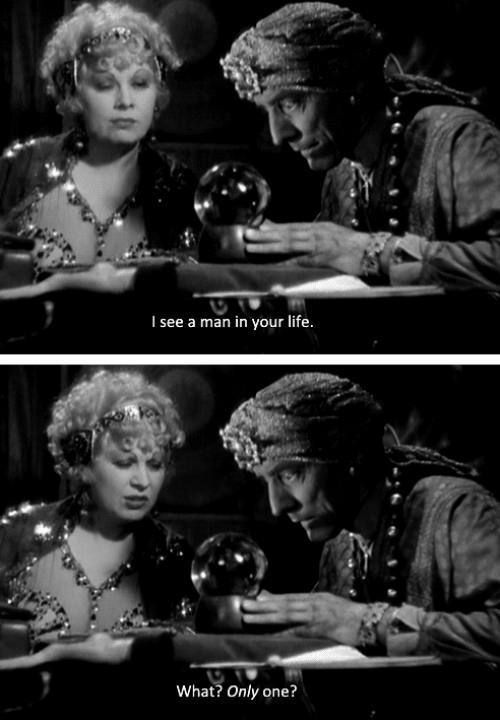
Mae West said it best. Picture by Sophie Charlotte on Pinterest

There are many dimensions to divination, some of which are indeed very deep. However, as far as our relationship with querents is concerned, we are simply an added means of intelligence-gathering, which, like all tools at our disposal, may fail for a variety of reasons, not the least of which is the diviner’s limited knowledge (our knowledge is always limited).

“But I came here to have undebiable, clearcut answers,” one might argue. To which I anwer: Tough titties! If you want undeniable clearcut answers shake a magic eightball. Divination is, quite literally, a divine language, and is not always so cleacut, either in itself or due to our limitations, or sometimes simply because the situation isn’t clearcut in itself. This is especially the case for issues involving human emotions.

As a rule, honesty is the best policy. I believe in voicing my procress to the querent, and the querent has a right to as clear an answer as I am capable of giving them, but we should never feel pressured to give them more certainty than we can truly see in the oracle.

It is perfectly acceptable to talk to the querent about our doubts or about the possible interpretations we are seeing in the oracle. For instance, it is ok to say “it seems like x, but y is also a possibility, while z seems less likely and w is out of the question.” It is also acceptable to say “these cards seem to point to such and such being the case, but I’m uncertain, as this other interpretation might also be right”. More often than not, the querent will say that both interpretations apply, and when this is not the case they can help us disambiguate the oracle.

Ultimately, the fact that divination has no legitimate place in our society implies as a consequence that, because our society believes itself to be held together by reasonable rules and processes, then divination must be either complete poppycock for delusional idiots or it must be capable of unreasonable fits of prowess in other to justify its existence in spite of its current ostracism.

This in turn creates expectations and hang-ups on both ends of the divination process that need to be analyzed and clarified to avoid them subconsciously ruling our practice. Doing so can make divination much more valuable and much more enjoyable.

MQS

On Sacrifice

Western occultism has an idiosyncratic relationship with the notion of sacrifice. On one hand we come from the Abrahamitic tradition, and especially the Christian one, where sacrifice plays a central doctrinal role (God sacrifices himself) and where the concept of sacrifice has often been used as a club against dissent or to elicit guilt and compliance.

On the other hand, the occult revival of the XIX century, especially but not only in its Crowleian branch, was incapable of integrating this concept in a positive way, largely as a form of juvenile reaction against the previous tradition. If the universe is pure and blind bliss there can be little place for sacrifice except in the most illusory sense. As long as occultism remains largely the occupation of misfits and oddballs, it must retain this juvenile attitude toward sacrifice (which largely explains the philosophical paucity of so much of the occult world).

But sacrifice comes from the Latin ‘sacer facere’, ‘to render sacred’. As such, there can be no spiritual path without sacrifice. Even the most atheistic and chaotic paths must render something sacred, whether it’s themselves and their ego or some abstract philosophical concept. Once something is made sacred, the rest is sacrificed to it as a means to an end, and thus also rendered sacred as a consequence.

In magic (and in religion as well), power can come from two sources: from formulas that have been solidified into a metaphysical building over the years (or centuries) or from contact with a direct source. In reality even the former path, if it is functional, must have had some direct contact at least at the beginning.

Therefore, much of one’s magical training consists in bridging the gap that exists between oneself and the source, that is, between micro- and macrocosm, between individual and universal. The aim is always to be able to embody the universal within oneself. To do so, we must necessarily sacrifice our singular nature, that is, we must empty ourselves of the decades of junk that have been filling our individual vessel since we were born, so that a higher power may come down and occupy it: after all, a pitcher must be emptied of muk before it can be filled with water.

This process necessarily implies sacrifice. As we grow up, we accumulate big and small vices, big and small dysfunctions and illusions, and anyone who has lived long enough and has developed enough self-reflection can probably recognize at least some of them as they keep reemerging.

All this needs to be purged from the system. In other words, it needs to be sacrificed, to be rendered sacred. One of my teachers’ mantras was “Offer it to the Divine“. It took me some years to understand what she meant. Whenever some of my vices, some of my illusions, pains, dysfunctions presented themselves, it was easy to simply abandon myself to them, to live them out in the solitary confinement of my individuality as a sort of chosen doom.

But “Offer it to the Divine” was the key to leaving that solitary confinement, of bridging the gap between the small world and the large world. It went beyond despair and guilt and all the typical associations of the word ‘sacrifice’. It required no judgement. It only required for me to stand back, allowing the sun to shine on that lower part of me.

This, I later learned, is the inner equivalent of what happens during rituals, when we sacrifice something to whatever power we are working with. It is part of what allows that apple offered to that spirit to be more than just a tip of the hat to a recipe found in a dusty grimoire.

MQS

Do Occultists *Need* Meditation?

A reader contacted me and we started chatting a little on magical training. One of his observations, which I found quite interesting, is that most schools require learning meditation as one of the first steps in occult development, and he was wondering if meditation is really necessary to occult development.

The first thing we need to clarify is what kind of meditation we are talking about. The influence of Blavatsky’s orientalist flavor of Theosophy has made it so that, when we say “meditation”, we tend to mean Eastern techniques. In reality, most cultures developed some form or other of meditation.

Western Platonism, for instance, developed its own form following Plotinus’ doctrine (already implicit in Plato) of “remove everything!” (aphele panta), whereby one strips naked of every specific determination of mind and soul, until he reaches a state of peaceful union with the divine.

This doctrine has been developed by some Christian mystics, especially of the German school, and is still very much present in all the iterations of Neoplatonism that have occurred throughout history (for instance in the Renaissance period). I am currently translating Robert Fludd’s treatise on geomancy, and his advice on how to prepare for divination essentially boils down to Plotinus’ aphele panta doctrine.

This is not just “high magic” stuff (I don’t believe in a high/low magic dichotomy). Even in folk magic, such as certain strands of Italian witchcraft, discursive forms of meditations are used (reciting the rosary, for instance, or using certain mantras). Let us also not forget that all religions have their own forms of meditation.

So why does most occult training start with meditation? In itself, meditation does nothing. It serves no necessary purpose outside of itself, in the sense that it is a sovereign technique. One can simply practice it for its own sake, as a form of spiritual dignification.

However, magic is largely about becoming fit vessels for a power higher than our own. Aside from its intrinsic benefits, meditation, in its various forms and with its various possible aims, is one of the techniques that shape our personal vessel to become more fit receivers.

Many times, within a ritual setting, meditation is practiced as a preparatory step, especially to visionary magic (but really, most magic is at least in part visionary). It is a way of starting the operation with a blank slate and to create an interruption between our daily preoccupations and the ritual.

Finally, meditation famously trains the “monkey mind”. Since our mind is one of our most important tools, we don’t want it running around, slinging crap at passers-by and hurting itself by sticking a finger in a wall socket.

Occult training is a balancing act, and while it is not true that anything goes, there is space for adaptation (if there weren’t, there would be only one occult path in the whole world, which is patently not the case). Meditation is NOT necessary, just like prayer, offerings, divination and many other things. But it is a tried and true set of tools for the journey.

MQS

On The Stupidity of TikTok Witches

I am an ecumenical troll: I will pour salt wherever I can regardless of political, religious, ethnic and gender affiliation, IF what I see is a sheer display of stupidity. This is one of those cases.

As most people will know by now, a certain oddly-colored politician has been reelected into office. Amongst the predictable TikTok meltdowns that were caused by the event, one peculiar trend caught my eye: that of witches sending him curses, either to make him croak or, and I quote, “having him willingly resign from the office so that Harris can take his place.”

Let us pretend for a second that this is how politics works (if it did, most politicians would dread winning an election more than losing it). What never ceases to amaze me is the complete detachment from reality that informs the witchcore scene.

Magic used to be the logical next step on the path to wisdom after mastering the worldly sciences. Now it’s a hobby for people with funny hair who need to unlearn anything resembling critical thinking in order to be able to tell themselves in front of a mirror that they are “witches”.

In large part this is due to the process of specialization and separation of knowledge that occurred after the scientific revolution, which virtually left no space for magic in the curriculum of the wise. This has led to two opposite tendencies developing: the “science confirms our eternal truths” tendency and the irrationalist tendency.

The “science confirms our eternal truths” strategy is typical of many XIX and XX century occultists. It makes no sense. Science is an open and ever-evolving body of theoretical and practical understanding which would survive even if it threw its most well-established theories overboard. If “scientific theory X is actually a reformulation of our eternal occult wisdom”, what does it say about that wisdom when, in 500 years, that theory is disproven and science moves on to the next one?

The scientific path is generally characterized by a flattening of magic onto (pseudo)scientific rationality. The irrationalist path, on the other hand, is characterized by the abandonment of all logic and understanding. It is typical of most milquetoast magical practitioners nowadays. This is the path that leads people to say with a straight face that you can manifest the result of an election and you can substitute sage with a piece of paper with “sage” written on it.1

This kind of irrationalist magic is the variety practiced by the TikTok witches sending curses to Trump. Rest assured that curses do exist. They mostly require some kind of contact with the victim, and even then almost no one can pull them off.

Even from the point of view of sending influences at a distance, Trump is as loved by those who voted for him as he is hated by those who didn’t: from a purely numerical standpoint, these influences cancel each other out, with something left over in his favor.

Finally, whether one likes it or not, the movement he leads has its own well-established etheric egregoric presence, which was created not just internally by those who support him, but also just as much externally by those who loathe him. A simple study of the life of Donald Trump, and even of the last months, shows that it would be very hard–not impossible, but hard–to hurt him, either physically or esoterically. Do you seriously think you lighting a candle and regurgitating formulas from a grimoir you bought on Etsy is going to change the course of humanity?

MQS

  1. Substitutions CAN be operated in magic, but they are an art in an of itself, and require understanding ↩︎