Tag Archives: Numerology

Vera Sibilla and Numerology – The Threes

The threes in the Vera Sibilla are all connected with the concept of movement. Card Reader and Youtuber Etienne Valancourt, who inspired me to study numerological hints in the Vera Sibilla, noted in one of his videos that threes seem to refer to spacial or metaphorcial movement. If the Ace was the single dot and the Two was the extension of the dot into a line, the Three brings in the idea of moving up and down, left and right, since movement implies at least two directions (where you start from and where you finish) that are connected by the movement itself.

The Threes in the Vera Sibilla Oracle: The Three of Hearts (Balcony), The Three of Clubs (Journey), The Three of Diamonds (Gift of Precious Stones), The Three of Spades (Widower)

The Three of Hearts, The Balcony, and the Three of Spades, The Widower, show, as usual, two opposite interpretations of the concept. The Three of Hearts, as the illustration points at, is a card of arrival. The lady is waiting for something or someone that are on their way to her (or, at least, that are supposed to). It’s a positive card, although, like all red cards, relatively easily influenced by the black cards around it.

The Balcony is also connected with sight, the eyes and looking (either literally or figuratively), which are a natural extension of its primary meaning: when something is coming our way, it becomes easier to spot than if it is parting from us. In general, the arrival, i.e. the notion of “getting closer”, may be interpreted as a general remark that new developments are on the way, that the issue under consideration has not reached its conclusion yet, and that the matter is not yet settled. For all its connection to the concept of “getting closer”, this card is also associated with great distances, especially when with cards that reinforce this meaning.

The Three of Hearts is a generally favorable card. The Three of Spades, on the other hand, is extremely negative. In the Widower we find the idea of separation, of getting away. When it’s not a character card depicting an older man, the Widower is always connected with feeling unwell, not necessarily in a health-related sense. He’s not the type of guy you’d want over for a cup of tea, he’s really gonna bring the mood down.

The main ideas connected with it are those of abandonment, loss (things getting away from us), bereavement, deprivation, and something being generally taken from us. If the Balcony points to new things and people coming our way, the Widower is a card of loneliness and isolation, of no news and no people arriving (it can function as a kind of “minus” sign, showing us what we don’t have). This card is pervaded by a general sense of finality, of matters being ready for burial. How fun, right?

In between, we have the Three of Clubs, The Journey, and the Three of Diamonds, The Gift of Precious Stones. The Journey card speaks for itself: it represents journey and movement in general. It can, however, also show change in general. This card is connected with things not remaining the same, of things going through some kind of change. This can be positive or negative, external or internal (e.g. changing point of view). It’s not a difficult card, aside from the fact that it’s one of those in the Vera Sibilla where directional cues need to be taken into account.

The Three of Diamonds is, in most editions of the Sibilla, assigned to the Gift card, but some newer and easily accessible editions have popularized its connection with the card of the Handmaid, The Eight of Diamonds. While I chose to stick with the traditional numerology, I am going to discuss this issue in a separate blog article to show how both attributions make sense. After all, the Gift and the Handmaid have some astounding similarities in their meanings.

In general, The Gift is a card of gifts (duh!) and proposals, of situations moving in our direction to allow us to jump on board. It represents the movement of objects, i.e. packages being sent or received, and, as an extended meaning, this is the card of objects in general, i.e. moveable goods. Another important connection of this card is with opulence and wealth, and therefore with upward mobility and a higher social status. The Handmaid card can also be appropriate as Three, considering that it, too, represents evolution, things that are given to us and a higher position in society. It also has other traits, however, that make her a good Eight as well.

Vera Sibilla and Numerology – The Sevens

The sevens in the Vera Sibilla are mainly connected with the ideas of intentions, mindset, projects and planning. They speak, in other words, of our ability to conjure up visions of reality and of ourselves that may then be planted into the outside world and grown. While the sixes spoke of the passage of time and the flow of events, the sevens represent our ability to see an alternative that may be tapped into to alter that flow. Differently put, they show us how the Self reacts to that flow.

The Sevens in the Vera Sibilla Oracle – The Seven of Hearts (Scholar or Artist), The Seven of Clubs (Gratification), The Seven of Diamonds (Child) and The Seven of Spades (Disaster)

As it should by now be clear, Hearts and Spades are direct opposites of one another. The Seven of Hearts, the Scholar or Artist, represents the power of reason. Notice the difference between the Seven of Hearts and the Six of Diamonds, the Thought card. The latter is about our inner reality, which may or may not be reasonable. A passing look at the amount of psychic crap that comes pouring out whenever we hit a shrink’s couch shows us that the Thought card, i.e. what goes on on the inside, may bear little to no resemblance to reality in its absolute, objective sense.

The Six of Diamonds may show projects, but only in so far as they are inside and not yet outside. The Seven of Hearts, on the other hand, represents the ability to plan. It represents rationality, brain power, the ability to measure and count (when reversed, the idea of measuring and counting becomes the negative notion of ulterior motives, of doing something because you are calculating individual).

It is also the card connected with the skill of coherently putting together a vision of reality that may be used to then mold reality itself. Hence its connection with creativity and art, which are not the opposite of reason, but its extension into the world. As unfashionable as thinking straight is among us new-agey folks, this card is very important. The most important practical meaning of the Scholar, i.e. contracts, comes from the fact that the juridical side of life is founded on the concept of “meeting of minds”, which is what generates contracts: it’s when my mind meets yours midways to create a stable, reasonable intersubjective agreement.

Let’s turn to the Seven of Spades, Disaster, which is notoriously similar to the Tower card in the tarot. This card is, in more than one sense, the direct opposite of the Scholar. In its most general sense, this is the card of immeasurability. It shows all those things that, no matter how “scholarly” we might be, hit us from the outside, without forewarning and without any discernible cause that we might prepare for in advance. It shows shit happening because shit just happens, and that’s kind of it.

As an extended, neutral meaning, this card also represents things happening all of a sudden, and usually very quickly, though not necessarily in a bad sense. A third important meaning of this card is that of negative projects. While the Scholar is the good architect of reality, the Disaster card can show ill-will, the desire to hurt or harm another. It is connected with anger and choler, all forces that blur the line between what’s reasonable and what isn’t.

In between we have the Seven of Clubs, Gratification, and the Seven of Diamonds, the Child. These, too, are starkly different cards in many ways, although with a common tread. The Seven of Diamonds is the card of all things new and novel. It represents new projects, new plans, new things in general coming into our lives. More subtly, this is also the card of new visions, of opening up to new points of view, new stimuli, new perspectives and new ways of understanding ourselves and others.

Its archetype extends to cover ideas such as purity of soul, candor, innocence, but also naivety. The Suit of Diamonds is the suit of seeds, of all those little impulses, positive or negative, that are planted into our lives. Among the other Diamonds cards, the Child is the one that most of all represents a seed: small, ready to grow and full of promise and potential.

The Seven of Clubs, Gratification, is anything except small. It is deeply connected with our sense of self, with what makes us secure in our identity and what supports our narrative of who we are and of how who we are finds its deepest fulfillment in real life. If the Child is the seed, Gratification is the tree ripe with succulent, plump fruits.

This is not a “theoretical” card, but a very material one. In the most general sense, it is connected with our sense of stability in the world: it may have to do with fame, recognition, our good or bad name (depending on the cards around and on whether this one is upright or reversed). Furthermore, the Seven of Clubs has strong ties with the concept of concreteness and concretization: it shows the next logical step in making a situation more stable, concrete and fulfilling, whether it’s marriage (the ring in the picture) a promotion at work (the bag of money) or a positive reception by our fellow humans (the wreath).

As Alessandra Venturi says in her book, this card can be the light at the end of the tunnel, in that after a slew of negative cards it can allow us to regain a sense of balance and a more positive outlook. Whatever the field, this card doesn’t speak of emotions, but it does speak of personal fulfillment in the situation.

Vera Sibilla and Numerology – The Fours

The fours of the vera sibilla. Like and subscribe to support my work

The four Fours in the Vera Sibilla appear to be connected with the notions of environment, context or situation. The famous squareness that almost every system of cartomancy ascribes to the number four is still present, but rather than talking about stability or lack of change, it is focused on describing of the type of 3D world that exists around the querent, depending on the suit. The Ace was like a spark, the Two extended it into a line, the Three provided movement, now we have a full-blown situation.

The four Fours in the Vera Sibilla: The Four of Hearts (Love), The Four of Clubs (Friend), The Four of Diamonds (Falsehood) and the Four of Spades (Sickness)

The Four of Hearts, Love, is perhaps the most famous card in the deck. Every traditional source describes it as a card that represents a live, blind force shaping the situation. This idea movement, aliveness and blindness are a consequence of the irrational nature of love, which is impossible to put in chains or define in a limiting way. I like what I like, I am attracted to what I am attracted to. Period.

Hence, the idea here is one of a context that the querent likes: it may be a house, a partner, a job, whatever. With this card, we are in a context we like. The Love card represents a situation that is alive, that has enough of that vital impetus to keep it going, and the vital impetus is, of course, attraction. The whole of the universe is love, and all that good shit.

Conversely, the Four of Spades, the Sickness card, shows a situation or context that is not hot, but cold, not lively and moving, but rotting, ill and decaying, not free, but stuck, not beneficial but noxious. This card represents sickness and illness in the most general sense, whether it’s an ill body, an ill career, a sick way of living a relationship, etc. Whereas the Four of Hearts is the card of a situation that we love, that we are compatible with, the Four of Spades is a card of wrong paths, situations that developed in the wrong way or that have grown stagnant.

In between, the Four of Clubs, the Friend, is a card of positive, helpful contexts. It may represent partnerships and co-operation, pacts etc., but in general it represents a supportive context or people who support the querent. Some of the undertones of this card are similar to those of the Nine of Hearts, Faithfulness, in that in both cases we have someone (or a general situation) that is loyal, caring and helpful, and will do what’s best for the querent.

Jobs and career in the field of service are often represented by the Friend, as well as all supportive roles (e.g. nurses). All this being said, this card sometimes represents a person, in which case it’s going to be neutral.

The Four of Diamonds, Falsehood or the Cat, is one of the most iconic in the deck. In the most general sense, it is the opposite of the Nine of Hearts and, in a way, of the Four of Clubs. While the Friend represents a positive, supportive context, the Four of Diamonds represents negative contexts in general. Under this card fall all those situations and contexts that are wrong, false or bad for the querent.

While the Dog card shows things being as they seem and seeming as they are, Falsehood is about reality being hidden behind a layer of something else which may be anything, but is not real. In this sense, it also covers illusion and self-deception, in addition to cheating and lies. Interestingly, this is also the card of bad weather, likely because bad weather is a passing illusion covering the eternal blue of the sky.

Vera Sibilla and Numerology – The Fives

A quick discussion of the fives of the vera sibilla. Like and subscribe to support my work

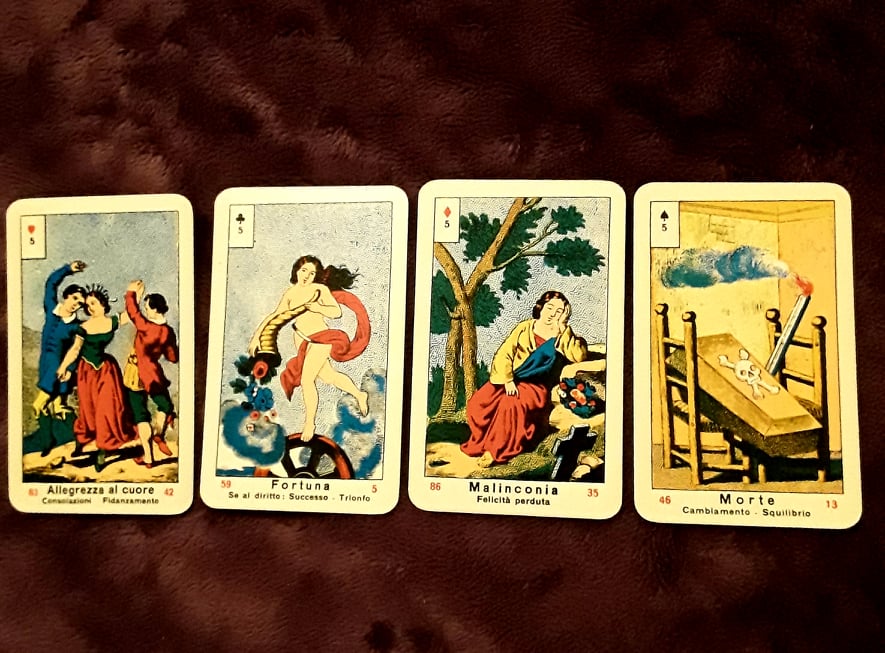
When we hit number Five we discover that here we have one of the most positive cards in the deck, Fortune, and one of the worst, Death. The keyword here is transition, or change, i.e. the end of something and the beginning of something else.

The Fives in the Vera Sibilla: The Five of Hearts (Happiness in the Heart), The Five of Clubs (Fortune), The Five of Diamonds (Melancholy) and the Five of Spades (Death)

The Five of Hearts, Happiness in the Heart, is the card of engagement, which is the transition between being single and being married. In the context of career, this usually means a temporary job or a trial period. More in general, however, this is the card of the “step toward stability”. It shows events put in motion toward a quick and promising resolution. Once this card is activated, unless other negative cards follow, it leads you rather effortlessly to your mark. It is also the card of relatives, which form a sphere of transition between your close family members, i.e. your most private sphere, and an outside world full of unknown people.

At the opposite end of the spectrum, the Five of Spades, Death, obviously shows a different kind of transition. While the Five of Hearts evokes the jollity and mirth of a family gathering, the Death card marches to a much gloomier rhythm. The former shows the quick, flowing motion of the dance of life, the latter shows the same motion coming to an end as its vital force dries up. This is the card of endings. Yes, when something ends, something else begins, but this isn’t saying much: when I die, I stop existing as a live person and begin to exist as a corpse, but that’s hardly reassuring!

In most scenarios, we want this card out of our spreads, unless it’s about inheritance, retiring (i.e. “killing” your career) or conjuring low spiritual energies. However, this card also has an important function when it divides the spread into two halves. In that case, it means that there is going to be a definite and irrevocable transition from one phase of life to the next. Whether this transition is going to be good or bad will be shown by the cards following it.

Between the two polar opposites we have the Five of Clubs, Fortune, and the Five of Diamonds, Melancholy. Fortune is one of the best cards in the deck, though not as good as the Two of Clubs. It marries the keyword associated to the number 5 to the lucky connotations of the suit of Clubs. Hence the classical meaning associated to this card of undeserved success.

Undeserved doesn’t mean that you are nasty and your success is proof that there is no just God holding the world together. It means that, whatever your personal merit might be, the Universe has decided to supplement it with a stroke of luck. You may need to hold your hand out, but it’s not your merit that pennies are raining down from heaven today.

Finally, we need to deal with the most mixed of the Suits in the Vera Sibilla, that of Diamonds. The compromise, here, seems to be that of passing (transitory) disappointment. While it is definitely not a good card, by itself the Five of Diamonds is not catastrophic, and it shows a sense of sadness or dissatisfaction that will eventually end.

By analogy, it represents all those situations that have left us wounded: we have survived them, the wound will heal, but for now it’s there and it itches. While the Five of Hearts is the “step toward stability”, if followed by mixed to negative cards, Melancholy can be the “step toward instability”.

Vera Sibilla and Numerology – The Nines

In the Vera Sibilla, the common thread that connect the nines is, perhaps, a little more obvious than the one shown in other numbers. Each of them represents how the energy of the suit interacts with the concepts of bond, ties and linkage. As usual, the Nine of Hearts and the Nine of Spades represent the polar opposites between which the other two cards, the Nines of Clubs and Diamonds, fluctuate.

The Nines in the Vera Sibilla: The Nine of Hearts (Faithfulness or the Dog), The Nine of Clubs (Cheerfulness), The Nine of Diamonds (The Fools) and the Nine of Spades (Prison)

The Faithfulness card or Dog is, at first, very similar to the Four of Hearts, Love. There is, however, an added dimension. Whereas Love is shown as an ungraspable, blind force, Faithfulness places restrictions on people’s behavior. If you are loyal to a person, even to an ideal, you will not betray it. Just as a loyal dog will follow you around even without a leash, simply out of a sense of affection and belonging to your “pack”, so the type of love depicted in the Nine of Hearts is a more disciplined version of the impetuous passion represented by the blindfolded cupid in the other card.

The symbolism of the loyal dog lends itself to the representation of various situations and states of being, including love, deep friendship or a sense of camaraderie, patriotism (when reversed, this card may show an anarchist), commitment to an ideal or group. In general, this card symbolizes the immediate coincidence between appearance and reality: what is shown is what is real. This is the opposite of the Four of Diamonds, Falsehood, represented by the Cat, which represents the divergence between appearance and reality. Be it as it may, Faithfulness interprets the idea of bond in a more positive way.

Its counterpart, the Prison, shows a very different kind of tie. Gone is the idea that we are where we are because an inner sense of belonging guides us: a physical chain now binds us to a certain place or situation. The Nine of Spades represents all those contexts that we are forced into against our will, or that we are prevented from leaving regardless of what we might think about them.

Depending on the context, more benign interpretations may emerge, but, in general, the Prison shows a state of affairs that we are unable to move away from even if we really want to. One of the classical meanings of this card, pregnancy, is derived from the fact that the chain tying the prisoner to the wall is reminiscent of an umbilical cord keeping the fetus securely tied to the mother’s womb. Needless to say, the baby doesn’t remain there because it roots for mommy (Faithfulness) but because it kind of has to (Prison).

The other two Nines take an interesting angle. They interpret the notion of bond socially. The Nine of Clubs, Cheerfulness, depicts a group of friends raising their glasses. Whatever happened, it is cause enough for everyone to get a little tipsy, which means that they all share at least some objectives. That being said, the bond that ties the three guys together is much lighter than the one of utter devotion displayed by the dog in the Nine of Hearts. This is a way more frivolous card, one that shows groups of people in a positive way, but not necessarily life-long companions.

The Nine of Diamonds, the Fools, similarly depicts three people, who have similarly been at the sherry. The suit of Diamonds, however, is less fortunate than that of Clubs, and in this case the darker side of mob mentality is depicted. Running with the wrong crowd is certainly one interpretation. Additionally, the Fools show unbalanced group behavior, or interpersonal problems.

By analogy, this is the card of unwarranted exaltation, foolishness, fights, arguments and of everything that is irregular, i.e. that defies the rules of what is “normal”, always in a negative sense. This goes from incoherent clauses in contracts to meaningless words to mental illness to natural disasters and cataclysms (which, in a sense, defy the laws of nature or disrupt the usual flow of life).

As a concluding remark, curiously, the Nine of Diamonds has a connection with excess and substance abuse (especially alcohol or meds), which is a very important meaning of the Nine of Clubs when it comes up reversed in a reading. When the situation is bad enough, i.e. when the bond with the substance seems unbreakable, the Nine of Spades will show up to add a sense of inability, on the part of the querent, to get out of the addiction.

Vera Sibilla and Numerology – The Tens

The Tens in the Vera Sibilla have a lot to do with the concept of materiality, matter and physicality. Each of them shows how the suit relates to the notion of an external reality that needs to somehow be conquered, or that the Self and the Will needs to enter into contact with. As the final number in the sequence, it shows how the suit materializes.

The Tens in the Vera Sibilla deck: The Ten of Hearts (Perseverance), The Ten of Clubs (Levity), The Ten of Diamonds (The Thief) and the Ten of Spades (The Soldier)

The Ten of Hearts, Perseverance, is known for its general meaning of success after toil and, well, perseverance. This is a result of the combination of the positive meaning of the suit of Hearts with the rather challenging notion of materiality.

It represents the hard, unyielding surface of external things bending to our patient effort, being incorporated into our picture of how things should be and therefore being beaten into shape. Note how the image on the card shows the young lady confidently resting on a column at the break of dawn, having withstood the long night. She may be living in a material world, but, just like Judge Judy, they definitely don’t keep her there because she’s gorgeous. She means business!

At the same time, the other important meaning of the card, i.e. a long duration, is derived from the fact that once matter has been beaten into a particular shape, it has a tendency to retain it until a strong counter-impulse is given.

Finally, the third important meaning of the Ten of Hearts, i.e. the querent’s city (but, in general, it can also represent the homeland) is derived from the fact that the realm of Hearts is concerned with what is closest to us, and which therefore we are intimately connected with. The physical, material space we are connected with is our city or homeland, because it is immediately around us. Incidentally, Perseverance is also connected with the patrimony, the drowry and accumulated wealth, again, showing the positive side of materiality.

At the opposite end of the spectrum, the Ten of Spades, the Soldier, shows materiality overwhelming the Self and the Will, engulfing it into its morass of inert darkness. That is why, at its best, the Ten of Spades represents the physical body’s ability to fight or to react, but no victory is automatically shown. Alternatively, this is another card that can show violence, arguments etc., i.e. negative physical contact.

It is also why this card represents impervious places, like mountains and deserts and, in a metaphorical sense, all uphill battles. It’s the card of darkness and the night (and, as an extension, of secrets), which is an obvious contrast with the sense of liberation coming to us as we see the Sun peeking from under the horizon in the Ten of Hearts.

Finally, it’s why this is one of the cards connected with strangers and strange cities and countries -though, usually, not by itself. If, in the Ten of Hearts, we were dealing with familiar physical spaces we are intimately connected with, with the Soldier we are faced with people, situations and places that remain outside of our sphere of familiarity, and that therefore remain outside of our control and sense of security.

With the Ten of Clubs, Levity, and the Ten of Diamonds, The Thief, we are shown gradations on the spectrum. The Butterfly is a simbol of everything that is light, impalpable and indefinite, as shown by its association with the element of Air. It represents a strong departure from the commited consistency of the Ten of Hearts. In the Ten of Clubs we have the self gliding from flower to flower, aimlessly wandering and always avoiding leaving a permanent mark in any direction.

The compromise is that we don’t get much in terms of results, but we are not crushed by the weight of matter either. All the main meanings of the Levity card are derived from this, including the idea of lack of focus, of carelessness and of “just a little”. Note that, in readings where physical death is shown, the Ten of Clubs might appear to show the soul leaving the body and flying away, i.e. relinquishing its ties to the material world.

With the Thief card things start to get ugly. Here we have the Self and the Will very much focused on doing something with the physical world. Unfortunately, it’s not anything that will win them a Nobel prize for peace. The Suit of Diamonds has a lot to do with material values, so the idea, here, is that the Self is hell-bent on appropriating physical things, and it has no moral compass to tell him where a line should be drawn. 

Note that, for their connection with the concept of matter and physical space, the four Tens are also representative of the four directions: the Ten of Hearts is assigned to the South, the Ten of Clubs to the North, the Ten of Diamonds to the West and the Ten of Spades to the East.

Vera Sibilla and Numerology – The Twos

The Twos in the Vera Sibilla. Like and subscribe to my YT channel to support my work

We’ve seen how the Aces in the Vera Sibilla already contain the idea of duality, albeit only in principle. The Twos, on the other hand, take the impulse that comes from the Ace and elaborate on it. They start from the point, as it were, and draw a line by extending that point. The Twos are connected with ideas of extension, consolidation, strengthening and elaboration.

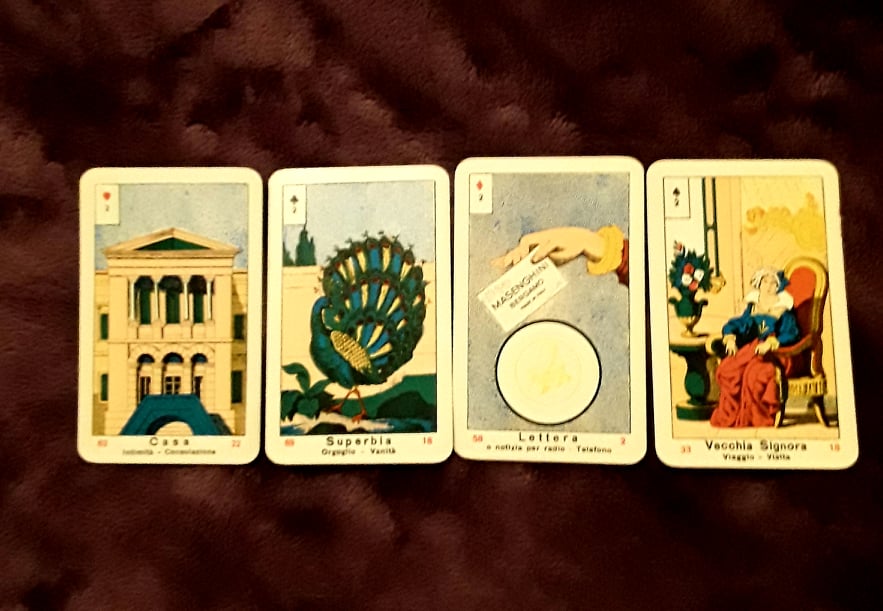
The Twos in the Vera Sibilla deck: The House, Haughtiness or the Peacock, The Letter and The Old Lady

As usual, the suits of Hearts and Spades represent opposite polarities. The Two of Hearts, the House, is a card of solidity. Aside from representing the querent’s house or any type of building, it shows the consolidation of a love situation. It can signify an established couple (not necessarily living together), and the cards nearby are going to tell us how strong their relationship is and what affects it.

In general, it represents the consolidation, usually in a positive sense, of a situation. In other words, it shows a situation that is built on good foundations. As an analogy, it shows the foundations or roots of a problem: the cards around it will tell us why something is the way it is, its origin.

On the opposite end of the spectrum, the Two of Spades, the Old Lady, is the card that represents losing strength. It shows a process of decline. This card encompasses all those situations that are approaching their natural end, just as the old crone is now too weak to be standing up all day and would rather have you come visit her while she’s comfortably sitting in her chair (indeed, this card can also represent a visit or very short journey, as connected with the idea of little mobility).

Because the suit of Spades is a generally negative one, the idea of strengthening is reversed into one of weakening, and that of elaboration becomes the not on of reaching a final conclusion. It can be any conclusion: from the natural end of the year to the natural end of a contract or job, etc. In a love reading, aside from being the ex (your old woman) it can represent a relationship that has lost impetus.

Between Hearts and Spades we have Clubs and Diamonds. The Two of Clubs, Haughtiness or the Peacock, is famously the traditional lucky charm or “amulet” card. It’s the best in the whole deck (much better than the Five of Clubs, Fortune). Through the image of the peacock’s feathers arranged in a complete “wheel”, the card suggests the idea of completion, of liberation from all limitations and bonds, of amplification of all that’s good and diminishing of all that’s bad.

We might also connect the traditional meaning of beauty that this card has with its other meaning of completion, as traditionally beauty was seen as an attribute of wholeness and proportion between parts of a whole. The Two of Clubs is also the main esoteric card of the deck. If you are a hexer, you want to keep an eye on this eye-catcher. In general, it represents (when upright and with other appropriate cards) things that are completed or elaborated through a work of magic. When it’s reversed, it becomes black magic.

Finally, let’s talk about the Two of Diamonds, the Letter. It’s a very simple card, showing the receiving of correspondence. But what are communication and correspondence if not an extension or consolidation of our connection with the world and the inputs that come to us from it, which is the main theme of the suit of Diamonds? In other words, the Letter shows that the matter under consideration will be added on by the arrival of news, telephone calls, explanations, documents, etc.

An important secondary meaning of the Letter connects it with writing, books and the elaboration of projects. It’s about pouring your brains on a piece of paper, which is why it is an important card to look for when you are going for a written exam: you’ll need to elaborate on your ideas in a written form.

Numerology and the Vera Sibilla – Introduction

Traditional oracle cards (Vera Sibilla, Kipperkarten, Gypsy cards, etc.) are sometimes thought to be somewhat shallow and pedestrian when compared to Tarot. Take the Vera Sibilla: here you have images like the Butterfly, the House, the Letter, the Room, the Soldier, etc. You even have someone about to blow their brains out in the Jealousy card. It all sounds like Soap Opera material. Compare it with the High Priestess, the Hanged Man, the Devil, all figures which seem to warrant a greater degree of symbolic interpretation in order to yield some tangible answer.

That seems to be why we often do not look for deeper layers of meaning in our oracle cards. It’s easy to disregard them (or to treasure them, depending on where you’re coming from) as the scullery maid that does Tarot’s dirty job while her master is locked in his tastefully decorated room, listening to Händel and thinking up philosophical abstractions.

I am certainly guilty of this sin. I have been studying the Vera Sibilla for some time now, and I had never even considered the possibility of there being some numerological factor at play. This, in spite of the fact that the Sibilla is a rare instance of a traditional oracle with four complete suits, Ace through Ten plus Jack, Queen and King.

The Suit of Hearts in the Vera Sibilla, Ace through King. Say “hi” to your strong lesbian aunt Martha there in the Ten of Hearts.

One of the reasons I tended to disregard numerology is that the way the Sibilla is taught is through its traditional meanings, upright and reversed, and then its combinations. Look at one of the very few valid books about the Sibilla out there, Alessandra Venturi’s Italian Cartomancy.

In her book, she devotes two to four pages to each card, but without any structure. All the meanings she relays are traditional, but they are thrown at the reader without any hint as to how to use them or how to prioritize them. She mentions numerology very briefly as a reason to prefer the attribution of the Handmaid card to the Eight of Diamonds, but she doesn’t explain why, and the subject of numerology is dropped altogether for all other cards.

I only started thinking about possible numerological structures when one of my favorite youtubers, the Italian card reader Etienne Valancourt, suggested in a couple of his videos that some cards with the same number do have some similarities. He makes the example of the Threes and the Fives, but he also suggests that other numbers do not seem to show any similarities among them. By the way, if you understand Italian I absolutely recommend his video course on the Vera Sibilla. I am personally waiting for his book like the second coming of Christ.

In this series of blog articles, I am going to (respectfully) challenge Etienne’s idea, and I am going to show how the core traditional meanings of all numerical cards can be boiled down to a numerological essence. Although I do use reversals, I am going to concentrate on the upright meanings only, for the simple fact the reversed meanings are often a modification of the upright ones, albeit not always.

Another important point I am going to mention is that I am not trying to say that every possible meaning of the cards can be reduced to numbers. The Two of Clubs, the Peacock, for instance, is traditionally the talisman card, the best in the deck. I suggest that the core meanings of this card, which are liberation, completion, help from above, etc. can be seen as a development of the meaning that the number Two seems to have in the Sibilla deck. But it also has other meanings, such as beauty, which seem to be derived from its iconography and archetypal essence more than from its numerical value.

In other words, I am not attempting to reduce everything to numerology, but show that numerology does play a role in this oracle deck. Nor am I suggesting that whoever drew the deck was trying to use a numerological system, but that the traditional set of meanings has, for some cosmic synchronicity, ended up developing according to a certain structure. Yes, it’s a very newagey explanation, and yes, I am ok with it.

Finally, I admit that, although I consider the system I am elaborating to be relatively well thought out, it is not necessarily perfect. I am sure that, as I keep studying this amazing deck, I will come up with more fitting numerological coordinates. I am aware of the fact that while most of my explanations fall perfectly in line with the meanings of the cards, some require a bit of mental gymnastics, which to me suggests that my system is going to have to be improved in the future.

Sure, I could take the easy way out and simply adjust the meanings to the numerology, but that would defeat my purpose of finding an order in this deck rather than beating the poor Sibilla senseless with my own preconceptions until it fits them. My aim is to use the traditional meanings of the cards, not to substitute them. My wish would be to make the Sibilla easier to assimilate and study, easier to remember in its enormous wealth of meanings than it currently is.