Tag Archives: Moon

Tarot Encyclopedia – The Nine of Wands

(Note: this is a collection of the meanings attributed to the cards by some occultists in the past centuries. It does not reflect my own study or opinion of the cards. It is only meant as a quick comparative reference as I develop my own take.)
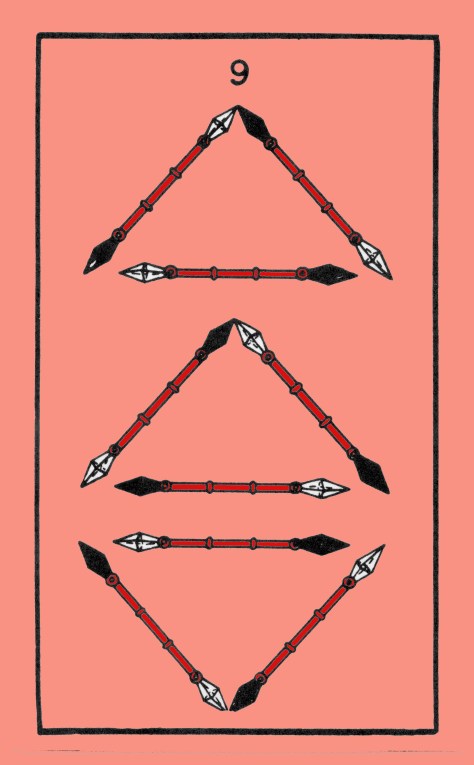
The Nine of Wands from the Builders of the Adytum (BOTA) tarot deck

Paul Foster Case (and Ann Davies)

In Tarot divination this Key combines the forces of the Moon, Mars and Jupiter and the zodiacal influences of Sagittarius and Aries, together with the Ninth house of the Higher Mind.
Well Dignified: well placed in a divination, this Key suggests originality, independence and daring. It has meanings that include strength in reserve; health after illness; success, but attended with some strife.
Ill-Dignified: danger; violence in foreign places or during long journeys; difficulties with relatives of the marriage partner; conflict with persons prominent in religion or law; obstinancy.
Keyword: Preparedness
(From the Oracle of Tarot course)

A. E. Waite

The figure leans upon his staff and has an expectant look, as if awaiting an enemy. Behind are eight other staves–erect, in orderly disposition, like a palisade. Divinatory Meanings: The card signifies strength in opposition. If attacked, the person will meet an onslaught boldly; and his build shews, that he may prove a formidable antagonist. With this main significance there are all its possible adjuncts–delay, suspension, adjournment. Reversed: Obstacles, adversity, calamity.
(From The Pictorial Key to the Tarot)
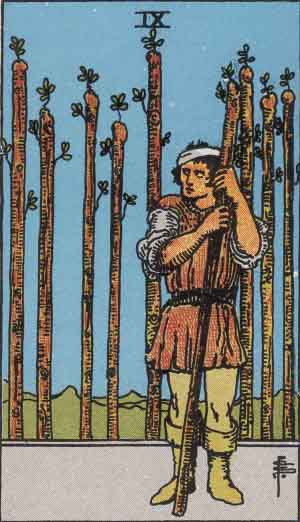
The Nine of Wands from the Rider Waite Smith Tarot

Aleister Crowley

The Nine of Wands is called Strength. It is ruled by the Moon and Yesod. In “The Vision and the Voice”, the eleventh Aethyr gives a classical account of the resolution of this antinomy of Change and Stability. The student should also consult the works of any of the better mathematical physicists.

Of all important doctrines concerning equilibrium, this is the easiest to understand, that change is stability; that stability is guaranteed by change; that if anything should stop changing for the fraction of a split second, it would go to pieces. It is the intense energy of the primal elements of Nature, call them electrons, atoms, anything you will, it makes no difference; change guarantees the order of Nature. This is why, in learning to ride a bicycle, one falls in an extremely awkward and ridiculous manner. Balance is made difficult by not going fast enough. So also, one cannot draw a straight line if one’s hand shakes. This card is a sort of elementary parable to illustrate the meaning of this aphorism: “Change is Stability.”

Here the Moon, the weakest of the planets, is in Sagittarius, the most elusive of the Signs; yet it dares call itself Strength. Defence, to be effective, must be mobile.

[…]

This card is referred to Yesod, the Foundation; this brings the Energy back into balance. The Nine represents always the fullest development of the Force in its relation with the Forces above it. The Nine may be considered as the best that can be obtained from the type involved, regarded from a practical and material standpoint.

This card is also governed by the Moon in Sagittarius; so here is a double influence of the Moon on the Tree of Life. Hence the aphorism “Change is Stability”.

The Wands have now become arrows. There are eight of them in the background, and in front of them one master arrow. This has the Moon for its point, and the Sun for the driving Force above it; for the path of Sagittarius on the Tree of Life joins the Sun and Moon. The flames in the card are tenfold, implying that the Energy is directed downwards.
(From The Book of Thoth)

The Nine of Wands from the Thoth tarot deck

Golden Dawn’s Book T

FOUR hands, as in the previous symbol, holding eight wands crossed four and four; but a fifth hand at the foot of the card holds another wand upright, which traverses the point of junction with the others: flames leap herefrom. Above and below are the symbols Moon and Sagittarius.

Tremendous and steady force that cannot be shaken. Herculean strength, yet sometimes scientifically applied. Great success, but with strife and energy.
Victory, preceded by apprehension and fear. Health good, and recovery not in doubt. Generous, questioning and curious; fond of external appearances: intractable, obstinate.

Yesod of HB:Y (Strength, power, health, recovery from sickness).
Herein rule the Angels HB:YRThAL and HB:ShAHYH.

Etteilla

Delay
Upright. This card, as far as the medicine of the spirit is concerned, means, in its natural position: Delayed, Dilated, Removed, Suspended, Stretched, Slowed, Slowly.
Reversed. Travail, Obstacle, Impediment, Contrariness, Disadvantage, Adversity, Penalty, Accident, Misfortune, Calamity.

MQS
The Road – A Deep Dive into Cartomancy

Following my deep dive into the Door Knockers, which seems to be an exclusive symbol (or almost) of Italian cartomancy, let’s talk about a much more universal presence in many traditions: the Road. Still, even though the symbol is widespread, the interpretations may vary.

I was introduced to the symbol of the road when being taught to read playing cards. In the system I was introduced to, the Two of Clubs is the card of the steps. Actually, the word for it was “cammino”, which means a way, road or path, but it also implies the idea of people taking steps on it. That is, a ‘cammino’ is a road that exists because people walk on it, rather than being a road that has been created so that people may or may not use it. An example would be a path through a forest or a road created by pilgrims as they progress on their pilgrimage.

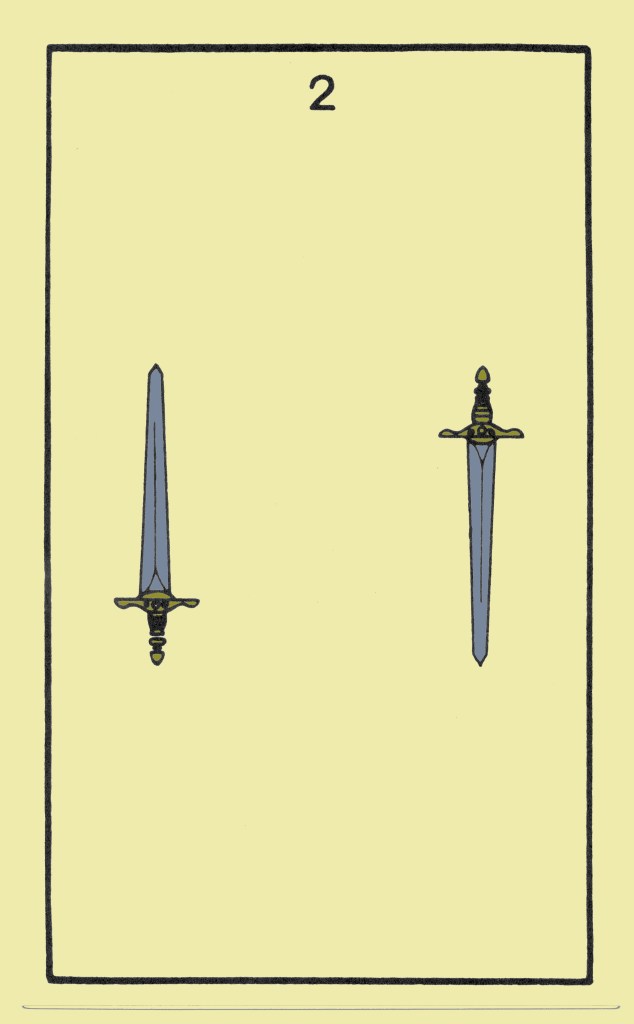
The Two of Clubs therefore implies forward motion toward a goal of some kind, and the taking of steps, whether literal or figurative. In this, it is similar to the Two of Wands in some Piacentine cards systems, which interpret the card as a road, largely due to its design showing two parallel staves, no doubt (although in some other Piacentine systems the road is the Knight of Wands).

The Vera Sibilla doesn’t have a road card per se, although it does have various cards connected with movement, journeying or taking steps/fighting for something. For instance, the Journey card is connected to traveling, while the Soldier may imply fighting to attain a goal (although, being a Spade card, the struggle is more accentuated).

Etteilla famously attributed the meaning of road to the Six of Swords, and his pupils developed a whole vocabulary of synonyms that extend the meaning into other areas. An example of this is the meaning of conduct, which is, figuratively speaking, the path of the person’s actions through life. Etteilla’s attribution of the meaning of road to the Six of Swords remained attached to tarot through the Golden Dawn, who preserved it in part as a possible meaning in their Book T, and then through Waite, who had Smith design the Six of Swords as a card of journey. Even in the Crowley tradition this attribution has in part been rediscovered in Eshlemann’s Liber Theta.

In the Bolognese tarot, the meaning of road is attributed usually to the Six or Eight of Wands. Some strands of the tradition also distinguish between an open road (Six/Eight of Wands) and a closed road (Nine of Wands or Ten of Swords). The road is in itself a card of forward motion, like the Two of Clubs, it can indicate short trips and it is a card of openness.

The road or path is also present in the Lenormand and Kipper traditions. I am unclear on the Lenormand meaning, as the interpretation seems to have evolved considerably through time. Most contemporary English-speaking sources seem to see it as a card of choice (with two paths, although I am unsure if this duality was intended in the original design). Most German sources interpret it differently. Since I am not a Lenormand reader, I will leave it at that.

As for the Kipper cards, they have a card called Ein langer Weg, a long road. In most of the sources I have consulted, the card is more static than in the other traditions, highlighting the element of time (some call it the Two Years card). Interestingly, in many German Skat systems of divination, the suit of Spades / Leaves is connected with movement, and the low-numbered cards, mostly the Seven and Eight, can show a short trip or something happening quickly, while the Ten is also called the long road, and it can indicate an actual journey or the need to wait a long time.

BONUS: The Road is obviously present in Geomancy as well. The Geomantic figure Via, attributed to the Moon, is a symbol of journey and change. It is the symbol with the least amount of points, only one in every position, so some sources also attribute it to the concept of ‘little’ and to the waning of something.

MQS

Tarot Encyclopedia – The Seven of Swords

(Note: this is a collection of the meanings attributed to the cards by some occultists in the past centuries. It does not reflect my own study or opinion of the cards. It is only meant as a quick comparative reference as I develop my own take.)

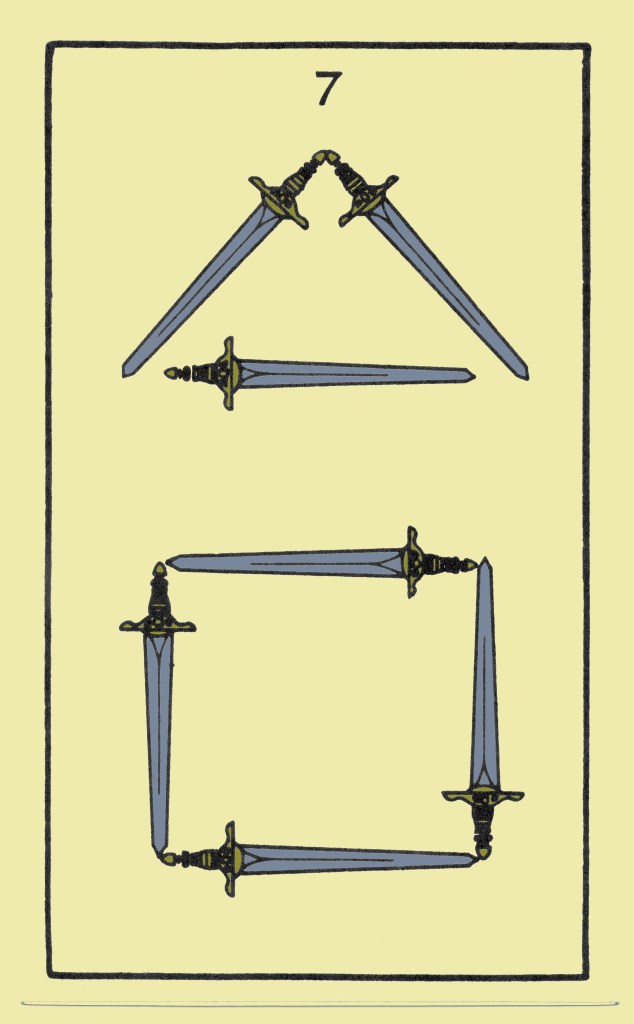
The Seven of Swords from the Builders of the Adytum (BOTA) tarot deck

Paul Foster Case (and Ann Davies)

The time period is the third decanate of Aquarius, February 9 to 18, under the rulership of Venus.
Well-Dignified: partial success; the Querent is too easy-going or does not draw sufficiently on his reserve force; he has good opportunities but may not make the most of them; he is likely to compromise too easily.
Ill-Dignified: love of ease and display cause loss; the Querent suffers from the insolence of others and may be insolent himself; there is danger that his own confidence may be betrayed, or that he may be led into betraying the confidence of others.
Keyword: Instability.
(From the Oracle of Tarot course)

A. E. Waite

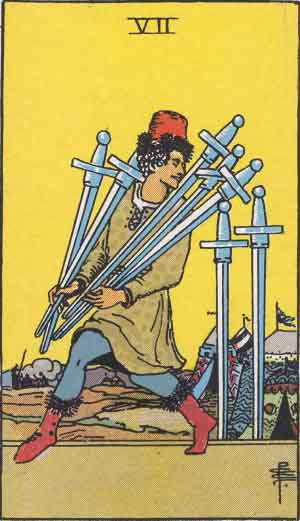
A man in the act of carrying away five swords rapidly; the two others of the card remain stuck in the ground. A camp is close at hand. Divinatory Meanings: Design, attempt, wish, hope, confidence; also quarrelling, a plan that may fail, annoyance. The design is uncertain in its import, because the significations are widely at variance with each other. Reversed: Good advice, counsel, instruction, slander, babbling.
(From The Pictorial Key to the Tarot)

The Seven of Swords from the Rider Waite Smith tarot

Aleister Crowley

The Seven of Swords is called Futility. This is a yet weaker card than the Seven of Wands. It has a passive sign instead of an active one, a passive planet instead of an active one. It is like a rheumatic boxer trying to “come back” after being out of the ring for years. Its ruler is the Moon. The little energy that it possesses is no more than dream-work; it is quite incapable of the sustained labour which alone, bar miracles, can bring any endeavour to fruition. The comparison with the Seven of Wands is most instructive.

[…]

Netzach, in the suit of Swords, does not represent such catastrophe as in the other suits, for Netzach, the Sephira of Venus, means victory. There is, therefore, a modifying influence; and this is accentuated by the celestial rule of the Moon in Aquarius.

The intellectual wreckage of the card is thus not so vehement as in the Five. There is vacillation, a wish to compromise, a certain toleration. But, in certain circumstances, the results may be more disastrous than ever. This naturally depends upon the success of the policy. This is always in doubt as long as there exist violent, uncompromising forces which take it as a natural prey.

This card, like the Four, suggests the policy of appeasement. The symbol shows six Swords with their hilts in crescent formation. Their points meet below the centre of the card, impinging upon a blade of a much larger up-thrusting sword, as if there were a contest between the many feeble and the one strong. He strives in vain.
(From the Book of Thoth)

The Seven of Swords from the Thoth tarot deck

Golden Dawn’s Book T

TWO Angelic Radiating Hands as before, each holding three swords. A third hand holds up a single sword in the centre. The points of all the swords “just touch” each other, the central sword not altogether dividing them.
The Rose of the previous symbols of this suit is held up by the same hand which holds the central sword: as if the victory were at its disposal. Symbols of Moon and Aquarius.

Partial success. Yielding when victory is within grasp, as if the last reserves of strength were used up. Inclination to lose when on the point of gaining, through not continuing the effort. Love of abundance, fascinated by display, given to compliments, affronts and insolences, and to spy upon others. Inclined to betray confidences, not always intentionally. Rather vacillatory and unreliable.
Netzach of HB:V (Journey by land: in character untrustworthy).
Herein rule the Great Angels HB:HHHAL and HB:Ma’aKAL.

Etteilla

Hope
Upright. This card, as far as the medicine of the spirit is concerned, means, in its natural position: Hope, Expectation, Expectation, Pretending, Founding, Overestimating, Founding, Designing, Willing, Wanting, Wishing, Vowing, Wanting, Taste, Fantasy.
Reversed. Wise opinion, Good advice, Salutary warnings, Instruction, Lesson. – Observation, Reflection, Note, Caution, Thoughtfulness. – Reprehension, Reprimand. – News, Announcement, Posting. – Consultation, Admonition.

MQS

Tarot Encyclopedia – The Six of Pentacles or Coins

(Note: this is a collection of the meanings attributed to the cards by some occultists in the past centuries. It does not reflect my own study or opinion of the cards. It is only meant as a quick comparative reference as I develop my own take.)

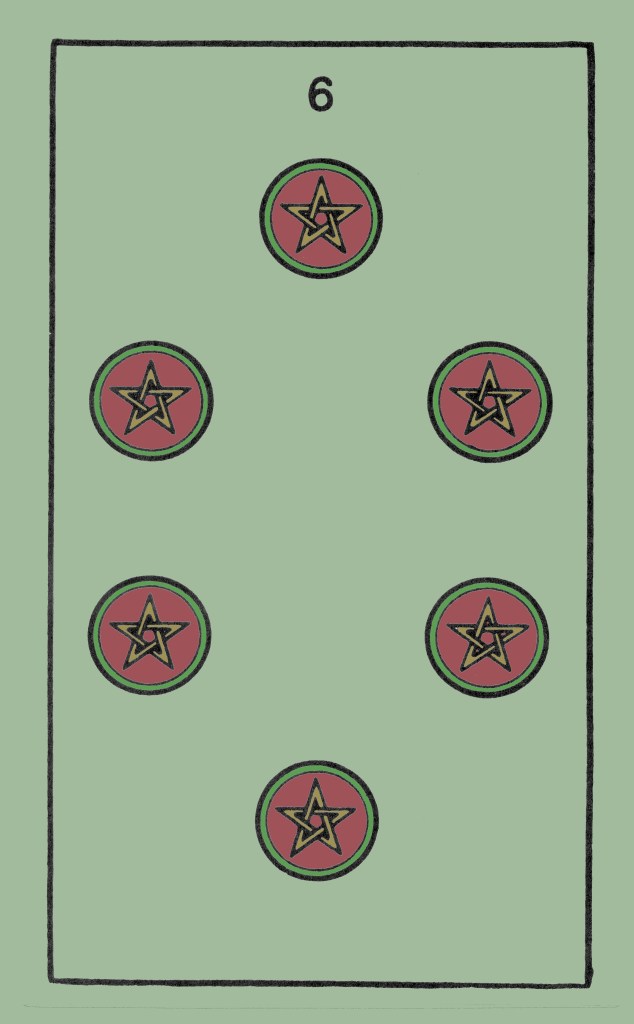
The Six of Pentacles from the Builders of the Adytum (BOTA) tarot deck

Paul Foster Case (and Ann Davies)

The time period is the second decanate of Taurus, under the rulership of Mercury, from April 30 to May 10. Meanings:
Well-Dignified: practicality and determination; discretion and diplomacy; gain by letters, writing, travel, speaking, teaching, commissions and through advertising, study, books and all things ruled b Mercury.
Ill-Dignified: Loss through the same things.
Keyword: Prosperity.
(From the Oracle of Tarot course)

A. E. Waite

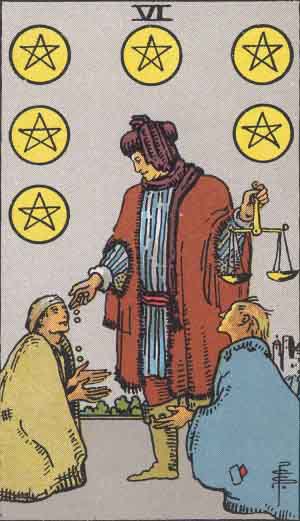
A person in the guise of a merchant weighs money in a pair of scales and distributes it to the needy and distressed. It is a testimony to his own success in life, as well as to his goodness of heart. Divinatory Meanings: Presents, gifts, gratification another account says attention, vigilance now is the accepted time, present prosperity, etc. Reversed: Desire, cupidity, envy, jealousy, illusion.
(From The Pictorial Key to the Tarot)

The Six of Pentacles from the Rider Waite Smith Deck

Aleister Crowley

The Six of Disks is called Success; the ruler is the Moon. This is a card of settling down; it is very heavy, wholly lacking in imagination, yet somewhat dreamy. Change is soon coming upon it; the weight of earth will ultimately drag the current down to a mere eventuation of material things. Yet the Moon, being in Taurus, the sign of her exaltation, the best of the Lunar qualities are inherent. Moreover, being a Six, the solar Energy has fertilized her, creating a balanced system for the time being. The card is worthy of the name Success. Remember only that all success is temporary; how brief a halt upon the Path of Labour.

[…]

The Number Six, Tiphareth, as before, represents the full harmonious establishment of the Energy of the Element. The Moon in Taurus rules the card; and this, while increasing the approach to perfection (for the Moon is exalted in Taurus and therefore in her highest form) marks that the condition is transient.

The disks are arranged in the form of the Hexagram, which is shown in skeleton. In the centre blushes and glows the light rose-madder of dawn, and without are three concentric circles, golden yellow, salmon-pink, and amber. These colours show Tiphareth fully realized on Earth; it reaffirms in form what was mathematically set forth in describing the Ace.

The planets are arranged in accordance with their usual attribution; but they are only shown as disks irradiated by the Sun in their centre. This Sun is idolized as the Rose and Cross; the Rose has forty-nine petals, the interplay of the Seven with the Seven.
(From The Book of Thoth)

The Six of Disks from the Thoth Tarot deck

Golden Dawn’s Book T

A WHITE Radiant Angelic Hand holding a rose branch with white roses and buds, each of which touches a Pentacle. Pentacles are arranged in two columns of three each:

* *
* *
* *
Above and below are the symbols Taurus and Moon of the Decan.
Success and gain in material undertakings. Power, influence, rank, nobility, rule over the people. Fortunate, successful, liberal and just.
If ill dignified, may be purse-proud, insolent from excess, or prodigal.

Tiphareth of HB:H (Success in material things, prosperity in business).
Herein rule the Angels HB:NMMYH and HB:YYLAL.

Etteilla

The present
Upright. This card, as far as the medicine of the spirit is concerned, means, in its natural position: Present, Presently, Now, Immediately, At the instant, At this time, Today, Attending, Witnessing, Contemporary. – Attentive, Careful, Vigilant.
Reversed. Desire, Vow, Ardor, Haste, Passion, Searches, Cupidity, Want, Jealousy, Illusion.

MQS

Tarot Encyclopedia – The Four of Cups

(Note: this is a collection of the meanings attributed to the cards by some occultists in the past centuries. It does not reflect my own study or opinion of the cards. It is only meant as a quick comparative reference as I develop my own take.)

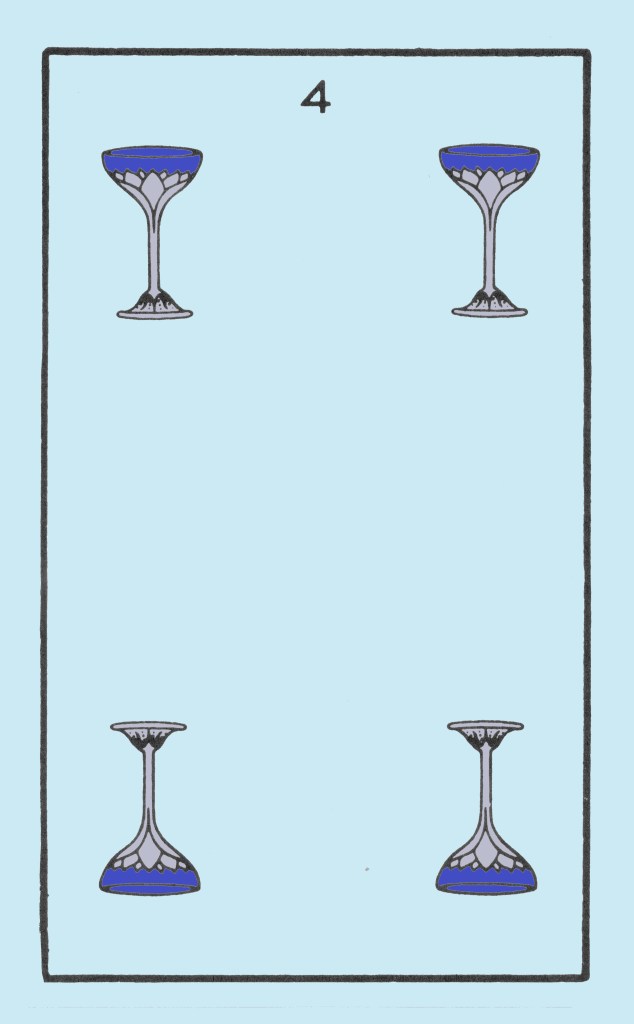
The Four of Cups from the Builders of the Adytum (BOTA) tarot deck

Paul Foster Case (and Ann Davies)

The specific divinatory meanings are thus based on the attributions of Chesed, the planetary forces of Jupiter and Neptune, the zodiacal influences of Cancer ruled by the Moon, and the astrological fourth house. Jupiter’s sphere of influence is Chesed. It co-rules the third decanate of Cancer besides being exalted in this zodiacal sign. Therefore the Four of Cups has a very strong Jupiterian influence of wealth and expansiveness. The Four of Cups corresponding to the third decanate of Cancer is the time period July 13 to July 22, ruled by Jupiter and Neptune.
In specific Tarot Divination its key meanings are:
Well Dignified: success in material things, but desire for something higher; a period of comparative comfort, yet a little confining, thus suggesting a measure of satiety; it is a symbol of contemplation and of the turning away from pleasure in quest of higher things; it intimates strong psychic influences in the life or environment of the Querent.
lll-Dignified: material gain, but through injustice; sorrows resulting from satisfaction of desire; getting what one has wanted but finding no joy in it.
Keyword: Surfeit
(From the Oracle of Tarot Course)

A. E. Waite

A young man is seated under a tree and contemplates three cups set on the grass before him; an arm issuing from a cloud offers him another cup. His expression notwithstanding is one of discontent with his environment. Divinatory Meanings: Weariness, disgust, aversion, imaginary vexations, as if the wine of this world had caused satiety only; another wine, as if a fairy gift, is now offered the wastrel, but he sees no consolation therein. This is also a card of blended pleasure. Reversed: Novelty, presage, new instruction, new relations.
(From The Pictorial Key to the Tarot)

Aleister Crowley

The Four of Cups is called Luxury.

The masculine nature of fire permits the Four of Wands to appear as a very positive and clear-cut conception. The weakness in the element of water threatens its purity; it is not quite strong enough to control itself properly; so the Lord of Pleasure is a little unstable. Purity has somehow been lost in the process of satisfaction.

[…]

This card refers to Chesed in the sphere of Water. Here, below the Abyss, the energy of this element, although ordered, balanced and (for the moment) stabilized, has lost the original purity of the conception.

The card refers to the Moon in Cancer, which is her own house; but Cancer itself is so placed that this implies a certain weakness, an abandonment to desire. This tends to introduce the seeds of decay into the fruit of pleasure.

The sea is still shown, but its surface is ruffled, and the four Cups which stand upon it are no longer so stable. The Lotus from which the water Springs has a multiple stem, as if to show that the influence of the Dyad has gathered strength. For although the number Four is the manifestation and consolidation of the dyad, it is also secretly preparing catastrophe by emphasizing individuality.

There is a certain parallelism between this card and the Geomantic figures Via and Populus, which are attributed to the Moon in her decrease and increase respectively. The link is primarily the “Change=Stability” equation, already familiar to readers of this essay. Four is an “awkward” number; alone among the natural numbers, it is impossible to construct a “Magic Square” of four cells. Even in the Naples Arrangement, Four is a dead stop, a blind alley. An idea of a totally different Order is necessary to carry on the series. Note also the refolding-in-upon-itself suggested by the “Magic Number” of Four 1 + 2 + 3 + 4 which is Ten. Four is the number of the Curse of Limitation, of Restriction. It is the blind and barren Cross of equal arms, Tetragrammaton in his fatal aspect of finality, as the Qabalists knew him before the discovery of the Revolving Formula whereby the Daughter, seated upon the Throne of the Mother, “awakens the Eld of the All-Father”.

For the meanings of Via and Populus, refer to the “Handbook of Geomancy” (Equinox Vol. I, No.2).

(From The Book of Thoth)

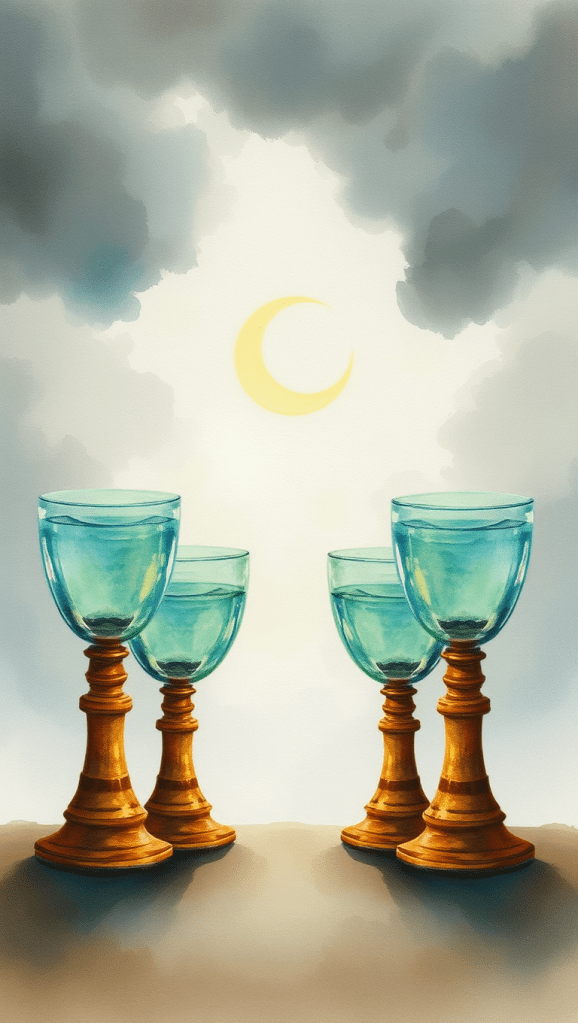
An AI-generated illustration for the Four of Cups

Golden Dawn’s Book T

FOUR cups: the two upper overflowing into the two lower, which do not
overflow. An Angelic Hand grasps a branch of lotus, from which ascends a stem bearing one flower at the top of the card, from which the white water flows into the two upper cups. From the centre two leaves pass right and left, making, as it were, a cross between the four cups. Above and below are the symbols Moon and Cancer for the Decan.

Success or pleasure approaching their end. A stationary period in happiness, which may, or may not, continue. It does not mean love and marriage so much as the previous symbol. It is too passive a symbol to represent perfectly complete happiness. Swiftness, hunting and pursuing. Acquisition by contention: injustice sometimes; some drawbacks to pleasure implied.
Chesed of HB:H (Receiving pleasure or kindness from others, but some
discomfort therewith).
Therein rule the great Angels HB:HYYAL and HB:MVMYH.

Etteilla

Boredom
Upright. This card, as far as the medicine of the spirit is concerned, means, in its natural position: Boredom, Displeasure, Discontent, Disgust, Aversion, Enmity, Hatred, Horror, Restlessness, Pain of spirit, Slight sadness, Affliction, Painful, Annoying, Unpleasant. – Saddening, Distressing.
Reversed. New Directive, New Light. – Index, Indication, Conjecture. – Augury, Foreboding. – Presentment, Foreboding, Predilection, Novelty.

MQS

The Geomancy of Peter of Abano – Book IV Pt. 2

Previous / Back to Index / Next

Abano discusses the various meanings of Via, Populus, Caput and Cauda when deriving from various figures.

Via

From Via and Populus, its meaning is weakened, but quickened.1
From Acquisitio and Amissio its efficacy is mediocre in every question.
From Major and Minor it means good luck, but it is still mediocre.
From Laetitia and Caput, it means good luck and success.

From Tristitia and Cauda it means misfortune in the question at hand, and it is very strong in its malice.
From Albus and Puer it is mediocre good luck.
From Rubeus and Puella it shows a mix of good and bad, but it brings about the thing quesited.
From Conjunctio and Carcer it means good luck, stability and firmness in all one asks about.

Populus

From Populus and Populus it means stability, getting one’s wish, copious amounts.
From Acquisitio and Acquisitio it means great good luck, great acquisition of what one wishes, usefulness.
From Amissio and Amissio it shows good luck, and being venereal and lascivious.
From Major and Major it means fortune, stability, great gain, honor.
From Minor and Minor it means mediocre good fortune.
From Via and Via it means weakness in the thing enquired about.
From Caput and Caput it means good luck, usefulness.
From Cauda and Cauda, it means great misfortune.

From Albus and Albus it means good effect, good outcome especially in watery things and womanly or white things.
From Rubeus and Ruveus it means excessive evil, war, loss of blood.
From Laetitia and Laetitia it means good luck, happiness, honor, easily getting what one wants.
From Tristitia and Tristitia it means great misfortune, long lengths of time, difficulties and problems, enmities.
From Conjunctio and Conjunctio it means good luck, getting one’s wish, good for marriage and partnerships.
From Carcer and Carcer it means great good luck in everything, melancholy and difficulties, anger, discord, infirmity, prison.
From Puella and Puella it means good luck and fortune, firmness, usefulness, getting one’s wish.
From Puer and Puer it means war, fighting, discord, good for merchandise, mediocre gain, good for marriage.2

Caput

From Populus and Caput it means great firmness, good outcome.
From Acquisitio and Albus it means great good luck, getting one’s wish.
From Amissio and Puer it means misfortune, loss, difficulties.
From Major and Rubeus great good luck, mediocre gain or honor, good fortune.
From Tristitia and Conjunctio it means good luck and gain, but with delay and difficulties.
From Cauda and Carcer it means misfortune and tragedy.

Cauda

From Populus and Cauda it means misfortune, long illness, difficulties, weakness in getting one’s wish.
From Acquisitio and Puella it means good fortune, firmness, usefulness in mobile things.3
From Amissio and Rubeus it means misfortune and grave danger.
From Major and Puer, it means misfortune under the guise of gain.

From Via and Tristitia it means misfortune in getting what one wishes, and long-lasting difficulties.
From Caput and Carcer it means mediocrity, good for virtue and honorable things, otherwise loss.
From Laetitia and Conjunctio it means mediocre fortune, but gain from merchandise.
From Albus and Minor, it means good luck and freedom from difficulties, but mediocre gain.4

MQS

Footnotes
  1. One of the reasons this Book IV is interesting is that it affords us a look into how old geomancers derived meanings from the interaction of figures. Unfortunately Abano’s process is not always clear. Furthermore, it is not clear whether Abano means what I have written (namely, Via’s meaning is weakened but quickened) or if he is saying that Via’s meaning is weakened more than any other figure. I have chosen my interpretation based on this logical argument: that Populus tends to accentuate the meaning of the figure it interacts with, and Via is weak and quick, so in interacting with Populus it would become weaker and quicker. ↩︎
  2. Generally speaking, it seems the effect of Populus is that of accentuating the meaning of the figures it comes from (‘lots of…’). However, some interpretations are not clear, for instance Carcer and Carcer meaning great good luck. Note also that Populus is the only figure that Abano explains in full, giving all possible combinations. ↩︎
  3. It seems here that the two positive figures rub off on the otherwise foreboding Cauda. ↩︎
  4. Again, the two positive figures it comes from seem to bring out the best in Cauda, according to Abano. ↩︎

The Geomancy of Peter of Abano – Book III Pt. 9

Previous / Back to Index / Next

Here Abano talks about the meanings of Caput Draconis and Cauda Draconis in the various houses.

Caput Draconis (The Dragon’s Head or North Moon Node)

Caput Draconis in the first house means good luck, noble people, wise people, leaders, captains, honor, dignity, a prelate.1
In the second it means good success, gaining wealth or dignity or money.
In the third it means noble brothers and sisters, lucky siblings, good through them, isolated gardens2, pleasures.

In the fourth it means good for the parents, inheritance, buildings, cities, citizens, noble people, good end to an issue.
In the fifth it means science, good children, gain and help through them.
In the sixth it means good servants, faithful servants, good officials, grave infirmity, melancholic infirmity,3 long fevers.

In the seventh it means honorable women, good marriage, good company, gain from noble people or from women and thanks to them.
In the eighth it means inheritance, goods gain from the dead, usefulness through women and noble people, gain through war and by violence against life, being beheaded.4
In the ninth it means honoring God, ecclesiastical dignity, religious people, noble people, good journeys, delay in coming back but with good results, a messenger with bad news, messenger bearing news of legal issues, ingeniousness in a noble science.

In the tenth it means the king, the emperor, the lord, a magistrate, dignity, honor, good regents and orators, noble people.
In the eleventh it means noble soldiers, captains, dignity, sublimation5, succeeding one’s lord, faithfulness, valor, good luck.
In the twelfth it means noble inheritance through the mother, honorable things for [or through] women, few enemies, weak enemies, certainty, fame.

In the thirteenth it means journeys, messengers, a king, lords, usefulness, gain, honor, dignity, friendship and good recoglientia.6
In the fourteenth it means coming back from a journey with dignity and mirth and gain, letters, positive answer, honors, dignity, usefulness.
In the fifteenth it means a good end to the question and strong hope.7

Cauda Draconis (The Dragon’s Tail or South Moon Node)

Cauda draconis in the first house means evil disposition of the querent or of the quesited, fear of death, being murdered.8
In the second it means wealth gain through illicit means, theft, violence.
In the third it means iniquity against siblings and relatives, remains, retaliations, killings on the streets.

In the fourth it means loss of inheritance, evil lands, evil people, betrayals, false rumors, destruction of a city or fortress.
In the fifth it means evil children or women, loss of children, danger during childbirth, loss of blood.
In the sixth it means evil servants, runaways, grave illness, bodily fluids, killing, desperation, damage.

In the seventh it means a harlot, vile marriage, evil company, unfaithfulness, betrayal, violence, enmity.
In the eighth it means fear of death for [or through] women, rumors, freedom from prison and from illness, loss through women, being killed, loss of blood and flobotomia.9
In the ninth it means being forced on a journey, loss, danger of death, toil, changing one’s religion, evil or false religious people, evil Christians,10 evil messengers, death during a journey.

In the tenth it means an evil lord, traitors of one’s country, iniquitous judges or orators, overthrowing tyrants, loss of dignity, destruction of one’s kingdom.
In the eleventh it means wrongful succession, betrayal, violence, rebellion, death of one’s lord.
In the twelfth it means hidden enemies of the kingdom, machinations, treason against one’s lord, assassinations both public and private, violence.

In the thirteenth it means betrayals during a journey, hate from noble people, the absent party doesn’t come back.
In the fourteenth it means toiling for gain and honor, bad luck, hatred from underlings and very evil enemies, overcoming one’s enemies,.
In the fifteenth it is the worst of all, eccept for doing evil things.11

MQS

Footnotes
  1. Possibly due to the Moon’s North Node connection with beginnings and with increase, as well as the connection of the term ‘head’ with leadership. ↩︎
  2. The text seems to say “giardini solati”, and I am not sure if it means isolated gardens or gardens in the sun or something else that escapes me. The connection with gardens is clear, as the Third House rules neighborhoods and therefore what’s around the house. ↩︎
  3. Illnessess were traditionally categorized based on the prevailing humor. ↩︎
  4. This is another excellent example of how to read the meaning of the figure into the meaning of the house. Caput Draconis is the head, and the Eighth House rules death, thus giving beheading (death by losing one’s head). Of course much depends on the question and the rest of the Shield. ↩︎
  5. This is not clear. ↩︎
  6. An archaic Italian word of whose meaning I am unaware. ↩︎
  7. Caput cannot be the Judge. ↩︎
  8. It is usually said that Cauda being in the First House is enough to break the figure. However, here Abano gives us coherent interpretations. Most of them are very dramatic, but it’s the principle that counts and needs to be assimilated. ↩︎
  9. A term belonging to the vocabulary of Medieval medicine. I do not know what it means. ↩︎
  10. Probably to be interpreted as evil believers in general, nowadays. ↩︎
  11. Cauda cannot be the Judge. ↩︎

The Geomancy of Peter of Abano – Book III Pt. 7

Previous / Back to Index / Next

Abano discusses some of the meanings of Populus and Via in the houses of the chart.

Populus

Populus in the first house means change,1 a mutable life, but a long one, and water, rivers, company, ships, mills, prairies, rain.
In the second it means gain of a lot of wealth, good merchandise, gain of money.
In the third it means gaiety with siblings, union with one’s neighbors, dangerous travel, gardens, watery places.

In the fourth it means the city, castles, buildings, union, congregation of people, inheritance, usefulness, abundance throughout the year.
In the fifth it means many children, succession, inheritance of a pregnant woman, unstable children.
In the sixth good family, many animals, usefulness through servants, deadly illness.

In the seventh it means good marriage, good partnership or company, usefulness, love of unstable women.
In the eighth it means tears, funerals,2 inheritance, usefulness from dead people, gain through women, fear of death.
In the ninth it means long travel with gain, rain, storm while at sea, shipwreck but ending well, peregrination with company.


In the tenth it means congregation of lords, exaltation of common people over the lords,3 rebellion, schism, diversion, suffocation of common people, grave person.
In the eleventh it means dignity, gifts from lords, usefulness from the mother.4
In the twelfth it means many occult enemies, damage from their coconspirators, unjust machinations, freedom from illness and by sea.

In the thirteenth it means good company, security, safety in travel, gain from friends, goodwill, gain from travel, good return of the absent party.
In the fourteenth it means gain from the mother5 and from relatives, inheritance, good fame.
In the fifteenth it means good things, but with delay.

Via

Via in the First House means a positive journey, whether long or short, poverty, a short life.
In the second it means little wealth, toil, loss of money and possessions.
In the third it means a short journey, gardens, pleasure, gain from the dead,6 few siblings.

In the fourth it means a small inheritance, little gain, desert places, lots of water, a year of dearth, being without a father or mother.
In the fifth it means few children, good relatives, succession for the mother.7
In the sixth it means servants fleeing, small animals, little gain from them, short but dangerous illness, bad servants.

In the seventh it means an unstable woman, corrupt, sad, unstable marriage, company of few but good people.
In the eighth it means liberation from infirmity and from prison, fleeing danger, return [of someone].
In the ninth it means a long journey soon, goods from the church, messengers, unstable and unfaithful religious people, a bad life.

In the tenth it means instability for the kingdom, lordship, dignity, unjust judges, infamy.
In the eleventh it means little hope, vain hope, unfaithful soldiers and curials.
In the twelfth it means few enemies, unfortunate journey, falling from a high place,8 danger of death, loss of inheritance due to the mother, freedom from prison.

In the thirteenth it means gain from travel, a secure street, little rain, good for selling.
In the fourteenth it means damaged goods, short journey, dispatching goods, the absent party is coming back soon.
In the fifteenth it means good change, a quick resolution.

MQS

Footnotes
  1. Usually, Populus is taken as a rather stable figure, while Via should indicate change. Here Abano considers them both rather changeable, possibly due to the association with the Moon. ↩︎
  2. A congregation due to death. ↩︎
  3. Because Populus means the common folk, and finding it in the Tenth House it can show that the common folk take over the place of honor. Once again, this shows very well how we ought to interpret the chart. ↩︎
  4. The mother is the Tenth House, her Second House shows gain from her. ↩︎
  5. Because the Fourteenth derives from the Eleventh and Twelfth and the Eleventh is, as discussed, gain from the mother. ↩︎
  6. I don’t understand why in this house Via should indicate gain from the dead. ↩︎
  7. This is unclear to me. ↩︎
  8. Possibly because the Twelfth House is cadent from the Tenth House, the highest place in the chart, and Via shows physical movement, thus “a movement that falls from a high place”. ↩︎

Tarot Encyclopedia – The Two of Swords

(Note: this is a collection of the meanings attributed to the cards by some occultists in the past centuries. It does not reflect my own study or opinion of the cards. It is only meant as a quick comparative reference as I develop my own take.)

The Two of Swords from the Builders of the Adytum (BOTA) tarot deck

Paul Foster Case (and Ann Davies)

The time period is the first decanate of Libra from September 23 to October 2, under the rulership of Venus.
Well-Dignified: contradictory characteristics in the same nature; strength through suffering; pleasure after pain; delay in the realization of objectives. This card sometimes indicates a period of uncertainty, during which the Querent, though he has a sense of adequate power, does not know just what to do with it. It also indicates justice, unselfishness and the restoration of peace.
Ill-Dignified: falsehood; sorrow; injury from another who really means well to the Querent, or injury by the Querent to another whom he wishes to help; always a symbol of tension, of want of tact, and suggests force held in abeyance, awaiting some announcement or revelation that will make decision possible.
Keyword: Indecision.
(From the Oracle of Tarot course)

A. E. Waite

A hoodwinked female figure balances two swords upon her shoulders. Divinatory Meanings: Conformity and the equipoise which it suggests, courage, friendship, concord in a state of arms; another reading gives tenderness, affection, intimacy. The suggestion of harmony and other favourable readings must be considered in a qualified manner, as Swords generally are not symbolical of beneficent forces in human affairs. Reversed: Imposture, falsehood, duplicity, disloyalty.
(From The Pictorial Key to the Tarot)

Aleister Crowley

The Two of Swords was formerly called the Lord of Peace Restored; but this word “restored” is incorrect, because there has been no disturbance. The Lord of Peace is therefore a better title: but it needs thinking hard to work this out, since the Sword is so intensely active. It may be helpful to study the Essay on Silence (p. 120) for a parallel: the Negative Form of the Positive Idea. See also the Essay on Chastity (Little Essays toward Truth, pp. 70-74) which concludes: Sir Knights, be vigilant: watch by your arms and renew your oath; for that day is of sinister augury and deadly charged with danger which ye fill not to overflowing with gay deeds and bold of masterful, of manful Chastity.

Witness also Catullus: domi maneas paresque nobis Novem continuas futationes. Nor does he misunderstand the gesture of Harpocrates; Silence and Chastity are isomers.
It is all one case of the general proposition that the sum of the infinite Energy of the Universe is Zero.

[…]

This card is ruled by Chokmah in the Element of Air. This suit, governing all intellectual manifestations, is always complicated and disordered. It is subject to change as is no other suit. It represents a general shaking-up, resulting from the conflict of Fire and Water in their marriage; and proceeds, when Earth appears, to crystallization. But the purity and exaltation of Chokmah are such that this card manifests the very best idea possible to the suit. The energy abides above the onslaught of disruption. This comparative calm is emphasized by the celestial attribution: the Moon in Libra.

The Moon is change, but Nature is peaceful; moreover, Libra represents balance; between them, they regulate the energy of the Swords.

In the card appear two swords crossed; they are united by a blue rose with five petals. This rose represents the influence of the Mother, whose harmonizing influence compounds the latent antagonism native to the suit. The Rose emits white rays, producing a geometrical pattern that emphasizes the equilibrium of the symbol.
(From The Book of Thoth)

An ominous AI-generated illustration for the Two of Swords

Golden Dawn’s Book T

Two crossed swords, like the air dagger of a Zelator Adeptus Minor, each held by a White Radiant Angelic Hand. Upon the point where the two cross is a rose of five petals, emitting white rays. At the top and bottom of the card are two small daggers, supporting respectively the symbol {Crescent moon with horns upward} thus, and Libra representing the Decanate.
Contradictory characters in the same nature, strength through suffering; pleasure after pain. Sacrifice and trouble, yet strength arising therefrom, symbolized by the position of the rose, as though the pain itself had brought forth beauty. Arrangement, peace restored; truce; truth and untruth; sorrow and sympathy. Aid to the weak; arrangement; justice, unselfishness; also a tendency to repetition of affronts on being pardoned; injury when meaning well; given to petitions; also a want of tact, and asking question of little moment; talkative.
Chokmah of Vau. Quarrel made up, yet still some tension in relations: actions, sometimes selfish, sometimes unselfish.
Herein rule the Great Angels HB:YZLAL and HB:MNHAL.

Etteilla

Friendship
Upright. This card, as far as the medicine of the spirit is concerned, means, in its natural position: Friendship, Attachment, Affection, Tenderness, Benevolence, Relationship, Identity, Intimacy, Convenience, Correspondence, Interest, Conformity, Sympathy, Affinity, Attraction.
Reversed. Falsehood, Falsehood, Lying, Imposture, Duplicity, Bad faith, Overbearingness, Dissimulation, Cunning, Deceit, Superficial, Superficiality, Surface.

MQS

Is This Course for Me? (Playing Cards Reading and Horary Astrology)

I’m always on the look-out for opportunities to deepen my knowledge of esoteric topics. Since the esoteric world is filled to the brim with junk covering a couple of pearls on the bottom (but don’t worry, things don’t get much better outside of lalaland) it is very useful to know some forms of divination to supplement my bullshitometer.

I recently came across a certain course on traditional Italian witchcraft which passed all my preliminary tests (no mention of Wicca or neopaganism, relating anecdotes on practices I’m already familiar with and know are valid, etc.)

Still something was off, though I couldn’t put my finger on it. On thing was probably the reference to authors, like Raven Grimassi, who have been largely debunked. I asked the heavens for a sign, and then pulled some cards. Let’s start with the cards. They were:

4♣ – 2♠ – K♦ – 2♣ – 6♦

Right off the bat, I don’t like the teacher being represented by a King of Diamonds. The King of Diamonds is the merchant, the banker, the one whose end goal is money. If he had been the King of Hearts or even the King of Spades I would have been reassured. You may argue that obviously a course is offered to earn money, to which I respond that there is a difference between earning through your passion and earning through other people’s passion.

I am unsure about the preceding combination of Four of Clubs and Two of Spades, but it likely represents contradictory (2♠, arguments, going apart) doctrines (4♣, that which is told). The Two of Clubs and Six of Diamonds traditionally represent limping (insecure steps). The King of Diamonds is not secure enough in his knowledge. Limping is still better than being bed-ridden, so there is something good to the course, but probably not enough to offset the negatives.

Horary Astrology Reading

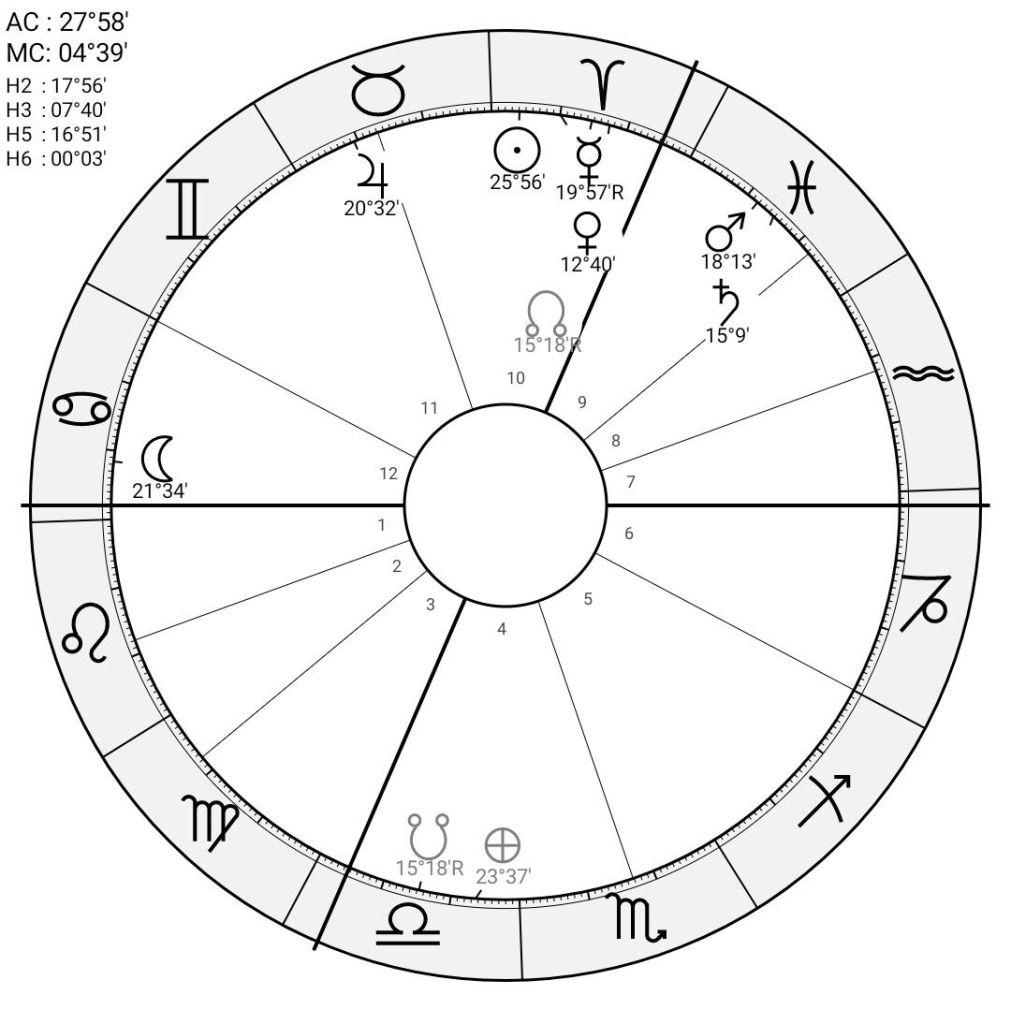
Let’s look at the horary chart:

Is the course good for me?

The Moon is the Lady of the Ascendant and thus represents me. Magic is higher knowledge, so it’s Ninth House. This is Jupiter. The two malefics Mars and Jupiter are present in the Ninth house, and are both peregrine, so they afflict the house.

The Moon is in her sign, but she’s also tucked away in the very malefic Twelfth house. Interestingly, the Twlefth house represents witchcraft, but only in the sense of something done behind the querent’s back to hurt him, not magic in general (which, again, is higher knowledge). So while I’d be capable of learning (Moon in own sign) my position is not good. There’s something iffy.

Jupiter is mildly dignified by term and in the succedent Eleventh house. The Moon is in sextile with Jupiter, which is technically good, but it is separating from it, indicating growing divergence. The Moon’s next aspect is a square of the Sun, which is negative. The Sun rules the second house, the house of money. So proceeding would put a strain on my finances. This isn’t necessarily to say that it costs too much in absolute terms, but it costs too much compared to its quality. Interestingly, Jupiter is disposited by Venus, which is in detriment and moving toward the Sun, which hurts her, so Venus has a rather excessive love of my money compared to the necessary love of knowledge.

All in all, based on both readings, I would say that the course would probably contain some valuable information, but would not be a great investment in my education.

MQS