Tag Archives: minor arcana

Tarot Encyclopedia – The King of Wands

(Note: this is a collection of the meanings attributed to the cards by some occultists in the past centuries. It does not reflect my own study or opinion of the cards. It is only meant as a quick comparative reference as I develop my own take.)

The King of Wands from the Builders of the Adytum (BOTA) Tarot

Paul Foster Case (and Ann Davies)

When well aspected the powers listed above are expressed by a personality represented by the King of Wands. However these same qualities when overly strong or intense can express as cruelty, oppression, ostentation and pride. Thus in Tarot divination, besides the basic principles expressed by Ab, the Father, and Yod, the Creative principle, the King of Wands has these specific meanings:
Well Dignified: an ardent, impulsive, influential man; one possessed of authority and strongly marked by the quality of leadership; somewhat hasty in temper but just, generous and friendly. lll Dignified: the same general type but cruel, ill-natured, intolerant and probably unfriendly to the querent.
(From the Oracle of Tarot course)

A. E. Waite

The physical and emotional nature to which this card is attributed is dark, ardent, lithe, animated, impassioned, noble. The King uplifts a flowering wand, and wears, like his three correspondences in the remaining suits, what is called a cap of maintenance beneath his crown. He connects with the symbol of the lion, which is emblazoned on the back of his throne. Divinatory Meanings: Dark man, friendly, countryman, generally married, honest and conscientious. The card always signifies honesty, and may mean news concerning an unexpected heritage to fall in before very long. Reversed: Good, but severe; austere, yet tolerant.
(From The Pictorial Key to the Tarot)

Aleister Crowley

(Note: Crowley and the Golden Dawn swap around King and Knight. This is in part true of Waite as well.)
The Knight of Wands represents the fiery part of Fire; he rules from the 21St degree of Scorpio to the 20th degree of Sagittarius. He is a warrior in complete armour. On his helmet for a crest he wears a black horse. In his hand he bears a flaming torch; a flame also in his mantle; and upon the flames does he ride. His steed is a black horse leaping.

The moral qualities appropriate to this figure are activity, generosity, fierceness, impetuosity, pride, impulsiveness, swiftness in unpredictable actions. If wrongly energized, he is evil-minded, cruel, bigoted and brutal. He is in either case ill-fitted to carry on his action; he has no means of modifying it according to circumstances. If he fails in his first effort, he has no resource.

In the Yi King, the fiery part of Fire is represented by the 51st hexagram, Kan. The signification there given is entirely in accordance with the doctrine of the Tarot, but great emphasis is laid on the startling, perilous, and revolutionary character of the events cognate. The Querent is advised to be apprehensive, yet cool, resolute and energetic: to beware of untimely action, but to go forward with tense confidence in his own ability.

All these correspondences of the Yi King are to be studied in that book (S.B.E. vol. XVI) and reference is here made to the text when important passages are too long to be conveniently quoted.
(From the Book of Thoth)

Oddly interesting AI-generated King of Wands illustration

Golden Dawn’s Book T

A KINGLY Figure with a golden, winged crown, seated on a chariot. He has large white wings. One wheel of his chariot is shewn. He wears corslet and buskins of scale armour decorated with a winged lion’s head, which symbol also surmounts his crown. His chariot is drawn by a lion. His arms are bare, save for the shoulder-pieces of the corslet, and he bears a torch or fire-wand, somewhat similar to that of the Zelator Adeptus Minor. Beneath the chariot are flames, some waved, some salient.
Swift, strong, hasty; rather violent, yet just and generous; noble and scorning meanness.
If ill dignified — cruel, intolerant, prejudiced and ill natured.

Etteilla

Country man
Upright. This card, as far as the medicine of the spirit is concerned, means, in its natural position: Country Man, Good and Stern Man, Well Intentioned Man, Honest Man. – Conscience, Probity. – Farmer, Worker, Cultivator.
Reversed. Good and stern man – Indulgence, Severity, Forbearance, Condescension.

Tarot Encyclopedia – The King of Cups

(Note: this is a collection of the meanings attributed to the cards by some occultists in the past centuries. It does not reflect my own study or opinion of the cards. It is only meant as a quick comparative reference as I develop my own take.)

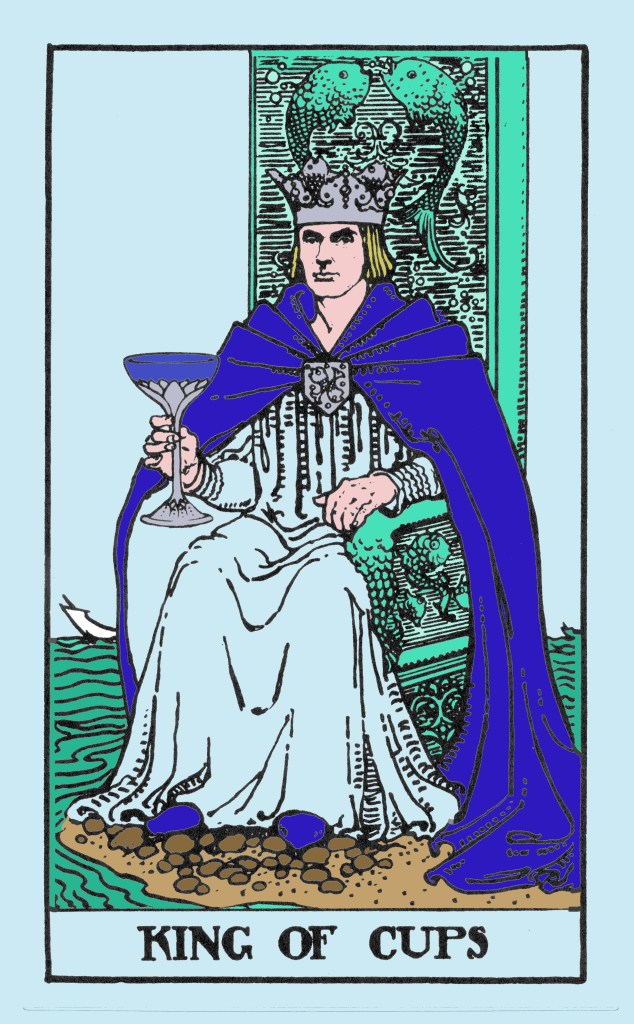
The King of Cups from the Builders of the Adytum (BOTA) Tarot

Paul Foster Case (and Ann Davies)

The time period is from the beginning of the last decanate of Gemini to the second decanate of Cancer, June 11 to July 12, combining the rulers hips of Saturn and Uranus, the Moon and Mars.
Well Dignified: a man subtle and secretive, crafty, psychic, artistic; of strong, violent desires but calm exterior. He is friendly to the Querent and really wise. Ill Dignified: evil and merciless and likely to be attracted by occult studies promising power or knowledge for the satisfaction of desire and control of others; without purification of character. Usually fair-haired with blue eyes.
(From the Oracle of Tarot course)

A. E. Waite

He holds a short sceptre in his left hand and a great cup in his right; his throne is set upon the sea; on one side a ship is riding and on the other a dolphin is leaping. The implicit is that the Sign of the Cup naturally refers to water, which appears in all the court cards. Divinatory Meanings: Fair man, man of business, law, or divinity; responsible, disposed to oblige the Querent; also equity, art and science, including those who profess science, law and art; creative intelligence. Reversed: Dishonest, double-dealing man; roguery, exaction, injustice, vice, scandal, pillage, considerable loss.
(From The Pictorial Key to the Tarot)

Aleister Crowley

(Note: Crowley and the Golden Dawn swap around King and Knight. This is in part true of Waite as well.)
The Knight of Cups represents the fiery part of Water, the swift passionate attack of rain and springs; more intimately, Water’s power of solution. He rules the Heavens from the 21st degree of Aquarius to the 20th degree of Pisces. He is clothed in black armour furnished with bright wings which, together with the leaping attitude of his white charger, indicates that he represents the most active aspect of Water. In his right hand he bears a cup from which issues a crab, the cardinal sign of Water, for aggressiveness. His totem is the peacock, for one of the stigmata of water in its most active form is brilliance. There is here also some reference to the phenomena of fluorescence.

The characteristics of the person signified by this card are nevertheless mostly passive, in accordance with the Zodiacal attribution. He is graceful, dilettante, with the qualities of Venus, or a weak Jupiter. He is amiable in a passive way. He is quick to respond to attraction, and easily becomes enthusiastic under such stimulus; but he is not very enduring. He is exceedingly sensitive to external influence, but with no material depth in his character.

When the card is ill dignified, he is sensual, idle and untruthful. Yet with all this he possesses an innocence and purity which are the essence of his nature. But he is, on the whole, so superficial that it is hard to reach this depth. “His name is writ in water.”

In the Yi King, the fiery part of Water is represented by the 54th Hexagram, Kwei Mei. The commentary is singularly obscure, and somewhat sinister. It deals with the difficulties of rightly mating such opposites as fire and water (compare the Queen of Wands; but in that case Water is the calming and modulating influence, while here it is Fire which creates trouble.) Swiftness and violence ill suit a character naturally placid; it is rare indeed to meet with a person who has succeeded in harmonizing these conflicting elements. He tends to mismanage all his affairs; and unless sheer good fortune attend him, his whole career will be an unbroken record of failure and disaster. Often his mental “civil war” ends in schizophrenia or melancholy madness. The abuse of stimulants and narcotics may precipitate the catastrophe.
(from The Book of Thoth)

Creepy-ass AI-generated King of Cups illustration

Golden Dawn’s Book T

A BEAUTIFUL, winged, youthful Warrior with flying hair, riding upon a white horse, which latter is not winged. His general equipment is similar to that of the Knight of Wands, but upon his helmet, cuirass and buskins is a peacock with opened wings. He holds a cup in his hand, bearing the sigil of the scale. Beneath his horse’s feet is the sea. From the cup issues a crab. Graceful, poetic, Venusian, indolent, but enthusiastic if roused. Ill dignified, he is sensual, idle and untruthful.
He rules the heavens from above 20 Degree of Aquarius to 20 Degree of Pisces, thus including the greater part of Pegasus.
(from Book T)

Etteilla

Blond man
Upright. This card, as far as the medicine of the spirit is concerned, means, in its natural position: Blond Man, Honest Man, Probity, Equity, Art, Science.
Reversed. Man occupying a good position, Distinguished man, Honest man. – Dishonest man. – Exaction, Concussion, Injustice, Brigand, Thief, Dissimulator. – Vice, Corruption, Scandal.

MQS

BOTA Tarot – A Relaxing New Project

I have been a member of BOTA in the past, before delving deeper into traditional occultism. I always kind of liked their tarot deck, so to relax I started painting a digital version of it. Once the whole set is done I’m going to have it printed. A friend of mine recommended to me that I take to doodling or coloring scrap books as an aid to creativity, and I must say it does work.

Note: according to Paul Foster Case, the blade of the Sword should be deep yellow, in good old Golden Dawn tradition, but I can’t stand that, especially since in the Magician card the sword is colored in steel gray

Painting the BOTA Tarot (Builders of the Adytum)

MQS