Tag Archives: minor arcana

Tarot Encyclopedia – The Ace of Pentacles or Coins

(Note: this is a collection of the meanings attributed to the cards by some occultists in the past centuries. It does not reflect my own study or opinion of the cards. It is only meant as a quick comparative reference as I develop my own take.)

The Ace of Coins or Pentacles from the Builders of the Adytum (BOTA) tarot

Paul Foster Case (and Ann Davies)

The time period is from the beginning of Capricorn to the end of Pisces, December 22 to March 20. Occult title: The Root of the Powers of Earth. Divinatory meanings: The power of Will as expressed on the physical plane. Materiality in all its phases, whether good or evil. “The things that are Caeser’s.” The power of the world-illusion. Material gain, contentment, wealth, and the things, conditions and
works which contribute to such gain.
Keyword: Materiality.
(From the Oracle of Tarot course)

A. E. Waite

A hand–issuing, as usual, from a cloud–holds up a pentacle. Divinatory Meanings: Perfect contentment, felicity, ecstasy; also speedy intelligence; gold. Reversed: The evil side of wealth, bad intelligence; also great riches. In any case it shews prosperity, comfortable material conditions, but whether these are of advantage to the possessor will depend on whether the card is reversed or not.
(From The Pictorial Key to the Tarot)

Aleister Crowley

The Ace of Disks pictures the entry of that type of Energy which is called Earth. It is here proper to insist a little strongly upon one of the essential theoretical theses which have inflamed the constitution of this present pack of Tarot cards; for this feature is significant, and distinguishes it from the numerous crude efforts of uninitiates to put themselves forward as adepts. The grotesque barber Alliette, the obscurely perverse Wirth, the poseur-fumiste Peladan, down to the verbose ignorance of such Autolycus-quacks as Raffalovitch and Ouspensky; none of these or their kin have done more than “play the sedulous ape” to the conventional Mediaeval designs. (Their luck was out: the Tarot is a razor!)

Eliphaz Levi was a master-scholar, and knew the true attributions; but his grade in the Great White Brotherhood was only 6=5 (Adeptus Major); and he had no instructed foresight of the New Aeon. He did indeed hope to find a Messiah in Napoleon III; but of the complete spiritual upheaval which accompanies the Proclamation of a new Magical Formula he had no glimpse; no, not though he had Maistre Alcofribas Nasier to guide him! [See The Grands Annales ou croniques Tresveritables des filz. Roy des Dipsodes. 1542. Book I, Chapter LVIII, where is given not only a remarkable description of the social conditions of the twentieth century e.v., but even, in the last line of the Prophetic Riddle, a clear indication of the Magical Motto of the Adept chosen by the Masters to announce this Formula-this Word, openly given in the name of the Abbey itself. But, as so often is the case, it was too simple and straightforward to be seen!]

Dr. Gerard Encausse, “Papus”, who followed Eliphaz Levi, felt himself even more closely bound by his Oath of Secrecy, so that his dealings with the Tarot are worthless; and that although he was Grand Master of the O.T.O. in France, and Grand Hierophant 97° of the Rite of Memphis on the death of John Yarker.

These historical data are necessary to explain why all previous packs are of little more than archaeological interest; for the New Aeon demanded a new system of symbolism. Thus, in particular, the old conception of the Earth as a passive, immobile, even dead, even “evil” element, had to go. It was imperative to restore the King-Scale colour attribution to that of the Aeon of Isis, Emerald Green, as was understood by the Egyptian Hierophants. This green is, however, not the original vegetable green of Isis, but the new green of spring following the resurrection of Osiris as Horus. Nor are the Disks any more to be considered as Coins; the Disk is a whirling emblem. Naturally so; since it is now know that every Star, every true Planet, is a whirling sphere. The Atom, again, is no more the hard, intractable, dead Particle of Dalton, but a system of whirling forces, comparable to the Solar hierarchy itself.

This thesis dovetails perfectly with the new Doctrine of Tetragrammaton, where the Earthy component, He’ final, the Daughter, is set upon the Throne of the Mother, to awaken the Eld of the All-Father. The NAME itself, accordingly, is no longer a fixed symbol, emblem of extension and limit, but a continuously revolving sphere; in the words of Zoroaster, “rebounding, whirling forth, crying aloud”.

It has been the custom of publishers or designers of packs to set their personal seal upon the Ace of Disks, for grammatical reasons not unconnected with the perhaps arbitrary differentiation in the Latin Language between the pronouns “meum” and “tuum”. Saith not the Bard?

“Steal not this Book for fear of shame!
The Ace of Disks-the Author’s name.
The Ace of Swords-thy corpse shall look
Like Agag’s did, in Samuel’s book.
The Ace of Cups-drink thou no less
Than Brinvilliers the Marchioness!
The Ace of Wands-thy death be reckoned
Like that of good King Edward Second!”

The central symbol of the Ace of Disks is consequently the personal Hieroglyph of “the chosen priest and apostle of infinite space”, “the prince-priest the Beast”. (Liber AL. 1.15.)

This is to be compared with the Sigillum Sanctum of the Order of A∴A∴

In the centre of all is yet another form of Tetragrammaton, the Phallus, showing Sol and Luna, with the number 666 duly inscribed, as if to equilibrate, to fit into the Vesica, with the seven sevens adding to 156 (BABALON 2 + 1 + 2 + 1 + 30 + 70 + 50=(7 + 7) divided by 7 + 77+ 77=156) as the Magick Square of 6 adds to 666 (1=62= TO MEGA QHRION 300 + 70 + 40 + 5 + 3 + I + 9 + 8 + 100 + 10 + 70 + 50=]Vyrt 400 + 200 + 10 + 6 + 50). Should one choose to interpret the vertical line above 666 as 1, and add it, the number of the Scarlet Woman, 667, appears. (667 = H KOKKINH GUNH =8 + 20 + 70 + 20 + 20 + 10 + 50 + 8 + 3 + 400 + 50+ 8.) This cipher is enclosed in a Heptagram, as manifestly needful; and this figure again in interlaced Pentagons whose sides are extended, so forming a Wheel of 10 spokes whose boundary is a Decagon; and this again within a circular band, upon which is inscribed in full the name TO MEGA QHRION, of 12 (6 x 2) letters.

About this whirling Disk are its six Wings; the entire symbol is not only a glyph of Earth as understood in this New Aeon of Horus, but of the number 6, the number of the Sun. This card is thus an affirmation of the identity of Sol and Terra-and that will be best understood by those who have punctually practised Liber Resh for the necessary number of years, preferably in such Hermitages as those of the Sahara Desert, where the Sun and the Earth can soon be instinctively recognized as living Beings, one’s constant companions in a Universe of Pure Joy.
(From The Book of Thoth)

AI generated illustration for the Ace of Pentacles or Ace of Coins

Golden Dawn’s Book T

A WHITE Radiant Angelic Hand, holding a branch of a Rose Tree, whereon is a large Pentacle, formed of Five concentric circles. The Innermost Circle is white, charged with a red Greek Cross. From this White Centre, Twelve Rays, also white, issue: these terminate at the circumference, making the whole something like an Astrological figure of the Heavens.
It is surmounted by a small circle, above which is a large white Maltese Cross, and with two white wings. Four Crosses and two buds are shewn. The Hand issueth from the Clouds as in the other three cases.
It represents materiality in all senses, good and evil: and is, therefore, in a sense, illusionary: it shows material gain, labour, power, wealth, etc.

Etteilla

Perfect contentment
Upright. This card, as far as the medicine of the spirit is concerned, means, in its natural position: Perfect contentment, Happiness, Fortune, Rapture, Enchantment, Ecstasy, Wonder, Complete satisfaction, Unspeakable joy, Inexpressible pleasure, Red color, Perfect medicine, Solar medicine, Pure, Fulfillment.
Reversed. Amount, Capital, Coin of great value. – Treasure, Wealth, Opulence. – Rare, Dear, Precious, Priceless.

MQS
Tarot Encyclopedia – The Ace of Swords

(Note: this is a collection of the meanings attributed to the cards by some occultists in the past centuries. It does not reflect my own study or opinion of the cards. It is only meant as a quick comparative reference as I develop my own take.)

The Ace of Swords from the Builders of the Adyum (BOTA) tarot deck

Paul Foster Case (and Ann Davies)

The time period is from the beginning of Libra to the end of Sagittarius, Sept. 23 to Dec. 21., representing the conjoined power of Venus, Mars and Jupiter. In divination , when the sword is turned downward it is ill-dignified and has a negative significance. In ceremonial magic the sword in this position is used for the invocation of evil forces, while with the point upward it denotes invocation of spiritual forces. Keep this in mind in divination , as an ill-dignified Ace of Swords shows need to control and overcome negative emotions and thoughts.
Keyword: Activity (particularly mental force in operation).
(From the Oracle of Tarot course)

A. E. Waite

A hand issues from a cloud, grasping as word, the point of which is encircled by a crown. Divinatory Meanings: Triumph, the excessive degree in everything, conquest, triumph of force. It is a card of great force, in love as well as in hatred. The crown may carry a much higher significance than comes usually within the sphere of fortune-telling. Reversed: The same, but the results are disastrous; another account says–conception, childbirth, augmentation, multiplicity.
(From The Pictorial Key to the Tarot)

Aleister Crowley

The Ace of Swords is the primordial Energy of Air, the Essence of the Vau of Tetragrammaton, the integration of the Ruach. Air is the result of the conjunction of Fire and Water; thus it lacks the purity of its superiors in the male hierarchy, Fire, Sol and the Phallus. But for this same reason it is the first card directly to be apprehended by the normal consciousness of Mankind. The errors of such cards as the 7 and 10 of Cups are yet of an Order altogether higher than the apparently much milder 4 of Swords. The study of the subtle and gradual degradation of the planes is excessively difficult.

In nature, the obvious symbol of Air is the Wind “which bloweth whithersoever it listeth”. It lacks the concentrated Will of Fire to unite with Water: it has no corresponding passion for its Twin Element, Earth. There is indeed, a notable passivity in its nature; evidently, it has no self-generated impulse. But, set in motion by its Father and Mother, its power is manifestly terrific. It visibly attacks its objective, as they, being of subtler and more tenuous character, can never do. Its “all-embracing, all-wandering, all-penetrating, all-consuming” qualities have been described by many admirable writers, and its analogies are for the most part patent to quite ordinary observers.

But, it will instantly be asked, what of the status of this Element in the light of other attributions? In the Yetziratic World, is not Air the first element to follow Spirit? Is not Vayu the first emergence of the phenomenal from the arcane obscurity of Akasha? How may one reconcile the doctrine of Mind with the fact that Ruh, or Ruach, actually means Spirit itself? “Achath Ruach Elohim Chiim” (777) means “One is the Spirit (not Air) of the Gods of the Living”? And is not Air, the element attributed to Mercury, also most properly the Breath of Life, the Word, the Logos itself?

The student must be referred to some less raw, cursory, elementary and superficial Treatise than this present bat-eyed, penguin-winged, bluebottle-brained buzzing. Nevertheless, although Air is in no system the lowest, and so cannot claim benefit of clergy from the doctrine that Malkuth automatically resolves into Kether, the following reference seems not wholly to lack either cogency or pertinence.

The Ruach is centred in the airy Sephira, Tiphareth, who is the Son, the first-born of the Father, and the Sun, the first emanation of the creative Phallus. He derives directly from his mother Binah through the Path of Zain, the sublime intuitive sense, so that he partakes absolutely of the nature of Neschamah. From his father, Chokmah, he is informed though the Path of Heh’, the Great Mother, the Star, our Lady Nuit, so that the creative impulse is communicated to him by all possibilities soever. [How strikingly this fact confirms the counterchange of IV and XVII, above fully expounded: as a link between Chokmah and Tiphareth, the Emperor would have no great significance, and this exquisite doctrine of the Three Mothers would be lost.] Finally, from Kether, the supreme, descends directly upon him, though the Path of Gimel, the High Priestess, the triune light of Initiation. The Three-in-One, the Secret Mother in her polymorphous plenitude; these, these alone, hail him thrice blessed of the Supernals!

The card represents the Sword of the Magus (see Book 4, Part II) crowned with the twenty-two rayed diadem of pure Light. The number refers to the Atu; also 22=2 X II, the Magical manifestation of Chokmah, Wisdom, the Logos. Upon the blade, accordingly, is inscribed the Word of the Law, This Word sends forth a blaze of Light, dispersing the dark clouds of the Mind.
(From The Book of Thoth)

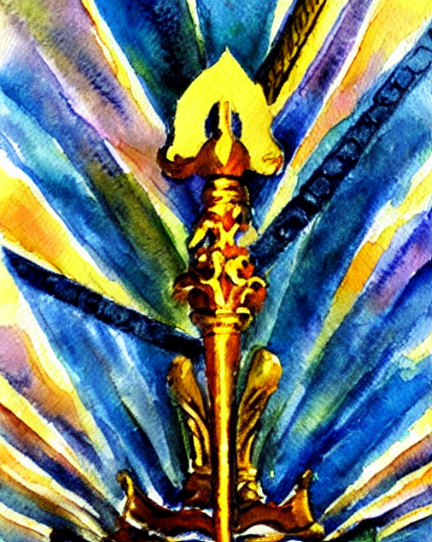
AI generated illustration for the Ace of Swords, looking more like a spear

Golden Dawn’s Book T

A WHITE Radiating Angelic Hand, issuing from clouds, and grasping the hilt of a sword, which supports a White Radiant Celestial Crown; from which depend, on the right, the olive branch of Peace; and on the left, the palm branch of suffering.
Six Vaus fall from its point. It symbolizes “Invoked,” as contrasted with Natural Force: for it is the Invocation of the Sword. Raised upward, it invokes the Divine crown of Spiritual Brightness, but reversed it is the Invocation of Demonic Force; and becomes a fearfully evil symbol. It represents, therefore, very great power for good or evil, but invoked; and it also represents whirling Force, and strength through trouble. It is the affirmation of Justice upholding Divine Authority; and it may become the Sword of Wrath, Punishment, and Affliction.

Etteilla

Fructification
Upright. This card, as far as the medicine of the spirit is concerned, means, in its natural position: Extreme, Great, Excessive. – Exaggerated, Furious, Choleric. – Extremely, Passionately, Excessively. – Vehemence, Animosity, Carriage, Impetus, Anger, Fury, Rage. – Extremity, Terms, Boundary, End, Limits. – Last sigh, Last extremity. – Divergence.
Reversed. Pregnancy, Germ, Seed, Sperm, Matter, Impregnation, Generation, Conception, Fructification. – Childbirth, Puerperium. – Fertilization, Production, Composition. – Enlargement, Increase, Multiplicity.

MQS

Tarot Encyclopedia – The Ace of Cups

(Note: this is a collection of the meanings attributed to the cards by some occultists in the past centuries. It does not reflect my own study or opinion of the cards. It is only meant as a quick comparative reference as I develop my own take.)

The Ace of Cups from the Builders of the Adytum (BOTA) tarot deck

Paul Foster Case (and Ann Davies)

Well Dignified: fertility, productiveness, development, multiplication, happiness, pleasure, gratification, fruition of desires; cheerfulness, geniality, gaiety.
lll Dignified: too much emphasis on pleasure; over-intensity of the desire nature; trouble in love.
Keyword: Desire force
(From the Oracle of Tarot course)

A. E. Waite

The waters are beneath, and thereon are water-lilies; the hand issues from the cloud, holding in its palm the cup, from which four streams are pouring; a dove, bearing in its bill a cross-marked Host, descends to place the Wafer in the Cup; the dew of water is falling on all sides. It is an intimation of that which may lie behind the Lesser Arcana. Divinatory Meanings: House of the true heart, joy, content, abode, nourishment, abundance, fertility; Holy Table, felicity hereof. Reversed: House of the false heart, mutation, instability, revolution.
(From The Pictorial Key to the Tarot)

Aleister Crowley

This card represents the element of Water in its most secret and original form. It is the feminine complement of the Ace of Wands, and is derived from the Yoni and the Moon exactly as that is from the Lingam and the Sun. The third in the Hierarchy. This accordingly represents the essential form of the Holy Grail. Upon the dark sea of Binah, the Great Mother, are Lotuses, two in one, which fill the cup with the Life-fluid, symbolically represented either as Water, as Blood, or as Wine, according to the selected purpose of the symbolism. This being a primordial card, the liquid is shown as water; it can be transformed into Wine or Blood as may be required.

Above the Cup, descending upon it, is the Dove of the Holy Ghost, thus consecrating the element.

At the base of the Cup is the Moon, for it is the virtue of this card to conceive and to produce the second form of its Nature.
(From The Book of Thoth)

AI-generated illustration for the Ace of Cups

Golden Dawn’s Book T

A WHITE Radiant Angelic Hand, issuing from clouds, and supporting on the palm thereof a cup, resembling that of the Stolistes.
From it rises a fountain of clear and glistening water: and sprays falling on all sides into clear calm water below, in which grow Lotuses and Water-lilies. The great Letter of the Supernal Mother is traced in the spray of the Fountain.
It symbolizes Fertility — productiveness, beauty, pleasure, happiness, etc.

Etteilla

Table
Upright. This card, as far as the medicine of the spirit is concerned, means, in its natural position: Table, Meal, Feast, Gala, Banquet, Nourishment, Food, Nutrition. – Guests, Services. – Invitation, Prayer, Supplication, Convocation. – Guest, Hotel, Inn, Tavern. – Abundance, Fertility, Production, Soundness, Stability, Steadfastness, Constancy, Perseverance, Continuance, Duration, Follow-through, Assiduity, Persistence, Steadfastness, Courage. – Picture, Painting, Image, Hieroglyphic, Description. – Tablet, Portfolio, Office, Secretary. – Natural tablet, Bronze tablet, Marble tablet, Law. – Catalog, Index of subjects. – Harmonic table, Garden table, Holy table.
Reversed. Mutation, Permutation, Transmutation, Alteration, Vicissitude, Variety, Variation, Inconstancy, Lightness. – Exchange, Barter, Purchase, Sale, Market, Treaty, Convention. – Metamorphosis, Diversity, Versatility, Reversal, Reversal, Revolution, Reversal. – Version, Translation, Interpretation.

MQS

Tarot Encyclopedia – The Ace of Wands

(Note: this is a collection of the meanings attributed to the cards by some occultists in the past centuries. It does not reflect my own study or opinion of the cards. It is only meant as a quick comparative reference as I develop my own take.)

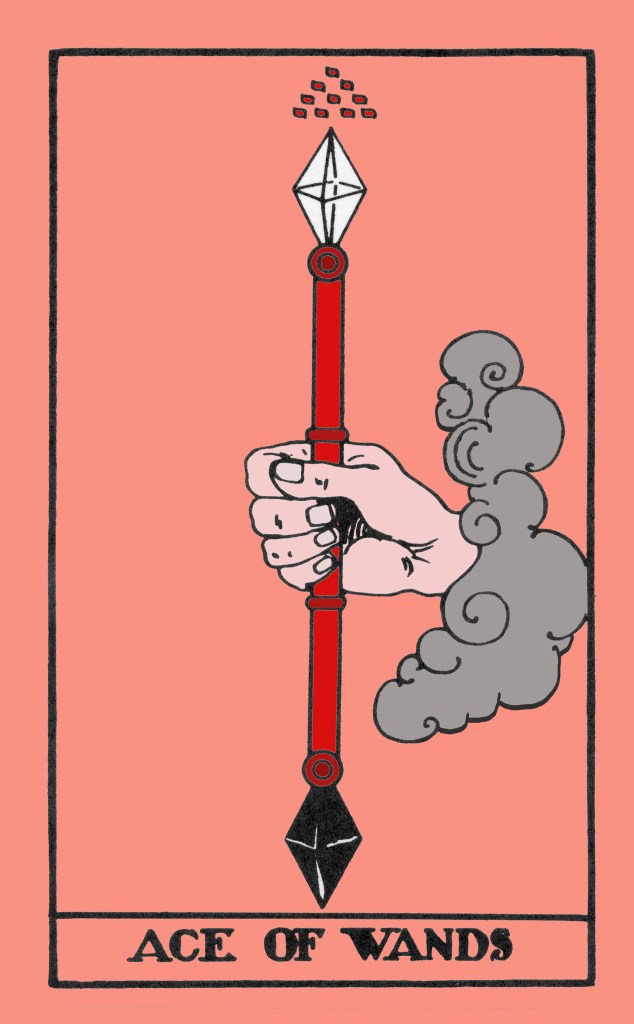
The Ace of Wands from the Builders of the Adytum (BOTA) Tarot deck

Paul Foster Case (and Ann Davies)

In Tarot Divination the Ace of Wands has these key meanings: natural as opposed to invoked force; strength; force; vigor; vitality; particularly the force of concentrated will; the principle of beginning; initiation or inception of any enterprise or activity; concentration of power; involution of force.
Keyword: Initiative
(From the Oracle of Tarot course)

A. E. Waite

A hand issuing from a cloud grasps a stout wand or club. Divinatory Meanings: Creation, invention, enterprise, the powers which result in these; principle, beginning, source; birth, family, origin, and in a sense the virility which is behind them; the starting point of enterprises; according to another account, money, fortune, inheritance. Reversed: Fall, decadence, ruin, perdition, to perish also a certain clouded joy.
(From The Pictorial Key to the Tarot)

Aleister Crowley

This card represents the essence of the element of Fire in its inception. It is a solar-phallic outburst of flame from which spring lightnings in every direction. These flames are Yods, arranged in the form of the Tree of Life. (For Yod, see Atu IX supra.) It is the primordial Energy of the Divine manifesting in Matter, at so early a stage that it is not yet definitely formulated as Will.

Important: although these “small cards” are sympathetic with their Sephirotic origin, they are not identical; nor are they Divine Persons. These (and the Court Cards also) are primarily sub-Elements, parts of the “Blind Forces” under the Demiourgos, Tetragrammaton. Their rulers are the Intelligences, in the Yetziratic world, who go to form the Schemhamphorasch. Nor is even this Name, “Lord of the Universe” though it be, truly Divine, as are the Lords of the Atu in the Element of Spirit. Each Atu possesses its own private, personal and particular Universe, with Demiourgos (and all the rest) complete, just as every man and every woman does.

For example II’s or VI’s Three of Disks might represent the establishment of such an oracle as that of Delphi, or VIII’s might be the first formula of a Code such as Manu gave to Hindustan; V’s, a cathedral, XVI’s, a standing army; and so on. The great point is that all the Elemental Forces, however sublime, powerful, or intelligent, are Blind Forces and no more.
(From The Book of Thoth)

Golden Dawn’s Book T

A WHITE Radiating Angelic Hand, issuing from clouds, and grasping a heavy club, which has three branches in the colours, and with the sigils, of the scales. The Right-and Left-hand branches end respectively in three Flames, and the Centre one in four Flames: thus yielding Ten: the Number of the Sephiroth. Twoand-twenty leaping Flames, or Yodh, surround it, answering to the Paths; of these, three fall below the Right branch for Aleph, Men, and Shin, seven above the Central branch for the double letters; and between it and that of the Right twelve: six above and six below about the Left-hand branch. The whole is a great and flaming Torch. It symbolizes Force — strength, rush, vigour, energy, and it governs, according to its nature, various works and questions. It implies Natural, as opposed to Invoked, Force.

Etteilla

Birth
Upright. This card means, in its natural position, as far as the medicine of the spirit is concerned: Birth, Beginning. – Nativity, Origin, Creation. – Source, Beginning, Primacy. – Extraction, Race, Family, Condition, House, Lineage, Posterity, Occasion, Cause, Reason, First, First fruits.
Reversed. Fall, Decadence, Decay, Decline, Decay, Decay, Dissipation, Failure, Bankruptcy, Ruin, Destruction, Demolition, Damage, Devastation. – Guilt, Error, Contempt, Abatement, Depression, Discouragement. – Perdition, Abyss, Chasm, Precipice. – Dying, Falling, Decay, Derogation. – Depth.

MQS

Tarot Encyclopedia – Index

Back to the Tarot Index

This is intended as a collection of meanings attributed by some sources to the Major Arcana and Minor Arcana of the Tarot. I will add sources as I study them. If you have sources to recommend, hit me up.

If you are interested in a (partial) list of the meanings I attribute to the Major arcana in my reading examples and case studies, click here.

Court Cards

Kings Wands, Cups, Swords, Coins/Pentacles
Queens Wands, Cups, Swords, Coins/Pentacles
Knights Wands, Cups, Swords, Coins/Pentacles
Pages Wands, Cups, Swords, Coins/Pentacles

Small Cards

Aces Wands, Cups, Swords, Coins/Pentacles
Twos Wands, Cups, Swords, Coins/Pentacles
Threes Wands, Cups, Swords, Coins/Pentacles
Fours Wands, Cups, Swords, Coins/Pentacles
Fives Wands, Cups, Swords, Coins/Pentacles
Sixes Wands, Cups, Swords, Coins/Pentacles
Sevens Wands, Cups, Swords, Coins/Pentacles
Eights Wands, Cups, Swords, Coins/Pentacles
Nines Wands, Cups, Swords, Coins/Pentacles
Tens Wands, Cups, Swords, Coins/Pentacles

MQS

Tarot Encyclopedia – The Knight of Wands

(Note: this is a collection of the meanings attributed to the cards by some occultists in the past centuries. It does not reflect my own study or opinion of the cards. It is only meant as a quick comparative reference as I develop my own take.)

The Knight of Wands in the Builders of the Adytum (BOTA) tarot deck

Paul Foster Case (and Ann Davies)

Astrologically the Knight of Wands includes the time period from the third decanate of Scorpio through the second decanate of Sagittarius, November 12 to December 11, representing, as we have seen, the combined influences of the Moon in Scorpio and of Jupiter and Mars in Sagittarius. In Divination we find the more specific meanings of each Key, but always remember that as advanced B.O.T.A. members, treading the Path of Return, you must use this art with discretion. It is best not to give querents for your help too specific instruction. Try to act as an emissary for the Hierophant and give them the principles behind their problems as they are unveiled to you by the sequence of Keys. Leave it to those you are helping to apply universal principles to specific problems in their lives.
Well Dignified: an active, generous, impetuous, quickmoving man, younger than the King of Wands. He is secretive, probably interested in the occult, somewhat psychic and mysterious. He is friendly to the querent and may bring him news relating to his enterprises.
Ill Dignified: e vil-minded, false, cruel, bigoted, brutal young man (or situation), dangerous or unfriendly to the querent1 s affairs. This card
sometimes signifies departure or change of residence.
(From the Oracle of Tarot course)

A.E. Waite

He is shewn as if upon a journey, armed with a short wand, and although mailed is not on a warlike errand. He is passing mounds or pyramids. The motion of the horse is a key to the character of its rider, and suggests the precipitate mood, or things connected therewith. Divinatory Meanings: Departure, absence, flight, emigration. A dark young man, friendly. Change of residence. Reversed: Rupture, division, interruption, discord.
(From The Pictorial Key to the Tarot)

AI-generated illustration for the Knight of Wands

Aleister Crowley

(note that Crowley and the Golden Dawn made a mess with the knights and kings)
The Prince of Wands represents the airy part of Fire, with its faculty of expanding and volatilising. He rules from the 21st degree of Cancer to the 20th degree of Leo. He is a warrior in complete armour of scale mail, but his arms are bare on account of his vigour and activity. He wears a rayed crown surmounted by a lion’s head winged, and from this crown depends a curtain of flame. On his breast is the sigil of To Mega Therion. In his left hand he bears the Phoenix wand of the Second Adept in the Ritual of 5=6 of R.R. at A.C.), the wand of Power and Energy, while with his other arm he reins the lion which draws his chariot, the chariot which is fortified by a wheel radiating flame. He rides upon a sea of flames, both waved and salient.

The moral qualities appropriate to this figure are swiftness and strength. But he is sometimes inclined to act on impulse; sometimes easily led by external influences; sometimes, especially in trifles, a prey to indecision. He is often violent, especially in the expression of an opinion, but he does not necessarily hold the opinion about which he is so emphatic. He states a vigorous proposition for the sake of stating it. He is in fact very slow to make up his mind thoroughly on any subject, but always sees both sides of every question. He is essentially just, but always feels that justice is not to be attained in the intellectual world.

His character is intensely noble and generous. He may be an extravagant boaster, while slyly laughing both at the object of his boast and at himself for making it. He is romantic, especially in matters of history and tradition, to the point of folly, and may engineer “stunts” or play elaborate practical jokes. He might select some inoffensive nobody, and pursue him for years with every weapon of ridicule) as Swift tormented the unhappy Partridge, all without the least animus, ready to give the shirt off his back, should his victim be in need. His sense of humour is omnivorous, and may make him a mysterious figure, dreaded without reason by people who actually know nothing about him but his name-as a symbol of Terror.

This is due to the influence of the last decan of Cancer upon this card. One of his greatest faults is pride; meanness and pettiness of any kind he holds in infinite scorn. His courage is fanatically strong, and his endurance indefatigable. He is always fighting against odds, and always wins in the long-the very long-run. This is principally due to his enormous capacity for work, which he exercises for its own sake, “without lust of result”; perhaps his haughty contempt for the world at large-which however coexists with profound and ecstatic respect for “every man and every woman” as “a star”-is responsible for this.

When this card is badly dignified, the character degenerates. Each of the qualities mentioned above is found in its antithesis. There is great cruelty in him, partly sadistic and partly due to callousness arising from indifference-and, in a sense, laziness! So too he may be intolerant, prejudiced and idle-principally because it saves trouble. He may furthermore be an empty boaster and a great coward.

In the YI King, the airy part of Fire is represented by the 42nd Hexagram, Yi, which signifies addition, increase. Full of virtue, and confident therein, he contemplates work of stupendous scope, often with the idea expressed in line 5: “with sincere heart seeking to benefit all below”. In this he may achieve immense success. But this course is fraught with commensurate danger. “We see one to whose in crease none will contribute, while many will seek to assail him. He observes no regular rule in the ordering of his heart”. (line 6) This peril avoided, there come “parties adding to the store of its subject ten pairs of tortoise shells whose oracles cannot be opposed-Let the King employ them in presenting his offerings to God….” (line 2).
(From The Book of Thoth)
Note: Crowley clearly sees himself in this card, which is why he depicts the Prince as the adorable occult prankster he saw himself as.

Golden Dawn’s Book T

A KINGLY Figure with a golden, winged crown, seated on a chariot. He has large white wings. One wheel of his chariot is shewn. He wears corslet and buskins of scale armour decorated with a winged lion’s head, which symbol also surmounts his crown. His chariot is drawn by a lion. His arms are bare, save for the shoulder-pieces of the corslet, and he bears a torch or fire-wand, somewhat similar to that of the Zelator Adeptus Minor. Beneath the chariot are flames, some waved, some salient.
Swift, strong, hasty; rather violent, yet just and generous; noble and scorning meanness.
If ill dignified — cruel, intolerant, prejudiced and ill natured.


Etteilla

Departure
Upright: This card, as far as the medicine of the spirit is concerned, means, in its natural position: Departure, Displacement, Removal, Absence, Abandonment, Change, Escape, Desertion, Transmigration, Emigration. – Transposition, Translocation, Transplantation, Transmutation, Evasion.
Reversed: Disunion, Disagreement, Rupture, Dissension, Division, Competition, Separation, Partition. – Faction, Party. – Complaint, Altercation. – Cut, Fracture, Discontinuity, Interruption.

Tarot Encyclopedia – The Queen of Wands

(Note: this is a collection of the meanings attributed to the cards by some occultists in the past centuries. It does not reflect my own study or opinion of the cards. It is only meant as a quick comparative reference as I develop my own take.)

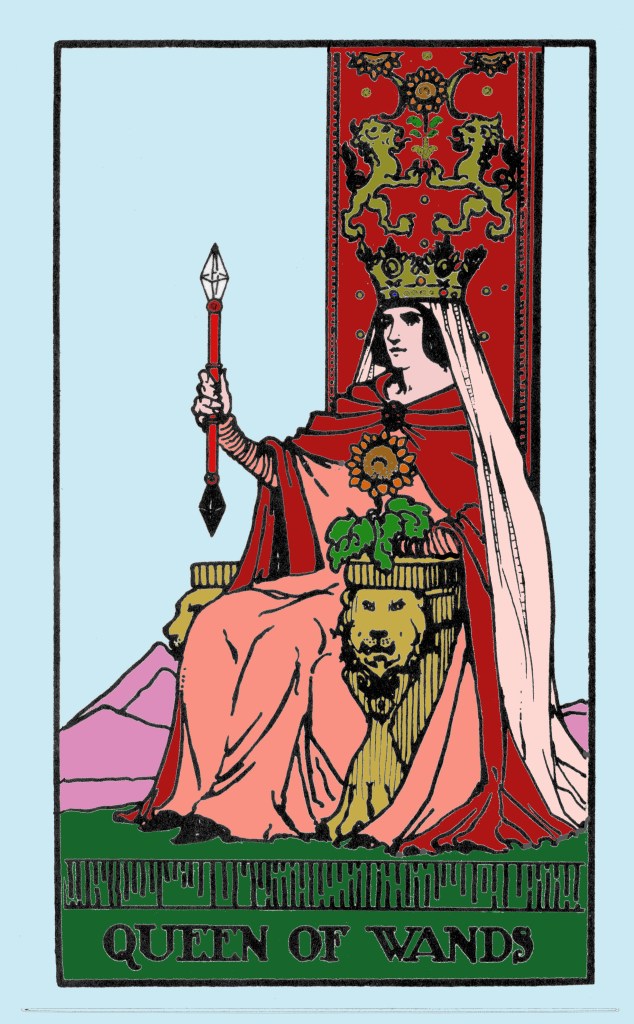
The Queen of Wands from the Builders of the Adytum (BOTA) tarot deck

Paul Foster Case (and Ann Davies)

The time period related to the Queen of Wands is from July 13 to August 12, symbolizing the influence of Jupiter and Neptune in Cancer and of the Sun and Jupiter in Leo. The basic power suggested by this Key is that of command.
Well Dignified: in a divination the Queen of Wands symbolizes a kind, generous woman, resolute in the face of opposition, strongly psychic and intuitive but practical in applying her spiritual gifts; intense; magnetic ; friendly to the querent and a favorable influence for the success or business of the querent.
Ill Dignified: Inimical to the querent; obstinate, dangerous woman, unfavorable to querent’s affairs; revengeful and tyrannical.
(From the Oracle of Tarot course)

A. E. Waite

The Wands throughout this suit are always in leaf, as it is a suit of life and animation. Emotionally and otherwise, the Queen’s personality corresponds to that of the King, but is more magnetic. Divinatory Meanings: A dark woman, countrywoman, friendly, chaste, loving, honourable. If the card beside her signifies a man, she is well disposed towards him; if a woman, she is interested in the Querent. Also, love of money, or a certain success in business. Reversed: Good, economical, obliging, serviceable. Signifies also–but in certain positions and in the neighbourhood of other cards tending in such directions–opposition, jealousy, even deceit and infidelity.
(From The Pictorial Key to the Tarot)

Aleister Crowley

The Queen of Wands represents the watery part of Fire, its fluidity and colour. Also, she rules in the Zodiac from the 21st degree of Pisces to the 20th degree of Aries. Her crown is topped with the winged globe and rayed with flame. Her long red golden hair flows down upon her armour of scaled mail. She is seated upon a throne of flame, ordered into geometrical light by her material power. Beneath the throne the surging flames are steady. She bears a wand in her left hand; but it is topped with a cone suggestive of the mysteries of Bacchus. She is attended by a couchant leopard upon whose head she lays her hand. Her face expresses the ecstasy of one whose mind is well in-drawn to the mystery borne beneath her bosom.

The characteristics of the Queen are adaptability, persistent energy, calm authority which she knows how to use to enhance her attractiveness. She is kindly and generous, but impatient of opposition. She has immense capacity for friendship and for love, but always on her own initiative.

There is as much pride in this card as in the Knight, but it lacks the spontaneous nobility which excuses that error. It is not true pride, but self-complacent vanity and even snobbery.

The other side of her character is that she may have a tendency to brood, come to a wrong decision thereon, and react with great savagery. She may be easily deceived; then she is likely to shew herself stupid, obstinate, tyrannical. She may be quick to take offence, and harbour revenge without good cause. She might turn and snap at her best friends without intelligible excuse. Also, when she misses her bite, she breaks her jaw!

In the YI King, the watery part of Fire is represented by the 17th hexagram, Sui. It indicates reflection upon impulse, and the consequently even flow of action. There is great capacity for lucid conception and steady prosecution of work; but this is only at the bidding, and under the guidance, of some creative mind. There is a tendency to be fickle, even disloyal; the ideas which she obeys make no deep or permanent impression. She will “cleave to the little boy and let go the man of age and experience” or the reverse (lines 2 and 3) without realizing what she is doing. There is liability of fits of melancholy, which she seeks to cure by bouts of intoxication, or by panic-stricken outbursts of ill-considered fury.
(From The Book of Thoth)

Strangely Crowley-esque AI-generated illustration for the Queen of Wands

Golden Dawn’s Book T

A CROWNED queen with long red-golden hair, seated upon a Throne, with steady flames beneath. She wears a corslet and buskins of scale-mail, which latter her robe discloses. Her arms are almost bare. On cuirass and buskins are leopard’s heads winged, and the same symbol surmounteth her crown. At her side is a couchant leopard on which her hands rest. She bears a long wand with a very heavy conical head. The face is beautiful and resolute.
Adaptability, steady force applied to an object, steady rule, great attractive power, power of command, yet liked notwithstanding. Kind and generous when not opposed.
If ill dignified, obstinate, revengeful, domineering, tyrannical, and apt to turn against another without a cause.
She rules the heavens from above the last Decan of Pisces to above the 20 Degree of Aries: including thus a part of Andromeda.

Etteilla

Country Woman
Upright: This card, as far as the medicine of the spirit is concerned, means, when upright: Country woman, housewife, economy, honesty, civility – Sweetness, virtue – Honor, chastity
Reversed: Good woman, goodness, excellence – Respectful, caring, obliging – Service, favor, benefit

MQS

Tarot Encyclopedia – The Queen of Cups

(Note: this is a collection of the meanings attributed to the cards by some occultists in the past centuries. It does not reflect my own study or opinion of the cards. It is only meant as a quick comparative reference as I develop my own take.)

The Queen of Cups from the Builders of the Adytum (BOTA) tarot deck

Paul Foster Case (and Ann Davies)

The time period is the beginning of the last decanate of Libra to the end of the second decanate of Scorpio, October 13 to November 11, combining the rulerships of Mercury, Mars, Jupiter and Neptune.
Well Dignified: through the influence of Mercury in Libra the Queen of Cups personifies a woman, mentally alert, yet somewhat superficial, who probably has a touch of the poetic in her nature. She is kindhearted though not likely to go to too much trouble for anyone. The Scorpio influence added gives her strong desires and makes her emotionally responsive and attractive to the opposite sex; very psychic, and if her hig he r nature is developed she depicts a very powerful spiritual force akin to the influence of the purified desire nature and the influence of Neshamah.
Ill Dignified: a woman who is subtle, decidedly coquettish and may even be a deliberate heart-breaker.
Usually gold-brown hair with blue eyes.
(From the Oracle of Tarot course)

A. E. Waite

Beautiful, fair, dreamy–as one who sees visions in a cup. This is, however, only one of her aspects; she sees, but she also acts, and her activity feeds her dream. Divinatory Meanings: Good, fair woman; honest, devoted woman, who will do service to the Querent; loving intelligence, and hence the gift of vision; success, happiness, pleasure; also wisdom, virtue; a perfect spouse and a good mother. Reversed: The accounts vary; good woman; otherwise, distinguished woman but one not to be trusted; perverse woman; vice, dishonour, depravity.
(From The Pictorial Key to the Tarot)

Aleister Crowley

The Queen of Cups represents the watery part of Water, its power of reception and reflection. In the Zodiac it rules from the 21St degree of Gemini to the 20th degree of Cancer Her image is of extreme purity and beauty, with infinite subtlety; to see the Truth of her is hardly possible, for she reflects the nature of the observer in great perfection.

She is represented as enthroned upon still water. In her hand she bears a shell-like cup, from which issues a crayfish, and she bears also the Lotus of Isis, of the Great Mother. She is robed in, and veiled by, endless curves of light, and the sea upon which she is enthroned conveys the almost unbroken images of the image which she represents.

The characteristics associated with this card are principally dreaminess, illusion and tranquillity. She is the perfect agent and patient, able to receive and transmit everything without herself being affected thereby. If ill-dignified, all these qualities are degraded. Everything that passes through her is refracted and distorted. But, speaking generally, her characteristics depend mostly upon the influences which affect her.

In the Yi King, the watery part of Water is represented by the 8th hexagram, Tui. The commentary is as colourless as the card; it consists of mild exhortations on the subject of pleasure. It may really be said that, normally, people of this type have no character at all of their own, unless it can be called a characteristic to be at the disposition of every impact or impression.

There is, however, a hint (line 6) that the chief pleasure of people of this type is to lead and attract others. Such are accordingly (often enough) exceedingly popular.
(From The Book of Thoth)

AI-Generated illustration for the Queen of Cups

Golden Dawn’s Book T

A VERY beautiful fair woman like a crowned Queen, seated upon a throne, beneath which is flowing water wherein Lotuses are seen. Her general dress is similar to that of the Queen of Wands, but upon her crown, cuirass and buskins is seen an Ibis with opened wings, and beside her is the same bird, whereon her hand rests. She holds a cup, wherefrom a crayfish issues. Her face is dreamy. She holds a lotus in the hand upon the Ibis. She is imaginative, poetic, kind, yet not willing to take much trouble for another.
Coquettish, good-natured and underneath a dreamy appearance. Imagination stronger than feeling. Very much affected by other influences, and therefore more dependent upon dignity than most symbols.
She rules from 20 Degree Gemini to 20 Degree Cancer.

Etteilla

Blonde Woman
Upright: As far as the medicine of the spirit is concerned, this card, when upright, means: Blonde Woman, Honest Woman, Virtue, Wisdom, Honesty
Reversed: Distinguished woman, Vice, Dishonesty, Debauchery, Corruption, Scandal

MQS

Tarot Encyclopedia – The King of Swords

(Note: this is a collection of the meanings attributed to the cards by some occultists in the past centuries. It does not reflect my own study or opinion of the cards. It is only meant as a quick comparative reference as I develop my own take.)

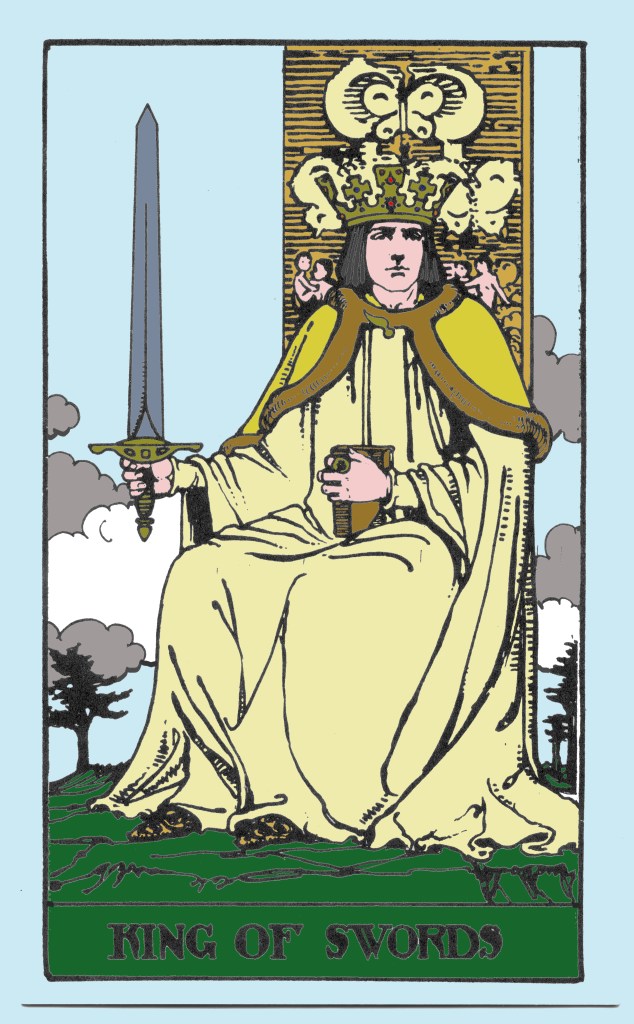
A collection of interpretations for the King of Swords
The King of Swords from the Builders of the Adytum (BOTA) tarot deck

Paul Foster Case (and Ann Davies)

The time period is from the beginning of the last decanate of Virgo to the end of the second decanate of Libra, September 13 to October 12, under the combined rulerships of Venus in Taurus, Venus in Libra, and Saturn-Uranus in Aquarius. Meanings: a man of strong and powerful imagination; hard worker and having authority; keen in understanding law and capable of excellent cooperation; somewhat distrustful and suspicious and therefor e hard to convince. He sometimes surprises his friends by sudden changes of attitude, although he is usually overcautious and analytical. In a divinatory lay-out:
Well Dignified: he is friendly to the Querent and will cooperate with him. lll Dignified: he is inimical, harsh, malicious and plotting, obstinate and wholly unreliable.
Dark hair and dark eyes.
(From the Oracle of Tarot course)

A. E. Waite

He sits in judgment, holding the unsheathed sign of his suit. He recalls, of course, the conventional Symbol of justice in the Trumps Major, and he may represent this virtue, but he is rather the power of life and death, in virtue of his office. 
Divinatory Meanings: Whatsoever arises out of the idea of judgment and all its connexions-power, command, authority, militant intelligence, law, offices of the crown, and so forth. 
Reversed: Cruelty, perversity, barbarity, perfidy, evil intention.
(From The Pictorial Key to the Tarot)

Aleister Crowley

(Note: Crowley and the Golden Dawn swapped around King and Knight. This is in part true of Waite as well.)

The Knight of Swords represents the fiery part of Air; he is the wind, the storm. He represents the violent power of motion applied to an apparently manageable element. He rules from the 21st degree of Taurus to the 20th degree of Gemini. He is a warrior helmed, and for his crest he bears a revolving wing. Mounted upon a maddened steed, he drives down the Heavens, the Spirit of the Tempest. In one hand is a sword, in the other a poniard. He represents the idea of attack.

The moral qualities of a person thus indicated are activity and skill, subtlety and cleverness. He is fierce, delicate and courageous, but altogether the prey of his idea, which comes to him as an inspiration without reflection.

If ill-dignified, the vigour in all these qualities being absent, he is incapable of decision or purpose. Any action that he takes is easily brushed aside by opposition. Inadequate violence spells futility. “Chimaera bombinans in vacuo”.

In the Yi King, the fiery part of Air is represented by the 32nd hexagram, Hang. This is the first occasion on which it has been simple to demonstrate the close technical parallelism which identifies Chinese thought and experience with that of the West. For the meaning is long continuance: “perseverance in well-doing, or continuously acting out the law of one’s being”, as Legge puts it in his note on the hexagram; and this seems incongruous with the Qabalistic idea of violent energy applied to the least stable of the elements. But the trigram of Air also indicates wood; and the hexagram may have Suggested the irresistible flow of the sap, and its effect in strengthening the tree. This conjecture is supported by the warning in line 6: “The topmost line, divided, shows its subject exciting himself to long continuance. There will be evil.”

Allowing this, the image of “the extended flame of mind”, as Zoroaster calls it, may well be subjoined to the former description. It is the True Will exploding the mind spontaneously. The influence of Taurus makes for steadiness, and that of the first decanate of Gemini for inspiration. So let us picture him, “integer vitae scelerisque purus”, a light-shaft of the Ideal absorbing the entire life in concentrated aspiration, passing from earthy Taurus to exalted Gemini. Here, too, is shewn (as in the Yi) the danger to the subject of this symbol; for the first decan is the card called “Interference”; or, in the old pack, “Shortened Force”.
(From the Book of Thoth)

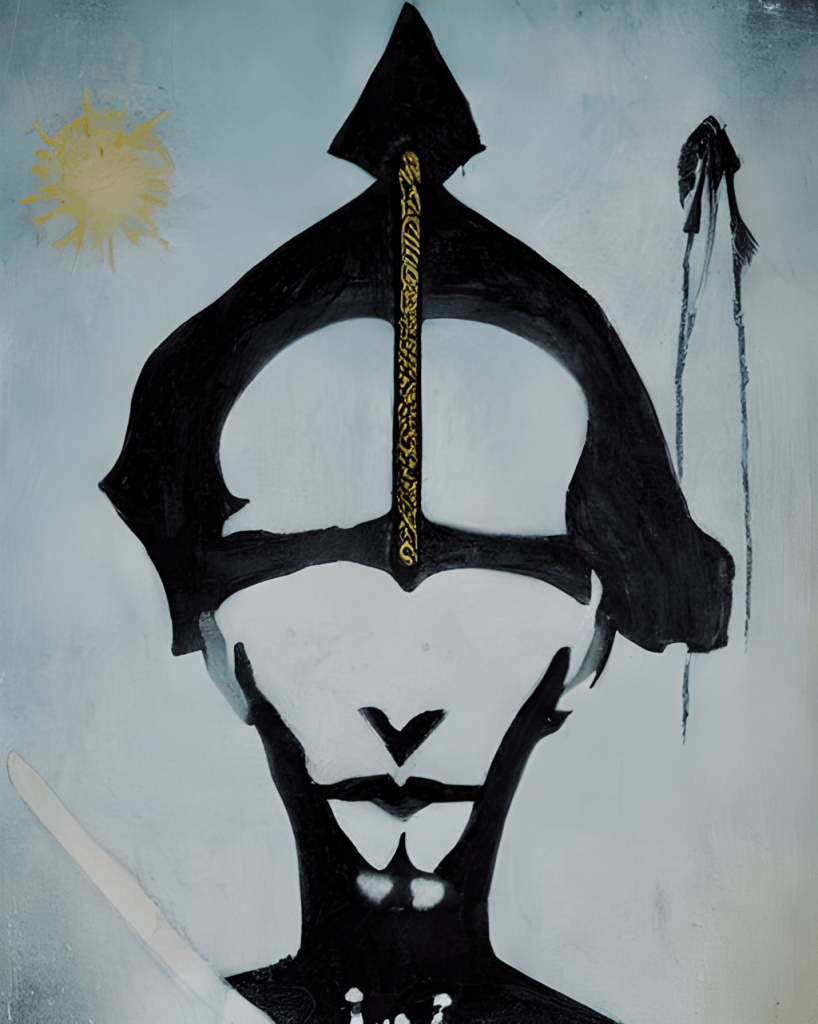
Oddly Bismarckian AI-generated Illustration for the King of Swords

Golden Dawn’s Book T

A WINGED Warrior with crowned Winged Helmet, mounted upon a brown steed. His general equipment is as that of the Knight of Wands, but he wears as a crest a winged six-pointed star, similar to those represented on the heads of Castor and Pollux the Dioscuri, the twins Gemini (a part of which constellation is included in his rule). He holds a drawn sword with the sigil of his scale upon its pommel. Beneath his horse’s feet are dark-driving stratus clouds. He is active, clever, subtle, fierce, delicate, courageous, skilful, but inclined to domineer. Also to overvalue small things, unless well dignified. If ill dignified, deceitful, tyrannical and crafty.
Rules from 20 Degree Taurus to 20 Degree Gemini.

Etteilla

Man in Uniform
Upright: This card, as far as the medicine of the spirit is concerned, means, in its natural position: Man in Uniform, Man of the Law, Judge, Councilor, Assessor, Senator, Business Man, Medical Practitioner, Lawyer, Prosecutor, Doctor, Physician. – Jurist, Law-making. – Litigant [= Party to litigation], Jurisconsult.
Reversed: Malicious, Maliciousness, Perversity, Perfidy, Crime, Cruelty, Atrocity, Inhumanity.

MQS

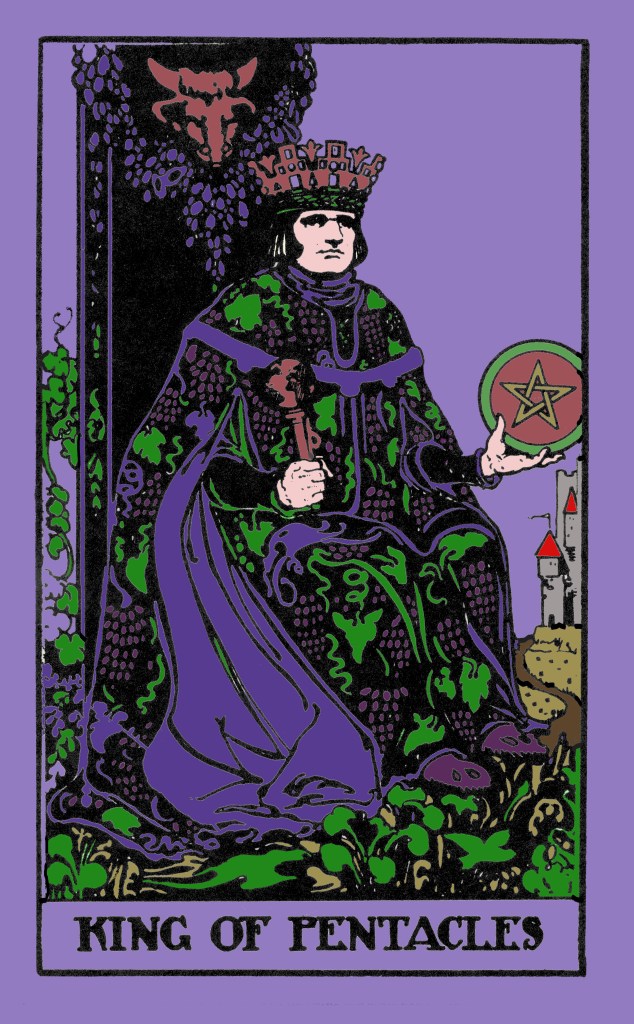
Tarot Encyclopedia – The King of Coins or Pentacles

(Note: this is a collection of the meanings attributed to the cards by some occultists in the past centuries. It does not reflect my own study or opinion of the cards. It is only meant as a quick comparative reference as I develop my own take.)

The King of Coins or King of Pentacles from the Builders of the Adytum (BOTA) tarot deck

Paul Foster Case (and Ann Davies)

The time period is from the beginning of the last decanate of Sagittarius to the end of the second d ecanate of Capricorn, De cember 12 to January 9. This period combines the rulerships of the Sun, Saturn and Venus .
Well-Dignified: the ability to see the workings of Divine Law in the phenomena of the physical plane – thus rulership. In divination, a dark man, friendly to the Querent, practical, steady and reliable. He is good at the practical application of ideas and theories. Things tend to prosper and increase under his direction. He is slow to anger, but furious when aroused. Ill-Dignified: good theoretical insight into the workings of Divine Law, but inability to apply it to everyday experiences. In divination, a man selfish and materialistic. Such a man could have some power to solidify evil forces and express them but is nevertheless somewhat stupid.
(From the Oracle of Tarot course)

A. E. Waite

The figure calls for no special description. The face is rather dark, suggesting also courage, but somewhat lethargic in tendency. The bull’s head should be noted as a recurrent symbol on the throne. The sign of this suit is represented throughout as engraved or blazoned with the pentagram, typifying the correspondence of the four elements in human nature and that by which they may be governed. In many old Tarot packs this suit stood for current coin, money, deniers. I have not invented the substitution of pentacles and I have no special cause to sustain in respect of the alternative. But the consensus of divinatory meanings is on the side of some change, because the cards do not happen to deal especially with questions of money. 
Divinatory Meanings: Valour, realizing intelligence, business and normal intellectual aptitude, sometimes mathematical gifts and attainments of this kind; success in these paths. Reversed: Vice, weakness, ugliness, perversity, corruption, peril.
(From The Pictorial Key to the Tarot)

Aleister Crowley

(Note: Crowley and the Golden Dawn swapped around King and Knight. This is in part true of Waite as well.)
The Knight of Disks represents the fiery part of Earth, and refers in particular to the phenomena of mountains, earthquakes, and gravitation; but it also represents the activity of Earth regarded as the producer of Life. He rules from the 21st degree of Leo to the 20th degree of Virgo, and is thus concerned greatly with agriculture. This warrior is short and sturdy in type. He is clothed in great solidity of plate armour; but his helmet, which is crested with the head of a stag, is thrown back, for at the moment his function is entirely confined to the production of food. For this reason he is armed with a flail. The disk which he bears, moreover, is very solid; it represents nutrition. These characteristics are borne out by his horse; a shire horse, solidly planted on all four feet, as was not the case with the other Knights. He rides through the fertile land; even the distant hills are cultivated fields.

Those whom he symbolizes tend to be dull, heavy and preoccupied with material things. They are laborious and patient, but would have little intellectual grasp even of matters which concern them most closely. Their success in these is due to instinct, to imitation of Nature. They lack initiative; their fire is the smouldering fire of the process of growth.

If ill-dignified, these people are hopelessly stupid, slavish, quite incapable of foresight even in their own affairs, or of taking an intelligent interest in anything outside them. They are churlish, surly, and jealous (in a dull sort of way) of what they instinctively realize is the superior state of others; but they have not the courage or intelligence to better themselves. Yet they are always irritably meddling about petty matters; they interfere with, and inevitably spoil, whatever comes their way.

In the Yi King, the fiery part of Earth is represented by the 62nd hexagram, Hsiao Kwo. This is as important as its complement, Kung Fu (see under Prince of Cups); it is a “big Khan”, the trigram of Luna with each line doubled. But it is also suggestive of the Geomantic figure Conjunctio, Mercury in Virgo, corresponding very closely indeed with the Fire of Earth attribution in the Qabalistic system.

To the Chinese sages, moreover, the shape of the figure gave the idea of a bird. The meaning is, accordingly, modified by human influence of the more frivolous and irresponsible kind, Shakespeare’s “little wanton harlotry”, the French cynic’s “Souvent femme vane”, and the fickle mob of Coriolanus; indeed, of History itself. But Mercury in Virgo symbolizes Intelligence (and even creative Idea) applied to Agriculture; and this (once more!) harmonizes perfectly with the Ten of Disks, which is ruled by this Planet and this Sign. This adds to the superabundant mass of proof that this whole system of symbolism is based upon Realities of Nature, as understood by the materialist School of Science-if such a school survives in some obscure and obsolescent University! Such coherence, such introverted exfoliation, cannot be the chance parallelism of the dreams of nebulous philosophies.

The character described by this card is therefore exceeding complex yet admirably well-knit; but its dangers are indicated by the symbols of Luna and the bird. In the happiest cases, the qualities thus indicated will be romance and imagination; but overweening ambition, the pursuit of Ignis Fatuus, superstition, and the tendency to waste time in idle dreaming, are perils all too frequently found in such sons of the soil. Thomas Hardy has painted many admirable portraits of the type. Ill-starred indeed and black with bile are those who have profaned the Sacred Fire, not enkindling Earth to new, more copious, more varied life, but peering in deceptive moonlight, turning their faces from their mother Earth.
(From the Book of Thoth)

AI-generated King of Pentacles or King of Coins illustration

Golden Dawn’s Book T

A DARK Winged Warrior with winged and crowned helmet: mounted on a light brown horse. Equipment as the Knight of Wands.
The winged head of a stag or antelope as a crest. Beneath the horse’s feet is fertile land with ripened corn. In one hand he bears a sceptre surmounted by a hexagram: in the other a Pentacle like that of the Zelator Adeptus Minor.
Unless very well dignified he is heavy, dull, and material. Laborious, clever, and patient in material matters. If ill dignified, he is avaricious, grasping, dull, jealous; not very courageous, unless assisted by other symbols.
Rules from above 20 Degree of Leo to 20 Degree of Virgo.

Etteilla

Dark man.
Upright. This card, as far as the medicine of the spirit is concerned, means, in its natural position: Dark Man, Trader, Shopkeeper, Banker, Stockbroker, Calculator, Speculator. – Physics, Geometry, Mathematics, Science. – Teacher, Professor.
Reversed. Vice, Defect, Weakness, Defective, Defective conformation, Deformed nature. – Abnormality, Ugliness, Deformity. – Corruption. – Stench.

MQS