(Note: this is a collection of the meanings attributed to the cards by some occultists in the past centuries. It does not reflect my own study or opinion of the cards. It is only meant as a quick comparative reference as I develop my own take.)
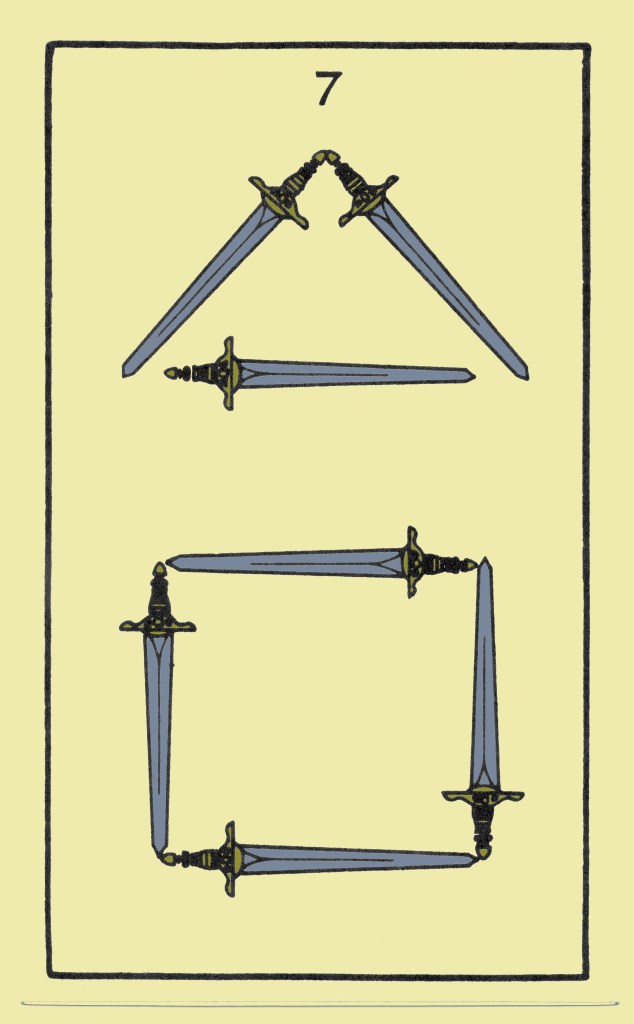
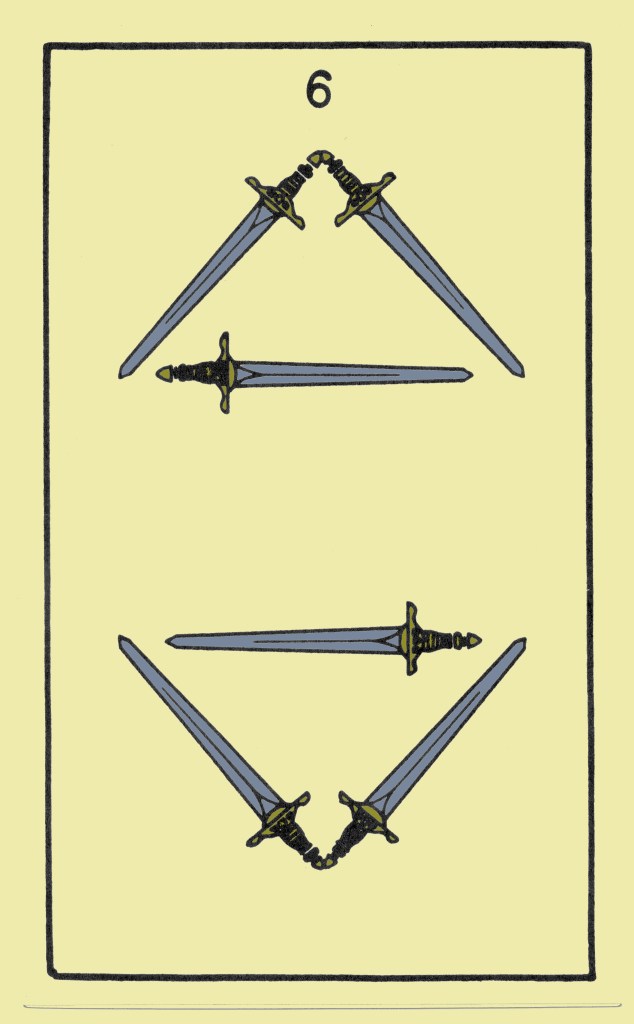
The Seven of Swords from the Builders of the Adytum (BOTA) tarot deck
Paul Foster Case (and Ann Davies)
The time period is the third decanate of Aquarius, February 9 to 18, under the rulership of Venus. Well-Dignified: partial success; the Querent is too easy-going or does not draw sufficiently on his reserve force; he has good opportunities but may not make the most of them; he is likely to compromise too easily. Ill-Dignified: love of ease and display cause loss; the Querent suffers from the insolence of others and may be insolent himself; there is danger that his own confidence may be betrayed, or that he may be led into betraying the confidence of others. Keyword: Instability. (From the Oracle of Tarot course)
A. E. Waite
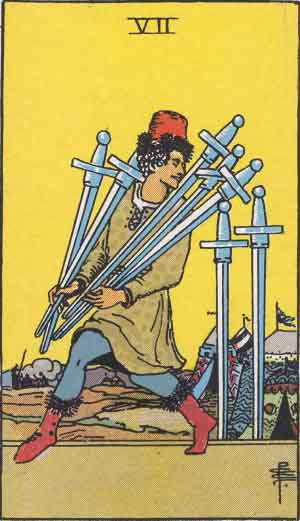
A man in the act of carrying away five swords rapidly; the two others of the card remain stuck in the ground. A camp is close at hand. Divinatory Meanings: Design, attempt, wish, hope, confidence; also quarrelling, a plan that may fail, annoyance. The design is uncertain in its import, because the significations are widely at variance with each other. Reversed: Good advice, counsel, instruction, slander, babbling. (From The Pictorial Key to the Tarot)
The Seven of Swords from the Rider Waite Smith tarot
Aleister Crowley
The Seven of Swords is called Futility. This is a yet weaker card than the Seven of Wands. It has a passive sign instead of an active one, a passive planet instead of an active one. It is like a rheumatic boxer trying to “come back” after being out of the ring for years. Its ruler is the Moon. The little energy that it possesses is no more than dream-work; it is quite incapable of the sustained labour which alone, bar miracles, can bring any endeavour to fruition. The comparison with the Seven of Wands is most instructive.
[…]
Netzach, in the suit of Swords, does not represent such catastrophe as in the other suits, for Netzach, the Sephira of Venus, means victory. There is, therefore, a modifying influence; and this is accentuated by the celestial rule of the Moon in Aquarius.
The intellectual wreckage of the card is thus not so vehement as in the Five. There is vacillation, a wish to compromise, a certain toleration. But, in certain circumstances, the results may be more disastrous than ever. This naturally depends upon the success of the policy. This is always in doubt as long as there exist violent, uncompromising forces which take it as a natural prey.
This card, like the Four, suggests the policy of appeasement. The symbol shows six Swords with their hilts in crescent formation. Their points meet below the centre of the card, impinging upon a blade of a much larger up-thrusting sword, as if there were a contest between the many feeble and the one strong. He strives in vain. (From the Book of Thoth)
The Seven of Swords from the Thoth tarot deck
Golden Dawn’s Book T
TWO Angelic Radiating Hands as before, each holding three swords. A third hand holds up a single sword in the centre. The points of all the swords “just touch” each other, the central sword not altogether dividing them. The Rose of the previous symbols of this suit is held up by the same hand which holds the central sword: as if the victory were at its disposal. Symbols of Moon and Aquarius.
Partial success. Yielding when victory is within grasp, as if the last reserves of strength were used up. Inclination to lose when on the point of gaining, through not continuing the effort. Love of abundance, fascinated by display, given to compliments, affronts and insolences, and to spy upon others. Inclined to betray confidences, not always intentionally. Rather vacillatory and unreliable. Netzach of HB:V (Journey by land: in character untrustworthy). Herein rule the Great Angels HB:HHHAL and HB:Ma’aKAL.
Etteilla
Hope Upright. This card, as far as the medicine of the spirit is concerned, means, in its natural position: Hope, Expectation, Expectation, Pretending, Founding, Overestimating, Founding, Designing, Willing, Wanting, Wishing, Vowing, Wanting, Taste, Fantasy. Reversed. Wise opinion, Good advice, Salutary warnings, Instruction, Lesson. – Observation, Reflection, Note, Caution, Thoughtfulness. – Reprehension, Reprimand. – News, Announcement, Posting. – Consultation, Admonition.
(Note: this is a collection of the meanings attributed to the cards by some occultists in the past centuries. It does not reflect my own study or opinion of the cards. It is only meant as a quick comparative reference as I develop my own take.)
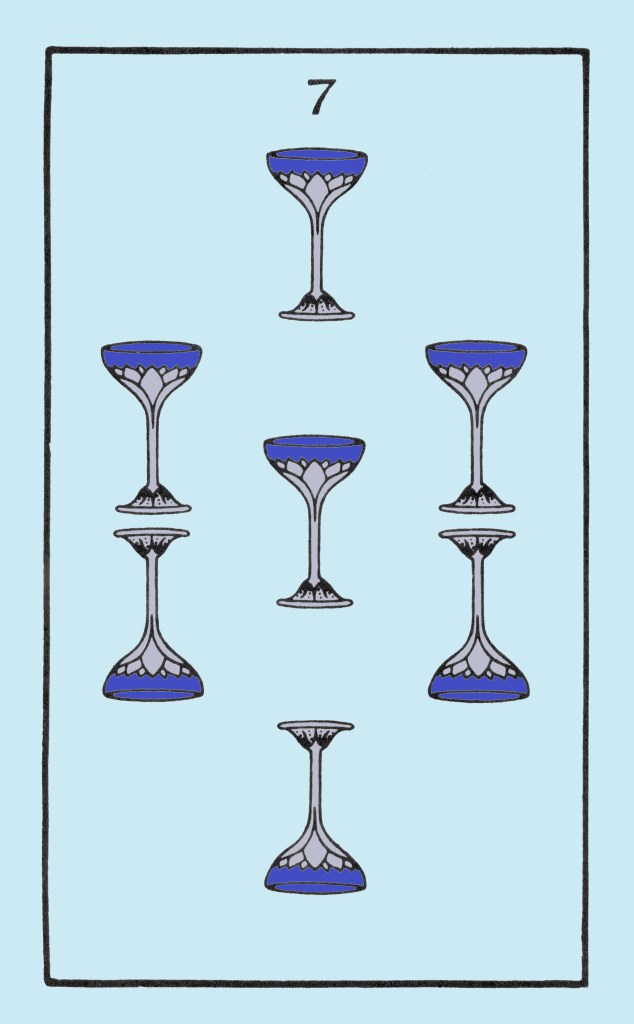
The Seven of Cups from the Builders of the Adytum (BOTA) tarot deck
Paul Foster Case (and Ann Davies)
The time period is the third decanate of Scorpio, November 11 to November 20, under the subrulership of the Moon. Well-Dignified: possible victory, but the person to whom the card applies may be too indolent to take advantage of his opportunities for commanding circumstance. Success may be gained, but not followed up; necessity for choosing only the highest objectives. lll-Dignified: illusionary success; lying and deceit; drunkenness; violence, even lust. Keyword: Illusion (From the Oracle of Tarot course)
A. E. Waite
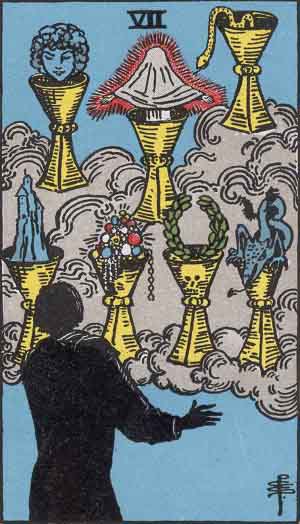
Strange chalices of vision, but the images are more especially those of the fantastic spirit. Divinatory Meanings: Fairy favours, images of reflection, sentiment, imagination, things seen in the glass of contemplation; some attainment in these degrees, but nothing permanent or substantial is suggested. Reversed: Desire, will, determination, project. (From The Pictorial Key to the Tarot)
The Seven of Cups from the Rider Waite Smith Tarot Deck
Aleister Crowley
The Seven of Cups is called Debauch. This is one of the worst ideas that one can have; its mode is poison, its goal madness. It represents the delusion of Delirium Tremens and drug addiction; it represents the sinking into the mire of false pleasure. There is something almost suicidal in this card. It is particularly bad because there is nothing whatever to balance it-no strong planet to hold it up. Venus goes after Venus, and Earth is churned into the scorpion morass.
[…]
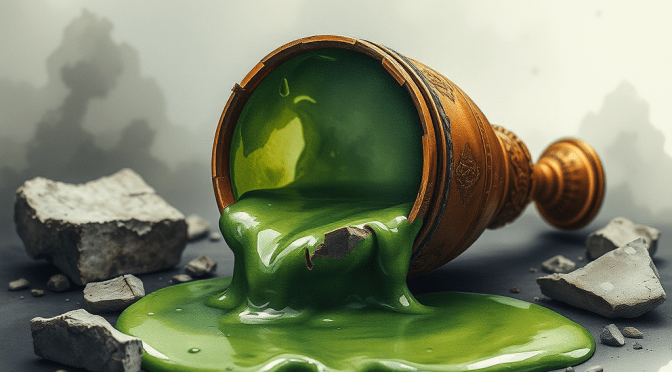
This card refers to the Seven, Netzach, in the suit of Water. Here recurs the invariable weakness arising from lack of balance; also, the card is governed by Venus in Scorpio. Her dignity is not good in this Sign; one is reminded that Venus is the planet of Copper, “external splendour and internal corruption”. The Lotuses have become poisonous, looking like tiger-lilies; and, instead of water, green slime issues from them and overflows, making the Sea a malarious morass. Venus redoubles the influence of the number Seven.
The cups are iridescent, carrying out the same idea. They are arranged as two descending triangles interlaced above the lowest cup, which is very much larger than the rest. This card is almost the “evil and averse” image of the Six; it is a wholesome reminder of the fatal ease with which a Sacrament may be profaned and prostituted.
Lose direct touch with Kether, the Highest; diverge never so little from the delicate balance of the Middle Pillar; at once the holiest mysteries of Nature become the obscene and shameful secrets of a guilty conscience. (From The Book of Thoth)
The Seven of Cups from the Thoth Tarot
Golden Dawn’s Book T
THE seven cups are arranged as two descending triangles above a point: a hand, as usual, holds lotus stems which arise from the central lower cup. The hand is above this cup and below the middle one. With the exception of the central lower cup, each is overhung by a lotus flower, but no water falls from these into any of the cups, which are all quite empty. Above and below are the symbols of the Decanate Venus and Scorpio.
Possible victory, but neutralized by the supineness of the person: illusionary success, deception in the moment of apparent victory. Lying, error, promises unfulfilled. Drunkenness, wrath, vanity. Lust, fornication, violence against women, selfish dissipation, deception in love and friendship. Often success gained, but not followed up. Modified as usual by dignity.
Netzach of HB:H (Lying, promises unfulfilled; illusion, deception, error; slight success at outset, not retained). Herein the Angels HB:MLHAL and HB:ChHVYH rule.
Etteilla
Thought Upright. This card, as far as the medicine of the spirit is concerned, means, in its natural position: Thought, Soul, Spirit, Intelligence, Idea, Memory, Imagination, Understanding, Conception, Meditation, Contemplation, Reflection, Deliberation, Viewpoint, Opinion, Feeling. Reversed. Plan, Design, Intention, Desire, Will, Resolution, Determination, Forethought.
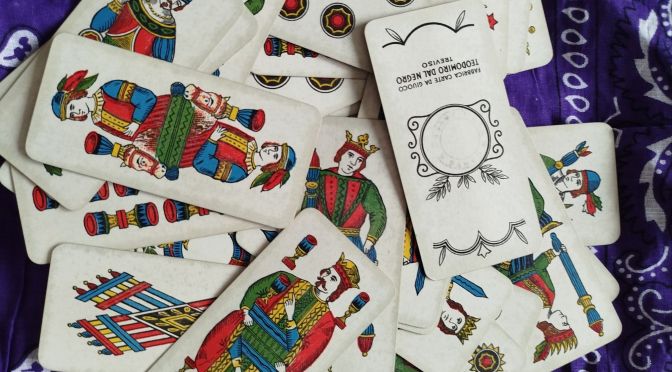
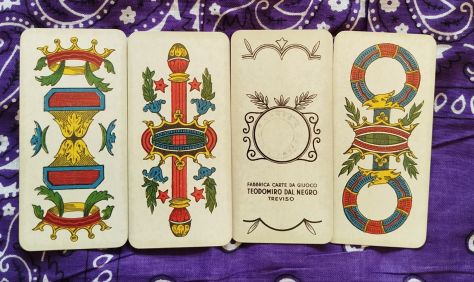
It wouldn’t make sense, at this point, to talk about each single card individually, but I think the cards do warrant a bit more discussion. I am referring to the 45-card system, even though most considerations will apply to the other systems as well.
The Aces
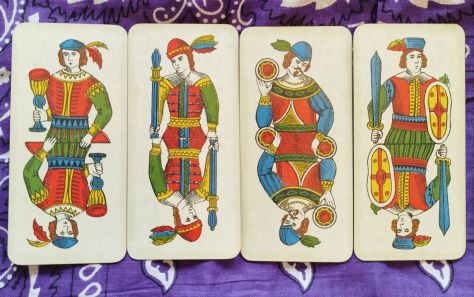
The four Aces in the Bolognese Tarot
Ace of Cups. This is the card of the home environment and of the family, as in many fortune-telling and divination traditions. Its presence usually indicates that the issue somehow relates to the family or the house. However, the card can also occasionally function as a sort of adjective, in that it can indicate a situation or environment is like family. Broadly speaking, the cards surrounding it generally show us whether the family is positive or negative, or is going through a rough patch, etc. I have found that sometimes, when the home or familiar situations simply cannot be part of the interpretation, the Ace of Cups can hint at the intimate life of a person, their inner side, or the intimate relationship between two people.
Ace of Wands. This is a somewhat more complex card. In the main it is a card of sex and sexual interest (or interest in general). However, it represents anything done by two people together, especially marriage (or a strong relationship) or partnership. It portends great vigor, energy, creativity. Another important meaning of this card is that of achievement, personal triumph or personal success, i.e., the ability to reach one’s aims and fulfill one’s aspirations. It is a powerful, active card.
Ace of Coins. In the most ancient set of meanings, this is the card of the table, and it therefore represents sitting together for whatever reason. This meaning has been retained, as well as its metaphorical extensions (conviviality, etc.) It represents daylight. Its most frequent meaning, however, is that of representing finances. Compared to the other money card, i.e., the Ten of Coins, the Ace represents a bigger amount. Whether the amount is coming or going depends on the question and cards surrounding it. Metaphorically it can sometimes portend great satisfaction or a prize.
Ace of Swords. The most common meaning found attached to this card is that of symbolizing the door knockers (see design). The image of the door knockers is widespread in Italian cartomancy and is found in many traditional Italian card reading systems. It symbolizes something about to happen, because it is knocking at the door. However, the card symbolism has also been interpreted as representing two wedding bands being exchanged or a pair of handcuffs. Broadly speaking, therefore, it can show a commitment or a binding situation for better or worse, from marriage to prison, from a contract to an obligation, from an oath to an addiction. The emphasis here is on the binding aspect of it, which limits us, whereas in the Ace of Wands the emphasis is more on doing or achieving something together with someone else.
The Sevens
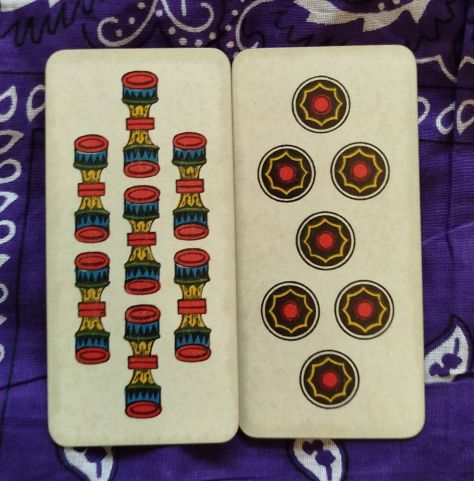
The two Sevens in the Bolognese Tarot
Seven of Cups. Called the card of the roof or the rooftops. Like all cups, it is strongly connected to the home environment. It is still a card of familiarity and closeness, but in a more extended sense than the Ace of Cups. Therefore, it also symbolizes the city or homeland (depending on the scope of the question). Due to its connection to the roof, it carries a certain connotation of protection with it. It is also another card that can show a quick timeframe.
Seven of Coins. The Seven of Coins is the card of tears. It shows melancholy, sadness, dissatisfaction. In itself it is not a tragic card, but it does indicate loss of heart, feeling down or blue, etc. When it falls together with other difficult cards, though, it compounds their effect, making it worse and showing that it affects the querent emotionally. On rare occasion, when with very positive cards (like the Sun and the Angel) it can show tears or joy, emotional relief in general. This is rare though. Note: some diviners use the Six of Coins instead of the Seven to symbolize tears.
The Eights
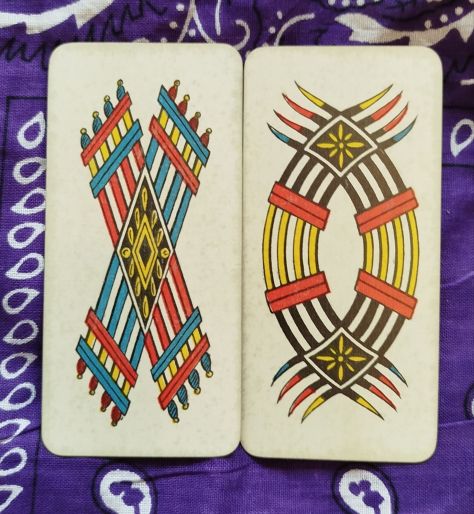
The two Eights in the Bolognese Tarot
Eight of Wands. The Eight of Wands is the card of the road or path. The road can be literal, representing a short journey (as opposed to the World), even just going out to meet or visit someone, or it can be metaphorical, indicating something that is moving or requires movement or evolution (e.g., a professional path, a study course, the trajectory of a relationship, etc.) In itself, the card tends to be positive, indicating a situation that is ‘open‘ (like a road) and still developing, but with negative cards it can show the opposite. It can also represent something that is on the way, and therefore, like the Ace of Swords, is about to happen. Note that some diviners use the Six of Wands instead of the Eight.
Eight of Swords. This card is traditionally called ‘passione’, i.e., passion, but more in the sense of the passion of the Christ. It represents torment, suffering and similar fun concepts. It is connected to pain in all its manifestations, whether physical, mental, psychophysical or of different kind. It is also connected with addictions, again literal or metaphorical (as when you make yourself dependent on what your ex thinks or does). Some diviners use the Six of Swords instead of the Eight.
The Tens
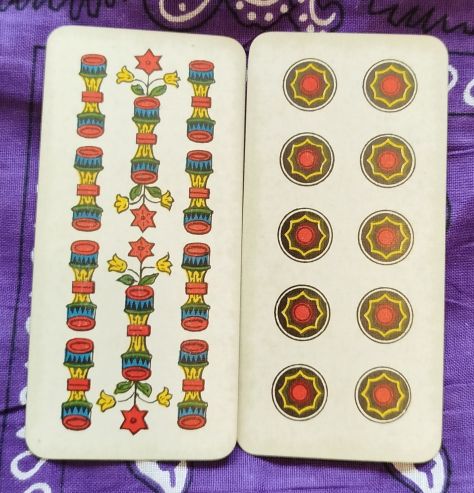
The two Tens in the Bolognese Tarot
Ten of Cups. As the image suggests, this is the card of all things that bloom and flourish. It shows rebirth and increase in all fields of life, and situations that metaphorically sprout, bringing mirth. It is the card of fun, of jollity, of parties and of drinking, so with cards showing excess it can indicate alcoholism. It is also the card of blood, so if the other cards seem to point to a stay at the hospital, it doesn’t mean the querent is having the time of his life, only that he is being cut open and blood is coming out.
Ten of Coins. This is again a money card, but its amount is smaller than the Ace. Still, by itself it is a positive card, showing satisfaction and well-being. It represents a positive flow of things, a situation that is calm, tranquil, without major ups and downs (unless the surrounding cards are negative, in which case the calmness is denied, as it were.) With negative cards it can show the querent has little money or little satisfaction.
The Pages
The four Pages in the Bolognese Tarot
Page of Cups. The Page of Cups has the traditional name of ‘coppina‘, i.e., little/young female cup-bearer. It signifies a young, younger or youthful woman, usually belonging to the family or to the querent’s everyday life. With negative cards confirming it, it can represent a rival in love (the fresh young thing snatching hubby from you) or an immature woman. When exploring a woman’s past, it can show “when she was young”. This is one of the hardest cards for me to read, as sometimes it shows up seemingly for no reason, even though there is no young woman involved. I have figured that in these situations she is still a small cup-bearer, cups being joyful, so it can represent the arriving or giving of small joys or satisfactions.
Page of Wands. In the Tarocchino Bolognese, we have not only cards for the male and female querents, but also for their thoughts. The Page of Wands represents the female querent’s thoughts, beliefs, plans, memories, character and inner side.
Page of Coins. This is the card of words, talks, conversations, dialogues. It heralds the arrival of meetings where situations are talked over, agreed on, clarified, etc. Cards surrounding the Page will show either the nature of the words (angry, loving, etc.) their content (work, love, money) or their outcome (agreement, disagreement and so on).
Page of Swords. Traditionally the letter card. Like the Page of Coins, it is a card of communication, but usually written or, nowadays, in the form of messages. It can symbolize documents and things made of paper. It also embodies the broader notion of contacts, developing contacts, coming into contact with others. This is especially relavant when we are not talking about a single specific letter or message.
The Knights
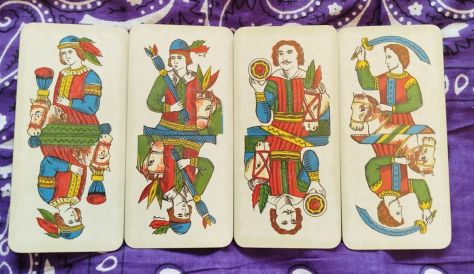
The four Knights in the Bolognese Tarot
Knight of Cups. In Italian, ‘accomodamento’, literally adjustment, compromise, agreement or even repair. This card’s main meaning is simple, but its applications are many: it shows situations that bring conciliation (or reconciliation), healing and the solution of trouble, or at least a way of dealing with it positively. It heralds harmonious interpersonal relationships, smooth sailing ahead, the ironing out of disagreements or difficulties, positive developments.
Knight of Wands. This is the male counterpart to the Page of Wands: the Knight represents the thoughts of the male querent or of a male figure that is involved in the situation. It is the thoughts, beliefs, character, memories and inner side of this male figure. Note, however, that sometimes, when it doesn’t make sense for this (and the Page) to represent thoughts, it can be taken as a secondary significator for the querent: if I show up not as a physical person (King) but as my thoughts (Knight) I am still there, the spread still talks about me.
Knight of Coins. This is the card of the ambassador, as it brings news, developments and similar things connected with the situation we are exploring. It can indicate knowledge of facts from third parties or other sources, but in general it is the card of news. In itself the news is implied to be good news (one of its traditional names is ‘cavallo di buona nuova’, ‘the horse(man) of good news’), because it brings a coin, and coins were considered good in traditionally poor Italian society. However, if the cards surrounding it are bad, the news may be less than positive, or the good news may be blocked or delayed. Sometimes this card can be ‘christened‘ as a young man, if you’ve run out of court cards.
Knight of Swords. The Knight of Swords is the opposite of the Knight of Cups. Where the Knight of Cups adjusts and irons out, the Knight of Swords complicates, twists, brings trouble, difficult situations that are not linear nor smooth (note the curved sword). Where the Knight of Cups conciliates, the Knight of Swords attacks. In interpersonal relationships it brings disagreements, misunderstandings and hurtful words (one of its names is ‘malalingua’, literally evil tongue). If the Knight of Cups brings healing and goodness, the Knight of Swords brings suffering and evil. One of its main symbolic connections is with cuts, either literal (cutting yourself, getting hurt, being cut open by a surgeon, wounds, breaking something) or figurative (cutting words, situations that hurt, etc.)
The Queens
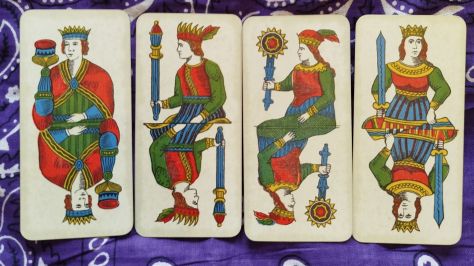
The four Queens in the Bolognese Tarot
Queen of Cups. A mother or a woman in your family, usually. If not in your family, then a friend or someone who acts in your interest. Or should. Always look at the cards surrounding her, as she can be a bad mother or friend if they confirm it, but one who is emotionally invested in you somehow. Mostly, though, it represents the figure of someone who holds you (look how she holds the cup) and has your back. Traditionally she is dark-haired or of dark complexion. Others say she is of medium complexion. Either way, we obviously need to be very careful with descriptions. The Queen of Cups can indicate femininity.
Queen of Wands. If the querent is female, then the Queen of Wands is going to represent her, and the Page of Wands her thoughts. If the querent is male, the Queen can be his partner, or it can be a woman who is somehow important in the situation. Note that when we are talking about triangles, the Queen of Wands is the person who is in the male querent’s heart, regardless of whether she is the official partner.
Queen of Coins. Traditionally ‘the truth‘. This is rarely a physical person. More often than not, it represents truth, reality, authenticity, wisdom, knowledge, education, exactitude, clarity, understanding and the like. It can also say that a situation is as it seems. Or isn’t, if it is surrounded by cards of deceit, indicating the truth is hidden. According to some, it can also sometimes stand for a blonde woman or a wise woman. A traditional phrase attached to this card is ‘di verità conferma’, meaning ‘confirming the truth’ or ‘and that’s the truth’: sometimes this card comes up at the end of a spread or of a group of cards, and acts like a sort of period, as if saying “and that’s exactly it.”
Queen of Swords. Its traditional name is ‘affliction.’ When this card doesn’t represent a woman, it indicates a situation that brings affliction, either physical or psychological. More often than not, though, it does indicate a woman. Tradition says she is gray-haired or a redhead. Others say she is dark. Again, I would advise caution. The Queen of Swords isn’t necessarily evil: she is another woman, usually less accomodating than the Queen of Cups, but not bad. She can be rigid, or she can be a competent but stern professional. With bad cards then she is a rival, the other woman, or a woman who is out to get you.
The Kings
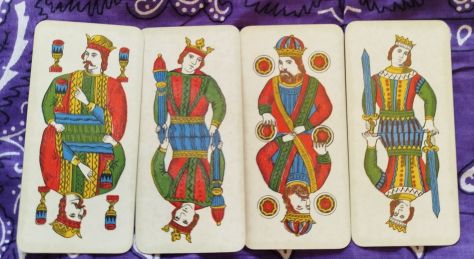
The four Kings in the Bolognese Tarot
King of Cups. The King of Cups is the male counterpart to the Queen of the same suit. He is typically the father or a man in your family. If not in your family, a friend, a wise male influence, someone who has a good word for you, who will help you (like the Queen, he can be a good boss or coworker). It can embody masculinity in general.
King of Wands. As with the Queen so with the King. This is the male querent, or the female querent’s partner, or another man that is important in the question at hand. The Knight of Wands indicates his thoughts. Again, in a triangle this is the man in the querent’s heart, regardless of whether he is the official partner.
King of Coins. It has several titles in the tradition: ‘uomo/vecchio da soldi’ (man/old man bringing money), doctor, important person, a good lord etc. More than a particular person, it represents a role: that of a professional, of someone who has an important job and/or money. Traditionally it shows someone with a degree, from back when degrees were something special. Being called the doctor, it indicates situations that bring healing and care for the querent’s needs. It can indicate a boss or superior. It can also indicate a situation, whether a job or a relationship or something else, which is helpful or nourishing or ‘important’. Traditionally the King is a man for obvious socio-historical reasons, but nowadays it can indicate a woman as well, especially if next to a female court card.
King of Swords. The male counterpart to the Queen, his traditional name is ‘spadino’, i.e., little/young sword-bearer. It can represent a man who is young and/or immature, like the Page of Cups, such as a son or nephew. When exploring a man’s past, it can indicate ‘when he was younger’. It can show a new entry in the querent’s love life, someone who hasn’t yet been promoted to King of Wands. He can be a rival or a problematic man, if with negative cards, or a problematic or immature situation in general. More often than not, it is a literal male figure. Whether positive or negative, it is shown by the other cards. In some traditions it can show a military man, a soldier, a policeman or similar. Look at the other cards for confirmation.
(Note: this is a collection of the meanings attributed to the cards by some occultists in the past centuries. It does not reflect my own study or opinion of the cards. It is only meant as a quick comparative reference as I develop my own take.)
The Six of Swords from the Builders of the Adytum (BOTA) tarot deck
Paul Foster Case (and Ann Davies)
The Six of Swords corresponds to the second decanate of Aquarius under the rulership of Mercury, January 30 to February 8. Well-Dignified: success after a period of trouble or anxiety; difficulties overcome; change of scene, possibly a journey by water; something mysterious effects a change o f circumstances for the better; success earned by the Querent’s laborious efforts. Ill-Dignified: sudden changes; circumstances dominate the Querent; he is in danger of being over-confident or conceited; too much effort expended for small results. Keyword: Patience (From the Oracle of Tarot course)
A.E. Waite
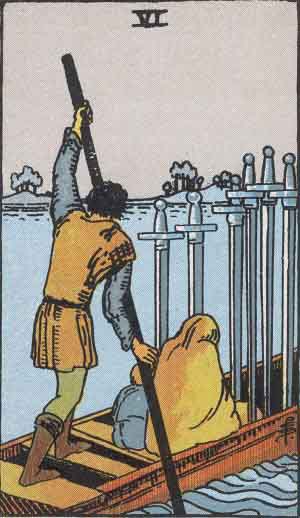
A ferryman carrying passengers in his punt to the further shore. The course is smooth, and seeing that the freight is light, it may be noted that the work is not beyond his strength. Divinatory Meanings: journey by water, route, way, envoy, commissionary, expedient. Reversed: Declaration, confession, publicity; one account says that it is a proposal of love. (From The Pictorial Key to the Tarot)
The Six of Swords from the Rider Waite Smith tarot
Aleister Crowley
The Six of Swords is called Science. Its ruler is Mercury, so that the element of success turns away from the idea of division and quarrel; it is intelligence which has won to the goal.
[…]
Tiphareth shows the full establishment and balance of the idea of the suit. This is particularly the case with this card, as the intellect itself is also referred to the number Six. Mercury, in Aquarius, represents the celestial Energy influencing the Kerub of the Man, thus showing intelligence and humanity.
But there is much more than this in the symbol. The perfect balance of all mental and moral faculties, hardly won, and almost impossible to hold in an ever-changing world, declares the idea of Science in its fullest interpretation.
The hilts of the Swords, which are very ornamental, are in the form of the hexagram. Their points touch the outer petals of a red rose upon a golden cross of six squares, thus showing the Rosy Cross as the central secret of scientific truth. (From The Book of Thoth)
The Six of Swords from the Thoth Tarot deck
Golden Dawn’s Book T
TWO hands, as before, each holding two swords which cross in the centre. Rose re-established thereon. Mercury and Aquarius above and below, supported on the points of two short daggers or swords.
Success after anxiety and trouble; self-esteem, beauty, conceit, but sometimes modesty therewith; dominance, patience, labour, etc.
Tiphareth of HB:V (Labour, work, journey by water). Ruled by the Great Angels HB:RHa’aAL and HB:YYVHL.
Etteilla
Road Upright. This card, as far as the medicine of the spirit is concerned, means, in its natural position: Road, Avenue, Walk, Course, Passage, Path, Way. – Path, Tract, Gait, Origin, Conduct, Means, Manner, Way, Expedient, Run, Career, Walk, Pattern to be followed, Track, Footprint, Sending, Commissary [= Deliveryman]. Reversed. Declaration, Declaratory act, Development, Explanation, Interpretation. – Charter, Constitution, Diploma, Manifest law, Ordinance. – Publication, Proclamation, Ostensibility, Manifesto, Publicity, Authenticity, Notoriety. – Denunciation, Census. – Enumeration. – Knowledge, Discovery, Unveiling, Vision, Revelation, Apparition, Appearance, Admission, Confession, Protest, Approval, Authorization.
(Note: this is a collection of the meanings attributed to the cards by some occultists in the past centuries. It does not reflect my own study or opinion of the cards. It is only meant as a quick comparative reference as I develop my own take.)
The Six of Wands from the Builders of the Adytum (BOTA) Tarot deck
Paul Foster Case (and Ann Davies)
The second decanate of Leo, related to this Key, is the time period of August 2 to August 12, ruled by Jupiter. In Tarot divination, the Six of Wands partakes of a meaning similar to the conjunction of the Sun and Jupiter, combined with the influence of Leo and its natural fifth house. Well-Dignified: success, happiness, gain; gain through love affairs or by the opposite sex; pleasure in labor; gain after a period of uncertainty and competition. lll-Dignified: loss through the same things; waste in pleasure; trouble through pride of riches or through insolence based on success. Keyword: Victory (From the Oracle of Tarot course)
A. E. Waite
A laurelled horseman bears one staff adorned with a laurel crown; footmen with staves are at his side. Divinatory Meanings: The card has been so designed that it can cover several significations; on the surface, it is a victor triumphing, but it is also great news, such as might be carried in state by the King’s courier; it is expectation crowned with its own desire, the crown of hope, and so forth. Reversed: Apprehension, fear, as of a victorious enemy at the gate; treachery, disloyalty, as of gates being opened to the enemy; also indefinite delay. (From The Pictorial Key to the Tarot)
Aleister Crowley
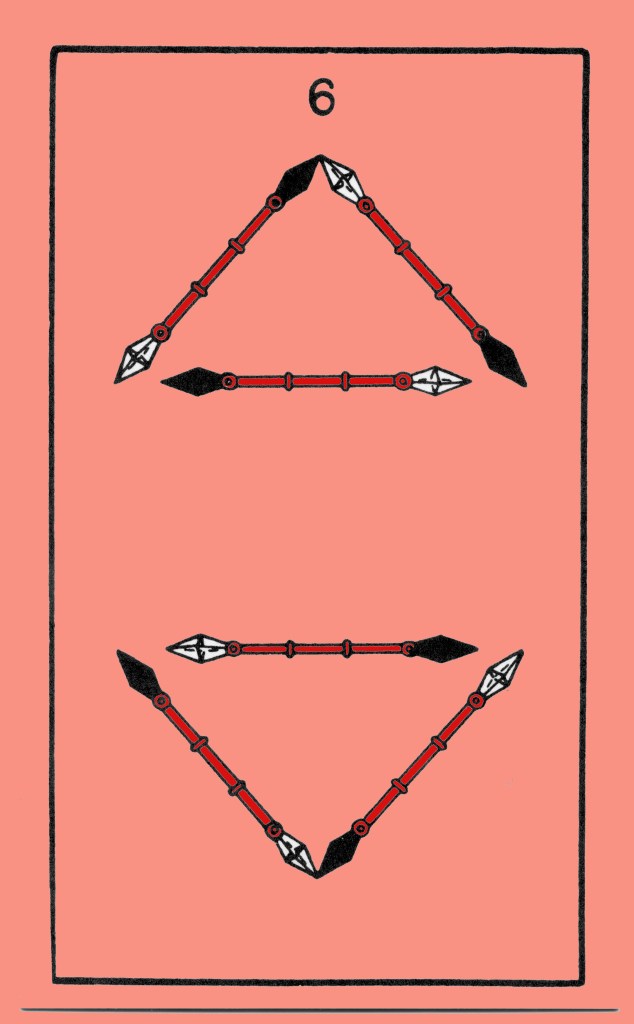
The Six of Wands is called Victory. The outburst of energy in the Five of Wands, which was so sudden and violent that it even gave the idea of strife, has now completely won success. The rule, or lordship, in the suit of Wands is not quite as stable as it might have been if there had been less energy displayed. So, from this point, as soon as the current leaves the middle pillar, the inherent weakness in the element of Fire (which is this: that, for all its purity, it is not completely balanced) leads to very undesirable developments.
[…]
This card represents Tiphareth of the suit of Fire. This shows Energy in completely balanced manifestation. The Five has broken up the closed forces of the Four with revolutionary ardour, but a marriage has taken place between them; and the result is the Son, and the Sun.
The reference is also to Jupiter and Leo, which seems to imply a benediction on the harmony and beauty of this arrangement. It Will be seen that the Three Wands of the Three Adepts are now orderly arranged; and the flames themselves, instead of shooting out in all directions, burn steadily as in lamps. They are nine in number, in reference to Yesod and the Moon. This shows the stabilization of the Energy, and its reception and reflection by the Feminine.
There is no circle to enclose the system. It is self-supporting, like the Sun. (From The Book of Thoth)
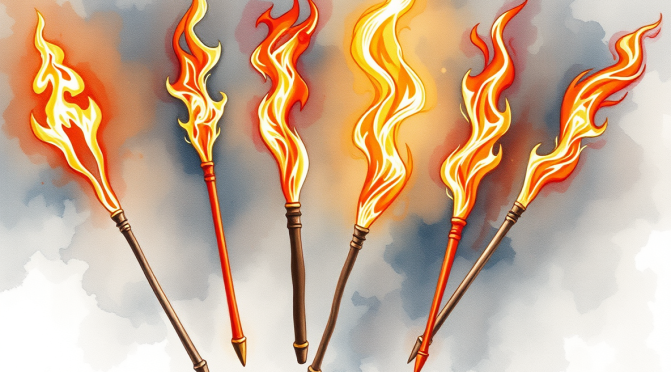
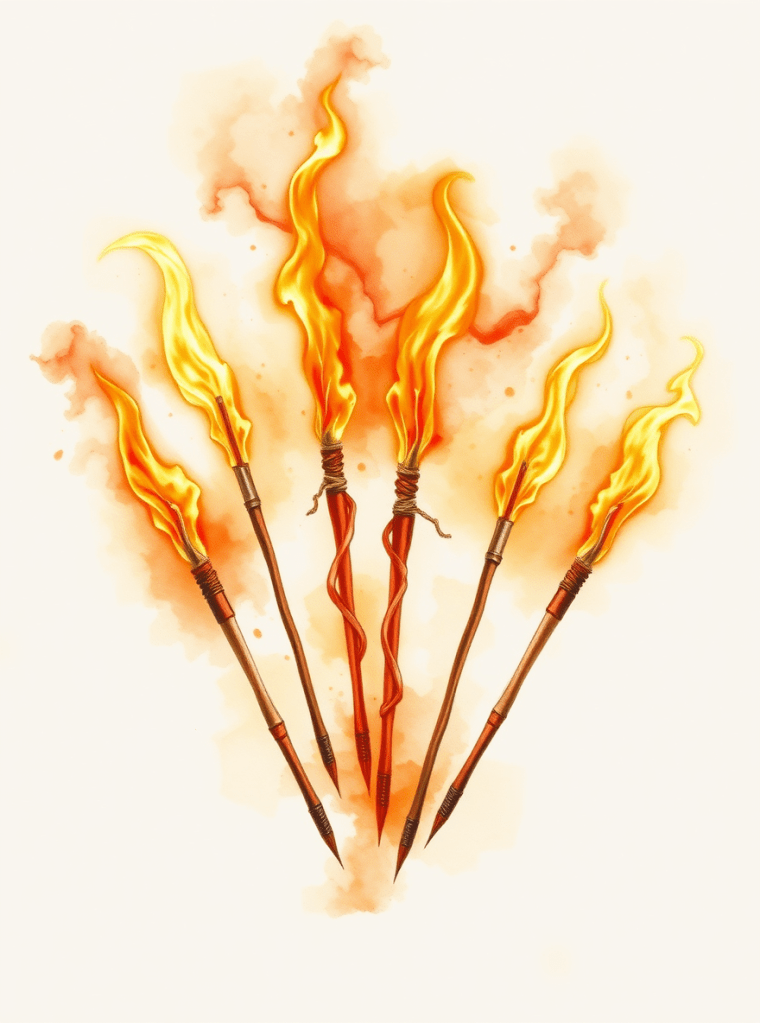
Rather prosaic AI-generated illustration for the Six of Wands
Golden Dawn’s Book T
TWO hands in grip as the last, holding six wands crossed three and three. Flames issue from the point of junction. Above and below are short wands with flames issuing, surmounted respectively by the symbols of Jupiter and Leo, representing the Decan.
Victory after strife: Love: pleasure gained by labour: carefulness, sociability and avoiding of strife, yet victory therein: also insolence, and pride of riches and success, etc. The whole dependent on the dignity.
Tiphareth of HB:Y (Gain).
Hereunto are allotted the great Angels HB:SYTAL and HB:a’aLMYH of the Schemhamphorash.
Etteilla
Servant Upright. This card, as far as the medicine of the spirit is concerned, means, in its natural position: Housekeeper, Servant, Valet, Lackey, Slave, Mercenary, Inferior. – Courier, Commissary, Factor. – Interior of the house, Ménage, Family, Complex of the servants of the house. Reversed. Expectation, Expectation, Hope, Relying on, Grounding, Trusting, Promise. – Confidence, Foresight. – Fear, Apprehension.
(Note: this is a collection of the meanings attributed to the cards by some occultists in the past centuries. It does not reflect my own study or opinion of the cards. It is only meant as a quick comparative reference as I develop my own take.)
The Four of Cups from the Builders of the Adytum (BOTA) tarot deck
Paul Foster Case (and Ann Davies)
The specific divinatory meanings are thus based on the attributions of Chesed, the planetary forces of Jupiter and Neptune, the zodiacal influences of Cancer ruled by the Moon, and the astrological fourth house. Jupiter’s sphere of influence is Chesed. It co-rules the third decanate of Cancer besides being exalted in this zodiacal sign. Therefore the Four of Cups has a very strong Jupiterian influence of wealth and expansiveness. The Four of Cups corresponding to the third decanate of Cancer is the time period July 13 to July 22, ruled by Jupiter and Neptune. In specific Tarot Divination its key meanings are: Well Dignified: success in material things, but desire for something higher; a period of comparative comfort, yet a little confining, thus suggesting a measure of satiety; it is a symbol of contemplation and of the turning away from pleasure in quest of higher things; it intimates strong psychic influences in the life or environment of the Querent. lll-Dignified: material gain, but through injustice; sorrows resulting from satisfaction of desire; getting what one has wanted but finding no joy in it. Keyword: Surfeit (From the Oracle of Tarot Course)
A. E. Waite
A young man is seated under a tree and contemplates three cups set on the grass before him; an arm issuing from a cloud offers him another cup. His expression notwithstanding is one of discontent with his environment. Divinatory Meanings: Weariness, disgust, aversion, imaginary vexations, as if the wine of this world had caused satiety only; another wine, as if a fairy gift, is now offered the wastrel, but he sees no consolation therein. This is also a card of blended pleasure. Reversed: Novelty, presage, new instruction, new relations. (From The Pictorial Key to the Tarot)
Aleister Crowley
The Four of Cups is called Luxury.
The masculine nature of fire permits the Four of Wands to appear as a very positive and clear-cut conception. The weakness in the element of water threatens its purity; it is not quite strong enough to control itself properly; so the Lord of Pleasure is a little unstable. Purity has somehow been lost in the process of satisfaction.
[…]
This card refers to Chesed in the sphere of Water. Here, below the Abyss, the energy of this element, although ordered, balanced and (for the moment) stabilized, has lost the original purity of the conception.
The card refers to the Moon in Cancer, which is her own house; but Cancer itself is so placed that this implies a certain weakness, an abandonment to desire. This tends to introduce the seeds of decay into the fruit of pleasure.
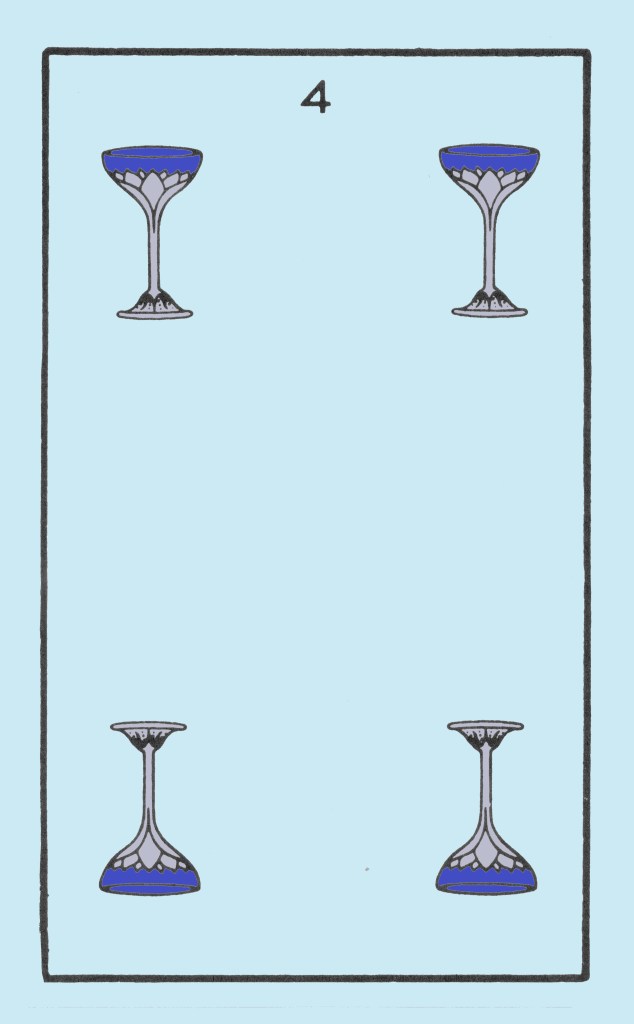
The sea is still shown, but its surface is ruffled, and the four Cups which stand upon it are no longer so stable. The Lotus from which the water Springs has a multiple stem, as if to show that the influence of the Dyad has gathered strength. For although the number Four is the manifestation and consolidation of the dyad, it is also secretly preparing catastrophe by emphasizing individuality.
There is a certain parallelism between this card and the Geomantic figures Via and Populus, which are attributed to the Moon in her decrease and increase respectively. The link is primarily the “Change=Stability” equation, already familiar to readers of this essay. Four is an “awkward” number; alone among the natural numbers, it is impossible to construct a “Magic Square” of four cells. Even in the Naples Arrangement, Four is a dead stop, a blind alley. An idea of a totally different Order is necessary to carry on the series. Note also the refolding-in-upon-itself suggested by the “Magic Number” of Four 1 + 2 + 3 + 4 which is Ten. Four is the number of the Curse of Limitation, of Restriction. It is the blind and barren Cross of equal arms, Tetragrammaton in his fatal aspect of finality, as the Qabalists knew him before the discovery of the Revolving Formula whereby the Daughter, seated upon the Throne of the Mother, “awakens the Eld of the All-Father”.
For the meanings of Via and Populus, refer to the “Handbook of Geomancy” (Equinox Vol. I, No.2).
(From The Book of Thoth)
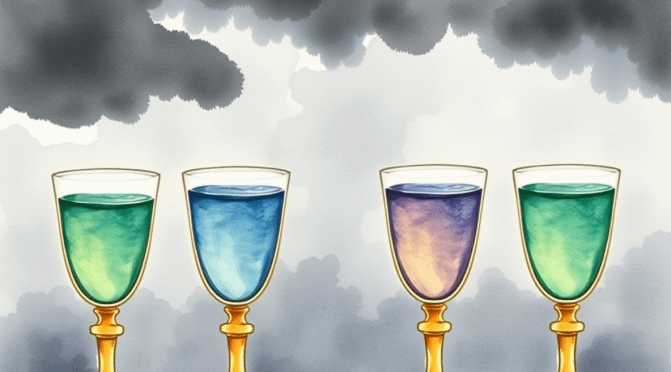
An AI-generated illustration for the Four of Cups
Golden Dawn’s Book T
FOUR cups: the two upper overflowing into the two lower, which do not overflow. An Angelic Hand grasps a branch of lotus, from which ascends a stem bearing one flower at the top of the card, from which the white water flows into the two upper cups. From the centre two leaves pass right and left, making, as it were, a cross between the four cups. Above and below are the symbols Moon and Cancer for the Decan.
Success or pleasure approaching their end. A stationary period in happiness, which may, or may not, continue. It does not mean love and marriage so much as the previous symbol. It is too passive a symbol to represent perfectly complete happiness. Swiftness, hunting and pursuing. Acquisition by contention: injustice sometimes; some drawbacks to pleasure implied. Chesed of HB:H (Receiving pleasure or kindness from others, but some discomfort therewith). Therein rule the great Angels HB:HYYAL and HB:MVMYH.
Etteilla
Boredom Upright. This card, as far as the medicine of the spirit is concerned, means, in its natural position: Boredom, Displeasure, Discontent, Disgust, Aversion, Enmity, Hatred, Horror, Restlessness, Pain of spirit, Slight sadness, Affliction, Painful, Annoying, Unpleasant. – Saddening, Distressing. Reversed. New Directive, New Light. – Index, Indication, Conjecture. – Augury, Foreboding. – Presentment, Foreboding, Predilection, Novelty.
(Note: this is a collection of the meanings attributed to the cards by some occultists in the past centuries. It does not reflect my own study or opinion of the cards. It is only meant as a quick comparative reference as I develop my own take.)
The Four of Wands from the Builders of the Adytum (BOTA) Tarot deck
Paul Foster Case (and Ann Davies)
The Four of Wands is associated with the third decanate of Aries, the time period April 10 to April 19, ruled by Jupiter. Well-Dignified: this card signifies success through personal merit, good social standing, influential friends, the perfection of something built up after labor, benefit through travel, shipping and business with foreign countries. lll-Dignified: loss in the same things, or in consequence of unpreparedness or by hasty action. Keyword: Perfected work. (From the Oracle of Tarot course)
A. E. Waite
From the four great staves planted in the foreground there is a great garland suspended; two female figures uplift nosegays; at their side is a bridge over a moat, leading to an old manorial house. Divinatory Meanings: They are for once almost on the surface–country life, haven of refuge, a species of domestic harvest-home, repose, concord, harmony, prosperity, peace, and the perfected work of these. Reversed: The meaning remains unaltered; it is prosperity, increase, felicity, beauty, embellishment. (From The Pictorial Key to the Tarot)
Aleister Crowley
In the Wand suit, the card is called Completion. The manifestation promised by Binah has now taken place. This number must be very solid, because it is the actual dominating influence on all the following cards. Chesed, Jupiter-Ammon, the Father, the first below the Abyss, is the highest idea which can be understood in an intellectual way, and that is why the Sephira is attributed to Jupiter, who is the Demiurge.
[…]
This card refers to Chesed in the suit of Fire. Being below the Abyss, it is the Lord of all manifested active Power. The original Will of the Two has been transmitted through the Three, and is now built up into a solid system:-Order, Law, Government. It is also referred to Venus in Aries, which indicates that one cannot establish one’s work without tact and gentleness.
The wands are headed by the Ram, sacred to Chesed, the Father-god Amoun-Ra, as also to Aries; but at the other end of the wands are the Doves of Venus.
In the symbol, the ends of the wands touch a circle, showing the completion and limitation of the original work. It is within this circle that the flames (four double, as if to assert the balance) of the Energy are seen to play, and there is no intention to increase the scope of the original Will. But this limitation bears in itself the seeds of disorder. (From The Book of Thoth)
AI-generated illustration for the Four of Wands
Golden Dawn’s Book T
TWO White Radiating Angelic Hands, as before, issuing from clouds right and left of the card and clasped in the centre with the grip of the First Order, holding four wands or torches crossed. Flames issue from the point of junction. Above and below are two small flaming wands, with the symbols of Venus and Aries representing the Decan. Perfection or completion of a thing built up with trouble and labour. Rest after labour, subtlety, cleverness, beauty, mirth, success in completion. Reasoning faculty, conclusions drawn from previous knowledge. Unreadiness, unreliable and unsteady through over-anxiety and hurriedness of action. Graceful in manner, at times insincere, etc. Chesed of HB:Y (Settlement, arrangement, completion). Herein are HB:NNAAL and HB:NYThHL Angelic rulers
Etteilla
Company Upright. This card, as far as the medicine of the spirit is concerned, in its natural position means: Society, Association, Assembly, Relation, Confederation, Alliance, Union, Gathering, Circle, Community, Assembling, Multitude, Mass, Crowd, Troop, Band, Company, Cohort, Army. – Convocation, Accompaniment, Mixing, Mixture, League, Amalgamation. – Contract, Convention, Covenant, Treaty. Reversed. Prosperity, Increase, Accretion, Advancement, Success, Succeeding, Fortune, Blossoming, Happiness. – Beauty, Beautification.
(Note: this is a collection of the meanings attributed to the cards by some occultists in the past centuries. It does not reflect my own study or opinion of the cards. It is only meant as a quick comparative reference as I develop my own take.)
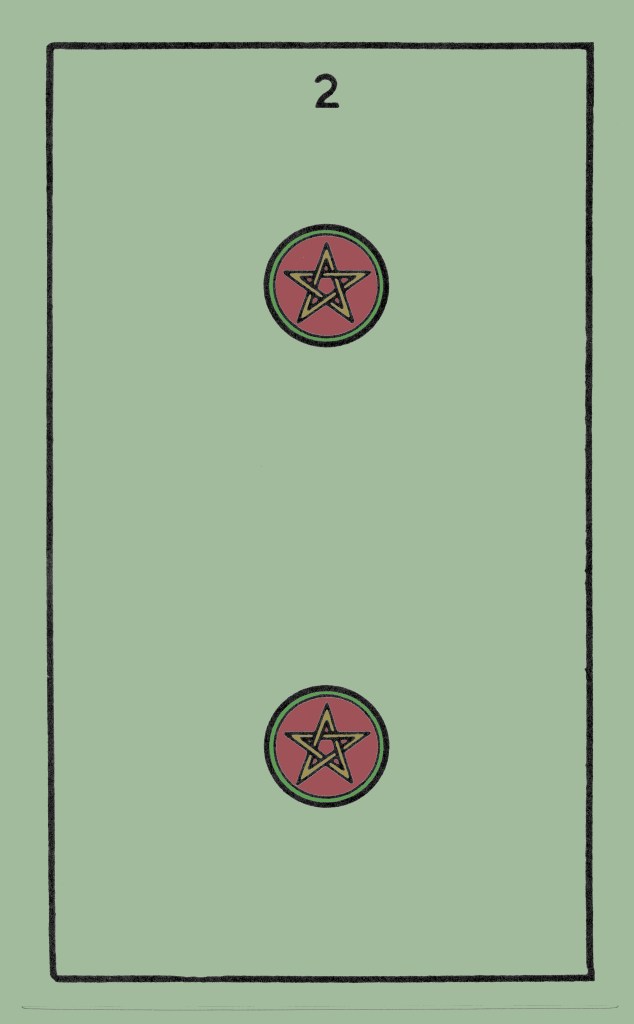
The Two of Pentacles / Coins from the Builders of the Adytum (BOTA) tarot deck
Paul Foster Case (and Ann Davies)
The time period is the first decanate of Capricorn, December 22 to December 31, under the rulership of Saturn. Meanings: Well-Dignified: harmony in the midst of change; alternation of gain and loss; change of occupation; travel in quest of wealth; ups and downs of fortune; a visit to friends. Ill-Dignified: intimates discontent; foolishness in the management of resources; restricted condition of material affairs due to bad management; the Querent is probably too talkative and too suspicious. He is kind, but inconsistent, and should avoid arguments. Keyword: Fluctuation (From the Oracle of Tarot course)
A. E. Waite
A young man, in the act of dancing, has a pentacle in either hand, and they are joined by that endless cord which is like the number 8 reversed. Divinatory Meanings: On the one hand it is represented as a card of gaiety, recreation and its connexions, which is the subject of the design; but it is read also as news and messages in writing, as obstacles, agitation, trouble, embroilment. Reversed: Enforced gaiety, simulated enjoyment, literal sense, handwriting, composition, letters of exchange. (From The Pictorial Key to the Tarot)
Aleister Crowley
The Two of Pentacles was of old time called the Lord of Harmonious Change. Now, more simply, Change; and here the doctrine must be stated a little more clearly. This suit being of Earth, there is a connection with the Princesses, and therefore with the final Heh of Tetragrammaton. Earth is the throne of Spirit; having got to the bottom, one immediately comes out again at the top. Hence, the card manifests the symbolism of the serpent of the endless band.
[…]
The number Two, Chokmah, here rules in the suit pertaining to Earth. It shows the type of Energy appropriate to Two, in its most fixed form. According to the doctrine that Change is the support of stability, the card is called Change.
Its celestial rulers are Jupiter and Capricornus; and these symbols are most inharmonious, so that in practical matters the good fortune of Jupiter is very limited. Their influence on the card is not great. Yet, Jupiter being himself the Wheel (Atu X), he emphasizes that idea.
The card represents two Pantacles, one above the other; they are the Chinese symbols of the Yang and Yin duplicated as in the Hsiang. One wheel is dextro- and the other laevo-rotatory. They thus represent the harmonious interplay of the Four Elements in constant movement. One may in fact consider the card as the picture of the complete manifested Universe, in respect of its dynamics.
About them is entwined a green Serpent (see Liber 65, chapter iii, verses 17-20). His tail is in his mouth. He forms the figure Eight, the symbol of the Infinite, the equation 0=2. (From The Book of Thoth)
Nice AI-generated illustration for the Two of Pentacles or Coins
Golden Dawn’s Book T
TWO wheels, disks or pentacles, similar to that of the Ace. They are united by a green-and-gold serpent, bound about them like a figure of 8. It holds its tail in its mouth. A White Radiant Angelic Hand holds the centre of the whole. No roses enter into this card. Above and below are the symbols of Jupiter and Capricorn. It is a revolving symbol.
The harmony of change, alternation of gain and loss; weakness and strength; everchanging occupation; wandering, discontented with any fixed condition of things; now elated, then melancholy; industrious, yet unreliable; fortunate through prudence of management, yet sometimes unaccountably foolish; alternatively talkative and suspicious. Kind, yet wavering and inconsistent. Fortunate in journeying. Argumentative. Chokmah of HB:H (Pleasant change, visit to friends). Herein the Angels HB:LKBAL and HB:VShRYH have rule.
Etteilla
Embarrassment Upright. This card, as far as the medicine of the spirit is concerned, means, in its natural position: Awkwardness, Obstacle, Commitment, Obstruction, Setback. – Disturbance, Bother, Emotion, Mess, Confusion, Difficulty, Impediment, Tangle, Obscurity. – Agitation, Restlessness, Perplexity, Concern. Reversed. Ticket, Piece of Writing, Writing, Text, Literature, Doctrine, Erudition, Work, Book, Production, Composition. – Dispatch, Epistle, Missive. – Written character. – Literal Meaning. – Alphabet, Elements, Principles. – Promissory note.
(Note: this is a collection of the meanings attributed to the cards by some occultists in the past centuries. It does not reflect my own study or opinion of the cards. It is only meant as a quick comparative reference as I develop my own take.)
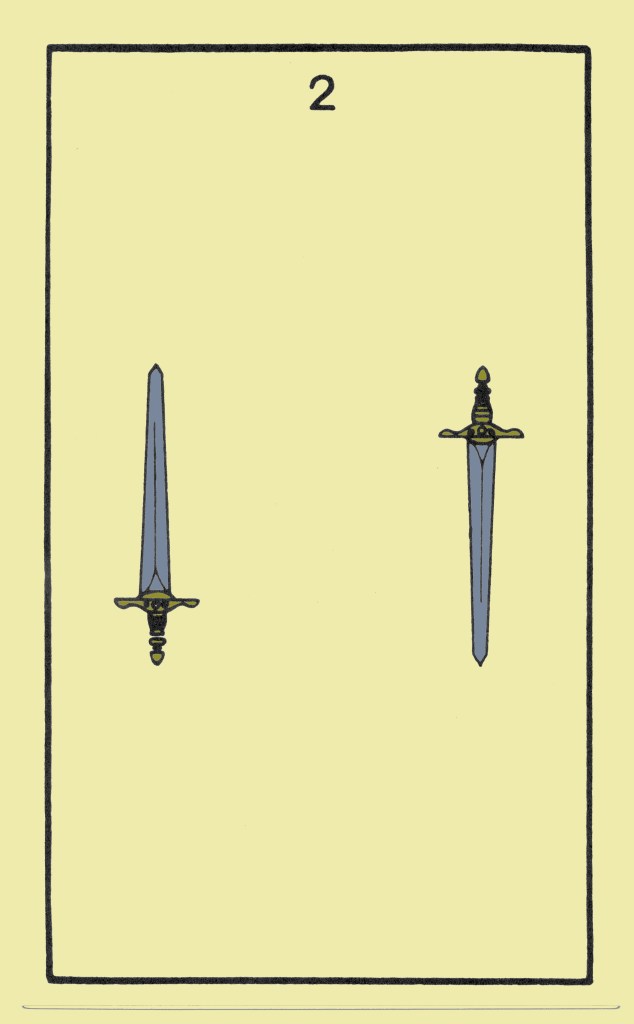
The Two of Swords from the Builders of the Adytum (BOTA) tarot deck
Paul Foster Case (and Ann Davies)
The time period is the first decanate of Libra from September 23 to October 2, under the rulership of Venus. Well-Dignified: contradictory characteristics in the same nature; strength through suffering; pleasure after pain; delay in the realization of objectives. This card sometimes indicates a period of uncertainty, during which the Querent, though he has a sense of adequate power, does not know just what to do with it. It also indicates justice, unselfishness and the restoration of peace. Ill-Dignified: falsehood; sorrow; injury from another who really means well to the Querent, or injury by the Querent to another whom he wishes to help; always a symbol of tension, of want of tact, and suggests force held in abeyance, awaiting some announcement or revelation that will make decision possible. Keyword: Indecision. (From the Oracle of Tarot course)
A. E. Waite
A hoodwinked female figure balances two swords upon her shoulders. Divinatory Meanings: Conformity and the equipoise which it suggests, courage, friendship, concord in a state of arms; another reading gives tenderness, affection, intimacy. The suggestion of harmony and other favourable readings must be considered in a qualified manner, as Swords generally are not symbolical of beneficent forces in human affairs. Reversed: Imposture, falsehood, duplicity, disloyalty. (From The Pictorial Key to the Tarot)
Aleister Crowley
The Two of Swords was formerly called the Lord of Peace Restored; but this word “restored” is incorrect, because there has been no disturbance. The Lord of Peace is therefore a better title: but it needs thinking hard to work this out, since the Sword is so intensely active. It may be helpful to study the Essay on Silence (p. 120) for a parallel: the Negative Form of the Positive Idea. See also the Essay on Chastity (Little Essays toward Truth, pp. 70-74) which concludes: Sir Knights, be vigilant: watch by your arms and renew your oath; for that day is of sinister augury and deadly charged with danger which ye fill not to overflowing with gay deeds and bold of masterful, of manful Chastity.
Witness also Catullus: domi maneas paresque nobis Novem continuas futationes. Nor does he misunderstand the gesture of Harpocrates; Silence and Chastity are isomers. It is all one case of the general proposition that the sum of the infinite Energy of the Universe is Zero.
[…]
This card is ruled by Chokmah in the Element of Air. This suit, governing all intellectual manifestations, is always complicated and disordered. It is subject to change as is no other suit. It represents a general shaking-up, resulting from the conflict of Fire and Water in their marriage; and proceeds, when Earth appears, to crystallization. But the purity and exaltation of Chokmah are such that this card manifests the very best idea possible to the suit. The energy abides above the onslaught of disruption. This comparative calm is emphasized by the celestial attribution: the Moon in Libra.
The Moon is change, but Nature is peaceful; moreover, Libra represents balance; between them, they regulate the energy of the Swords.
In the card appear two swords crossed; they are united by a blue rose with five petals. This rose represents the influence of the Mother, whose harmonizing influence compounds the latent antagonism native to the suit. The Rose emits white rays, producing a geometrical pattern that emphasizes the equilibrium of the symbol. (From The Book of Thoth)
An ominous AI-generated illustration for the Two of Swords
Golden Dawn’s Book T
Two crossed swords, like the air dagger of a Zelator Adeptus Minor, each held by a White Radiant Angelic Hand. Upon the point where the two cross is a rose of five petals, emitting white rays. At the top and bottom of the card are two small daggers, supporting respectively the symbol {Crescent moon with horns upward} thus, and Libra representing the Decanate. Contradictory characters in the same nature, strength through suffering; pleasure after pain. Sacrifice and trouble, yet strength arising therefrom, symbolized by the position of the rose, as though the pain itself had brought forth beauty. Arrangement, peace restored; truce; truth and untruth; sorrow and sympathy. Aid to the weak; arrangement; justice, unselfishness; also a tendency to repetition of affronts on being pardoned; injury when meaning well; given to petitions; also a want of tact, and asking question of little moment; talkative. Chokmah of Vau. Quarrel made up, yet still some tension in relations: actions, sometimes selfish, sometimes unselfish. Herein rule the Great Angels HB:YZLAL and HB:MNHAL.
Etteilla
Friendship Upright. This card, as far as the medicine of the spirit is concerned, means, in its natural position: Friendship, Attachment, Affection, Tenderness, Benevolence, Relationship, Identity, Intimacy, Convenience, Correspondence, Interest, Conformity, Sympathy, Affinity, Attraction. Reversed. Falsehood, Falsehood, Lying, Imposture, Duplicity, Bad faith, Overbearingness, Dissimulation, Cunning, Deceit, Superficial, Superficiality, Surface.
(Note: this is a collection of the meanings attributed to the cards by some occultists in the past centuries. It does not reflect my own study or opinion of the cards. It is only meant as a quick comparative reference as I develop my own take.)
The Two of Wands from the Builders of the Adytum (BOTA) Tarot deck
Paul Foster Case (and Ann Davies)
In Tarot divination the Two of Wands has these key meanings: Well Dignified: it shows force, enterprise, boldness, resolution, some combativeness, much originality. lll Dignified: it signifies restlessness, fierceness, shamelessness, inordinate ambition, turbulence, obstinancy, revenge. A card of enthusiasm, but of strong self-interest. Keyword: Dominion (From the Oracle of Tarot course)
A. E. Waite
A tall man looks from a battlemented roof over sea and shore; he holds a globe in his right hand, while a staff in his left rests on the battlement; another is fixed in a ring. The Rose and Cross and Lily should be noticed on the left side. Divinatory Meanings: Between the alternative readings there is no marriage possible; on the one hand, riches, fortune, magnificence; on the other, physical suffering, disease, chagrin, sadness, mortification. The design gives one suggestion; here is a lord overlooking his dominion and alternately contemplating a globe; it looks like the malady, the mortification, the sadness of Alexander amidst the grandeur of this world’s wealth. Reversed: Surprise, wonder, enchantment, emotion, trouble, fear. (From The Pictorial Key to the Tarot)
Aleister Crowley
The Two of Wands is called the Lord of Dominion, and represents the energy of fire; fire in its best and highest form.
[…]
This card, pertaining to Chokmah in the suit of Fire, represents the Will in its most exalted form. It is an ideal Will, independent of any given object.
“For pure will, unassuaged of purpose, delivered from the lust of result, is every way perfect.” AL. 1. 44.
The background of this card shows the power of the planet Mars in his own sign Aries, the first of the Signs. It there represents Energy initiating a Current of Force.
The pictorial representation is two Dorjes crossed. The Dorje is the Tibetan symbol of the thunderbolt, the emblem of celestial Power, but more in its destructive than its creative form.
More, that is, in its earlier rather than its later form. For destruction may be regarded as the first step in the creative process. The virgin ovum must be broken in order to fertilize it. Fear and repulsion are therefore the primary reaction to the assault. Then, with understanding of the complete plan, willing surrender rejoices to co-operate. Six flames issue from the centre. This indicates the influence of the Sun, who is exalted in Aries. This is the creative Will.
Mars in Aries is the attribution of the Geomantic Figure Puer. The meaning of these figures is to be studied in the Handbook of that science: “The Equinox” Vol. I, No.2. Remember that the Geomantic Intelligences (see Liber 777 Cols. XLIX and CLXXVIII) are all primarily Gnomes. (From the Book of Thoth)
Weirdly religious AI-generated illustration of the Two of Wands
Golden Dawn’s Book T
A WHITE Radiating Angelic hand, issuing from clouds, and grasping two crossed wands. Flames issue from the point of junction. On two small wands above and below, with flames of five issuing therefrom, are the symbols of Mars and Aries for the Decan. Strength, domination, harmony of rule and of justice. Boldness, courage, fierceness, shamelessness, revenge, resolution, generous, proud, sensitive, ambitious, refined, restless, turbulent, sagacious withal, yet unforgiving and obstinate. Chokmah of HB:Y (Influence over others, authority, power, dominion). Therein the Angels HB:VHVAL and HB:DNYAL bear rule.
Etteilla
Sadness Upright. This card, as far as the medicine of the spirit is concerned, signifies, in its natural position: Sadness, Misery, Melancholy, Affliction, Sorrow, Desolation, Mortification, Mood, Discontent, Vapors, Gloomy Ideas. – Bitterness, Anger, Spite. Reversed. Surprise, Enchantment, Shock, Upset, Unexpected event, Unexpected fact, Excitement, Fear, Fright, Terror. – Consternation, Stunning, Domination, Abduction, Alarm. – Marvel, Phenomenon, Miracle.