Tag Archives: mental-health

The Trouble with Keywords

This reflection was prompted by witnessing how shallow many people discussing the Enneagram are, but it applies to anything connected with spirituality and occultism, including divination.

Keywords can be a great learning tool, and often they tend to stand us in better stead than cheap, unguided intuition. There’s also the false assumption that keywords are useful only until our intuition kicks in, but that presupposes that what most people call intuition is serviceable at all beyond suggesting sugary commonplace statements (true intuition is another thing altogether, of much nobler origin, and a much rarer phenomenon).

But keywords, too, must be handled with care. I was at an Enneagram retreat and we were discussing Type One, which everyone kept referring to as the Perfectionist or the Critic. At which point everyone and their mother started realizing that they, too, were perfectionists and sometimes too critical, even if they didn’t think they were a One.

The trouble with keywords is that they are effective at condensing knowledge and understanding only as long as that understanding has taken place beforehand. Otherwise, keywords veil just as much as they reveal. Taken at face value, and not as quick stands-in, they lead us astray.

Type One is constantly in a tension between their irreflective urges and the perceived need to justify them in front of an (internal) higher authority, so they end up trying to align those immediate urges with ‘what’s right’. If this then expresses as criticism or perfectionism, it is purely an outward manifestation. A Type Six can be just as perfectionistic because abiding by a certain ideal gives them peace and security and soothes their fear of being left to their own devices. In fact, any type can be perfectionistic in a way that fits their internal dynamic.

The trouble with keywords is therefore that we  simply take them at face value from our own perspective, without seeing them as condensations of deeper knowledge. In the case of the Enneagram, a Six will hear “perfectionism” (Type One) or Helper (Type Two) and apply it to themselves.

Even a Type Five can see themselves as a Helper if they find themselves giving out knowledge to others whom they deem to be helping. But a Five is motivated by themes of (in)adequacy and (in)competence to function in the world, which they compensate for by acquiring knowledge. A Two (the Helper) is motivated by the need to be seen, loved and confirmed in their existence by another.

What I just applied to the Enneagram is valid for pretty much all fields of occultism, and for that matter all fields of life. But especially in occultism, whether it be divination, magic or devotion, we are trying by definition (occult is what is hidden) to look past the veil of appearances and to go to the essence of things. Essence is an unfashionable word in our postmodern world, where everything is performative and internally empty, Yet keywords are useful only in so far as they represent on the surface what lies beneath. Once the connection is lost, occultism becomes the confused research so many people rightfully consider it to be.

MQS

On Managing Attention

You know the old adage that people who sell solutions need the problem to remain unsolved. I’m not talking about odd conspiratorial crap, like “the government is hiding the secret of immortality”. I’m talking about observable facts.

When influencers started becoming a thing, it was simply a bunch of kids in their rooms talking about stuff they were passionate about. Corporations then smelled the opportunity and ruined everything, as they usually do, by turning them into advertisers.

There is, obviously, absolutely nothing wrong in wanting to make money on the Internet. My mom, who was a journalist, used to say to people criticizing that she made money off of reporting tragedies, that it’s possible to do her job well with professionalism and strong ethics. A look at the Internet today shows me that most people are not my mom.

Whenever you end up in a rabbit hole on a particular topic on social media or youtube, your feed is going to fill to the brim with people trying to part you from your money. Even if they don’t want to part you from your money, they still want to part you from your attention, and your attention is one of the most precious things you have, so you should administer it well.

I’ve already talked about the pros I experienced from reducing Internet consumption, learning again to stay with myself. I’m not some kind of Luddite or Amish. I don’t dislike technical progress. I just think it should serve me rather than the other way around.

I generally try to spend less than an hour a day on the Internet (which, for a Millennial, is quite the achievement) not counting the time I spend working on the blog or yt channel. I’ve found that most days I can safely stay under 30 minutes.

What I’ve noticed in my journey toward reclaiming my own attention is that it is especially easy to spot someone trying to sell you something on the Internet. Again, I’m not saying it is wrong to sell goods and services, and in a way all is fair in love and marketing, but the point is that my aim of keeping my attention to myself and deploying it only for worthwhile pursuits is at odds with most people’s need to make a couple of bucks off of me.

You can immediately spot a youtuber (and probably tiktoker) who is out to get your attention and/or money because they have a distinctive (and very effective) way of serializing even the most minute unit of crappy information they are going to give you. For instance, if you watch a video about fitness, you’ll be swamped with videos all telling you how you are missing out on every possible secret hack.

You will always notice that their way of pushing out ‘content’ is to make it seem as though that video is always going to be exactly the one thing you need in whatever niche you’re exploring, and without which you will utterly fail or be lied to by invisible entities who won’t tell you the truth about it.

That is, until the next video, which will drop 24 hours later, and which will also be exactly the one thing you need and are missing and are being lied to by others and without which you’ll fail. Once you start spotting these trends it becomes almost amusing to see how much sludge can be manufactured with so little actual material.

MQS

The Scrolling Mind

Back in my smoking days, I remember thinking that the biggest obstacle to quitting was not just the physical addiction to nicotine, but the fact that cigarettes had simply become a part of my day. Addictions slowly (or quickly) carve time for themselves in our life, so that even when we decide to stop engaging in the addictive behavior, there is a chasm left between the time before engaging in it and the time after engaging in it that needs to be filled. The hardest thing is beginning to reimagine our life as something whole even without the thing we stop doing.

I was talking to my husband’s little cousin the other day. She’s 16 and she is the typical fried-brained teenager who has been conditioned to expect that anything should be presented in small 15-second soundbites that you can scroll through if the gratification doesn’t hit within the first two seconds. By the way, I’m not saying this as a jab at the younger generations: my generation was fried-brained in a different sense, and besides, I know plenty of people older than me whose mind has been beaten to a pulp by the mechanisms of social media.

What I thought was funny, but also a bit worrying, was her fidgety demeanor whenever she had to spend more than a couple of minutes without fiddling with her phone. She was in principle no different than me after an hour of not smoking–except that the withdrawal symptoms kick in much more quickly. I asked her if she could fathom spending a day doing absolutely nothing that she didn’t have to do (e.g., going to school, help clean the house, etc.) and she looked at me as if I started speaking in tongues.

To be fair, asking this of most teenagers is asking too much, regardless of the generation, and she’s the ‘go go go’ type anyway. But yesterday I spent the day doing exactly that–nothing that I didn’t have to do. It was refreshingly hard to accomplish.

Coming to a point of stillness is difficult when we are constantly bombarded by stimuli. Plus, our conscience of other people’s awareness and attention has expanded in recent years from the couple of people around us to potentially the whole world.

The ringing silence I experienced was a reminder of how abstract this type of conscience actually is: I am not in front of an audience. I am alone, a point in the existence reflecting upon itself. It was one of the longest days I had in my recent memory, but not in a bad sense. I can start to see why so many ancient stoics said that each day can be treated as a lifetime in and of itself.

I feel this is a good exercise to do regularly, so I will incorporate it into my practice. It is not meant to be a flight from reality. It is a way of coming back to it so I don’t lose sight of its right proportions.

MQS

The Slop Must Flow On (and the Esoteric Anti-Initiation)

I don’t know about you, but at the ripe old age of 35 I’m an old fart who remembers the wild west days of the Internet, when people tried cool stuff just because they could. In the last few years I’ve noticed a shift, which probably started in the early 2010s when governments and corporations decided the internet wasn’t something to be vilified as they had done up until that point, but a space to be sanitized, homogenized and monetized.

I am not one to decry money as evil: money is simply an equivalent for one’s work that may be exchanged for the equivalent of another person’s work. In this sense, money has deep metaphysical properties and implications.

What I did notice, however, is that now, wherever I go, someone is trying to sell me something, even if it’s just a free, safe, “binge-worthy” series of videos designed to hook me in so that they may make money out of my attention.

And the more safe formulas get proofed and tested for grabbing people’s attention as quickly as possible, often with AI to provide the missing accelerationist flavor, the more the content that is peddled can be identified as slop. The existential ennui of someone who browses the internet in the year of our Lord 2025 with a smidgen of self-awareness is not to be undererstimated.

I’m bringing this up because I recently received an (automated) email on the account I use for my youtube channel where I was invited to take a course for blowing up my channel, which included such thoughtful advice as “make bad content” (their words, not mine). And honestly, that might very well work, if it wasn’t for the fact that I don’t give a rat’s tutu about drawing big numbers and am perfectly happy with my little corner.

Essentially, slop has been acknowledged as the fastest and most effective way to plug oneself into a premade template of ‘Internet success story’. This, in itself, is not a revolutionary discovery: crap has always existed and has always had success, and the reason why we often don’t know about the crap that existed in the past is that crap tends to be forgotten in the long run, unless it’s so bad it becomes an acquired taste.

What is new is the psychotic speed at which this is happening as attention spans get shorter, the number of people competing for them gets higher and the tools for achieving the result get more powerful.

From a metaphysical and esoteric standpoint, slop is simply the elevation of the lower aspects of the human consciousness to the status of aim to be pursued, with a result that might very well be seen as a form of anti-initiation.

The word initiation tends to conjure images of hooded figures bestowing grace on a supplicant. While the ritual aspect of it is not insignificant, the idea of initiation is far broader and it applies to many fields, not just esoteric, as a path that forces the person’s spirit to acquire, develop or balance certain qualities that allow it to adapt to the ideals of that path.

An anti-initiation, in this sense, is a process whereby the human spirit ossifies, rots and collapses in on itself, having lost any semblance of a guiding light and being only stirred into motion by the gravitational pull of its own ass.

I am not a prude and I am not a no-fun Fräulein Rottenmeier. I enjoy some of the products of our current age, and I accept the rest with some irony (what else is left?) I am merely observing an interesting trend. It is often repeated that initiation (any initiation) is for the few, but it seems to me that is becoming something for the fewer.

MQS

On Mental Health (Example Reading)

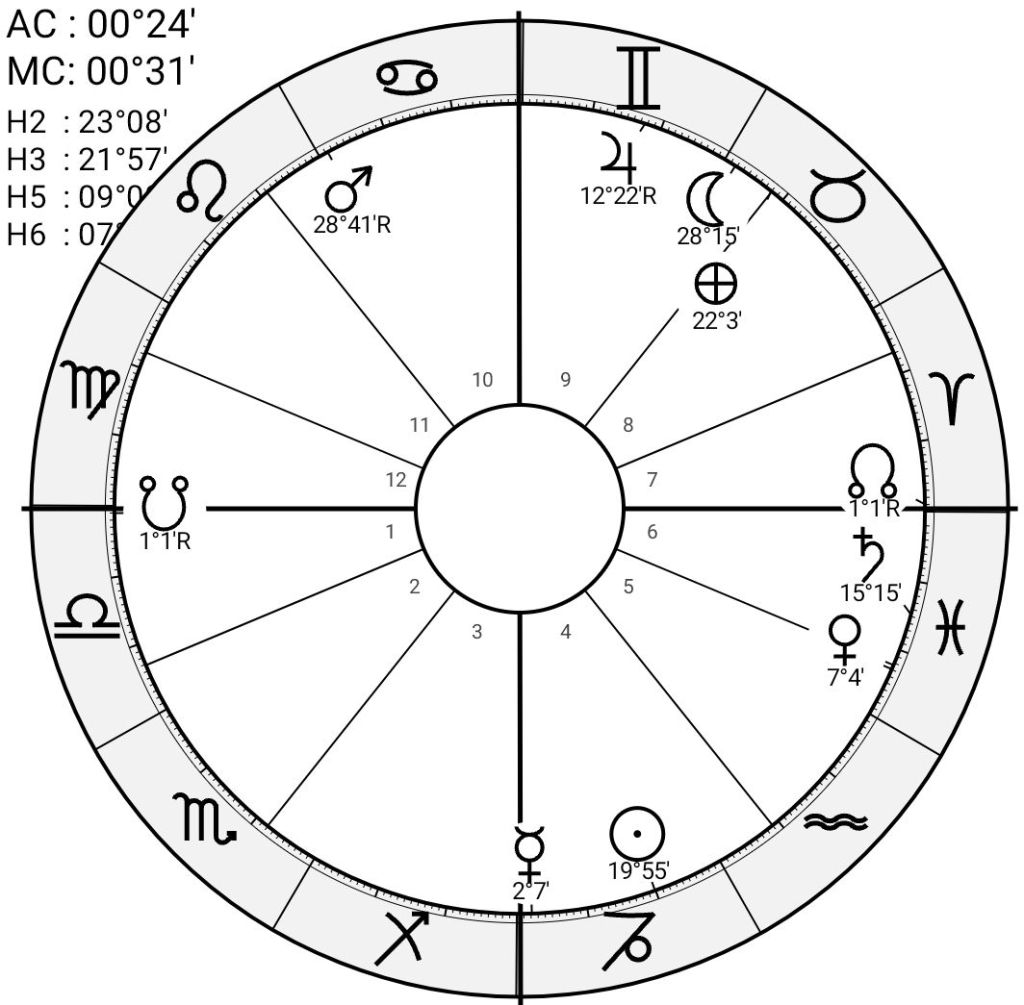
Since I’ve started studying horary astrology, my teacher has encouraged me to take on questions to learn on battlefield, as it were. I probably only need some exra push to start offering cheap readings here. This horary was asked by a social media contact of mine, who wants to know how her mental health will evolve.

Mental health. App used: Aquarius2Go

An immediate giveaway that something is off is the conjunction of the South Node of the Moon to the Ascendant. This is the “bad” node, traditionally attributed to the nature of the malefics, Mars and Saturn. It is as if the chart wanted to tell us “hey, there IS something wrong, go look!”

The querent is represented by the ruler of the Ascendant, Venus. Venus is exalted in Pisces, but conjunct the cusp of the malefic Sixth House of sickness. The Moon shows us the flow of the action. She, too, is exalted in Taurus, but conjunct some evil fixed stars and cadent in the Ninth House. She is sextiling Mars.

Venus is not terribly afflicted, but it is in a bad place in the chart. Since we are talking about mental health, and Venus is conjunct a house of sickness, it is probably reasonable to conclude that the querent is experiencing mental trouble of some sort. Considering that Pisces is a common sign, the trouble is probably recurring, coming and going.

Venus is approaching conjunction with a bad Saturn in the Sixth, and before that a square aspect with the ruler of the Sixth house, Jupiter, which is cadent, retrograde and in detriment. Since the square is approaching, the trouble is intensifying, at least at present. Still, there is reception between Venus and Jupiter, which tells me that the querent does have some inner strength to deal with it and work through it, especially with someone’s help. Note that both Venus and the Moon are exalted, which argues that the mental trouble is due to excessive expectations being disappointed.

The Moon is quickly approaching the sextile aspect with Mars. Mars is ruler of the Third and Eighth house. The Eighth house is the house of death, but also of mental anguish. But the sextile is a positive aspect and it happens with reception, so once again we have an image of the potential for overcoming the trouble.

All in all, the chart depicts a situation of suffering but it is encouraging. The querent is not as helpless as she may think and can find the strategies to go through the period of difficulty.

MQS

Enneagram Comparisons – Type Five and Type Six

Enneagram Type Five and Enneagram Type Six belong both to the Head triad, yet they give off markedly different energies. Fives actively employ their Head energy, using it to make sense of the world from a distance. Sixes often suppress their Head energy, don’t trust their own judgment and seek someone or something that will explain reality to them.

Being both Head types, both Fives and Sixes deal at their core with fear of the world around them. Fives thus retreat from the world into the safe realm of their own intellect, from which they observe life without being touched by it. It is often held that Fives are taking time off from real life in order to look for something, an idea or strategy, with which they may join the others and be useful or have a fighting chance, but while some great Fives really do come up with revolutionary ideas that changed the world, most Fives become lost and almost hooked on their own thinking power.

Sixes deal with fear differently. They don’t trust their own mind, so they seek structures outside of them, whether social, political, religious or other kind. For them, life is a sea of difficult choices, risks and dangers, a place where nothing seems certain. They therefore become engaged in an endless quest for the person, idea, group or thing that will give them clear answers that they don’t need to question anymore. Once they have found (or if they find) something that stands up to their scrutiny, they espouse it with militant fervor.

Fives tend to be philosophical and rational (though not always reasonable). Their approach to ideas and concepts is seldom practical, and they tend build up mental constructs not to employ them but to sharpen their overactive mind’s claws on them. Their attitude toward ideas is often playful and nihilistic. Sixes on the other hand are more practically oriented because their sense of fear is less rarefied and is almost palpable, as if they needed to actually survive from moment to moment. Their attempt at tearing down ideas and concepts is not playful at all: they keep poking holes in everything in hopes of finding the one thing where holes cannot be poked.

From a social standpoint, the difference between Fives and Sixes is often marked. Fives are withdrawn, remote, aloof. Even at average levels they are often socially inept, nor do they care to work on this aspect of their life, as they consider it inessential. Sixes, on the other hand, while often questioning people’s motivations, put on a friendly and even cheerful facade, because they are aware of how important networking is in dealing with the uncertainties of the world.

In reality, both Fives and Sixes are mistrustful of people. However, as far as Fives are concerned, rather than mistrusting people’s motives, like Sixes do, they tend to mistrust other people’s ability to understand reality better than them. On the other hand, a Six’s skepticism is generally oriented at people’s loyalties and competence in providing answers the Six can rely on. For instance, in an educational context, a Six pupil may not believe the teacher is good and is, in a way, faking it, while a Five pupil will often think they are better.

MQS

Enneagram Comparisons – Type Four and Type Seven

Enneagram Type Four and Enneagram Type Seven are quite different from one another, and not easy to confuse. Fours are a Heart type whose main focus is on what’s missing and what they are lacking. Sevens are a Head type, and they are generally focused more on finding exciting ways to fill up their time to distract them from life’s unpleasant aspects.

In general, Fours tend to have a relatively pessimistic view of life, and especially of their own life. Sevens are not necessarily optimistic, but they do tend to seek distraction from the negative side of things, which they usually acknowledge only in their more sober moments.

Fours tend to see beauty in what they don’t have, which is the basis of their envy. Some Fours may not even know what it is that they feel they are missing, they just know they don’t have it. They tend to focus on the past (what is lost and unrecoverable). Sevens on the other hand have an anticipatory mindset (they are the “looking forward to” type), whereby they get hyped about new possibilities for enjoyment. Fours can also focus on the future, but they also often know from experience that when the future comes, if it comes at all, it is generally a letdown.

Experience

Fours and Sevens are also very different around people. Sevens are people magnets, even when they don’t want to be. Stuff just tends to happen around them. Fours are usually ill-at-ease around people, though they long for contact and meaningful relationships. Furthermore, Sevens generally don’t question people’s motives too much unless they are given reason to, whereas Fours often overinterpret people’s behavior around them as a negative reaction to them and as proof that they don’t belong and are misunderstood (note that Four’s overinterpretation is different from, say, a Six’s questioning of people’s motives).

It is not rare for both Fours and Sevens to appreciate peculiar experiences and have a marked aesthetic appreciation. Sevens tend to have a quick pace, and they usually “eat life” at a high speed. While they can have a small handful of favorite activities, they are generally on the go and will always incorporate new ones into their routine to avoid it getting stale. They also tend to be somewhat hedonistic and materialistic.

Fours, on the other hand, usually like to savor a more limited range of things and activities for a more protracted period of time, tend to have a slower pace and are less materialistic and more concentrated with depth, as they tend to have an almost spiritual dedication to their practices. This is not to say that Sevens are necessarily shallow (though less healthy Sevens certainly are). Many Sevens can extract all there is to extract from something in a very short time and then move on collecting new experiences. The moving on part is what Fours struggle with, as they often feel the need to create and recreate the same kind of experience to evoke certain (usually negative) feelings.

MQS

Enneagram Comparisons | Type Four and Type Six

Enneagram Type Four and Enneagram Type Six share some similarities in spite of focusing on entirely different things. Fours are a Heart type, whose deep desire for authentic connection is only equaled by their feeling unable to find someone who will truly see them in their uniquely flawed nature. Sixes are a Head type, and their need to be reassured is equaled only by their inability to trust anything they or anyone else say.

Both types can have a generally negative view of the world. Fours believe themselves to be flawed and disadvantaged and feel that they don’t belong because they lack something other people have. Sixes are negative because they are used to questioning everything that is apparently good until they have managed to squeeze something that can be considered iffy or untrustworthy out of it, and see the world as a dangerous, or at least precarious place.

However, Fours are unapologetic in their pessimism, whereas Sixes may often try to tone it down or even suppress it in order to ingratiate themselves to others (they can even come off as upbeat) to build up friendships and alliances. In general, Sixes don’t like putting others off because they subconsciously don’t want to make enemies, whereas Fours generally don’t like behaving in a way that is not authentic to how they truly feel.

Indeed, the theme of authenticity is a leitmotif for both Fours and Sixes. Sixes want someone or something to explain reality to them in a way that leaves no place for doubt and fear, even if that means identifying threats or enemies (in fact, average Sixes love to be told who or what their enemy or threat is). One of their great fears is of being lied to, or of coming into contact with people who keep their real agenda secret to them. They also fear that people won’t tell them the truth to avoid hurting them, but because they have a very good nose, Sixes often can smell something is off.

Uncertainty

Average Fours do not so much fear lack of authenticity as they feel disdain for it, and are often unable to bring themselves to play socially accetaple roles if that means not being true to themselves.

Another similarity lies in the fact that both Fours and Sixes often feel a great deal of confusion within themselves. In spite of being a Head type, Sixes often come off as emotional and stormy. This is due to their lack of trust in their own judging ability, which sometimes leads them to drowning in a glass of water. Sixes would love to be told the clearcut truth, but as soon as they are presented with (one version of) it, they begin picking the black and white apart until a chaotic mess of shades of gray is left.

Fours also feel a great deal of confusion, but this is due more to their inability to pin their own personal identity down to a specific set of characteristics, because they always end up discovering a part of themselves that doesn’t fit any definition.

An important difference between the two types comes from the fact that Sixes tend to be sturdy, gregarious and friendly, whereas Fours are generally individualistic and delicate and experience great difficulties fitting in. Secretly, Fours may envy people who do fit in, but outwardly they often show contempt. On the other hand, Sixes may admire people who manage to stand out, but they generally deem it safer to fall back in line.

MQS

Enneagram Comparisons | Type Four and Type Five

Enneagram Type Four and Enneagram Type Five are, on paper, extremely different, yet they end up sharing a number of similarities. Fours are a Heart type whose main focus is on what makes them uniquely deficient in life and on attracting someone who will see them and love them in their brokenness. Fives are a Head type, preoccupied with security and with trying to overcome their ineptitude in facing life’s unpredictability and problems.

Fives are on the quest for pure objectivity, completely devoid of the dross of personal belief, feeling, hopes and desires. Fours are possibly the most subjective type in the Enneagram, whose attention always goes to their particular emotional reaction to life.

Both Fours and Fives share an often deeply negative view of reality and have no problem facing the dark side of life. Both are individualistic and ‘odd’ by social standards and don’t care if what they do or say isn’t accepted or common. Fours tend to defy conventions because they are primarily concerned with being true to themselves, while Fives defy conventions because they derive pleasure from the iconoclastic process of disruption. Fours are primarily existentialists, Fives are primarily nihilists, though of course there is some overlap.

Both types interpret the theme of aloneness, albeit in different ways. Type Four represents the single heart, with its ability to feel, to explore emotions of all shades and to create worlds of great beauty and meaning, longing for someone or something. Type Five is the single mind, with its ability to think, to explore concepts of all degrees of subtlety and to erect magnificent cathedrals of philosophical thought, only to smash them to bits like a kid would a sand castle.

Individual

For both types it is extremely important to be given space for self-expression, both dislike canned views and highly value individualism and creativity, and both types find themselves by difference from the world around them: Fours feel they are uniquely flawed and are on a quest to find themselves, their identity and their meaning, Fives feel that they can’t count on anything or anyone but their own mind and are on a quest to crack open the ultimate secrets of life.

That being said, there are also a number of differences. Fives are rarely very expressive of their feelings (which doesn’t mean they don’t have them), unless they have worked a lot on themselves, and even then it is often a conscious exercise. Fours are naturally expressive and they are capable of great emotional honesty in all circumstances, even if it’s uncomfortable for others. On the other hand, Fives are naturally cool-headed and always cut through endless layers of emotional nonsense in one fell swoop to reach the logical core of any situation, while Fours can only do so by consciously learning to disengage from their emotional reactions when it is not helpful to cling to them.

Even the way the two types are self-oriented is different. Fours are self-oriented because they relate everything to their experience of life, their pain, their longings, their particular idiosyncrasies, etc. Fives are self-oriented because they relate everything to their own ability to analyze it, without automatically accepting what anyone else has to say about it.

Both types tend toward pessimism, but with different motivations and implications. Fours are pessimistic about themselves and their life, believing they are unlucky or broken or that they have messed up somehow. Fives tend to be cosmic pessimists, that is, they observe the nature of things in a pessimistic or nihilistic light.

MQS

Enneagram Comparisons | Type Three and Type Seven

Enneagram Type Three and Enneagram Type Seven can on occasion be lookalikes, so distinguishing them may be treaky. Threes are a Heart type, and seek recognition for their (real or perceived) merits and for their excellence. Sevens are a Head type, concerned with achieving security by filling their life with distractions and exciting projects.

Let us never forget that the quest for recognition is part of our human makeup: it is how we work as social beings, regardless of our Enneagram Type. The same can be said for security and for looking out for exciting new things. Everyone needs security.

Threes, though, are essentially social in their psychological framework, even when they are introverted, simply because their usual way of acting is aimed at meeting criteria that have been set up for them by society or family. Thus, their actions and plans always imply the presence of other people, even when those people are not there. Sevens, on the other hand, may very well attract colorful and interesting people due to how they behave and may enjoy their praises, but they are ultimately interested in filling their lives with novelty and excitement to avoid looking at what they fear or causes them pain.

Threes are status-seekers, Sevens are pleasure-seekers. Sevens tend to have a strong materialistic streak and find comfort in owning stuff. Of course, they often want the cool new stuff, and coolness is generally a socially defined concept, but the comfort this stuff gives them is that they can use it to fill their lives with thrills and stimulations. Threes, on the other hand, want to be praised more than anything else. Of course, in our society, praise is often linked to the ability to have material possessions (prizes, wealth, etc.) but for Threes stuff matters mostly for what it means for their status.

Action

Both Threes and Sevens can be very hard and efficient workers. Sevens usually need more clearly to be in a line of work that stimulates them, but lacking this, they can put up with a job they don’t like that will allow them to fuel their extravance. Ultimately, their fear is of finding themselves in a situation of scarcity and being left without options, alone with their pain and a sneaking sense of void, meaninglessness and gloom. Threes tend to pursue paths that they deem themselves good at. Of course, if they like the path, all the better, but Threes can go down career paths they despise as long as they can stand out and gain approval. Their fear is mainly that of failure.

Both Threes and Sevens can have a grandiose sense of self. In Sevens, this is due to their disconnection (momentary or permanent) from the negative side of life, which often lauches them into phases of mania where they can become dangerously foolhardy and have unrealistic feelings of invincibility. Average Threes are grandiose about their sense of self, which is almost the sole reason, together with social or familial conditioning, why they get into careers or other life paths even if they don’t particularly like them, simply because they are looking for something that will give them a recognition they deem adequate to their view of themselves.

Ultimately, the grandiosity of an average Three does not blind them to reality, but merely fuels their plans, while the grandiosity of a Seven tends pravail in particularly unbalanced phases of their life and can cause them to make grave blunders (again, it is like a mania).

MQS