Tag Archives: medieval divination

Robert Fludd’s Geomancy – Book II Pt. 7

Previous / Back to Index / Next

Fludd discusses the signification of a figure springing from one house to another.

Of the signification of the 16 figures, when they duplicate in a question, that is, when similar figures are found in different houses, such as two Via, two Populus, etc.1

The figure in the first house means, when it is duplicated in the following houses:
In the Second, especially if it fortunate and fixed, and so the opposite, which is valid for all other houses.2
In the Third, good situation between relatives, brothers, sisters or neighbors.
In the Fourth, it is a bad mutation3 but not excessively so, unless the figure is Cauda Draconis.
In the Fifth, mirth, vivacious and gluttonous companions, new clothes, music, melodies, antique things, good according to the mind’s opinion,4 so that one couldn’t wish things to be better, unless the figure is Cauda Draconis.
In the Sixth, sickness, tribulations, fears.
In the Seventh, fearful things due armies or evil women; good [signification], unless Cauda or Via are there, which denote all evil in this house, unless a question has been made for a gathering, or for marriages and enemies, for otherwise they show danger.
In the Eighth, evil, great wrath or death or injury, loss, hurtful words, evil tribulations, but if the figure is good, it signifies the acquisition of the inheritances of the dead.
In the Ninth, something good, a firm and stable change to acquire some thing for another,5 and to negotiate some religious business or of the Church, or with ecclesiastical men or people, or with messengers or those who return from a journey, unless Cauda and Rubeus come up in a question made for a journey.
In the Tenth, all good, so that the thing cannot be better, and especially for the acquisition of honor and dignity, unless Cauda or Rubeus are there.
In the Eleventh, good, so that it is not better in the question propounded; for it signifies hope, a good friend, especially if it is Major, Via or Acquisitio.
In the Twelfth, the querent will fall into some tribulation, or a serious illness, or the loss of some thing, or defiance from enemies; nor can the thing be worse if the figure is Cauda.

The figure in the second house means, when it is duplicated in the following houses:
in the Third, gain from parents, brothers, sisters or neighbors, if the figures are good, but if bad, the opposite.
In the Fourth, what the querent thinks of gaining from his father, or from some great lord [he will get], if the figure is good; if bad, [he won’t get them].
In the Fifth, what the querent thinks of gaining from food, or clothes, or news that will come to him with letters, or loss by fire.6
In the Sixth, future illness of the family, or some loss, or fear, or great tribulation, or disease, or some evil thing.
In the Seventh, marriage, loss from a woman, great enmity for the querent, or robbery, or the thoughts of women about lust, or quarrels, threatening words, change from place to place.
In the Eighth, the return of an absent person, or of some other member of the family.
In the Ninth, gain for the querent, religious or ecclesiastical, or a priest, or some other similar thing.
In the Tenth, the Necromantic arts,7 or that the querent will win the love of some woman, or Lord, or great Majesty, or sciences according to the good or evil of the figures.
In the Eleventh, fortune in that house, or in the family, or through the family, or through gain, or friends, or merchandise; for this is the force and power of the whole question.
In the Twelfth, the imprisonment of some member of the family, or a serious illness, a serious molestation, or the destruction of someone from the family, of what you have gained, great accidents, or future tribulation and anguish.

The figure in the third house means, when it is duplicated in the following houses:
In the Fourth, brothers, sisters, companions, neighbors, messengers [arriving ] to the questioner, profit or loss according to the nature of the figures.
In the Fifth, joy, gladness, speedy news from friends, letters and messengers.
In the Sixth, tribulation, diseases, some fear, loss through a servant, or machination, or evil enemies.
In the Seventh, quarrels, change of place, there will be hatred and discord between brother and sister, anger against the questioner, marriage, etc.
In the Eighth, death or danger from the past, thoughts about a woman, or about one’s enemies, or fear, and future profit from evil thoughts.
In the Ninth, an occasion for the Clergy, great journeys to be made,8 benefits of the Church, some great prelate or honor.
In the Tenth, brothers and sisters will attain to some arts,9 or great marriages, or great dominion, or they will become great prelates, or be exalted to honor.
In the Eleventh, fortune or good favor from someone.
In the Twelfth, imprisonment, long illness, occupation, or entering into [a period of] tribulation, from which there will be no easy way out.

The figure in the fourth house means, when it is duplicated in the following houses:
In the Fifth, the father will rejoice with his children, or an uncle, or a relative, or some friend, or the father will make a profit through his children.
In the Sixth, the father will soon fall ill, or he will be forced into great labor in his house, or in the town where he lives.
In the Seventh, marriage or enemies, or lascivousness, or a change of state, or a change of land.
In the Eighth, mortality will enter the land10 and inheritance of the questioner, or some tribulation, or, if he is outside his country, a return.
In the Ninth, the death of priests or their loss in the Church.
In the Tenth, the questioner’s honor, gain, riches.
In the Eleventh, the questioner will be fortunate in some profitable matter, so that he will suddenly make a profit in it, and indeed through some of his friends, or some of the querent’s friends will give letters to those living in his house, which will bring the questioner much profit.
In the Twelfth, long anguish and sadness, illness, envy, betrayal of the land of some lord, or of someone of his blood, but if the figure is good, it will not do much harm.

The figure in the fifth house means, when it is duplicated in the following houses:
In the Sixth, disease by contusion or corrosion, or in other such ways, or news of children, the capture of some small beasts.
In the Seventh, a gathering for a wedding or for trade, the joy of friends, fortune for women and children.
In the Eighth, mortality, and the danger of some evil to come, the return of an absentee, and letters of joy, profit or news.
In the Ninth, the son of the querent will be a cleric or a priest of the Church or a religious person, or he will make a great and long journey, or will have great joy through the honor of the Church, that is, through a man of the Church.
In the Tenth, the son will have dominion, and the mother and sister will rejoice or find joy, or some assistance from [those in a position of] honor, or profit from the lord, or a prelature, or he [the son] will be a judge or teacher.
In the Eleventh, the son will have dominion or fortune over his enemies, or in trade or in a similar matter or in news, or his friends will rejoice over his children.
In the Twelfth, illness, imprisonment, great enemies for children, or some loss for the querent, or strangers will rejoice.11

The figure in the sixth house means, when it is duplicated in the following houses:
In the Seventh, disease, or the servant or the woman of the querent, or his companion, will suddenly become angry or will end up among enemies, or the querent and his woman will fall into the hands of robbers, or disgrace, which they will nevertheless escape from as much as possible.
In the Eighth, the servants or the beasts of the querent will fall into danger or tribulation, pain or sadness, and he will be beaten, or he will lose some object, and he will be absent and in the company of enemies of his house, or the woman of the querent will be familiar with someone else.12
In the Ninth, the servant or the animals of the querent will make a fortunate path, diseases will befall a cleric, or will hinder his exaltation, or the servants will have the company of the clergy, and especially with good and fortunate figures, such as Acquisitio and Major.
In the Tenth, those who will remain in the place about which the question was made will be sick or oppressed by some Lord.13
In the Eleventh, fortune, and your enemies will envy you.
In the Twelfth, a disease among one’s animals, or the querent himself will fall ill or be imprisoned and suffer loss either through useless beasts or through a long journey.

The figure in the seventh house means, when it is duplicated in the following houses:
In the Eighth, the death of one’s woman, iniquities and all those things which pertain to the seventh house, namely lost merchandise, etc.
In the Ninth, the companion of the querent will return to his country, and the clergy will be enemies to the querent, or his wife will enter religious life or go on a long journey.
In the Tenth, honors to those who are represented in the seventh house, or the servant of the querent will be a familiar of his wife, or of his enemies.
In the Eleventh, a friend will immediately become an enemy, or someone will immediately become a friend to the querent,14 or he will gain in some matter, or will suffer some loss from his friends.
In the Twelfth, occupation of large animals, or the querent will fall into a serious and long illness, or imprisonment, or a long journey, or poverty, or that some letters will bring him loss in a short time, which should be kept secret as proof.15

The figure in the eighth house means, when it is duplicated in the following houses:
In the Ninth, a judge of the enemies or of the woman or of the friend of the querent will attain great exaltation in the church, or he will be absent on a journey, or death threatens someone.16
In the Tenth, loss for the querent, or the death of the lord, or a defect in good will, or an impediment in some thing, or the absence of some lord.
In the Eleventh, the death of the querent, or he will acquire some thing, or the inheritance of a dead man, or that while absent he will acquire friends, or that friends will restrain the hatred of the querent.
In the Twelfth, secret enemies of the querent, who labor mightily to oppress him, or while absent he will be imprisoned or sick, or while imprisoned he will die.

The figure in the ninth house means, when it is duplicated in the following houses:
In the Tenth, being friends with priests or clerics, or the querent will suddenly marry a wife, or messengers will come from some place, or from the querent’s mother.
In the Eleventh, the journey of women, or a cleric will be your friend, or your fortune will be in the church, or you will have possessions in the church.
In the Twelfth, sadness during a the journey for the querent, or he will have trouble with his horse, or a cleric will be imprisoned. This is a bad place for the querent.

The figure in the tenth house means, when it is duplicated in the following houses:
In the Eleventh, the house or place of some lord, the completion of his fortune and hope, or that he will be a friend to some great lord, through whom he will be fortunate.
In the Twelfth, that the questioner will be shortly in great tribulation or illness, or will be imprisoned, or his enemy will be made a priest, and that the petitioner will have great loss from beasts.

A figure existing in the eleventh house signifies, when it doubles itself in the twelfth house, imprisonment, hatred of enemies, a similar thing.

MQS

Footnotes
  1. That is, if the same figure is found in two different houses. This, as we shall see, is generally interpreted as the two houses being linked together. Some of Fludd’s interpretations are straightforward, others rather obscure. Similar chapters are often found in other handbooks of geomancy as well. Their value consists not so much in their offering interpretations that need to be memorized, but rather in the kind of mental exercise that they allow the reader to engage in. ↩︎
  2. This sentence doesn’t mean much. Fludd is simply asserting that the signification of the link between the two houses is colored by the positive or negative meaning of the geomantic figure. ↩︎
  3. Mutation in the sense that the figure in the First house moves to the Fourth. ↩︎
  4. Somewhat obscure. I think Fludd means that this connection between First and Fifth houses is good concerning whatever the querent is thinking about. ↩︎
  5. Possibly referring to a business-related journey ↩︎
  6. Unclear what fire has to do with this house. ↩︎
  7. The connection of the Tenth house with necromancy is unclear. ↩︎
  8. Probably due to the connection of Third and Ninth houses, which both pertain to journeys. ↩︎
  9. The Tenth house is the house of art in the older Aristotelean sense of poiesis, i.e., practical science, which is what allows people to gain money. In short, it is one’s learned trade. ↩︎
  10. The land is a Fourth house matter. ↩︎
  11. Joy is here brought into the equation by the Fifth house. ↩︎
  12. That is, intimate. Older astrological texts are filled with lists of testimonies to look for to establish whether the querent’s wife is faithful, or even if he is exploring herself. I suggest we leave these things in the past. Still, from a purely didactical standpoint, Fludd’s paragraph makes sense. ↩︎
  13. I have no idea what Fludd meant. ↩︎
  14. Here we see how ambiguous this type of interpretation can become if we don’t keep the question in mind: it could go either way, namely that a friend (Eleventh) becomes an enemy (Seventh) or that someone else (Seventh) becomes a friend (Eleventh). ↩︎
  15. Not very clear. ↩︎
  16. The involvement of a judge here is unclear and seemingly random. ↩︎

A Brush With Death (Example Reading)

At the beginning of the year I did a reading for myself using the Bolognese tarot to have a look at my 2025. I am 99% sure I took a picture of it, but unfortunately can’t find it. One of the predictions was that an older female member of the family would probably need an operation around the middle of the year. There was no death in the cards (that I could see), but I remember that particular column looking a bit difficult. I assumed the cards were possibly talking about my mother. But I was wrong.

Last month my mother-in-law came to visit. She spent a week with us, although I couldn’t enjoy her company very much due to being in and out of a clinic in the past eight weeks (my bipolar depression flared up big time this summer).

At the end of our week together, she put off going back home for a day due to feeling sick, and on the following day hubby drove her home personally. Then she went completely off radar, to the point that we were all worried she might have had some serious health issue. We called the paramedics on her after she sent a somewhat incoherent message (we thought she might have had a stroke or something similar).

She was rushed to the hospital, and we all braced for the worst. As there was a real possibility of her dying, I asked if she would survive, and how the situation would evolve. To be fair, my question was a bit confused: I don’t know exactly what I asked, only that my concern was her survival.

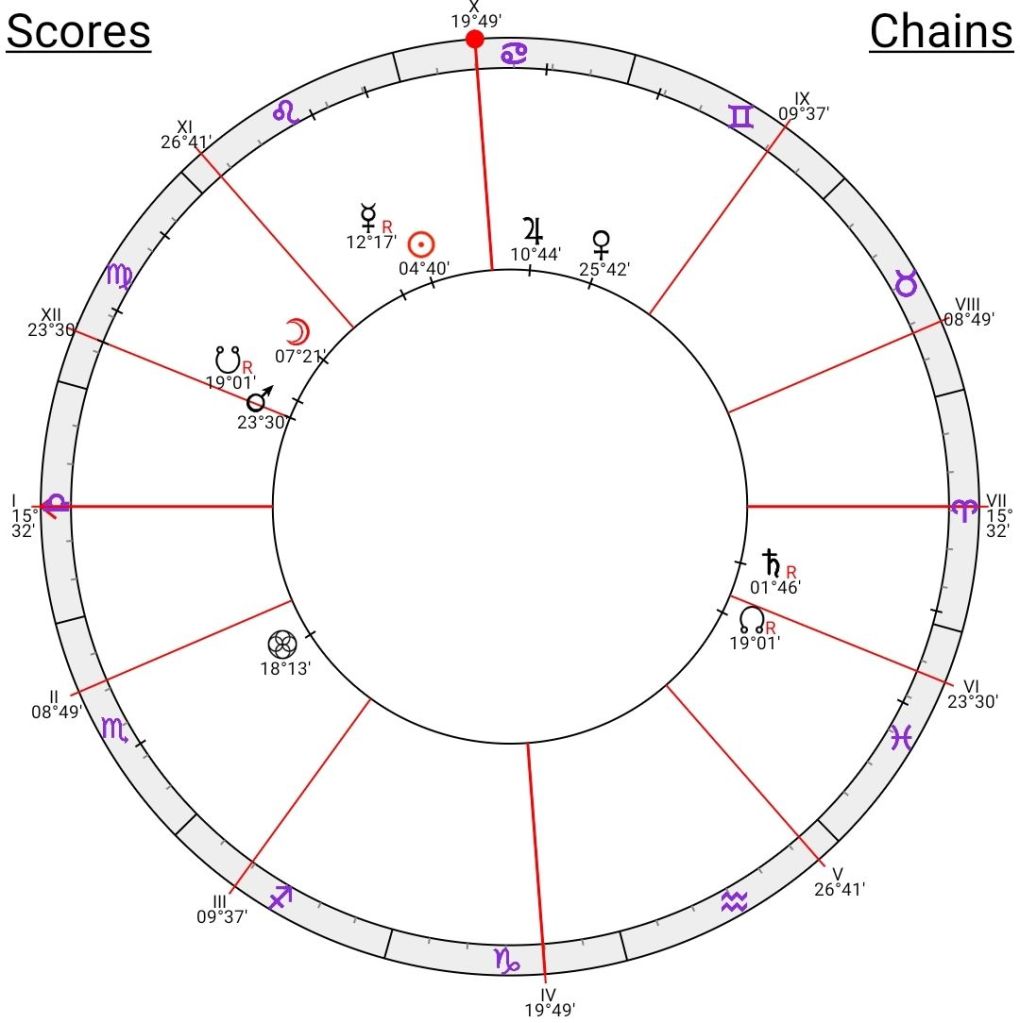
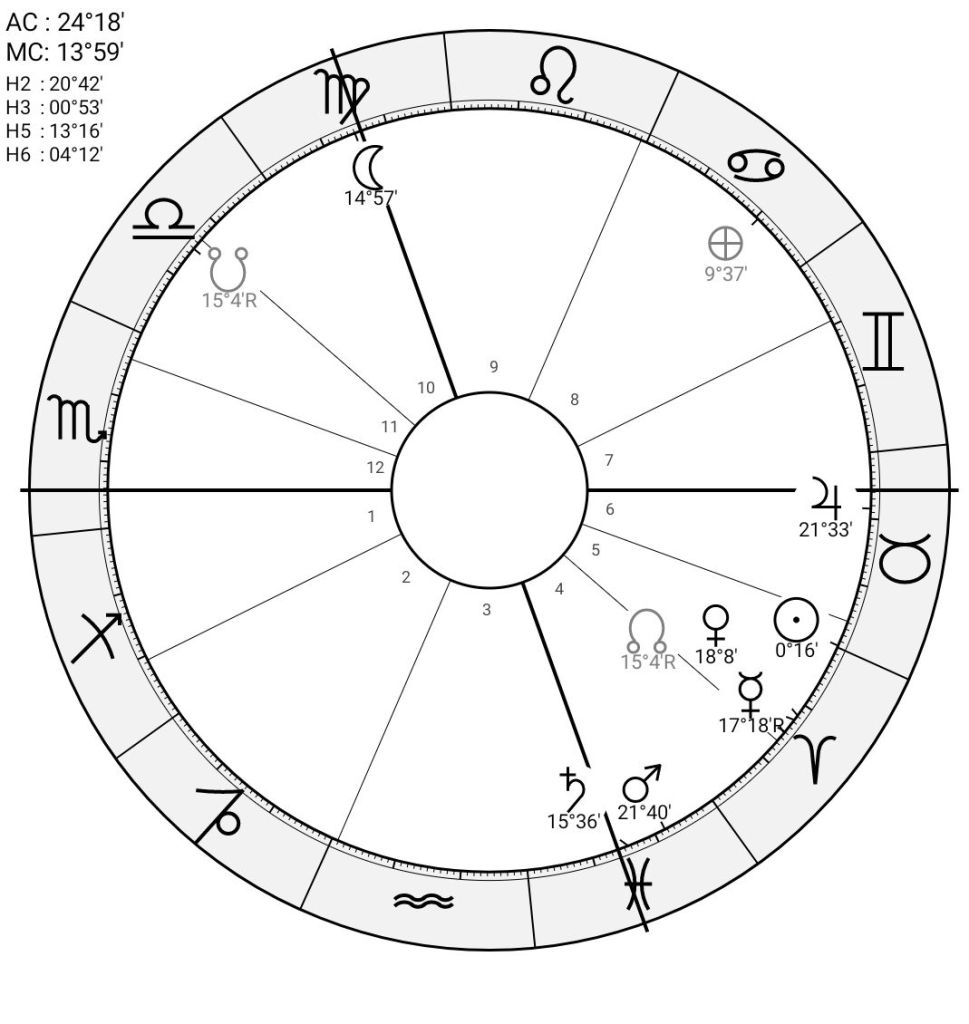
My mother-in-law is my husband’s (seventh house) mother (tenth house), so she should be represented by the radical fourth house and its ruler, Saturn. How is Saturn’s condition? Dreadful! It is in Aries, and therefore in fall, retrograde and tucked into the radical sixth house of illness. As I was concerned about her survival, I looked at the eighth house of death. Both the radical and the derived eighth house are in play, represented by Venus (radical) and the Sun (derived, radical eleventh).

Venus makes no aspect to Saturn in her current sign. The Sun is separating from a trine with reception from Saturn: there was a brush with death, but that was as close as they will come to each other in a while.

The Moon applies to a sextile of exalted Jupiter with reception. Things will improve. Saturn is about to come out of its fall by retrograding into Pisces, so while the situation remains difficult, she will survive.

It turned out she hadn’t had a stroke, but there was a serious bacterial infection in her bloodstream that caused her to have an alarmingly high fever (hence the confused message). She was treated with antibiotics. A couple of days later I asked a more relaxed: how will the matter evolve?

This time she Is represented by Venus as lady of the fourth house. Venus is peregrine in the sixth house of sickness, but she is about to change sign, whereupon she will enter her triplicity and decan: not out of the woods, but better. Once again there is no contact with death (once again the lord of the derived eighth house, Mars, separates from her planet).

But upon changing sign, Venus will bump into a difficult square with a very nasty Saturn. The situation will improve, but there is still something very unpleasant in her near future, though I could not tell what it was at the time.

Turns out that the infection, though cured in her blood, had reached her heart, and she needed an operation to change a valve, as well as additional antibiotics. The operation went fortunately really well and she is already improving a lot. I will edit the post if something changes.

MQS

Robert Fludd’s Geomancy – Book II Pt. 5

Previous / Back to Index / Next

Fludd discusses the meanings of Puer, Puella, Fortuna Major and Fortuna Minor.

Puer

in the First House, hope, marriage, the cheerful manner of a child, who loves nothing but to sing and spend time with music and the company of women.1
In the Second House, profits in commerce, good fortune, good profit, company of women, reception of debts.
In the Third House, joy on account of brothers and neighbors, charming and cheerful neighbors, a good journey, a good dream, and delightful news.

In the Fourth House, fights, no acquisition of the desired object, refusal of the thing that one desires, water.
In the Fifth House, joy, good children, news and letters, good news, pleasures, love, delights with women, musical instruments.
In the Sixth House, good servants, foolish women, children born from fornication, good animals, and long or prolonged illnesses.

In the Seventh House, evil and foolish women,2 fornication and bad company, marriage of children.
In the Eighth House, death and disease.
In the Ninth House, a journey by land, false belief, lewdness of the church.3

In the Tenth House, litigations over women, or for servants, or children in judgment or before a judge, (being in) the service of some master.4
In the Eleventh House, joy, luck, good love, love of women and men due to lewdness.5
In the Twelfth House, victory, a bad man, dangers, prisons, the failure of that which is equired about, good animals, strong and bad enemies.

In the Thirteenth House, joy and profits come from great people, letters, news, life, joy and travels.
In the Fourteenth House, danger but later a good end, drinking well, eating well, news and love.
In the Fifteenth House, temperance, profit in all things, and the completion of goods.6
In the Sixteenth House, all good.7

Note, when this figure is in the first house, it signifies a young man, handsome, and of good looks, with a fine beard, luxurious, fond of instruments and music, monks, hypocrites, and scholars.

Puella

In the First House, happiness of friends, food, having children, lewd and licentious words, lying, full of superfluous speech.8
In the Second House, profit, a tendency to extravagance.
In the Third House, love of relatives, good company, good relatives, much talk, weariness on the journey, and sometimes robbers.

In the Fourth House, profits in works of love, from father and mother,9 from inheritances, small fruits, talk, lewdness and dishonesty in the house.
In the Fifth house, happy children, news, letters, delights, superfluous words about lewdness, love of women, liars, and cowards.
In the Sixth House, evil women, disease of slaves, profit from animals, slaves (who are) full of boastful and lustful speech, diseases, that is, ulcers, swellings, bruises and the like.

In the Seventh House, marriage, profitable partners, women’s joys, many talkative and lustful women, harlots and dishonest women who touch others without merit.
In the Eighth House, the death of parents or sisters, inheritance from the dead, many words, the death of slaves in a foreign country.
In the Ninth House, profits on the way, sagacity, a man who loves joy and cheerfulness more than prayers and divine worship, dreams, news without much merit, good understanding in one’s teaching, singing, disturbance for the church.

In the Tenth House, happiness and profits on the way of one’s lord,10 good master and duties, but much talking done before.
In the Eleventh House, good friends, profit from slaves and beasts and good fortune, much talk, lust and fornication.
In the Twelfth House, talkativeness, profits from beasts and servants, enemies full of quarrels, beasts quite good.

In the Thirteenth House, profitable journey, profits from some lords.
In the Fourteenth House, good luck, profit from danger.
Note, when this figure is found in the First House, it denotes a man having a small body, and a short neck, a large head, teeth badly arranged, a fine intellect.

Fortuna Major

In the First House, thoughts of kings, treasures, old men, a man of good life, good fortune in all matters of profit and honor of the seeker, steadfastness, good hope.
In the Second House, wealth, profit, and especially from animals, a rich man, good luck, acquisition, joy, sense of gain.
In the Third House, good journey, but a little delayed, a good brother, good and rich relatives, a good dream, good news, joy, profit.

In the Fourth House, a good estate, the acquisition of the inheritance of great lords, treasures hidden in the earth, a good house, great advantage in all things stable,11 a good end, a good father and mother.
In the Fifth House, good children, good news, good letters, good love with wife, security of heart,12 change and honours.
In the Sixth House, long illness and pain, good animals, good servants, faithful and stable.

In the Seventh House, a good marriage, a good and chaste and prudent woman, great wealth, conquering one’s enemies, both in legal proceedings and in battles, strong and stable enemies,13 good in commerce, receiving one’s desire in other countries, the gathering of men and women.
In the Eighth House, rich enemies, riches from the dead, profits in a foreign country; where it is noted that this figure is good, but the house is terrible.
In the Ninth House, good journeys, though slow, good dreams.

In the Tenth House, good judgment, good decision in the place where the figure is duplicated, peaceful kings and kingdoms; a peaceful and firm state of the lords, the acquisition of one’s desire, reward and lasting honor from the lords.
In the Eleventh House, good fortune, noble and faithful friends, profits in trade, good hope of riches from the king and prince, joy and happiness.
In the Twelfth House horses, good and useful animals, a long and dangerous imprisonment, a dangerous disease, long debts, long tribulations, strong enemies14, evil for journeying.

In the Thirteenth House, a good journey and good fortune, acquisition from the king, absence, happiness in riches and joy.
In the Fourteenth House, deliverance from diseases, escape from prison and debts, good luck, sudden riches for the absent, good company, good friends and security in hope.
In the Fifteenth House, a good judgment, a good end, a good outcome for joys, and if it comes from good Witnesses, it will give the petitioner security in all good things, and the good is witnessed in the place (in the chart) where the figure is found.

Note, when Major is in the First House, it means an old man, a merchant of precious cloths, affable, of average stature, well dressed, good hair.

Fortuna Minor

in the First House, goodness, a good journey to princes and lords, a rich and fortunate man, also a king,15 a prince, a leader, a man of great authority, knowledge, good animals, a good and humble wife.
In the Second House, the acquisition of a house by a master or a great man, and indeed without effort.
In the Third House, good brothers, and wealth and profit from them, good neighbors, good knowledge and good faith, good travels, especially by sea, a good woman.

In the Fourth House, treasures of kings or magnates, good journeys to parents, noble inheritance, and acquisition of inheritance.
In the Fifth House, good children, good news, a good journey towards children, joy and comfort, useful journeys,16 pleasures and delights of nobles.
In the Sixth House, the insults of kings and princes and their injuries from other lords,17 as well as victory from them, fear of losing their dominion or kingdom, proud servants.

In the Seventh House, a good woman, beautiful and rich, but it will be doubtful that she will be destroyed by foolish love, murder committed by a great man, denotes to one’s son a noble marriage and good travels.18
In the Eighth House, the death of kings, or the fear of kings, so that he who has become a problem may fear them, and if Rubeus is found in the Seventh House, death due to loss of blood, it is not good to go out of the country or to travel, for imprisonment or violent death are to be feared.
In the Ninth House, a good journey, a good relationship with kings or superiors to obtain favor, a faithful man, of good faith and God-fearing.

In the Tenth House, a good king and a ruler with good virtues, victory, good for migration by sea and making journeys, the acquisition of property from a prince or king, acquisition thanks to the love of judges, profit and honor.
In the Eleventh House, good hope, good friends, good fortune, good company, good fortune in beasts and servants.19
In the Twelfth House, good animals, coming out of prison, poverty for the petitioner due to that, where the figure is duplicated, and especially in the Tenth House, it denotes the loss of the kingdom to the king, either due to himself or his children.

In the Thirteenth House, profits on the way, and receiving one’s wish from some lord.
In the Fourteenth House, a long life, good fortune, and profits in the business one hopes for.
In the Fifteenth House, a good result in all good things, a good end, good company, honor and glory.

Note, Minor in the First House signifies a king or queen, a handsome and brave man, clothed in scarlet, who likes to travel often, covered with gold.

MQS

Footnotes
  1. Puer and Puella are the two most confusing figures in traditional texts. Here we find mixed together attributions that, in contemporary geomancy, have been attributed to one or the other. ↩︎
  2. Fludd seems to attribute Puer to women, and since the Seventh House is the house of enemies, it causes the women to be evil. ↩︎
  3. Here seems to emerge the typical sexual theme that some today attribute to Puer. ↩︎
  4. Possibly meaning being subservient to another. ↩︎
  5. Possibly indicating homosexuality. ↩︎
  6. Puer cannot be the judge. ↩︎
  7. This is possibly the only time that Fludd discusses the Reconciler (also knwn as Judge of the Judge) ↩︎
  8. Similar traits are assigned by others to Puer. However, let us also not forget that in those times, sometimes women were considered deceitful by default. ↩︎
  9. Note that typically the Fourth House is assigned to the father and the Tenth to the mother. However, when considering one’s parents in general, they are both Fourth House matter, since the Fourth is the house of the family and the home. ↩︎
  10. “In via de Domino”. I don’t understand what this means. ↩︎
  11. Major is considered one of the most stable figures. ↩︎
  12. The heart is often assigned to the Fifth House, and Major gives steadfastness. ↩︎
  13. In this interpretation, the power of Fortuna Major is in favor of the enemy, ruled by the Seventh House. ↩︎
  14. In the Twelfth House, Major causes prison sentences to be steadfast, that is, long. ↩︎
  15. Fludd seems to attribute worldly honors more th Minor than to Major. ↩︎
  16. I don’t understand the connection to journeys. ↩︎
  17. possibly due to the negative effect of the house. ↩︎
  18. Much of what is said here is hard to understand logically. ↩︎
  19. The connection with animals and servants is odd. ↩︎

Robert Fludd’s Geomancy – Book II Pt. 3

Previous / Back to Index / Next

Fludd explains some of the meanings of Acquisitio, Amissio, Laetitia and Tristitia in the various houses.

Of the Nature and Meaning of the Sixteen Figures in Each of the Houses of the Shield

Acquisitio

In the First house, riches, prudence, profit, good end (or aim)1 luck, receiving what one wishes, but this figure is not good for selling;2 but it is truthful.
In the Second house, wealth, gain, profit, good luck in commerce, reception of something promised, recovery of lost property, increase of all good things.
In the Third house, good luck from relatives, good relatives, siblings, neighbors, good journey, good sense (or feeling).3

In the Fourth house, good inheritance, good and useful house, in which one will acquire riches, rich father, positive solution to all things connected with inheritance.
In the Fifth house, gain from one’s children,4 good children, good letters, good clothes, happiness in the heart, delighting in women, the fruits of the inheritance.5
In the Sixth house, long illness,6 which however will be cured, good animals, good servants.

In the Seventh house, a chaste and submissive woman,7 good company, good dealings, peace, reconciliation with enemies, whether it be in litigation or in war.
In the Eighth house, redress, natural death, gain in foreign land, freedom from fear of death, the enemy is happy and rich.8
In the Ninth house, gain from death, path or travel, fear of God, positive journey, benefit, good dreams, good sense in all actions, piety and religious devotion, good in things of church.

In the Tenth house, profit from (or for) the master or king, peaceful and happy masters, obtaining one’s wish, good sentence from the judge.
In the Eleventh house, good luck, good friends, gain from commerce, immediate reception of gain.
In the Twelfth house, poverty or incarceration due to debts, profit for (or from) servants and beasts,9 long prison sentence, good in case of illness and in being paid back a debt.

In the Thirteenth house, loss and change in profits,10 good journey, acquisition in everything, receipt, implementation of the wish of the absent person.11
In the Fourteenth house, gain in everything one wishes, long life, luck, usefulness, goodness.
In the Fifteenth house, good in everything, recovery of lost things, delay in one’s journey.

Note that this figure in the first house shows a man who is handsome, with yellow or beautiful hair, mediocre build, a red face, a merchant.12

Amissio

In the First house, a bold, unstable man, full of crime and deception, receiving nothing.
in the Second house loss of merchandise and goods, no profit, loss of all goods from robbers.
In the Third house enmity between relatives, parents, brothers, neighbors full of deception, fear on the way.

In the Fourth house falsity and loss of inheritance and patrimony, bad end of the city or house.13
In the fifth house loss of fruits of the inheritance,14 bad and unstable children, bad letters,15 no pleasure in the love of unserious women.
In the Sixth house escape from disease, loss of animals, flight of slaves, likewise injury and perversity.

In the Seventh house an evil woman, a quarrel with one’s master16 or partner, an unstable and lustful woman, loss of merchandise, fugitive robbers, inimical partners, changeable and deceitful, bad change (or removal).17
In the Eighth house loss from death, loss of sense, no profit in the place where one goes, poor enemies, loss a woman’s dowry.
In the Ninth house a long journey without pleasure, no knowledge, some evil for the querent from the Church.

In the Tenth house evil lords, loss of honour, dominion or office, unstable lords, troubles of kingdoms, obstacles to honour.
In the Eleventh house loss of friends, loss of merchandise, false hope, changeable and useless friends.
In the Twelfth house loss of animals, escape from debts, bad change, escape from prison, friends full of falsehood, changeable and derisive.

In the Thirteenth house loss and change in authority or government, bad luck.
In the Fourteenth house loss of friends, much toil in every matter.18
In the Fifteenth house a reception of nothing, a bad conclusion.

note, when this figure Loss is found in the first house, it signifies a pale man, a liar, a predator, a thief.

Laetitia

In the First house judges, wise men, a good and upright life, fullness of joy and exaltation, joy to the querent in all things.
In the Second house a multitude of honors, a life full of fidelity and joy.
In the Third house good fortune through one’s brothers, no fear of God,19 good love of brothers, neighbors, parents, much joy in everything.

In the Fourth house profit from inheritances and from all things on earth,20 a happy end, happiness through real estate, happiness of parents, peaceful inheritance.
In the Fifth house profitable children, long life, happiness in all things, happy and delightful letters and news, happiness from women and all good things.
In the Sixth house servants, animals cured from disease, joyful and cheerful servants.

In the Seventh house a good marriage, profitable partners or profit from partners, victory due to a cheerful and chaste woman, cheerful company, peace and harmony, good change (or removal).
In the Eighth house profits inherited from the dead, escape from fear, profit and profits in the place where one removes to.
In the Ninth house, journeys, fear of God, knowledge, faithfulness, cheerfulness, a holy man,21 business of the church, good news, fine arts, devotion and love of the church.

In the Tenth house exaltation to great honors, bishops and prelates, help from the lords, a happy and cheerful office, beautiful temples, a good judge, a just and good opinion, a warm place.22
In the Eleventh house good fortune from associates, profitable animals,23 joyous love, good hope from a good man, cheerful and good friends, a prudent man and of good knowledge, profit in trade.
In the Twelfth house profitable beasts and slaves, coming out of prison, deliverance from debt, and from all tribulation, peace and reconciliation with enemies.

In the Thirteenth house, profit from a journey, from the king, from the lord, positive change.
In the Fourteenth house good hope of fulfilling one’s will, happy hope, the fulfillment of one’s wishes, joy and exaltation.

When this figure is found in the first house, it signifies a bishop, a prelate of the church, religious and ecclesiastical, a long beard, some evil existing in the finger,24 remaining in high places.

Tristitia

In the First house, sad thoughts, debts, poverty, hidden loss, obligations, prison, roadblocks, bad change, unbelieving and without hope.25
In the Second house fortune and commerce,26 avarice, loss of property, an unfortunate usurer, dishonor.
In the Third house bitterness with relatives, silent hatred with neighbors and relatives, a secret obstacle on the way.27

In the Fourth house loss of inheritance and in battles, loss of house, trouble, bad house, bad luck, poverty of parents, loss.
In the Fifth house bad and poor children, false letters, sadness and anguish of heart, secrets in love of sad women, poor food and clothes.
In the Sixth house evil servants, fear of captivity and poverty, timid and useless animals, long illness or death, poverty, rejection without injury and confusion.28

In the Seventh house a bad woman, a victorious man,29 a thief in the night, poor condition, loss, bad change (or removal), a sad woman.
In the Eighth house being poor from the death of another, loss in a foreign nation, damage from the absent person.30

In the Ninth house the road is unprofitable, hindrances in the journey and loss, a man without wisdom and knowledge, a crude understanding, the downfall of the church and benefits.

In the Tenth house, loss and degradation of men, the exaltation of the wicked,31 loss of duties, sad lords, fear of kings and kingdoms, wrong judgment of judges, a fall from honor.
In the Eleventh house, contemptuous friends, bad luck which will last for a long time, but still with hope, a poor friend, no failure in business.32
In the Twelfth house, debts, enemies, loss, long imprisonment or death in prison, a timid and poor enemy, trouble, fear of obligations and debts, long or incurable illness.33

In the Thirteenth house evil on the road and sadness.
In the Fourteenth house, bad luck, small journeys, anxiety and trouble, despair and irreparable evil.

When this figure is found in the first house, it signifies a dark man,34 having torn clothes, and who deals in dark, foul, and vile things.

MQS

Footnotes
  1. It is unclear to me whether he means a good end to the matter at hand or a positive aim in mind. ↩︎
  2. Because it implies receiving rather than giving away. ↩︎
  3. Probably meaning clarity of mind. ↩︎
  4. This was written in preromantic times, when children were often seen as helping hands. ↩︎
  5. Because the Fifth house is the second from the Fourth. ↩︎
  6. Because it implies not getting rid of it. ↩︎
  7. Implying the querent is a man. However, in some old Astrology handbooks, the Seventh house is assigned specifically to women. ↩︎
  8. Because it is the second from the Seventh house, which is the house opposing the first. ↩︎
  9. The Twelfth house rules larger animals. ↩︎
  10. This sentence is not clear to me, nor why Acquisitio would imply loss. ↩︎
  11. “Implementum desiderii absentis.” This is obscure to me. ↩︎
  12. Fludd attributes, like many others, physical descriptions to the figures when they are in the First House. This is typical of traditional astrology, where the first house represents the querent. Note that these descriptions are rather limiting and conform to old stereotypes. Plus, they imply that the same querent would always be represented by the same figure whenever they come to the geomancer for a consultation, which is highly unlikely. They are still useful on occasion, but one must “mix discretion with art”. ↩︎
  13. In addition to one’s home, the Fourth house indicates the city. ↩︎
  14. Again because the Fifth is the second from the Fourth. However, the Fourth house also rules orchards and lands, so the Fifth can indicate literal fruits from the lands. ↩︎
  15. There is some confusion in traditional astrology on which house rules letters. Some say the Third house, some the Fifth, some the Ninth. As far as I can rationalize this matter, the Third house represents communication and private correspondence; the Fifth house represents messengers because it is the second from the Fourth, the Fourth house being the city, and the second house from any house indicates that thing’s representatives (for instance, my Second house would indicate my lawyer, who represents me in a court of law.) ↩︎
  16. It’s unclear why the Seventh would indicate the master. ↩︎
  17. The Seventh house represents “there”, while the Firsth house is “here”. ↩︎
  18. The Thirteenth and Fourteenth houses, i.e., the Witnesses, generally receive their signification (as we have seen in Abano’s case) from the two houses they derive from on the Shield: the Right Witness from the Ninth and Tenth, the Left Witness from the Eleventh and Twelfth. ↩︎
  19. It is unclear whether this is positive or negative, as fear of God was considered the beginning of wisdom. As for why it is attributed to the Third house instead of the Ninth, in some very old Astrological texts the Third House is the house of the Goddess, and in Christian times it possibly came to represent how one’s faith affected one’s everyday life. ↩︎
  20. The Fourth house, the Imum Coeli, is the earth. ↩︎
  21. All these positive religious connotations stem from Acquisitio’s attribution to Jupiter. ↩︎
  22. The Tenth house, the M.C., represents the sky and therefore the weather. ↩︎
  23. I don’t get why. ↩︎
  24. I don’t understand why. ↩︎
  25. Probably as character traits, since it is about the First House. ↩︎
  26. I do not understand why Tristitia in the second would bode well for commerce. ↩︎
  27. Fludd’s insistence on the idea of secrecy is due to Tristitia’s association with Saturn. ↩︎
  28. “abjectionem sine vulnere et confusione”. I do not understand this sentence. ↩︎
  29. I don’t understand why “a victorious man”. ↩︎
  30. The reference to absent people is due to how common it was to ask astrologers or geomancers about people who had simply gone away or vanished. This is understandable, considering astrology was probably the only tracking device available at the time. ↩︎
  31. Because the Tenth House is the highest place in the chart and Tristitia indicates downward movement and lowly things or people, it can show the elevation of someone unworthy or the downfall of someone who is in a high place. ↩︎
  32. This last part is unclear to me. Possibly because the failure announced by Tristitia is mitigated by the positivity of the house. ↩︎
  33. Typically we assign illness to the Sixth house. However, there are old handbooks that assign illness (especially serious illness) to the Twelfth house. Some distinguish between the Illness (Sixth House) and the confinement that derives from it (Twelfth House). ↩︎
  34. From Saturn’s influence ↩︎

Robert Fludd’s Geomancy – Book II Pt. 1

Previous / Back to Index / Next

Fludd gives some basic details about the geomantic figures.

Of the Names, Forms and Natures of the Geomantic Figures

those figures which can be drawn from the series of four geomantic lines are sixteen in number, which are distinguished from one another by name and form, as follows:1

NameForm
First: Acquisitio* *
*
* *
*
Second: Amissio*
* *
*
* *
Third: Laetitia*
* *
* *
* *
Fourth: Tristitia* *
* *
* *
*
Fifth: Caput Draconis* *
*
*
*
Sixth: Cauda Draconis*
*
*
* *
Seventh: Albus* *
* *
*
* *
Eighth: Rubeus* *
*
* *
* *
Ninth: Puer2*
* *
*
*
Tenth: Puella*
*
* *
*
Eleventh: Major Fortuna (sic)* *
* *
*
*
Twelfth: Minor Fortuna (sic)*
*
* *
* *
Thirteenth: Populus* *
* *
* *
* *
Fourteenth: Via*
*
*
*
Fifteenth: Conjunctio* *
*
*
* *
Sixteenth: Carcer*
* *
* *
*

And these figures are obviously referred to the signs of the Zodiac:

FigureZodiac Sign
AcquisitioAries
Laetitia and Fortuna MinorTaurus
Rubeus and PuerGemini
Albus and PopulusCancer
ViaLeo
Caput Draconis and ConjunctioVirgo
PuellaLeo
Tristitia and AmissioScorpio
Cauda DraconisSagittarius
PopulusCapricorn
Fortuna MajorAquarius
CarcerPisces

Similarly they are given to:

PlanetFigures
MarsRubeus (D), Puella (R)3
SunMajor (fast), Minor (slow)4
VenusPuer (D)5, Amissio (R)
MercuryAlbus (D), Conjunctio (R)
MoonPopulus (D), Via (R)6
Jupiter and VenusCaput Draconis (D)
Saturn and MarsCauda Draconis (R)

These Figures are also:

ElementFigures
Fiery, assigned to the SouthRubeus
Minor
Amissio
Cauda
Airy, assigned to the EastLaetitia
Acquisitio
Puella
Conjunctio
Watery, assigned to the NorthPopulus
Via
Puer
Albus
Earthy, assigned to the WestMajor
Caput
Carcer
Tristitia

The Figures are:

ValueFigures
Always positive and fortunateMajor
Laetitia
Caput
Albus
Puer
Acquisitio
Always negative and unhappyTristitia
Rubeus
Puella
Amissio
Cauda
Minor
Carcer
Neither always good nor always evil, but middling, that is, neither exceptionally good nor exceptionally badPopulus
Via
Conjunctio

The Figures are however:

StabilityFigures
Strong and stableMajor
Acquisitio
Laetitia
Puer
Albus
Caput
Weak and moveableAmissio
Tristitia
Puella
Rubeus
Cauda
Mediocre, that is, neither strong nor weakPopulus
Via
Conjunctio
Carcer7

Rule I
Strong and firm figures make a thing stable and firm, for better or worse, depending on whether the figure is found in a good or evil house.

Rule II
Weak figures are so called, because they render a weak judgement without stability, neither are they so good and stable as much as they are mediocre,8 whether in a question of illness or incarceration or pregnancy.

Rule III
Mediocre figures are so called, because they are between strong and weak figures, and they make a situation mediocre, that is, neither totally good nor totally bad.

MQS

Footnotes
  1. Fludd was fond of using tables. I will try to make the layout of the translation as clear as possible ↩︎
  2. Fludd gives here to Puer the form we typically assign to Puella and vice versa. ↩︎
  3. ‘D’ is for ‘direct’, ‘R’ for retrograde.
    ↩︎
  4. The Sun cannot go into retrogradation, which is why some sources, like Fludd, attribute the two Fortunes to the Sun at different speeds. This is still somewhat odd, considering the Sun is always rather constant in its speed (which is probably behind the traditional symbolic view of the Sun as a source of stability, as opposed to the Moon’s changeability). ↩︎
  5. Generally, today, we would assign Venus to Puella and Mars to Puer. It is unclear to me the extent to which Fludd was making a mistake or providing a blind to challenge the reader’s thinking. He is not the only traditional authority who swaps Puer and Puella, though. ↩︎
  6. The Moon cannot go into retrogradation. Usually, Populus is assigned today to the waxing Moon, Via to the waning Moon. ↩︎
  7. There exist other lists with partially different attributions. ↩︎
  8. It is unclear to me whether Fludd means that weak figures are mediocre or that they are worse than those called mediocre. Logic would dictate that the latter interpretation is correct. ↩︎

Cancelled Flights? (Example Reading)

One pro of using more than one system of divination is that sometimes they clarify each other: sometimes one reading is somewhat obscure in one system but clear in the other, and we can use the clear one to navigate the one that has us scratching our heads. Granted, obscurity is in the eye of the beholder, being always a consequence of our own limitations, but it is still an occasion to learn.

I was at the airport yesterday, trying to catch a flight to get back home. Suddenly, and to my horror, I noticed that plenty of flights were being cancelled due to the heavy mist, including one flight on the same route I needed. My first instinct was to cast a Horary chart, asking if I’d be able to get back home.

Will my flight go as planned or will it be cancelled? Horary Astrology

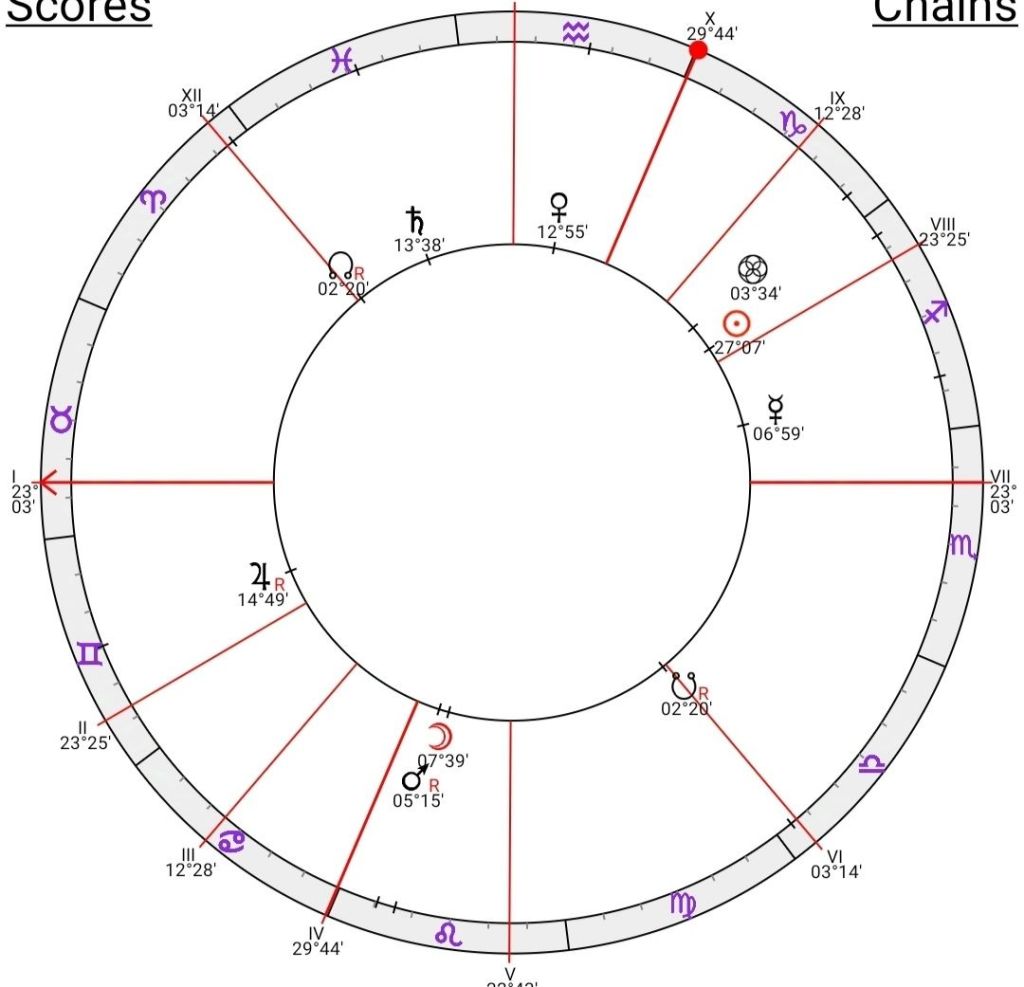
This was my first interpretation. I am represented by Venus, ruler of the ascendant. The place I want to get is my home, which is ruled by the Fourth House and therefore by the Moon (Cancer is on the cusp). The Moon is approaching an opposition of Venus. Bam! The flight will be cancelled.

After a while, as I was waiting for information, I did a Geomancy reading on the same question. Here is the chart:

Will the flight go as planned or will it be cancelled? App used: Simple Geomancy

The first thing the struck me is the generally positive Judge, Conjunctio, which arises from Carcer and Via. It argues mobility more than stasis, and obstacles that are removed. The second important point is the figure that represents me: Laetitia in the first. Laetitia represents upward motion. It is an exiting figure, meaning movement. What a wonderful symbol for a plane taking off!

Even if we want to involve the Fourth house, we see that it is occupied by Puella, a mildly benefic figure, which is also connected to the ninth house of journeys (it occupies it). So the journey (Ninth) connects with the home (Fourth).

Obviously, two systems of divination cannot give contradictory answers if correctly interpreted, and the Geomancy seemed rather obviously positive. So I went back to the Horary Chart (again below)

Will my flight go as planned or will it be cancelled? Horary Astrology

I meditated on this chart quite a while (I had plenty of time, after all). Then it hit me. I am represented by Venus. Venus is in the Midheaven (up in the sky) in Aquarius, an *air* sign. Not only, but Aquarius is fixed: it doesn’t change. My being in the sky is fixed. So there will be a flight: I will be up in the sky as planned.

But what about that opposition by the Moon? Well, there was significant delay, so the Moon could show the flow of events causing trouble to my being up in the air.

Ultimately, the Fourth House didn’t need to get involved. The point of the question was not whether I would get home (I would have gotten home anyway at some point) but what would happen to me/my flight.

I managed to come home yesterday.

MQS

Robert Fludd’s Geomancy – Book I Pt. 2

Previous / Back to Index / Next

Fludd discusses how the diviner should prepare to a geomancy reading.

The Preparation of the Soul of the Diviner Prior to Making a Figure

Since this knowledge is founded on [an operation of] the soul,1 it is certain and manifest that no truth can be guaranteed in it, except in so far as the soul permits it.

Therefore it is required that he who wishes to be versed in this art, before he begins his operation, should have a good and clear conscience, and that his body and spirit should be governed without disturbance, and that he should not think worse of another than of himself,2 nor should his mind be spare in judgment, and not tend to negation more than to affirmation. He should be a just judge of the question proposed.

Finally, he must trust in God almighty, who is the author of all knowledge and truth,3 and pray to him that through this knowledge he will be allowed to find the truth that his heart longs to know.

All of this having been properly considered, and with a soul well established in the proposed matter, he will immediately make the projections of the points.

Hence it is that so much fallacy and uncertainty arise in this art. This is also the reason why the same art is immediately regarded as nothing, namely, because some, falsely ascribing the name of artists to themselves, neglecting God, and not being moved in the least by the pacification of their souls and of the pleasures of the body, falsely judge of the things proposed, and by this reason render this secret and very profound art so despised, that it is also commonly regarded as the most falsified of all.

The fault, then, is not in the science, but in those who profess it: the science is doubtless most truthful, but its proponents are often hindered by ambiguities and difficulties because of their vicious dispositions.

For who can doubt that the soul can direct any part of the body to the true knowledge of the future more easily than the whole body itself?4

When we perceive that she governs her whole body in such a way that she foresees the future every day and every hour, that is to say, that she will arrange such a business the next day, and ride to this or that city, and do other things the following week, or even that she will marry at this or some other time, or that he would carry out his purpose and plan at such or such an hour, etc.5

MQS

Footnotes
  1. As established in the previous chapter. ↩︎
  2. To the modern reader, these tips may seem to have a moralistic taste, but we should keep in mind that, aside from being in part a product of the times, they may be boiled down to the very sensible idea that a diviner, as intermediary between the querent and the divine, should purify himself of that which keeps him away from the divine. One cannot be a bridge between A and B without being capable of reaching both sides. Aside from being against Christian morality, “thinking worse of another than oneself” also implies being engrossed in outside world nonsense. ↩︎
  3. A fundamental truth of all divination is that its knowledge does not originate within the diviner. ↩︎
  4. That is, the soul is more capable of the body of considering the future. ↩︎
  5. This remark may appear odd, but from an occult standpoint it does make sense: our soul is capable of conceiving the future because it is integral part of an inner world (which opposes and complements the outside world, of which our body is an integral part) wherein the normal rules of time don’t unfold as they do outside. ↩︎

The Geomancy of Peter of Abano – Book IV Pt. 4

Previous / Back to Index

Abano discusses the various meanings of Tristitia, Laetitia, Puer and Puella as they derive from other figures.

Laetitia

When from Populus and Laetitia, it means luck, gain, especially in large [or great] things.
When from Acquisitio and Puer it means gain, merriment, especially in changeable things.
When from Amissio and Albus it means luck, but with mediocre gain.
When from Major and Puella it means fixity, gain and good luck.

When from Minor and Rubeus it means mediocre gain or honor or good luck.
When from Via and Caput it means gain, honor, positive change.
When from Cauda and Conjunctio it means misfortune, evil, but incapable of doing all it wants.1
When from Tristitia and Carcer it means mifortune, difficulties and problems.

Tristitia

When from Populus and Tristitia it means misfortune, danger, evil.
When from Acquisitio and Rubeus it means fixity and misfortune, except in in things lascivous or feminine.
When from Major and Albus it means luck, gain and honor with firmness.2
When from Minor and Puer it means better3 luck in every question.

When from Caput and Conjunctio it means great fortune, gain and stability.
When from Via and Cauda it means mediocre luck, difficulties, problems.
When from Laetitia and Carcer it means a good deal of luck, but with more problems than positive things.4

Puella

When from Populus and Puella it means infirmity, lascivousness, luck, gain.
When from Acquisitio and Cauda it means mobility, mediocre luck.
When from Amissio and Tristitia it means good luck after much toiling and difficulties, gain in venereal5 things.

When from Via and Rubeus it means misfortune and anger, rumors, change, damage.
When from Albus and Carcer it means gain, good luck, firmness.
When from Conjunctio and Puer it means fortune in everything, luck.

Puer

When from Populus and Puer it means gain, good luck, change.
When from Acquisitio and Laetitia it means gain, honor, mirth, goodness in everything.
When from Amissio and Caput it means good luck, bood in easy things and in seeking pleasure.

When from Major and Cauda it means unfortunate change, damage.
When from Via and Albus it means useful variety,6 fortune, good change.
When from Carcer and Rubeus it means major misfortune in everything, loss.
When from Minor and Tristitia it means fortune, some kind of gain, strife.

THE END

MQS

Footnotes
  1. It is not clear wheter Abano means that the person won’t be able to do all he or she wants, or whether the evil signified by this combination is not all-pervasive. ↩︎
  2. In this case, it seems that Tristitia’s role is to solidify the good fortune signified by the two figures it comes from. ↩︎
  3. ‘migliore’ means ‘better’, but it’s unclear better than what. ↩︎
  4. These two meanings might be hard to harmonize, though maybe not impossible. ↩︎
  5. That is, in things ruled by Venus. ↩︎
  6. It is not always clear what Abano means when he talks about variety, firmness, changeable things, etc. ↩︎

The Problem With the Neighbors (Reading Example)

As I already talked about ad nauseam, some months ago hubby and I bought an apartment. During that period I kept track of the situation using various divination tools, including Horary. This is a reading that I didn’t cover, since I didn’t have any feedback for it yet.

My question was simply if we would be happy in the new home. Here is the chart.

Will we be happy in the new home? Horary question. App used: Aquarius2go

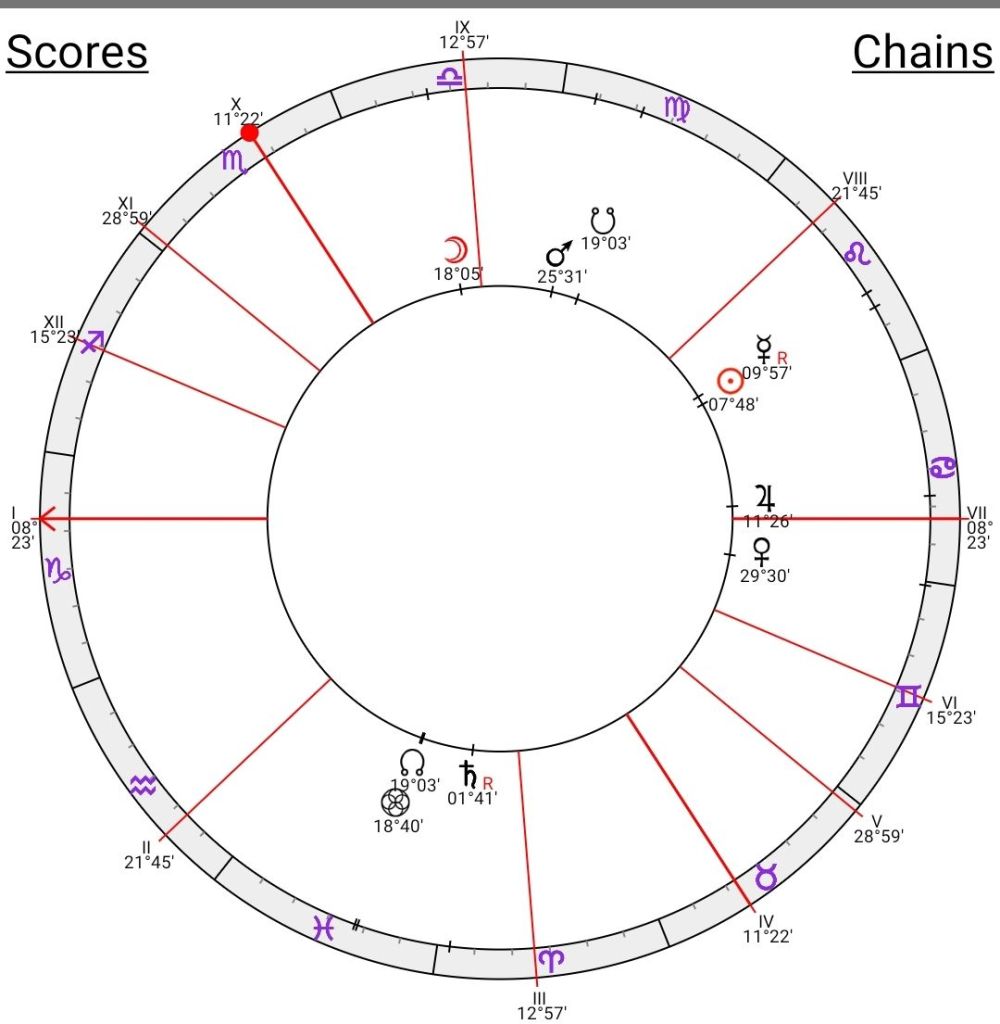
We are represented by the First house and the planet ruling it, Mars (ruler of the rising sign Scorpio). As for which house represents the new place, I believe there are two schools of thought: either the Seventh House (that place there, as opposed to this place here, which is the First house), or the Fourth House of real estate and umoveable property.

The chart seems to guide us to the Fourth House. Plus, usually the Seventh house is reserved for hypothetical “there” places, whereas we had already bought the new place (therefore it was our property) and I was not interested in a comparison between the old apartment and the new, but only in the new place (I already hated the old one).

The Fourth House thus represents the apartment. Jupiter, ruler of Pisces, is the house. And look! Mars, our significator, is right inside the Fourth House, which is good and a symbol of liking the place. It has no major dignity in it (no house rulership or exaltation) but it is dignified by triplicity, term and face. So while it is not the ultimate castle of our dreams, it is very comfortable indeed.

The place’s significator, Jupiter, is conjunct the Seventh cusp and thus angular, and sextiles our significator. A sextile is a positive aspect of ‘friendship’. All in all the picture that emerges is not perfect, but it is quite satisfying.

However, look at the Moon! The Moon is about to oppose Saturn, which is right inside the Fourth cusp, afflicting it. There is some kind of problem ahead. Pinpointing it is not very easy, but considering that Saturn is inside the house representing the place itself and that Saturn rules the Third house, my first instinct was that there might be issues concerning the neighbors (the other people who live in the building). These issues would not be major, as the picture remains generally favorable, but they would be serious enough to be worth mentioning.

Fortunately, a couple of months passed and we saw that the neighbors are generally well-adjusted people. Furthermore, the apartment is, in fact, very comfortable.

What did turn out to be the problem was that the neighbors started some major fuss about the manager of the building as, according to them, he is incompetent and charges way too much for his services and even skims off on the money required for taking care of the building. The thing escalated so far as to almost end up in court, and finding a new manager is costing us quite a lot of time spent traveling and talking to new candidates.

MQS

The Geomancy of Peter of Abano – Book IV Pt. 2

Previous / Back to Index / Next

Abano discusses the various meanings of Via, Populus, Caput and Cauda when deriving from various figures.

Via

From Via and Populus, its meaning is weakened, but quickened.1
From Acquisitio and Amissio its efficacy is mediocre in every question.
From Major and Minor it means good luck, but it is still mediocre.
From Laetitia and Caput, it means good luck and success.

From Tristitia and Cauda it means misfortune in the question at hand, and it is very strong in its malice.
From Albus and Puer it is mediocre good luck.
From Rubeus and Puella it shows a mix of good and bad, but it brings about the thing quesited.
From Conjunctio and Carcer it means good luck, stability and firmness in all one asks about.

Populus

From Populus and Populus it means stability, getting one’s wish, copious amounts.
From Acquisitio and Acquisitio it means great good luck, great acquisition of what one wishes, usefulness.
From Amissio and Amissio it shows good luck, and being venereal and lascivious.
From Major and Major it means fortune, stability, great gain, honor.
From Minor and Minor it means mediocre good fortune.
From Via and Via it means weakness in the thing enquired about.
From Caput and Caput it means good luck, usefulness.
From Cauda and Cauda, it means great misfortune.

From Albus and Albus it means good effect, good outcome especially in watery things and womanly or white things.
From Rubeus and Ruveus it means excessive evil, war, loss of blood.
From Laetitia and Laetitia it means good luck, happiness, honor, easily getting what one wants.
From Tristitia and Tristitia it means great misfortune, long lengths of time, difficulties and problems, enmities.
From Conjunctio and Conjunctio it means good luck, getting one’s wish, good for marriage and partnerships.
From Carcer and Carcer it means great good luck in everything, melancholy and difficulties, anger, discord, infirmity, prison.
From Puella and Puella it means good luck and fortune, firmness, usefulness, getting one’s wish.
From Puer and Puer it means war, fighting, discord, good for merchandise, mediocre gain, good for marriage.2

Caput

From Populus and Caput it means great firmness, good outcome.
From Acquisitio and Albus it means great good luck, getting one’s wish.
From Amissio and Puer it means misfortune, loss, difficulties.
From Major and Rubeus great good luck, mediocre gain or honor, good fortune.
From Tristitia and Conjunctio it means good luck and gain, but with delay and difficulties.
From Cauda and Carcer it means misfortune and tragedy.

Cauda

From Populus and Cauda it means misfortune, long illness, difficulties, weakness in getting one’s wish.
From Acquisitio and Puella it means good fortune, firmness, usefulness in mobile things.3
From Amissio and Rubeus it means misfortune and grave danger.
From Major and Puer, it means misfortune under the guise of gain.

From Via and Tristitia it means misfortune in getting what one wishes, and long-lasting difficulties.
From Caput and Carcer it means mediocrity, good for virtue and honorable things, otherwise loss.
From Laetitia and Conjunctio it means mediocre fortune, but gain from merchandise.
From Albus and Minor, it means good luck and freedom from difficulties, but mediocre gain.4

MQS

Footnotes
  1. One of the reasons this Book IV is interesting is that it affords us a look into how old geomancers derived meanings from the interaction of figures. Unfortunately Abano’s process is not always clear. Furthermore, it is not clear whether Abano means what I have written (namely, Via’s meaning is weakened but quickened) or if he is saying that Via’s meaning is weakened more than any other figure. I have chosen my interpretation based on this logical argument: that Populus tends to accentuate the meaning of the figure it interacts with, and Via is weak and quick, so in interacting with Populus it would become weaker and quicker. ↩︎
  2. Generally speaking, it seems the effect of Populus is that of accentuating the meaning of the figures it comes from (‘lots of…’). However, some interpretations are not clear, for instance Carcer and Carcer meaning great good luck. Note also that Populus is the only figure that Abano explains in full, giving all possible combinations. ↩︎
  3. It seems here that the two positive figures rub off on the otherwise foreboding Cauda. ↩︎
  4. Again, the two positive figures it comes from seem to bring out the best in Cauda, according to Abano. ↩︎