Tag Archives: medieval astrology

Robert Fludd’s Geomancy – Book II Pt. 7

Previous / Back to Index / Next

Fludd discusses the signification of a figure springing from one house to another.

Of the signification of the 16 figures, when they duplicate in a question, that is, when similar figures are found in different houses, such as two Via, two Populus, etc.1

The figure in the first house means, when it is duplicated in the following houses:
In the Second, especially if it fortunate and fixed, and so the opposite, which is valid for all other houses.2
In the Third, good situation between relatives, brothers, sisters or neighbors.
In the Fourth, it is a bad mutation3 but not excessively so, unless the figure is Cauda Draconis.
In the Fifth, mirth, vivacious and gluttonous companions, new clothes, music, melodies, antique things, good according to the mind’s opinion,4 so that one couldn’t wish things to be better, unless the figure is Cauda Draconis.
In the Sixth, sickness, tribulations, fears.
In the Seventh, fearful things due armies or evil women; good [signification], unless Cauda or Via are there, which denote all evil in this house, unless a question has been made for a gathering, or for marriages and enemies, for otherwise they show danger.
In the Eighth, evil, great wrath or death or injury, loss, hurtful words, evil tribulations, but if the figure is good, it signifies the acquisition of the inheritances of the dead.
In the Ninth, something good, a firm and stable change to acquire some thing for another,5 and to negotiate some religious business or of the Church, or with ecclesiastical men or people, or with messengers or those who return from a journey, unless Cauda and Rubeus come up in a question made for a journey.
In the Tenth, all good, so that the thing cannot be better, and especially for the acquisition of honor and dignity, unless Cauda or Rubeus are there.
In the Eleventh, good, so that it is not better in the question propounded; for it signifies hope, a good friend, especially if it is Major, Via or Acquisitio.
In the Twelfth, the querent will fall into some tribulation, or a serious illness, or the loss of some thing, or defiance from enemies; nor can the thing be worse if the figure is Cauda.

The figure in the second house means, when it is duplicated in the following houses:
in the Third, gain from parents, brothers, sisters or neighbors, if the figures are good, but if bad, the opposite.
In the Fourth, what the querent thinks of gaining from his father, or from some great lord [he will get], if the figure is good; if bad, [he won’t get them].
In the Fifth, what the querent thinks of gaining from food, or clothes, or news that will come to him with letters, or loss by fire.6
In the Sixth, future illness of the family, or some loss, or fear, or great tribulation, or disease, or some evil thing.
In the Seventh, marriage, loss from a woman, great enmity for the querent, or robbery, or the thoughts of women about lust, or quarrels, threatening words, change from place to place.
In the Eighth, the return of an absent person, or of some other member of the family.
In the Ninth, gain for the querent, religious or ecclesiastical, or a priest, or some other similar thing.
In the Tenth, the Necromantic arts,7 or that the querent will win the love of some woman, or Lord, or great Majesty, or sciences according to the good or evil of the figures.
In the Eleventh, fortune in that house, or in the family, or through the family, or through gain, or friends, or merchandise; for this is the force and power of the whole question.
In the Twelfth, the imprisonment of some member of the family, or a serious illness, a serious molestation, or the destruction of someone from the family, of what you have gained, great accidents, or future tribulation and anguish.

The figure in the third house means, when it is duplicated in the following houses:
In the Fourth, brothers, sisters, companions, neighbors, messengers [arriving ] to the questioner, profit or loss according to the nature of the figures.
In the Fifth, joy, gladness, speedy news from friends, letters and messengers.
In the Sixth, tribulation, diseases, some fear, loss through a servant, or machination, or evil enemies.
In the Seventh, quarrels, change of place, there will be hatred and discord between brother and sister, anger against the questioner, marriage, etc.
In the Eighth, death or danger from the past, thoughts about a woman, or about one’s enemies, or fear, and future profit from evil thoughts.
In the Ninth, an occasion for the Clergy, great journeys to be made,8 benefits of the Church, some great prelate or honor.
In the Tenth, brothers and sisters will attain to some arts,9 or great marriages, or great dominion, or they will become great prelates, or be exalted to honor.
In the Eleventh, fortune or good favor from someone.
In the Twelfth, imprisonment, long illness, occupation, or entering into [a period of] tribulation, from which there will be no easy way out.

The figure in the fourth house means, when it is duplicated in the following houses:
In the Fifth, the father will rejoice with his children, or an uncle, or a relative, or some friend, or the father will make a profit through his children.
In the Sixth, the father will soon fall ill, or he will be forced into great labor in his house, or in the town where he lives.
In the Seventh, marriage or enemies, or lascivousness, or a change of state, or a change of land.
In the Eighth, mortality will enter the land10 and inheritance of the questioner, or some tribulation, or, if he is outside his country, a return.
In the Ninth, the death of priests or their loss in the Church.
In the Tenth, the questioner’s honor, gain, riches.
In the Eleventh, the questioner will be fortunate in some profitable matter, so that he will suddenly make a profit in it, and indeed through some of his friends, or some of the querent’s friends will give letters to those living in his house, which will bring the questioner much profit.
In the Twelfth, long anguish and sadness, illness, envy, betrayal of the land of some lord, or of someone of his blood, but if the figure is good, it will not do much harm.

The figure in the fifth house means, when it is duplicated in the following houses:
In the Sixth, disease by contusion or corrosion, or in other such ways, or news of children, the capture of some small beasts.
In the Seventh, a gathering for a wedding or for trade, the joy of friends, fortune for women and children.
In the Eighth, mortality, and the danger of some evil to come, the return of an absentee, and letters of joy, profit or news.
In the Ninth, the son of the querent will be a cleric or a priest of the Church or a religious person, or he will make a great and long journey, or will have great joy through the honor of the Church, that is, through a man of the Church.
In the Tenth, the son will have dominion, and the mother and sister will rejoice or find joy, or some assistance from [those in a position of] honor, or profit from the lord, or a prelature, or he [the son] will be a judge or teacher.
In the Eleventh, the son will have dominion or fortune over his enemies, or in trade or in a similar matter or in news, or his friends will rejoice over his children.
In the Twelfth, illness, imprisonment, great enemies for children, or some loss for the querent, or strangers will rejoice.11

The figure in the sixth house means, when it is duplicated in the following houses:
In the Seventh, disease, or the servant or the woman of the querent, or his companion, will suddenly become angry or will end up among enemies, or the querent and his woman will fall into the hands of robbers, or disgrace, which they will nevertheless escape from as much as possible.
In the Eighth, the servants or the beasts of the querent will fall into danger or tribulation, pain or sadness, and he will be beaten, or he will lose some object, and he will be absent and in the company of enemies of his house, or the woman of the querent will be familiar with someone else.12
In the Ninth, the servant or the animals of the querent will make a fortunate path, diseases will befall a cleric, or will hinder his exaltation, or the servants will have the company of the clergy, and especially with good and fortunate figures, such as Acquisitio and Major.
In the Tenth, those who will remain in the place about which the question was made will be sick or oppressed by some Lord.13
In the Eleventh, fortune, and your enemies will envy you.
In the Twelfth, a disease among one’s animals, or the querent himself will fall ill or be imprisoned and suffer loss either through useless beasts or through a long journey.

The figure in the seventh house means, when it is duplicated in the following houses:
In the Eighth, the death of one’s woman, iniquities and all those things which pertain to the seventh house, namely lost merchandise, etc.
In the Ninth, the companion of the querent will return to his country, and the clergy will be enemies to the querent, or his wife will enter religious life or go on a long journey.
In the Tenth, honors to those who are represented in the seventh house, or the servant of the querent will be a familiar of his wife, or of his enemies.
In the Eleventh, a friend will immediately become an enemy, or someone will immediately become a friend to the querent,14 or he will gain in some matter, or will suffer some loss from his friends.
In the Twelfth, occupation of large animals, or the querent will fall into a serious and long illness, or imprisonment, or a long journey, or poverty, or that some letters will bring him loss in a short time, which should be kept secret as proof.15

The figure in the eighth house means, when it is duplicated in the following houses:
In the Ninth, a judge of the enemies or of the woman or of the friend of the querent will attain great exaltation in the church, or he will be absent on a journey, or death threatens someone.16
In the Tenth, loss for the querent, or the death of the lord, or a defect in good will, or an impediment in some thing, or the absence of some lord.
In the Eleventh, the death of the querent, or he will acquire some thing, or the inheritance of a dead man, or that while absent he will acquire friends, or that friends will restrain the hatred of the querent.
In the Twelfth, secret enemies of the querent, who labor mightily to oppress him, or while absent he will be imprisoned or sick, or while imprisoned he will die.

The figure in the ninth house means, when it is duplicated in the following houses:
In the Tenth, being friends with priests or clerics, or the querent will suddenly marry a wife, or messengers will come from some place, or from the querent’s mother.
In the Eleventh, the journey of women, or a cleric will be your friend, or your fortune will be in the church, or you will have possessions in the church.
In the Twelfth, sadness during a the journey for the querent, or he will have trouble with his horse, or a cleric will be imprisoned. This is a bad place for the querent.

The figure in the tenth house means, when it is duplicated in the following houses:
In the Eleventh, the house or place of some lord, the completion of his fortune and hope, or that he will be a friend to some great lord, through whom he will be fortunate.
In the Twelfth, that the questioner will be shortly in great tribulation or illness, or will be imprisoned, or his enemy will be made a priest, and that the petitioner will have great loss from beasts.

A figure existing in the eleventh house signifies, when it doubles itself in the twelfth house, imprisonment, hatred of enemies, a similar thing.

MQS
Footnotes
  1. That is, if the same figure is found in two different houses. This, as we shall see, is generally interpreted as the two houses being linked together. Some of Fludd’s interpretations are straightforward, others rather obscure. Similar chapters are often found in other handbooks of geomancy as well. Their value consists not so much in their offering interpretations that need to be memorized, but rather in the kind of mental exercise that they allow the reader to engage in. ↩︎
  2. This sentence doesn’t mean much. Fludd is simply asserting that the signification of the link between the two houses is colored by the positive or negative meaning of the geomantic figure. ↩︎
  3. Mutation in the sense that the figure in the First house moves to the Fourth. ↩︎
  4. Somewhat obscure. I think Fludd means that this connection between First and Fifth houses is good concerning whatever the querent is thinking about. ↩︎
  5. Possibly referring to a business-related journey ↩︎
  6. Unclear what fire has to do with this house. ↩︎
  7. The connection of the Tenth house with necromancy is unclear. ↩︎
  8. Probably due to the connection of Third and Ninth houses, which both pertain to journeys. ↩︎
  9. The Tenth house is the house of art in the older Aristotelean sense of poiesis, i.e., practical science, which is what allows people to gain money. In short, it is one’s learned trade. ↩︎
  10. The land is a Fourth house matter. ↩︎
  11. Joy is here brought into the equation by the Fifth house. ↩︎
  12. That is, intimate. Older astrological texts are filled with lists of testimonies to look for to establish whether the querent’s wife is faithful, or even if he is exploring herself. I suggest we leave these things in the past. Still, from a purely didactical standpoint, Fludd’s paragraph makes sense. ↩︎
  13. I have no idea what Fludd meant. ↩︎
  14. Here we see how ambiguous this type of interpretation can become if we don’t keep the question in mind: it could go either way, namely that a friend (Eleventh) becomes an enemy (Seventh) or that someone else (Seventh) becomes a friend (Eleventh). ↩︎
  15. Not very clear. ↩︎
  16. The involvement of a judge here is unclear and seemingly random. ↩︎
A Brush With Death (Example Reading)

At the beginning of the year I did a reading for myself using the Bolognese tarot to have a look at my 2025. I am 99% sure I took a picture of it, but unfortunately can’t find it. One of the predictions was that an older female member of the family would probably need an operation around the middle of the year. There was no death in the cards (that I could see), but I remember that particular column looking a bit difficult. I assumed the cards were possibly talking about my mother. But I was wrong.

Last month my mother-in-law came to visit. She spent a week with us, although I couldn’t enjoy her company very much due to being in and out of a clinic in the past eight weeks (my bipolar depression flared up big time this summer).

At the end of our week together, she put off going back home for a day due to feeling sick, and on the following day hubby drove her home personally. Then she went completely off radar, to the point that we were all worried she might have had some serious health issue. We called the paramedics on her after she sent a somewhat incoherent message (we thought she might have had a stroke or something similar).

She was rushed to the hospital, and we all braced for the worst. As there was a real possibility of her dying, I asked if she would survive, and how the situation would evolve. To be fair, my question was a bit confused: I don’t know exactly what I asked, only that my concern was her survival.

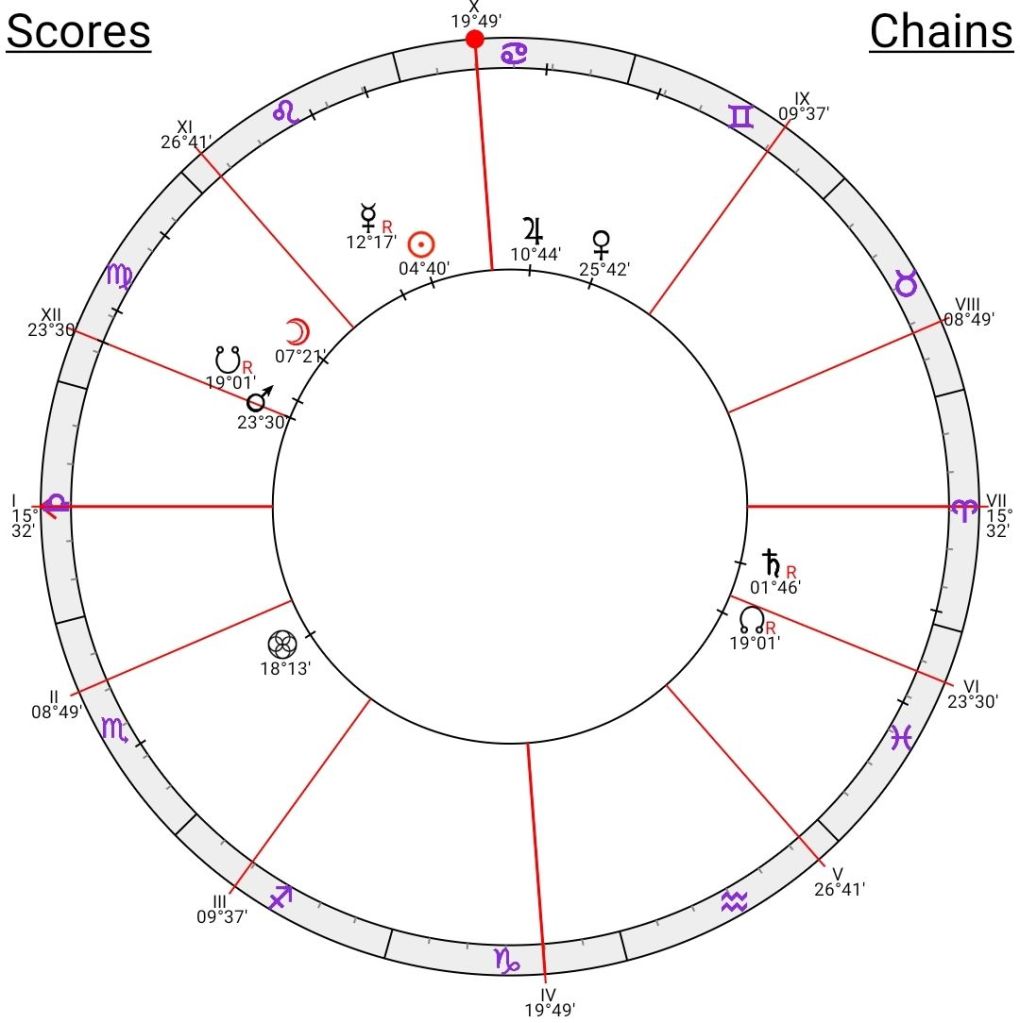
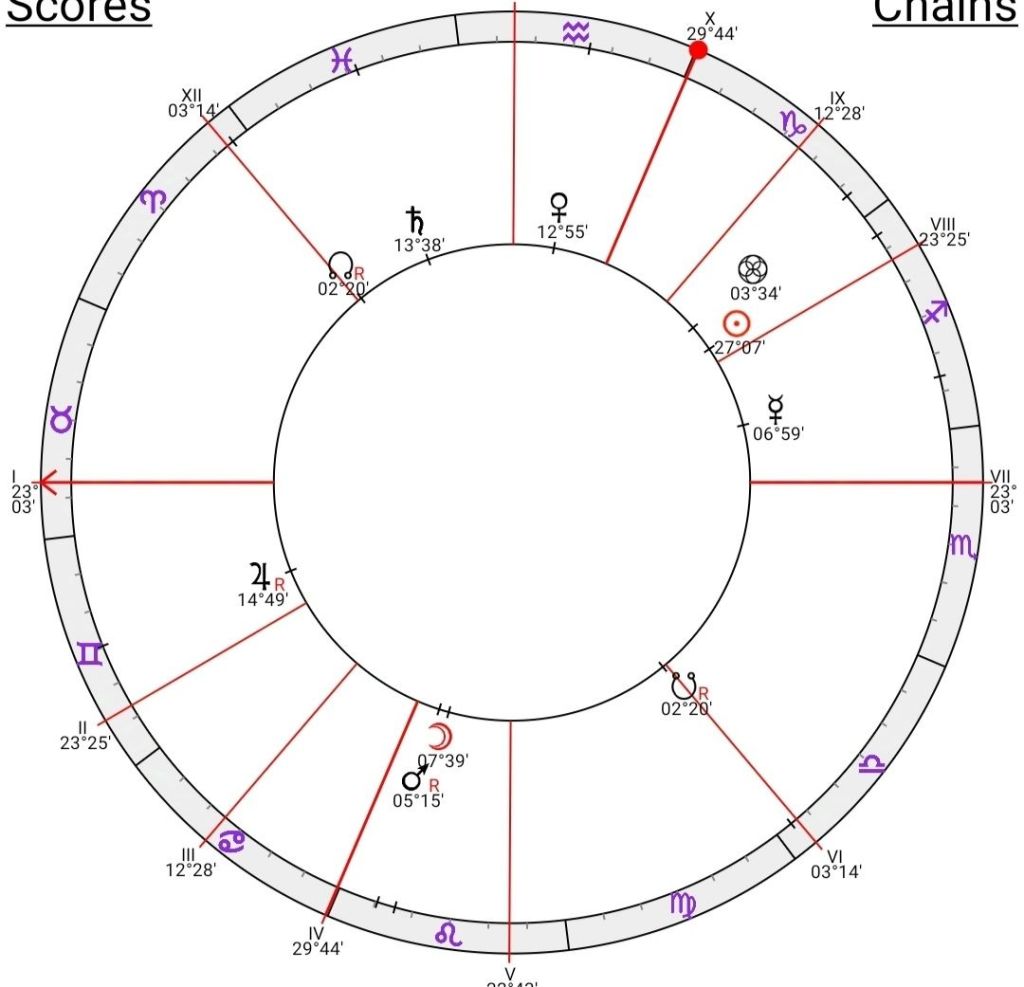
My mother-in-law is my husband’s (seventh house) mother (tenth house), so she should be represented by the radical fourth house and its ruler, Saturn. How is Saturn’s condition? Dreadful! It is in Aries, and therefore in fall, retrograde and tucked into the radical sixth house of illness. As I was concerned about her survival, I looked at the eighth house of death. Both the radical and the derived eighth house are in play, represented by Venus (radical) and the Sun (derived, radical eleventh).

Venus makes no aspect to Saturn in her current sign. The Sun is separating from a trine with reception from Saturn: there was a brush with death, but that was as close as they will come to each other in a while.

The Moon applies to a sextile of exalted Jupiter with reception. Things will improve. Saturn is about to come out of its fall by retrograding into Pisces, so while the situation remains difficult, she will survive.

It turned out she hadn’t had a stroke, but there was a serious bacterial infection in her bloodstream that caused her to have an alarmingly high fever (hence the confused message). She was treated with antibiotics. A couple of days later I asked a more relaxed: how will the matter evolve?

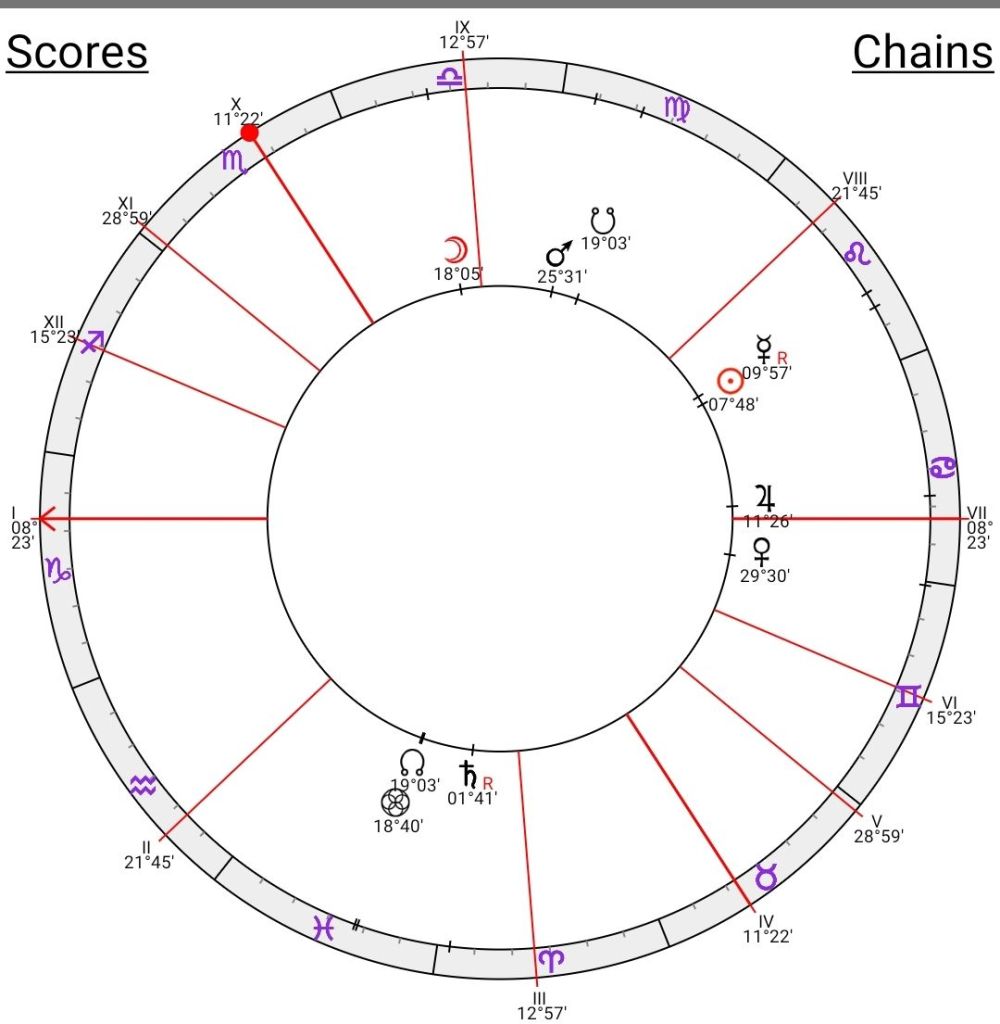
This time she Is represented by Venus as lady of the fourth house. Venus is peregrine in the sixth house of sickness, but she is about to change sign, whereupon she will enter her triplicity and decan: not out of the woods, but better. Once again there is no contact with death (once again the lord of the derived eighth house, Mars, separates from her planet).

But upon changing sign, Venus will bump into a difficult square with a very nasty Saturn. The situation will improve, but there is still something very unpleasant in her near future, though I could not tell what it was at the time.

Turns out that the infection, though cured in her blood, had reached her heart, and she needed an operation to change a valve, as well as additional antibiotics. The operation went fortunately really well and she is already improving a lot. I will edit the post if something changes.

MQS

Which House Is Next To Which?

In astrology, the contiguity of the houses is obvious, since the houses are usually arranged either in a square or in a circle, but always forming a loop. Thus, we have that the Ascendant is always squished between the second house and the twelfth; that it always opposes the seventh, and, if we go by whole sign houses, that it has fixed relationships with all the others (inconjunct, sextile, square or trine).

This is not the case in Geomancy, where the relationship between houses is controversial, at least nowadays. First off, it is not pacific that the houses of the Shield represent astrological houses, unless we operate an equivalence with astrology, as was done at least since Geomancy reached Europe.

Those coming to Geomancy through Michael Greer, as I did, are probably used seeing the geomantic houses as equivalent to astrological houses: once the Shield is turned into a square chart, the houses follow the same astrological pattern as in an astrological chart. Those coming to Geomancy through the Golden Dawn, though using a different way of assigning the mothers to the houses (the one popularized by Agrippa), still end up dealing with a 1:1 replica of an astrological chart.

However, the idea that the Shield chart and the astrological chart are separate ways of doing Geomancy seems to be relatively new. In most old books, only the Shield is shown, and even when the astrological format is followed, this is done more to show some of the similarities with astrology.

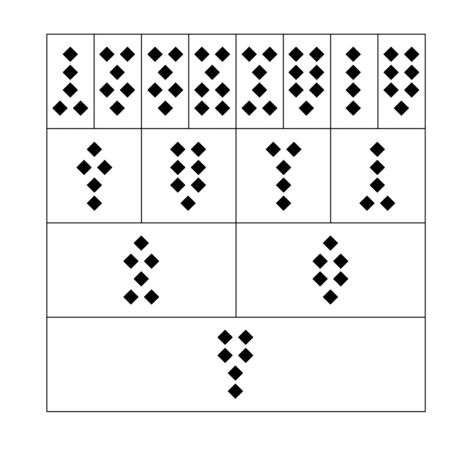
Secondly, which house is next to which is not always clear, and sometimes varies by author. In some sources it seems that only houses that are in company are considered to be next to each other: first and second, third and fourth (but not second and third), fifth and sixth (but not fourth and fifth) and so on pair by pair. This seems to follow the order in which the Shield chart is generated.

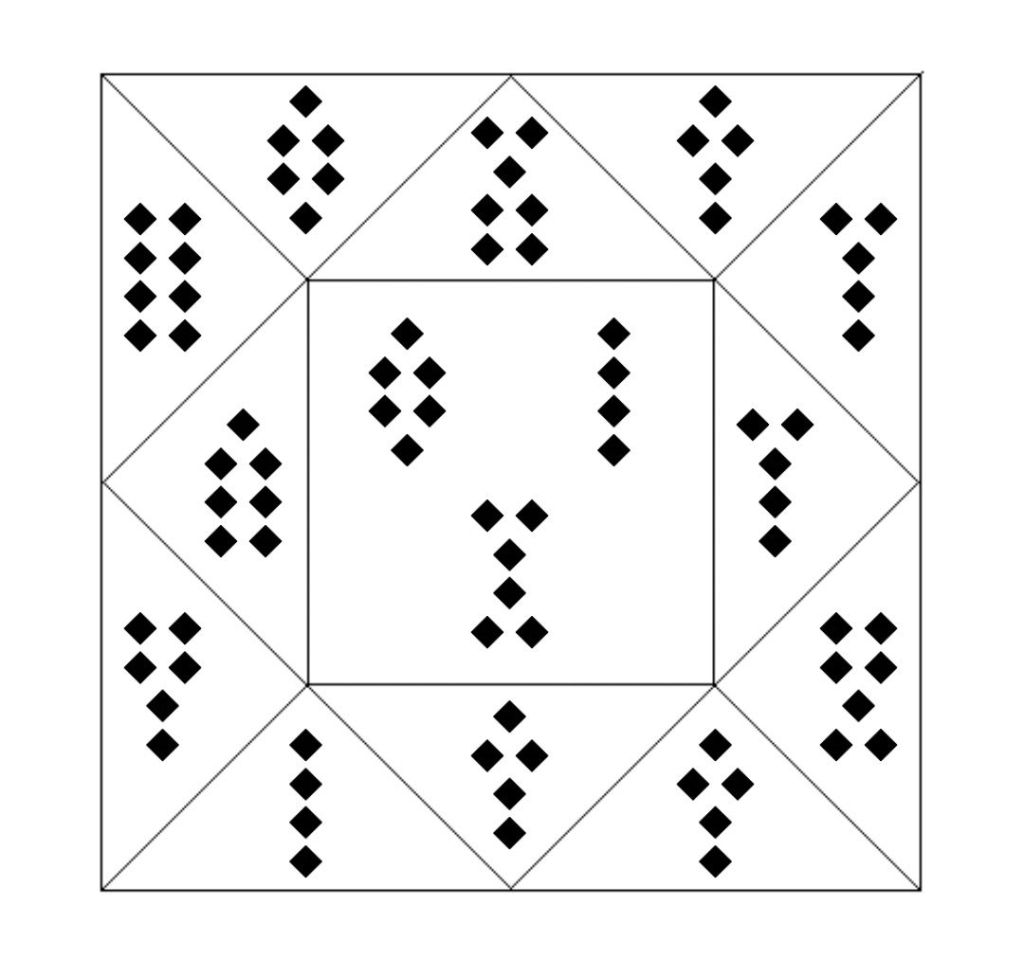
An example shield chart. App used: Simple Geomancy

In the example above, Tristitia in the first is next to Via in the second, and Tristitia in the third is next to Conjunctio in the fourth, but not to Via in the second. This is possibly because the first and second combine to form the ninth and the third and fourth combine to form the tenth, but the second and third never combine. This approach obviously restricts the possibilities of perfecting the chart, since most houses end up losing a possible spot next to them for other figures to move to.

Another approach is the one I found while translating Abano’s work. Here Abano started by saying (or rather, implying) that the twelfth house is not next to the first. Initially, I thought this was because he was following the arrangement for the company of houses I just discussed. Yet he gives other examples where he does not follow it, for instance by implying that the eighth and ninth house are next to each other, which would contradict the company of houses (the eighth is with the seventh, the ninth with the tenth).

Then, in another one of his examples, he implies that a figure in the tenth house is next to a figure in the third. This does not make sense from an astrological standpoint, but from a sheer geomantic standpoint it does: the third house DOES border with the tenth, since it co-generates it with the fourth. This would also explain why he doesn’t consider the twelfth house to be next to the first: not because they are not in company, but because they are not close on the Shield (they are, in fact, on opposite ends of the shield).

This approach of considering the houses close on the Shield as being next to each other is certainly different from anything I’ve seen, especially in contemporary geomancy, and if it weren’t for the fact that enough readings I’ve done confirmed to me that the twelfth house CAN perfect with the first, I would find Abano’s approach extremely appealing. Unfortunately, one of my rules when dealing with divination is that practice trumps theory.

Abano goes even further, implying that the Witnesses (and possibly even the Judge) are to be treated as regular houses. This, in itself, is not unique to him, but what I find unique is that he considers the Witnesses capable of perfecting the reading, for instance if the first figure moves to the tenth and the quesited’s figure moves to the right Witness, where, by Abano’s theory, the two figures touch.

Another consequence of Abano’s approach is that not all houses are created equal: the first house, for instance, only touches with the second and the ninth, while the tenth house must be considered to be next to the ninth, eleventh, third, fourth and to the right Witness.

A possible argument, at this point, could be that this approach makes certain readings too easy (like those involving the tenth house, as I just showed). Still, we should keep in mind 1. that divination reflects reality, so a no is a no, regardless of the system 2. secondly, that Abano doesn’t always consider merely the querent and quesited. Often he considers the whole chart, and sometimes he resolves certain questions by dividing the shield into two sides (the left and the right side) and seeing which side is stronger. This is a method he has from traditional astrology, where questions of contest or war are often decided in such manner.

Ultimately, which approach we choose depends on what works, which means that the only way is to try, record and compare with what actually ends up happening.

MQS

Intuition – Do You Need The Gift of Prophecy?

I received a really sweet message from a fledgling occultist who wants to pick up some form of divination, but has been put off so far because they have been convinced that they don’t have “the gift”, as they put it, by which I think they meant intuition.

It is a fact of life that a certain predisposition can give you a head start. My high school chemistry teacher could explain to me every single step of how to balance a formula, and I would sort of understand it, but then, left to my own devices, I would still get it wrong. I certainly didn’t have the gift for it. But that doesn’t make chemistry hoplessly outside of my reach. If I had persevered instead of throwing my hands up and saying “oh well, at least I can read Plato in Greek” I would have definitely made some progress. It’s just that in life you’ve got to pick your battles, and I knew I wasn’t the next Marie Curie, and I did like Plato, so Plato it was.

The same holds true for the various esoteric disciplines. The kind of gift that is required to practice them is not different from the predisposition toward high school subjects. Yet there is this widespread belief something more is needed. Well, it isn’t needed.

Oracles, i.e., the various forms of divinations, are languages, and like all languages they require study and practice. The idea that all it takes is intuition is a result of the loss of understanding for occult practices that resulted from the scientific revolution, which confined anything that wasn’t understandable in terms of the rising empiricism to the realm of irrational superstition.

This new designation was either consciously or unconsciously accepted by those practicing divination, so divination became something irrational that requires non-rational tools to be practiced. This, in spite of the fact that, wherever you look around the world, and even in the West before the Enlightenment, divination is considered to be primarily made of rules to be studied and applied with intelligence.

True divination, like all parts of magic, is hopelessly technical. It has nothing to do with following your heart, much less your intuition. Speaking of which, actual intuition is a much more sacred thing than the “I can’t prove it but I know it’s true” that many make it out to be. “I just feel this is how it is” is how cults get started, which is probably why so many people who describe themselves as intuitive are so up their own asses and so full of unconscious prejudices.

That is not intuition: it is personal bias subtracting itself from scrutiny. Actual intuition is the prerogative of the great saints, and only to a lesser extent of people who are on a spiritual/esoteric path. It is rare and cannot be commanded. It is the result of brief moments of perfect union with the source of all, and for that reason it comes from outside the limitations of the individual vessel. What many call intuition are simply personal hunches that they cannot trace back to any line of reasoning.

And mind you: hunches ARE a thing. They can work, and sometimes they can help. They can also fail. Many people seem to believe that ‘intuition’ is never wrong. And fair enough, the intuition I talked about is in fact never wrong. But personal hunches CAN indeed be wrong, in the same way that a logical inference can be wrong: hunches, like reason, the senses and all other channels humans use to gather information, are fallible. The fact that many think their hunches are never wrong is simply the result of confirmation bias: if they concentrated on how often their hunches let them down on a daily basis they’d be crushed.

Another use of the term intuition is simply a cooler way of describing the facility that comes from experience. The experienced doctor comes in, eyeballs you, listens to a couple of your complaints and knows with a high degree of probability what is wrong with you. The experienced mechanic listens to the purr of your car and knows immediately it will break down in two weeks if you don’t do something about it.

That’s also not intuition, although it is far more valuable than what average psychics do. It is simply the result of having gone through the same process so often that you can skip some of the steps, at least consciously. It is the intellectual version of muscle memory.

So, can anyone become a diviner? Let me answer with a question: can anyone become a chemist? Well, no. If we all could, the human race would go extinct. But the only thing keeping you from studying chemistry is your decision and perseverance. So is with divination.

MQS

The Neighbors (Update on Reading)

In this article I discussed a horary reading I did for myself on whether the new house we moved to would be good. My interpretation was that the house was generally good, but that there might be problems with the neighbors due to Saturn, ruler of the third house, afflicting the cusp. It turned out that the neighbors were normal people, it seemed, and that there was a problem with the manager.

Well, that was until last week, when the new manager contacted my husband, who represents the homeowners, to tell him that one of our neighbors hasn’t been paying his share of the bills for some months. Hopefully we won’t have to end up in front of a judge, but it is turning out to be quite an annoyance.

There is a small lesson to be learned, I think, from this whole thing. Often when I read for others, they contact me after a week telling me that they were excited about the prediction but nothing has come to pass. It is easy, right after a reading, to forget that readings can take months (sometimes many months) to materialize.

This is also where we, as readers, need to be honest with the querent. It is easy to turn our sitters into addicts hanging on to our every word, asking for a reading on whether they should shift their weight on their right or left ass cheek when sitting on the toilet, needing to be reassured every week of what we are saying.

Personally, I rarely accept to redo readings unless enough time has passed, or unless something absolutely new and unforeseen comes up that I hadn’t predicted. Still, it is normal for querents (and for us, when we are the querent) to assume that the first thing that happens is the materialization of the final result instead of a step in its unfoldment.

MQS

On Mental Health (Example Reading)

Since I’ve started studying horary astrology, my teacher has encouraged me to take on questions to learn on battlefield, as it were. I probably only need some exra push to start offering cheap readings here. This horary was asked by a social media contact of mine, who wants to know how her mental health will evolve.

Mental health. App used: Aquarius2Go

An immediate giveaway that something is off is the conjunction of the South Node of the Moon to the Ascendant. This is the “bad” node, traditionally attributed to the nature of the malefics, Mars and Saturn. It is as if the chart wanted to tell us “hey, there IS something wrong, go look!”

The querent is represented by the ruler of the Ascendant, Venus. Venus is exalted in Pisces, but conjunct the cusp of the malefic Sixth House of sickness. The Moon shows us the flow of the action. She, too, is exalted in Taurus, but conjunct some evil fixed stars and cadent in the Ninth House. She is sextiling Mars.

Venus is not terribly afflicted, but it is in a bad place in the chart. Since we are talking about mental health, and Venus is conjunct a house of sickness, it is probably reasonable to conclude that the querent is experiencing mental trouble of some sort. Considering that Pisces is a common sign, the trouble is probably recurring, coming and going.

Venus is approaching conjunction with a bad Saturn in the Sixth, and before that a square aspect with the ruler of the Sixth house, Jupiter, which is cadent, retrograde and in detriment. Since the square is approaching, the trouble is intensifying, at least at present. Still, there is reception between Venus and Jupiter, which tells me that the querent does have some inner strength to deal with it and work through it, especially with someone’s help. Note that both Venus and the Moon are exalted, which argues that the mental trouble is due to excessive expectations being disappointed.

The Moon is quickly approaching the sextile aspect with Mars. Mars is ruler of the Third and Eighth house. The Eighth house is the house of death, but also of mental anguish. But the sextile is a positive aspect and it happens with reception, so once again we have an image of the potential for overcoming the trouble.

All in all, the chart depicts a situation of suffering but it is encouraging. The querent is not as helpless as she may think and can find the strategies to go through the period of difficulty.

MQS

Robert Fludd’s Geomancy – Book II Pt. 1

Previous / Back to Index / Next

Fludd gives some basic details about the geomantic figures.

Of the Names, Forms and Natures of the Geomantic Figures

those figures which can be drawn from the series of four geomantic lines are sixteen in number, which are distinguished from one another by name and form, as follows:1

NameForm
First: Acquisitio* *
*
* *
*
Second: Amissio*
* *
*
* *
Third: Laetitia*
* *
* *
* *
Fourth: Tristitia* *
* *
* *
*
Fifth: Caput Draconis* *
*
*
*
Sixth: Cauda Draconis*
*
*
* *
Seventh: Albus* *
* *
*
* *
Eighth: Rubeus* *
*
* *
* *
Ninth: Puer2*
* *
*
*
Tenth: Puella*
*
* *
*
Eleventh: Major Fortuna (sic)* *
* *
*
*
Twelfth: Minor Fortuna (sic)*
*
* *
* *
Thirteenth: Populus* *
* *
* *
* *
Fourteenth: Via*
*
*
*
Fifteenth: Conjunctio* *
*
*
* *
Sixteenth: Carcer*
* *
* *
*

And these figures are obviously referred to the signs of the Zodiac:

FigureZodiac Sign
AcquisitioAries
Laetitia and Fortuna MinorTaurus
Rubeus and PuerGemini
Albus and PopulusCancer
ViaLeo
Caput Draconis and ConjunctioVirgo
PuellaLeo
Tristitia and AmissioScorpio
Cauda DraconisSagittarius
PopulusCapricorn
Fortuna MajorAquarius
CarcerPisces

Similarly they are given to:

PlanetFigures
MarsRubeus (D), Puella (R)3
SunMajor (fast), Minor (slow)4
VenusPuer (D)5, Amissio (R)
MercuryAlbus (D), Conjunctio (R)
MoonPopulus (D), Via (R)6
Jupiter and VenusCaput Draconis (D)
Saturn and MarsCauda Draconis (R)

These Figures are also:

ElementFigures
Fiery, assigned to the SouthRubeus
Minor
Amissio
Cauda
Airy, assigned to the EastLaetitia
Acquisitio
Puella
Conjunctio
Watery, assigned to the NorthPopulus
Via
Puer
Albus
Earthy, assigned to the WestMajor
Caput
Carcer
Tristitia

The Figures are:

ValueFigures
Always positive and fortunateMajor
Laetitia
Caput
Albus
Puer
Acquisitio
Always negative and unhappyTristitia
Rubeus
Puella
Amissio
Cauda
Minor
Carcer
Neither always good nor always evil, but middling, that is, neither exceptionally good nor exceptionally badPopulus
Via
Conjunctio

The Figures are however:

StabilityFigures
Strong and stableMajor
Acquisitio
Laetitia
Puer
Albus
Caput
Weak and moveableAmissio
Tristitia
Puella
Rubeus
Cauda
Mediocre, that is, neither strong nor weakPopulus
Via
Conjunctio
Carcer7

Rule I
Strong and firm figures make a thing stable and firm, for better or worse, depending on whether the figure is found in a good or evil house.

Rule II
Weak figures are so called, because they render a weak judgement without stability, neither are they so good and stable as much as they are mediocre,8 whether in a question of illness or incarceration or pregnancy.

Rule III
Mediocre figures are so called, because they are between strong and weak figures, and they make a situation mediocre, that is, neither totally good nor totally bad.

MQS

Footnotes
  1. Fludd was fond of using tables. I will try to make the layout of the translation as clear as possible ↩︎
  2. Fludd gives here to Puer the form we typically assign to Puella and vice versa. ↩︎
  3. ‘D’ is for ‘direct’, ‘R’ for retrograde.
    ↩︎
  4. The Sun cannot go into retrogradation, which is why some sources, like Fludd, attribute the two Fortunes to the Sun at different speeds. This is still somewhat odd, considering the Sun is always rather constant in its speed (which is probably behind the traditional symbolic view of the Sun as a source of stability, as opposed to the Moon’s changeability). ↩︎
  5. Generally, today, we would assign Venus to Puella and Mars to Puer. It is unclear to me the extent to which Fludd was making a mistake or providing a blind to challenge the reader’s thinking. He is not the only traditional authority who swaps Puer and Puella, though. ↩︎
  6. The Moon cannot go into retrogradation. Usually, Populus is assigned today to the waxing Moon, Via to the waning Moon. ↩︎
  7. There exist other lists with partially different attributions. ↩︎
  8. It is unclear to me whether Fludd means that weak figures are mediocre or that they are worse than those called mediocre. Logic would dictate that the latter interpretation is correct. ↩︎

Cancelled Flights? (Example Reading)

One pro of using more than one system of divination is that sometimes they clarify each other: sometimes one reading is somewhat obscure in one system but clear in the other, and we can use the clear one to navigate the one that has us scratching our heads. Granted, obscurity is in the eye of the beholder, being always a consequence of our own limitations, but it is still an occasion to learn.

I was at the airport yesterday, trying to catch a flight to get back home. Suddenly, and to my horror, I noticed that plenty of flights were being cancelled due to the heavy mist, including one flight on the same route I needed. My first instinct was to cast a Horary chart, asking if I’d be able to get back home.

Will my flight go as planned or will it be cancelled? Horary Astrology

This was my first interpretation. I am represented by Venus, ruler of the ascendant. The place I want to get is my home, which is ruled by the Fourth House and therefore by the Moon (Cancer is on the cusp). The Moon is approaching an opposition of Venus. Bam! The flight will be cancelled.

After a while, as I was waiting for information, I did a Geomancy reading on the same question. Here is the chart:

Will the flight go as planned or will it be cancelled? App used: Simple Geomancy

The first thing the struck me is the generally positive Judge, Conjunctio, which arises from Carcer and Via. It argues mobility more than stasis, and obstacles that are removed. The second important point is the figure that represents me: Laetitia in the first. Laetitia represents upward motion. It is an exiting figure, meaning movement. What a wonderful symbol for a plane taking off!

Even if we want to involve the Fourth house, we see that it is occupied by Puella, a mildly benefic figure, which is also connected to the ninth house of journeys (it occupies it). So the journey (Ninth) connects with the home (Fourth).

Obviously, two systems of divination cannot give contradictory answers if correctly interpreted, and the Geomancy seemed rather obviously positive. So I went back to the Horary Chart (again below)

Will my flight go as planned or will it be cancelled? Horary Astrology

I meditated on this chart quite a while (I had plenty of time, after all). Then it hit me. I am represented by Venus. Venus is in the Midheaven (up in the sky) in Aquarius, an *air* sign. Not only, but Aquarius is fixed: it doesn’t change. My being in the sky is fixed. So there will be a flight: I will be up in the sky as planned.

But what about that opposition by the Moon? Well, there was significant delay, so the Moon could show the flow of events causing trouble to my being up in the air.

Ultimately, the Fourth House didn’t need to get involved. The point of the question was not whether I would get home (I would have gotten home anyway at some point) but what would happen to me/my flight.

I managed to come home yesterday.

MQS

Robert Fludd’s Geomancy – Book I Pt. 2

Previous / Back to Index / Next

Fludd discusses how the diviner should prepare to a geomancy reading.

The Preparation of the Soul of the Diviner Prior to Making a Figure

Since this knowledge is founded on [an operation of] the soul,1 it is certain and manifest that no truth can be guaranteed in it, except in so far as the soul permits it.

Therefore it is required that he who wishes to be versed in this art, before he begins his operation, should have a good and clear conscience, and that his body and spirit should be governed without disturbance, and that he should not think worse of another than of himself,2 nor should his mind be spare in judgment, and not tend to negation more than to affirmation. He should be a just judge of the question proposed.

Finally, he must trust in God almighty, who is the author of all knowledge and truth,3 and pray to him that through this knowledge he will be allowed to find the truth that his heart longs to know.

All of this having been properly considered, and with a soul well established in the proposed matter, he will immediately make the projections of the points.

Hence it is that so much fallacy and uncertainty arise in this art. This is also the reason why the same art is immediately regarded as nothing, namely, because some, falsely ascribing the name of artists to themselves, neglecting God, and not being moved in the least by the pacification of their souls and of the pleasures of the body, falsely judge of the things proposed, and by this reason render this secret and very profound art so despised, that it is also commonly regarded as the most falsified of all.

The fault, then, is not in the science, but in those who profess it: the science is doubtless most truthful, but its proponents are often hindered by ambiguities and difficulties because of their vicious dispositions.

For who can doubt that the soul can direct any part of the body to the true knowledge of the future more easily than the whole body itself?4

When we perceive that she governs her whole body in such a way that she foresees the future every day and every hour, that is to say, that she will arrange such a business the next day, and ride to this or that city, and do other things the following week, or even that she will marry at this or some other time, or that he would carry out his purpose and plan at such or such an hour, etc.5

MQS

Footnotes
  1. As established in the previous chapter. ↩︎
  2. To the modern reader, these tips may seem to have a moralistic taste, but we should keep in mind that, aside from being in part a product of the times, they may be boiled down to the very sensible idea that a diviner, as intermediary between the querent and the divine, should purify himself of that which keeps him away from the divine. One cannot be a bridge between A and B without being capable of reaching both sides. Aside from being against Christian morality, “thinking worse of another than oneself” also implies being engrossed in outside world nonsense. ↩︎
  3. A fundamental truth of all divination is that its knowledge does not originate within the diviner. ↩︎
  4. That is, the soul is more capable of the body of considering the future. ↩︎
  5. This remark may appear odd, but from an occult standpoint it does make sense: our soul is capable of conceiving the future because it is integral part of an inner world (which opposes and complements the outside world, of which our body is an integral part) wherein the normal rules of time don’t unfold as they do outside. ↩︎

The Geomancy of Peter of Abano – Book IV Pt. 4

Previous / Back to Index

Abano discusses the various meanings of Tristitia, Laetitia, Puer and Puella as they derive from other figures.

Laetitia

When from Populus and Laetitia, it means luck, gain, especially in large [or great] things.
When from Acquisitio and Puer it means gain, merriment, especially in changeable things.
When from Amissio and Albus it means luck, but with mediocre gain.
When from Major and Puella it means fixity, gain and good luck.

When from Minor and Rubeus it means mediocre gain or honor or good luck.
When from Via and Caput it means gain, honor, positive change.
When from Cauda and Conjunctio it means misfortune, evil, but incapable of doing all it wants.1
When from Tristitia and Carcer it means mifortune, difficulties and problems.

Tristitia

When from Populus and Tristitia it means misfortune, danger, evil.
When from Acquisitio and Rubeus it means fixity and misfortune, except in in things lascivous or feminine.
When from Major and Albus it means luck, gain and honor with firmness.2
When from Minor and Puer it means better3 luck in every question.

When from Caput and Conjunctio it means great fortune, gain and stability.
When from Via and Cauda it means mediocre luck, difficulties, problems.
When from Laetitia and Carcer it means a good deal of luck, but with more problems than positive things.4

Puella

When from Populus and Puella it means infirmity, lascivousness, luck, gain.
When from Acquisitio and Cauda it means mobility, mediocre luck.
When from Amissio and Tristitia it means good luck after much toiling and difficulties, gain in venereal5 things.

When from Via and Rubeus it means misfortune and anger, rumors, change, damage.
When from Albus and Carcer it means gain, good luck, firmness.
When from Conjunctio and Puer it means fortune in everything, luck.

Puer

When from Populus and Puer it means gain, good luck, change.
When from Acquisitio and Laetitia it means gain, honor, mirth, goodness in everything.
When from Amissio and Caput it means good luck, bood in easy things and in seeking pleasure.

When from Major and Cauda it means unfortunate change, damage.
When from Via and Albus it means useful variety,6 fortune, good change.
When from Carcer and Rubeus it means major misfortune in everything, loss.
When from Minor and Tristitia it means fortune, some kind of gain, strife.

THE END

MQS

Footnotes
  1. It is not clear wheter Abano means that the person won’t be able to do all he or she wants, or whether the evil signified by this combination is not all-pervasive. ↩︎
  2. In this case, it seems that Tristitia’s role is to solidify the good fortune signified by the two figures it comes from. ↩︎
  3. ‘migliore’ means ‘better’, but it’s unclear better than what. ↩︎
  4. These two meanings might be hard to harmonize, though maybe not impossible. ↩︎
  5. That is, in things ruled by Venus. ↩︎
  6. It is not always clear what Abano means when he talks about variety, firmness, changeable things, etc. ↩︎