Tag Archives: mars in astrology

The Problem With the Neighbors (Reading Example)

As I already talked about ad nauseam, some months ago hubby and I bought an apartment. During that period I kept track of the situation using various divination tools, including Horary. This is a reading that I didn’t cover, since I didn’t have any feedback for it yet.

My question was simply if we would be happy in the new home. Here is the chart.
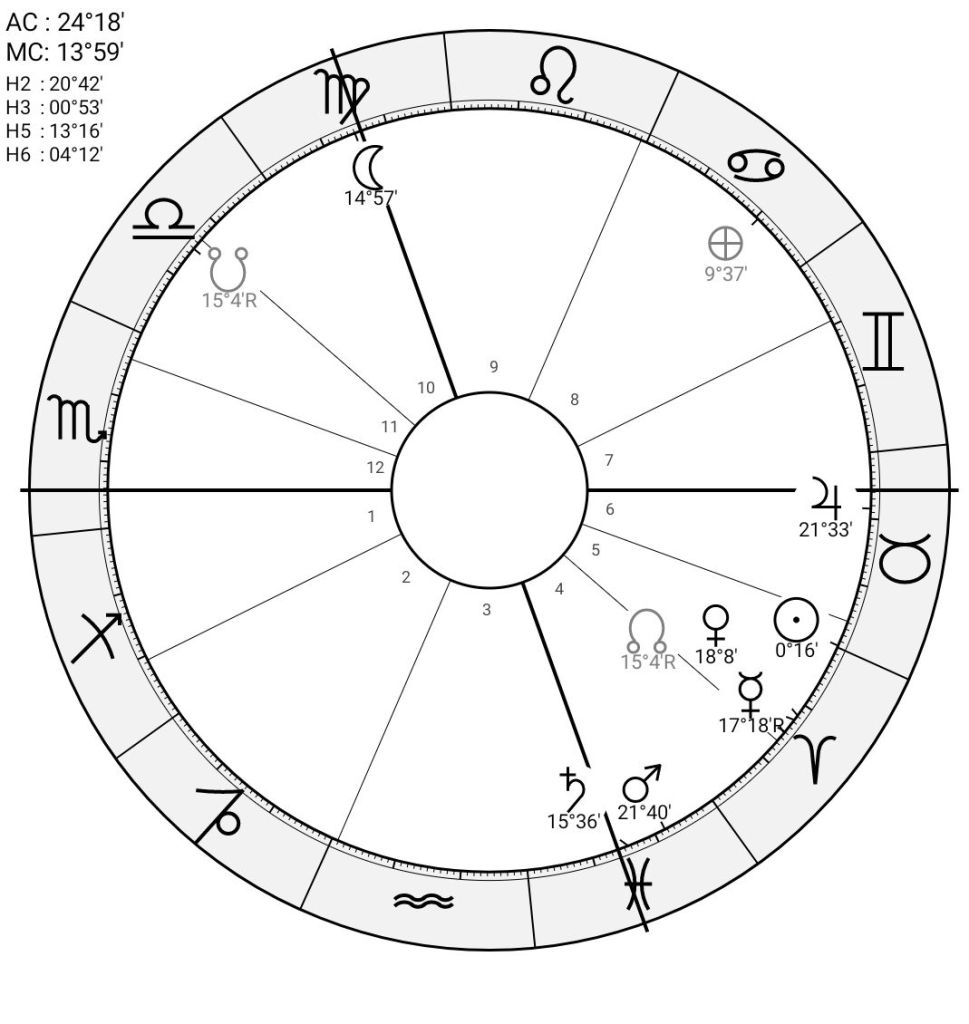
Will we be happy in the new home? Horary question. App used: Aquarius2go

We are represented by the First house and the planet ruling it, Mars (ruler of the rising sign Scorpio). As for which house represents the new place, I believe there are two schools of thought: either the Seventh House (that place there, as opposed to this place here, which is the First house), or the Fourth House of real estate and umoveable property.

The chart seems to guide us to the Fourth House. Plus, usually the Seventh house is reserved for hypothetical “there” places, whereas we had already bought the new place (therefore it was our property) and I was not interested in a comparison between the old apartment and the new, but only in the new place (I already hated the old one).

The Fourth House thus represents the apartment. Jupiter, ruler of Pisces, is the house. And look! Mars, our significator, is right inside the Fourth House, which is good and a symbol of liking the place. It has no major dignity in it (no house rulership or exaltation) but it is dignified by triplicity, term and face. So while it is not the ultimate castle of our dreams, it is very comfortable indeed.

The place’s significator, Jupiter, is conjunct the Seventh cusp and thus angular, and sextiles our significator. A sextile is a positive aspect of ‘friendship’. All in all the picture that emerges is not perfect, but it is quite satisfying.

However, look at the Moon! The Moon is about to oppose Saturn, which is right inside the Fourth cusp, afflicting it. There is some kind of problem ahead. Pinpointing it is not very easy, but considering that Saturn is inside the house representing the place itself and that Saturn rules the Third house, my first instinct was that there might be issues concerning the neighbors (the other people who live in the building). These issues would not be major, as the picture remains generally favorable, but they would be serious enough to be worth mentioning.

Fortunately, a couple of months passed and we saw that the neighbors are generally well-adjusted people. Furthermore, the apartment is, in fact, very comfortable.

What did turn out to be the problem was that the neighbors started some major fuss about the manager of the building as, according to them, he is incompetent and charges way too much for his services and even skims off on the money required for taking care of the building. The thing escalated so far as to almost end up in court, and finding a new manager is costing us quite a lot of time spent traveling and talking to new candidates.

MQS
The Geomancy of Peter of Abano – Book I Pt. 4

Previous / Back to Index / Next

Abano quickly summarises the meanings of the planets in traditional Western astrology, so that the geomancer may better understand the meanings of the corresponding figures.

In order to make it even easier to make a judgment, we shall now consider the planet of every figure, and conveniently we shall list the virtue and meaning of every planet.1

Saturn is always evil, wherever it is, and it means sick or vile people, malady, poverty, blind or maimed people, laborers, problems and toil, prison and prisoners. Adversities and obstacles, loss of wealth. It is only good for building and in agriculture and in things that need to last. Its two figures are Tristitia and Carcer.

Jupiter is always good, wherever it is, and it means Church people, prelates, noblemen, rich people, merchants, captains, courtesans and friendly people. It is good and pleasurable, useful in every thing. It is only bad for the sick and the prisoner, whose trouble it prolongs. Its figures are Acquisitio and Laetitia. Acquisitio is the better one.

Mars is sometimes good and sometimes bad, depending on the question, but inclining to evil, and it means malicious people, wrongdoers, traitors, thieves, ruffians, harlots, murderers. It is only good in things of wars and when blood is concerned. Its figures are Puer and Rubeus, and Puer is the worse one.2

Venus is good, but its goodness is minor, for good or ill, depending on the question asked. It means people who are friendly, happy, young, with little troubles in life. But also harlots. Its figures are Puella and Amissio. Puella is the more noxious for travel and sickness and prison. Amissio is the better one.3

Mercury is a mixed planet in terms of good and evil. It means servants, messengers, letters, embassies, writers, scholars and painters, science and doctrine. Its figures are Albus and Conjunctio. Conjunctio is the worse one, as it always shows malicious intention or duplicity, and hexes.

The Sun and Moon are mixed planets in their good and evil import depending on the question, but the Sun is the better of the two,4 and it means nobles, kings, emperors and people of high station, who have dominion. Its figures are Fortuna Major and Fortuna Minor. Minor means more trouble than prosperity.

The Moon is also a mixed planet, but mostly bad, and its figures are Via and Populus. Via is only good for travel, Populus is good for dealing with people, and it means abundance and lots of water.

Caput and Cauda are associated with the planets Jupiter and Venus (Caput) and Mars and Saturn (Cauda).5

MQS

Footnotes
  1. The elaborate psychological attributes that modern astrology assigns to the twelve zodiac signs are virtually unknown to premodern Astrology, having been invented relatively recently to make up for modern astrology’s inability to make verifiable predictions. Instead, traditional astrology relies much more heavily on the planets as celestial actors. ↩︎
  2. This is not the first time Abano alludes to Puer being worse than Rubeus, although in other places he seems to contradict this statement. ↩︎
  3. This statement is also odd, and it reeks of either mistake or blind. ↩︎
  4. In Medieval Astrology the Sun was often considered a benefic when aspecting other planets, but a malefic in conjunction (planets conjunct to the Sun are said to be combust or burned up, except when they are very close, in which case they are said to be in the heart of the Sun and strengthened). The Moon’s evaluation, quite ironically, fluctuated depending on the author, but in general she was believed to be a benefic when waxing and a malefic when waning. ↩︎
  5. The practice of assigning the two Nodes to the benefics and malefics seems to have started possibly with Medieval Muslim philosophers, or at least in the Latin West. In the original Western tradition, the Hellenistic one, there doesn’t seem to have been much talk of the Nodes except in negative terms. ↩︎