Tag Archives: Mars

Tarot Encyclopedia – The Ten of Cups

(Note: this is a collection of the meanings attributed to the cards by some occultists in the past centuries. It does not reflect my own study or opinion of the cards. It is only meant as a quick comparative reference as I develop my own take.) 

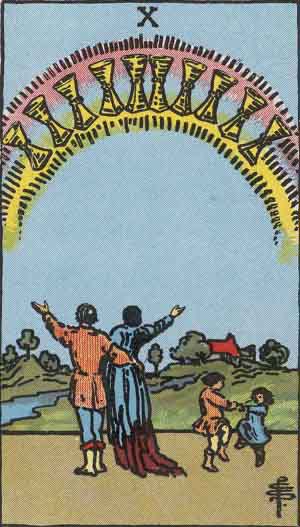
The Ten of Cups from the Builders of the Adytum (BOTA) tarot deck

Paul Foster Case (and Ann Davies)

The time period is the third decanate of Pisces, from March 11 to March 20, under the sub-rulership of Mars in its Scorpio aspect.
The meanings are unfortunate unless the divination refers to spiritual
matters; for the combined forces of Mars, Jupiter and Neptune in Pisces on the physical levels, while they mean tremendous power of desire and sometimes the satisfaction of desire, point rather to unbalanced force than otherwise,
Well-Dignified: if relating to spiritual matters, permanent and lasting success through inspiration from higher levels of consciousness; high psychic development; realization of the highest aspirations; happiness. On questions at a lower level, even if well dignified: great ambition; ultra sensitiveness; great power of realizing desires, but equally great danger of misusing that power.
lll-Dignified: in spiritual questions, danger from psychism; probability of being injured mentally through unwise attempts at meditation. On all other questions: danger of self-undoing from psychism; prodigality; possibility of being influenced by others through the desire-nature; tendency to drug habits and drunkenness; disgust resulting from overindulgence; excess in pleasure.
Keyword: Excess .


(From The Oracle of Tarot course)

A. E. Waite

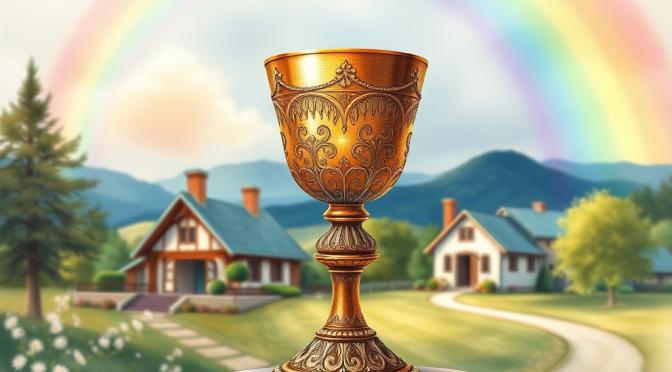
Appearance of Cups in a rainbow; it is contemplated in wonder and ecstacy by a man and woman below, evidently husband and wife. His right arm is about her; his left is raised upward; she raises her right arm. The two children dancing near them have not observed the prodigy but are happy after their own manner. There is a home-scene beyond. Divinatory Meanings: Contentment, repose of the entire heart; the perfection of that state; also perfection of human love and friendship; if with several picture-cards, a person who is taking charge of the Querent’s interests; also the town, village or country inhabited by the Querent. Reversed: Repose of the false heart, indignation, violence.
(From The Pictorial Key to the Tarot)

The Ten of Cups from the Rider Waite Smith tarot

Aleister Crowley

The Ten of Cups is called Satiety. Its attribution is Mars in Pisces. The watery sign has sunk into a stagnant dream, but in it broods and breeds the violent quality of Mars, to putrefy it. As it is written: “Until a dart strike through his liver.” The pursuit of pleasure has been crowned with perfect success; and constantly it is discovered that, having got everything that one wanted, one did not want it after all; now one must pay.

[…]

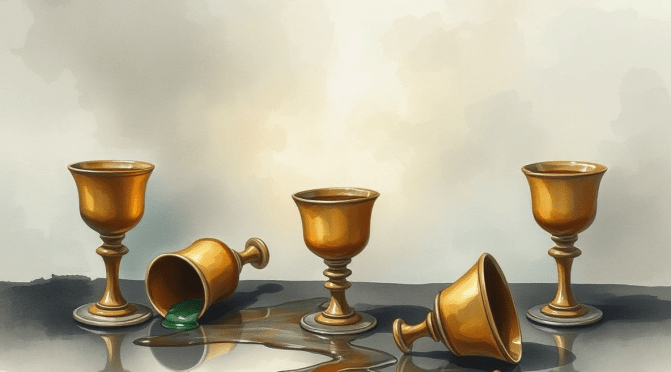
This card represents a conflicting element. On the one hand, it receives the influence of the Ten, Malkah the Virgin. The arrangement of the cups is that of the Tree of Life. But, on the other hand, they are themselves unstable. They are tilted; they spill the water from the great Lotus which overhangs the whole system from one into the other.

The work proper to water is complete: and disturbance is due. This comes from the influence of Mars in Pisces. Mars is the gross, violent and disruptive force which inevitably attacks every supposed perfection. His energy displays the greatest possible contrast with that of Pisces, which is both peaceful and spiritualized.
(From The Book of Thoth)

The Ten of Cups from the Thoth tarot deck

Golden Dawn’s Book T

HAND, as usual, holding bunch of water-lilies or lotuses, whose flowers pour a white water into all the cups, which “all run over.” The uppermost cup is held sideways by a hand, and pours water into the left-hand upper cup. A single lotus flower surmounts the top cup, and is the source of the water that fills it. Above and below the symbols Mars and Pisces.

Permanent and lasting success and happiness, because inspired from above. Not so sensual as “Lord of Material Happiness,” yet almost more truly happy.
Pleasure, dissipation, debauchery, quietness, peacemaking. Kindness, pity, generosity, wantonness, waste, etc., according to dignity.

Malkuth of HB:H (Matter settled: complete good fortune).
Herein the Great Angels HB:a’aShLYH and HB:MYHAL rule.

Etteilla

The city
Upright. In terms of spiritual medicine, this card, in its natural position, signifies: City, City Center, Homeland, Country, Town, Village, Place, Site, Dwelling, Home, Residence. – Citizen, Group of citizens, City dweller.
Reversed. Anger, Indignation, Agitation, Irritation, Outburst of rage, Wrath, Violence.

MQS

A Note On The Ten Of Cups

I always maintain that the Golden Dawn were not great astrologers, largely because the XIX century astrology they had access to was not very good. Still, for the purposes of deriving symbolism for magical operations, their take was acceptable.

One thing that has always fascinated me about the Golden Dawn’s take on astrology was how they tried to synthesize it into their tarot system. Aside from the attributions of Zodiac signs and planets to the Hebrew letters and of the Hebrew letters to the major trumps, they also assigned the thirty-six decans to the thirty-six minor cards two through ten and, in different ways, to the aces and court cards as well.

This way of allocating the symbolism was not unique to them, but (as someone who doesn’t like to mix cartomancy and astrology) I must say that it probably produced the most coherent system.

Crowley generally doesn’t stray too far from the GD interpretation of the minors, but there are a couple of exceptions, the most obvious of which is the Ten of Cups.

For the GD, the Ten of Cups is an excellent card (which is what inspired Waite’s take on it). Crowley, however, disagrees on account of the decan assigned to the card, which is the third decan of Pisces, ruled by Mars. This leads Crowley to argue that this is a card ruled by two disarmonious symbols (Pisces and Mars) and so it produces bad results.

The problem with Crowley’s take is that he constantly, throughout the book, mistakes decan rulership with the influence of a planet in a sign. This is wrong. Rulerships represent affinities of a planet with a sign or subdivision of the sign.

For instance, Aries is ruled by Mars, which means there is an affinity and so when Mars is in Aries it is said to be well-dignified, at least according to the astrological practice that developed in the middle ages. The Sun is also exalted in Aries, which means there is also an affinity. Then we have the three decans: the first ten degrees ruled my Mars, the second ten by the Sun and the last ten by Venus.

Now, Venus is in detriment in Aries, which means there is disharmony between Venus and Aries, so Venus is ill-dignified in it. She is like a dainty ballerina stranded in a war-torn country. It’s not her place. However, in the last ten degrees of Aries, Venus has subrulership by decanate. This means that, even though she is the anti-venusian environment of Aries, she has a small room where she is a bit more comfortable, though not by much: it’s as if our dainty ballerina had been hired to entertain the troops in the barracks. She’s still in the wrong place, but in a less uncomfortable subplace.

Therefore, when Crowley says that Mars is not compatible with Pisces he is saying something that is irrelevant: by definition, the fact that Mars rules the third decan of Pisces means that Mars is at least a bit comfortable in the last ten degrees of the sign. This is because the last decan of Pisces has some kind of Mars-like quality to it: it is the part of Pisces that expresses through Mars.

This is not to say that his system is more right or wrong than the GD (one can stretch symbolism in almost any direction by abusing it long enough), but his misunderstanding runs through the whole minor arcana section, and I thought it would be interesting to bring it up.

MQS

Tarot Encyclopedia – The Seven of Wands

(Note: this is a collection of the meanings attributed to the cards by some occultists in the past centuries. It does not reflect my own study or opinion of the cards. It is only meant as a quick comparative reference as I develop my own take.)
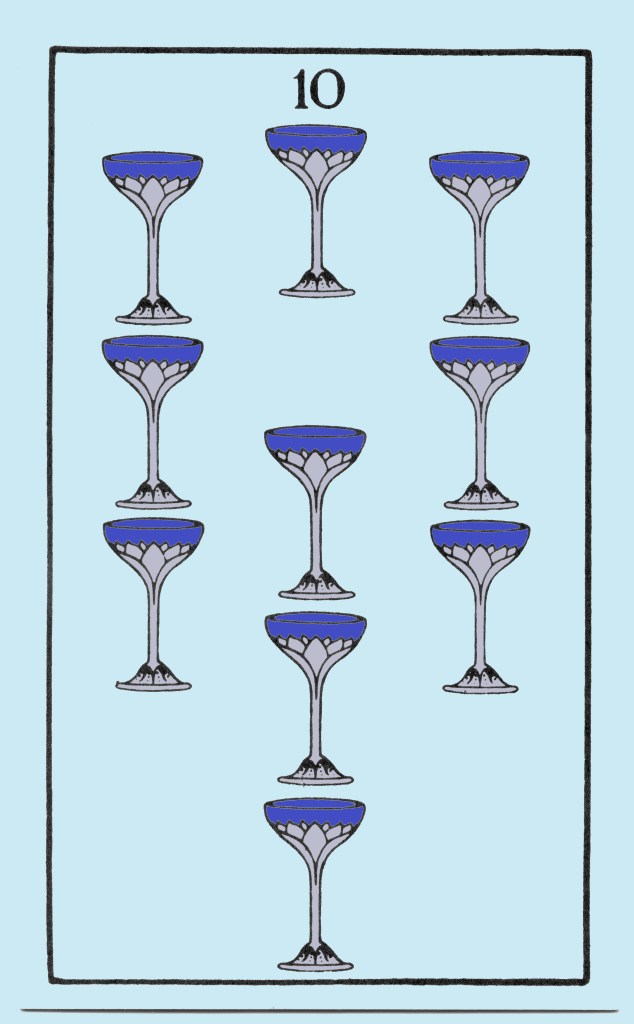
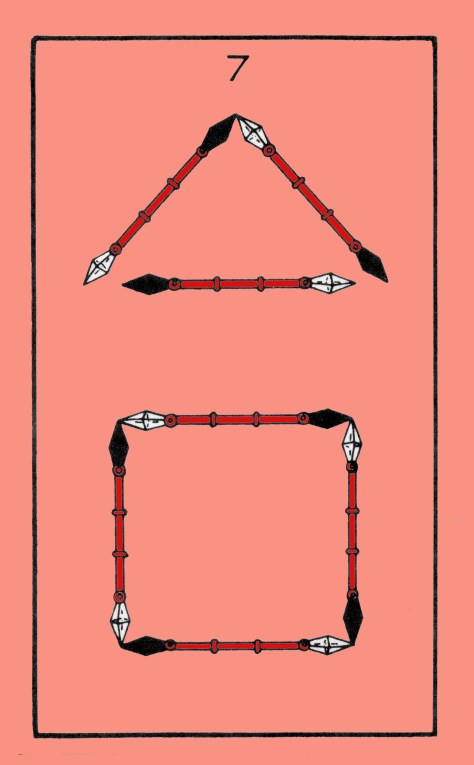
The Seven of Wands from the Builders of the Adytum (BOTA) tarot deck

Paul Foster Case (and Ann Davies)

Astrologically, the Seven of Wands, because it corresponds to the third decanate of Leo, is the time period from August 13 to August 22. In divination, the Seven of Wands combines the activities of the Keys listed in the Tableau [Empress, Sun, Tower, Strength, Emperor] together with ideas of pleasure and love connected with the fifth house in Astrology, the natural house of Leo.
Well Dignified: denotes pleasure in strenuous action; some danger through love affairs or self indulgence; also strength and magnanimity;
adventure; courage in the face of difficulties; influence over subordinates.
lll Dignified: indicates ignorance, pretense, vain-glory, quarrels and wrangling, threats and very determined opposition, especially from subordinates and open enemies.
Keyword: Valor
(From the Oracle of Tarot course)

A. E. Waite

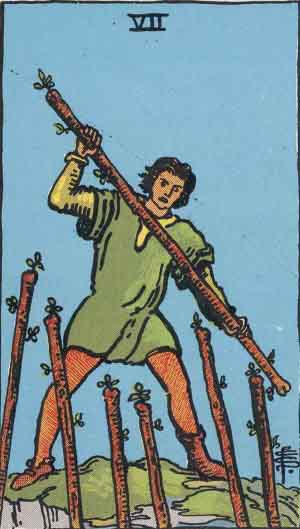
A young man on a craggy eminence brandishing a staff; six other staves are raised towards him from below. Divinatory Meanings: It is a card of valour, for, on the surface, six are attacking one, who has, however, the vantage position. On the intellectual plane, it signifies discussion, wordy strife; in business–negotiations, war of trade, barter, competition. It is further a card of success, for the combatant is on the top and his enemies may be unable to reach him. Reversed: Perplexity, embarrassments, anxiety. It is also a caution against indecision.
(From The Pictorial Key to the Tarot)
    The Seven of Wands from the Rider Waite Smith tarot deck

    Aleister Crowley

    The Seven of Wands is called Valour. Energy feels itself at its last gasp; it struggles desperately, and may be overcome. This card brings out the defect inherent in the idea of Mars. Patriotism, so to speak, is not enough.

    […]

    This card derives from Netzach (Victory) in the suit of Fire. But the Seven is a weak, earthy, feminine number as regards the Tree of Life, and represents a departure from the balance so low down on the Tree that this implies a loss of confidence.

    Fortunately, the card is also attributed to Mars in Leo. Leo is still the Sun in his full strength, but the marks of decadence are already to be seen. It is as if the wavering fire summoned the brutal energy of Mars to its support. But this is not enough to counter-act fully the degeneration of the initial energy, and the departure from equilibrium.

    The army has been thrown into disorder; if victory is to be won, it will be by dint of individual valour-a “soldiers’ battle”. The pictorial representation shows the fixed and balanced wands of the last card relegated to the background, diminished, and become commonplace.

    In front is a large crude uneven club, the first weapon to hand; evidently unsatisfactory in ordered combat. The flames are dispersed, and seem to attack in all directions without systematic purpose.
    (From The Book of Thoth)

    The Seven of Wands from the Thoth Tarot deck

    Golden Dawn’s Book T

    TWO hands holding by grip six wands, three crossed. A third hand issuing from a cloud at the lower part of the card, holding an upright wand which passes between the others. Flames leap from the point of junction. Above and below the central wand are the symbols of Mars and Leo, representing the Decan.

    Possible victory, depending on the energy and courage exercised; valour;
    opposition, obstacles and difficulties, yet courage to meet them; quarrelling, ignorance, pretence, and wrangling, and threatening; also victory in small and unimportant things: and influence upon subordinates.

    Netzach of HB:Y (Opposition, yet courage).
    Therein rule the two great Angels HB:MHShYH and HB:LLHAL of the
    Schemhamphorash.

    Etteilla

    Talking
    Upright. This blade, as far as the medicine of the spirit is concerned, means, in its natural position: Talking, Negotiation, Conference, Colloquy, Conversation, Dissertation, Deliberation, Discussion. – Word, Pronunciation, Language, Idiom, Dialect, Negotiation, Market, Exchange, Measure, Trade, Traffic, Correspondence. – Talking, Saying, Proferring, Conferring, Discussing, Chatting, Dividing, Chattering, Gossiping.
    Reversed. Indecision, Irresolution, Uncertainty, Perplexity, Inconstancy, Lightness, Variation, Diversity, Hesitating, Hesitating. – Temptation, Vacillation, Versatility.

    MQS

    Tarot Encyclopedia – The Five of Cups

    (Note: this is a collection of the meanings attributed to the cards by some occultists in the past centuries. It does not reflect my own study or opinion of the cards. It is only meant as a quick comparative reference as I develop my own take.)

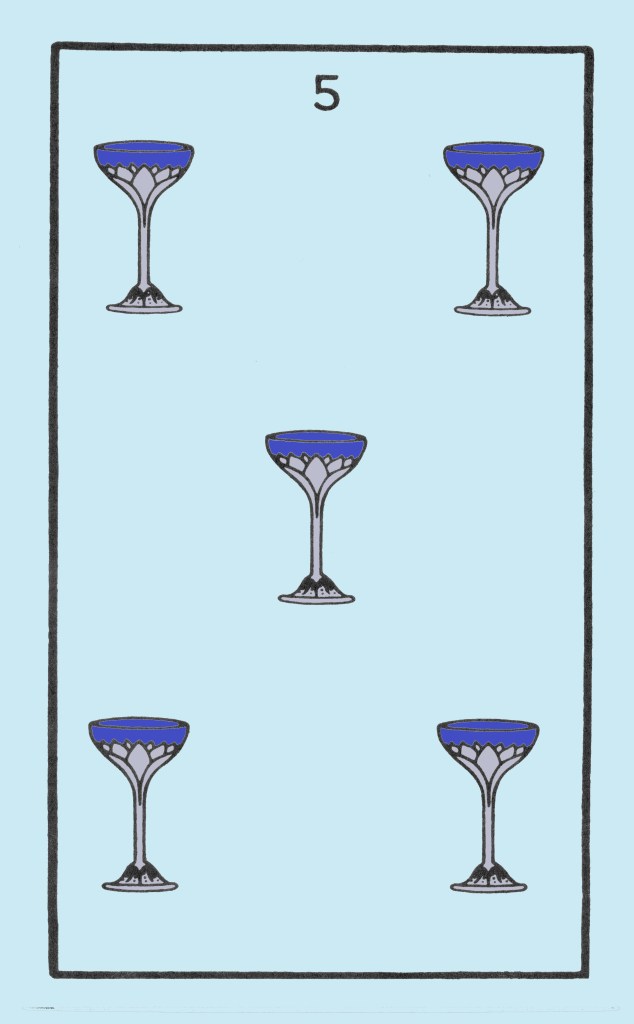
    The Five of Cups from the Builders of the Adytum (BOTA) tarot deck

    Paul Foster Case (and Ann Davies)

    The Five of Cups is the first decanate of Scorpio, ruled by Mars, time period October 22 to October 31.
    Well-Dignified: strength, power to do; ability to introduce needed changes and let go of relationships, prejudices and false ideas that are hindering spiritual progress.
    lll-Dignified: loss in pleasure, vain regret, disappointment, sorrow and loss of those things which have been much desired; treachery, deceit; unexpected troubles and anxieties; disappointments in love, broken engagements, broken friendships.
    (Note: These sorrows and disappointments, as indicated by the Five of Cups, lll Dignified, are often the necessary destruction before the beginning of a new and greater expansion and growth in the life of the Querent, depending on his basic understanding and evolutionary level.)
    Keyword: Defeated desire.
    (From the Oracle of Tarot course)

    A. E. Waite

    A dark, cloaked figure, looking sideways at three prone cups two others stand upright behind him; a bridge is in the background, leading to a small keep or holding. Divanatory Meanings: It is a card of loss, but something remains over; three have been taken, but two are left; it is a card of inheritance, patrimony, transmission, but not corresponding to expectations; with some interpreters it is a card of marriage, but not without bitterness or frustration. Reversed: News, alliances, affinity, consanguinity, ancestry, return, false projects.
    (From The Pictorial Key to the Tarot)

    Aleister Crowley

     […] the Five of Cups is called Disappointment, as is only natural, because Fire delights in superabundant energy, whereas the water of Pleasure is naturally placid, and any disturbance of ease can only be regarded as misfortune.

    This card is ruled by Geburah in the suit of Water. Geburah being fiery, there is a natural antipathy. Hence arises the idea of disturbance, just when least expected, in a time of ease.

    The attribution is also to Mars in Scorpio, which is his own house; and Mars is the manifestation on the lowest plane of Geburah, while Scorpio, in its worst aspect, suggests the putrefying power of Water. Yet the powerful male influences do not show actual decay, only the beginning of destruction; hence, the anticipated pleasure is frustrated. The Lotuses have their petals torn by fiery winds; the sea is arid and stagnant, a dead sea, like a “chott” in North Africa. No water flows into the cups.

    Moreover, these cups are arranged in the form of an inverted pentagram, symbolizing the triumph of matter over spirit.

    Mars in Scorpio, moreover, is the attribution of the Geomantic figure Rubeus. This is of such evil omen that certain schools of Geomancy destroy the Map, and postpone the question for two hours or more, when Rubeus appears in the Ascendant. Its meaning is to be studied in the “Handbook of Geomancy” (Equinox Vol. I, No.2).
    (From The Book of Thoth)

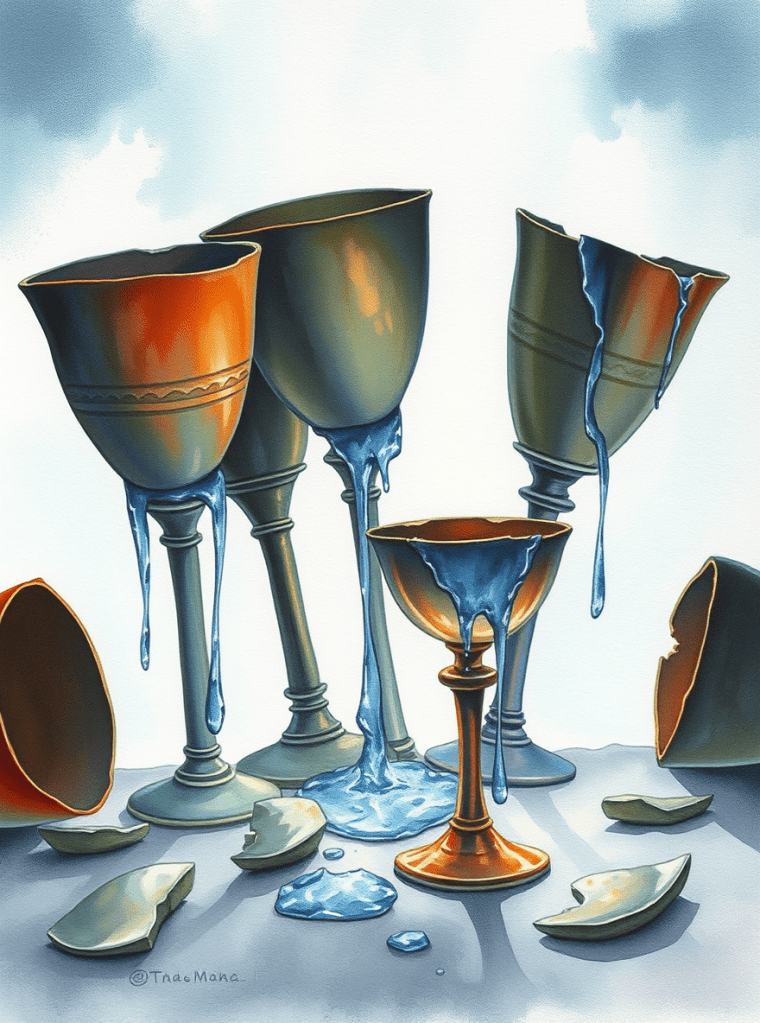
    AI-generated illustration for the Five of Cups

    Golden Dawn’s Book T

    A WHITE Radiating Angelic Hand, holding lotuses or water-lilies, of which the flowers are falling right and left. Leaves only, and no buds, surmount them. These lotus stems ascend between the cups in the manner of a fountain, but no water flows therefrom; neither is there water in any of the cups, which are somewhat of the shape of the magical instrument of the Zelator Adeptus Minor. Above and below are the symbols of Mars and Scorpio for the Decan.

    Death, or end of pleasure: disappointment, sorrow and loss in those things from which pleasure is expected. Sadness, treachery, deceit; ill-will, detraction; charity and kindness ill requited; all kinds of anxieties and troubles from unsuspected and unexpected sources.
    Geburah of HB:H (Disappointment in love, marriage broken off, unkindness of a
    friend; loss of friendship).
    Herein rule HB:LVVYH and HB:PHLYH.

    Etteilla

    Legacy
    Upright. This card, in its natural position, means, as far as the medicine of the spirit is concerned: Inheritance, Succession, Bequest, Gift, Donation, Endowment, Estate, Transmission, Will. – Tradition, Resolution [=Decision]. – Kabbalah.
    Reversed. Consanguinity, Blood, Family, Avi, Ancestors, Father, Mother, Brother, Sister, Uncle, Aunt, Cousin, Cousin. – Filiation, Extraction, Race, Lineage, Alliance. – Affinity, Attachment, Relationship, Ties.

    MQS

    Tarot Encyclopedia – The Three of Pentacles or Coins

    (Note: this is a collection of the meanings attributed to the cards by some occultists in the past centuries. It does not reflect my own study or opinion of the cards. It is only meant as a quick comparative reference as I develop my own take.)

    The Three of Pentacles from the Builders of the Adytum (BOTA) deck

    Paul Foster Case (and Ann Davies)

    The time period is the second decanate of Capricorn, under the rulership of Venus, from January 1 to January 9.
    Well-Dignified: construction; increase, growth; financial gain; the building up of favorable conditions; gain in commercial transactions; rank or prestige in vocation or business; beginning of matters to be perfected later.
    Ill-Dignified: selfishness; cleverness in business, but lack of scruples;
    narrowness and prejudice; too much ambition.
    Keyword: Constructiveness.
    (From the Oracle of Tarot course)

    A. E. Waite

    A sculptor at his work in a monastery. Compare the design which illustrates the Eight of Pentacles. The apprentice or amateur therein has received his reward and is now at work in earnest. Divinatory MeaningsMétier, trade, skilled labour; usually, however, regarded as a card of nobility, aristocracy, renown, glory. Reversed: Mediocrity, in work and otherwise, puerility, pettiness, weakness.
    (From The Pictorial Key to the Tarot)

    Aleister Crowley

    The Three of Pentacles, in a similar manner, exhibits the result of the idea of Earth, of the crystallization of forces; and so the Three of Pentacles is called the Lord of Work. Something has definitely been done.

    […]

    The influence of Binah in the sphere of Earth shows the material establishment of the idea of the Universe, the determination of its basic form. It is ruled by Mars in Capricornus; he is exalted in that Sign, and therefore at his best. His energy is constructive, like that of the builder or engineer. The card represents a pyramid viewed from above the apex. The base is formed by three wheels-Mercury, Sulphur, and Salt; Sattvas, Rajas, and Tamas in the Hindu system; Aleph, Shin, and Mem-Air, Fire, and Water-the three Mother letters of the Hebrew alphabet.

    This pyramid is situated in the great Sea of Binah in the Night of Time, but the sea is solidified; hence the colours of the back-ground are mottled, a cold thin dark grey with a pattern of indigo and green. The sides of the pyramid have a strong reddish tint, showing the influence of Mars.
    (From The Book of Thoth)

    AI-generated illustration for the Three of Pentacles or Coins

    Golden Dawn’s Book T

    A WHITE-WINGED Angelic Hand, as before, holding a branch of a rose tree, of which two white rosebuds touch and surmount the topmost Pentacle. The Pentacles are arranged in an equilateral triangle. Above and below the symbols Mars and Capricorn.
    Working and constructive force, building up, creation, erection; realization and increase of material things; gain in commercial transactions, rank; increase of substance, influence, cleverness in business, selfishness. Commencement of matters to be established later. Narrow and prejudiced. Keen in matters of gain; sometimes given to seeking after impossibilities.
    Binah of HB:H (Business, paid employment, commercial transaction).
    Herein are HB:YChVYH and HB:LHChYH Angelic Rulers.

    Etteilla

    Important
    Upright. This card, as far as the medicine of the spirit is concerned, means, in its natural position: Noble, Considerable, Famous, Important, Great, Major, Extended, Vast, Sublime, Renowned, Famous, Powerful, Elevated, Illustrious. – Excellence, Consideration, Greatness of mind, Nobility of conduct, Generous deeds, Magnificently, Splendidly.
    Reversed. Puerility, Childhood, Infantilism, Frivolity. – Weakening, Lowering, Diminishing, Education, Modicity, Mediocrity, Minuity, Inezia, Frivolity, Lowness, Vileness, Poltrony, Rampant, Small, Puerile, Petty, Low, Servile, Vile, Abject, Humble. – Abjection, Humility, Humiliation.

    MQS

    The Geomancy of Peter of Abano – Book III Pt. 9

    Previous / Back to Index / Next

    Here Abano talks about the meanings of Caput Draconis and Cauda Draconis in the various houses.

    Caput Draconis (The Dragon’s Head or North Moon Node)

    Caput Draconis in the first house means good luck, noble people, wise people, leaders, captains, honor, dignity, a prelate.1
    In the second it means good success, gaining wealth or dignity or money.
    In the third it means noble brothers and sisters, lucky siblings, good through them, isolated gardens2, pleasures.

    In the fourth it means good for the parents, inheritance, buildings, cities, citizens, noble people, good end to an issue.
    In the fifth it means science, good children, gain and help through them.
    In the sixth it means good servants, faithful servants, good officials, grave infirmity, melancholic infirmity,3 long fevers.

    In the seventh it means honorable women, good marriage, good company, gain from noble people or from women and thanks to them.
    In the eighth it means inheritance, goods gain from the dead, usefulness through women and noble people, gain through war and by violence against life, being beheaded.4
    In the ninth it means honoring God, ecclesiastical dignity, religious people, noble people, good journeys, delay in coming back but with good results, a messenger with bad news, messenger bearing news of legal issues, ingeniousness in a noble science.

    In the tenth it means the king, the emperor, the lord, a magistrate, dignity, honor, good regents and orators, noble people.
    In the eleventh it means noble soldiers, captains, dignity, sublimation5, succeeding one’s lord, faithfulness, valor, good luck.
    In the twelfth it means noble inheritance through the mother, honorable things for [or through] women, few enemies, weak enemies, certainty, fame.

    In the thirteenth it means journeys, messengers, a king, lords, usefulness, gain, honor, dignity, friendship and good recoglientia.6
    In the fourteenth it means coming back from a journey with dignity and mirth and gain, letters, positive answer, honors, dignity, usefulness.
    In the fifteenth it means a good end to the question and strong hope.7

    Cauda Draconis (The Dragon’s Tail or South Moon Node)

    Cauda draconis in the first house means evil disposition of the querent or of the quesited, fear of death, being murdered.8
    In the second it means wealth gain through illicit means, theft, violence.
    In the third it means iniquity against siblings and relatives, remains, retaliations, killings on the streets.

    In the fourth it means loss of inheritance, evil lands, evil people, betrayals, false rumors, destruction of a city or fortress.
    In the fifth it means evil children or women, loss of children, danger during childbirth, loss of blood.
    In the sixth it means evil servants, runaways, grave illness, bodily fluids, killing, desperation, damage.

    In the seventh it means a harlot, vile marriage, evil company, unfaithfulness, betrayal, violence, enmity.
    In the eighth it means fear of death for [or through] women, rumors, freedom from prison and from illness, loss through women, being killed, loss of blood and flobotomia.9
    In the ninth it means being forced on a journey, loss, danger of death, toil, changing one’s religion, evil or false religious people, evil Christians,10 evil messengers, death during a journey.

    In the tenth it means an evil lord, traitors of one’s country, iniquitous judges or orators, overthrowing tyrants, loss of dignity, destruction of one’s kingdom.
    In the eleventh it means wrongful succession, betrayal, violence, rebellion, death of one’s lord.
    In the twelfth it means hidden enemies of the kingdom, machinations, treason against one’s lord, assassinations both public and private, violence.

    In the thirteenth it means betrayals during a journey, hate from noble people, the absent party doesn’t come back.
    In the fourteenth it means toiling for gain and honor, bad luck, hatred from underlings and very evil enemies, overcoming one’s enemies,.
    In the fifteenth it is the worst of all, eccept for doing evil things.11

    MQS

    Footnotes
    1. Possibly due to the Moon’s North Node connection with beginnings and with increase, as well as the connection of the term ‘head’ with leadership. ↩︎
    2. The text seems to say “giardini solati”, and I am not sure if it means isolated gardens or gardens in the sun or something else that escapes me. The connection with gardens is clear, as the Third House rules neighborhoods and therefore what’s around the house. ↩︎
    3. Illnessess were traditionally categorized based on the prevailing humor. ↩︎
    4. This is another excellent example of how to read the meaning of the figure into the meaning of the house. Caput Draconis is the head, and the Eighth House rules death, thus giving beheading (death by losing one’s head). Of course much depends on the question and the rest of the Shield. ↩︎
    5. This is not clear. ↩︎
    6. An archaic Italian word of whose meaning I am unaware. ↩︎
    7. Caput cannot be the Judge. ↩︎
    8. It is usually said that Cauda being in the First House is enough to break the figure. However, here Abano gives us coherent interpretations. Most of them are very dramatic, but it’s the principle that counts and needs to be assimilated. ↩︎
    9. A term belonging to the vocabulary of Medieval medicine. I do not know what it means. ↩︎
    10. Probably to be interpreted as evil believers in general, nowadays. ↩︎
    11. Cauda cannot be the Judge. ↩︎

    The Geomancy of Peter of Abano – Book III Pt. 6

    Previous / Back to Index / Next

    Here Abano examines some of the meanings of Puer and Puella in the various houses.

    Puella

    Puella in the first house means happy things, fleeing from adversity, singing, dancing, usefulness, younger siblings or dead siblings.1
    In the second it means usefulness for women and for merchandise, good luck, clothes.
    In the third house it means love between siblings and relatives, good friends, usefulness through them.

    In the fourth it means fighting over inheritance, difficulty in whatever you wish to gain from your father or mother,2 hiding secrets, good profession.
    In the fifth house it means good messenger and letters, gaiety with children, obtaining your wish.
    In the sixth house it means lovesickness,3 good servants, harlots, fornication, lasciviousness.

    In the seventh it means a marriage of love,4 lucky marriage, lascivious women, lack of stability.
    In the eighth it means death of small children, arms and swords.5
    In the ninth it means usefulness through travel, good change of place, gain through merchanidse, knowledge, good news.

    In the tenth it means honor from lords, good servants, good things for powerful people, happiness, goodness in everything.
    In the eleventh it means happiness from friends, good luck for sick people, gain, usefulness through injustice, good in everything.
    In the twelfth it means being firm, scams, gain through animals, problems through servants and evil people and phony people.

    In the thirteenth it means usefulness through travel and lords, happiness, good news, good messenger.
    In the fourteenth it means freedom from danger, usefulness, happiness, gain through toil.
    In the fifteenth it depends on the other figuers, depending on where they fall.6

    Puer

    Puer in the first house means happiness, hope of gain, having kids, obtaining your wish, money.7
    In the second it means gain through merchandise, selling, abundance, obtaining the wish.
    In the third it means discord among siblings and relatives, gain with difficulty and with company, difficulties, useless dream.

    In the fourth it means controversy, fighting, discord, rumors about the father or mother due to inheritance, it brings to light the hidden, useful strategies.
    In the fifth it means happiness, false messenger, fights, wealth from minors.
    In the sixth it means fled servants, dishonest women, danger from giving birth, male child.

    In the seventh it means illegal marriage, harlots, dirty words, useful company.
    In the eighth it means death of an enemy or of a minor, inheritance, fraud, if with Rubeus8 it means wounds and loss of blood.
    In the ninth it means long travel, reunion, false science and false people, false news.

    In the tenth fight, bad judge, dishonor, one’s lord is too credulous, loss of dignity and wealth.
    In the eleventh it means false soldiers, false friends, false churchmen, unfaithfulness, treason, contrarieties.
    In the twelfth it means enemies, invasion, bad for journeying, subjects, the sick person is evil and a traitor.

    In the thirteenth it means travel, impediments, murder, evil people, violence, eviction, loss of inheritance.
    In the fourteenth it means evil company, false marriage, harlots, instability.
    In the fifteenth it is always evil except in war.9

    MQS

    Footnotes
    1. This last correspondence escapes me. ↩︎
    2. Puella is usually presented as a positive, if weak, figure. Why it should cause strife over inheritance is not clear. In some Medieval books on Geomancy it seems as though Puer and Puella are often mixed together. ↩︎
    3. The connection of love, one of the meanings of Venus/Puella, with the sickness typical of the Sixth House, is rather smart here, and should be taken as example of how to derive meanings from the Figure-in-House combination. ↩︎
    4. That is, as opposed to a marriage of convenience or marriage for money, which were common back in the day. ↩︎
    5. This latter correspondence seems more plausible for Puer. ↩︎
    6. Puella cannot be the Judge. ↩︎
    7. Once again, this feels like a mix between Puer and Puella. ↩︎
    8. It is not clear where Rubeus should appear in order for Puer to be ‘with’ it. Perhaps in company. At any rate, it is an interesting comment as it reinforces the idea that the figures combine their meanings to give us a clearer picture of the situation. ↩︎
    9. Puer cannot be the Judge. ↩︎

    The Geomancy of Peter of Abano – Book III Pt. 5

    Previous / Back to Index / Next

    Abano gives some examples of the meanings of Albus and Rubeus in the various houses.

    Albus

    Albus in the first house means obtaining the wish, success in white things,1 happiness, success in watery things, good news, letters.
    In the second it means increase of wealth, riches, gain in merchandise, usefulness through partnership.
    In the third it means obtaining what you wish, good for serving a lord or nobleman, good brothers and relatives.

    In the fourth it means gain through the father, inheritance, gain through travel and water, rivers, watery places.
    In the fifth it means good kids, good messenger, good news, good letters, honor, good life.
    In the sixth it means serious, long sickness,2 tears, servants, animals.

    In the seventh it means chaste women, honest woman, pregnant woman, gain through women.
    In the eighth it means tears due to bereavement, rain, lots of water.
    In the ninth it means gain through travel, problems due to rain (during travel), good news from afar, good messenger.

    In the tenth it means good luck, good things from noblemen, or friends, good in any question.
    In the eleventh it means good luck through friends and happiness in all you wish.
    In the twelfth it means certainty in what you doubt in things of war or armed men, good for animals, bad for the prisoner, success after difficulty.

    In the thirteenth it means good change of place, gain through congregation of lords.3
    In the fourteenth it means help from friends, freedom from enemies, happiness in what you wish.
    In the fifteenth it is good depending on the other figures.4

    Rubeus

    Rubeus in the first means problems, fear of death and blood, great fights, enmity, ingratitude, rumors, all kinds of problems.5
    In the second it means theft, loss of gain, poverty, little gain through merchandise.
    In the third it means sadness, loss of blood, enmity, discord among siblings and relatives, evil siblings, blood, traveling by night.

    In the fourth it means loss of blood or sebum, loss of inheritance, a bad year, drought.
    In the fifth it means evil children, useless study, evil science,6 violence, damange through animals, evil life, good luck in war.
    In the sixth it means acute infirmity, fever, choler, problems through servants and animals, theft.

    In the seventh it means war, fights, evil marriage, evil wife, perversion of the spouse, bad outcome, except in war, depending what side (of the chart) it favors by its presence.7
    In the eighth it means loss of blood, fear of death, infamy after death.
    In the ninth it means dangerous journey due to thieves, assassins, public violence, wounds, drunkenness, horrible things.

    In the tenth it means tyranny,8 public violence due to one’s lords, evil judge.
    In the eleventh it means enmity, discord, evil friends, foes, misfortune, problems, evil servants.9
    In the twelfth it means toil, enemies, big misfortune, loss of what you wish, damage through merchandise, loss of wealth, bad for the prisoner.

    In the thirteenth it means bad journey, loss through noblemen, hatred from higher ups, misfortune.
    In the fourteenth it means useless toil, prison of the messenger, hatred of evil servants, theft, evil men, dangerous travel.
    In the fifteenth it means good or evil depending on the figures in the other houses, it is only good in war for the victorious side.10

    MQS

    Footnotes

    1. This is because Albus, of course, means ‘white’. However, one is left wondering what these white things are, and if there are deeper implications based on the symbolic and alchemical meaning of the figure. ↩︎
    2. In many sources Albus in the Sixth House is considered a symbol of medicine. ↩︎
    3. The idea of lords or masters is given by the Tenth House. Albus, being a figure of Mercury, supplies the idea of connection. ↩︎
    4. Albus cannot be the Judge. See my footnote in Book III Part 4. ↩︎
    5. It is known that Geomancers often discouraged people from reading the chart if Rubeus was in the first house. Here Abano does not mention this rule, but rather interprets Rubeus in the First House as a normal figure. ↩︎
    6. The connection of the Fifth House with science is not clear. ↩︎
    7. As discussed previously, in things of war Abano suggests giving one half of the shield to one party and the other half to the opposing party. ↩︎
    8. In classical philosophy, tyranny was considered the greatest illness of politics, so it is fitting that it should be represented by the most sinister figure. ↩︎
    9. This probably refers to ‘sevants of the king’ as the Eleventh is the second from the Tenth. ↩︎
    10. Rubeus cannot be the Judge. ↩︎

    Tarot Encyclopedia – The Two of Wands

    (Note: this is a collection of the meanings attributed to the cards by some occultists in the past centuries. It does not reflect my own study or opinion of the cards. It is only meant as a quick comparative reference as I develop my own take.)

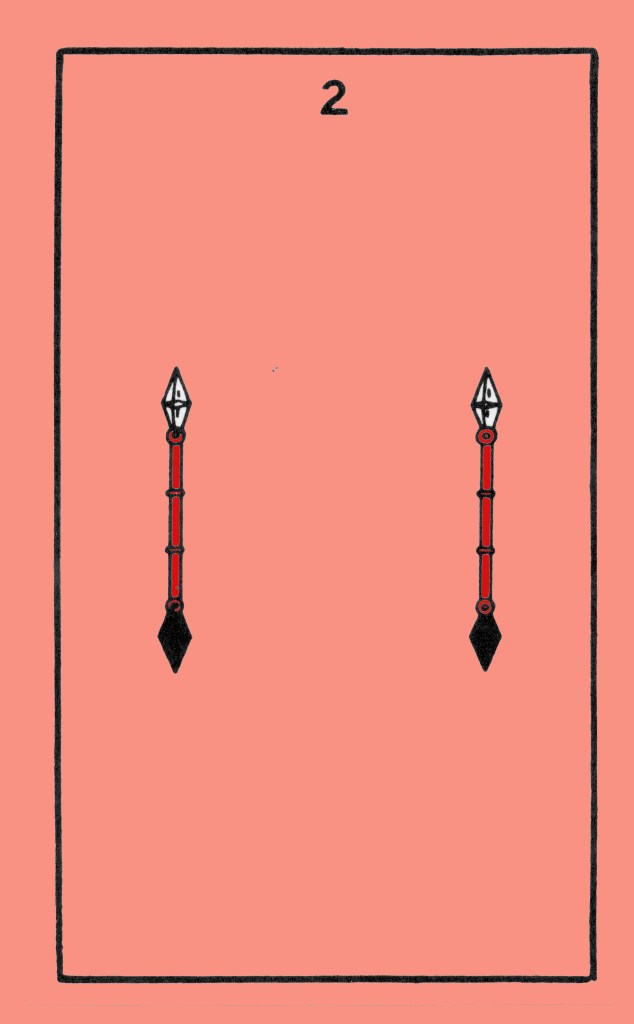
    The Two of Wands from the Builders of the Adytum (BOTA) Tarot deck

    Paul Foster Case (and Ann Davies)

    In Tarot divination the Two of Wands has these key meanings:
    Well Dignified: it shows force, enterprise, boldness, resolution, some
    combativeness, much originality.
    lll Dignified: it signifies restlessness, fierceness, shamelessness, inordinate ambition, turbulence, obstinancy, revenge. A card of enthusiasm, but of strong self-interest.
    Keyword: Dominion
    (From the Oracle of Tarot course)

    A. E. Waite

    A tall man looks from a battlemented roof over sea and shore; he holds a globe in his right hand, while a staff in his left rests on the battlement; another is fixed in a ring. The Rose and Cross and Lily should be noticed on the left side. Divinatory Meanings: Between the alternative readings there is no marriage possible; on the one hand, riches, fortune, magnificence; on the other, physical suffering, disease, chagrin, sadness, mortification. The design gives one suggestion; here is a lord overlooking his dominion and alternately contemplating a globe; it looks like the malady, the mortification, the sadness of Alexander amidst the grandeur of this world’s wealth. Reversed: Surprise, wonder, enchantment, emotion, trouble, fear.
    (From The Pictorial Key to the Tarot)

    Aleister Crowley

    The Two of Wands is called the Lord of Dominion, and represents the energy of fire; fire in its best and highest form.

    […]

    This card, pertaining to Chokmah in the suit of Fire, represents the Will in its most exalted form. It is an ideal Will, independent of any given object.

    “For pure will, unassuaged of purpose, delivered from the lust of result, is every way perfect.” AL. 1. 44.

    The background of this card shows the power of the planet Mars in his own sign Aries, the first of the Signs. It there represents Energy initiating a Current of Force.

    The pictorial representation is two Dorjes crossed. The Dorje is the Tibetan symbol of the thunderbolt, the emblem of celestial Power, but more in its destructive than its creative form.

    More, that is, in its earlier rather than its later form. For destruction may be regarded as the first step in the creative process. The virgin ovum must be broken in order to fertilize it. Fear and repulsion are therefore the primary reaction to the assault. Then, with understanding of the complete plan, willing surrender rejoices to co-operate. Six flames issue from the centre. This indicates the influence of the Sun, who is exalted in Aries. This is the creative Will.

    Mars in Aries is the attribution of the Geomantic Figure Puer. The meaning of these figures is to be studied in the Handbook of that science: “The Equinox” Vol. I, No.2. Remember that the Geomantic Intelligences (see Liber 777 Cols. XLIX and CLXXVIII) are all primarily Gnomes.
    (From the Book of Thoth)

    Weirdly religious AI-generated illustration of the Two of Wands

    Golden Dawn’s Book T

    A WHITE Radiating Angelic hand, issuing from clouds, and grasping two crossed wands. Flames issue from the point of junction. On two small wands above and below, with flames of five issuing therefrom, are the symbols of Mars and Aries for the Decan.
    Strength, domination, harmony of rule and of justice. Boldness, courage,
    fierceness, shamelessness, revenge, resolution, generous, proud, sensitive, ambitious, refined, restless, turbulent, sagacious withal, yet unforgiving and obstinate.
    Chokmah of HB:Y (Influence over others, authority, power, dominion).
    Therein the Angels HB:VHVAL and HB:DNYAL bear rule.

    Etteilla

    Sadness
    Upright. This card, as far as the medicine of the spirit is concerned, signifies, in its natural position: Sadness, Misery, Melancholy, Affliction, Sorrow, Desolation, Mortification, Mood, Discontent, Vapors, Gloomy Ideas. – Bitterness, Anger, Spite.
    Reversed. Surprise, Enchantment, Shock, Upset, Unexpected event, Unexpected fact, Excitement, Fear, Fright, Terror. – Consternation, Stunning, Domination, Abduction, Alarm. – Marvel, Phenomenon, Miracle.

    MQS

    Cauda Draconis / Dragon’s Tail (Geomancy Figures)

    Name of the Figure: Cauda Draconis (Dragon’s Tail); sometimes called Outward Threshold
    Element: Fire
    Planet: None, Moon’s South Node (some say also the malefics, Mars and Saturn)
    Sign: Sagittarius
    Quality: Exiting
    Fortune: Bad

    Cauda Draconis is the less lovable sibling of Caput Draconis. Like its counterpart, Cauda is not traditionally associated with any planet, although some classics say it belongs to the malefics of astrology, namely Mars and Saturn. However, in itself, Cauda is connected with the Moon’s South Node. Technically every planet has nodes, that is, points where they cross the Sun’s ecliptic. However, in traditional astrology, only the Moon’s nodes are considered, as the Moon’s connection with the journey of life is said to begin with the North and end with the South Node. Visually, the symbol of Cauda is said to show a series of steps leading away from a threshold, symbolizing the sense of ending.

    Illustration of the geomantic figure Cauda Draconis, Dragon’s Tail

    And ending is indeed one of the main meanings of Cauda. Ending is not necessarily bad. When you want to get rid of an illness, or really anything, Cauda can be positive, if not easy. It also shows quick, sharp change, so it can bring stagnant situations to an end.

    Still, Cauda is mostly unwelcome in most readings. It can indicate the end of a relationship (or that a relationship won’t start). It can show unemployment and loss of money. It can announce difficult interpersonal relationships all around.

    Due to its connection with the bad side of life, Cauda is one of the figures that, traditionally, prompted geomancers to break their figure and abandon divination if it shows up in the first house. Don’t do it. Just because Cauda is in the first house doesn’t mean your querent is a psychopath. Cauda is a challenging figure. It can simply mean the person is going through challenging times, that their life is changing dramatically and they have lost the plot.

    Common Keywords: Ending, Loss, Abandonment, Evil, Quarrel, Evil intentions, Disruption, Letting go

    Cauda Draconis in the Geomantic Houses (these are only examples. Use context to guide your interpretation)

    HousePossible Meanings
    FirstDangerous person, Person in danger, Person who is going through hell, Person who is ending something
    SecondLoss of money or items
    ThirdQuarrels among neighbors or siblings, Bad news, False rumors
    FourthEnd of lineage, Death of father, Eviction, Loss of home
    FifthDanger though excess, Loss of pregnancy, Questionable pastimes
    SixthEnd of sickness (but if the chart is bad, it could end with death), stay way from your servants
    SeventhDivorce, Quarrel, Theft, Untrustworthy individuals, Fraud
    EighthDeath, Danger, Loss of money
    NinthEvil religion or way, Inability to learn, Atheism, Materialism, Loss of faith
    TenthBeing fired, Loss of employment, Revolution, Coup d’etat, Death of mother
    EleventhEnd of a friendship, Fights, Quarrels, End of hope
    TwelfthEscape, Freedom, Death of large animals
    ThirteenthThere was upheaval, ending, disaster, the querent is capable of letting go
    FourteenthThere will be upheaval, ending, disaster, the querent is unable to let go
    FifteenthCauda cannot be Judge
    Possible meanings of Cauda Draconis in the various Geomantic Houses. Note that this is not meant to be exhaustive, and it only serves to jog your interpretive muscles

    MQS