While the number of Minor Arcana differs from system to system, being usually comprised of the aces, court cards and a variable number of pips, the Major Arcana of Bolognese Tarot the are always the same: eighteen classically recognizable trumps (the regular ones, minus the Emperor, Empress, Pope/Hierophant and Popess/High Priestess), plus any number of Moors (from zero to all four, depending on the school of thought). For more information on the peculiarities of this deck read here.
NOTE: when I was kindly taught the 45-card system, the person who taught it to me considered the Moor card to be part of the suit of swords, possibly due to the spear. I include it in the Major Arcana simply because the four Moors are replacements for the four missing trumps.
NOTE 2: The Bolognese major arcana sequence is older than the one we are used to, and quite different. I stick to the sequence we know just to avoid confusion. It has no divinatory implications either way.
The Fool
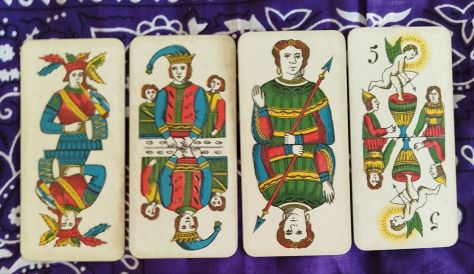
A neutral card, with both positive and negative implications. It represents oddity and strangeness, but also carefreeness and thoughtlessness, and possibly confusion, uncertainty, mental trouble, lack of restraint, etc. Its meaning is very sensible to how the cards surrounding it modify it. It is always a bit of a question mark in many spreads, so much so that a teacher and friend said that there is a tradition, when the cards are unclear and the Fool is among them, to put the deck back together and knock on it, asking the Fool to be more clear. It is also a card of creativity and inspiration, if it makes sense within the context. For instance, it can show a line of work where one needs to follow their own sensibility, vision or intuition.
The Juggler
Again a neutral card that heavily depends on the others. It is mainly the significator of children. For this reason, it is important when we talk about pregnancies or the family, or when we explore someone’s childhood. It also has the implication of childishness or of things that are small and of little literal or moral value, or something that hasn’t found its footing or stability. For this reason, depending on the combinations, it can represent someone who is not to be trusted. It can also signify situations where we are like children, that is, powerless or passive. According to others it can also sometimes depict a beginning. According to most, it is also the card of pets.
The Moor or The Stranger
In the 45-card system I know, only one of these cards is used, namely the one with the earring and the spear. It represents a stranger, and therefore things that disrupt regular life, hence the ideas of surprise, unexpected events or meetings, hiccups along the way, etc. The other cards will tell us if the unexpected situation is good or bad. In itself it can be mildly annoying, as we tend not to like disruptions to our routine. It is also traditionally associated with a priest (oddly enough) and therefore with all kinds of ceremonies.1
Love
It means mostly what it says on the tin: love. It is possibly the single most important card in the single most requested type of consultation, i.e., about relationships. Whether the love is strong or weak, childish or mature, increasing or declining depends on the cards surrounding this one. It also represents one’s emotional world, emotions in general, and it is a card of good heart and good feelings. When not talking about love, it can show something that involves your heart (you are emotionally invested for good or ill), or something you love. In itself it is positive, signifying joy.
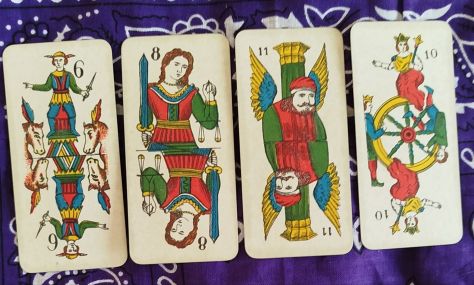
Chariot or The Bed
This is where the Bolognese Tarot is at its oddest. In the card’s design, the Chariot appears to be still, with the horses resting on each side, and the man looks unhappy. For this reason, the Chariot has been called the Bed card. This led to interpreting it exactly the opposite way as most would: instead of movement, stasis. In itself it is a negative card of tribulation, illness, static situations, tiredness, exhaustion. It can also signify nooky time with other cards (like the Ace of Wands). Mostly, though, it signifies illness, either literal or figurative (e.g., an unhealthy love, an unhealthy way of expressing anger, etc.) Still, some card readers retain the traditional idea of moving toward a goal quickly, and attribute it to the card when surrounded by good cards.2
Justice
Mainly this is the card of everything legal and justice-related. When talking about wills, fines, trials, bureaucracy and similar things, Justice is an important card, as the cards surrounding it can tell us if the situation is going to go well or not. It is also the card of fairness or of things that are just or ok, or equilibrated. It represents control, controlling, testing, etc. (including in a medical or academic sense). Justice next to a person can mean a just person, the person’s sense of justice, or someone wearing a uniform.
The Hermit
The Bolognese variant of this card has none of the introspective undertones that it has been attributed in other traditions. This is a bad card: it is called blockage (in italian Blocco or Incaglio, the latter word indicating a ship that has run aground). It shows big obstacles that delay a situation, whether indefinitely or momentarily depends on the rest of the spread. It is also the card of small ailments, either seasonal (cold, flu), obnoxious but not life-threatening (like toothache) or age-related. Obviously it can also indicate a character that is reserved or tending to isolation, as the blockage can be inner as well as outer.
The Wheel
This is the only card in the Bolognese tarot whose reversal is discernible and is read accordingly. Look to the left: if the crowned figure is ascending, the card is upright. If the young boy is ascending, it is reversed. According to some, when upright the Wheel represents good luck, when reversed bad luck. According to others, the Wheel represents movement and evolution of circumstances in general, but when upright it brings stability (stable good luck, decisive chances, etc) while when reversed it shows instability (unstable luck, with ups and downs, requiring effort). I have been taught according to the second school. Much also depends on the surrounding cards. Still, unstable luck is always more likely to turn into bad luck when surrounded by bad cards.
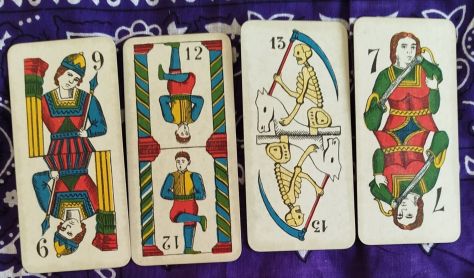
Strength or Fortitude
Considered a very good card, Strength brings energy, decisiveness, steadfastness, focus in meeting obstacles and taking action. The cards following it, however, can block it or diminish it, so it is important to pay attention to them as well. In itself, when coming up at the end of a sequence or with positive cards, it shows a situation that is reliable (“strong”) or a person (if next to a court card) who is strong in a positive sense, usually to help us. When following negative cards it can indicate the ability to pick yourself up or stand your ground. It always indicates an active stance in the matter.
The Hanged Man or The Traitor
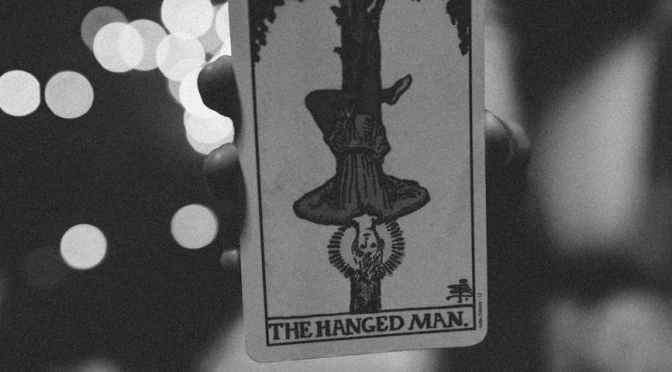
Here we enter the realm of history. In spite of the many mystical interpretations of the Hanged Man that started popping up during the occult revival, traditionally the card was inserted in the oldest packs to represent how traitors were punished in the Middle Ages (namely, by being hanged by a foot), and thus served as a cautionary tale to those playing tarot games never to betray the church or the government: “Know your place and stay there. Don’t try to overreach, or we’ll hang you upside down, so instead of moving upward in life, you’ll be going downward to hell.” That’s the message. The Bolognese tarot retains this old tradition, as the Hanged Man is mainly the card of treason. The treason can be literal (cheating, betrayal, etc.) or it can be metaphorical (a situation that betrays you, stabs you in the back when you are heading for the finish line, that makes you feel cheated on or sorely disappoints you). It is one of the worst cards in the pack, and it can show situations that end badly (like traitors in the past), or that are being upended. Even when no one is betraying anyone in particular, it can still symbolize life kicking you in the nuts, so you feel betrayed by it, as if you’ve ended up in a bad place or situation. Sometimes, in my experience, the upending can be good, but only when the querent’s expectations are negative and the cards following the Hanged Man are positive. In this case, the negative expectations are betrayed. In itself, though, the upending tends to be of the negative kind.
Death or Thirteen
This card is never actually called by its name, but by its number (tredici, i.e., thirteen). Different schools of thought interpret it slightly differently. It largely depends on the context though. Its first meaning is that of physical death, but this is rare and never by itself. In itself it shows the end of something. It can also indicate an inner sense of loss or death (“mortificazione”, which has the same root as the Italian “morte”, death, but indicates inner devastation and mortification). When, however, Death cannot be interpreted as ending, it can act as confirmation: “tredici conferma”, “the thirteenth card confirms”, or, if you will, “as sure as the fact we all die”. For instance, when it is surrounded by positive cards, it acts as a highlighter, confirming them. Same with negative cards: it makes them stronger and more important in the querent’s destiny. It can also indicate a situation that changes radically. Suppose, for instance, the cards preceding it are bad and those following it good: in this case it shows the end of the bad situation.
Temperance
The old diviners must have taken a look at this card and thought it looked like an hourglass, because the main meaning is that of time, the passage or flow of time. It is usually a slow card, which slows down the reading. It is connected with such concepts as waiting, patience, stagnation, but also of things that last a long time, take a long time or happen after a lot of time has passed. For instance, if it is followed by cards that show falling in love, it might mean that we will fall in love after a long time, while if it is preceded by cards of love it indicates that the love will last a long time. Use your commonsense. I have also found that, when it falls in the first few lines of a spread, the cards surrounding it, and especially those preceding it, tend to either talk about the past (a long time ago) or have started a long time ago and still drag on. Finally, some card readers connect it with the flow of water, and therefore water in general. I haven’t verified this connection but it does make sense.
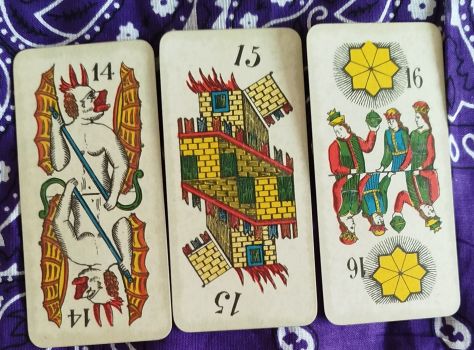
The Devil
In Italian “Diavolerie”, i.e., things that bedevil you. It is a deeply negative card, but with some redeeming qualities. In the main it is connected, traditionally, with anger, which depending on the context can range from annoyance to rage, due to things, people or circumstances bedeviling you. In general, though, it can indicate all passions that seize us and we fail to control. When falling with a person card, it is usually a sign the person is negative for us (depending on the context it can show jealousy or envy as well). When it describes a situation, it is bad for us. It is a card of excess all around, but it can indicate sexy energy, when with cards that talk about it, and it can also represent a strong energy when surrounded by very positive cards. Finally, it is one of the cards connected with magic.
The Tower
The image shows a burning building, and the main meaning is consequently that of places we’d rather not find ourselves in, mostly prison or hospital (or, if next to the Ace of Cups, our home). However, it can also signify a metaphorical prison, that is, a situation that is strongly limiting for us and prevents us from fleeing or moving freely, where we must sacrifice our hopes and aspirations or resources at least in part (“sacrificio” is one of the main Italian keywords for this card). Whether this card can indicate neutral or positive places is up for debate, as it depends on the school of thought. I guess in the appropriate context and with the appropriate cards it might, but generally, in my experience, it mostly shows negative places or negative situations. It can, however, show neutral places of authority (like a city hall, where there is an authority above us) or very large or foreboding buildings.
The Star
Another peculiar card. The main keyword is “roba”, i.e., stuff, especially referred to one’s objects, belongings and possessions. This is because the image shows three people holding some unspecified object. Some say they are the three Wise Men bringing gifts to Jesus, others say they are merchants. Either way, the emphasis is on objects and materiality. This is the card of business, belongings, objects, work (either one’s work life or working on something). It can represent study (which is the student’s work). In health readings it shows the objects used in medicine, that is, meds (and therefore therapy in general). This card can represent gifts when coupled with other specific cards. To summarize: business, work, stuff (material/practical life), study, gifts.
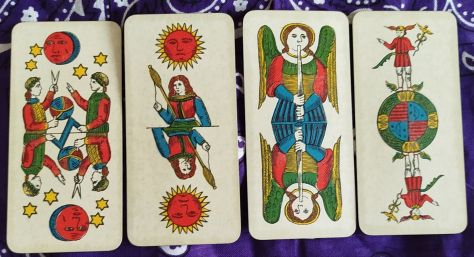
The Moon and the Sun
The reason I talk about these two cards together is that they complement each other. They are also called “le due rosse”, “the two red (cards)”. Their main meaning is temporal: the Moon shows things happening by night or in the evening, the Sun shows things happening by day. But they are also two polar opposites. The Sun indicates positivity, life, energy, clarity, success, happiness, vitality. When coupled with other cards it slants them positively. The Moon indicates negativity, death, lethargy, secrets, falsity, dissatisfaction, sadness. When coupled with other cards, it slants them negatively.
The Angel or Judgement
The best card in the deck, the Angel is the card of goodness, peace, friendship, protection. It brings solutions to difficult situations. However, if followed by cards indicating obstacles or impossibility, it can show the solution is delayed or impossible. When coupled with a person card, it can signify the person is an angel for us, helping and protecting us, or that they are good. It is also the main card connected with spirituality.
The World
“Around the world“, “the world outside“. It is the card of travel and journeys, as well as of distance. It signifies movement, whether literal or metaphorical. Often it shows actual journeys, relocations and removals. The journey doesn’t have to be very long, however traditionally, when falling next to a court card it can show a person we don’t yet know (the person comes from the outer world, i.e., is not part of our daily life), although, depending on the context, it can also show someone who travels or someone who lives distant from us. It can indicate a stranger, though again, how much of a stranger depends on the context. It shows situations that are open, in motion, and it gives the sense of something big or large or important (as opposed to the Juggler, which is something small). It can be symbolic of life (the great journey). Finally, some attach the idea of something recurring to it (like recurring thoughts, etc.)
MQS
- In other reading systems with more cards, where more Moors are used, the priest is often associated with the Moor with the hat, who is also the doctor. ↩︎
- How positive or negative (or neutral) the card is depends on the system as well. In systems with more cards, where there is a specific illness card (the Moor with the hat) the Chariot is more neutral. In the 45-card system, it is more negative. ↩︎