Not every question is fit for divination, and as diviners who get approached by people, discernment and, if necessary, gate-keeping is among our rights and duties. I say this not because I want to feel part of a superior caste of priests, but because our practice should be informed by two great principles: the well-being of our querents and the honor of our art.
It is perfectly fine to ask questions out of mere curiosity or for fun, but the ultimate decision on whether a question shall be put to the cards rests with us. I, for one, have dodged more questions about controversial politicians in the last couple of weeks than in the last couple of years altogether, largely because the question, when boiled down to its essential meaning, was “Is it true this politician I hate is a spawn of Satan?”
Such questions are unanswerable not merely because they are idle, but because they are ultimately unverifiable: unless you are that politician’s cleaning lady you have few ways of verifying my answer. Furthermore, consider this: if my answer is anything except “yes, you’re absolutely justified in your hatred,” the person is going to be inclined to dismiss my answer as superstitious nonsense. Why, then, whould a positive answer be of any value?
But unanswerable questions are not just those that belong to the “is it true that my particular preferences are absolutely valid and I don’t ever need to question them?” category. Some are more tragic. Recently I got asked something heart-breaking: “Is my life still worth living?”
No matter how we slice it, THIS is an unanswerable question, which doesn’t make it a meaningless string of sounds. On the contrary, it is a clearly formulated cry for help. As someone who has been struggling with depression since my teen years and has gone dangerously close to the edge on more than one occasion, I resonate strongly with it. But the fact remains that divination is not the tool to solve this issue.
I refused to open the cards on this question, obviously, but suppose I had, and suppose that, predictably, the cards had shown me the absolute mess that is this person’s life: does this make their life less worth living?
There is no answer. In this case, not because we cannot verify the details (I could easily point at the cards and say “your career is in shambles and your family life is a museum of red flags”) but because the reality of the situation has no bearing on the answer. Worth is subjective. The exact same set of circumstances that might drive someone to walk into a lake with stones in their pockets would be taken by someone else as life throwing a little challenge their way.
Therefore, in this case the question would translate as “What is your personal opinion on what makes life worth living and do you think I still meet those criteria?” I don’t think anyone would be foolish enough to even consider taking such a responsibility for themselves.1 It is much wiser to talk to the person, encourage them to open up and direct them to an appropriate source of (medical) help.
Again, though, the fact that the question cannot be answered does not imply that there isn’t a deep, real, visceral experience behind it. It is just that divination is not the way to go. It is like asking a pair of scales to measure whether you are pretty.
MQS
Furthermore, people in a seriously distressed state are especially prone to esoteric influences, and would to better to avoid them, even if it’s just a simple card reading ↩︎
Abano discusses the various meanings of Tristitia, Laetitia, Puer and Puella as they derive from other figures.
Laetitia
When from Populus and Laetitia, it means luck, gain, especially in large [or great] things. When from Acquisitio and Puer it means gain, merriment, especially in changeable things. When from Amissio and Albus it means luck, but with mediocre gain. When from Major and Puella it means fixity, gain and good luck.
When from Minor and Rubeus it means mediocre gain or honor or good luck. When from Via and Caput it means gain, honor, positive change. When from Cauda and Conjunctio it means misfortune, evil, but incapable of doing all it wants.1 When from Tristitia and Carcer it means mifortune, difficulties and problems.
Tristitia
When from Populus and Tristitia it means misfortune, danger, evil. When from Acquisitio and Rubeus it means fixity and misfortune, except in in things lascivous or feminine. When from Major and Albus it means luck, gain and honor with firmness.2 When from Minor and Puer it means better3 luck in every question.
When from Caput and Conjunctio it means great fortune, gain and stability. When from Via and Cauda it means mediocre luck, difficulties, problems. When from Laetitia and Carcer it means a good deal of luck, but with more problems than positive things.4
Puella
When from Populus and Puella it means infirmity, lascivousness, luck, gain. When from Acquisitio and Cauda it means mobility, mediocre luck. When from Amissio and Tristitia it means good luck after much toiling and difficulties, gain in venereal5 things.
When from Via and Rubeus it means misfortune and anger, rumors, change, damage. When from Albus and Carcer it means gain, good luck, firmness. When from Conjunctio and Puer it means fortune in everything, luck.
Puer
When from Populus and Puer it means gain, good luck, change. When from Acquisitio and Laetitia it means gain, honor, mirth, goodness in everything. When from Amissio and Caput it means good luck, bood in easy things and in seeking pleasure.
When from Major and Cauda it means unfortunate change, damage. When from Via and Albus it means useful variety,6 fortune, good change. When from Carcer and Rubeus it means major misfortune in everything, loss. When from Minor and Tristitia it means fortune, some kind of gain, strife.
THE END
MQS
Footnotes
It is not clear wheter Abano means that the person won’t be able to do all he or she wants, or whether the evil signified by this combination is not all-pervasive. ↩︎
In this case, it seems that Tristitia’s role is to solidify the good fortune signified by the two figures it comes from. ↩︎
‘migliore’ means ‘better’, but it’s unclear better than what. ↩︎
These two meanings might be hard to harmonize, though maybe not impossible. ↩︎
One cool thing about moving to our new place is that we now live much closer to the countryside. Although there are a couple of major cities around us, our district is basically a cluster of small pictoresque old German villages close to the woods. This is a very good place for a magic practitioner to settle down.
I also discovered that there is a small lake or large pond (depending on who you ask) nearby. It’s been my experience that old water places, just like old caves, tend to be stably inhabited by spirits. In fact, in a subtle way, these spirits *are* the place they inhabit.
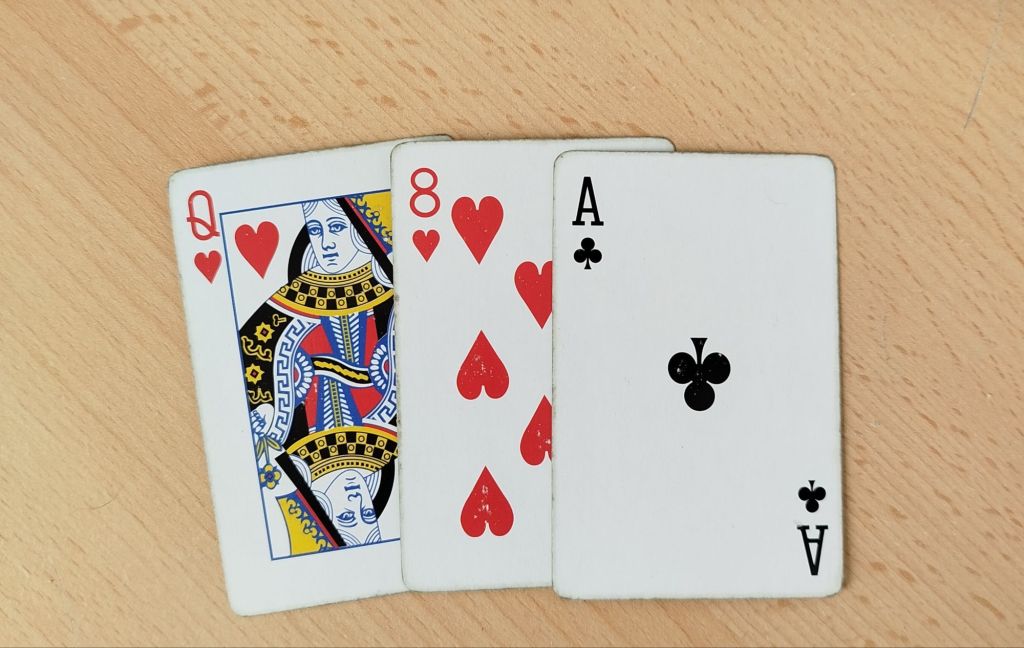
Before visiting the place I drew three cards to investigate, and these cards came up:
A water spirit – Cartomancy with playing cards
Obviously, the first thing to take note of is the presence of the Queen of Hearts, which is a motherly figure or a positive female entity. This is confirmed by the Eight of Hearts which can represent a water place, so in the context of an esoteric / magical reading it would represent a female entity of a broadly positive nature tied to water. The Ace of Clubs represents power, dominion, rulership. It indicates that the spirit has power over the place, so while she is positive, she is not the airy-fairy pushover type.
After doing the reading, I started researching local folklore. If you know of any such place near where you live, it may be wise to research local legends, as they often contain romanticized but accurate hints about the nature of the spirit.
What I discovered is that there is a medieval legend tied to the place, according to which a mother (!!!) once brought a local duke a basket of vegetables, in exchange for having a new irrigation system dug near where she lived. This irrigation system became the pond. There is no narrative reason why she should be characterized as a mother. Her being a mother serves no purpose in the legend, which makes it a very important hint in understanding the spirit: she is essentially motherly.
“But” you may be wondering “this is an artificial pond, how can it be magical?”
We must not draw strict boundaries between the world of humans and that of the great powers of nature. What we know from the legend is that a water spirit wanted to establish herself in this place and convinced the humans around her to cooperate by being motherly and nurturing toward them, and the humans were intelligent enough to accept her offer. There is nothing strange about this: in actuality, humans cooperate with nature all the time.
Note how the reading hints at a spirit that is positive (Queen of Hearts) but not submissive (Ace of Clubs). Had she been a difficult spirit she could have simply flooded the zone. There is altogether too much mischaracterization of water in the spiritual and magical community as something weak, vague and mystical. Water can be devastatingly powerful, so it is a good thing our local water spirit is a positive member of the community.
I’ve been having a lot of fun lately, watching AI generated videos based on pre-existing material. If you are not familiar with the “steamed hams” meme, here’s the original video:
and this is a meme version (one of the hundreds of versions being produced every year) of the same video, but reworked with AI:
One thing that struck me about it was how incredibly similar this video’s internal logic (or lack of it) is to the logic of dreams, especially of weird dreams. Everything flows into everything else, hanging together with it by thin threads of association.1
Notice, for instance, how the two characters, Skinner and Superintendent Chalmers, start dancing a romantic dance out of the blue just because the AI interprets the two characters getting close to each other as them engaging in romantic behavior, in spite of the fact that one of them is actually rather pissed at the other in the actual scene, and the other actually would rather avoid being in his presence.
This reminds me of how clearly the tone of dreams seems to shift flowingly from fun to scary to dramatic, to fun again, to romantic and so on, based on cues that the brain interprets much more loosely than when governing our waking consciousness. As an example, I recently dreamt I was visiting an old friend back in Italy, and the tone of the dream was cheerful and whimsical. Then, my friend taps on my shoulder from behind, and this must have reminded my brain of some horror movie I watched, because upon turning, my friend’s face turned into a demonic one and I was jumpscared awake.
Interestingly, what AI seems to be lacking, at least at this point in time, is the faculty of judgment, which is exactly what we also lack when dreaming or inebriated.
What I’m saying doesn’t really have any direct magical application. Technically, from a purely magical standpoint, the ability to let the consciousness flow in a dreamlike state is only one of the first levels to be achieved,2 as visionary work deals not only with a rigorous sculpting of the inner reality but also with the contacting of beings on different planes, which does require judgment (and sound judgment, possibly). On the other hand, the free flow of association, while it does have its artistic, psychological and even spiritual uses, is not immediately helpful in magic. In fact, it can lead to self-deception.
Still, I am left wondering if further progress can push AI in the same direction our consciousness moves toward in visionary work. It is a stretch, of course. After all, even the term ‘intelligence’ is used rather loosely when describing AI at this point. But what we thought was impossible yesterday is coming true today, so it is really hard to discern what AI will and won’t be able to achieve, and whether some kind of computer-generated magic or computer-fueled magic is possible.
MQS
Footnotes
It reminded me of what Paul Foster Case says about how the subconscious works, when describing his own version of the High Priestess tarot card ↩︎
Which is why so many self-styled visionaries who used or use drugs to fuel their trips are usually rather shallow, when the consistency of their vision is probed (and we should always probe the consistency of our visions) ↩︎
One of my favorite books of all times is Ursula Le Guin’s second Earthsea novel, The Tombs of Atuan. Actually, I adore the whole first trilogy. It is one of the few fantasy cycles that can actually inform one’s magical practice quite a lot, if one is observant enough. But The Tombs of Atuan is my absolute favorite, and I find myself rereading it every now and then as a sort of comfort book.
In The Tombs of Atuan, the protagonist Tenar, a young priestess in a remote and almost forgotten place of worship, is tasked with guarding the dark subterranean labyrinth of the Tombs and with worshipping the Old Powers of the Earth that seem to reside there (the Old Powers are never clearly defined in the other Earthsea novels and material, as far as I know, but they seem to be a sort of mix between natural powers, pre-divine titans and incomprehensible amoral entities).
Over the course of the book Tenar comes into contact with Ged, the protagonist of the first Earthsea novel and gradually realizes, thanks to him, not only that there is no point in worshipping the Old Powers, but that her worship of them has actually made her worse. There is a lot more to the novel, but this one key point is worth thinking about.
It is one of the tenets of my devotional, philosophical and magical practice that no power comes from me as an individual. It can, at most, come through me. The way we as individuals become channels for powers greater than us is through our worship of them (whether it be devotional, theurgic or of a different kind.)
We all worship something, whether it be mystical, philosophical or mundane. And the more we worship it, the more we make space for it in our life and in the world. This has nothing to do with the manifestation or attraction nonsense that is practiced by people online and is to magic what McDonalds is to food. It is, actually, a simple, almost physical fact.
Most, if not all, magical traditions recognize this. For instance, the reciting of the rosary in certain strands of Italian witchcraft, in addition to accomplishing certain magical goals, is also meant to empty the devotee of themselves to make space for the divine. In many so-called High Magic traditions, the aim of initiation is to balance the components of the personal vessel so as to make it a better tool for something much greater than it: “Now be assured that no one can be enlightened unless he be first cleansed or purified and stripped. So also, no one can be united with God unless he be first enlightened.” (Theologia Germanica, Ch. XIV)
(similarly, in many strands of Chinese magic, Qi Gong and other practices are used to the same effect).
A lot of people, including a lot of magicians, worship God, but this is not enough. What does God mean? How do you define the God that you worship? I feel this sort of clarification is extremely important, not because your definition changes the substance of God in a postmodern fashion, but because there are plenty of powers, objective and real, in the world that are capable of fitting the mold of your definition and seeping through the cracks of your practice, just like the Old Powers in Le Guin’s novel. Clarity, therefore, is extremely important.
Way too often do we see people who think of themselves (and are thought of) as spiritually “evolved”, whatever that means, or magically powerful who, at a second glance, have merely turned themselves into a walking collection of metaphysical parasites.
This process of clarification starts with a rational and philosophical assessment, and rationality is incredibly important (I’ve written a whole article about the importance of reason in occultism). However, keeping the lights on in your head is just the first step. What is needed is a broader cultivation of our vessel.
Can this all be taught? It is a tricky question. It is my belief that few things in life can truly be taught, or rather, most things can be taught, but the ability to be taught is harder to teach than all the rest. When I say that most branches of the occult path are for the few I do not mean to sound elitist. I mean it in the same way that I mean that math is really for few people. Not everything is for everyone.
Yet I believe that at least this one process of clarifying what we worship is important to everyone, whether they be on an occult magical path or not, simply because, as said, everyone worships something.
Here Abano examines some of the meanings of Puer and Puella in the various houses.
Puella
Puella in the first house means happy things, fleeing from adversity, singing, dancing, usefulness, younger siblings or dead siblings.1 In the second it means usefulness for women and for merchandise, good luck, clothes. In the third house it means love between siblings and relatives, good friends, usefulness through them.
In the fourth it means fighting over inheritance, difficulty in whatever you wish to gain from your father or mother,2 hiding secrets, good profession. In the fifth house it means good messenger and letters, gaiety with children, obtaining your wish. In the sixth house it means lovesickness,3 good servants, harlots, fornication, lasciviousness.
In the seventh it means a marriage of love,4 lucky marriage, lascivious women, lack of stability. In the eighth it means death of small children, arms and swords.5 In the ninth it means usefulness through travel, good change of place, gain through merchanidse, knowledge, good news.
In the tenth it means honor from lords, good servants, good things for powerful people, happiness, goodness in everything. In the eleventh it means happiness from friends, good luck for sick people, gain, usefulness through injustice, good in everything. In the twelfth it means being firm, scams, gain through animals, problems through servants and evil people and phony people.
In the thirteenth it means usefulness through travel and lords, happiness, good news, good messenger. In the fourteenth it means freedom from danger, usefulness, happiness, gain through toil. In the fifteenth it depends on the other figuers, depending on where they fall.6
Puer
Puer in the first house means happiness, hope of gain, having kids, obtaining your wish, money.7 In the second it means gain through merchandise, selling, abundance, obtaining the wish. In the third it means discord among siblings and relatives, gain with difficulty and with company, difficulties, useless dream.
In the fourth it means controversy, fighting, discord, rumors about the father or mother due to inheritance, it brings to light the hidden, useful strategies. In the fifth it means happiness, false messenger, fights, wealth from minors. In the sixth it means fled servants, dishonest women, danger from giving birth, male child.
In the seventh it means illegal marriage, harlots, dirty words, useful company. In the eighth it means death of an enemy or of a minor, inheritance, fraud, if with Rubeus8 it means wounds and loss of blood. In the ninth it means long travel, reunion, false science and false people, false news.
In the tenth fight, bad judge, dishonor, one’s lord is too credulous, loss of dignity and wealth. In the eleventh it means false soldiers, false friends, false churchmen, unfaithfulness, treason, contrarieties. In the twelfth it means enemies, invasion, bad for journeying, subjects, the sick person is evil and a traitor.
In the thirteenth it means travel, impediments, murder, evil people, violence, eviction, loss of inheritance. In the fourteenth it means evil company, false marriage, harlots, instability. In the fifteenth it is always evil except in war.9
Puella is usually presented as a positive, if weak, figure. Why it should cause strife over inheritance is not clear. In some Medieval books on Geomancy it seems as though Puer and Puella are often mixed together. ↩︎
The connection of love, one of the meanings of Venus/Puella, with the sickness typical of the Sixth House, is rather smart here, and should be taken as example of how to derive meanings from the Figure-in-House combination. ↩︎
That is, as opposed to a marriage of convenience or marriage for money, which were common back in the day. ↩︎
This latter correspondence seems more plausible for Puer. ↩︎
Once again, this feels like a mix between Puer and Puella. ↩︎
It is not clear where Rubeus should appear in order for Puer to be ‘with’ it. Perhaps in company. At any rate, it is an interesting comment as it reinforces the idea that the figures combine their meanings to give us a clearer picture of the situation. ↩︎
In scrolling on youtube I must have passed the third or fourth pompous video essay on the loneliness epidemic and theatomization of society. Then I had to laugh as I looked at myself from the outside, lonely in my office, my eyes glued to a stupid screen, which is usually what these videos complain about. I don’t like complaining, but I do like observing.
From an astrological standpoint, loneliness is ruled by Saturn, the greater malefic. Let me stress the word ‘malefic’. Generations of people better than us had no problem calling Saturn and Mars malefic and acknowledging the presence of evil in the world, yet the Becky’s and LaRhonda’s of the world who spend their time deluding themseves manifesting on social media think the concept of evil is beneath them.
It is, by the way, no moralistic notion of evil. Evil is simply that which is contrary to life (life being understood not vitalistically, but as outward expression of the metaphysical process of emanation).
Saturn is evil, greatly so. Even the few gifts it has for us are laced with poison: its deep wisdom, discernment and secret philosophy are often accompanied by illness, depression, poverty, general gloominess of circumstances. Saturn is not the cantankerous but loveable teacher that it is made out to be in pop astrology.
This doesn’t mean that Saturn is an unaccountable Satan like that of the exoteric tradition of many religions: Saturn does actively take part in the process of creation, but it usually does so by fulfilling the destructive and separative part of the equation. For instance, in some old hermetic and astrological texts Saturn is said to rule the first part of the pregnancy. This is the part where the soul becomes bound to the biological process of an individual body.
Through Saturn we become ‘this thing here’, before the other planets add their traits. Because we become ‘this thing here’ we also become subject to death, also ruled by Saturn, who is thus the first Planet we encounter descending and the last one we encounter ascending. Our being one thing, one individual, is the result of Saturn’s work.
As such, our existence as individual, ‘saturnian’ beings is also the basis of our loneliness, which is the presupposition of all we can do and achieve in life, all the social, political, cultural and economic structures we can weave together with other people.
It is not casual that all totalitarian ideologies seek to break down the ties that bind us to other people. All ideologies aim to push a certain image of humanity that corresponds to that ideology’s idea of good, but this image is usually the product of the ideologue’s deep delusion and would never occur by itself. The ideologue’s push becomes therefore a push for the reconstruction of humanity from the ground up.
And what is the ground? Saturn! The isolated individual, the one who has been torn from his or her social, moral, spiritual fabric is an individual who has been reduced to the Saturn phase of his conception, the phase where all we can say about them is that they are one thing, but before the other planets (let alone life experience) have added their specifications. The ideology then seeks to add its own imprint on this amorphous thing.
We do not live in times of totalitarian rule (anyone who argues the contrary has likely never experienced the horrors of totalitarianism). But we do live in times where there are people who profit from our isolation in a similar way.
So what is the conclusion? There is no conclusion. This is just a collection of notes as I observe the world around me. I am not suggesting any conspiracy or any evil master plan. I am merely observing who profits and who doesn’t from the current state of affairs. It is a simple reflection on what it means, from a magical standpoint, to isolate people.
Since it’s Leo season I’m rather busy creating Sun talismans and “recharging” old ones (I am not fond of the idea of talismans as something to be charged, but I digress).
This reminded me of one time, a couple of years back, when hubby was in somewhat of an existential crisis as far as his job was concerned. I was working on a Sun talisman, but didn’t tell him (he knows of my esoteric interests but doesn’t interfere, and I don’t keep him abreast of all my workings).
The night after the consecration, hubby woke up at dawn, something that rarely happens, and was drawn by the rising Sun. Inexplicably he was compelled to open a job-searching app he hadn’t opened in a while. Right in front of him was the perfect job opportunity. He applied and got the job.
This little episode, I think, is a good example of how objective magic’s power is. Of course, if by objective we mean “amenable to consistent, quasi-scientific manipulation” then magic is not objective. The presupposition nestled in the heart of science is the possibility of endlessly manipulating reality, while magic has its unbreakable patterns.
Furthermore, white magic tends to have less dramatic (sometimes hardly noticeable) effects than dark magic, because it largely harmonizes the person with the patterns available in their life rather than running against them (if someone is saying that they’ll bring back the love of your life with white magic, they are lying).
Finally, magic doesn’t work as reliably as the technology stemming from science, and never will. If the remote doesn’t work you know you must either change the batteries or see if some wires have come loose inside. But pinpointing what’s gone wrong in a magical operation is much harder, and sometimes things simply don’t work because screw you any old mortal.
But magic is objective in the sense that its influence on reality becomes undeniable to those who have had to do with it. Just like with divination, it is really hard to find excuses and rationalizations.
Also, magic is objective in the sense that it forces us out of our ego and in contact with objective forces outside of us. Some may argue these forces also exist inside of us, and that’s true. In the esoteric constitution of humanity the seven planets are all present, but in so far as their activity is bound by our limitation it is relatively useless, which is why it becomes imperative to overcome those limitations by coming into contact with those same forces outside of us.
Way too much emphasis today is placed on the psychological side of magic and spirituality. This is in part a survival mechanism adopted by our forebears to allow magic to survive the scientific revolution (you can’t disprove me if I’m just an inner feeling).
Working on ourselves is certainly a great idea, though rarely in the sense that this is done nowadays, which usually plunges people even more deeply in their narcissism. However, I believe much of the value of the esoteric arts is that they force us to come out of our selves and in contact with something objective and far greater.
The famous esoteric/philosophical motto “Know thyself” has been reinterpreted in the most abstrusely psychological ways recently, but it is very unlikely that this is what those who wrote it meant by “knowing ourselves”: in the old view of the cosmos, it was impossible to know oneself without knowing one’s place in the scheme of things and therefore not eluding reality, including higher forms of reality, and experiencing the point of juncture between the individual and the universal.
Abano starts a discussion on the meaning of the various figures in each of the houses, beginning with Acquisitio and Amissio.
I have already discussed how every figure has two properties, one by virtue of its essence, and one by virtue of its accidental placement in the chart. What follows is the meaning of each figure in each of the fifteen houses.1
Acquisitio
Acquisitio in the first house means gain through partnerships,2 obtaining what one wishes, acquisition, gain, honor, good life, health, property. In the second house it means gain, merchandise, money, good outcome, usefulness. In the third house it means good luck for one’s siblings and relatives or neighbors, and in science, and the dream is true,3 good outcome through journey.
In the fourth house it means inheritance, goods from the deceased, increase of wealth and of stable things, abundance. In the fifth house it means good luck with children, or through them, recognition, happiness, what one wishes to gain, following one’s lords. In the sixth house it means sickness, falling ill, relapsing,4 gain through animals and servants and subjects.
In the seventh it means good change of place, good friendship, good partnership, usefulness, properties. In the eighth it means gaining back the money you loaned, gain through dead people, mediocre outcome in all things, except for sickness, where it lengthens the process. In the ninth it means gain through travel, honorable travel, especially if of elevated people and people who have fear of God.
In the tenth it means exaltation, lordship, lords, honor, dignity, gaining through one’s masters, kings, emperors. In the eleventh it means good luck in every question, gain, good friends, happiness and friendship and offspring. In the twelfth it means prison, loss, toil, problems, fear, gain through serfs, subjects, animals.
In the thirteenth it means honorable journey or journeying with great people or in their stead, or with one’s mother. Gain.5 In the fourteenth it means obtaining what one wishes but with trouble, problems, difficulties.6 In the fifteenth it means good outcome in everything, good brother, good things from brothers and relatives.7
Amissio
Amissio means damage, loss, especially in movable things, coins, in wealth, theft, gossip, evil in everything, except for sickness or prison or travel.8 In the second it means loss of wealth, damage through merchandise, and in everything where gain is hoped for. In the third it means enmity with siblings and relatives or through them, wrath, discord, malice, good outcome for journeys.
In the fourth it means damage, loss, misfortune in secret things, loss of inheritance, destruction of the city, of the home, of the land, of the fortress. In the fifth it means problems and misfortune with children, loss of wealth, famine.9 In the sixth it means healing of sickness, liberation of the fled servant, loss due to animals, and when one is sick, depending on the other houses, there might still be doubts [about his health].10
In the seventh it means fraud, treachery from women and enemies, loss through marriage and partnership and friendship. In the eighth it means loss of inheritance, loss of money and wealth, death of the sick person. In the ninth it means long but good journey. Late journey in a distant land, problems on the road, with changes, harlots.11
In the tenth it means loss and problems in all you wish to gain, and if Rubeus is born from it it means being harmed, if Tristitia it means prison.12 In the eleventh it means misfortune in everything you wish to get, discord, enmity with friends, bad for prisoners. In the twelfth it means bad journey, loss through animals and loss of wealth, toil, loss of merchanidse, and you’ll collect a debt at a loss, freedom from prison and sickness.
In the thirteenth it means loss of wealth, damage through one’s lords, change of country, misfortune. In the fourteenth it means loss of friends, toil, great problems. In the fifteenth it means bad outcome, flight, not retreiveing what you wish to retrieve, misfortune in all.
MQS
Footnotes
This way of proceeding is rather typical of medieval handbooks of geomancy and even of astrology. It generally aims at allowing the reader to form an idea of the abstract properties of each figure by showing its concrete manifestation. ↩︎
It is unclear why Acquisitio in the First House should indicate gain through partnerships. In most medieval handbooks of astrology, for instance, a planet showing gain in the First House usually indicates the querent’s industriousness. ↩︎
Dreams and science are usually Ninth House matters, although the distinction is not as rigid as some modern traditional astrologers make it out to be. ↩︎
This is a typical example of a broadly positive figure having a negative meaning: people usually don’t want to ‘gain’ an illness. ↩︎
Why Abano characterizes the Thirteenth Figure, i.e., the Right Witness, as meaning all these things is obscure, until we remember that, for Abano, the Right Witness is in connection with the Ninth and Tenth houses, from which it is formed. ↩︎
Probably from the mixing of Eleventh and Twelfth House meanings. ↩︎
The connection to relatives and brothers escapes me. ↩︎
Abano does not say “Amissio in the first house means…” but “Amissio means…” I suspect though that it is just a mistake. ↩︎
Because it shows loss of the products (second from) of the earth (Fourth House) ↩︎
Amissio is generally favorable in case of illness, but what Abano is saying is that we should always look at the picture as a whole, without focusing on a single testimony. ↩︎
In a relatively straightforward passage, Abano gives the reader examples of what it may mean when a figure moves from one house to another.
To truly understand mutation and the variety of the figures, you need to consider the property of the figure, whether it be fortunate or not, entering or exiting, fixed or mobile, and judge according to its meaning the effect of the mutation, always keeping in mind the question, the quesited and the querent. Another mutation1 to be kept in mind with its meaning in order understand better what has been said so far, is the one that happens to every figure as it changes from one house to another.
If the first figure changes to the second, and is good, fortunate, entering, it means gain, good luck for oneself, and when it is evil it means ill; if it moves to the third it bodes well for neighbors, relatives, traveling; when to the fourth, it means small losses, except if it is Cauda or if the question is about older relatives, friends and things fixed and immobile, endings, buildings and possessions; if to the fifth it’s excellent, except if it is Cauda; if to the sixth, it is very bad, except if it is Via or Cauda, or if the question is about sixth house matters; if to the seventh it has a very bad meaning, unless it is for seventh house matters, as said above, or unless it is Via or Cauda; if to the eighth it means ill luck, accident, loss, death, fear, except if you are asking about your enemy’s wealth or of the wealth of another person; if to the ninth it is good, unless it is Cauda or Rubeus, and if the question is about travel it won’t be made as scheduled; if to the tenth, it is very good, except if it is Via or Cauda; if to the eleventh it is also excellent; if to the twelfth, it is the worst of all, unless it is Cauda and in twelfth house questions.2
If the second figure moves to the third house, it means good luck and gain through siblings and relatives, or due to them, but if the figure is bad it shows the opposite; if it moves to the fourth it shows good outcomes in stable things, and through one’s older relatives; if to the fifth, it means well through messengers, letters, etc; when to the sixth it means infirmity, even of the family, and loss in moble things, and of servants. If it moves to the seventh, if it is good it means well, but if it is bad it shows loss through enemies or women, or games of chance,3 or thieves; if it moves to the eighth it shows that the absent party comes back with good news, and maybe the death of some relative, or loss depending on the angles of the chart; when it moves to the ninth it shows gain or loss from the church or through travel; if to the tenth it means gain from the profession or from one’s lords and good luck; if to the eleventh it shows good luck and good friends, and good luck from the community; if to the twelfth, it means one of his relatives will fall ill or be imprisoned, or shall lose wealth, but if the figure is good it shows buying animals, and things unthought of.
The third figure, when it moves to the fourth, shows gain or loss through relatives; when to the fifth, it shows happiness and new things, and messengers, clothes, etc. When to the sixth, it shows sickness, servitude, toil, small animals; to the seventh, it means copulation,4 change of place, fights, separation; when to the eighth it means gain or loss, death, fear; when to the ninth it means long travel, churches, religious people; when to the tenth it shows the army, profession, dominion, lordship, honor; when to the eleventh it means good luck, noble servants; when to the twelfth, prison, long sickness, retrieving lost animals or buying them.
When the fourth figure goes to the fifth it shows goods from one’s relatives or children, clothes, food, and other things of the home; when to the sixth, it means sickness in the family or animals, relatives, servants; when to the seventh it means getting married, a bandit coming back for you,5 the home becomes inimical; when to the eighth it shows inheritance, the absent party comes back; dying in one’s home country or home; to the ninth, it means death of a religious person, acquisition of church things; when to the tenth, honor of the house, lordship, honors, etc; when to the eleveth, it shows good luck in one’s home, family, congregation of friends, etc.; when to the twelfth, if good, it shows good things, but when bad it means sickness, long prison sentences, toil, difficulties in one’s home or country, or through one’s relatives.
When the fifth figure goes to the sixth house, it means sickness through being hexed6 or food, or issues with children, or messengers, or animals; when to the seventh, it means marrying off one’s child, merchandise, fights, enemies rejoicing, problems with children or a woman giving birth; to the eighth, problems and death of one’s child, or [acquiring] other people’s wealth, and the absent party is doing well; when to the ninth, a child entering the clergy, long travel, happiness and gain, a churchman having a child, gain from things of the church; to the tenth, it means a happy mother, lordship or [happiness] of one’s lord; when to the eleventh it means good news for the child, and a messenger resolving all kinds of issues, and friends are happy for or with the querent; to the twelfth it means sickness or imprisonment for the child, large animals and a prisoner or wayfarer who is doing well.
When the sixth moves to the seventh house, it means sickness, wrath, problems through small animals, servants or one’s wife or other people; when to the eighth, it means death of animals or servants, loss of wealth, sickness of the absent party, and servants helping one’s enemies; when to the ninth, it means a journey full of issues, and sickness during the journey, or a sick churchman, occupation, problems with the church; when to the tenth, it means sickness and problems, but also having good and faithful [servants?], obtaining a lordship; when to the eleventh it means sickness of self or of a friend, or contrarieties with friends; when to the twelfth it means sickness of great animals, loss through them, prison, pilgrimage.
When the seventh goes to the eighth house, if it is good, it means good things for the absent party, but if bad, death, loss and issues for those represented by the seventh; when to the ninth, it means the absent party will come back, the bandit goes away, the querent gets married, the enemy makes peace, long travel, religious people, or a churchman becomes your enemy; to the tenth, the lord gets married or becomes inimical, lordship, honors; when to the eleventh it means a friend becomes an enemy, and what’s good for him is bad for you, the partner won’t keep his promise, the thief is a false friend, the marriage or partnership is changeable; when to the twelfth loss of animals through enemies, or due to sickness of animals, and prison, and the prisoner gets married, problems during a pilgrimage, long pilgrimage, betrayal from hidden enemies.
The eighth figure, when it goes to the ninth house, means wealth, help from the church, death of a priest, travel full of fear and problems, the absent party is traveling; when to the tenth, it means death, occupation of stable things, the absent party comes back to the country; to the eleventh, it means death of a friend, gain through a dowry, inheritance, misfortune, loss through friends, good luck of the absent party if the figure is good; when to the twelfth, it means the prisoner or sick person is seriously sick, death of the same, and of the wayfarer, and being imprisoned due to enemies.
When the ninth goes to the tenth, it means ecclesiastical dignity, increase of church things, an honorable journey or for religious purposes; when to the eleventh it means good luck in travel, good company or partnership, luck with friends and things of the church, recognition within the church; when to the twelfth it means issues while traveling, danger through horses, being imprisoned, the prisoner may be released, the wayfarer comes back, the horse is found, and this causes more or less trouble to the querent depending on how good or bad the figure is.
When the tenth figure goes to the eleventh it means good in all things, and one’s lord or master is good and friendly, the year abundant; when to the twelfth it means prison, sickness, one’s enemies are not seen in a good light, and are hated by your friends and by your masters.
When the eleventh goes to the twelfth it means sickness, prison, adversities, problems, and one’s hidden enemies are lucky, and all is good for the querent.
MQS
Footnotes
It is rather typical, in premodern occultism, to use the same word to signify different things depending on the context. ↩︎
The general principle in judging the mutation of one figure to another house is whether it bodes well for the question at hand and whether the figure accords with the question and is fortunate. As such, in Abano’s example, a figure moving from the first to the seventh is unfortunate because it oppses itself, but the same movement is positive if the question is about Seventh House matters (marriage, alliances, etc.) ↩︎
Gambling is often seen as a Fifth house matter, but in this case the relationship with the Seventh House is through the fact that we are playing against ‘other people’. ↩︎
it is not clear why the conjunction of Third House and Seventh House matters should produce sex. ↩︎
‘Ritorna il bandito’. Bandito is an ambiguous word in Italian, as it can mean both bandit and banished. In this case it is probably the latter meaning which is relevant: someone who has been banished will come back. ↩︎
‘per fature’, similar to the current Italian word ‘fattura’, which in this context would mean a hex. It is possible the word has another meaning which escapes me. ↩︎