Enneagram Type Six and Enneagram Type Nine are quite distinct from one another, so much so that they are each other’s arrow: Six relaxes at Nine, Nine stresses at Six. Sixes are a Head type, and their priority is to find security and certainty in an uncertain world. Nines are a Body type, whose main goal is to not have their inner sense of independence disrupted by disharmonious trends.
Both Six and Nine usually come across as friendly and likeable. Sixes want to prove to others that they are dependable and that they can be allies in facing common struggles. Nines are also broadly supportive of others, but more in the sense that they go with other people’s flow so as to not cause the kind of friction that might disrupt their inner sense of balance as independent individuals (“If I say yes to the invitation she won’t make a fuss”).
Sixes are often found evaluating the risk factors in every situation or assessing other people’s behavior to see if they can trust them, while Nines normally hold a non-descript optimistic view of people and life, and a sense that things will turn out well somehow, to the point where they may deny the existence of objective hurdles and problems. Sixes seek to predict all possible problems, while Nines often look the other way. On the other hand, average to unhealthy Sixes often end up compromising stable or positive situations in an attempt to smoke out hidden threats or enemies that exist only in their head.
Peace
A Six’s strategy for survival generally implies developing a conscience of themselves as a social being (they are the archetype of the ‘member’, whether of a party, a church, an organization, a class, a country, etc.) The Six’s idea of survival implies minimizing risk and uncertainty by handing over the final say on their life decisions to something external (a belief system, a person, a group, etc.) that is perceived as stable or trustworthy. However, once a Six has identified the idea or group they belong to, they can become rather confrontational with that idea’s or group’s enemies.
A Nine’s minimization of problems is more geared toward preserving an inner sense of peace. Swept under the rug of a general, bland “it’s all fine”-ness, external trouble can be denied the status of force that pushes against them. Similarly, in social situations Nines will tend to be agreeable and limber so as to not allow others to perceive resistance in their part that might turn into a power struggle. In other words, by denying a strong reaction, Nines seek to cause the external action to dissipate by itself.
Enneagram Type Six and Enneagram Type Eight can be similar, depending on certain factors, but overall they are very different. Sixes are a Head type and are concerned with security and certainty. Eights are a Body type and are concerned with independence and autonomy.
Sixes often tend to be sheepish, friendly, helpful and gregarious. They look for external points of reference that can give them the security they feel they lack (whether this point of reference be a leader, an idea, a group or something else). Eights are much more maverick-like, usually fight for themselves (and for those they wish to protect) and don’t usually need external frames of reference. In fact, they may despise them. If Eights are warriors, Sixes are worriers.
However, Sixes can also act in a radically different way when they enter their contraphobic stance, when they stop running away from fear and tackle it head-on. When this happens, Sixes can be very similar to Eights in that they act in an bold, fierce way that could even come across as arrogant or smug. The main difference between an Eight and a contraphobic Six is that the contraphobic Six still acts based on their deep fears. They are like herbivores charging against the predator.
courage
Socially, Sixes generally adopt a friendly stance. They hope to come across as those fun, dependable fellas you’d take inside and defend if the zombie apocalypse they fear should actually happen. They have a strong sense of the importance of safety nets, since they are forever catastrophizing and thinking about worst case scenarios and since they feel helpless in front of an uncertain world.
Eights rarely act like this. They are usually fierce and even overconfident. Their strategy is to force others to see them as either a threat they want to stay away from or a point of reference to gravitate around, submitting to their guidance. If Sixes try to poke holes in every certainty they have in order to see if if it is, in fact, certain, Eights can often jump the gun, confident they can bend the world to their will by sheer power.
Enneagram Type Five and Enneagram Type Six belong both to the Head triad, yet they give off markedly different energies. Fives actively employ their Head energy, using it to make sense of the world from a distance. Sixes often suppress their Head energy, don’t trust their own judgment and seek someone or something that will explain reality to them.
Being both Head types, both Fives and Sixes deal at their core with fear of the world around them.Fives thus retreat from the world into the safe realm of their own intellect, from which they observe life without being touched by it. It is often held that Fives are taking time off from real life in order to look for something, an idea or strategy, with which they may join the others and be useful or have a fighting chance, but while some great Fives really do come up with revolutionary ideas that changed the world, most Fives become lost and almost hooked on their own thinking power.
Sixes deal with fear differently. They don’t trust their own mind, so they seek structures outside of them, whether social, political, religious or other kind. For them, life is a sea of difficult choices, risks and dangers, a place where nothing seems certain. They therefore become engaged in an endless quest for the person, idea, group or thing that will give them clear answers that they don’t need to question anymore. Once they have found (or if they find) something that stands up to their scrutiny, they espouse it with militant fervor.
Fives tend to be philosophical and rational (though not always reasonable). Their approach to ideas and concepts is seldom practical, and they tend build up mental constructs not to employ them but to sharpen their overactive mind’s claws on them. Their attitude toward ideas is often playful and nihilistic. Sixes on the other hand are more practically oriented because their sense of fear is less rarefied and is almost palpable, as if they needed to actually survive from moment to moment. Their attempt at tearing down ideas and concepts is not playful at all: they keep poking holes in everything in hopes of finding the one thing where holes cannot be poked.
From a social standpoint, the difference between Fives and Sixes is often marked. Fives are withdrawn, remote, aloof. Even at average levels they are often socially inept, nor do they care to work on this aspect of their life, as they consider it inessential. Sixes, on the other hand, while often questioning people’s motivations, put on a friendly and even cheerful facade, because they are aware of how important networking is in dealing with the uncertainties of the world.
In reality, both Fives and Sixes are mistrustful of people. However, as far as Fives are concerned, rather than mistrusting people’s motives, like Sixes do, they tend to mistrust other people’s ability to understand reality better than them. On the other hand, a Six’s skepticism is generally oriented at people’s loyalties and competence in providing answers the Six can rely on. For instance, in an educational context, a Six pupil may not believe the teacher is good and is, in a way, faking it, while a Five pupil will often think they are better.
Enneagram Type Four and Enneagram Type Six share some similarities in spite of focusing on entirely different things. Fours are a Heart type, whose deep desire for authentic connection is only equaled by their feeling unable to find someone who will truly see them in their uniquely flawed nature. Sixes are a Head type, and their need to be reassured is equaled only by their inability to trust anything they or anyone else say.
Both types can have a generally negative view of the world. Fours believe themselves to be flawed and disadvantaged and feel that they don’t belong because they lack something other people have. Sixes are negative because they are used to questioning everything that is apparently good until they have managed to squeeze something that can be considered iffy or untrustworthy out of it, and see the world as a dangerous, or at least precarious place.
However, Fours are unapologetic in their pessimism, whereas Sixes may often try to tone it down or even suppress it in order to ingratiate themselves to others (they can even come off as upbeat) to build up friendships and alliances. In general, Sixes don’t like putting others off because they subconsciously don’t want to make enemies, whereas Fours generally don’t like behaving in a way that is not authentic to how they truly feel.
Indeed, the theme of authenticity is a leitmotif for both Fours and Sixes. Sixes want someone or something to explain reality to them in a way that leaves no place for doubt and fear, even if that means identifying threats or enemies (in fact, average Sixes love to be told who or what their enemy or threat is). One of their great fears is of being lied to, or of coming into contact with people who keep their real agenda secret to them. They also fear that people won’t tell them the truth to avoid hurting them, but because they have a very good nose, Sixes often can smell something is off.
Uncertainty
Average Fours do not so much fear lack of authenticity as they feel disdain for it, and are often unable to bring themselves to play socially accetaple roles if that means not being true to themselves.
Another similarity lies in the fact that both Fours and Sixes often feel a great deal of confusion within themselves. In spite of being a Head type, Sixes often come off as emotional and stormy. This is due to their lack of trust in their own judging ability, which sometimes leads them to drowning in a glass of water. Sixes would love to be told the clearcut truth, but as soon as they are presented with (one version of) it, they begin picking the black and white apart until a chaotic mess of shades of gray is left.
Fours also feel a great deal of confusion, but this is due more to their inability to pin their own personal identity down to a specific set of characteristics, because they always end up discovering a part of themselves that doesn’t fit any definition.
An important difference between the two types comes from the fact that Sixes tend to be sturdy, gregarious and friendly, whereas Fours are generally individualistic and delicate and experience great difficulties fitting in. Secretly, Fours may envy people who do fit in, but outwardly they often show contempt. On the other hand, Sixes may admire people who manage to stand out, but they generally deem it safer to fall back in line.
Enneagram Type Three and Enneagram Type Six are generally quite different, so much so that they are each other’s arrow: Threes grow at Six, Sixes stress at Three. Threes are a Heart type and they crave recognition of their talent and worth, while Sixes are a Head type and need security and certainty.
Both types are affable, but in quite different ways. Threes are more assertive and want to impress others with the rabbits they can pull out of their hat (the exact rabbit depending on the context). Sixes tend to prove themselves dependable and friendly so as to elicit positive and protective feelings in others while avoiding the dangers of a hostile environment.
Sixes generally want to quickly sort you out as either a danger or a dependable ally, but once you are in the latter camp they will often go the extra mile for you. Threes on the other hand are more competitive, so depending on the context they will go for your jugular if it means emerging victorious and winning the prize. Of course they can be good friends like anyone else, but because they are used to setting aside their emotions to reach their goal, they can be just as competitive against a colleague they are usually friendly with outside of work, assuming the colleague will behave the same way.
Other People
Threes are often concerned with image for image’s sake, and understand that, especially in a social context, one is supposed to wear a mask, while Sixes are terrified at the prospect of someone presenting them with a fake facade that doesn’t correspond to reality. They’d rather be told the ugly truth than be left hanging. In this, though, they can become paranoid and obsessively questioning, in a way that average Threes, who understand the importance of propriety and playing one’s role well, usually don’t become.
Paradoxically, Sixes, a Head type, are far more volatile and emotional than Threes, a Heart type. This is because Threes have learned to suppress their Heart energy, so they come off as cool and collected, like they’ve got it together. Sixes, however, have suppressed their Head energy, so they cannot trust their thinking process and are therefore often prey to strong emotions, so they come off as somewhat insecure.
Ultimately, Threes are focused on achieving status and therefore on drawing attention on them, while Sixes generally shy away from the limelight to avoid exposing themselves to possible dangers. When they do strive for recognition, it is often because they feel this is the best avenue to security in a particular context.
Enneagram Type One and Enneagram Type Six can sometimes be similar, but their differences are even more striking. Ones are a Body type, and focus on how to act rightly as autonomous beings. Sixes are a Head type, and their focus is on security from potential threats and uncertainties, which they try to achieve by thinking about all possibilities and by finding allies and leaders they can rely on.
Both Ones and Sixes tend to be dependable, dutiful and reasonable, linear in their thinking. They usually dislike extravagance and iffy ideas. Ones dislike them because they see themselves as the keepers of the orthodoxy, while Sixes dislike them because they want to try to focus on things and ideas that give them certainty.
Sixes have a marked social component that is not very prevalent in Ones. Sixes appreciate group cohesion and therefore conformity of opinions. They like their beliefs being reflected back at them by others like them. A Six with rebellious ideas tend to like being together with other rebels like them. Even Sixes who appreciate or accept pluralism and settings where pluralism is accentuated want to make sure that everyone is on board at least on the fact that pluralism is good.
Ones, on the other hand, do not need social validation and do not look for someone to tell them what’s right or wrong, what’s true or false, so while they are by no means loners, they can accept that their beliefs will make them some enemies. By contrast, Sixes can accept the existence of an enemy as long as there is a “we the people” fighting against it that can provide them group protection, even if just in their heads.
Duty
Both can have an ambivalent relationship with authorities: Ones ultimately obey their conscience, which can cause frictions with the powers that be; Sixes are desperately looking for someone or something whose authority they can rely on, but they also distrust authorities on the grounds of them either being potentially dangerous or not providing them enough protection or peace of mind. Both Ones and Sixes can occupy themselves with ideas of justice and can be very ideological, but Ones have a selfless relation with justice (“this is what is right. We must do it. Period”), while Sixes want to create a society in which they or those like them can feel safe or nurtured.
Ones rarely question their values and ideals and are possessed of a certain inner certainty about what’s to be done and what’s to be left alone. Sixes definitely lack this sense of inner guidance as they are known for sometimes spinning in circles about even the most trivial matters and are forever drowning in a sea of questions in their search for an unquestionable dry land. Of course, they may adhere blindly to a belief, an ideology, a religion, a group, etc. as a way to rescue themselves from their uncertainties, but there is always, even if just subconsciously, a nagging sensation that they may be wrong, and are always looking for external reassurance that the path they’ve chosen is the right one. Even the most committed Six will occasionally look at someone outside of them with a “This is the absolute truth, right?” look in their face.
If Ones can quite easily play the role of the lone martyr, Sixes tend to play that of the party members getting each other going at a political rally, or that of brave warriors inspired by a great speech their leader made in an epic movie.
Enneagram Type Six, sometimes called the Loyalist or the Skeptic, belongs to the Head triad. Those of this Enneatype tend to feel the need for an external source of security, whether it be in the form of social connections, love, a political ideology or religion, etc. They are often friendly and want to show themselves as dependable and trustworthy to avoid danger and controversy, but they also have a skeptical streak that undermines their ability to find the security they need. They are often given to catastrophizing, questioning and poking holes into everything in hopes of finding the one thing that they can trust, but once they feel they have found it, they rarely question it.
Enneagram Type Six
Enneatype Six Grows: Move to Nine
The beginning of a Six’s fear lies in their inability to give themselves the security and stable ground that they need. Because they lack a sense of inner guidance, they usually look outside of themselves, finding it in people, institutions, systems of all type, etc. Ultimately, Sixes want their anchor to be beyond doubt (that is, in a way, perfect).
This is obviously a problem, since an honest look at anything and anyone will reveal their flaws. Although some Sixes manage to convince themselves to stick to something even if imperfect, the nagging sense of uncertainty remains.
When a Six learns to trust themselves, their decisions, their own processes and learn to see the difference between a healthy dose of skepticism and an excessive one, they can also relax and, in doing so, they pick up certain qualities of healthy Nines. Enneagram Type Nine is often trusting of others and allows space for honest interaction without the drama that average Sixes often stir up when they haven’t yet sorted a person in trustworthy or dangerous.
Usually, Nines tend to see beyond division and can capture the unitary essence of all processes, including interpersonal ones. In integrating aspects of Enneatype Nine, Sixes, usually become much calmer and more capable of seeing the simple essence of a situation without getting lost in a myriad contradictions and doubts. More importantly, healthy Sixes develop the kind of self-assurance that they usually lack.
Courage, the Virtue of Enneagram Type Six
Enneatype Six Under Stress: Move to Three
Enneatype Six tends to create secure and stable social connections, which they reinforce by being trustworthy and friendly. Largely they do it to reduce the uncertainty of life (it wouldn’t be a stretch to say that the Six’s socially cohesive instinct is what brought humanity together and created the basis for society)
Unfortunately, this strategy is not always effective. Depending on their particular situation, Sixes may feel that their life is too unpredictable and dangerous. They may feel like they are swimming in a sea of ungraspable alternatives whose consequences they can’t pin down and anticipate. When this happen, a Six may still try to create certainty, but if the strategy fails, they will go to their stress point, where they embody the less healthy qualities of Ennneagram Type Three.
Threes are the workaholics of the Enneagram, constantly trying to emerge and establish themselves as worthy of respect. At their worst, Threes are unreasonably competitive and tend to see everyone as an opponent to outdo, outfox, outperform at any cost and using any trick possible. Stressed Six embody this more antisocial aspect of Type Three, as they feel they can no longer trust others and must therefore learn to compete with them.
Highly cynical and with a generally negative outlook, unhealthy Six can try to constantly undermine others, as though doing this was necessary to deactivate the potential threat associated with other untrustworthy human beings. This behavior is often seen together with panicked responses to every minor setback and a tendency toward authoritarianism as a coping mechanism.
Often Known As: Doubter, Skeptic, Loyalist, Underdog (note that names are as limiting as they are revealing.) Sin/Passion: Fear Focus: on security Fear: of not finding any stable protection Energy Center: Head (energy is suppressed) Social Stance: Compliant Key Positive Traits (embodied at their best): Dependable, Friendly, Supportive, Dutiful, Mild, Reasonable, Gregarious, Courageous, Cooperative, Group-conscious, Good partner, A buddy, With good hunches, Encouraging, Loyal, Funny, Hardy, Good at foreseeing problems Key Negative Traits (embodied at their worst): Fearful, Critical, Cynical, Cowardly, Mindless, Ideological, Catastrophizing, Alternating between following blindly and rebelling blindly, between conformism and mutiny, A deer in the headlights, Given to unwarranted fight or flight behavior Growth and Stress Directions: to Nine and Three respectively
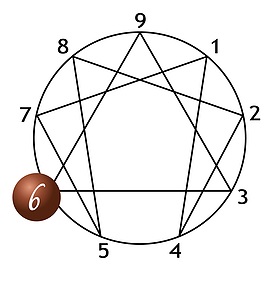
Enneagram chart with Type Six highlighted.
Introduction
In a way, Type Six represents Joe Citizen. Supportive, generally friendly, Sixes are usually mild-mannered and dependable with others. They tend to form strong and stable bonds and they are normally there for the people they have bonded with. Often capable of a great spirit of sacrifice in the name of fairness and friendship, they are always willing to fight for the underdog and try to be good neighbors with their fellow humans.
They often have incredible hunches that almost invariably turn out to be true. This is nothing supernatural. It is the consequence of a life spent trying to anticipate and prevent uncertainties and dangers. When a Six tells you that something is off about someone or something, they are probably right.
Sixes value loyalty–loyalty to ideas and to people. It is rare for them to question the motives of people they trust, and they usually go well out of their way to justify friends and associates. There is little they dislike more than untrustworthy people and traitors. They also occasionally display an obdurate unwillingless to trust others and have trouble with authority figures (unless they blindly trust them).
Sixes often have a good sense of humor, but also a cynical streak. Occasionally they make skeptical remarks that feel unwarranted or exaggerated, and they are seldom satisfied with the level of proof required by others in order to feel confident in a situation: Sixes need more.
The defenseless lamb, a good symbol for Enneagram Type Six
Core Mechanism
It is incredibly hard to pin down Type Six in a single description. In a way, it is the most complex type. Sixes can and often do showcase opposite tendencies at different times, or even at the same time, and sometimes it is hard to see what links them to other Sixes. From a behavioral standpoint, Sixes are probably the most heterogeneous Enneagram type.
Sixes often swing between extremes of obedience and rebellion, mindless acceptance and rejection, aggression and passivity, fight and flight, faith and skepticism. The reason is that they lack any inner sense of certainty about life.
In the introduction I said that Sixes are always willing to fight for the underdog. This is because Sixes often feel like they are underdogs. Their worldview is one of great uncertainty. In a way, Sixes feel like they have been cast into the world with no protection–a world full of wolves that are waiting to attack.
Sixes are a Head type, but unlike the major head type, Fives, who trust only their own mind and relish in endless doubt and uncertainty, Sixes don’t trust themselves to have something figured out for good, but they do want to figure it out for good. Their mental processes are forever undermining their choices and their sense of certainty: “What if this happens? What if that happens? What is the worst that could happen?”
To compensate for their lack of inner guidance, Sixes seek a source of guidance outside of themselves (something Fives would never do). Once this source of guidance (which may be a person, a political ideology, a religion, an institution, etc.) is selected, the Six is unlikely to question them, and will become a brave little soldier fighting for the cause. Sixes also tend to find strength in number and in networking with other people they deem dependable, often on the assumption that they are all potential victims of this uncertain world and so they can help each other.
As soon as the cracks start showing in whatever source of certainty the Six has selected (after all, nothing and no one is perfect one hundred percent of the times) Sixes may try to overlook them by becoming more mindless, but if the cracks become impossible to ignore, Sixes turn on their “protectors” becoming the stereotype of the torch-bearing villagers. Once the rebellion is over, Sixes look for another anchor, and the cycle starts over.
Passion
The passion of Enneagram Type Six is Fear. To understand this we must take a step back and recognize that fear is, in a way, the foundation of every form of life. As soon as an organism exists, it seeks to perpetuate itself and to avoid what damages it, which it fears.
Sixes embody this idea in a visceral and almost archetypal way. Their primary concern is with their safety (and that of the people they care about, of course). Their fear stems from the fact that they cannot find anything around them that they can one hundred percent rely upon.
This leads them to their famous trait of catastrophizing about everything under the sun. Paradoxically, Sixes do this because it calms them, as it allows them to come up with endless Plans B (and C, and D) in case something goes south.
Unfortunately, their fear interferes with this focus on certainties, as eventually they’ll manage to poke a hole even in their fifth, sixth and seventh wheel, leading to a breakdown of their view of reality as it is, and not in a positive sense.
Fear is the constant companion of a Six’s life. It manifests as an ocean of variables when they don’t know what or whom to trust; when they have found this solid rock, fear manifests as a mute, nagging sensation that all is not well, that something is escaping them and will bite them in the ass one day.
In relation to the passion of fear, we distinguish two possible reactions on the Six’s part: the phobic reaction, which consists in running away from fear, and the contraphobic reaction, which consists in ramming through fear (if you’ve seen a herbivore attack a predator in a fearful frenzy, you’ve seen a contraphobic Six). Most Sixes fall somewhere between the two extremes, but some crystallize on one end or the other of the spectrum.
Fear, the passion of Enneagram Type Six
Misconceptions
A common misconception about Sixes is that, because they tend to undermine people’s credibility when they do not fully trust them, they are personally out to get them. Although it can be difficult to deal with a Six in these circumstances, their cynicism and snide remarks are not to be taken personally (which does not make them acceptable, of course).
Sixes are constantly looking for an anchor, something in the world that they can rely on, something that won’t change or be found faulty. As is often the case with psychological mechanisms, other people are simply casualities in our war with ourselves. Knowing this can help you in defusing difficult situations.
Another common misconception is that, because Hitler was supposedly a contraphobic Six, then every contraphobic Six is Hitler or a potential serial killer. I’ve heard this from a number of supposed authorities on the Enneagram. In an age where all it takes to be called Hitler is to mildly disagree with someone with funny hair, it should perhaps be pointed out that, since most Sixes have contraphobic tendencies buried more or less deep within them, and since Six is probably the most common type, it would be silly to say that more than one ninth of the population is made up of deranged dictators, but maybe this is a conversation for a more sane age.
Under normal circumstances, a contraphobic Six is simply someone who has a tendency to react to fear by moving toward and against it (it’s the “fight” part of “fight or flight”). This is not in itself a negative thing. It is just yet another survival strategy.
Wings
6w5: Sixes with a Five wing have definite intellectual, even scientific bent. They are very systematic in their survey of all possibilities, variables and factors, and they are likewise very systematic in their attempt at finding the solution to all of them. They often come up with ponderous defenses of the ideas that give them certainty, which tend to be somewhat more conventional than the ideas a pure Type Five might be interested in, but less than what a pure Six would find comforting.
6w7: Sixes with a Seven wing are very friendly and very entertaining. They often have a sharp sense of humor and a tendency to like and to be liked by others. The Six’s strategy to make friends with everyone so as not to end up eaten by wolves finds application, in part, through the Seven-ish drive toward enjoying time with others and networking. Less intellectual and more practical in their orientation, they fare well in social contexts, especially in group efforts.
(note that wings can have some minor descriptive power in terms of superficial behavior, but they are irrelevant in terms of what motivates the person. Many people have no noticeable wing, while few show signs of both.)