There are couples who stay together a lifetime, couples who break up at the first sign of hardship, and then couples that seem to follow some kind of fated path made of pushing and pulling. This is one example.
8♥️ 6♣️ 7♣️ 4♠️
Q♣️ J♦️ K♣️
9♣️ 3♣️
6♥️
Note the absolude predominance of Clubs. Clubs are a heavy suit that causes difficulties and slowness. There is no card of great love, but the Eight of Hearts is a card of fun and good times.
Followed by two problematic Club cards, the Six and the Seven, which end up in break-up (Four of Spades) it is clear that the two didn’t break up from one day to the other never to see each other again, but have been on a constant path of ups and downs ending up in separation.
At the time of the reading the two were broken up, so when I told the (female) querent what I was seeing she confirmed that they’ve been on again off again for quite some time.
Look the second line! We have the two significators united by the messenger card (Jack of Diamonds). So the two have broken up but are still in contact. The querent told me it’s not so much that they send each other messages as they communicate and cause misunderstandings with one another through mutual friends (the Jack of Diamonds can show a go-between). Clearly not a very healthy situation!
The final cards, the Three of Clubs and Six of Hearts, show a reconciliation in the union, but the Nine of Clubs before them implies this is going to be a long-term goal rather than a matter of days or weeks. So the unsatisfactory situation is likely to persist for a while.
As far as giving the querent some advice based on this spread is concerned, I would personally be wary of that Jack of Diamonds between them. It is much better to clear up misunderstandings directly instead of playing up the drama by involving friends as if the two were still high-schoolers (they are in their 40s).
All in all, this spread gives off bad vibes for a relationship. It seems the two are attached more to the drama than to each other. To each their own.
a reading with interesting implications. Like and subscribe to support my work
I thought this was a rather interesting reading, in part because of what it revealed and in part because it shows that divination requires rules and flexibility. I’ll probably talk about it again in an article.
The Bolognese Tarot tradition has several spreads for the couple. One that has been taught to me, and which I have also found is practiced by other Bolognese tarot readers, is the following:
1
2
3
4
5
6
He
She
7
8
9
10
11
12
13
14
15
He and She are, of course, the King and Queen of Wands. However, we can explore the relationship between any two individuals. The cards above the two significators show what’s on their mind (1-2-3 his mind, 4-5-6 her mind, in this case).
The cards covering them (7-8-9 for him, 10-11-12 for her) are ambiguous. The way the method has been passed down to me, these cards show what’s going on with him and what’s going on with her, but I have found other readers (such as Rossella Giliberti) who say that these cards show what’s in his heart and what’s in her heart. Choose the variant you prefer, and remember that these are local methods, so there’s bound to be variations between one town and the other. The final three cards (13-14-15) show what’s happening to them as a couple in the near future, or if there is potential, or what connects them.
Another spread, which is found in Maria Luigia Ingallati’s book on the Bolognese Tarot (which I will review in the near future together with the few others that have been published). The layout is as follows:
He
She
1
2
3
15
16
17
8
9
10
4
5
6
18
19
20
11
12
13
7
21
14
Here we have cards 1 through 7 talking about what’s going on with him, cards 8 through 14 telling us what’s going on with her, and finally the group in the center (15 through 21) talking about them as a couple. Another reader I know (Monica Barbieri) uses thirteen cards for each group instead of seven.
Another variant is found in Lia Celi’s out-of-print book on the 45-card method. This is the layout:
He and She
1
2
3
4
5
6
7 – 8
9
10
11
12
13 – 14
15
As can be seen, this is a pyramid spread. Here, cards 1, 2, 6, 7, 10 and 13 talk about him, cards 4, 5, 8, 9, 12 and 14 talk about her, and cards 3, 11 and 15 talk about them.
These methods are specific for analyzing two people’s interaction, but nothing prevents you from using a simpler spread, like the thirteen card spread. To be honest, that’s what I do. Still, this is an interesting bit of traditional lore about the Bolognese tarot.
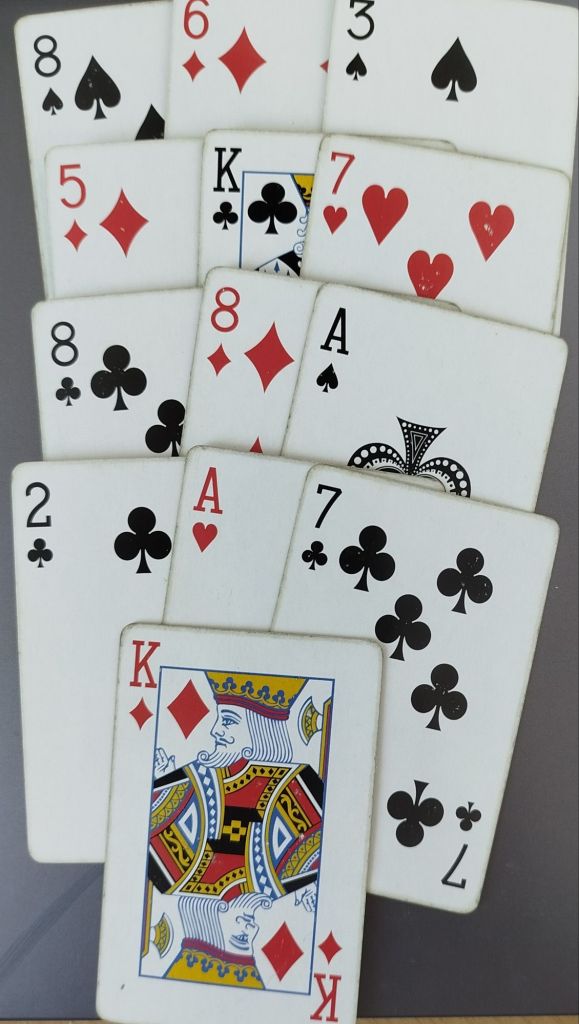
Here the querent is a friend of mine whose live-in boyfriend is acting aloof toward her. She was afraid that he was either having an affair or he was falling out of love with her, or that she had done something to him (he does have a tendency to keep things in until it’s time to explode).
Divination with playing cards: have I done something to him?
My querent doesn’t come up, so we can exclude that she has done something to him or that his love toward her is an issue. There is also a complete absence of mistresses, so we can immediately rule out that he is cheating, especially since there are no cards indicating sneakiness (like the Ten of Spades or the Jack of Spades). There is a Three of Spades, which might indicate intrigue, but clearly this is not what the spread is driving at, and the Three of Spades can also indicate a ‘knotted’, complex situation that doesn’t flow harmoniously.
His significator comes up in the second line, surrounded by cards that show positive development, so the situation is not permanent. However, the first line is a bit concerning, since we have tears, worry and the complex situation. Note that the worry card (the Six of Diamonds) is hemmed in by the spades, so it gives us a picture of the person being somewhat overwhelmed.
Then we have the two Eights and the Ace of Spades. As I wrote sometime ago, the Ace of Spades is often sterilized as a card of change, but at least in my tradition it shows great grief. The grief here is connected to cards of work and business, so this is the problem. The querent said that he doesn’t know if his temp job is going to be renewed. So that’s the problem.
Finally, to complete the picture, there is the house card with problems (Seven of Clubs) next to it. The steps (Two of Clubs) he takes at home (Ace of Hearts) are problematic, as a consequence of the issues shown in the cards above.
We have a final card, the King of Diamonds. We couldn’t identify him, although we suspect it’s either a colleague or a boss. We don’t know from the cards if his influence is positive or negative. It would require another spread, but it doesn’t matter since my friend’s worry was of a different nature.
This is not the first time I do a reading for someone who has a crush on a colleague. The girl in question asked me if a love story could start with him
A love reading using the Bolognese Tarot (Thirteen Card Spread)
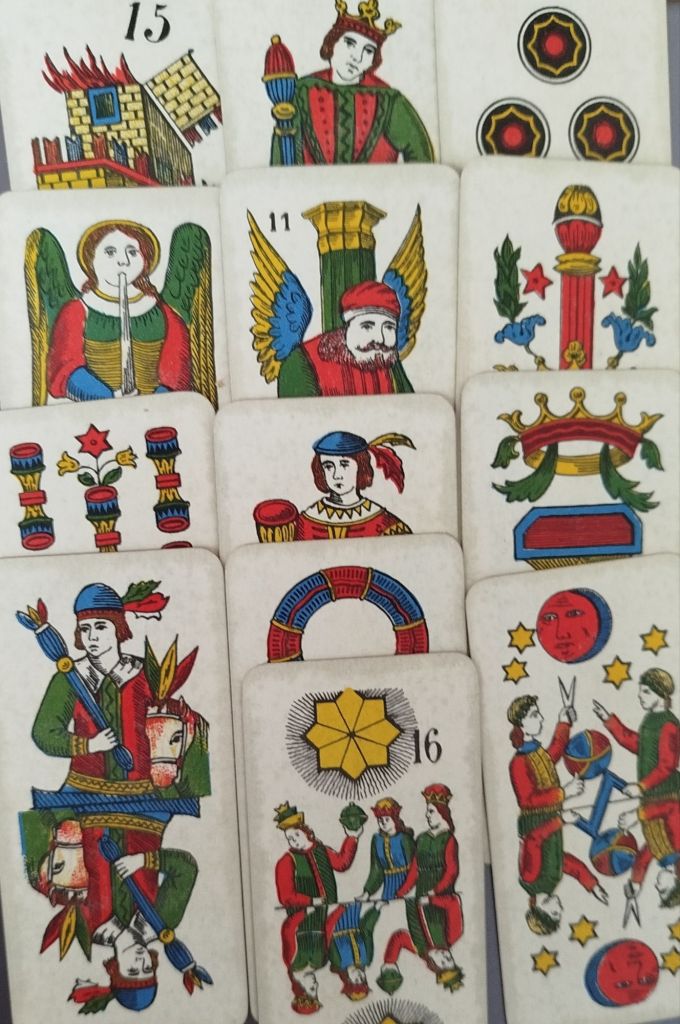
This is one of those spreads that let themselves be interpreted in more than one direction: not just horizontally but vertically as well. The First two things that caught my eye were the first line, with the King of Wands (him) trapped between the Tower (prison) and the Seven of Coins (tears); and the vertical line on the right, with the Ace of Wands and the Ace of Cups together, indicating a family, but the two cards are hemmed in by the tears and the Moon (again, negativity).
So this isan unhappy man we are talking about. In the following line, the Angel card, which would provide happiness and solutions or at least peace, is blocked by the Hermit. Note that the Ace of Wands, which can indicate attraction, is also affected by the blockage, so while he may be somewhat attracted by the querent, he is not gonna act out on it.
The following line was a bit harder to decipher, but I saw it as him having a daughter and being especially attached to her: note the Page of Cups, the girl, of the house (Ace of Cups) brings him jollity or happiness (Ten of Cups). It later turned out he has more than one child but he is more attached to the girl. It is possibly one of the things that keep him in the marriage.
In the end, there is probably going to be no relationship with the man: the relationship card (te Ace of Swords) is negatively affected by the Moon, and the querent will only have a business relationship (Star) with him.
One thing I need to emphasize is that the querent knew the dude is married, but didn’t tell me, not because she wanted to try me, but because in her mind she thought it was somehow “obvious”. It is always interesting to see how querents take our ability to see things for granted (only to be sorely disappointed when we make the most minor mistake).
Yesterday we had a nice reunion with some friends. One of them asked the cards if she has a shot with her dance instructor, whom she’s crushing hard on. These were the cards:
The first thing that jumped at me was that nasty Eight of Spades at the end, which literally says “it will end in tears.” If we take the three angles of the pyramid, they are the Six of Clubs, Nine of Spades and Eight of Spades. Bleak.
My querent’s card falls on the first line, together with the Six, the Ten of Hearts and the Nine of Spades. If we were to read this line as a literal sentence, it would be “Coming from a place of fatigue your happiness there’s not“. In other words, my friend is not just single, but lonely, has been for a while and she’s unhappy about it. This is interesting, because it shows that her crush is more like a compensation mechanism.
Then we come to him, the King of Clubs, who is on a journey (Ten of Clubs) with a loved woman (Queen of Hearts) that leads to a house (Ace of Hearts) of union (Three of Clubs). He is engaged. The final Eight of Spades does not say that he is unhappy about the engagement, but that the engagement brings tears to the querent.
Here’s a quick one I thought was interesting. A querent wanted to know if her boyfriend would propose to him. This is the reading:
K♣️ – 3♦️ – J♥️ – Q♣️ – 2♣️
Notice that the two querent cards both come up in the reading. They are separated by the Three of Diamonds and the Jack of Hearts. I didn’t think the Jack could represent a literal child, but to be on the safe side I asked the querent and she said they have no children. If they did, it could have shown a relatively loose relationship but with children.
The Three of Diamonds represents small projects within the couple. It is not negative, but falling next to the querent’s boyfriend it made me think that he was still a bit immature (especially with the Jack) or at least that he didn’t have big projects in mind. However, we find the Queen followed by the Two of Clubs which represents some steps taken. To me it looked as though she would be the one to take action, either proposing herself or pressuring him to commit further.
What ended up happening is that the querent fell pregnant and told the boyfriend she wanted to at least move together. They are apparently making arrangements to find a place, and an engagement may be on the horizion in the next few years.
Could I have foreseen the pregnancy? Maybe, with the Jack of Hearts so central to the spread. Still, it didn’t feel like a pregnancy spread (and after all it wasn’t even the question).
What I find interesting about the spread is how it describes the nature of the querent’s relationship and who wants to take it to the next level
Here Abano discusses matters relating to the Seventh House and Eighth House.
Seventh House
Of marriage The first and second house are for the man, the seventh and eighth for the woman.1 The first signifies the person, the second his wealth, the eighth the wife’s dowry. If these figures are good they show a positive outcome. If the third figure is conform to the first and seventh, the marriage is mediated by messenger [intermediary],2 especially if the eleventh is conform to the third. If the fourth is conform to the first and seventh, it means the marriage is arranged by one’s relatives, especially if the fifteenth figure confirms it. If the second house is bad it means the husband’s (lack of) wealth is a problem, and so judge for the wife if the eighth is unfortunate. Similarly, if the first or seventh are bad, either the husband or the wife cause problems, and if the third, the mediator, and if the fourth, the family. If the first or seventh are unfortunate and move to the sixth, it shows that the marriage won’t happen due to sickness or because one of the two has a physical defect.3
If the spouse shall be chaste and honest4 Look at the first and sixth, seventh, eighth, fourth and twelfth. If you find good figures, it shows the spouse to be chaste and honest, especially if the figures move to other houses. But if the figures are evil, it shows the contrary, especially if they move to other houses, especially if Populus is born from those houses. If Puer is in the sixth and seventh, it shows the wife to be cheating with a young(er) man, and if it is in the seventh and eighth, it means it’s common knowledge.5 If in these places you find Rubeus, and if it moved as we have said above, it means the same, and similarly if in those houses you find Rubeus and Tristitia or Puer and Laetitia. And again, the more you find Populus in the whole figure, all the more dishonest the spouse is shown to be. But if the you find that the figures add up to Carcer, it shows honesty and reserve, and if the above mentioned figures cause Tristitia in the twelfth it means dishonesty with a family member or with a vile person, or with an almost beast-like man. And if Puer or Rubeus were formed in the twelfth, it means dishonesty with young men or with strangers, especially if they are conform to the thirteenth, fourteenth and fifteenth.
If the querent shall have (the love of) the lover or girlfriend If the first and seventh are fortunate and entering, benign and conform one to the other, it shows obtaining what he wants. If the first moves to the eighth or sixth, it means he will need to insist a little, but if the seventh moves to the second she will insist with him, but the mutation still shows a positive answer.6
Of partnerships and similar affairs If the first, second, fifth, seventh and eleventh figures are good, fortunate, fixed, it shows the partnership is good, especially if the second and seventh are the same figure. If the figures are fixed and fortunate it will last, but if not it shows they won’t. If you want to know who will cause problems, look at which side of the chart hosts more signs of instability and ill will, and judge in the same way as with marriage.
If one’s enemy will cause one offense If the seventh is fortunate and positive it means the enmity is of small moment, unless the enemy is a woman, because it still means ill will toward the enemy.7 But if the seventh is unfortunagte and strong and malicious, it means a great and powerful enmity, especially if the twelfth is equally evil. Look also at the fifteenth, and which planets are more fortunate, whether in the first or seventh, and in the other angles, whom they conform to. And if the first and seventh are good, fortunate, entering and the seventh conjuncts the first, or vice versa, it shows reconciliation and peace. If the figure that conjunct the other also moves to another place, it means that the reconciliation will happen through the persons signified by those houses. Always consider the fifteenth and the Witnesses. If there is no conjunction and no translation, but only conformity of the first and seventh, look at the Judge, whether it is also found in another house (of the first twelve), and the more you find it, the more the two parties shall make peace.
Whether there will be war or peace Assign the first house to one side and the seventh to the other, and look on whose side there are more fortunate figures, and look whether the figures that signify war are in the seventh or the first, or if the figures are fortunate, entering and good. If the figures are good, there is no war, but if they are malicious and fortunate in war, they mean war from the side where they are, and it will be as bad as the figures are, and the side will win that holds the more fortunate figures. Rubeus, Tristitia, Puer, Conjunctio are fortunate in war. Carcer, Amissio, Laetitia are unfortunate in war. If Popoulus or Conjunctio are in the sixth, seventh, eighth or twelfth it means death and great loss of blood, and fleeing, and great cruelty.8 If in those places you find Rubeus and Carcer is in the eighth it means death, prison, fires and flames, and if in the seventh and eighth you find Puer it shows great victory, but always look at the tenth, fifteenth and first, whether they move.
Of litigations The first is the querent, the seventh is the other party. The figure that is stronger and more fortunate wins, and if Amissio is found in either, that party shall lose. Laetitia and Puella signify concord, while Tristitia and Rubeus are very evil. And if the first moves to the sixth, eighth or twelfth, the person shall lose, but if the seventh moves in the same way, the other party shall lose. And if the whole figure is occupied by figures of more or less positive import, there will be agreement.
Of fled servants, prison and lost items If the first, seventh, eighth figures are conform and are entering and fortunate, it shows retrieval, and vice versa if they aren’t. If the first is in the sixth, the servant has not fled, but has hidden, and if the figure is Carcer, he hasn’t changed place, if not very little, especially if the first, fourth and the Judge are entering and fortunate. Acquisitio and Fortuna Major signify retrieval, but the opposite figures show the opposite.
Whether the absent party shall come back, and how soon If the first house is fortunate and well-meaning, and similarly the seventh and ninth, it shows the absent party is well and in good state,9 and vice versa if the figures are bad, especially if the sixth is unfortunate. Also look at the fifteenth and tenth. If the first is unfortunate and moves to the eighth it means death, especially if in conjunction with Carcer, Rubeus or Conjunctio.
If the sixth is unfortunate and moves to the first or in conjunction with it, it means a deadly infirmity, and similarly when the first and seventh are unfortunate are united somewhere in the figure. But if the sixth is unfortunate (but doesn’t move) it shows an illness that shall pass, especially if the eighth is good. And if you want to know whether the absent party shall come back soon, look at the first and ninth, and if they are Cauda, Acquisitio or Laetitia he shall come back soon. If Populus or Via, very soon. If the eighth is good and is in the first, he will come back in a month, if in the second, in two, and so on. And if the said figure is in the second and in the eighth, entering, he shall come in a month.10
Eighth House
Whether one shall die within the year If the first figure is the same as the eighth, or if it is conjunct to it, it is an indication of death, especially if it is also in the thirteenth or fifteenth house. If you want to see what kind of death one shall suffer, look at the nature and quality of the figure, and judge as follows: if it’s Rubeus, it indicates fire or steel (that is, being wounded by an arm,) if it is Puella, being beaten to death, if it is Carcer due to a long sickness, phlegm, melancholy or various health issues; and similarly judge of every other figure depending on its virtue and meaning and quality.
On who shall die first between two people Consider the eighth and see if it is in the house of the person you are inquiring about, or if it in conjunction to it, or if it is in the first house, and judge accordingly who shall die first.
If one shall have the money back If the eighth and the first are entering and fortunate it shows getting the money back without difficulty or problems, vice versa if they aren’t. And this is especially true if the thirteenth and the fifteenth agree, but when they don’t, and if on the side of the first house you find weak figures, it means getting back the money with great trouble. If the eighth is in the third it means one’s siblings will help, and if in the fourth, the relatives, and if in the fifth, one’s children, etc.
If the bad thing you fear shall come to pass Consider the first, second, eighth and twelfth.11 If they are lucky it shows the thing won’t come to pass, but if some of them are unfortunate, it shows it shall partly come to pass, and if they are evil, it shall come to pass, and the bad thing will be identified by the type of figure. If the first figure is in conjunction with the eighth or the eighth with the first, it means harm to the person. If the second is in the seventh or ninth, it means harm to one’s wealth. And so judge all the other things with respect to the eighth house according to the meaning of the house and the thing inquired about. Always keep in mind the Witnesses and the Judge.
MQS
Footnotes
This statement is interesting for a number of reasons. I will only mention one. Abano does not say that the First is for the querent and the Seventh for the spouse, but that the First is for the man and the Seventh for the woman. It would be easy, especially in the current cultural climate, to attribute this to Medieval sexism. I am not saying that it doesn’t play a part, but there could be more. In many Medieval astrological texts the Seventh house, as noted before, is assigned to women, and when delineating marriage from the birth chart different procedures seem to have been used to predict a man’s marriage as opposed to a woman’s, the method for the man involving the seventh house, the one for the woman being more weighed toward other considerations. ↩︎
It would be easy to update this interpretation to show the influence of social media in bringing two partners together nowadays. ↩︎
The modern doctrine would dictate that the marriage happens if the first figure springs to the Sixth House. ↩︎
The Italian title is “if she will be chaste and honest”, again presupposing a female Seventh House. ↩︎
This passage is exceedingly complex. It is not clear if Puer in the Sixth indicates a younger man because it is Puer or because it is in the Sixth (which is below the Seventh). The thing being common knowledge when it happens in the Eighth is possibly due to the fact that the Eighth house is above the horizon. ↩︎
Of interest here is that the querent can obtain the lover by moving to the Eighth or Sixth House, but the Seventh can only spring to the Second, not the Twelfth. ↩︎
This passage is not clear. It seems to imply that a good figure in the Seventh House still bodes ill if the enemy is a woman. ↩︎
These attributes seem ill-fitting for Conjunctio. ↩︎
Older astrology handbooks are filled with indications on delineating the Eleventh House in a horary question to know whether what one hopes will come to pass. Abano here applies the same method to the Eighth house to delineate one’s fears. ↩︎