Tag Archives: Libra

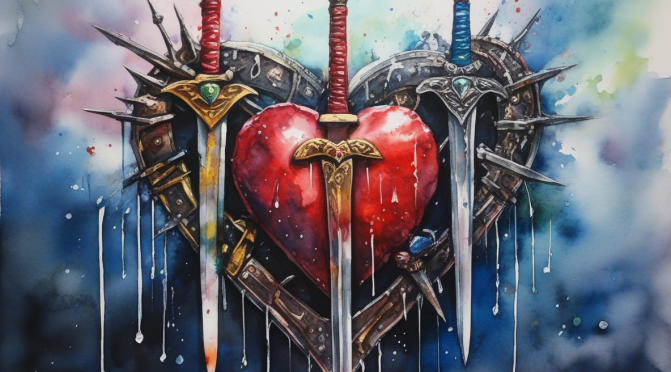
Tarot Encyclopedia – The Three of Swords

(Note: this is a collection of the meanings attributed to the cards by some occultists in the past centuries. It does not reflect my own study or opinion of the cards. It is only meant as a quick comparative reference as I develop my own take.)

The Three of Swords from the Builders of the Adytum (BOTA) tarot deck

Paul Foster Case (and Ann Davies)

The time period is the second decanate of Libra, under the combined rulership of Saturn and Uranus, October 3 to October 12. Because Libra is involved, remember that the qualities of the Seventh house are prominent.
Well-Dignified: this is nevertheless a Key depicting sorrow, disappointment and tears, but it can be the beginning of deep understanding as to the basis and cause of our problems; disruption of friendship; interruption of cherished projects; quarrels; occasionally the position in the layout may indicate platonic friendships; in money matters this card is almost always a symbol of loss, but indicates that whatever money matters are under consideration have been fair and honest, so that no blame attaches to anyone for the loss.
Ill-Dignified: slander; selfishness and dissipation; deceit with respect to promises; loss in legal affairs.
Keyword: Sorrow
(From the Oracle of Tarot course)

A. E. Waite

Three swords piercing a heart; cloud and rain behind. Divinatory Meanings: Removal, absence, delay, division, rupture, dispersion, and all that the design signifies naturally, being too simple and obvious to call for specific enumeration. Reversed: Mental alienation, error, loss, distraction, disorder, confusion.
(From The Pictorial Key to the Tarot)

Aleister Crowley

The idea of division, of mutability, the idea of the airy quality of things, manifests itself in the Three of Swords, the Lord of Sorrow. Here one is reminded of the darkness of Binah, of the mourning of Isis; but this is not any vulgar sorrow dependent upon any individual disappointment or discontent. It is Weltschmerz, the universal sorrow; it is the quality of melancholy.

[…]

Binah, the Great Mother, here rules the realm of Air. This fact involves an extremely difficult doctrine which must be studied at length in The Vision and the Voice: Aethyr 14.
Binah is here not the beneficent Mother completing the Trinity with Kether and Chokmah. She represents the darkness of the Great Sea.
This is accentuated by the Celestial Lordship of Saturn in Libra.
This card is dark and heavy; it is, so to speak, the womb of Chaos. There is an intense lurking passion to create, but its children are monsters. This may mean the supreme transcendence of the natural order. Secrecy is here, and Perversion.
The symbol represents the great Sword of the Magician, point uppermost; it cuts the junction of two short curved swords. The impact has destroyed the rose. In the background, storm broods under implacable night.
(From The Book of Thoth)
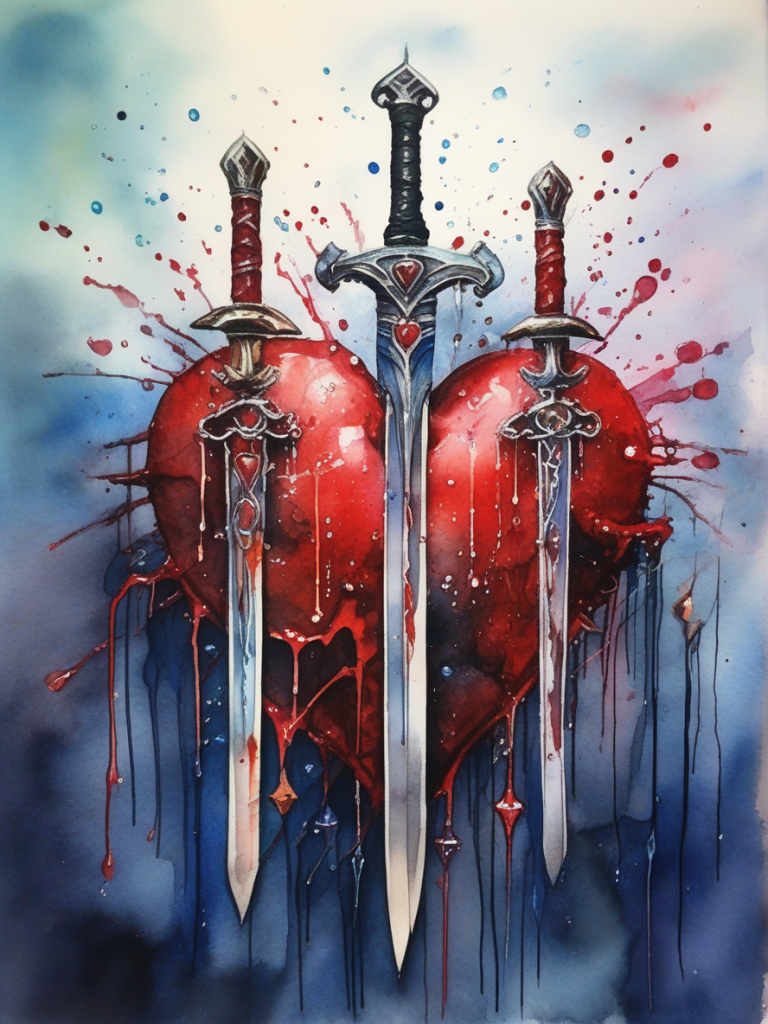
A gruesome AI-generated illustration for the Three of Swords

Golden Dawn’s Book T

THREE White Radiating Angelic Hands, issuing from clouds, and holding three swords upright (as though the central sword had struck apart the two others, which were crossed in the preceding symbol): the central sword cuts asunder the rose of five petals, which in the previous symbol grew at the junction of the swords; its petals are falling, and no white rays issue from it. Above and below the central sword are the symbols of Saturn and Libra.

Disruption, interruption, separation, quarrelling; sowing of discord and strife, mischief-making, sorrow and tears; yet mirth in Platonic pleasures; singing, faithfulness in promises, honesty in money transactions, selfish and dissipated, yet sometimes generous: deceitful in words and repetitions; the whole according to dignity.
Binah of HB:V (Unhappiness, sorrow, and tears).
Herein rule the Great Angels HB:HRYAL and HB:HQMYH as Lords of the Decan.

Etteilla

Removal
Upright. This card, as far as the medicine of the spirit is concerned, means, in its natural position: estrangement, Departure, Absence, Discarding, Dispersion, Remoteness, Delay. – Contempt, Repugnance, Aversion, Hatred, Disgust, Horror. – Incompatibility, Contrariness, Opposition, Unsociability, Misanthropy, Incivility. – Separation, Division, Breaking, Antipathy, Section, Cutting off.
Reversed. Misdirection, Dementia, Vanity, Alienation of spirit, Distraction, Insane conduct. – Error, Miscalculation, Loss, Deviation, Discard, Dispersion.

MQS

Tarot Encyclopedia – The Two of Swords

(Note: this is a collection of the meanings attributed to the cards by some occultists in the past centuries. It does not reflect my own study or opinion of the cards. It is only meant as a quick comparative reference as I develop my own take.)

The Two of Swords from the Builders of the Adytum (BOTA) tarot deck

Paul Foster Case (and Ann Davies)

The time period is the first decanate of Libra from September 23 to October 2, under the rulership of Venus.
Well-Dignified: contradictory characteristics in the same nature; strength through suffering; pleasure after pain; delay in the realization of objectives. This card sometimes indicates a period of uncertainty, during which the Querent, though he has a sense of adequate power, does not know just what to do with it. It also indicates justice, unselfishness and the restoration of peace.
Ill-Dignified: falsehood; sorrow; injury from another who really means well to the Querent, or injury by the Querent to another whom he wishes to help; always a symbol of tension, of want of tact, and suggests force held in abeyance, awaiting some announcement or revelation that will make decision possible.
Keyword: Indecision.
(From the Oracle of Tarot course)

A. E. Waite

A hoodwinked female figure balances two swords upon her shoulders. Divinatory Meanings: Conformity and the equipoise which it suggests, courage, friendship, concord in a state of arms; another reading gives tenderness, affection, intimacy. The suggestion of harmony and other favourable readings must be considered in a qualified manner, as Swords generally are not symbolical of beneficent forces in human affairs. Reversed: Imposture, falsehood, duplicity, disloyalty.
(From The Pictorial Key to the Tarot)

Aleister Crowley

The Two of Swords was formerly called the Lord of Peace Restored; but this word “restored” is incorrect, because there has been no disturbance. The Lord of Peace is therefore a better title: but it needs thinking hard to work this out, since the Sword is so intensely active. It may be helpful to study the Essay on Silence (p. 120) for a parallel: the Negative Form of the Positive Idea. See also the Essay on Chastity (Little Essays toward Truth, pp. 70-74) which concludes: Sir Knights, be vigilant: watch by your arms and renew your oath; for that day is of sinister augury and deadly charged with danger which ye fill not to overflowing with gay deeds and bold of masterful, of manful Chastity.

Witness also Catullus: domi maneas paresque nobis Novem continuas futationes. Nor does he misunderstand the gesture of Harpocrates; Silence and Chastity are isomers.
It is all one case of the general proposition that the sum of the infinite Energy of the Universe is Zero.

[…]

This card is ruled by Chokmah in the Element of Air. This suit, governing all intellectual manifestations, is always complicated and disordered. It is subject to change as is no other suit. It represents a general shaking-up, resulting from the conflict of Fire and Water in their marriage; and proceeds, when Earth appears, to crystallization. But the purity and exaltation of Chokmah are such that this card manifests the very best idea possible to the suit. The energy abides above the onslaught of disruption. This comparative calm is emphasized by the celestial attribution: the Moon in Libra.

The Moon is change, but Nature is peaceful; moreover, Libra represents balance; between them, they regulate the energy of the Swords.

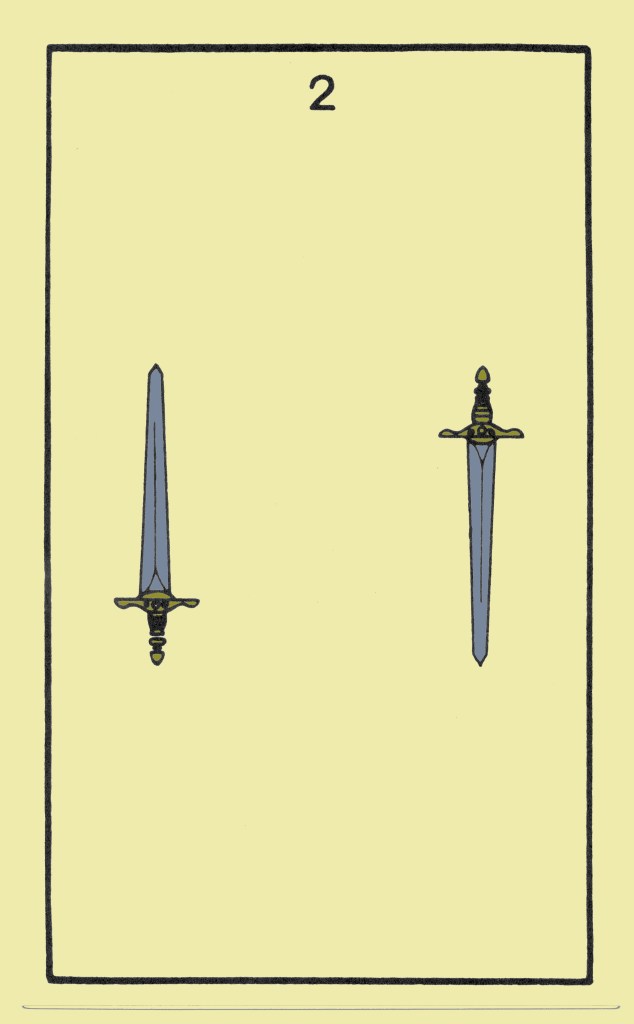
In the card appear two swords crossed; they are united by a blue rose with five petals. This rose represents the influence of the Mother, whose harmonizing influence compounds the latent antagonism native to the suit. The Rose emits white rays, producing a geometrical pattern that emphasizes the equilibrium of the symbol.
(From The Book of Thoth)

An ominous AI-generated illustration for the Two of Swords

Golden Dawn’s Book T

Two crossed swords, like the air dagger of a Zelator Adeptus Minor, each held by a White Radiant Angelic Hand. Upon the point where the two cross is a rose of five petals, emitting white rays. At the top and bottom of the card are two small daggers, supporting respectively the symbol {Crescent moon with horns upward} thus, and Libra representing the Decanate.
Contradictory characters in the same nature, strength through suffering; pleasure after pain. Sacrifice and trouble, yet strength arising therefrom, symbolized by the position of the rose, as though the pain itself had brought forth beauty. Arrangement, peace restored; truce; truth and untruth; sorrow and sympathy. Aid to the weak; arrangement; justice, unselfishness; also a tendency to repetition of affronts on being pardoned; injury when meaning well; given to petitions; also a want of tact, and asking question of little moment; talkative.
Chokmah of Vau. Quarrel made up, yet still some tension in relations: actions, sometimes selfish, sometimes unselfish.
Herein rule the Great Angels HB:YZLAL and HB:MNHAL.

Etteilla

Friendship
Upright. This card, as far as the medicine of the spirit is concerned, means, in its natural position: Friendship, Attachment, Affection, Tenderness, Benevolence, Relationship, Identity, Intimacy, Convenience, Correspondence, Interest, Conformity, Sympathy, Affinity, Attraction.
Reversed. Falsehood, Falsehood, Lying, Imposture, Duplicity, Bad faith, Overbearingness, Dissimulation, Cunning, Deceit, Superficial, Superficiality, Surface.

MQS

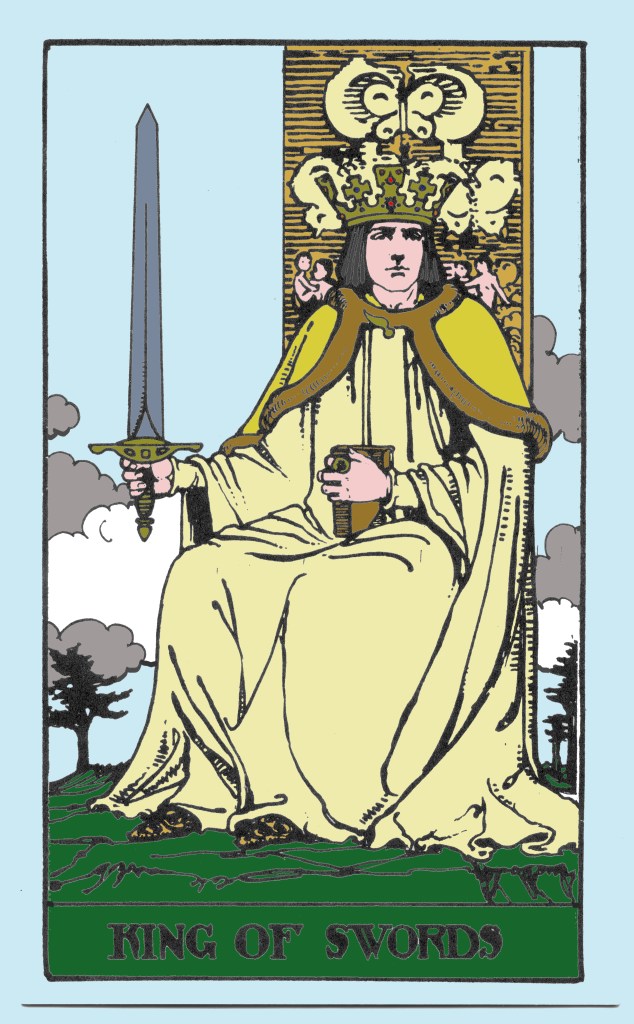
Tarot Encyclopedia – The King of Swords

(Note: this is a collection of the meanings attributed to the cards by some occultists in the past centuries. It does not reflect my own study or opinion of the cards. It is only meant as a quick comparative reference as I develop my own take.)

A collection of interpretations for the King of Swords
The King of Swords from the Builders of the Adytum (BOTA) tarot deck

Paul Foster Case (and Ann Davies)

The time period is from the beginning of the last decanate of Virgo to the end of the second decanate of Libra, September 13 to October 12, under the combined rulerships of Venus in Taurus, Venus in Libra, and Saturn-Uranus in Aquarius. Meanings: a man of strong and powerful imagination; hard worker and having authority; keen in understanding law and capable of excellent cooperation; somewhat distrustful and suspicious and therefor e hard to convince. He sometimes surprises his friends by sudden changes of attitude, although he is usually overcautious and analytical. In a divinatory lay-out:
Well Dignified: he is friendly to the Querent and will cooperate with him. lll Dignified: he is inimical, harsh, malicious and plotting, obstinate and wholly unreliable.
Dark hair and dark eyes.
(From the Oracle of Tarot course)

A. E. Waite

He sits in judgment, holding the unsheathed sign of his suit. He recalls, of course, the conventional Symbol of justice in the Trumps Major, and he may represent this virtue, but he is rather the power of life and death, in virtue of his office. 
Divinatory Meanings: Whatsoever arises out of the idea of judgment and all its connexions-power, command, authority, militant intelligence, law, offices of the crown, and so forth. 
Reversed: Cruelty, perversity, barbarity, perfidy, evil intention.
(From The Pictorial Key to the Tarot)

Aleister Crowley

(Note: Crowley and the Golden Dawn swapped around King and Knight. This is in part true of Waite as well.)

The Knight of Swords represents the fiery part of Air; he is the wind, the storm. He represents the violent power of motion applied to an apparently manageable element. He rules from the 21st degree of Taurus to the 20th degree of Gemini. He is a warrior helmed, and for his crest he bears a revolving wing. Mounted upon a maddened steed, he drives down the Heavens, the Spirit of the Tempest. In one hand is a sword, in the other a poniard. He represents the idea of attack.

The moral qualities of a person thus indicated are activity and skill, subtlety and cleverness. He is fierce, delicate and courageous, but altogether the prey of his idea, which comes to him as an inspiration without reflection.

If ill-dignified, the vigour in all these qualities being absent, he is incapable of decision or purpose. Any action that he takes is easily brushed aside by opposition. Inadequate violence spells futility. “Chimaera bombinans in vacuo”.

In the Yi King, the fiery part of Air is represented by the 32nd hexagram, Hang. This is the first occasion on which it has been simple to demonstrate the close technical parallelism which identifies Chinese thought and experience with that of the West. For the meaning is long continuance: “perseverance in well-doing, or continuously acting out the law of one’s being”, as Legge puts it in his note on the hexagram; and this seems incongruous with the Qabalistic idea of violent energy applied to the least stable of the elements. But the trigram of Air also indicates wood; and the hexagram may have Suggested the irresistible flow of the sap, and its effect in strengthening the tree. This conjecture is supported by the warning in line 6: “The topmost line, divided, shows its subject exciting himself to long continuance. There will be evil.”

Allowing this, the image of “the extended flame of mind”, as Zoroaster calls it, may well be subjoined to the former description. It is the True Will exploding the mind spontaneously. The influence of Taurus makes for steadiness, and that of the first decanate of Gemini for inspiration. So let us picture him, “integer vitae scelerisque purus”, a light-shaft of the Ideal absorbing the entire life in concentrated aspiration, passing from earthy Taurus to exalted Gemini. Here, too, is shewn (as in the Yi) the danger to the subject of this symbol; for the first decan is the card called “Interference”; or, in the old pack, “Shortened Force”.
(From the Book of Thoth)

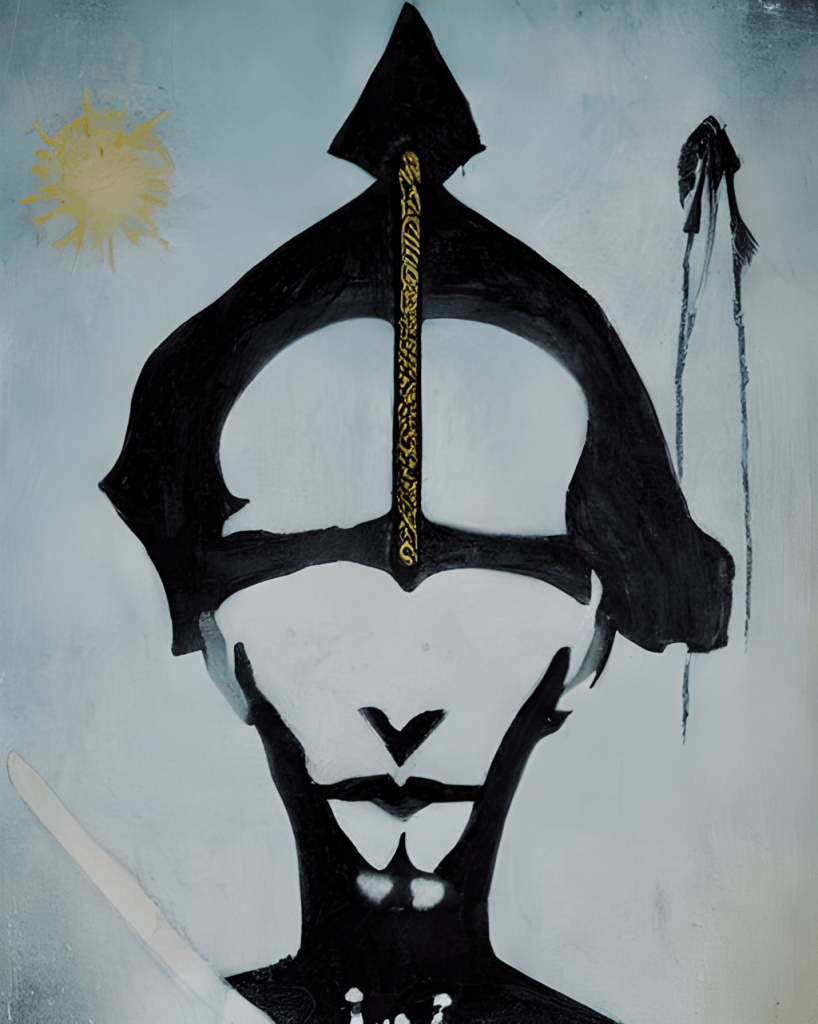
Oddly Bismarckian AI-generated Illustration for the King of Swords

Golden Dawn’s Book T

A WINGED Warrior with crowned Winged Helmet, mounted upon a brown steed. His general equipment is as that of the Knight of Wands, but he wears as a crest a winged six-pointed star, similar to those represented on the heads of Castor and Pollux the Dioscuri, the twins Gemini (a part of which constellation is included in his rule). He holds a drawn sword with the sigil of his scale upon its pommel. Beneath his horse’s feet are dark-driving stratus clouds. He is active, clever, subtle, fierce, delicate, courageous, skilful, but inclined to domineer. Also to overvalue small things, unless well dignified. If ill dignified, deceitful, tyrannical and crafty.
Rules from 20 Degree Taurus to 20 Degree Gemini.

Etteilla

Man in Uniform
Upright: This card, as far as the medicine of the spirit is concerned, means, in its natural position: Man in Uniform, Man of the Law, Judge, Councilor, Assessor, Senator, Business Man, Medical Practitioner, Lawyer, Prosecutor, Doctor, Physician. – Jurist, Law-making. – Litigant [= Party to litigation], Jurisconsult.
Reversed: Malicious, Maliciousness, Perversity, Perfidy, Crime, Cruelty, Atrocity, Inhumanity.

MQS

Amissio / Loss (Geomancy Figures)

Name of the Figure: Amissio (Loss)
Element: Fire
Planet: Venus (retrograde)
Sign: Libra
Quality: Exiting
Fortune: Bad

Amissio is another rather straightforward figure, with a caveat that I will address at the end. It is the opposite of Acquisitio, and its symbol shows it, as it seems to depict a bag with its mouth held downward, signifying loss. Tradition assigns this figure to Venus retrograde, meaning that while it is bad in most things, some see it as good in love affairs.

Illustration for the geomantic figure Amissio, Loss

Mainly, Amissio is a figure of loss, especially financial or material loss. It is also often associated with losing items or having them stolen from you. Needless to say, it is bad in any situations where we hope for increase, gain and the like. It is good in situations where you want to lose something, such as weight, illness, prison sentences, etc. Some say that Amissio is good for love because in love you “lose yourself” in the other.

Frankly, I believe we need to be very cautious with this line of reasoning, as it can be played with and made to say whatever we want. “Will I find a job?” “Why, yes! Here it says you will lose your lack of employment!” Furthermore, even in matters of love I have personally found that there are better figures to represent love (Puella) elation (Laetitia), ardor (Puer) or commitment (Conjunctio). I have the sneaking suspiscion that the only reason the Medievals assigned Amissio to Venus was that Saturn already had two figures to its name and nothing else was available, so always take the attributions with a grain of salt. The main meaning is loss, plain and simple.

Common Keywords: Loss, Difficulties, Hardships, Theft, Healing, Liberation, Letting go, Falling in love

Amissio in the Geomantic Houses (these are only examples. Use context to guide your interpretation)

HousePossible Meanings
FirstLoss, Depression, In love, Lost, Needy, In need
SecondLoss of money or valuables, Loss of an object, Hardhips, Sacrifices
ThirdThieves in the neighborhood, Bad relationship with siblings, rumors, gossip
FourthLoss of inheritance, Loss from real estate or from the father
FifthLosing yourself in pleasures, Loss of pregnancy, Sadness
SixthHealing, Loss from servants and subordinates or from small animals, losing your pet
SeventhFalling in love, Losing your partner, Thieves
EighthBereavement, Loss, Loss of partner’s money
NinthLoss during journey, Losing your way, Bad skill or bad science
TenthLoss of employment, Inability to find a job
EleventhLoss of friendship, loss of hope, Loss of government support
TwelfthBeing freed from prison or a curse, Loss through large cattle
ThirteenthPast expenses, Past sacrifices
FourteenthFuture loss, Expenses, If the Judge is positive, there may be bad consequences in the future
FifteenthNot getting what you want (may be good in “Venusian” pursuits)
Possible meanings of Acquisitio in the various Geomantic Houses. Note that this is not meant to be exhaustive, and it only serves to jog your interpretive muscles

MQS

Puella / Girl (Geomancy Figures)

Name of the Figure: Puella (The Girl)
Element: Water
Planet: Venus (direct)
Sign: Libra (Sometimes given as Aries)
Quality: Entering
Fortune: Good (with neutral undertones)

Puella is the counterpart to Puer, the boy, and the opposite figure of Rubeus (if you push Puella through Via you get Rubeus, not Puer). It is a figure of Venus direct. Just as Venus is the lesser fortune in astrology, Puella is a positive figure, but not very strong. Its testimony is easily overruled by other consideration. Its figure has two points in the Air line. This fact has been interpreted variously in modern literature. From a visual standpoint, this is said to represent a mirror or a woman’s breasts.

Illustration of the geomantic figure Puella, girl

Puella represents a girl’s or woman’s influence in the querent’s life. In this sense, the figure is neutral, and its meaning must be clarified by the rest of the chart. It also represents things we traditionally associated with women. This ranges from objects typically used by women (mirrors, lipsticks, gowns, etc.) to a feminine attitude and feminine interests.

Obviously, given its association with Venus and with womanhood, Puella has to do with love, harmony, balance, in all their applications. For instance, Puella tends to bring affection, love, togetherness. It is a good figure for interpersonal relationship, as it shows tactfulness, although it can signify someone who is easily influenced. It also has a connection with the arts, just like Venus. Everything that is pleasing to the eye falls under its jurisdiction.

Another idea connected with Puella is that of innocence. This can be played with if it is relevant to the question. Finally, Puella can represent an inability to assert oneself. If found in an unfavorable position, it can point to laziness and wastful behavior.

Common Keywords: A girl or a woman, female things (gowns, stockings, lipsticks, etc.) beauty, art, creativity, gentleness, harmony, girlish, unstable, submissive, (re)conciliation, love, feelings, easily swayed or overwhelmed, broadly positive outcome but with instability

Puella in the Geomantic Houses (these are only examples. Use context to guide your interpretation)

HousePossible Meanings
FirstHarmonious, girlish, pleasing, conciliatory, well-meaning, prissy
Secondfinery, nice things, good for money
Thirdsisters, good siblings and neighbors, good news, true rumors
Fourthharmony in the family, homemaking, gardening
Fifthsinging, dancing, arts, beauty, fun, love, kisses, a baby girl
Sixthrest, good servants, lovesickness, female pets
Seventhmarriage, wife, harmony with other people or with partner
Eighthdowry, gain through others
Ninthholiday, vacation, respite, fun, learning an art
Tenthpleasure from one’s occupation, good relationship with people above
Eleventhfemale friends, realization of hopes, help
Twelfthfemale animals, wastefulness, lack of effort, an evil woman
Thirteenthgoodwill, acceptance, loving nature, a woman from the past, a woman’s help
Fourteenthlack of harmony, there will be harmony in the future, a future woman, a woman’s opposition, indecision
FifteenthPuella cannot be Judge
Possible meanings of Puella in the various Geomantic Houses. Note that this is not meant to be exhaustive, and it only serves to jog your interpretive muscles

MQS

Puer / The Boy (Geomancy Figures)

Name of the Figure: Puer (The Boy); sometimes called Beardless
Element: Air
Planet: Mars (direct)
Sign: Aries (Sometimes given as Libra)
Quality: Exiting
Fortune: Bad (but in practice neutral, sometimes positive)

Puer is a much misunderstood figure in Geomancy. Because it is assigned to Mars, it is sometimes given as invariably bad. In reality, the figure is mostly neutral, and much depends on the question, where it comes up and with what other figures. Symbolically, the Puer glyph is said to represent a phallus or a sword, which is fitting considering the Mars association. The sword is a symbol of war, justice and action. Indeed, these are all potential meanings of Puer.

Illustration for the geomantic figure Puer, the Boy

The main meaning, however, is that of representing a man (not necessarily young) Very often, Puer shows the influence of a man in the question. Man means man, not your lesbian aunt who looks like Super Mario and has been called “sir” once by a distracted store clerk. On the other hand, in my limited experience I have found that trans men do show up as Puer and trans women as Puella. Needless to say, the influence of this man in your life or question will depend on the other figures, and is not in itself negative.

As an extended set of correspondences, Puer also indicates all manly things, the male side of existence. This can go from traditionally man-related things (trousers, ties, drills etc.) to traditionally man-related action, such as taking action and fighting. The figure, however, is called Puer, boy, so there is always the martian tendency to be rash and take action without putting much thought in it. Interestingly, Puer and Puella both tend to be rather unstable figures, but for different reasons. Puer is instability due to lack of foresight and forethought.

Sometimes, Puer can be exactly what is needed to break a stall: sometimes you just need to go “the hell with it” and do your thing. However, Puer lacks patience and the ability to reconcile oppositions, and this can be the cause of trouble. Also, sometimes Puer is associated with sex due to the Mars correspondence, but I see it more as the ardor or drive toward sex (in other words, horniness) but I see sex as a prerogative of Conjunctio.

Common Keywords: A boy, A man, All things manish or masculine, Justice, Doing what’s right, Action, Energy, Strong drive, Thoughtlessness, Danger from rash action, Cutting instruments, Fights, Litigation, Arguments

Puer in the Geomantic Houses (these are only examples. Use context to guide your interpretation)

HousePossible Meaning
FirstEnergy, Action, Manish behavior, Justice, Rashness
SecondRash action, Overspending, Energy in enterprise
ThirdArgument with siblings or neighbors, False rumors
FourthControversy, Fights, Useful to take action, Discovering hidden treasures
FifthA baby boy, Bad intermediary, Happiness, Having fun
SixthSurgery, Danger from doing the wrong thing, Need for toil
SeventhDivorce, Marriage or partnership too soon, Energy in enterprise, Picking fights
EighthLittle gain from other people, Danger with sharp instruments
NinthGood for travel, bad for learning, False science
TenthGreat enterprise in job, Loss of job, Manual work, Infamy
EleventhArguments with friends, Being friends with the bad boys, Minor contrarieties in getting one’s wish
TwelfthTrouble with the law from doing something silly, Quick liberation, Backstabbing
ThirteenthQuerent has energy, Takes action, Has been rash in the past, There has been fighting
FourteenthQuerent will need to put more energy into it, There will be fighting
FifteenthPuer cannot be the Judge
Possible meanings of Puer in the various Geomantic Houses. Note that this is not meant to be exhaustive, and it only serves to jog your interpretive muscles