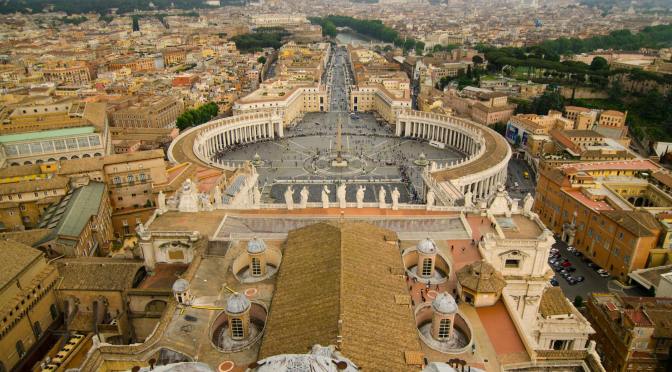
Regardless of what one thinks of the church as an institution, it is hard not to be impressed by the sheer power and majesty of its rituals and customs. As a non-Christian, or rather as a post-Christian, I am still convinced that the Catholic mass, especially in its older forms, is one of the best-constructed rituals in the history of humanity (I was reminded of it during my dad’s funeral last year).
When I talk about power I am not talking about political or social power, which are undeniable. I’m talking about the power to create a ritualized experience of reality that mobilizes real forces.
This, I’ve noticed, is something many people are not willing to concede, partly out of spite toward the institution (which I may understand), partly as a result of the typical view underpinning modern esotericism that anything goes, and so the rituals of the church have no particular quality compared to the ones anyone could make up on the go, except maybe that traditional religious rituals, being older, have become more powerful through engramming.
Let us leave aside for now the memetic esoteric aspect, which however is certainly present, especially with how Leo XIV’s election has literally been turned into one of the biggest memeplexes I’ve seen in recent times.
I think that the fundamental misconception that is at the root of so much esoteric junk is that something becomes true simply by way of repetition. Yet, in spite of the dogma, reality is not merely what we make of it, as anyone who tried to fly off a skyscraper won’t be able to testify.
True: just like the small mind (the human mind) the great mind (the larger universe) is endowed with a certain level of plasticity. Just like the small brain can be impressed with habits, so can the great brain be impressed with certain forms or procedures that wouldn’t naturally arise. That’s because there is a difference between different gradations of reality: my reflection in the mirror is, from a physical standpoint, just as real as me, but in another sense, being completely dependent on the form of the mirror and my own form, it is subordinated and can be changed, to a degree.
But good rituals are not powerful simply because they have been repeated enough times. While repetition does engram rituals with an authentic foundation, if we take the time to study various magical traditions, we notice that they often utilize the ritual blueprint of the dominant religion of their area, but bending it in other directions.
The spiritual “aeon” within which they operate is their source of authentic power, because most major religions and philosophical currents do capture something of the universal life and its might. Authenticity is the keyword.
In addition, there may sometimes be certain powerful experiences that allow different traditions to fuse together into new ones (take for instance some of the magical traditions created by the descendants of African slaves converted to Christianity).
But the root of magic is always an authentic source of power, which is ultimately always the same, but which is channeled and shaped through the form of the religious or philosophical tradition, and regardless of the how corrupt or unlikeable the representatives of that tradition become. Lacking it, the most one can conjure, if anything at all, are some cheap tricks of lower esoteric jugglery.
This is also why it’s important to take the time to soak into the traditions we want to work with. Eclecticism is pure vanity if it is divorced from understanding. If I had a euro for everytime I saw someone on social media simply plucking formulas left and right, one from the magical papyri, one from esoteric Daoism and so on, without understanding their philosophical contours… Well I wouldn’t be able to buy much, because I’m not often on social media, but a nice coat would probably be within my price range.
MQS