Tag Archives: Leo

Tarot Encyclopedia – The Seven of Wands

(Note: this is a collection of the meanings attributed to the cards by some occultists in the past centuries. It does not reflect my own study or opinion of the cards. It is only meant as a quick comparative reference as I develop my own take.)
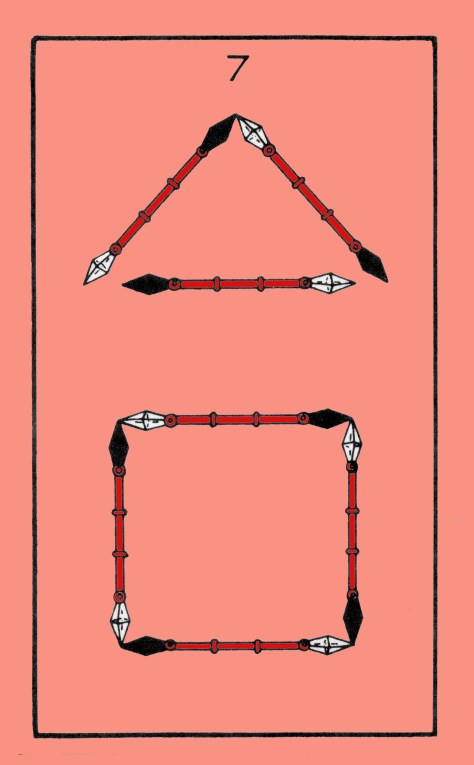
The Seven of Wands from the Builders of the Adytum (BOTA) tarot deck

Paul Foster Case (and Ann Davies)

Astrologically, the Seven of Wands, because it corresponds to the third decanate of Leo, is the time period from August 13 to August 22. In divination, the Seven of Wands combines the activities of the Keys listed in the Tableau [Empress, Sun, Tower, Strength, Emperor] together with ideas of pleasure and love connected with the fifth house in Astrology, the natural house of Leo.
Well Dignified: denotes pleasure in strenuous action; some danger through love affairs or self indulgence; also strength and magnanimity;
adventure; courage in the face of difficulties; influence over subordinates.
lll Dignified: indicates ignorance, pretense, vain-glory, quarrels and wrangling, threats and very determined opposition, especially from subordinates and open enemies.
Keyword: Valor
(From the Oracle of Tarot course)

A. E. Waite

A young man on a craggy eminence brandishing a staff; six other staves are raised towards him from below. Divinatory Meanings: It is a card of valour, for, on the surface, six are attacking one, who has, however, the vantage position. On the intellectual plane, it signifies discussion, wordy strife; in business–negotiations, war of trade, barter, competition. It is further a card of success, for the combatant is on the top and his enemies may be unable to reach him. Reversed: Perplexity, embarrassments, anxiety. It is also a caution against indecision.
(From The Pictorial Key to the Tarot)
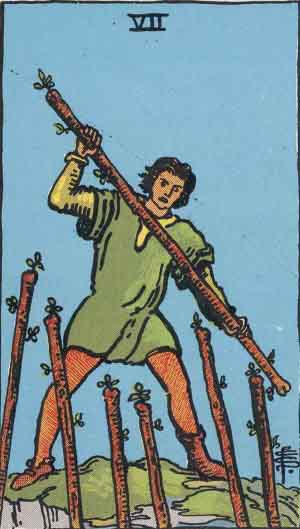
    The Seven of Wands from the Rider Waite Smith tarot deck

    Aleister Crowley

    The Seven of Wands is called Valour. Energy feels itself at its last gasp; it struggles desperately, and may be overcome. This card brings out the defect inherent in the idea of Mars. Patriotism, so to speak, is not enough.

    […]

    This card derives from Netzach (Victory) in the suit of Fire. But the Seven is a weak, earthy, feminine number as regards the Tree of Life, and represents a departure from the balance so low down on the Tree that this implies a loss of confidence.

    Fortunately, the card is also attributed to Mars in Leo. Leo is still the Sun in his full strength, but the marks of decadence are already to be seen. It is as if the wavering fire summoned the brutal energy of Mars to its support. But this is not enough to counter-act fully the degeneration of the initial energy, and the departure from equilibrium.

    The army has been thrown into disorder; if victory is to be won, it will be by dint of individual valour-a “soldiers’ battle”. The pictorial representation shows the fixed and balanced wands of the last card relegated to the background, diminished, and become commonplace.

    In front is a large crude uneven club, the first weapon to hand; evidently unsatisfactory in ordered combat. The flames are dispersed, and seem to attack in all directions without systematic purpose.
    (From The Book of Thoth)

    The Seven of Wands from the Thoth Tarot deck

    Golden Dawn’s Book T

    TWO hands holding by grip six wands, three crossed. A third hand issuing from a cloud at the lower part of the card, holding an upright wand which passes between the others. Flames leap from the point of junction. Above and below the central wand are the symbols of Mars and Leo, representing the Decan.

    Possible victory, depending on the energy and courage exercised; valour;
    opposition, obstacles and difficulties, yet courage to meet them; quarrelling, ignorance, pretence, and wrangling, and threatening; also victory in small and unimportant things: and influence upon subordinates.

    Netzach of HB:Y (Opposition, yet courage).
    Therein rule the two great Angels HB:MHShYH and HB:LLHAL of the
    Schemhamphorash.

    Etteilla

    Talking
    Upright. This blade, as far as the medicine of the spirit is concerned, means, in its natural position: Talking, Negotiation, Conference, Colloquy, Conversation, Dissertation, Deliberation, Discussion. – Word, Pronunciation, Language, Idiom, Dialect, Negotiation, Market, Exchange, Measure, Trade, Traffic, Correspondence. – Talking, Saying, Proferring, Conferring, Discussing, Chatting, Dividing, Chattering, Gossiping.
    Reversed. Indecision, Irresolution, Uncertainty, Perplexity, Inconstancy, Lightness, Variation, Diversity, Hesitating, Hesitating. – Temptation, Vacillation, Versatility.

    MQS

    Tarot Encyclopedia – The Six of Wands

    (Note: this is a collection of the meanings attributed to the cards by some occultists in the past centuries. It does not reflect my own study or opinion of the cards. It is only meant as a quick comparative reference as I develop my own take.)

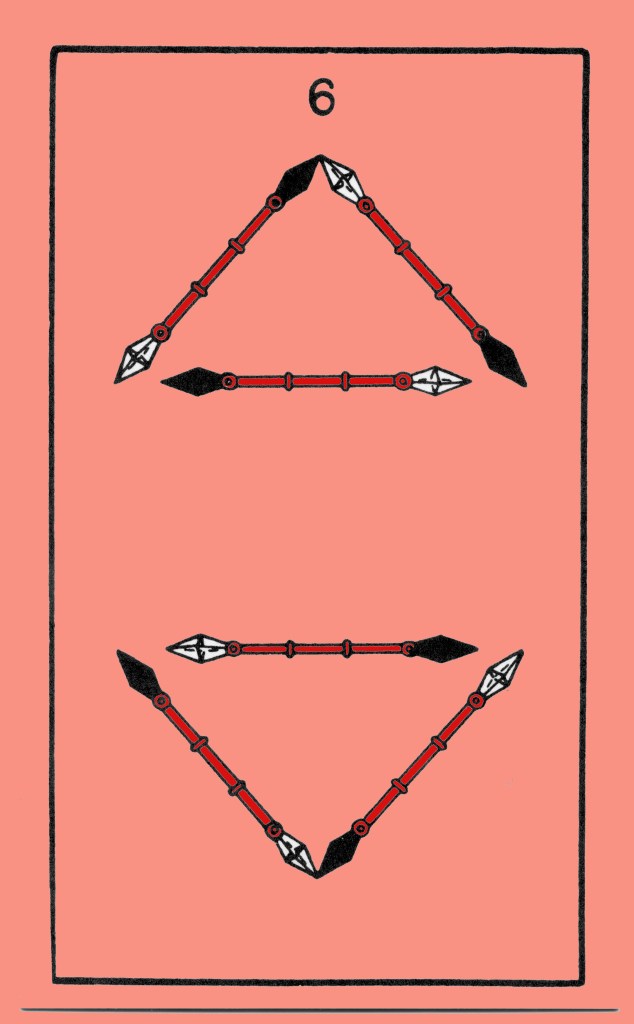
    The Six of Wands from the Builders of the Adytum (BOTA) Tarot deck

    Paul Foster Case (and Ann Davies)

    The second decanate of Leo, related to this Key, is the time period of August 2 to August 12, ruled by Jupiter. In Tarot divination, the Six of Wands partakes of a meaning similar to the conjunction of the Sun and Jupiter, combined with the influence of Leo and its natural fifth house.
    Well-Dignified: success, happiness, gain; gain through love affairs or by the opposite sex; pleasure in labor; gain after a period of uncertainty and competition.
    lll-Dignified: loss through the same things; waste in pleasure; trouble through pride of riches or through insolence based on success.
    Keyword: Victory
    (From the Oracle of Tarot course)

    A. E. Waite

    A laurelled horseman bears one staff adorned with a laurel crown; footmen with staves are at his side. Divinatory Meanings: The card has been so designed that it can cover several significations; on the surface, it is a victor triumphing, but it is also great news, such as might be carried in state by the King’s courier; it is expectation crowned with its own desire, the crown of hope, and so forth. Reversed: Apprehension, fear, as of a victorious enemy at the gate; treachery, disloyalty, as of gates being opened to the enemy; also indefinite delay.
    (From The Pictorial Key to the Tarot)

    Aleister Crowley

    The Six of Wands is called Victory. The outburst of energy in the Five of Wands, which was so sudden and violent that it even gave the idea of strife, has now completely won success. The rule, or lordship, in the suit of Wands is not quite as stable as it might have been if there had been less energy displayed. So, from this point, as soon as the current leaves the middle pillar, the inherent weakness in the element of Fire (which is this: that, for all its purity, it is not completely balanced) leads to very undesirable developments.

    […]

    This card represents Tiphareth of the suit of Fire. This shows Energy in completely balanced manifestation. The Five has broken up the closed forces of the Four with revolutionary ardour, but a marriage has taken place between them; and the result is the Son, and the Sun.

    The reference is also to Jupiter and Leo, which seems to imply a benediction on the harmony and beauty of this arrangement. It Will be seen that the Three Wands of the Three Adepts are now orderly arranged; and the flames themselves, instead of shooting out in all directions, burn steadily as in lamps. They are nine in number, in reference to Yesod and the Moon. This shows the stabilization of the Energy, and its reception and reflection by the Feminine.

    There is no circle to enclose the system. It is self-supporting, like the Sun.
    (From The Book of Thoth)

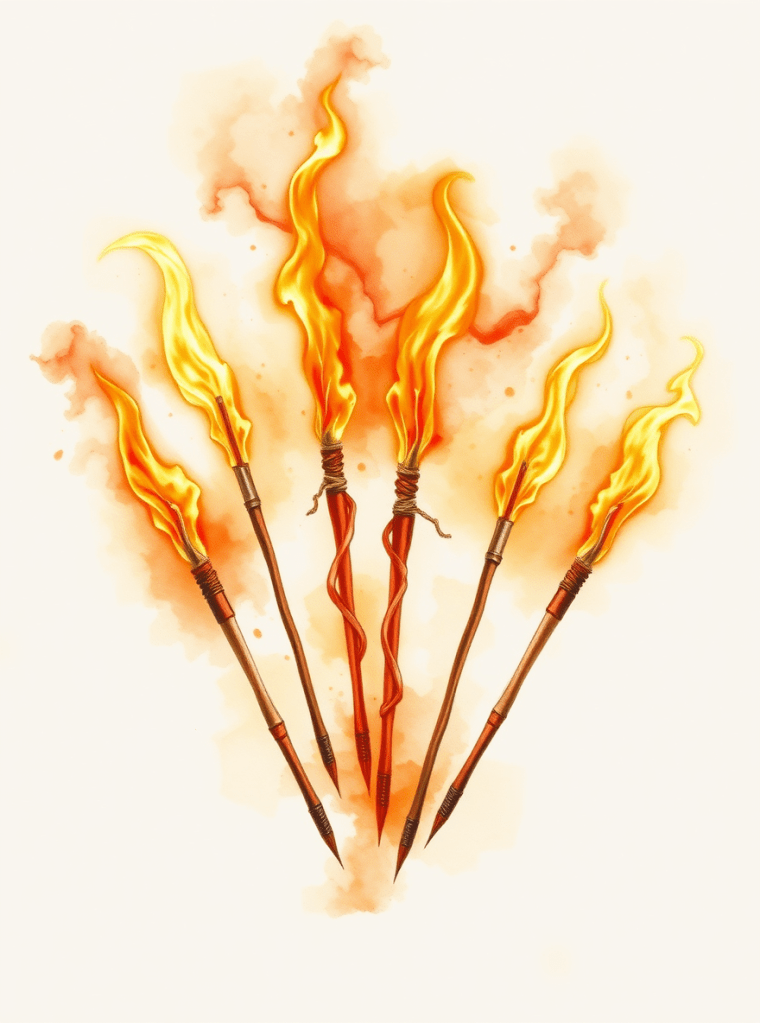
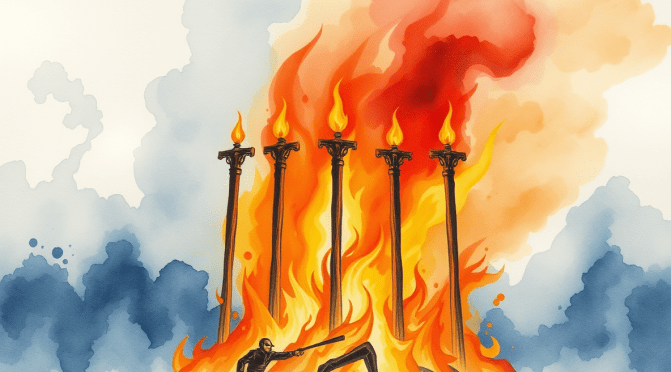
    Rather prosaic AI-generated illustration for the Six of Wands

    Golden Dawn’s Book T

    TWO hands in grip as the last, holding six wands crossed three and three. Flames issue from the point of junction. Above and below are short wands with flames issuing, surmounted respectively by the symbols of Jupiter and Leo, representing the Decan.

    Victory after strife: Love: pleasure gained by labour: carefulness, sociability and avoiding of strife, yet victory therein: also insolence, and pride of riches and success, etc. The whole dependent on the dignity.

    Tiphareth of HB:Y (Gain).

    Hereunto are allotted the great Angels HB:SYTAL and HB:a’aLMYH of the Schemhamphorash.

    Etteilla

    Servant
    Upright. This card, as far as the medicine of the spirit is concerned, means, in its natural position: Housekeeper, Servant, Valet, Lackey, Slave, Mercenary, Inferior. – Courier, Commissary, Factor. – Interior of the house, Ménage, Family, Complex of the servants of the house.
    Reversed. Expectation, Expectation, Hope, Relying on, Grounding, Trusting, Promise. – Confidence, Foresight. – Fear, Apprehension.

    MQS

    Tarot Encyclopedia – The Five of Wands

    (Note: this is a collection of the meanings attributed to the cards by some occultists in the past centuries. It does not reflect my own study or opinion of the cards. It is only meant as a quick comparative reference as I develop my own take.)

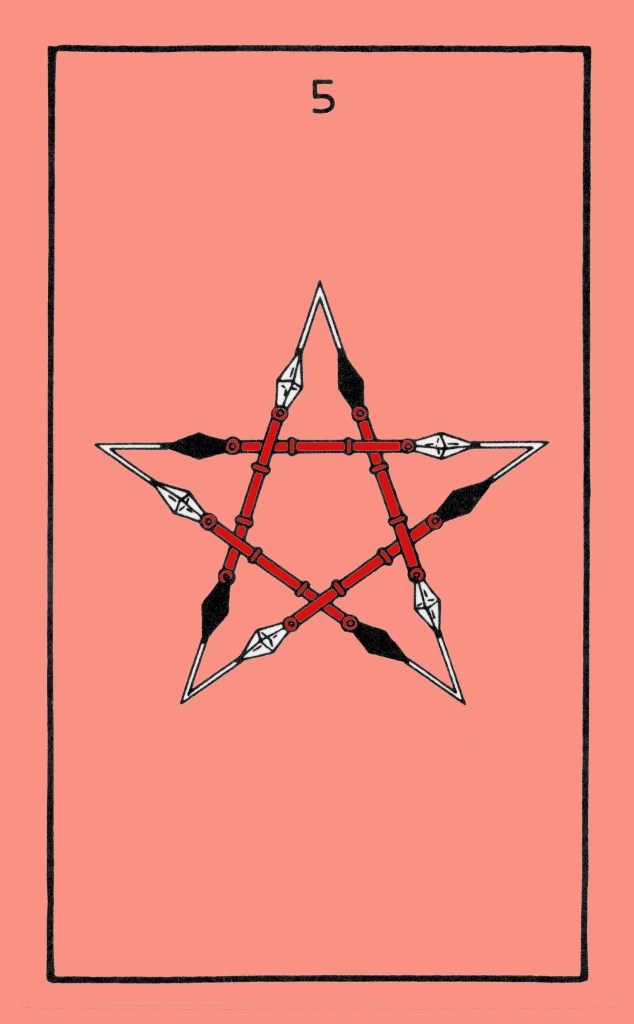
    The Five of Wands from the Builders of the Adytum (BOTA) tarot deck

    Paul Foster Case (and Ann Davies)

    The first decanate of Leo encompasses the time period from July 23 to August 1. It is ruled doubly by the Sun, so that the Sun and its attributions have a marked influence on the meanings of this Key.
    Thus the Five of Wands is a combination of the powers of Mars, active in Geburah and the powers of the Sun in Leo, together with the meanings of the number five and the pentagram. Key ideas associated with the Five of Wands are power and pleasure in exercising it. This is the combined influence of the strength resident in Geburah together with the pleasure associated with Leo and its natural fifth house in astrology.
    The Martian influence gives a spirit of adventure and speculation, together with some uncertainty in carrying out plans. The Leo influence, a fixed fire sign, intimates strong attachments, either to family or in love affairs.
    Well-Dignified: boldness, command and generosity.
    lll-Dignified: cruelty, violence, lust, prodigality. –
    Keyword: Competition.
    (From the Oracle of Tarot course)

    A. E. Waite

    A posse of youths, who are brandishing staves, as if in sport or strife. It is mimic warfare, and hereto correspond the Divinatory Meanings: Imitation, as, for example, sham fight, but also the strenuous competition and struggle of the search after riches and fortune. In this sense it connects with the battle of life. Hence some attributions say that it is a card of gold, gain, opulence. Reversed: Litigation, disputes, trickery, contradiction.
    (From The Pictorial Key to the Tarot)

    Aleister Crowley

    This card is referred to Geburah of the suit of Fire. Geburah itself being fiery, it is a purely active ,force. It is ruled also by Saturn and Leo. Leo shows the element of Fire at its strongest and most balanced. Saturn tends to weigh it down and to embitter it. There is no limit to the scope of this volcanic energy.

    The symbol represents the wand of the Chief Adept, showing that the authority is derived from the superiors; were it not so, this card would be thoroughly disastrous. Moreover, there are also two wands of the Second, or Major Adept. They have the head of the Phoenix, which gives the idea of destruction (or rather purgation) through fire, and the resurrection of the energy from its ashes.

    There is also a pair of wands of the Third, or Minor, Adept, which are daughters, so to speak, of the wands in the Three of Wands. In this card there is the mitigating influence of the Mother. One of the most difficult doctrines with regard to Geburah is that, while it represents all this tameless irrational energy and disturbance, yet it derives from the benign and gentle influence of the feminine.

    The Egyptians understood this doctrine perfectly. Their Lion goddess, Pasht, was hailed as “saeva” and “ferox”, was even called “red in tooth and claw” by those fanatical devotees who wished to identify her with Nature. The idea of sexual cruelty is often inherent in the highest divine nature; compare Bhavani and Kali in the Hindu system, and observe the Shiva-Sakti coition portrayed on many Tibetan banners. See also Liber 418,4th, 3rd, and 2nd Aethyrs; and the description supra of Atu XI.
    (From The Book of Thoth)

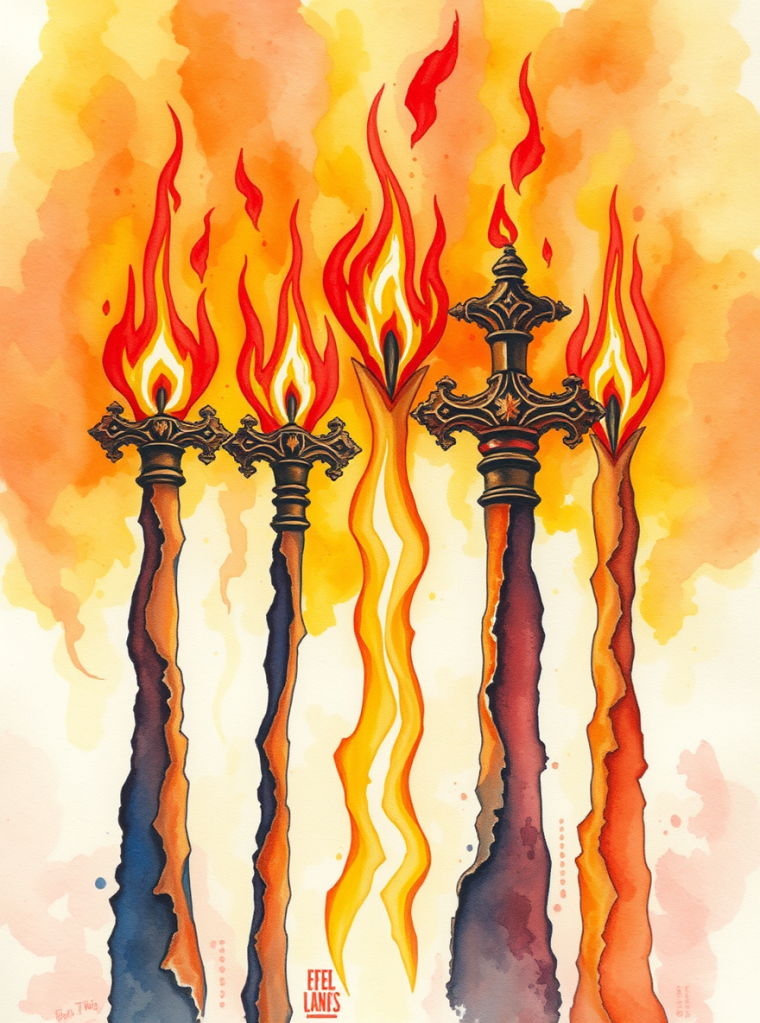
    AI-generated illustration for the Five of Wands

    Golden Dawn’s Book T

    TWO White Radiant Angelic Hands issuant per nubes dexter and sinister. They are clasped together in the grip of the First Order, “i.e.” the four fingers of each right hand crooked into each other, the thumbs meeting above; and they hold, at the same time, by their centres, five wands or torches which are similar unto the wands of a Zelator Adeptus Minor. One wand is upright in the middle; the others cross each other. Flames leap from the point of junction. Above the middle wand is the sign Saturn, and below is that of Leo: thus representing the Decante.

    Violent strife and boldness, rashness, cruelty, violence, lust, desire, prodigality and generosity; depending on whether the card is well or ill dignified.
    Geburah of HB:Y (Quarrelling and fighting).
    This Decan hath its beginning from the Royal Star of Leo: and unto it are allotted
    the two great Angels of the Schemhamphorash HB:VHVYH and HB:YLYAL.

    Etteilla

    Gold
    Upright. This card, as far as the medicine of the spirit is concerned, means, in its natural position: Gold, Wealth, Opulence, Magnificence, Sumptuousness, Splendor, Luxury, Abundance, Good. – Physical, philosophical and moral sunshine.
    Reversed. Trial, Arguing, Differences, Altercations, Disputes, Disputes, Instance, Investigation, Judicial proceedings. – Contradictions, Arguments, Brig, Harassment. – Contradiction, Inconsistency.

    MQS

    Via / The Way (Geomancy Figures)

    Name of the Figure: Via (The Way); some give it as Candela (Candle)
    Element: Water
    Planet: Moon (waning)
    Sign: Leo
    Quality: Common
    Fortune: Mixed

    When interpreting Via, there’s a couple of notions to keep in mind. First, its interesting geomantic property of turning every figure into its opposite: If you add Via to Conjunctio, meaning connectivity, you get Carcer, isolation; if you add Via to Puella, innocence and balance, you get Rubeus, vice and lying; if you add Via to Caput Draconis, the beginning of something, you get Laetitia, its peak, etc. This is because Via has one point in each elemental row: one point in the Fire row, one in the Air row, one in the Water row, one in the Earth row. One point, when added to another single point, turns it into an even double point, while when added to a double point it turns it into an odd number again.

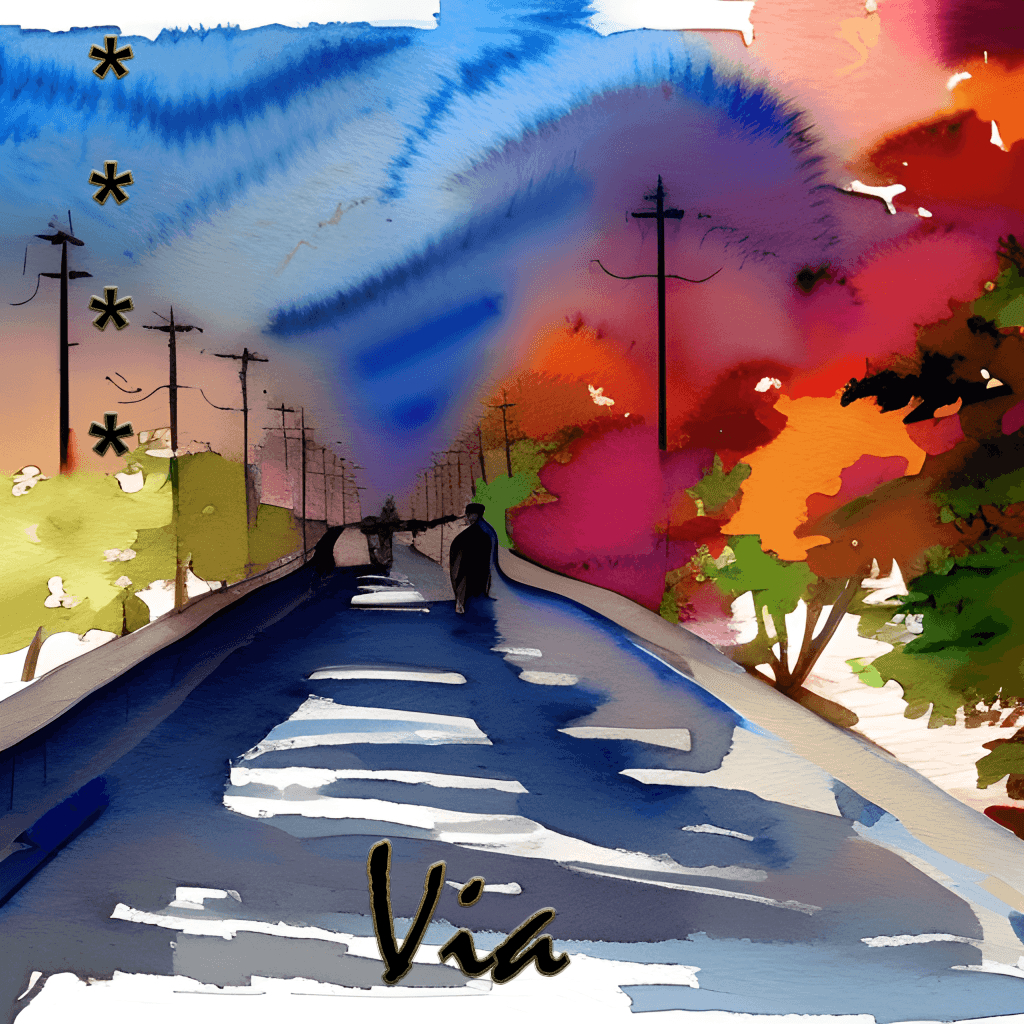
    Illustration of the Geomantic figure Via, the Way

    This property of Via connects well with its meaning of change, travel, etc. It is an active, transformative figure, indicating that the situation will not stay as it is. Something that began one way will finish as something different.

    Another interesting and often mentioned property of Via is that it has the least amount of points of any figure in Geomancy, four. This can mean that Via stands for a small amount of something, whether for good or ill. This, however, is usually only in questions of quantity (“Will I get back the money?” “Yes, but only a small part.”)

    Finally, because it is in contrast with the other figure of the Moon, Populus, which is the crowd, Via can represent aloneness, not necessarily in a bad sense. It can show someone doing something alone, following their own path. It may indicate independence. However, if you dabble in the old manuscripts, you will see that depending on the author Via is attributed better or worse qualities depending on that author’s own ideas. I personally find it a neutral figure, if an unstable one.

    Common Keywords: Travel, path, journey, going, moving, acting, making inroads, change, transformation, one, only, lonely, small, little, small amount

    Via in the Geomantic Houses (these are only examples. Use context to guide your interpretation)

    HousePossible Meanings
    FirstA traveler, wayfarer, piligrim, small stature, phlegmatic temperament, changeable, A short life
    SecondTraveling merchant, Little money, change in the economic situation, poverty
    ThirdShort trip, visit, younger siblings, arrival of news, partly true rumors, the garden or neighborhood
    Fourthmixed end results, instability at the end, a trip to see one’s parents of father, little inheritance
    FifthFew children (possibly one), going to a party, little pleasure
    Sixthshort illness, change in the health, servants are arriving or fleeing (traditionally), small animals, small gain from animals
    SeventhUnstable partner, highwaymen, little company, gain or loss of support (depending on how one is at the present moment)
    EighthFleeing danger or fearful situation, little money from other people
    NinthLong travel, little faith, unworthy knowledge or teacher, a process of transformation, inner journey
    TenthUnstable government, Unstable profession, change of job, traveling for work, authority figures are not to be trusted
    Eleventhvain hope, little hope, little help, changeable friends, few of them
    TwelfthRelease from prison, Freedom from addiction, Few enemies
    ThirteenthUnstable past, ability to change, good for traveling, positive journey or path
    Fourteenthquick solution, the situation will evolve or change, issues while traveling
    FifteenthThere will be travel or change for good or ill, Quick solution
    Possible meanings of Via in the various Geomantic Houses. Note that this is not meant to be exhaustive, and it only serves to jog your interpretive muscles

    MQS