Tag Archives: Lenormand

The Bed – A Deep Dive Into Cartomancy

The bed symbolism is almost as widespread in cartomancy as that of the table, of which it is a natural counterpart. The table often stands for conviviality, nourishment, feasting and interpersonal contact, and it often represents situations happening during the day. The bed, by contrast, is a nocturnal symbol of retreat and rest, and can stand for sickness, but also for physical intimacy, depending on the other cards. As usual, it is admirable how the card readers of yore used to weave simple and effective symbols of daily life in their reading systems, which allowed them to talk about reality.

The oldest mention I could find of a card representing the bed is in a little-known system for reading Italian regional playing cards with a reduced pack of 25 (instead of the full deck of 40). In this method, the Four of Coins is the bed card. It tends to represent situations becoming static or sick, or it can talk about passion, depending on the other cards. It can also indicate that something happens in the evening or at night. Interestingly, in another system I’m aware of, this time utilizing the full pack, the Four of Coins is the table, while the Five of Wands is the bed.

In the Bolognese Tarot, which is the oldest used divination deck we have written records of, the Chariot is the bed card. This has got to be one of the most puzzling bits of symbolism of the deck: a card that is usually indicative of forward movement, travel, progress, launching forward is seen as a card of static sickness, likely due to how the chariot is represented, with the horses crouching at the sides, as if the forward movement had stopped.

Truth be told, in the oldest extant document on divination with the Bolognese tarot, which dates back to the Pre-Napoleonic period, the Chariot is still considered a card of journey, but shorter than the World card, which is assigned the meaning ‘long journey’. This may indicate that the meaning of the card evolved through time, from ‘little journey’ to ‘little movement’ to ‘not much movement’ to ‘staticity’. Another likely possibility is that different meanings were used by different strands of the tradition, one of which hadn’t yet been put down in writing. This latter possibility is confirmed by the fact that there are readers who who assign both meanings to the Chariot, depending on the cards that surround it (static cards activate the static meaning, active cards the moving, active meaning).

The bed card is also present in some of the oracle decks that originated in the XVIII century as parlor games. In the Sibilla we have two bed cards: one is the Four of Spades, the Sickness card, which interprets the symbolism of the bed in its more static and negative sense of needing to interrupt one’s routine and of situations that are not healthy. The other bed card is the Ace of Diamonds, the Room, which can indicate any room in a building, but which in itself stands for the bedroom. As an extended meaning, it is the card of intimacy, so the presence of cards indicating love or physical contact can lead to rather hot interpretations.

The Kipper deck does not have two bed cards, but it does contemplate the symbol of the bed in the card “a short sickness”, which depicts a patient in bed being visited by a doctor. This is mostly a card of sickness, but many German-language sources I’ve read consider it also an ingredient in combinations about intercourse, partly due to the presence of the bed and partly due to the doctor touching the sick man’s wrist, which is supposed to be indicative of physical contact, if supported by other cards.

MQS

My New (Old) Lenormand Deck

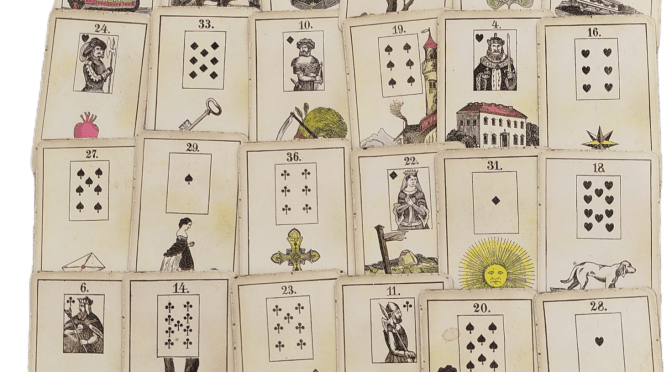
I was accompanying hubby to the optometrist in another city, when we came across one of those easily overlooked book shops selling second-hand books. And right on display was this deck (I’ll do a flip-through video soon):

An old Lenormand deck

Also, get a load of this: the backs are completely plain, like in days of yore!

The cards’ back

The deck came with a book. The author gives off German Mary Greer vibes, in the sense that he published on a variety of topics while trying to appeal both to the casual as well as to the psychotically fixated at the same time.

However, being an old book (I believe it came out in 1992 or so) I was hoping for less psychology. He has the (suspicious to me) tendency to read way too much into the symbols, bringing in Freud, among others. He also tries to combine the meaning of the skat cards with that of the symbols, with mixed results. Sometimes it makes sense, sometimes it doesn’t.

But this is only from leafing through the book cursorily. Maybe I’m judging him too harshly. An interesting thing is that he uses the Grand Tableau / Große Tafel in the less known 6×6 variant.

However good or bad the book may be, I only bought it because it was attached to the deck, which is lovely, and the set cost only a little over 5€. The deck has an old-timey feel to it. Some of the symbols are a bit hard to see. For instance, the Clouds look more like a sea, and the Mice are actually a single mouse which almost disappears in comparison to the pudding and wine he is stealing: while looking at the card I was thinking “Wait, did the Lenormand deck have a Bistro card?” Oh well, at least the mouse doesn’t have to share the wine with the others.

Still a really cute deck and a good buy. I am not planning on studying the Lenormand deck soon (I have way too many irons in the fire) but I just couldn’t resist it.

MQS

The Road – A Deep Dive into Cartomancy

Following my deep dive into the Door Knockers, which seems to be an exclusive symbol (or almost) of Italian cartomancy, let’s talk about a much more universal presence in many traditions: the Road. Still, even though the symbol is widespread, the interpretations may vary.

I was introduced to the symbol of the road when being taught to read playing cards. In the system I was introduced to, the Two of Clubs is the card of the steps. Actually, the word for it was “cammino”, which means a way, road or path, but it also implies the idea of people taking steps on it. That is, a ‘cammino’ is a road that exists because people walk on it, rather than being a road that has been created so that people may or may not use it. An example would be a path through a forest or a road created by pilgrims as they progress on their pilgrimage.

The Two of Clubs therefore implies forward motion toward a goal of some kind, and the taking of steps, whether literal or figurative. In this, it is similar to the Two of Wands in some Piacentine cards systems, which interpret the card as a road, largely due to its design showing two parallel staves, no doubt (although in some other Piacentine systems the road is the Knight of Wands).

The Vera Sibilla doesn’t have a road card per se, although it does have various cards connected with movement, journeying or taking steps/fighting for something. For instance, the Journey card is connected to traveling, while the Soldier may imply fighting to attain a goal (although, being a Spade card, the struggle is more accentuated).

Etteilla famously attributed the meaning of road to the Six of Swords, and his pupils developed a whole vocabulary of synonyms that extend the meaning into other areas. An example of this is the meaning of conduct, which is, figuratively speaking, the path of the person’s actions through life. Etteilla’s attribution of the meaning of road to the Six of Swords remained attached to tarot through the Golden Dawn, who preserved it in part as a possible meaning in their Book T, and then through Waite, who had Smith design the Six of Swords as a card of journey. Even in the Crowley tradition this attribution has in part been rediscovered in Eshlemann’s Liber Theta.

In the Bolognese tarot, the meaning of road is attributed usually to the Six or Eight of Wands. Some strands of the tradition also distinguish between an open road (Six/Eight of Wands) and a closed road (Nine of Wands or Ten of Swords). The road is in itself a card of forward motion, like the Two of Clubs, it can indicate short trips and it is a card of openness.

The road or path is also present in the Lenormand and Kipper traditions. I am unclear on the Lenormand meaning, as the interpretation seems to have evolved considerably through time. Most contemporary English-speaking sources seem to see it as a card of choice (with two paths, although I am unsure if this duality was intended in the original design). Most German sources interpret it differently. Since I am not a Lenormand reader, I will leave it at that.

As for the Kipper cards, they have a card called Ein langer Weg, a long road. In most of the sources I have consulted, the card is more static than in the other traditions, highlighting the element of time (some call it the Two Years card). Interestingly, in many German Skat systems of divination, the suit of Spades / Leaves is connected with movement, and the low-numbered cards, mostly the Seven and Eight, can show a short trip or something happening quickly, while the Ten is also called the long road, and it can indicate an actual journey or the need to wait a long time.

BONUS: The Road is obviously present in Geomancy as well. The Geomantic figure Via, attributed to the Moon, is a symbol of journey and change. It is the symbol with the least amount of points, only one in every position, so some sources also attribute it to the concept of ‘little’ and to the waning of something.

MQS