Tag Archives: Interpreting playing cards

A Cross Spread with Playing Cards

The cross spread I use is often used to get a general picture of the querent before them asking questions. It is useful because people don’t always know what’s really important in their life: they may come to you with a pressing issue which ends up being of no consequence: you can’t find a job, but the cards say it doesn’t even matter because you’ll inherit from an unknown uncle tomorrow. The bottom line is: our perspective on our own life is always limited. The chief use of divination is to give us a wider bird-eye view of our life.

This is a spread I did for a friend of mine I hadn’t seen in a while (note that it is possible to take out the significator of the person, as I did here, but it is not necessary)

General card reading with the cross spread

The first thing I noticed, which ended up not having anything to do with the rest of the reading, is the past position, with the Ten of Clubs, the Ten of Hearts and the Two of Hearts. Upon asking if she’d traveled with family (the Two of Hearts) she said she’d been to Japan with her brother. Clearly this was a journey she’d wanted to go on for a while because the Ten of Hearts is a card of great fulfillment.

The cards over the head and those under the feet are often to be connected (though this isn’t a hard rule). In this case she’s thinking about a woman from her family (Queen of Hearts with Ace of Hearts) in a surprising way. This is not very easy to interpret, so we look under her feet and we find the Three of Spades, the Nine of Clubs and the Nine of Hearts. She’s not happy (Nine of Hearts below) about their interaction, she feels like taking some distance from her.

Upon asking my friend, she said she’s been very disappointed in realizing her mother is starting to have occasional senile moments, which she has reacted to by cutting off contact, not because she doesn’t love her, but because she doesn’t know how to deal with the stress of her realization. I explained to her that the cards in her head still show a great deal of love (three heart cards) so the best course of action is to talk openly about it.

As I was saying this to her, the cards in the center or heart position suddenly made sense to me (I had skipped over them initially because I didn’t know how to interpret them). Contact (Two of Diamonds, Four of Clubs) is going to resume (Six of Hearts) quickly (it’s in the center)

As for the two future positions, they talk about financial/work issues. The right fan (what’s coming to the querent) shows something that should be given to her by an authority figure but there are issues. Looking at the other fan I ventured a guess that it’s money. My friend said she’s waiting for a loan to be approved to refurbish the store she owns. This will be hard and long and she’s probably going to have to jump through absurd hoops (Nine of Spades, Jack of Spades) but the money should come (Seven of Diamonds closing).

MQS

A Deceptive Pregnancy Spread (Card Reading Example)

This spread is proof that we always need to have good communication with the querent, because sometimes readings are deceptive.

Sometimes spreads don’t answer the question at hand. This happens in two cases: when something more important is going on (or about to happen) in the querent’s life or when the cards want to give us details about the question that we haven’t asked for. This latter case requires great care, especially if the question is of a delicate nature.

A woman asked me if she will get pregnant. This is the spread (this is a rather old reading):

A pregnancy question answered with playing card divination

You’d probably think (and you’d be right) that my first instinct was to say “no” due to the horrible mesh of Spades following the Jack of Hearts, which is the child card.

However, something didn’t sit right with me about this spread. I wasn’t at all convinced the spread was answering the question directly. The reason is that the cards Ace of Spades, Nine of Spades and Ten of Spades can show bereavement, and bereavement can only happen if there *is* a child.

The King of Spades could be a doctor performing an abortion, but this isn’t confirmed by any other card (e.g. the Six of Spades). In this case, the King of Spades seems to be more like a priest celebrating a funeral.

I asked the querent if she already had a child, and she said that she unfortunately had a miscarriage in the recent past when the pregnancy was already relatively advanced.

So the cards were not saying that she wouldn’t have a child: they were merely reflecting a recent trauma. With that in mind, I interrupted the reading, telling her the cards were telling her to take time for herself. This was an excuse, of course: I could have done another reading, but I didn’t want to risk having to predict another miscarriage.

Fortunately, today the woman is the happy mother of two twins.

MQS

Using Playing Card Divination on Psychological Questions (Example Reading)

There is a general stigma toward certain forms of divination such as cartomancy with playing cards, namely that they are good at discussing mundane issues, while the Tarot should be used for deeper questions. This presupposes two things: that deeper questions don’t take place in the same world as regular life and that the Tarot is too deep to talk about everyday occurences. Both these beliefs are wrong.

The Tarot is perfectly capable of talking about whatever it wishes, just like playing cards, the Sibilla deck and every other oracle. The first presupposition, though, is more insidious and requires a bit more discussion.

The oldest extant series of tarot meanings has been retrieved in Bologna. The meanings there are what you would expect from a fortune-telling deck: the Ace of Swords is a letter, the Ace of Cups the house, the Hermit an old person etc. Furthermore, some rare examples of tarot fortune-telling in pre-modern Italian literature confirm that the Tarot has probably been used for such aims long before the occult revival started by Court de Gébelin, which slowly removed the Tarot from real life and confined it to the realm of “higher metaphysics”, that is to say, of psychological onanism.

In order to justify this “higher” (I would say emptier) use, several hypotheses on the Tarot’s origins have been put forth, depending on what was considered fashionable and not too easily disproven at the time. First it was the Egyptians, then the Kabbalists, then the Cathars, etc. Instead of being seen for what it obviously is, namely a wonderful product of European Neoplatonic Christian art that anyone before the Enlightenment would have immediately understood and considered familiar, and that only the ignorance of our post-Enlightenment metaphysicians could try to disguise as a distant voice coming from distant secret masters to apply in the understanding of distant matters, rather than an immediately obvious tool to mirror immediately obvious real life situations, which are all instances of an eternal story that constantly tells itself.

So yes, the Tarot can talk about daily experience. In the same way, other, more apparently mundane forms of fortune-telling can talk about problems that some would consider ‘deep’. Just like the Tarot, they can talk about it in immediate terms, immediately understood by anyone with who has some understanding of symbols.

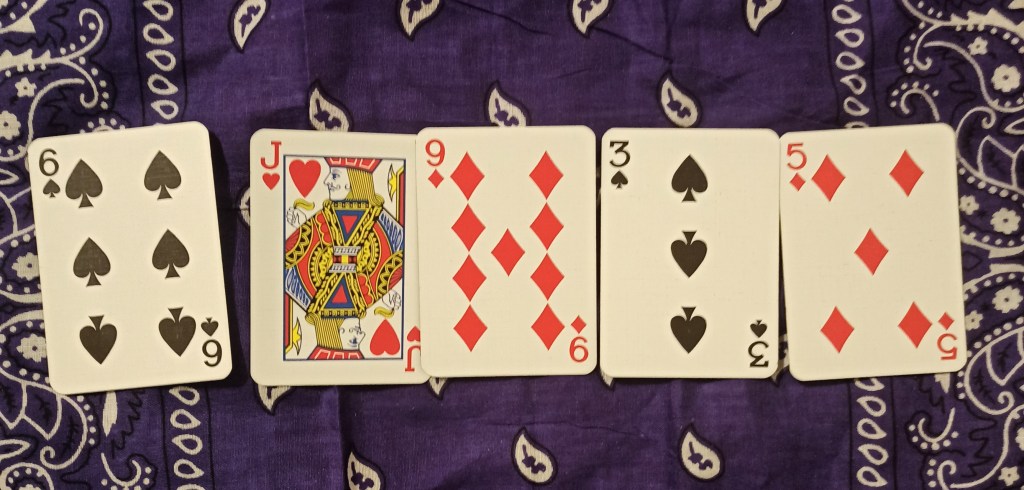
Here’s an example of playing cards used for a ‘deeper’ reading. The querent is a woman I met at an Enneagram convention. She asked what was the reason for her constant bouts of depression. These are the cards:

“Why am I always depressed?”

There is a sickness in her life, signaled by the Six of Spades. There are no cards of deep trauma, but something definitely needs healing. This card falling first sets the tone. The Jack of Hearts represents a child, a project, etc. Next we have the Nine of Diamonds, which is a card that represents the realization of ambitions, but more broadly can represent ambition. Then we have the Three of Spades and the Five of Diamonds. These two cards oftne indicate turning away from something. But the Three of Spades also comes directly before the ambition card. So she has turned away from some ambition. Two possible interpretations that came to mind are that she had the ambition of having a child but couldn’t or that she turned away from a childhood ambition.

I asked her, and it was the second possibility. She’d had big dreams for her life when was a child, but some disappointments had led to seeing them as unrealistic and she had let go of them. I told her that she hadn’t really let go of them, otherwise the Six of Spades wouldn’t have shown up: those ambitions still fester inside of her, and the fact that she is not doing anything about them could make her sick if she isn’t careful. These cards clearly show that she needs to go after her dreams, perhaps in her free time. Alternatively, if she doesn’t want to, she needs to truly let go of them and move on.

MQS

General Cross Spread / Cartomancy with Playing Cards

In the Sibilla section of this site I posted some spreads that may also be used with playing cards. One type of spreads is generally used for broad readings without a specific focus. I must confess I don’t often use these spreads myself when reading for others (especially the 21 card spread which I will cover in another post), although I have found them invaluable for a quick glance into my own future.

A typical general spread is the cross spread. The disposition of the cards, after shuffling and having the deck cut by the querent, is as follows:

4 – 9 – 14
2 – 7 – 121 – 6 – 113 – 8 – 13
5 – 10 – 15
Cross spread for cartomancy with playing cards

The center of the spread (cards 1, 6, 11) indicates the querent’s present situation, or something that is happening that is very important to them. To the querent’s left (2, 7, 12) is his or her recent past. To the querent’s right (3, 8, 13) is his or her future in the next month or so. Above the querent (4, 9, 14) are his or her thoughts or something they are aware of, while underneath (5, 10, 15) shows something the querent doesn’t like or doesn’t know.

This spread is general, but I am sure it can be adapted to answer broad questions (“Tell me about my career”). It can also be used to investigate a person the querent is interest in knowing about (“My friend’s been behaving strangely lately…”)

One variation of this spread consist in shuffling the remaining cards again and dealing out an additional three cards for the further future or for the “answer”.

Here’s an example. I asked a friend of mine if we could do a spread for her as a demonstration and she graciously accepted. Here’s what came out.

3♣ – 3♥ – 9♣
J♥ – A♦ – 4♠8♥ – 6♠ – 8♠K♠ – 6♦ – A♥
7♠ – J♠ – 7♦
Example of a general cross spread with playing cards

It is never a good idea to start talking immediately, especially when the spread is general. It is always better to simply let your eyes absorb the cards as a whole.

Still, it is quite evident that the central heap is rather problematic, as it shows illness. This is not the querent’s own illness, but that of a relative (Eight of Hearts). This is confirmed by the future cards, where there is worry in the house, with the King of Spades in this case as the doctor. The querent’s grandma needs some minor surgery, it turns out, but given her age, her family is understandably concerned. Fortunately there is no indication of great difficulties, let alone bereavement.

The querent’s thoughts, however, are occupied by the desire for a lasting love union (upper fan), which however she doesn’t have, considering the past fan (blocked news concerning romance).

The bottom fan is difficult to interpret, as it doesn’t appear to link up with the others. It is very possible that, in her life in general, the querent doesn’t feel seen or appreciated (the Seven of Diamonds is money, but also rewards, broadly construed) and she feels unlucky.

This spread, as can be seen, is short and quick, and should ideally only be used as an “opener” to break the ice, before moving on to specific spreads.

MQS

Describing Court Cards, Part 3 / Cartomancy with Playing Cards

We’ve been talking a little bit about identifying court cards in cartomancy. Another possible key for identifying them, of course, is combinations. There is no need to memorize endless lists of combinations, as they are generally self-explanatory.

The difficulty comes when a reading contains many Court Cards, or even just court cards. Usually, this indicates a situation that involves many people, often a reunion of some kind. Note that when a bunch of Court Cards are together, Jacks usually count as people, that is, they strengthen the meaning of “many people together” even if they don’t indicate any specific person. However, if many Jacks show up, this can indicate that there will be children.

I know that some readers panic when a string of cards consists only or mostly of Court Cards, but I have learned to see this possibility as one of the easiest to deal with. This is because readers coming from a tarot background (especially in America) want to drown questioners in saccarine or self-helpy words, and Court Cards are hard to use in this respect.

But if we learn to see cartomancy (with the tarot or with playing cards, or any other means) as a way of decoding simple sentences, then Court Cards become very easy to interpret, even if a lot of them shows up. Usually there isn’t much to say, only that there has been or will be shortly a reunion of some kind. Here’s a recent example. I was visiting a friend and she asked me to do a reading about her job prospects. Here are the cards that came up:

8♥ – Q♣ – K♥ – J♥ – Q♥ – K♠ – Q♦

I asked her if there was a family reunion of some kind coming up, and she said that she was invited as a photographer to the christening of a friend’s child. She would get paid and, of course, she would also be there as a guest. Since this is something she already knew, we tried asking again, this time with five cards. Here’s what came up:

Q♣ – J♥ – K♠ – K♥ – Q♦

Clearly, the cards still wanted to talk about the christening, so we decided to let it go for now and I told my friend we would do another reading after the event. A couple of weeks later she told me that at the party she had been introduced to one of her friend’s relatives (probably the Queen of Diamonds here) who put her in contact with a photographer she knows personally, and who has a studio and hired her for some gigs.

I found it fascinating that the cards managed to talk about something partly unrelated to the question, but yet so pertinent to my friend’s job situation.

MQS

Describing Court Cards, Part 1 / Cartomancy with Playing Cards

In many card reading systems, the appearance of a court cart is enough to make the reader panic. This is partly because there is no fudging with real people: they are there in flesh and blood, so if you botch the interpretation, it’s gonna show.

It’s hard to place people cards in the querent’s life. But there are some tricks that can help us. These are rules of thumb, and need to be applied flexibley. Be sensible and reasonable. If something doesn’t make sense for whatever reason, don’t say it: if it doesn’t make sense in divination it doesn’t make sense in real life, and vice versa. Leave space for some intuition as well.

In general, we know that the Club court cards represent the two querents. In general, the Club court card of the opposite sex represents the significant other for straight querents (for gay querents it’s the Heart court card of the same sex, while the other Club card becomes an important figure who is close to the querent or will have an important role)

Often, Heart cards represent people the querent already knows as they have a close bond with them, shown by the Heart suit. However, if the cards surrounding them show newsness or being unknown, then the Heart suit represents that they are good to the querent.

Diamond and Spade figures may or may not be known. If they are surrounded by Hearts, they are more likely to have a close relationship with the querent, although Spades surrounded by Hearts still show a problematic relationship. Surrounding Clubs suggest a more distant relationship, while Diamonds and Spades suggest the relationship is purely transactional or even hostile (in the case of Spades.)

When two court cards show up next to each other, they are related in some way. Related doesn’t necessarily mean that they are relatives, but that they know each other and have already interacted in the past. When the two cards come up with some other cards between them, we need to pay attention to the cards that separate them. If these separating cards describe a type of relationship, they simply describe their interaction. if they describe happenings, then it may be that the two people don’t know each other yet.

A court card next to the Ace of Hearts is usually a member of the household. A court card next to the Two of Hearts is usually a relative, but usually not a sibling or parent. Obviously, a court card next to the Eight of Clubs is a colleague, and so on.

Here’s an example. The acquaintance of a friend asked me once if she would find a new boyfriend. I knew nothing about her.

K♣ – 6♣ – Q♣ – 5♠ – 10♠ – 2♦ – J♥

It is patently clear that this person is already in a committed relationship: the King of Clubs shows up at the beginning. He and the Queen do not interact directly, because their court cards don’t touch. However, the card that separates them, the Six of Clubs, represents the type of relationship they have: a tired one. This makes the Queen feel confined and unwell (Five of Spades) which leads her to sending secret flirty messages (Ten of Spades, Two of Diamonds, Jack of Hearts) probably over the internet. This spread does not show new relationships, it just shows that the querent is already in a relationship.

People have the Power | Cartomancy with Playing Cards

Court cards are scary, because they don’t seem to have a logical meaning, or at least not a prominent one. Instead, they represent people, and this can be inconvenient, because people exist in the real world and need to be described more or less accurately for the reading to be useful. This can be very difficult.

Queens and Kings are more likely to represent people and less likely to represent concepts, although on occasion they might. The K♣ and Q♣ are the two querent cards, and only in the rarest occasion do they stand for anything other than that.

A general rule of cartomancy (not just with playing cards) is that action happens in the spread. Who is not in the spread does not act. This can take on a variety of meanings, but most commonly what it means is that, for instance, if the querent doesn’t show up, they are relatively passive, and it is going to be harder for them to change the situation.

A natural corollary to this is the fact that if a person does show up in the spread, they influence the situation directly. Example: a female querent once asked me if she would find a job. The cards were:

10♠ – Q♥ – 7♥

The querent is not represented in the spread. This doesn’t mean that she wasn’t actively looking for a job (she was). It just means that her looking for one won’t solve the problem. Instead, out of nowhere (10♠) a woman will provide the solution in an unexpected way. What happened was that an aunt who lived far from home and didn’t even know the niece was looking for a job phoned and she happened to mention that there was an opening in the company she worked at that she needed to fill. Once she discovered the niece was looking for a job she helped her get the job.

Another example. A friend of mine once asked if the relationship that had just ended would resume (he had been left)

K♣ – 5♣ – A♦

An accumulation of Clubs is not good when asking about reconciliations. Here, the querent’s significator is shown acting (Five of Clubs) to start something new (Ace of Diamonds.) A week later he met a new girl and he (successfully) went after her. Here, despite the question, it is clear that the previous girl is completely out of the picture and cannot influence the events, so much so that later on she tried to reconnect with him (obviously, when she noticed that he was taken) but the spread showed that he was the one wielding power within the situation and was committed to the new.

MQS