Tag Archives: Interpreting playing cards

Regina Russell’s Answer Spread (with Example Reading)

The Answer Spread was popularized by Regina Russell in her Card Reader’s Handbook.1 Here, Russell details a system of fortune-telling by playing cards that is different from mine, but still quite interesting as a reference. She also gives examples of some spread layouts, including a small one to answer specific question.

I have rarely used this spread, but I added it to my repertoire just for variety, and I have found it to be quite reliable. You’ll need to shuffle or have the querent shuffle the deck after formulating a clear question. Then, have the querent take out six cards from the fanned out deck (or pull them yourself, if you’re doing a phone reading). Lay the cards out in this order

123
456
Layout for Regina Russell’s Answer Spread

Russell explains that the cards are read exclusively in columns (1-4, 2-5, 3-6). Each column has a different meaning: the first (1-4) indicates the background of the question or the current situation; the second (2-5) answers the question; the third (3-6) adds information about the answer. The sixth card can on occasion be of special importance and may contain the answer or some information on which everything hinges, but I have generally found this not to be the case.

As you may have guessed, this is a very short spread to receive information quickly. Here is an example from the recent past with my husband as a guinea pig: his birthday was approaching and he wanted to know relatives would drop by unannounced to celebrate. These were the cards (note that I am not using Russell’s meanings, but those I am familiar with):
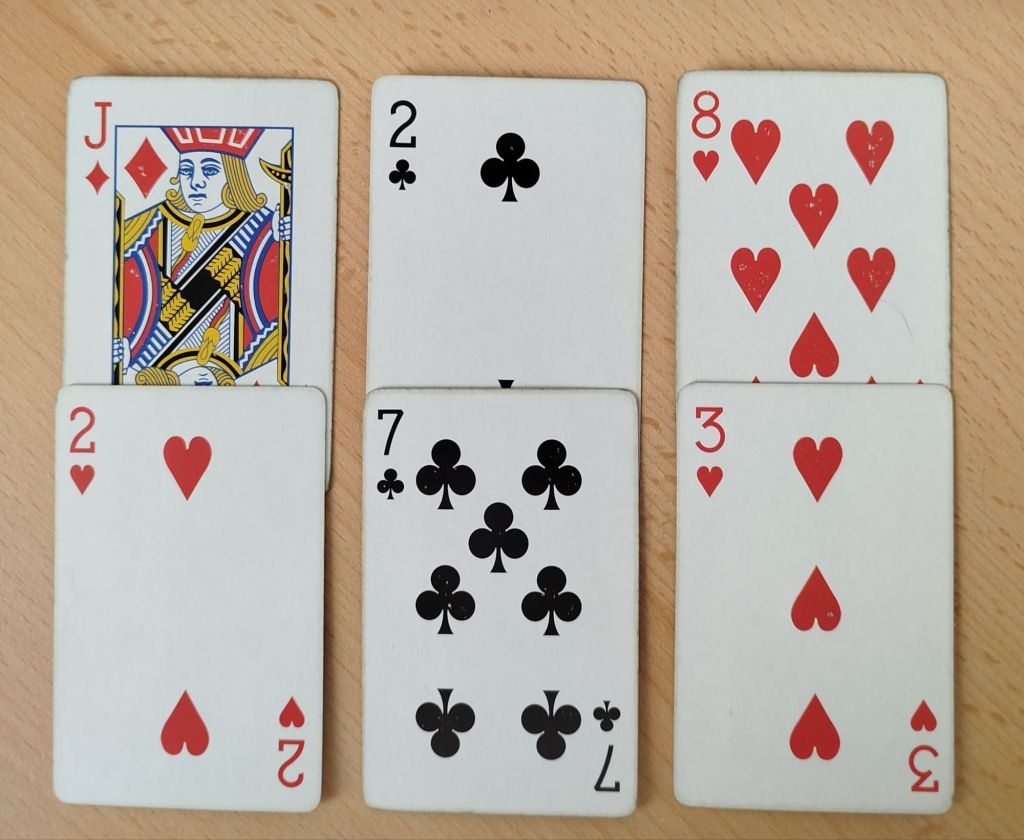
Will there be a surprise visit? Regina Russell’s Answer Spread

Since the question is so specific, you have the right to wonder why he thought they would throw him a surprise party. If we look at the column on the left, the one that talks about background information, we have the Jack of Diamonds and the Two of Hearts, an exciting message or a message from relatives. I didn’t know this at the time of hubby pulling the cards, but in talking to his family on his family chatgroup there had been odd remarks that had made him suspect something was being prepared. So this is the background information we need to understand the spread.

The answer, however, is somewhat disappointing. There are steps (Two of Clubs) being taken, so something is indeed being organized, but the Seven of Clubs causes trouble.

If we look at the right column, where additional information is found, we see a party (Eight of Hearts) and a gift (Three of Hearts). If these two cards had been in the center column, the answer would have been positive. As it stands though, these cards merely explains what steps had were being taken. So the answer is no, they won’t come on the day of his birthday.

It turned out that they did not come, though his brother would have liked to and was making plans for, because his mother was still recovering from a minor operation she’d had: this is the problem (Seven of Clubs). However, looking at this spread, I wouldn’t be surprised if a little celebration did take place next time we get together.

MQS
  1. Which you may buy here if interested. I’m not affiliated with them, I just think the book is a good reference to have. ↩︎

Answering Airy-Fairy Questions… Meaningfully (Example Reading)

As someone who advocates a grounded approach to divination, you’d expect me to scoff at questions that deal with more philosophical or spiritual themes. But this is not so. Airy-fairy is in the eye of the beholder, or rather, of the reader. Just like many airy-fairy readers can drown concrete topics in a deluge of commonplace spiritual-but-not-religious buzzwords, so can a grounded reader approach complex, ‘soulful’ topics from a grounded standpoint, while always following what the oracle says.

Someone asked me what was the goal of her current incarnation. Right off the bat we are confronted with a dilemma: firstly, the question presupposes that there is such a thing as reincarnation, which I don’t believe (at least, not in a sense that is compatible with what most people think of as reincarnation);1 secondly, it presupposes that this happens with a goal.

The first problem (reincarnation) we may circumvent by simply asking what’s the goal of the querent’s life. The second question (the goal) is trickier, but as I show in the example, it is not unanswerable.

What is my life’s goal? Playing card divination

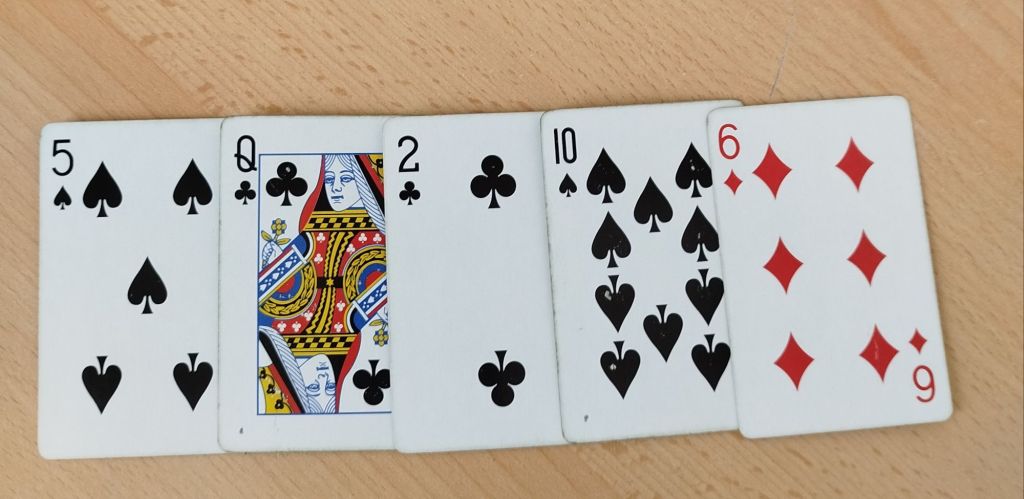
Since we have absolutely nothing to go off on, we can start by noting that the querent’s significator shows up (the Queen of Clubs), though not in a very good spot. She comes after the Five of Spades which is the card of sacrifice, imprisonment and the inability to move. So we can already sort of guess that the querent is feeling trapped in some form or another.

The spread ends with the Six of Diamonds, which represents worry, insecurity and the like. Often it shows financial problems, but not necessarily: it can be a card of general nervousness and uncertainty. The spread is now starting to reek of psychological hang-ups.

Usually, the Two of Clubs after a person card indicates the person taking steps. Toward what? Toward the Ten of Spades. This is the card of secrets, of the night and of unknown situations.

At this point I asked the querent if she’s someone who never leaps into unclear, unknown situations. She said that that was one of the things keeping her from enjoying life, since she always prefers to avoid risk or put off taking it until she feels prepared, which is never.

Bingo. This is the answer: she must learn to step into the dark, take risks and be ok with not having everything figured out. She must learn to swim by swimming rather than by reading up on how to swim. If she doesn’t do it, she will spend her whole life by the poolside waiting for every condition to be perfect.

So, have the cards talked about the purpose of the querent’s whole life? You may disagree with me, but I don’t think so. I do not think that this is the purpose of her whole life (I think there is much, much more to anyone’s life), nor do I think that this is the reason she was born or has reincarnated (if you believe in reincarnation at all). And I told the querent as much, in the spirit of transparency.

What I do mean is that, at least at this juncture in her life, this is a recurring pattern that weighs her down and that needs addressing because it influences her general quality of life. That’s already enough to be worth being mentioned by the cards.

Ultimately, almost every airy-fairy woo woo question is the voluntary or involuntary corruption and modernization of some kind of longing that is deeply seated in the human soul. Questions about the purpose of one’s life may be often answered with the usual mix of mind body spirit platitudes, but the human desire for purpose is not to be lightly dismissed, whether the purpose is really there or not. And divination can address this desire in some form or another.

I believe that divination should be able to run the whole gamut of the human experience, from the most concrete questions to the most abstract, because this is the extension of the human soul. The problem arises only when we try to reduce one order of problems (Will I the chicken cross the street?) to another order of problems (What kind of psychospiritual drama do you think caused the chicken to want to cross the street?)

MQS

  1. I will probably discuss it more at length in another section, but my belief is that there is only one, universal soul that is constantly incarnating and reincarnating through everything. ↩︎

Is He Coming Back? Example Reading

This is a super-quick reading I did for a friend of a friend. She doesn’t believe in the cards, which is fine, but decided to try them by asking a silly question. She asked if her ex would come back to her. Here are the cards:

K♣️ 3♣️ 10♥️

On the surface of it, the cards seem positive: they show the man she’s asking about, they show a union (the Three of Clubs) and they show happiness (the Ten of Hearts).

Unfortunately, what the cards seem to be saying is that he has a marriage going on, and he is happy in it. When I told the querent, she confirmed that they haven’t spoken in years and he is married and has children.

This is not the first time someone asks me a fake question, either purposefully or out of self-delusion, and it is not rare for people to ask about old sweethearts who have moved on.

It goes without saying that we, as diviners, must always come to terms with our finitude and fallibility, but the more the querent is deluded or insincere, the harder it becomes to interpret the cards. This time I was doubtlessly lucky that the cards came up very clear.

NOTE: if the querent had told me that the man she was asking about is not married, then I would have asked if they had just broken up. In this case, the spread would have probably meant that their relationship was still going on strong, and that the break-up was something so fleeting the cards didn’t feel the need to describe it.

MQS

The Ghost That Came Back (Example Reading)

Certain topics are exceedingly rare, and they should remain so, because people otherwise tend to see the supernatural at play everywhere. Traditional divination takes these topics very seriously, which is why it rarely discusses them. In most systems, a vocabulary is given to describe most situations in life, including encounters with ghosts. We are, of course, free to disbelieve, but the cards can still talk about it.

A querent asked me if there was a ghost in her (very old) apartment complex. As I said when talking about curses and hexes, the answer is almost invariably no (although, to be fair, ghosts and other entities are far more common than competent witches). Here’s the spread (it started as a three card spread, I kept adding cards until I was satisfied).

A♠️ – Q♠️ – 2♠️ – K♥️ – 2♣️ – 4♣️ – 9♥️ – 5♠️ – 10♥️

I asked the querent an open question (to avoid influencing her), that is, I asked her to describe the ghost she thought she saw. She said she thought it was the spirit of an ugly, angry woman moving in the hallways of the building. This fits very well with the Queen of Spades and Two of Spades. The Ace of Spades, aside from indicating death, is also a card of great evil.

What about the rest of the spread? Usually the Heart court cards indicate either positive spirits (God, etc.) or religious people. I asked the querent if she was planning on contacting a priest, shaman or other such figure. She said she wasn’t really thinking about it, but another tenant was.

I said that it was a good idea. Look at the King’s action: he is taking steps (Two of Clubs) by uttering words (Four of Clubs) which are positive (Nine and Ten of Hearts). But what about the Five of Spades? My sense is that the presence will not be eradicated or banished for good, since the Five of Spades is a card of imprisonment, but it will be contained in some form (the two Hearts hemming in the Spade).

The interesting thing was that, according to the querent, the other tenant (who had been living in the building for much longer than the querent) told her that many years ago they had had a problem with the same presence and had managed to somehow exorcise it.

My view is that even this time the situation will not be remedied completely, but the situation should improve by calling in someone to perform a religious ritual.

MQS

A Reading Gone Wrong

Getting things wrong hurts, but is part of the human condition. In fact, I would argue that if a reader says they are infallible, that’s a good time to put as much distance between you and them as possible. An infallible reader is either so delusional that they block out all negative feedback from their reality or so dishonest that they’ll constantly be looking for the right bridge to sell you. Either way, they are best kept at a distance.

Still, there’s no denying that getting a reading wrong is disheartening because, as much as we should keep the ego out of the equation, the ego always seeps into it. I think it’s fair to share our failures as well as our triumphs. Here is a reading I got wrong relatively recently.

The querent was asking about her recent pregnancy.

Q♣️ – 7♣️ – J♥️ – 3♠️ – 2♥️

Accepting the question was my first mistake, as such issues are way too delicate. There is no situation where “you will miscarry” is an acceptable thing to say, and if we can’t be honest there is no point in giving a reading. Even if I had interpreted the cards correctly I would never have told the querent.

Thing is, though, that I wanted to give her good news, albeit subconsciously, and so I ended up interpreting a clearly negative spread positively. The querent falls first in the spread, and there is a card of obstacles between her and the child (the Jack of Hearts). The Three of Spades in questions of pregnancy often leads to loss, but I interpreted the Two of Hearts as the solution of the problems, while in fact it was merely saying that the loss would happen soon (it was knocking at the door). In hindsight, I probably should have added some cards.

I told the querent the pregnancy would go fine, though with minor problems which would be solved, but that she should always listen to the doctor. In reality, the cards point to a situation that not even doctors would be able to salvage (the doctors don’t show up in the spread).

Two things can be learned: first, never accept questions you are not really comfortable answering; second, always keep your desire to give a skewed answer in check. It is human nature to want other people to be happy (or sad, if we don’t like them) but this gets in the way of our objectivity.

MQS

Playing Cards That Indicate Loss

After discussing the playing cards that indicate gain, let’s take a look at the ones that represent loss. Keep in mind that loss can be indicated by any card of gain that is poorly placed in the spread, i.e., when surrounded by difficult cards. For instance, the 7♦, normally a card of money, followed by most Spades or even some Clubs, would represent either loss of money or a sum of money being withheld.

Six of Clubs

The Six of Clubs is a card of difficulties, toil and fatigue. It is not inherently a card of monetary loss. However, it represents a stagnand situation which, applied to money, can imply either loss or lack of gain, and especially lack of compensation for one’s toil.

Seven of Clubs

The Seven of Clubs is, again, not directly connected to loss, but it does show problems in all levels, and as such it can indicate loss or lack of gain when together with Diamonds or when summoned for a money reading. Keep in mind, though, that Clubs are not tremendously nefarious, so while they can create unsatisfactory situations, that are unlikely to cause dramatic loss.

Six of Diamonds

The Six of Diamonds is a card of worry and preoccupation, usually over money matters (but not necessarily). In general it shows situations of all kinds that stand on a shaky foundation, living paycheck to paycheck, businesses that don’t take off, etc. Again, it is not a dramatic card, but it can signify money problems or even, in general, not gaining something.

Ace of Spades and Nine of Spades

All Spades can signal loss. However, the way each of them causes loss is different. I will just highlight some of the differences. The Ace of Spades is a seriously bad card, which is often involved of configurations indicating bankruptcy, poverty and failure all around. The Nine of Spades is equally bad, and when they come up together they often prevent success in accumulating money for very long periods of time.

Two of Spades and Three of Spades

Less dramatic than most Spades, the Two of Spades indicates small losses, situations that cause headaches from a financial standpoint. The Three can also indicate small losses, and can also be found in sequences indicating scams.

Four of Spades, Five of Spades and Six of Spades

Much more dramatic, the Four and Five of Spades indicate serious loss, projects going awry and being abandoned. They can often represent difficult circumstances, but with the appropriate cards they can point to the querent being at fault (missteps, etc). The Six of Spades represents financial situations characterized as ‘sick’, that is, unhealthy, structurally unsound and therefore destined to failure.

Seven of Spades and Eight of Spades

These cards, especially the Seven, can indicate accidental loss, that is, loss not due to negligence (however, always remember to take the context into account).

MQS

The Lost Coins (Example Reading)

Readings about lost objects are hard. I am very much less than infallible in finding them. The reason is quite simple: most questions have a limited number of likely answers and an even more limited number of unlikely ones, so it is usually easier to make sense of the cards. “Yes he’ll marry you”, “No, he hates you”, “There doesn’t seem to be much tenderness left in the relationship, but with some effort you can keep it going a while.” There is, of course, some skill for finding nuances involved, and a good reader will add some details, but in general, the possible answers are relatively limited.

But a lost object can be anywhere, and we can either be very right or very wrong, with little space for “yes, but…” and “no, although…” Especially if we’ve never seen the place where the object was lost, it becomes hard to read the symbolism of the cards without reading our own fantasy into them. As far as I am concerned, much depends on how clear the cards decide to be with me. Since I have nothing to prove, I have no problem throwing my hands up and saying “Dunno” if that is my honest answer.

As we are moving all our stuff from the old house into the new one, plenty of things have gone momentarily missing, in the sense that I don’t know which of the dozens of boxes we’ve brought along they are in, and frankly I’m not too eager to start searching.

Except that I started itching to do some I Ching readings, and I couldn’t find my I Ching coins anymore. I did remember putting them somewhere where “I know I will find them”. The problem is that I have done the same with so many of my things in the last couple of months that the trick doesn’t work anymore. So I asked the cards for a pointer:

K♣ – 2♥ – 5♣

In general, what makes this reading relatively easy, compared to other lost item readings, is that it does not describe the place where the coins are, but rather their relationship to me. The King of Clubs is my significator. It is followed by a card, the Two of Hearts, which indicates ‘close to home’, but also ‘close’ in general. I know I cannot have left the coins in the neighborhood, which is naturally signified by the Two of Hearts, so I take it to mean ‘close’.

That Five of Clubs is interesting. In general it represents effort, but it is connected also with the body in general, understood as moving, acting ‘machine’, and also the hands. Close at hand, maybe? Or close to my body?

Either reading would have been correct. I found the coins in an internal pocket of my jacket where I usually don’t keep anything and don’t bother looking.

MQS

Playing Cards That Indicate Gain

I’m doing it with the Sibilla, so it stands to reason that I should do it with playing cards too. As usual, this list is not meant to be complete. It is only intended to look at the cards as if through a cross-section based on a particular topic. In this case, gain.

Three of Hearts

In my playing card system, the Three of Hearts is a gift. It represents all things that we acquire easily. It is not, strictly speaking, a card of gain, but it can entail gain. For instance, if someone asked about their business, this card falling at the end of the spread would indicate improvements and therefore, within the context, additional wealth, that is, gain.

Five of Hearts

The Five of Hearts is the card of abundance. It is one of the cards that can indicate a very positive evolution and increase of wealth. As with the Three, the Five, being in the suit of Hearts, is not strictly about money, but it can promise positive situations in a reading about finances. Furthermore, next to money cards, it increases their import.

Nine of Hearts

Not much to say here. In many respects the Nine of Hearts is like the Three of Hearts, but much more powerful.

Ace of Clubs

The Ace of Clubs is a very strong card, which indicates power within the situation. If it falls next to the querent, it shows the querent actively obtaining something, having power over it. However, unlike in the suit of Hearts, the Club suit requires effort and action, and is therefore less rosy than the Three, Five or Nine of Hearts. The Ace of Clubs can also indicate a powerful vision that comes true in material terms.

Three of Clubs

The Three of Clubs is a card of union, and can represent a business affair. As such, it usually promises gain in material issues, but we must be careful in our analysis of the whole spread, as we all know a business deal can be disastrous when attended by Spades or less promising Club cards. By itself, the Three is mildly encouraging.

Ace of Diamonds

The Ace of Diamonds represents news in general, but it also represents gold and all things that have high value. It is a card of great riches and wealth when not impeded by other difficult cards.

Three of Diamonds

The Three of Diamonds is a money card. As such it is usually read as small gains, whether in a positive sense (as in a small inheritance or a small raise) or in a negative sense (as in having only little money). Furthermore, we must be careful to note whether the little money is being gained or spent. By itself the Three shows gain.

Four of Diamonds

The Four of Diamonds represents agreements and pacts. Being in the suit of Diamonds it is geared more toward material affairs and thus indicates contract, whether positive or negative will be shown by other cards.

Five of Diamonds

The Five of Diamonds indicates change, especially (though not exclusively) within the context of money matters. It can indicate money changing hands for better or worse.

Seven of Diamonds

This is like the Three of Diamonds, but it shows a larger amount. Furthermore, the Seven is more clearly indicative of gain over loss. It is a more inherently fortunate cards.

Nine of Diamonds

The Nine of Diamonds is strongly connected with the realization of plans, material projects and with social ascent. Increase in wealth may or may not be tied to it, though in our society it usually is. It represents strong satisfaction in money matters, and upward mobility with all the perks that are entailed.

Ten of Diamonds

The biggest money card in the game, the Ten of Diamonds indicates success all around. For entrepreneurs it shows the reaching of great goals, while for business owners it can represents advantageous situations that generate wealth and ease in terms of money. Note that gain can be intended also as a reduction in expenses, so if the question is something like “Will I manage to get my landlord toreduce my rent in the next contract?” that counts as gain.

MQS

The Copyright Claim (Example Reading)

This is a fun little reading I did some time ago for myself. I’ve waited enough to know with relative confidence that it was accurate. Basically, one day, about four or so months ago, I found a message in my folder by someone claiming I had appropriated their image without asking them for permission.

Since I only use stock photos from WP’s archives or pictures I have taken myself, I knew this could not be the case. Still, the person was threatening legal action against me, and I wanted to avoid issues, so I sent them an email asking what picture they were referring to, and saying that I could take the picture down although I highly doubted I was in the wrong.

I also pulled some cards from the playing card deck. This was the reading:

Q♠ – 2♣ – 3♥ – 10♠ – 9♥

Notice immediately the Queen of Spades. The person who sent me the email was a woman. If it had been a man, in the absence of mentions of a woman, I could have taken it to indicate some evil intent on his part. The fact that the woman is represented by a Spade does not necessarily indicate that she is trying to scam me or anything. It could very well be that she thought she was in the right and was angry (Spades) at me. The reality is that I have no real evidence from the spread about her true motives.

She is immediately followed by the Two of Clubs, which indicates a step taken, so obviously the angry woman took a step, or I wouldn’t have an email in my folder accusing me of breaking the copyright law.

Finally, note the Ten of Spades, a usually negative card, besieged by two of the most positive cards in the deck, the Three of Hearts and the Nine of Hearts. The Ten of Spades is the night, and it indicates everything that is dark, secret or obscure, but also all things that come out of nothing. The two positive cards surrounding it represent the positive solution of the problem. Therefore, the solution comes out of nothing, which, I reasoned, is the same as saying that the person writing me that email will, more or less, disappear into the night. Thus, I judged that little or nothing would come of the situation. So far I seem to be correct. The woman hasn’t answered my email. It may be that she realized she had made a mistake.

MQS

Is He An Atheist? (Card Reading Example)

Traditional cartomancy, like all traditional divination systems, is full of tips on how to handle spiritual topics. The difference with contemporary psychobabble is that in traditional cartomancy we deal with a spirituality that is rooted in the earth and in everyday life rather than in Mind/Body/Spirit section poppycock. As I often remark, in such systems spirituality is seen as the logical next step for someone who is acquainted with real life, not as a consolation prize for someone who is trying to avoid it.

The querent asked if her boyfriend believes in “a superior being”, by which I assume she meant God (“being” is probably a more reassuring term compared to “bearded guy holding a lightning bolt”). She places great importance on the topic, but he seems to avoid talking about it. This is a playing card reading. In the next days I will also post a Vera Sibilla reading done on a similar question by a different person some time ago.

A♥ – 8♣ – 9♣ – K♥ – 7♣

Seeing this, I asked the querent to draw three more cards to open the reading on the Ace of Hearts, which yielded the 2♠, the 2♣ and the 6♣.

The first thing I noticed was the complete absence of Spades (except in opening the spread, but that’s a very weak Spade). This generally bodes well for spirituality. However, there is also a majority of Clubs, which indicate struggles and difficulties. There is no need to interpret the spread card by card. The spread indicates a slow or difficult relation with the divine. Belief is not denied, but it is rendered heavy, problematic.

The first card is the Ace of Hearts, which can indicate “inner” issues, but because the first card in a spread can also represent the cause of a situation described by the following cards, I ventured to interpret it as issues relating to the home causing the querent’s boyfriend to falter in his faith. The three additional cards with which I opened the spread on the Ace of Hearts reinforced my idea that there must have been a difficult atmosphere at home surrounding the topic.

What about the King of Hearts? Is it the dad? Well, no. Traditionally, in spiritual readings the King of Hearts is God himself (just like in the Sibilla): he is the lord (King) of your inner life (Hearts). Surrounded by all those Clubs, the God-side of the boyfriend’s life suffers, is stifled. Yet it is there, since the King of Hearts comes up and is not surrounded by Spades.

I asked the querent to give another three cards to open the spread on the King of Hearts. These were the 10♠, the 4♣ and the 10♥. At night (Ten of Spades) he speaks (Four of Clubs) spiritually/finding consolation (Ten of Hearts). He prays to God at night.

MQS